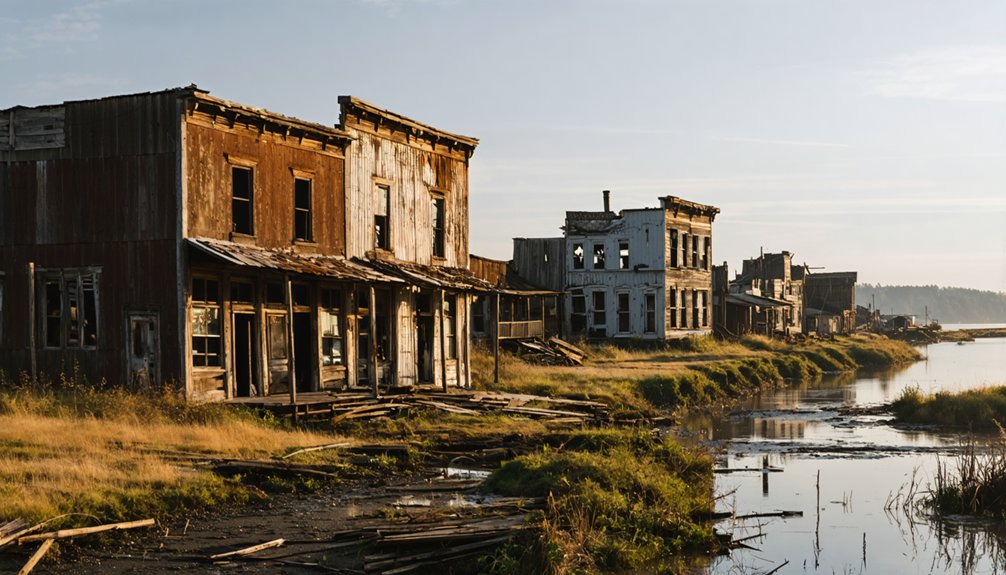
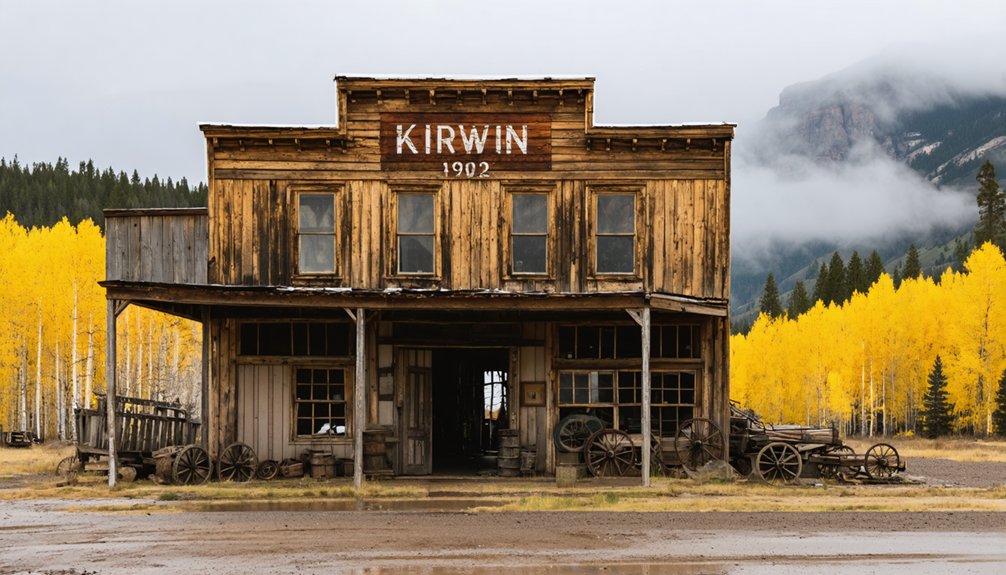
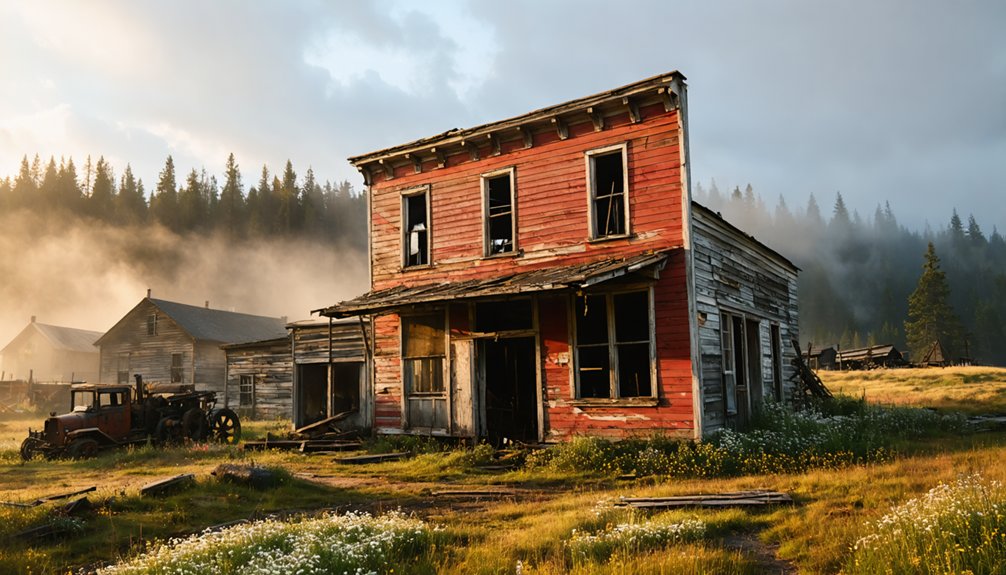
Plan your Pacific Northwest ghost town adventure strategically by season: summer for accessibility, fall for solitude. Two primary routes offer distinct experiences: Eastern Oregon’s gold rush towns (Jacksonville, Granite) and Washington’s mining communities (Molson, Monte Cristo). Pack sturdy boots, gloves, and respiratory protection while respecting preservation ethics—photograph don’t collect. Idaho’s remote mountain towns like Silver City add depth to your journey with over 75 historic structures awaiting your exploration.
Key Takeaways
- Best times for ghost town exploration are summer for accessibility and early autumn for moderate temperatures and fewer crowds.
- Washington offers abandoned mining towns like Molson, Monte Cristo, and Liberty with varying degrees of preservation and accessibility.
- Oregon’s ghost towns include Jacksonville’s preserved district and Sumpter’s gold panning experiences along the Southern Oregon Trail.
- Idaho features remote mountain ghost towns like Silver City and Bayhorse with over 75 historic structures and hot springs.
- Pack sturdy boots, gloves, and respiratory protection while following preservation ethics and securing legal permissions before visits.
Planning Your Ghost Town Expedition: Routes and Seasons

Exploring the Pacific Northwest’s ghost towns requires careful planning, as the region’s diverse topography and seasonal fluctuations considerably impact accessibility and experience quality.
Summer provides ideal ghost town accessibility with cleared trails and open roads throughout the region, while fall offers moderate temperatures with fewer crowds.
For ghost town explorers, summer unlocks accessibility while autumn balances comfortable temperatures with peaceful solitude
Consider crafting your itinerary around two primary circuits: the Eastern Oregon route featuring Shaniko, Sumpter, and Lonerock, or the Western Washington mountain trail encompassing Monte Cristo, Lester, and Franklin.
Each circuit demands different preparation strategies.
For maximum exploration efficiency, early autumn delivers the perfect balance—extended daylight hours with favorable weather conditions. The four-mile hike to reach Monte Cristo’s ruins makes this season particularly advantageous for visiting the famous Western Washington ghost town.
Don’t miss the chance to explore Shaniko’s exhibits, which feature authentic Wild West-style attractions including a jail and general store that offer glimpses into the town’s historical past.
Winter renders many locations inaccessible, particularly those requiring hiking or mountain passes, while spring brings wildflowers but potential snow at higher elevations.
Washington’s Abandoned Mining Communities
You’ll find Washington’s mining heritage uniquely preserved in Molson, where the School Museum showcases a complete collection of pioneer artifacts and farming implements within fully restored structures.
Monte Cristo presents a more rugged experience, where abandoned mining equipment and rusty signage can be explored via an 8-mile roundtrip hike through mountain terrain.
Liberty, Washington’s oldest mining town, offers visitors a glimpse into the state’s Gold Rush era of the 1870s with its historic buildings and interpretive displays.
In Okanogan County, visitors can explore Ruby City, which was once a vibrant silver mining town with numerous saloons and a dangerous reputation before declining around 1900.
These contrasting sites offer you distinct glimpses into Washington’s resource-extraction past—Molson with its intact buildings and interpretive displays, Monte Cristo with its remote, atmospheric ruins set against dramatic alpine scenery.
Molson’s Preserved Pioneer Heritage
As you venture into the historic remnants of Molson, Washington, you’ll discover a remarkable preservation of pioneer heritage that dates back to the gold rush era of the late 1890s. Founded in 1898 by George Meacham with financing from the Canadian brewing family, this once-thriving mining community swelled from just a dozen residents to over 300 by 1903.
Molson’s history embodies the classic boom-and-bust cycle of frontier settlements. When Meacham failed to register land titles, a contentious dispute forced residents to relocate half a mile west, creating “New Molson.” The arrival of the railroad in 1901 played a crucial role in the town’s rapid population growth.
Today, the Molson Historical Society maintains the Old Molson Ghost Town Museum where you can explore original structures, mining artifacts, and remnants of pioneer life. The museum preserves three general stores and other businesses that once served the bustling community. At 3,708 feet, the former railroad station stands as Washington’s highest—a proof of frontier determination.
Monte Cristo’s Mountain Ruins
Nestled deep within the rugged Northern Cascade Mountains, Monte Cristo represents one of Washington’s most isolated and historically significant ghost towns, where silver ore discovery in 1889 triggered a brief but intense mining boom.
This remote mining heritage site, once invested in by John D. Rockefeller himself, briefly rivaled Seattle with 1,000 residents.
To fully appreciate Monte Cristo’s compelling history:
- Hike the 4-mile trail from Barlow Pass to view approximately 15 remaining structures
- Examine the remnants of tramways and mills that once processed ore from the mountainsides
- Note the town’s unique dual development with separate upper and lower sections
Nature reclaimed Monte Cristo after the 1897 flood and ore depletion by 1907, leaving behind a haunting reminder to boom-and-bust resource economies. The concentrator mill was an impressive operation that processed up to 300 tons of ore daily during its peak in the 1890s and early 1900s. Visitors follow the historic miners’ path along the South Fork Sauk River, experiencing the same route taken by prospectors during the 1890s gold rush.
Oregon’s Gold Rush Remnants

As you travel through Oregon’s historic gold country, you’ll encounter Jacksonville’s remarkably preserved 19th-century district where over 100 buildings from the 1850s gold rush era stand as monuments to the wealth that once flowed from nearby mines.
In Granite, you can explore the weathered remains of a once-thriving mining community where collapsed wooden structures and rusting equipment hint at the town’s peak population of 5,000 during the 1900s. The town lacked working utilities until the Millennium, highlighting the remote and rustic nature of these historic settlements.
The Southern Oregon Trail connects these ghost towns with other significant sites including Golden’s church (one of the few remaining structures in a town that significantly operated without saloons) and the imposing Sumpter Valley Dredge that once extracted millions in gold from the surrounding landscape. Visitors to Sumpter can enjoy gold panning experiences and witness reenacted train robberies that bring the frontier history to life.
Jacksonville’s Historic District
Gold fever transformed Jacksonville from an obscure mining camp into southern Oregon’s most influential 19th-century settlement.
After a devastating fire in 1853, residents rebuilt the commercial core using brick, creating the historical architecture that earned National Historic Landmark status in 1967.
Today, you’ll find over 100 preserved 19th-century buildings documenting the town’s fascinating evolution.
When exploring this remarkably intact district, prioritize these highlights:
- C.C. Beekman’s bank building, representing the town’s status as southern Oregon’s financial center
- The Chinese heritage site at the intersection of Oregon and West Main Streets—Oregon’s first Chinatown
- Peter Britt’s photography studio, established in 1852, which documented the town’s development
Jacksonville’s decline began when railroad officials routed tracks through Medford instead, inadvertently preserving this architectural time capsule for your discovery.
Granite’s Mining Legacy
Prosperity surged through Granite’s steep canyons in 1862 when prospectors uncovered significant gold deposits within Oregon’s rugged Blue Mountains. Following Canyon Creek’s promising placer deposits, miners quickly established claims, transforming this remote location into a bustling frontier settlement.
You’ll discover the evolution of Granite mining techniques as you explore the historic district—from simple panning operations to sophisticated hydraulic systems that washed entire hillsides away.
The town’s historical significance is preserved in remaining structures and mining artifacts that tell the story of boom and inevitable bust. By the 1880s, exhausted deposits drove miners elsewhere, leaving behind the ghost town you can visit today.
Now listed on the National Register of Historic Places, Granite’s abandoned buildings and mining remnants offer a tangible connection to the Pacific Northwest’s gold rush era.
Southern Oregon Trail
While the mining boom of Granite captivated Oregon’s Blue Mountains, a different chapter of the state’s gold rush unfolded 200 miles to the southwest along what you’ll now discover as the Southern Oregon Trail.
This forgotten network connects the remnants of boomtowns that emerged after gold’s discovery on Josephine Creek in 1851.
You’ll encounter three remarkable gold mining landmarks:
- Jacksonville – Once the region’s bustling commercial hub after gold was found on Jackson Creek
- Sterling Mine Ditch Trail – A 26-mile engineering marvel that powered hydraulic mining operations
- Sterlingville – An abandoned settlement where Chinese miners continued extraction after Americans departed for Idaho
These ghostly reminders tell a complex story of innovation, cultural exchange, and environmental transformation that defined Southern Oregon’s gold rush era—now preserved through hiking trails and interpretive sites.
Idaho’s Remote Mountain Ghost Towns

Nestled within Idaho’s rugged mountain ranges lie some of America’s most evocative ghost towns, abandoned remnants of the state’s mining boom era that offer travelers a tangible connection to the past.
Similarly, exploring abandoned towns in Washington State reveals a unique narrative of perseverance and decline, where structures stand as silent witnesses to histories etched in the landscape. Each town tells its own story, inviting adventurers to uncover the tales of those who once called these places home. From lingering relics of industry to the natural reclamation of spaces once bustling with life, these ghost towns provide a hauntingly beautiful glimpse into the past.
Silver City history stands remarkably preserved with over 75 historic structures, including Idaho’s first telegraph and newspaper. Rocky Bar ruins hint at its 1860s heyday, while Custer mining remnants showcase its role as a regional supply hub.
At Bayhorse, you’ll discover relics from Idaho’s longest-running silver producer, including the historic Beardsley and Ramshorn Mines.
For a unique experience, visit Burgdorf hot springs, where you can soak in thermal waters surrounded by original cabins. Access requires traversing steep or unpaved roads, making summer months ideal for your backcountry ghost town expedition.
Essential Gear and Safety Tips for Ghost Town Exploration
Before setting foot in the Pacific Northwest’s historic ghost towns, proper preparation can mean the difference between an enriching adventure and a dangerous mishap. Your exploration essentials should include sturdy boots with ankle support, protective gloves, and appropriate respiratory protection—especially in structures containing potential asbestos or mold.
Safety protocols demand meticulous attention to your surroundings:
- Always secure legal permissions before visiting sites, as most ghost towns remain private property.
- Never explore alone—the buddy system provides vital assistance during emergencies.
- Perform thorough exterior assessments of buildings before entering, staying near walls rather than center spaces.
Pack navigation tools including offline maps and compasses, and inform a trusted contact about your itinerary.
Remember: respecting these historic spaces means leaving everything as you found it.
Photography Guide: Capturing Decay and History

Documenting ghost towns through photography demands both technical skill and artistic sensitivity, as these weathered remnants tell complex stories of boom-and-bust cycles across the Pacific Northwest.
To capture abandoned beauty effectively, shoot during golden hour when warm light accentuates textures of peeling paint and weathered wood, or on overcast days for a somber mood matching the sites’ desolation.
Employ storytelling techniques by sequencing your images—start with wide-angle shots of streets and buildings before focusing on architectural details like doorways and windows, then move to intimate close-ups of artifacts.
Use black and white processing to emphasize texture and mood.
Remember your ethical obligation: photograph from public areas only, never disturb artifacts, and avoid fire-based light painting that could harm these fragile historic structures.
Respecting History: Preservation Ethics and Leave-No-Trace Practices
As you explore the haunting beauty of Pacific Northwest ghost towns, your responsibility extends beyond mere appreciation to active preservation of these irreplaceable historical treasures.
These sites represent our shared cultural heritage and demand ethical stewardship from every visitor.
When visiting these historic sites, remember:
- Take only photographs, leave only footprints – even small items like nails or rusting metal are protected artifacts.
- Stay on established trails to prevent erosion and structural damage to fragile historic buildings.
- Respect private property boundaries and obtain permission before entering sites not open to the public.
Remember that federal and state laws protect these sites, and surveillance methods often monitor for vandalism.
Your conscientious behavior guarantees these windows to our past remain intact for future generations.
Frequently Asked Questions
Are There Any Genuinely Haunted Pacific Northwest Ghost Towns?
Over 60% of visitors to Monte Cristo report unexplained phenomena. You’ll find haunted legends at Northern State’s asylum ruins and encounter ghostly encounters in Silver City’s Idaho Hotel—paranormal hotspots await your exploration.
Can I Legally Collect Artifacts From Abandoned Ghost Towns?
No, you can’t legally collect artifacts without proper permits. Artifact laws strictly protect ghost town preservation regardless of abandonment status. You’ll need landowner permission and often special authorization for any collection activities.
Which Ghost Towns Are Suitable for Children or Elderly Visitors?
All four ghost towns offer kid-friendly activities, but Molson and Ashcroft provide better elderly accessibility with mostly flat paths. Bodie offers staff assistance, while Franklin’s main area is accessible despite stairs to the falls.
Are Any Pacific Northwest Ghost Towns Accessible in Winter?
Like snowbound sentinels of the past, several ghost towns welcome winter adventurers. You’ll find Melmont, Monte Cristo, and Garnet accessible with proper gear, though ghost town safety demands preparation for muddy trails or snowshoe conditions.
Do Any Ghost Towns Still Have Part-Time or Seasonal Residents?
Yes, you’ll find numerous ghost town communities maintain seasonal inhabitants, particularly in areas with recreational appeal, where part-time residents occupy historic structures during favorable weather months, preserving minimal life in these settlements.
References
- http://pnwphotoblog.com/ghost-towns/
- https://en.wikipedia.org/wiki/List_of_ghost_towns_in_Washington
- https://stateofwatourism.com/ghost-towns-of-washington-state/
- https://www.geotab.com/ghost-towns/
- https://metskermaps.com/products/washington-state-ghost-towns-map
- https://traveloregon.com/things-to-do/culture-history/ghost-towns/
- https://map.proxi.co/r/Washington_Ghost_Towns
- https://bestofthenorthwest.com/northwest-travel-ideas/northwest-ghost-towns/
- https://openroadbeforeme.com/2018/11/the-great-pacific-northwest-road-trip.html
- https://thatoregonlife.com/2016/04/road-trip-ghost-towns-eastern-oregon/