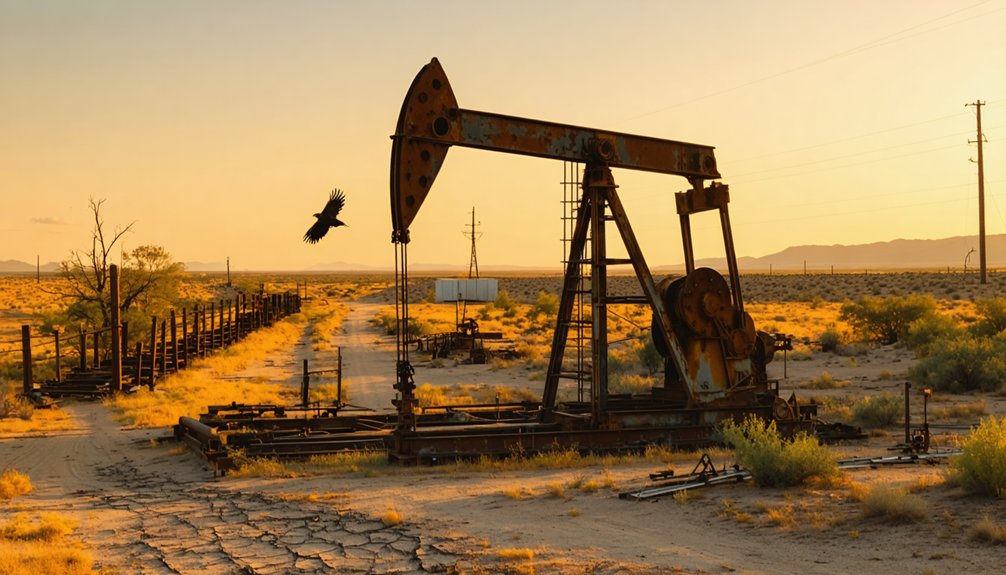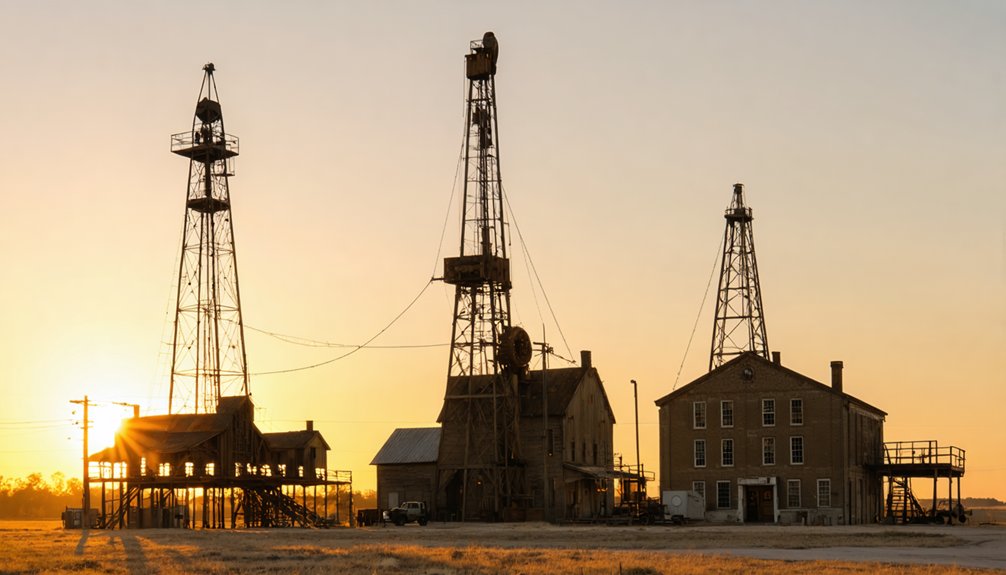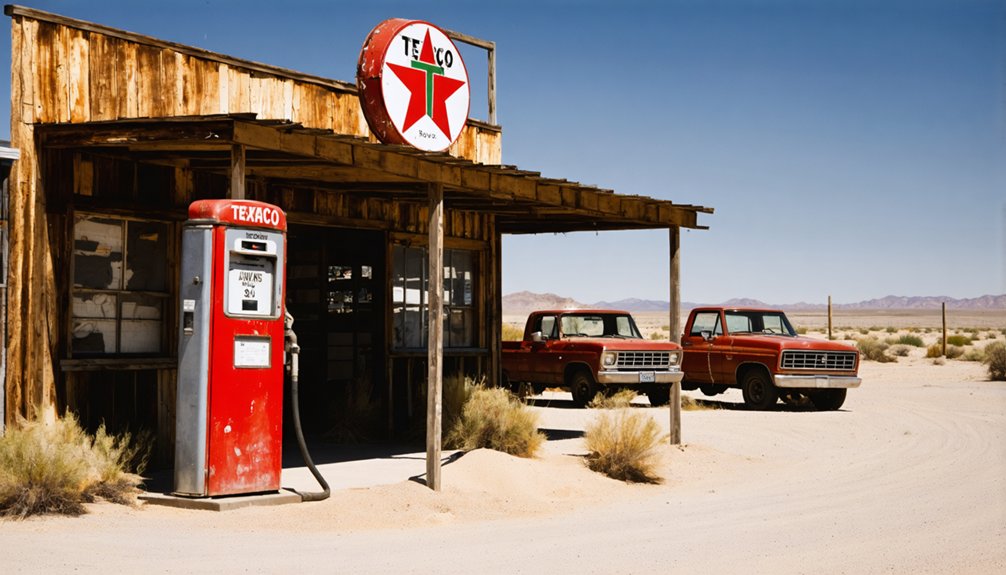
America’s abandoned oil towns stand as relics of rapid boom-and-bust cycles that transformed rural communities overnight. You’ll find these ghost towns scattered across the Permian Basin, California, and other oil-rich regions where prosperity vanished when wells ran dry. Today, these sites present both environmental challenges from orphaned wells and preservation opportunities through heritage trails and community initiatives. Their silent structures tell complex stories of American resource extraction, economic volatility, and environmental consequences that await your exploration.
Key Takeaways
- America’s oil boomtowns expanded rapidly, with places like Beaumont growing from 8,500 to 50,000 residents in just one year.
- Nearly 8,900 orphaned oil wells in Texas alone pose environmental hazards, affecting approximately 4.6 million Americans living nearby.
- Ghost towns like Texon (abandoned 1962) and Mentryville (California’s first oil boomtown) exemplify the boom-bust cycle of petroleum communities.
- The Bipartisan Infrastructure Law allocates $4.7 billion for restoration efforts of abandoned oil sites across the country.
- Community-led preservation movements are transforming abandoned sites into museums and cultural centers to preserve petroleum heritage.
The Birth and Collapse of America’s Oil Boomtowns
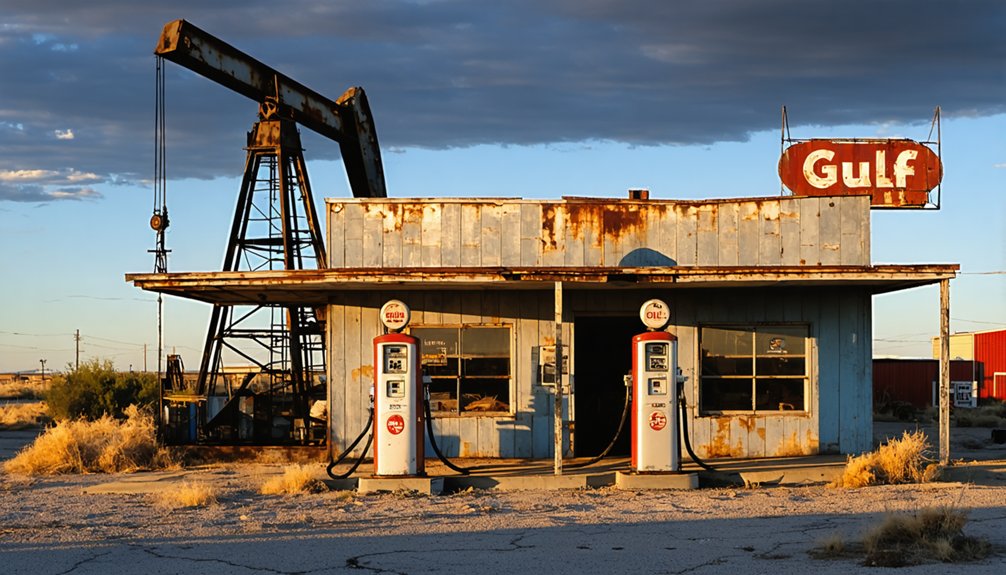
While many American towns developed gradually through centuries of settlement, oil boomtowns emerged with explosive suddenness, rewriting the landscape of rural America in mere months.
After major oil discoveries like Spindletop in 1901, sleepy communities transformed overnight into industrial epicenters. You’d hardly recognize Beaumont, Texas, which swelled from 8,500 to 50,000 residents within a year.
This rapid urbanization created makeshift cities where fortune-seekers converged, driving land values to astronomical heights. Companies like Texaco and Gulf Oil emerged from this frenzy of investment. The Supreme Court’s 1911 ruling that ordered Standard Oil to break up into 34 separate companies further diversified the competitive landscape in these oil territories. By the end of 1901, an astonishing 235 million dollars had been invested in Texas oil operations alone.
Yet the prosperity proved fleeting. Over-drilling depleted field pressure, and when wells ran dry, these monuments to American ambition emptied just as quickly as they’d filled, leaving ghost towns scattered across the landscape—physical reminders of the volatility of resource-based economies.
Ghost Towns of the Texas Permian Basin
Traveling through the Permian Basin today, you’ll encounter the skeletal remains of towns like Texon where boom-bust cycles erased once-thriving communities within a single generation.
You’re witnessing the environmental legacy of this abandonment in the region’s estimated thousands of orphaned wells, which leak contaminants into groundwater and create hazardous sinkholes across the landscape.
These ghost towns—now marked only by crumbling foundations and historical markers—represent the human cost of an extractive economy that transferred wealth elsewhere while leaving local communities to shoulder the environmental and economic aftermath. Pecos County stands as a stark example with over 600 orphan wells, the highest concentration in the entire state of Texas.
Many of these abandoned wells release poisonous gases like hydrogen sulfide, creating serious health risks for any remaining residents and visitors to these forgotten places.
Permian’s Boom-Bust Cycle
After the historic 1923 discovery at Santa Rita No. 1 well in Reagan County, the Permian Basin rapidly transformed from a sparsely populated region into a landscape dotted with bustling oil towns.
The resulting oil town dynamics created dramatic population shifts—places like Best, Texas exploded from nothing to 3,500 residents by 1925. You’d scarcely recognize these communities during peak production, with their rough living conditions and reputations for lawlessness. The town of Best earned the dubious distinction as the place with the best name but the worst reputation in the area. This echoes the pattern seen in Texas’s 511 ghost towns, which represent the highest number of abandoned settlements in any U.S. state.
When production declined, however, these boomtowns collapsed just as quickly as they’d emerged. Best’s population plummeted to under 300 by 1945.
Unlike family-centered settlements such as Texon, mainly male transient towns suffered more severely from boom-bust cycles. Economic downturns coupled with increased mechanization eliminated jobs, sending workers elsewhere and leaving behind decaying infrastructure—physical monuments to the region’s volatile economic foundation.
Forgotten Wells Haunt Landscape
The haunting legacy of the Permian Basin’s boom-bust cycle extends beyond abandoned buildings and empty streets—it persists in nearly 8,900 orphaned oil and gas wells scattered across the Texas landscape.
You’ll find the highest concentration in counties like Reeves, Crockett, and Pecos, where bankruptcies and corporate abandonment have left toxic infrastructure without oversight.
These forgotten sentinels pose serious environmental risks: wells blowing out toxic gas, failed plugs creating sinkholes spanning 200 feet, and chemical-laden liquids contaminating groundwater. These abandoned wells emit dangerous levels of hydrogen sulfide gas, which can impact air quality up to 50 miles away.
The financial burden falls disproportionately on taxpayers, with cleanup costs approaching $1 billion.
Landowners like those at Kelton Ranch watch helplessly as their property becomes collateral damage, with sinkholes expanding and no clear path to remediation.
The orphaned wells represent a toxic inheritance—physical reminders of prosperity’s fleeting nature and extraction’s lasting consequences.
Some of these areas, like Texon town, were once thriving company communities built to house oil workers and their families before being abandoned as production declined.
Communities Erased by Decline
Ghost towns dot the Permian Basin landscape like tombstones marking the graves of once-thriving communities extinguished by oil’s boom-and-bust cycle.
Texon exemplifies this pattern—founded in 1923 after the Santa Rita #1 discovery, it thrived briefly as Texas’s only true oilfield company town before Marathon Oil abandoned maintenance in 1962, leading to complete desertion by the early 2000s.
You’ll find similar stories throughout the region: McCamey’s refinery closure in 1932, Wink’s failed urban renewal, and thousands of abandoned wells requiring costly remediation. The drilling of Santa Rita No. 1 took an astonishing 21 months to complete, a testament to the determination that ironically led to these ghost towns’ creation.
These communities lacked economic adaptation strategies, with infrastructure outlasting populations as production declined. Despite occasional attempts at community resilience, many towns couldn’t survive when companies relinquished responsibility, leaving environmental liabilities and hollowed-out settlements where vibrant communities once stood—casualties of an industry’s cyclical nature. The region’s vast 75,000 square miles of petroleum reserves that once promised prosperity ultimately couldn’t sustain these vulnerable communities.
California’s Forgotten Petroleum Settlements
While America’s early petroleum industry flourished primarily in Pennsylvania and Texas, California developed its own remarkable oil settlements that have since faded into obscurity.
Among these forgotten settlements, Mentryville stands as California’s first oil boomtown, founded in the 1870s by French immigrant Charles Alexander Mentry.
You’ll discover that its prosperity stemmed from the Pico Number 4 well, which operated continuously until 1990—becoming the longest-running oil well on record.
What makes these oil town stories particularly compelling:
- Mentryville once boasted a vibrant community with a 13-room mansion, school, and bakery before declining into abandonment.
- By 1962, the settlement had transformed into a ghost town with only a caretaker family.
- Today, Mentryville is preserved as California Historical Landmark No. 516-2, safeguarding its petroleum heritage.
Environmental Legacy: The Hidden Costs of Abandoned Wells
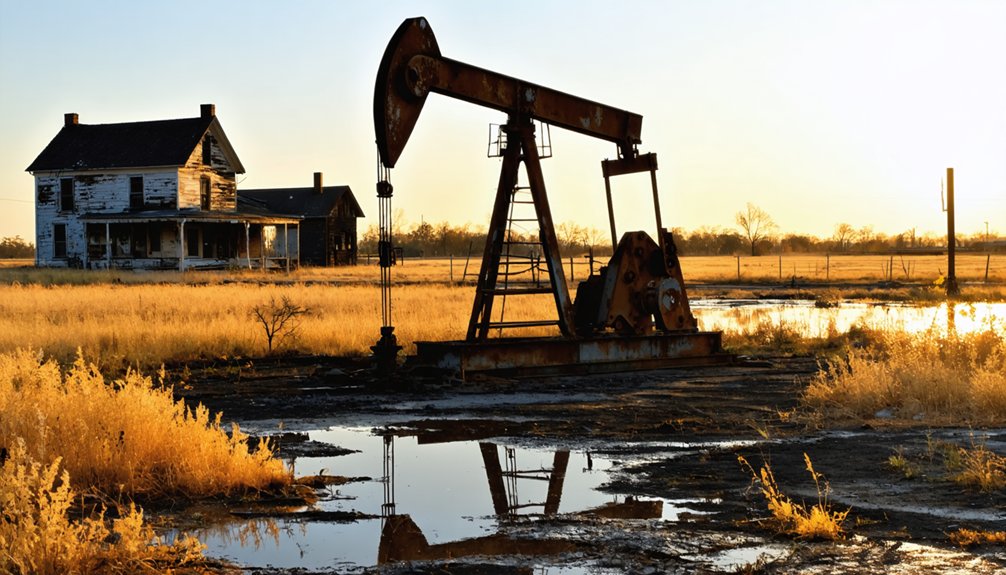
Beneath America’s picturesque landscapes of former oil boomtowns lies a troubling environmental legacy that continues to haunt communities long after the last barrel was extracted.
Forgotten wells fester beneath America’s surface, silent polluters of a bygone industrial era.
You’re living with the toxic legacy of over 81,000 documented orphaned wells—and potentially millions more undocumented ones—that release substantial methane emissions equivalent to 2-5 million cars annually.
The regulatory challenges are staggering: these wells pose serious groundwater contamination risks, with approximately 4.6 million Americans residing within 1 km of an orphaned well.
The economic implications extend beyond property devaluation—restoration funding falls short by up to $3.7 billion.
Environmental monitoring remains inadequate, with less than 0.03% of abandoned wells measured for emissions.
Communities grappling with public health risks from mobilized toxic elements need greater historical awareness and community engagement to address this persistent threat.
Preservation Efforts: Saving America’s Oil History
You’ll find Heritage Trails emerging across former boomtowns, where communities document and preserve America’s petroleum legacy through interpretive signs, museums, and restored infrastructure.
Federal initiatives, including the Bipartisan Infrastructure Law‘s $4.7 billion allocation, address funding restoration challenges while tribal-led efforts like the Osage Nation’s successful plugging of over 80 abandoned wells demonstrate targeted preservation approaches.
Community-led preservation movements have gained momentum as local advocates partner with state agencies, exemplified by Texas’s extensive program that has remediated nearly 31,600 wells since 1992, balancing environmental remediation with historical conservation.
Heritage Trails Emerge
As the ghosts of America’s oil boom began to fade into obscurity, preservation advocates across the nation mobilized to establish heritage trails that would commemorate this pivotal chapter in American industrial history.
You’ll find these pathways following historical transport routes like the Erie to Pittsburgh Trail, connecting oil towns from Titusville to Emlenton through a network of interpretive sites and reclaimed industrial corridors.
These trails enhance heritage tourism through:
- Integration of educational programs at sites like Drake Well Museum and Oil Creek State Park
- Interpretive panels that explain technological innovations and environmental reclamation
- Guided tours illuminating the socioeconomic transformation from extraction economies to cultural preservation
Walking these routes, you’re traversing not just geographical space but temporal dimensions—experiencing firsthand how industrial ambition shaped America’s landscape and liberty.
Funding Restoration Challenges
While America’s oil boomtowns stand as proof of industrial innovation, the monumental task of preserving these historical landmarks faces significant financial hurdles.
You’ll find federal programs like the Bipartisan Infrastructure Law allocating $4.7 billion for cleanup nationwide, but significant funding gaps persist as costs consistently outpace available resources.
State agencies in Texas, Louisiana, and West Virginia struggle with these cleanup challenges, often warning that restoration expenses exceed their budgets.
You’re witnessing this tension as inflation and operational costs strain both federal and state coffers.
Though Texas received $105 million to plug over 2,400 wells, thousands remain abandoned.
Your heritage preservation efforts compete with environmental priorities, creating a complex balance between honoring America’s industrial past and addressing the ecological damage these sites continue to inflict.
Community-Led Preservation Movements
Beyond government funding challenges, grassroots initiatives have emerged as powerful forces in preserving America’s oil heritage.
From Raton, New Mexico, to Oil City, Pennsylvania, community engagement has transformed abandoned industrial sites into vibrant museums and cultural centers. These preservation movements rely on passionate volunteers who collect oral histories and establish local archives that catalog photographs and documents from boom eras.
Three remarkable community preservation strategies include:
- Formation of local museum associations that restore and maintain historic oil structures
- Development of digital databases where residents contribute family photographs and industry artifacts
- Implementation of educational partnerships between historical societies and schools to create oil heritage curricula
These community-led efforts demonstrate how determined citizens can protect significant cultural landmarks even when formal institutions lack resources—proving that preservation power often resides with the people who cherish these histories most.
From Prosperity to Decay: The Life Cycle of Oil Towns
The dramatic rise and fall of American oil towns represents one of the most striking examples of boom-and-bust economic cycles in the nation’s industrial history.
You’ll find these oil town dynamics illustrated most vividly in Texas, where over one million people migrated between 1926-1983 seeking opportunity. Following discoveries like Spindletop in 1901, remote areas transformed into thriving communities with schools, hospitals, and established infrastructure.
However, economic resilience proved elusive. When market volatility struck, companies abandoned operations, leaving behind over 100,000 idle wells across Texas and New Mexico.
The physical decay manifests through 600,000 deteriorating underground pipes and abandoned wells leaking hazardous materials. With cleanup costs reaching $335 million and individual wells costing $100,000 to plug, the financial burden ultimately shifts to taxpayers when operators disappear.
Tourism and Exploration in America’s Petroleum Ghost Towns
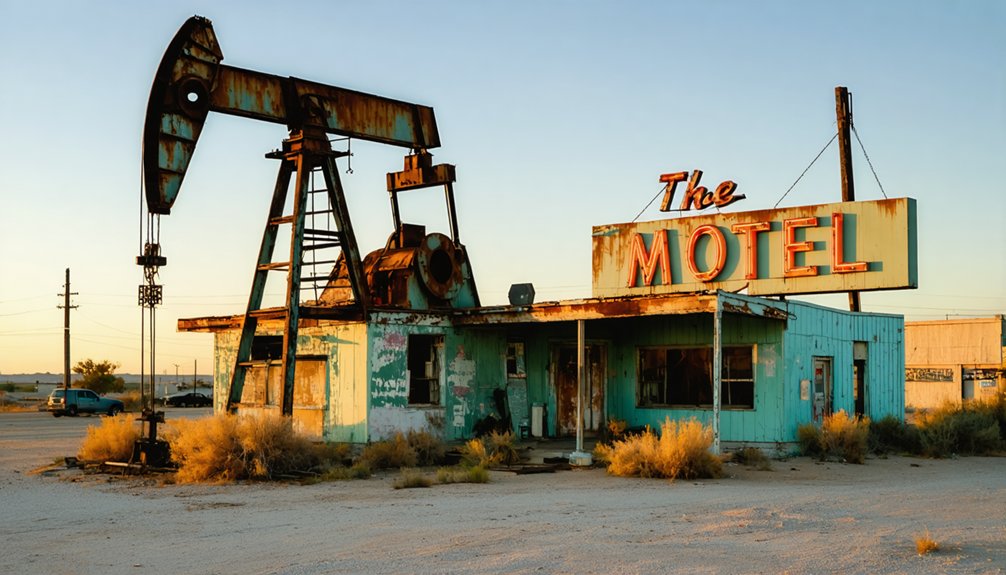
What draws travelers to America’s decaying petroleum towns, where rusted derricks and crumbling infrastructure stand as monuments to forgotten prosperity?
the historical significance of abandoned towns often unveils stories of resilience and the fleeting nature of success. These sites serve as poignant reminders of industries that once thrived, inviting visitors to reflect on the profound changes that shape communities. As explorers traverse these ghostly landscapes, they uncover layers of history that resonate far beyond their rusty relics.
These sites offer authentic glimpses into America’s industrial heritage while presenting unique preservation challenges. Ghost town tourism transforms these abandoned landscapes into living museums where you’ll discover both cultural significance and environmental concerns.
When exploring these petroleum relics, you’ll encounter:
- Meticulously preserved sites like Calico, California, offering guided tours and historical reenactments
- Environmental hazards including thousands of orphaned wells requiring billions in cleanup costs
- Economic opportunities for surrounding communities that balance heritage conservation with visitor safety
The juxtaposition of historic value against safety concerns creates a complex landscape where your exploration connects you with America’s boom-and-bust industrial legacy.
Frequently Asked Questions
Can Former Oil Ghost Towns Be Safely Reinhabited Today?
You can reinhabit former oil ghost towns, but only after thorough environmental remediation, proper well plugging, and strict urban redevelopment protocols that balance historical preservation with safety regulations addressing persistent contamination risks.
What Happened to the People Who Lived in Abandoned Oil Towns?
You’ll find former oil town residents scattered—many migrated following job losses, facing severe economic impacts like housing insecurity and food scarcity, while others remained, preserving cultural legacies despite community disintegration.
Are There Any Completely Underwater Oil Ghost Towns?
Beneath America’s tranquil waters lies forgotten history! You’ll find several submerged oil ghost towns like St. Thomas and North Dakota’s oil towns, offering rich opportunities for underwater exploration of our submerged history.
How Do Abandoned Oil Towns Compare to Mining Ghost Towns?
You’ll find both share oil boom patterns and economic decline triggers, but differ in their abandonment mechanisms—oil towns failed through price volatility while mining settlements collapsed when mineral resources became depleted.
Which Oil Ghost Towns Have Reported Paranormal Activity?
You’ll find haunted history and spectral sightings in Mentryville, California, where oil workers’ ghosts linger around the superintendent’s house and abandoned derricks, creating an accessible paranormal experience near Los Angeles.
References
- https://www.atlasobscura.com/things-to-do/united-states/oil
- https://timesofindia.indiatimes.com/life-style/travel/famous-abandoned-towns-in-the-u-s-tourists-can-actually-visit/photostory/125742383.cms
- https://grist.org/abandoned-oil-gas-wells-permian-texas-new-mexico/
- https://www.geotab.com/ghost-towns/
- https://www.planetizen.com/node/81347/ghost-towns-remain-after-rush-build-north-dakota-oil-boom
- https://en.wikipedia.org/wiki/List_of_ghost_towns_by_country
- https://abcnews.go.com/US/abandoned-oil-gas-wells-us-bring-fears-leak/story?id=116764814
- https://mix931fm.com/texas-ghost-towns-history/
- https://drillers.com/spindletop-oil-discovery/
- https://aoghs.org/oil-almanac/chronology-of-u-s-petroleum-history/