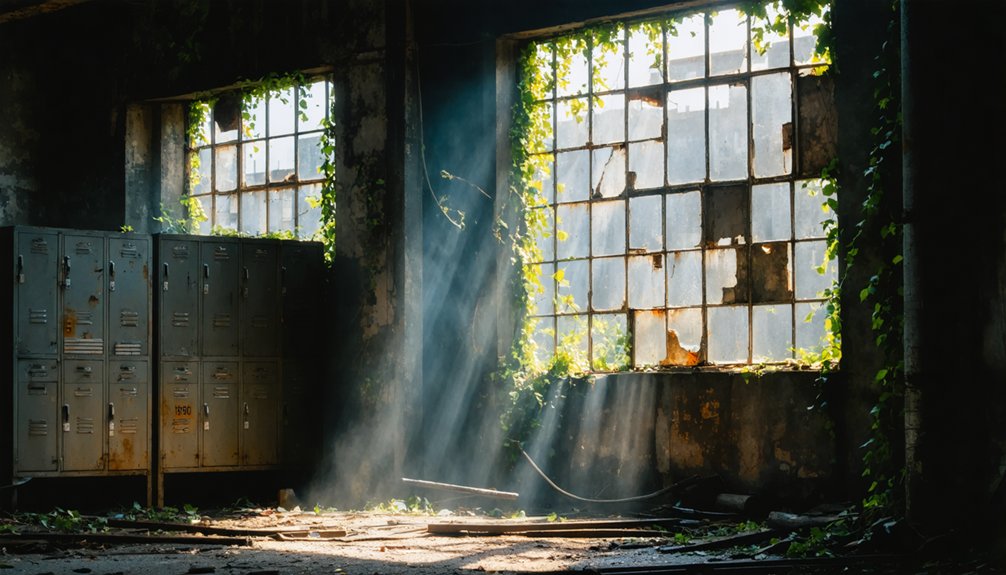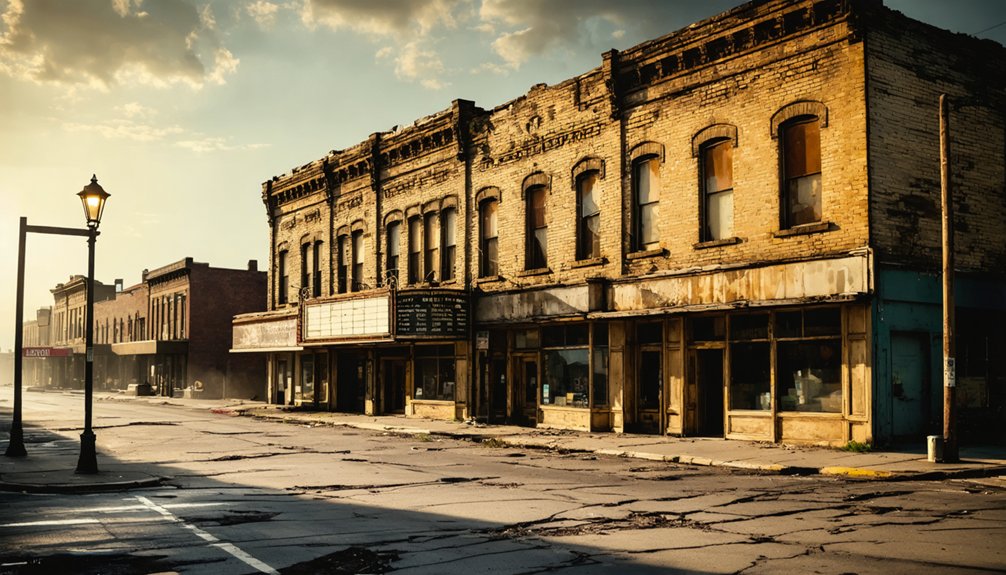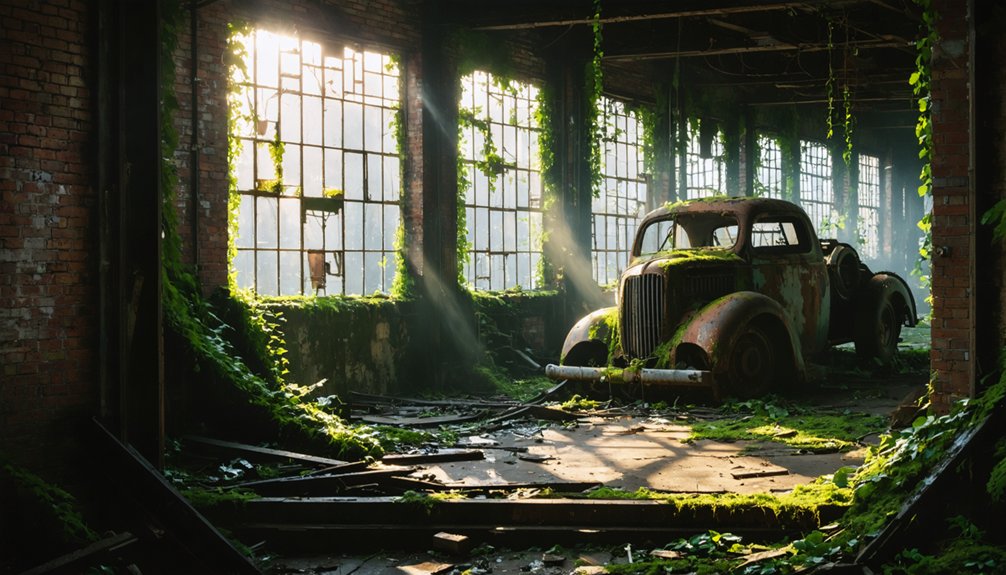
You’ll find the Rust Belt’s abandoned landscape haunting yet mesmerizing. Detroit’s massive Packard Plant sits vacant like a concrete graveyard, while Gary’s gothic City Methodist Church stands as a crumbling cathedral to industry. Buffalo’s towering grain elevators, Cleveland’s empty neighborhoods, and Youngstown’s nature-reclaimed streets tell stories of American prosperity gone silent. These forgotten places freeze moments of sudden departure that await your curious footsteps.
Key Takeaways
- Detroit’s Packard Plant spans 3.5 million square feet of abandoned industrial space, becoming a target for vandalism since its closure in 1999.
- Gary’s City Methodist Church stands as a Gothic ruin with plans to transform it into an official ruins garden and cultural amphitheater.
- Buffalo’s historic grain elevators, once processing 300 million bushels annually, now represent architectural achievements despite abandonment.
- Youngstown’s forgotten neighborhoods feature eerie silence and nature’s reclamation overtaking abandoned homes and industrial structures.
- Flint’s abandoned schools contain classrooms frozen in time, with lessons still visible on boards since closures in 2009.
The Ghost Factories of Detroit: Manufacturing Giants Left to Decay
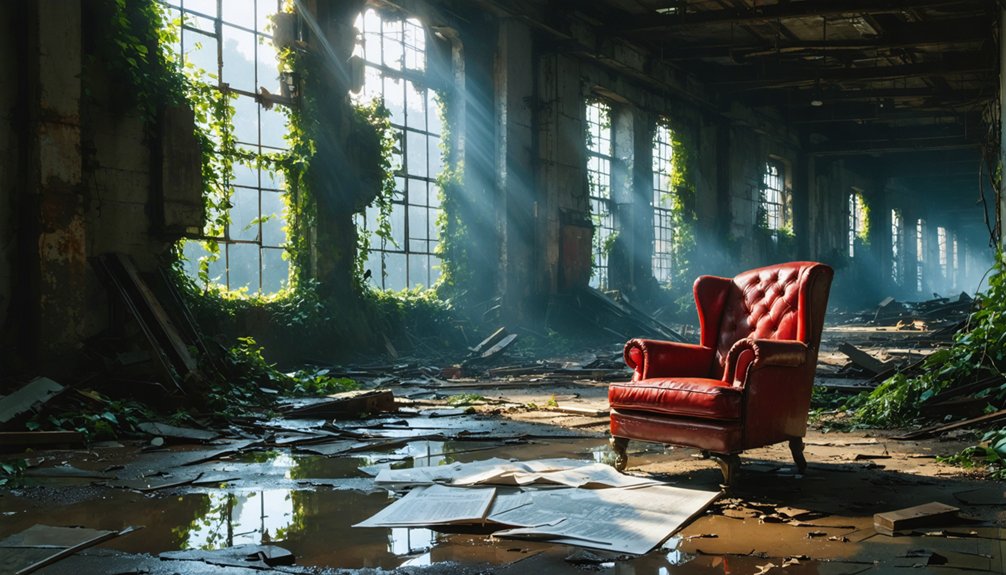
As you cruise through Detroit’s forgotten industrial corridors, you’ll witness the skeletal remains of what once made this city the beating heart of American manufacturing.
Nearly 900 abandoned factories dot the landscape, from the massive 80-acre Packard Plant to hundreds of smaller tool-and-die shops tucked between residential blocks.
These industrial relics tell a story of decline. The Packard’s 3.5 million square feet stood proud until 1999 before becoming a paradise for vandals.
Fisher Body Plant 21, Ford’s Highland Park assembly line, and the AMC Headquarters—all now ghost towns where innovation once thrived.
These hollow giants border disadvantaged neighborhoods, their contaminated soil and crumbling walls depressing property values and isolating communities.
Despite demolition efforts funded by stimulus money, the path to redemption remains challenging for Detroit’s abandoned manufacturing temples. The city’s renewed focus on the Packard Plant culminated in the Packard Park Initiative, transforming the long-abandoned site into a mixed-use development with public spaces. Many of these sites require adaptive reuse strategies to transform them into productive spaces that benefit surrounding communities.
Gary’s Steel Cathedrals: Monuments to America’s Industrial Past
While most abandoned churches evoke quiet spiritual neglect, Gary’s City Methodist Church screams industrial decline with every crumbling Gothic arch.
Built in 1926 with U.S. Steel’s deep pockets ($800,000—over $7 million today), this nine-story behemoth wasn’t just a place of worship but a community legacy where steel workers found refuge beyond Sunday service.
When steel forged America’s backbone, it built cathedrals where workers found sanctuary beyond their Sunday prayers.
You’ll be captivated by:
- The majestic English Gothic architecture that once housed 3,000 faithful during the 1950s religious revival
- A multi-functional complex featuring a gymnasium, theater, and cafeteria—Gary’s beating heart during industrial prosperity
- The haunting four-manual Skinner organ donated by Elbert Gary himself, now silent as the overseas competition that killed American steel
Walk these ruins and feel freedom in the forgotten temples of America’s faded industrial might. Since 2017, the church has been selected for transformation into a ruins garden with plans for an amphitheater to host weddings and cultural events. Not far away stands St. John’s Evangelical Lutheran Church with its distinctive dual towers that have become neighborhood landmarks since 1923.
Buffalo’s Grain Elevators: Silent Sentinels Along the Waterfront

Stand in the shadow of Buffalo’s mammoth grain elevators, and you’ll feel the ghostly pulse of America’s industrial heartbeat that once thundered through these concrete cathedrals.
These silent sentinels—once processing 300 million bushels annually and making Buffalo the world’s largest grain port—now loom frozen in time along the waterfront. The 1860s marked a revolutionary period when cylindrical steel bins were pioneered, though their adoption was initially slow due to cost concerns. The shift to fireproof construction offered tremendous financial advantages, with insurance savings covering the entire construction costs within just four years.
You’re witnessing the skeletons of American might that influenced architectural giants like Le Corbusier before falling quiet as the Rust Belt‘s economic tide retreated.
Industrial Giants Frozen
Towering like frozen giants against Buffalo’s skyline, the grain elevators that once powered America’s heartland now cast long shadows over the waterfront.
You’re looking at the ghosts of grain commerce that transformed a small creek settlement into the world’s largest grain port, outpacing London and Rotterdam by the Civil War’s end.
These concrete and steel behemoths tell the story of architectural evolution from Dart’s 1843 wooden pioneer to the mammoth concrete silos that inspired Le Corbusier and modern architecture itself.
Many of these structures, built between 1906 and 1936, stand as testaments to Buffalo’s era as the Grain Capital of the World.
Preservationists are working to nominate these historic monuments for National Register recognition to ensure their protection for future generations.
When you visit, don’t miss:
- Silo City – once-silent spaces now pulsing with cultural rebirth
- The American Elevator (1906) – the first concrete titan on Buffalo’s shore
- Steel monsters like the Great Eastern (1901) with their revolutionary hemispherical bottoms
Concrete Cathedral History
As you wander the Buffalo waterfront, these massive concrete cathedrals tell a story that began with the completion of the Erie Canal in 1825.
Joseph Dart’s steam-powered elevator invention in 1842 changed everything, transforming Buffalo into America’s grain capital.
What you’re seeing isn’t just abandoned industrial space—it’s architectural significance frozen in time. These structures were celebrated by influential architects like Le Corbusier as the first fruits of the New Age in architecture.
The Concrete Central Elevator, built 1915-1917, stretches a quarter-mile along the river, a demonstration of the “slip form” construction technique that revolutionized industrial architecture. Though now listed on the National Register of Historic Places since 2003, the structure faces ongoing threats from scrap metal thieves and vandalism.
Cleveland’s Forgotten Neighborhoods: Once-Thriving Communities Now Empty
You’re witnessing the ghosts of Cleveland’s heyday when you cruise through Hough’s crumbling mansions that once housed 76,000 souls but now stand empty at 13% capacity.
Slavic Village tells a brutal tale of the foreclosure crisis, where zombie homes and predatory lending left blocks abandoned and dreams shattered.
Walk Glenville’s streets today and you’ll find urban prairie replacing what was a thriving neighborhood of 65,000 residents in 1950, with 83 vacant apartment buildings marking the landscape like tombstones.
Hough District’s Empty Homes
When the Hough riots erupted in the 1960s, nobody could’ve predicted the ghost town that would emerge from the ashes.
Today, you’ll find a quarter of Hough housing sitting empty—1,546 vacant units haunting the landscape like ghosts of a better time. Urban decay creeps through streets where discriminatory lending practices left Black homeowners stranded without improvement loans, forcing many to abandon ship.
Walk these blocks and you’ll witness:
- Once-grand homes deteriorating behind overgrown yards
- Entire streets dotted with vacant lots where families once thrived
- A staggering 24% vacancy rate that’s crushed property values
Despite demolition efforts and the Land Bank’s push to renovate, Hough remains a shadow of its former glory—a stark reminder of how quickly freedom can vanish when systems fail communities.
Slavic Village Housing Crisis
While Hough’s empty homes tell one tale of urban abandonment, just a few miles southeast lies an even more haunting monument to the American Dream gone wrong.
the legacy of utopian societies can be seen in the remnants of planned communities that once promised a better way of life. These ambitious projects often crumbled under the weight of societal expectations and economic pressures, leaving behind a stark reminder of their failed aspirations. Today, they stand as ghostly reflections of hope, lost in the shadows of what could have been.
Welcome to Slavic Village, ground zero of America’s 2008 mortgage meltdown. You’ll find block after block of boarded windows, sagging porches, and faded “Bank Owned” signs – ghosts of zip code 44105’s infamous distinction as the nation’s hardest-hit foreclosure zone.
Predatory lenders like Argent Mortgage swooped in, leaving devastation that makes your gut twist. Half the neighborhood’s mortgages were subprime bombs waiting to explode.
Yet amid these ruins, witness defiant community resilience. Residents decorated boarded houses as acts of resistance.
Slavic Village Development fought back against foreclosure impacts with lawsuits and rehabilitation programs, refusing to surrender their streets to vulture investors who treated homes like disposable profit machines.
Glenville’s Urban Prairie
What remains in these forgotten streets:
- Ghost blocks where Jewish and later Black families built their American dreams, now surrendered to wild grasses and volunteer trees.
- Traces of the 1968 shootout that accelerated white flight, hastening urban decay that even recent community revitalization efforts can’t fully reverse.
- Echoes of New England farmers and immigrant truck gardens in open spaces where demolition crews have erased 11,000+ blighted structures.
Freedom isn’t just absence—sometimes it’s the haunting emptiness between what was and what could be.
Youngstown’s Urban Prairie: Where Nature Reclaims the City
The eerie silence that blankets Youngstown’s forgotten neighborhoods tells a story more haunting than any ghost tale you’ll hear.
Where 100,000 residents once lived, you’ll now find nature’s relentless urban reclamation – entire blocks surrendered to weeds pushing through cracked concrete and vines strangling empty steel worker homes.
Drive these streets and you’ll dodge potholes while passing row after row of abandoned shells, their minimalist interiors stripped bare.
The furnace glow that once lit up the sky fifty miles to Akron has vanished completely. In winter, you’ll spot footprints leading into these forgotten structures where the homeless seek shelter.
This nature resurgence isn’t beautiful – it’s defiant.
Wild growth covering the remains of America’s industrial might, reclaiming what we built and then abandoned.
Pittsburgh’s Abandoned Rail Yards: The Rusted Arteries of Commerce
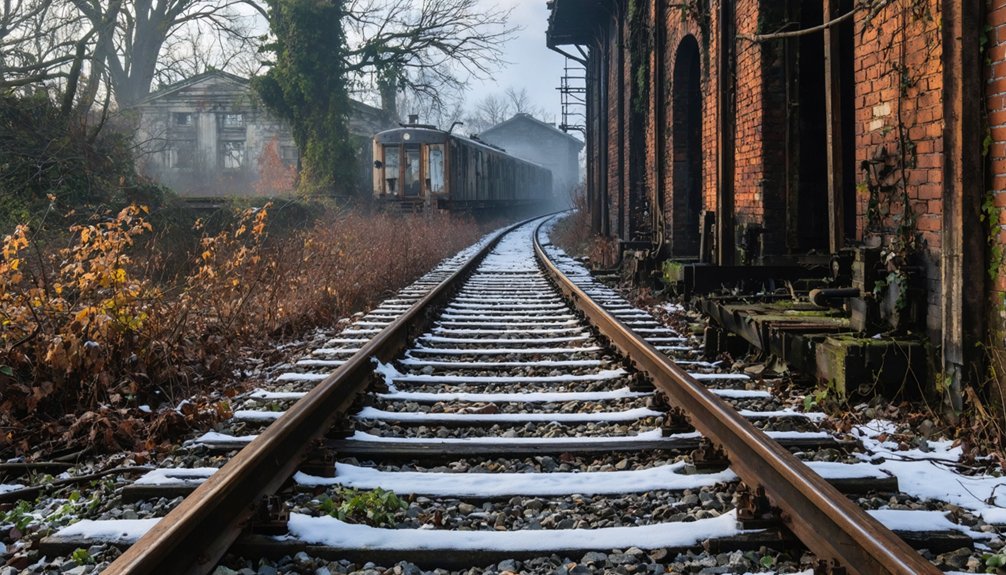
Ghostly metal giants rest in permanent slumber across Pittsburgh’s forgotten rail yards, their rusted frames standing as monuments to a vanished industrial empire.
You’ll feel the weight of history as you explore the remnants of the P&LE “Little Giant” and Panhandle Route—once-mighty arteries pumping steel across America, now silent casualties of industrial decline.
If you’re hunting Pittsburgh’s industrial heritage, check out:
- Gateway Yard’s vandalized remains, abandoned after CSX’s 1993 takeover
- The Brilliant Cut-Off, a ghostly corridor dormant under county ownership since 2019
- Former tunnels now serving as bat sanctuaries—nature’s ultimate rail yard revitalization
The city’s skeleton lies exposed where tracks once thundered—a freedom to wander through time without schedules or signals, just rust, regrowth, and remembrance.
The Hollow Schools of Flint: Education Landmarks Standing Empty
You’ll find classrooms frozen in 2009 at Flint Central High, where algebra equations still haunt chalkboards and senior photos never made it into yearbooks.
The school district’s financial collapse sent kids packing from over twenty schools, leaving once-vibrant education landmarks as hollow shells across a city that’s lost more than half its population.
These architectural ghosts—stripped of copper, covered in graffiti, and slowly crumbling—stand as monuments to what happens when America’s manufacturing backbone snaps.
Abandoned Classrooms Freeze Time
Frozen in time like eerie snapshots of education past, Flint’s abandoned schools stand as hollow monuments to the city’s fading industrial glory.
You’ll find chalkboards with final lessons still visible, lockers that haven’t slammed shut in decades, and vacant memories haunting these educational graveyards.
Walking through these forgotten halls triggers intense abandoned nostalgia—Washington Elementary’s century of learning snuffed out in 2013, while Flint Central High’s grand 1923 architecture now crumbles silently.
Three eerie remnants you’d discover:
- Carpenter School’s abandoned renovation, with supplies still scattered like its occupants vanished mid-lesson
- Northern High’s empty gymnasium where championship banners hang over debris-strewn floors
- Longfellow’s time-capsule classrooms, frozen since 2007, their desks awaiting students who’ll never return
Funding Crisis Emptied Hallways
As Flint’s industrial heart stopped beating, its schools became the first casualties of a financial hemorrhage that’s left educational wastelands across the city.
Walk past two dozen abandoned school buildings, monuments to educational neglect where 86% of students vanished over twenty years.
You’re witnessing the aftermath of funding disparities that gutted a system. While $156 million in Covid relief couldn’t stop the bleeding, the district hemorrhaged into a $14.7 million deficit.
Meanwhile, kids fled to eleven charter competitors.
The evidence is stark: 75% chronic absenteeism, 35% graduation rates, and classrooms where teacher-student ratios hit 53:1 in some buildings.
Those empty desks and shuttered windows tell a story of systematic collapse—where Pierce Elementary just closed and Neithercut follows next year, leaving hollowed shells where education once thrived.
St. Louis’ Crumbling Mansions: Grandeur Lost to Time

Grandeur and decay dance a haunting waltz through St. Louis’ once-magnificent mansions.
You’ll feel abandoned elegance at every turn—like the Lemp Mansion, where five family members ended their lives beneath ornate ceilings that once witnessed beer fortune revelry. These historical hauntings echo through wine cellars and art vaults now shrouded in mystery.
The ghosts of St. Louis aristocracy linger where crystal chandeliers once illuminated lavish soirées, now casting shadows on dusty parquet floors.
What killed these architectural treasures?
- Prohibition crushed brewery empires, turning $7 million properties into $588,500 bargains.
- Absentee slumlords collect properties sight unseen, letting code violations stack while pocketing profits.
- Urban flight funneled investment to suburbs while downtown’s Italianate masterpieces crumbled.
Urban pioneers have restored some mansions, rescuing them from bulldozers.
But thousands more wait silently, their ghosts watching as time steals what remains of their forgotten glory.
Akron’s Rubber Legacy: The Vacant Factories That Built America’s Wheels
Rubber giants once ruled Akron’s skyline, their smokestacks piercing the Ohio clouds like industrial cathedrals. You can still feel the rubber nostalgia as you walk past these hollow shells where the Big Four—Goodrich, Goodyear, Firestone, and General Tire—churned out America’s wheels.
These weren’t just factories; they were kingdoms. In their 1950s prime, over 85,000 workers hustled through these gates daily, producing one-third of the nation’s tires.
The same buildings now showcase industrial decay—crumbling brick facades and broken windows that whisper stories of a vanished era.
It happened almost overnight. Between ’75 and ’82, they all fled south or dissolved into corporate takeovers. The empty warehouses stand like ghosts, reminders of when Akron’s strategic advantages—water, canals, railroads—made it the Rubber Capital of the World.
The Eerie Beauty of Rust Belt Theaters: Entertainment Palaces Frozen in Time

Step into the skeletal remains of the Rust Belt’s forgotten movie palaces, where faded velvet seats and peeling gilded trim tell stories that echo through empty auditoriums.
These Renaissance-style behemoths once represented the pinnacle of entertainment design during manufacturing’s heyday, now frozen in architectural decay.
You’re witnessing the ghosts of prosperity – fifteen theaters thriving in the 1950s, most shuttered within a decade as cities hemorrhaged population.
The theater nostalgia hits hardest when you realize these weren’t just buildings but symbols of better times.
- Visit Cleveland’s Allen Theater, once used only 90 days yearly before revival
- Explore Liberty/Paramount, which mirrored its city’s 1960s downfall
- Discover Gordon Square District, where vaudeville stages transformed urban landscapes
Frequently Asked Questions
Is Urban Exploration of Abandoned Rust Belt Structures Legal?
It’s straight-up trespassing unless you’ve got permission, friend. Urban exploration’s legal implications bite hard when you’re caught—but damn if that rush of freedom ain’t worth dancing with danger sometimes.
What Safety Hazards Exist in These Abandoned Places?
Vacant building fires kill 6X more firefighters than normal blazes. You’ll face deadly structural instability in these decaying temples—floors collapse without warning and toxic substances linger like ghosts from our industrial past. Watch your step.
Are Any Abandoned Sites Being Successfully Repurposed?
Hell yeah they’re being reborn! You’ll find steel mills transformed into apartment complexes and vacant lots becoming community parks through adaptive reuse. These revitalization efforts are breathing new life into forgotten industrial bones.
How Do Locals Feel About Tourism to Abandoned Areas?
Like rust eating away at forgotten factories, local perspectives on abandonment tourism are mixed. You’ll find pride in artistic projects but resentment when outsiders turn your economic wounds into their adventure playground.
What Personal Items Are Commonly Left Behind in Abandoned Buildings?
You’ll find forgotten possessions everywhere—clothes still hanging, family photos, toys, letters, medication bottles. These haunting reminders of lives suddenly interrupted tell raw stories that’ll make your soul ache for freedom.
References
- https://www.youtube.com/watch?v=g00kMsxdpJ8
- https://schoolofcities.utoronto.ca/neighbourhood-abandonment-in-the-american-rust-belt/
- https://www.youtube.com/watch?v=tHl1b1N2tpo
- https://mrpexplores.substack.com/p/east-st-louis-illinois-more-abandoned
- https://www.clevelandfed.org/publications/economic-commentary/2013/ec-201306-urban-decline-in-rust-belt-cities
- https://en.wikipedia.org/wiki/Rust_Belt
- https://www.newgeography.com/content/008487-the-great-bones-rust-belt-cities
- https://www.freep.com/story/money/business/john-gallagher/2017/05/29/next-detroit-find-uses-900-vacant-manufacturing-sites/348442001/
- https://www.historicdetroit.org/buildings/packard-plant
- https://detroiturbex.com/content/industry/index.html