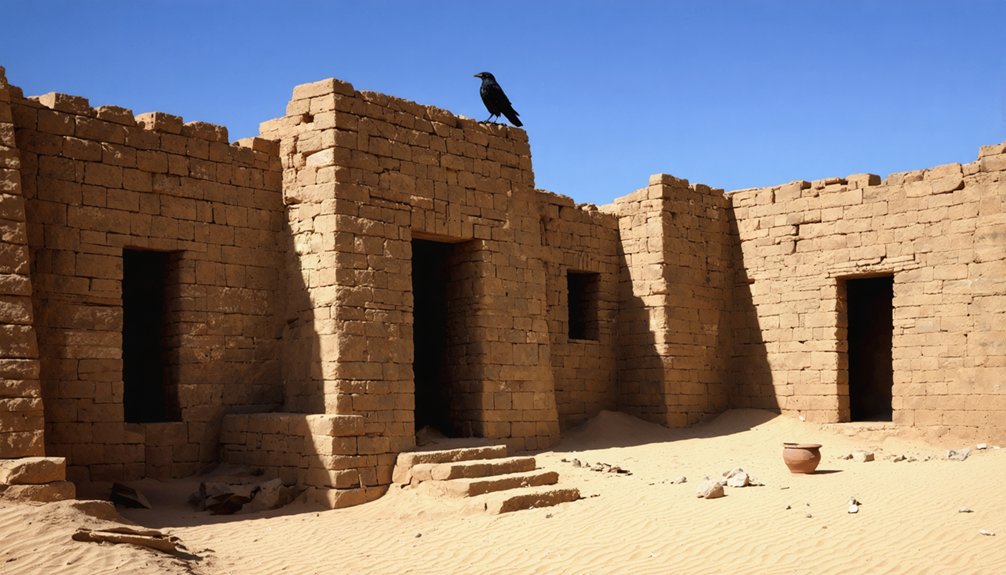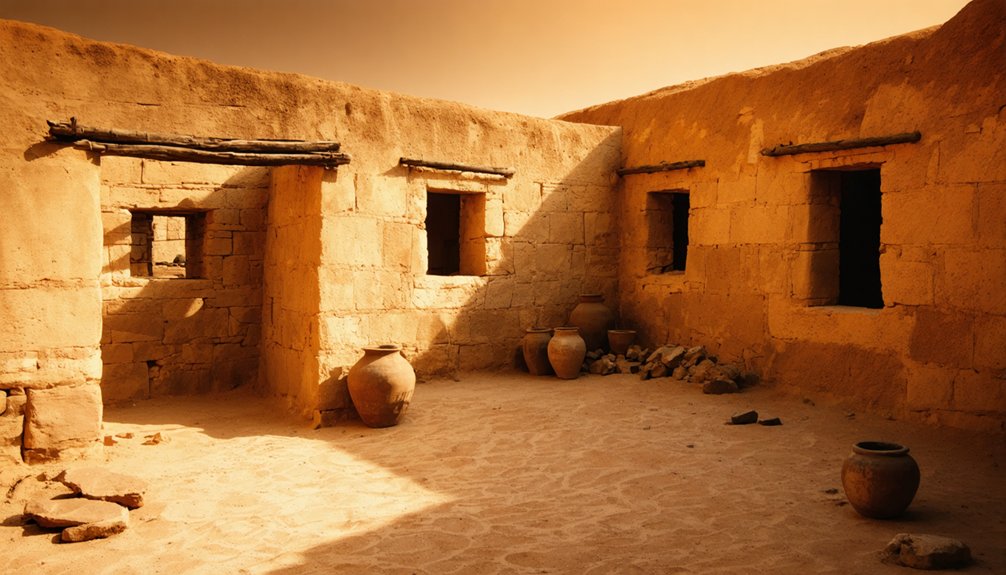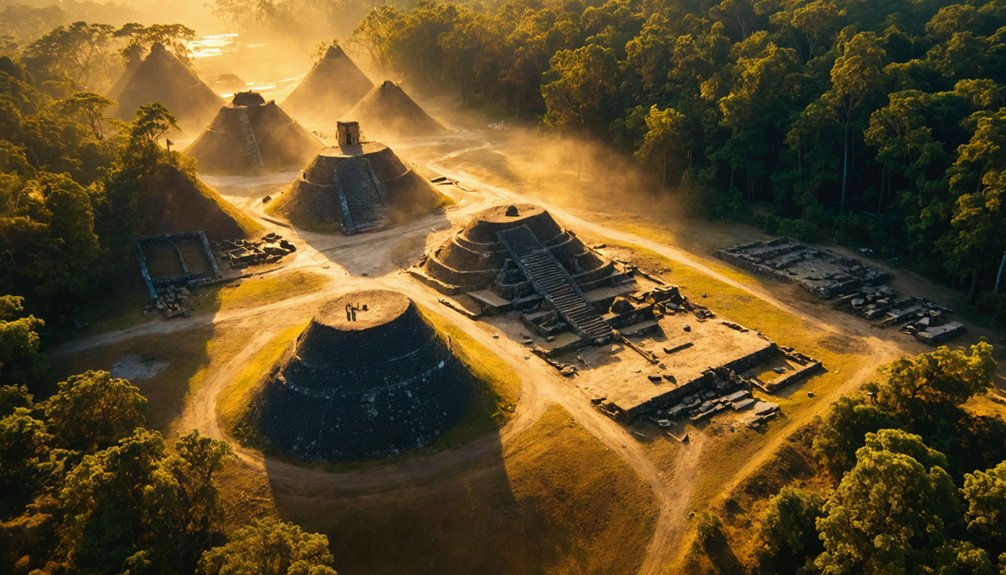
You’ll find numerous forgotten Native American settlements across the USA, from the submerged “Lost City” beneath Lake Mead to Cahokia’s sophisticated urban complex near St. Louis. Advanced technologies like LiDAR now reveal previously hidden sites like Etzanoa in Kansas, which once housed 20,000 people. Mesa Verde’s cliff dwellings and Chaco Canyon’s astronomical alignments demonstrate remarkable architectural achievements. These ancient towns offer glimpses into sophisticated societies that thrived long before European contact.
Key Takeaways
- Advanced technologies like LiDAR reveal previously hidden Native American settlements beneath forest canopies and vegetation.
- Lost City near Las Vegas exemplifies how archaeological sites can be submerged by modern infrastructure projects.
- Mesa Verde and Cahokia demonstrate the architectural sophistication of ancient Native American urban centers.
- Etzanoa in Kansas, once home to 20,000 people, represents major economic centers being rediscovered through modern archaeology.
- Collaborative partnerships between archaeologists and tribal communities preserve cultural knowledge during excavation and interpretation of sites.
The Submerged Legacy of Lake Mead’s Lost City
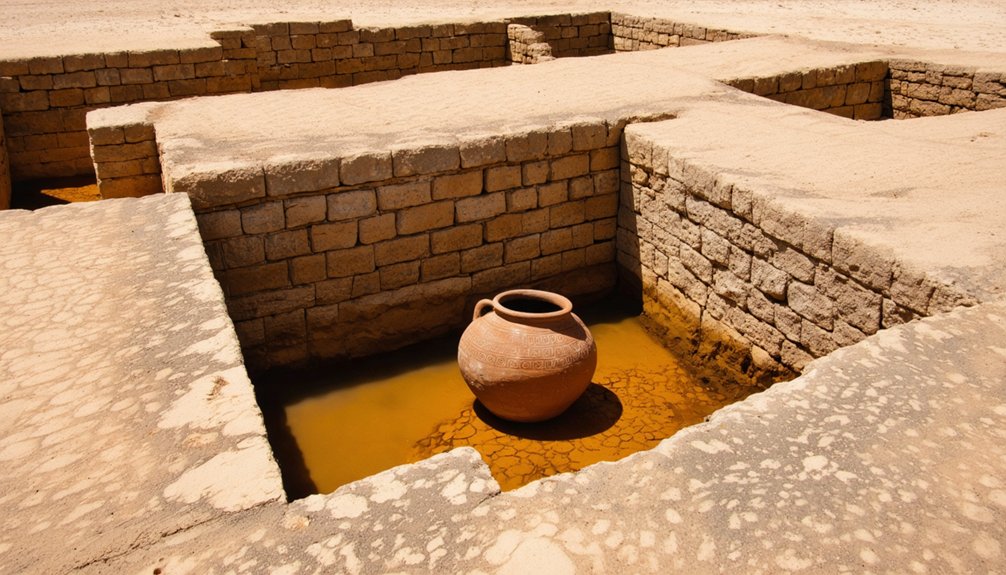
Just north of the bustling Las Vegas strip, where the Muddy River meets the Virgin River, lies the partially submerged archaeological treasure known as Lost City or Pueblo Grande de Nevada.
This westernmost outpost of Ancestral Puebloan culture thrived for nearly a millennium until 1150 AD, featuring 46 multiroomed masonry pueblos along a five-mile stretch.
In 1935, Hoover Dam‘s completion created Lake Mead, flooding significant portions of this ancient settlement. The Lost City Museum now houses original building foundations and reconstructions that showcase the architectural achievements of these skilled builders.
Before the waters rose, archaeologists documented sophisticated submerged archaeology, including advanced ancient irrigation systems that channeled spring-fed waters to sustain productive agriculture.
They recovered intricately painted pottery, turquoise jewelry, woven cotton textiles, and salt mining implements.
Today, during drought periods, receding waters occasionally reveal previously hidden structures, allowing researchers to continue studying this remarkable civilization’s legacy.
The earliest inhabitants of the region were the Basketmaker culture who constructed circular underground pit-houses accessed by ladders around 300 AD.
Mesa Verde: Architectural Marvels Carved in Sandstone
Tucked away in the southwestern corner of Colorado, Mesa Verde stands as a tribute to the architectural ingenuity of the ancestral Puebloan people who flourished there between the 6th and 13th centuries.
The site contains approximately 600 cliff dwelling architecture marvels, with Cliff Palace housing 150 rooms and over 20 kivas.
Mesa Verde’s 600 cliff dwellings showcase ancestral Puebloan mastery, with Cliff Palace featuring 150 rooms and 20+ ceremonial kivas.
You’ll discover these remarkable structures:
- Multi-story buildings integrated with natural cliff features
- Sandstone blocks joined with mud mortar and wooden support beams
- Colored plaster finishes in yellow, white, and red
- Strategic placements providing environmental protection
The ancestral Puebloan culture abandoned these settlements around 1300 CE, likely due to megadroughts and social pressures. Located at an altitude of over 2,600 meters, Mesa Verde offers a uniquely preserved glimpse into ancient Native American civilization.
Today, these archaeological treasures connect modern Puebloan peoples to their ancestors through preserved structures that demonstrate sophisticated environmental adaptation and community organization. The National Park Service collaborates with 26 affiliated tribes to ensure proper management of this significant cultural landscape.
Cahokia’s Urban Planning and Social Complexity
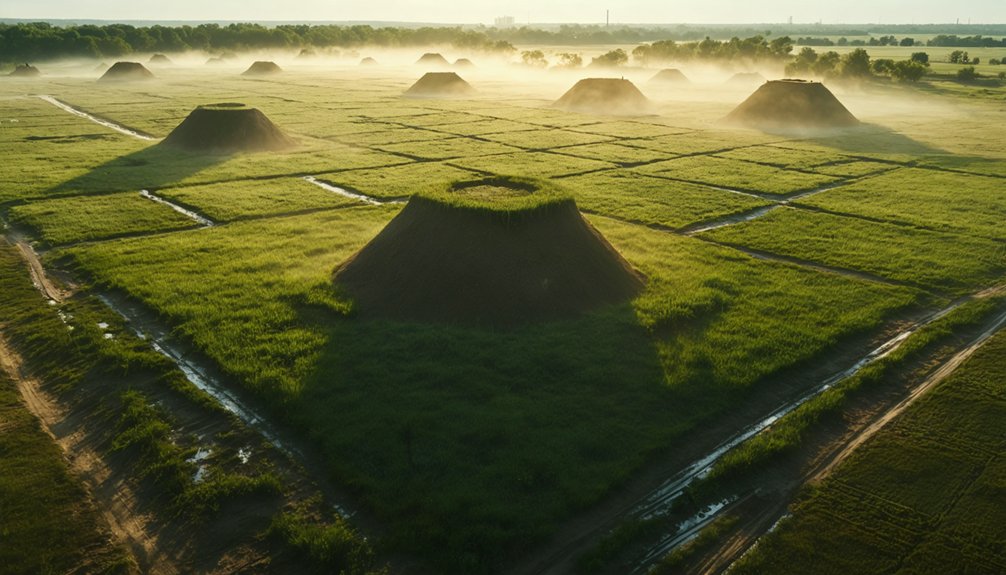
Located on the Mississippi River floodplains near present-day St. Louis, Cahokia represents North America’s most sophisticated pre-Columbian urban center.
You’ll find a meticulously planned 4,000-acre metropolis where Cahokia architecture incorporated over 120 earthen mounds arranged in geometric patterns around plazas aligned with cardinal directions.
This wasn’t random development but deliberate urban stratification. The imposing 100-foot Monks Mound—built in 14 stages with over 55 million cubic feet of soil—served as the power center where elites resided, while commoners occupied designated districts.
The Grand Plaza functioned as the ceremonial heart where 10,000-20,000 inhabitants gathered for rituals and commerce. These impressive gatherings occurred in a space spanning forty acres, making it the largest of four plazas honoring cardinal directions.
Cahokia’s complexity extended beyond physical structures into economic systems, with trade networks reaching the East Coast, demonstrating remarkable organizational capacity and social coordination among Mississippian peoples.
The site included a reconstructed wooden palisade and an astronomical observatory known as Woodhenge, revealing sophisticated knowledge of celestial movements and seasonal changes.
Rediscovering Quivira: The Wichita Metropolis of the Plains
While Spanish conquistadors searched for mythical golden cities in the 1500s, they instead encountered one of North America’s most extensive yet least recognized Indigenous urban centers—the Wichita metropolis of Quivira.
This sophisticated Quivira civilization emerged around 1450 along Kansas’s Arkansas and Walnut Rivers, becoming North America’s economic powerhouse by 1601. Francisco Vázquez de Coronado’s expedition was led into the Plains by the Turk, an Indian captive who deceived the Spaniards with tales of great wealth. The people of Quivira spoke a common language among themselves, which helped unite their massive population.
- Etzanoa alone housed 20,000 people across five miles of riverbank settlement
- Archaeological evidence reveals continental trade networks extending to Aztec territories and southwestern Arizona
- Specialized bison processing tools comprised 80% of stone artifacts, fueling their vast commerce
- Detailed documentation from Coronado (1541) and Oñate (1601) expeditions confirms its scale
Tragically, within a century of European contact, this pinnacle of Wichita heritage collapsed through warfare, disease, and slave raids, leaving a forgotten legacy of Indigenous urban achievement.
Sacred Spaces and Ceremonial Centers of the Four Corners
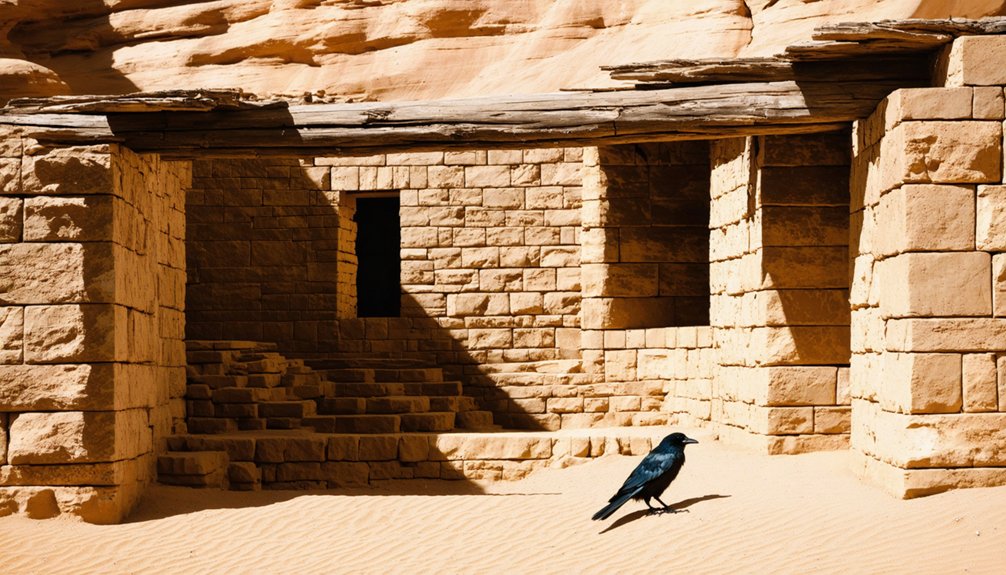
Beyond the plains settlements of Quivira, the Four Corners region harbored an extraordinary network of sacred spaces that functioned as the spiritual and sociopolitical hubs of Ancestral Puebloan civilization from 850 to 1250 CE.
At Chaco Canyon, you’ll find monumental sacred architecture built with precise astronomical alignments. The largest great house, rapidly constructed around 1109-1115 CE, contained 400 rooms where hundreds gathered for ceremonial practices.
Great kivas served as community gathering spaces, particularly the massive reconstructed one at Aztec Ruins.
These ceremonial centers extend to Canyon de Chelly, Chimney Rock, and Hopi mesas, where indigenous peoples maintain cultural continuity today. Chimney Rock’s unique position at 7,000 feet elevation makes it the highest Chacoan site with incredible lunar alignments during standstill events.
Square towers, wooden ritual posts, and circular plazas facilitated sophisticated religious observances tied to solar and lunar cycles. An extensive road network connected Chaco to approximately 150 settlements throughout the region.
Despite abandonment of many sites around 1100-1300 CE, these sacred landscapes remain essential to Diné, Hopi, and other tribes.
Trading Networks That Connected Ancient Native Settlements
Through a vast web of interconnected pathways stretching across the North American continent, indigenous trade networks formed the economic backbone of Native American civilizations long before European arrival.
These extensive trade routes weren’t merely economic systems but crucial conduits for cultural exchange, spreading innovations, spiritual practices, and political alliances.
You’ll find evidence of these sophisticated networks in archaeological sites across America:
- The Mississippian system centered at Cahokia moved exotic goods thousands of miles from the Gulf Coast to the Great Lakes.
- Columbia River networks utilized specialized canoes and developed distinct trade languages to bridge cultural differences.
- Puebloan turquoise, mined in the Southwest, traveled across complex exchange systems that connected diverse communities.
- Hopewell tradition routes distributed marine shells, copper, and obsidian across what would become dozens of modern states.
Environmental Adaptation Strategies in Diverse Landscapes
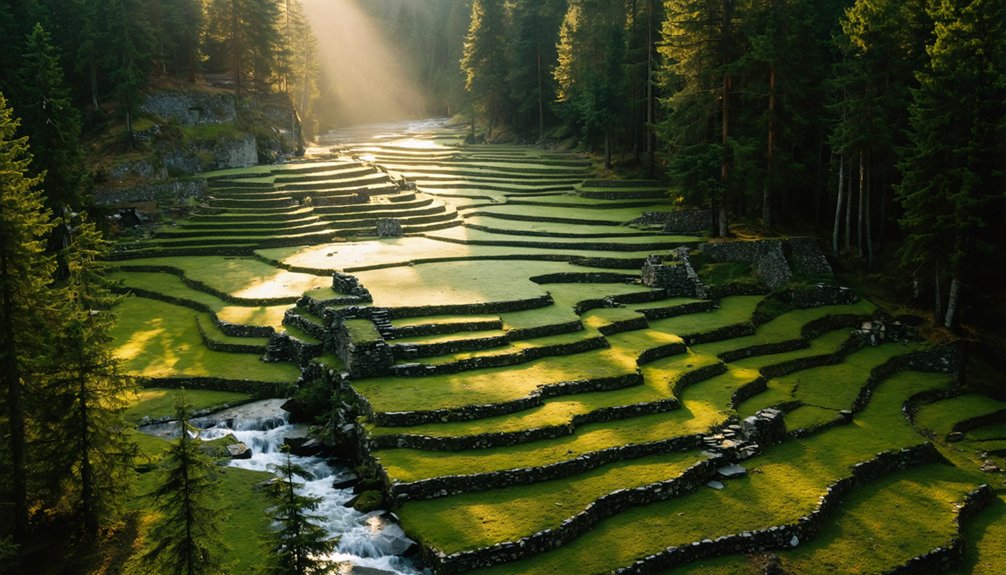
As you explore forgotten Native American towns, you’ll encounter sophisticated water management systems that channeled scarce desert resources through canals, cisterns, and terraced agriculture.
These communities developed heat-adaptive architectural techniques, including semi-subterranean structures, strategic orientation for passive cooling, and materials that moderated temperature extremes.
Their seasonal migration patterns followed resource availability across elevation gradients, allowing communities to optimize hunting, gathering, and agricultural activities through precisely timed movements coordinated with ecological cycles.
Water Resource Management
While examining the environmental adaptation strategies of forgotten Native American towns, water resource management emerges as perhaps their most essential innovation.
You’ll find these indigenous practices weren’t merely utilitarian—they integrated spiritual relationships with engineering precision across diverse landscapes.
Pre-colonial water management systems demonstrate remarkable ingenuity:
- Sophisticated networks of reservoirs, canals, and aqueducts supported thriving communities in challenging environments
- Sacred water ceremonies complemented practical conservation methods, viewing water as both resource and spiritual element
- Intergenerational knowledge transmission facilitated sustainable freshwater maintenance for robust ecosystems
- Community-specific approaches reflected unique ecological contexts, balancing human needs with environmental preservation
These ancestral systems offer critical insights as modern tribes navigate complex federal funding structures while reclaiming their water sovereignty—proving ancient wisdom remains relevant for contemporary challenges.
Desert Heat Adaptations
Surviving the unforgiving desert heat required Native American communities to develop extraordinarily sophisticated adaptation strategies that extended far beyond their water management systems.
You’d find remarkable shelter innovations in their thick-walled adobe dwellings and semi-subterranean pit houses that utilized earth’s thermal mass to moderate temperatures.
Their heat resilience manifested in specialized clothing made from breathable natural fibers, strategic timing of activities to dawn and dusk, and consumption of moisture-rich desert plants.
By constructing shelters in advantageous microclimates, they optimized shade and airflow while minimizing sun exposure.
These adaptations weren’t static but evolved through intergenerational knowledge transfer that integrated spiritual practices with ecological understanding.
Their ingenuity extended to food preservation techniques and specialized hunting patterns that acknowledged the rhythms of the desert, demonstrating a profound relationship with their challenging environment.
Seasonal Migration Patterns
The movement of Native American communities followed rhythmic patterns that shifted with changing seasons and available resources, extending their environmental adaptations beyond fixed settlements.
You’ll find these migratory hunting strategies weren’t random wanderings but sophisticated seasonal resource management systems aligned with ecological cycles.
Indigenous peoples mastered landscape navigation through:
- Pacific Northwest communities timing movements to salmon spawning runs
- Plains tribes following seasonal bison migrations across vast territories
- Agricultural groups gathering for communal planting and harvest periods
- Northern communities developing specialized winter hunting and summer fishing camp rotations
These patterns created a dynamic relationship with the land, with multi-family dwellings serving as seasonal hubs rather than permanent residences.
Archaeological evidence reveals repeated site occupations, demonstrating how Native Americans strategically maximized resource availability throughout changing annual cycles.
Modern Technologies Revealing Ancient Settlement Patterns
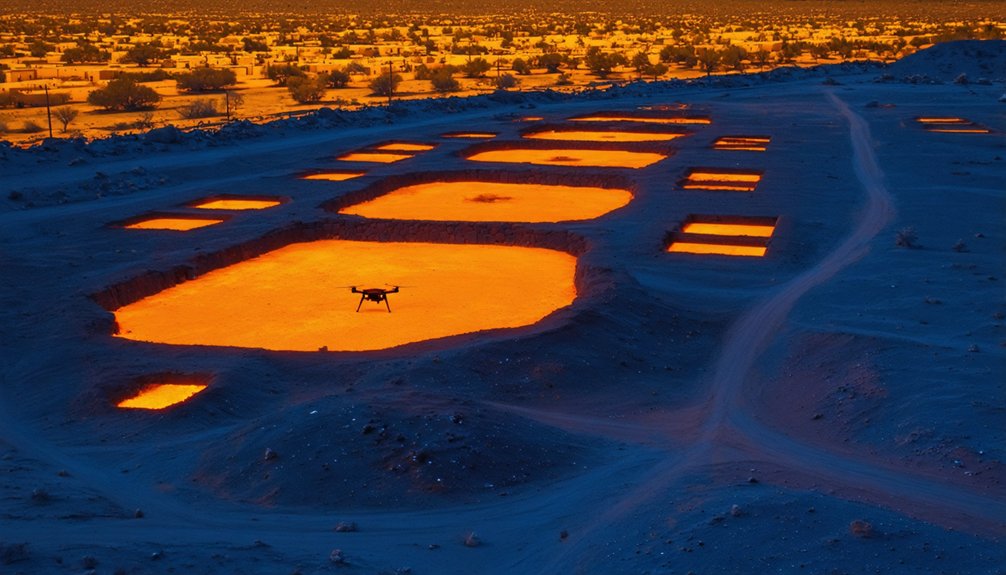
Over recent decades, advanced technological tools have revolutionized archaeological approaches to discovering forgotten Native American settlements across the United States.
As researchers delve deeper into these historical sites, they are also uncovering connections to haunted locations in California. The intersection of technology and folklore offers a unique perspective on both the archaeological findings and the cultural narratives surrounding these eerie sites. Such explorations not only enrich our understanding of the past but also highlight the enduring legacy of these stories in contemporary society.
LiDAR technology mounted on drones now captures high-resolution images that penetrate dense vegetation, revealing 750-year-old structures at sites like Sand Canyon Pueblo in Colorado. You’ll find this method particularly effective for exposing subtle anthropogenic features in forested environments where traditional methods fail.
LiDAR unveils ancient stories hidden beneath forest canopies where conventional archaeology cannot reach.
AI integration enhances this process by analyzing massive remote sensing datasets with greater efficiency than human interpretation alone. These machine learning models are trained on verified site locations to create predictive frameworks that guide focused ground-truthing efforts.
The Digital Index of North American Archaeology further amplifies these technological advances by aggregating century-spanning datasets while collaborating with tribal nations to respect Indigenous perspectives on cultural heritage management.
Preserving Cultural Heritage Through Collaborative Archaeology
Preserving ancient Native American cultural heritage has evolved substantially through collaborative archaeological practices that bridge Indigenous knowledge systems with scientific methodologies.
When you participate in cultural partnerships today, you’re engaging with frameworks like NAGPRA and ARPA that mandate tribal consultation and joint archaeological stewardship.
- THPOs now serve as official liaisons managing cultural heritage on tribal lands
- Traditional knowledge integration provides deeper insights into ancestral practices
- Avoidance strategies protect up to 80% of important cultural sites under California law
- Community engagement guarantees proper artifact cataloging and digital preservation
These collaborative approaches guarantee that archaeological investigations respect Indigenous perspectives while employing scientific rigor.
Non-invasive technologies like ground-penetrating radar allow for site documentation without disturbance, while traditional ecological knowledge guides sustainable management practices—creating a more holistic approach to preserving America’s Indigenous past.
The Living Legacy: Contemporary Connections to Ancient Towns
You’ll find a remarkable continuity in many Native American communities that maintain direct connections to ancient towns, where elders transmit cultural knowledge through oral traditions, ceremonies, and daily practices.
Tribal museums have established innovative partnerships with archaeologists and historians to present indigenous perspectives on ancestral sites, combining material evidence with living memory.
These collaborative efforts have transformed heritage tourism at places like Taos Pueblo and Acoma, where visitor experiences now emphasize the unbroken human story rather than treating these communities as archaeological curiosities.
Cultural Knowledge Transmission
While ancient Native American towns may have crumbled into archaeological sites, their cultural essence thrives through sophisticated knowledge transmission systems that bridge past and present.
You’ll find oral traditions remain vibrant living archives where elders convey ancestral wisdom during seasonal gatherings, ensuring cultural continuity despite historical disruptions.
Cultural transmission manifests through:
- Ceremonial practices that function as experiential classrooms for spiritual and practical knowledge
- Elder-led mentorship that transfers specialized ecological and historical understanding
- Artistic expression encoded with symbolic references to tribal histories and cosmologies
- Community-driven intergenerational projects that adapt traditional knowledge for contemporary relevance
This resilient knowledge infrastructure doesn’t merely preserve the past—it actively shapes contemporary Indigenous identity, maintaining unbroken connections to ancient town sites through cultural memory rather than physical occupation alone.
Tribal Museum Partnerships
Tribal museum partnerships have emerged as essential conduits between ancient Native American settlements and contemporary tribal communities, representing a profound shift in cultural stewardship models.
You’ll find institutions like the Clyfford Still Museum prioritizing tribal voices in defining collaboration terms rather than imposing predetermined outcomes. This tribal collaboration extends beyond mere consultation—it centers Indigenous epistemologies in exhibit design and interpretation.
When you visit places like the A:shiwi A:wan Museum, you’re experiencing cultural preservation through Indigenous lenses, where living history connects past to present.
The Three Affiliated Tribes Museum exemplifies this approach, commemorating Mandan, Hidatsa, and Arikara heritage through artifacts and oral traditions.
These partnerships actively challenge colonial narratives by ensuring tribal communities participate in shaping how their ancestral towns and histories are presented, fostering authentic representation and restorative practices.
Heritage Tourism Development
As forgotten Native American settlements transform into destinations of cultural significance, heritage tourism has emerged as a powerful economic engine generating $14 billion in annual impact across Indigenous communities.
You’re witnessing a renaissance where ancestral towns become conduits for heritage preservation while creating sustainable economic pathways.
When you engage with these living cultural landscapes, you’ll find:
- Direct participation in endangered cultural practices sustains traditions that might otherwise vanish
- Indigenous-controlled tourism guarantees authentic representation and storytelling sovereignty
- Financial benefits fund language revitalization and cultural education programs
- Technical assistance through the NATIVE Act builds Tribal capacity for long-term tourism sustainability
The challenges remain significant—infrastructure limitations and environmental fragility require careful management—but tourism development offers a pathway to self-determination while reconnecting these forgotten towns to America’s broader historical narrative.
Frequently Asked Questions
What Language Systems Did Ancient Native Americans Use for Long-Distance Communication?
You’d observe Native Americans utilizing sophisticated smoke signals with dot-dash coding systems, complemented by drum signals, gesture-based communications, and pan-tribal sign languages that transmitted critical information across vast distances despite linguistic barriers.
How Did Ancient Native Economies Function Without Modern Currency?
While you’d recognize modern market structures, ancient Native economies thrived through extensive trade networks spanning continents. You’ll find they used natural currencies like shell beads alongside barter systems built on reciprocity and communal resource stewardship.
What Cosmological Knowledge Guided Placement of Native American Settlements?
You’ll find native settlements were positioned according to astronomical alignments with solstices and cardinal directions, reflecting spiritual significance of celestial bodies and creating microcosms of their understood cosmic order.
How Did Community Leadership Structures Evolve Across Different Native Societies?
You’d be astounded by how tribal governance transformed—from clan-based consensus with hereditary chiefs to elected councils. Leadership roles evolved from spiritual-military frameworks to accommodate colonial pressures while preserving traditional decision-making values.
What Caused Population Decline in Major Native American Urban Centers?
You’ll find that epidemic diseases caused catastrophic mortality, with smallpox alone decimating communities by 90%. Resource depletion through settler colonialism and forced displacement further accelerated the collapse of your ancestral urban centers.
References
- https://www.legendsofamerica.com/na-ancientcities/
- https://www.nps.gov/lake/learn/the-lost-city.htm
- https://www.scmp.com/lifestyle/travel-leisure/article/3254037/ultimate-us-ghost-towns-exploring-ancient-native-americans-settlements-and-culture-and-camping-under
- https://www.historyextra.com/period/medieval/native-american-city-cahokia-rivalled-london/
- https://www.wichita.edu/about/wsunews/news/2023/03-march/quivira_3.php
- https://www.youtube.com/watch?v=Z-rNZU3vIzU
- https://en.wikipedia.org/wiki/Category:Former_Native_American_populated_places_in_the_United_States
- https://www.doi.gov/pressreleases/10-public-lands-powerful-native-american-connections
- https://www.knau.org/earth-notes/2025-04-09/earth-notes-the-lost-city
- https://nvtami.com/2022/03/27/lost-city-ghost-town/