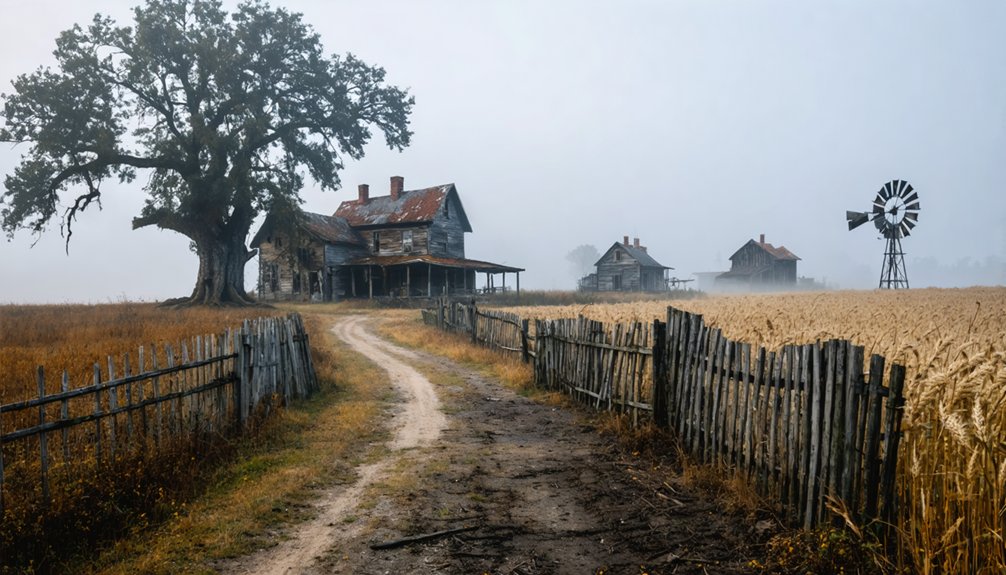
Abandoned ghost towns harbor unique acoustic phenomena beyond visual decay. You’ll encounter wind-generated harmonics through deteriorating structures, dormant machinery producing haunting resonances, and the psychological impact of ultra-quiet environments below 38 dBA. These soundscapes activate powerful emotional and memory responses by directly stimulating your amygdala and hippocampus. Modern documentation efforts now preserve these ephemeral acoustic artifacts, revealing historical narratives invisible to the eye. The whispers of these forgotten places await your attentive ear.
Key Takeaways
- Wind turbulence creates haunting echoes in decaying structures, transforming ordinary breezes into eerily musical sounds.
- Metal structures in abandoned towns produce deep groans from temperature fluctuations, while water droplets create rhythmic percussion.
- Absence of ambient noise amplifies remaining sounds, enhancing fear responses and triggering emotional reactions.
- High-fidelity recording equipment captures ephemeral sounds from structural settling to wildlife interactions across seasonal variations.
- Original sounds like creaking wood and wind whispers reflect historical authenticity, telling stories beyond visual observation.
The Silent Epidemic: Mapping America’s Ghost Town Landscape

While the American landscape evokes images of thriving metropolises and bustling small towns, a silent epidemic of abandonment has been steadily reshaping the nation’s geography.
You’ll find over 4,530 ghost towns scattered across every state, with Texas leading at approximately 550. These aren’t merely historical curiosities but represent significant shifts in American ghost town demographics.
The causes reveal complex economic vulnerabilities: mining operations dried up, Dust Bowl conditions devastated farming communities, and oil booms eventually busted. These abandoned locations come in various classifications including barren and neglected towns with few remaining structures.
Even today, cities like St. Louis and New Orleans face population declines exceeding 5%, with retail vacancy rates soaring 35% above average. Baton Rouge stands out with the second-highest homeowner vacancy rate at 1.5% among potential ghost towns.
These abandoned places persist as physical repositories of cultural heritage, their vacant buildings and empty streets testifying to boom-and-bust cycles that continue to transform American communities.
When the Winds Whisper: Natural Acoustics of Abandoned Settlements
Beyond the visual tableau of abandoned towns lies an equally compelling phenomenon: their distinctive soundscapes.
You’ll experience how wind turbulence interacts with decaying structures, creating haunting echoes that reverberate through empty spaces. Nature’s symphony emerges through the acoustic resonance of broken windows and hollow pipes, amplified by the absence of human noise.
As you wander these rural soundscapes, you’ll notice how architectural remnants produce ghostly harmonies when air currents flow through them. The relative silence of these areas allows listeners to perceive subtle sounds that would normally be masked by anthropogenic noise from urban environments. Research indicates that environments with sound levels below 38 dBA provide significantly enhanced visitor experiences compared to noisier settings.
Environmental acoustics shift with temperature and humidity, while sound reflections bounce between collapsed walls, creating acoustic interference patterns.
These abandoned acoustics aren’t random noise—they’re complex interactions between wind, structure, and landscape that transform ordinary breeze into something eerily musical, a voice that speaks of time’s passage.
Echoes of Industry: Mechanical Sounds That Linger After Humans Leave
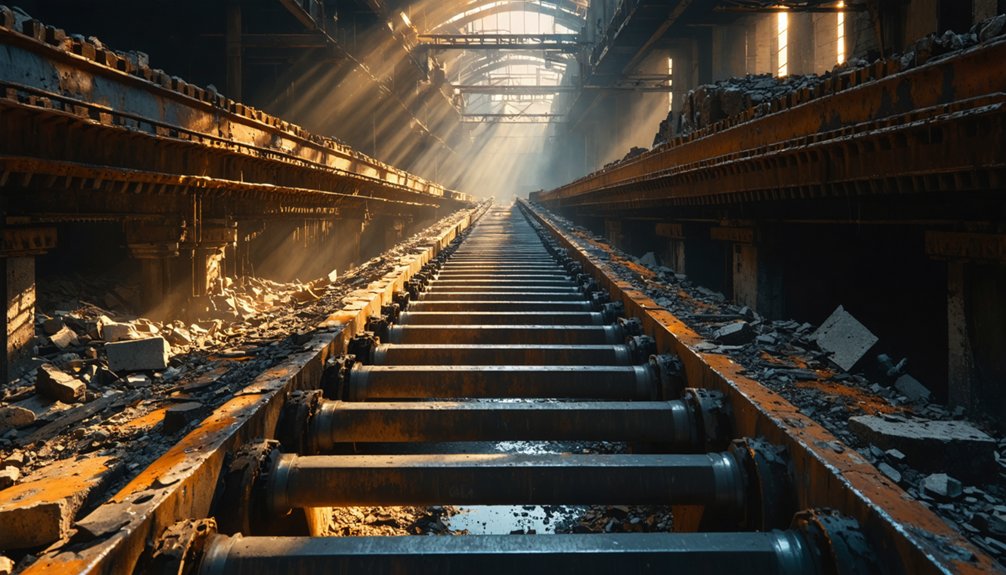
Abandoned industrial landscapes resonate with the persistent mechanical voices of dormant machines and deteriorating infrastructure. When you explore these forgotten territories, you’ll encounter a unique form of auditory decay—metal structures expanding and contracting with temperature fluctuations, producing deep groans that echo through empty halls.
The mechanical resonance of these spaces creates an acoustic signature distinct from natural environments.
Industrial decay speaks in frequencies unknown to forest or field—metal memories resonating through manufactured canyons.
- Wind transforms ventilation systems into eerie musical instruments, generating haunting tones through rusted ducts.
- Water infiltration establishes rhythmic patterns as droplets strike metal surfaces, creating unpredictable percussion.
- Residual electrical systems occasionally manifest low-frequency hums, suggesting persistent energy despite abandonment.
These acoustic phenomena warrant methodical skepticism—are they merely physical processes, or do they represent something more profound?
The soundscape invites interpretation beyond conventional scientific understanding, offering liberation from ordinary auditory experiences.
The Psychological Impact of Ghost Town Soundscapes
You’ll notice how the absence of ambient noise in abandoned towns paradoxically amplifies remaining sounds, creating a psychological environment where fear responses intensify.
Your brain processes these isolated acoustic signals differently, connecting them to episodic memories that might trigger unexpected emotional reactions in these desolate settings.
The unique acoustics of ghost towns—characterized by echoes, amplified natural sounds, and mysterious sources—directly stimulate your autonomic nervous system, potentially inducing anxiety even when you cognitively recognize no actual threat exists. This psychological phenomenon mirrors techniques used in horror films where sound as storytelling evokes primal fear through carefully crafted audio cues that bypass rational thought.
Silence Amplifies Fear
Stillness pervades the forgotten corridors of ghost towns, creating not merely an absence of sound but an active psychological force that transforms the human mind. Within this auditory isolation, your brain switches to alert mode—the missing ambient sounds of human habitation register as fundamentally wrong.
Your nervous system, designed to interpret soundscapes as safety indicators, perceives this psychological disorientation as an immediate threat.
- The contrast between expected human acoustics and profound silence triggers hypervigilance
- Minor sounds become amplified, paradoxically intensifying your anxiety response
- The “charged emptiness” forces uncomfortable introspection about abandonment and mortality
This silence functions as an affective environment that eliminates essential communication pathways. Without the rhythm of life’s acoustic markers, you become acutely aware of your vulnerability—the void not only watches but listens for your disruption of its perfect stillness. The absence of human presence activates inherent survival instincts that evolved to protect us from dangerous environments. These abandoned spaces create powerful affective atmospheres that provoke deep existential reflection about our place in the world and the impermanence of human creation.
Sounds Trigger Memories
In the labyrinthine corridors of human memory, sounds act as powerful catalysts that resurrect dormant recollections, particularly within ghost towns where acoustic fragments linger as psychological artifacts.
You’ll find that creaking floorboards or distant wind whistles function as potent memory triggers, bypassing your logical defenses to activate emotional centers directly. These auditory stimuli evoke more intense recall than visual cues, often distorting your perception of past experiences. The direct connection between sound and the amygdala and hippocampus creates a neurological pathway that makes ghost town sounds particularly effective at unlocking forgotten memories.
Ghost town soundscapes amplify this phenomenon—the rustling leaves or settling foundations might trigger unexpected waves of auditory nostalgia or even trauma.
Notice how your brain engages more regions when processing these sounds than with visual stimuli, potentially resurrecting somatic memories complete with physical sensations. This explains why abandoned locations feel psychologically charged; their acoustic elements directly manipulate your memory architecture, sometimes resurrecting more trauma than actually occurred.
Anxiety Through Acoustics
While visually striking, ghost towns harbor a more insidious threat through their unique acoustic environments that systematically undermine psychological stability. Your brain’s auditory perception mechanisms become compromised in these settings, where ambient soundscapes trigger your amygdala’s fear response. Research shows that special sound frequencies can intensify these eerie sensations and psychological effects. The unpredictable creaks, hollow echoes, and wind whistles constitute potent anxiety triggers that activate primitive vigilance circuits.
- Low-frequency drones from structural decay prime your nervous system for perceived threats
- Auditory pareidolia transforms ambiguous sounds into illusory human activity
- The “sonic void” creates sensory deprivation comparable to isolation experiments
You’re experiencing a scientifically documented phenomenon—the absence of normal environmental sounds creates cognitive dissonance, forcing your mind to fill acoustic gaps. This process, coupled with visual decay cues, generates a feedback loop of heightened alertness and psychological distress that persists until you escape the environment. With access to over 500,000 sound effects in dedicated libraries, researchers can now authentically recreate and study these psychological phenomena in controlled settings.
Listening for History: What Sound Tells Us About Abandoned Communities
When you listen carefully to ghost towns, you’ll notice acoustic remnants that chronicle the arc from bustling prosperity to abandonment through machinery echoes and structural deteriorations.
Changes in the sonic environment—where human-generated sounds have yielded to nature’s soundtrack of wildlife, vegetation, and weather patterns—mark the transformation of these once-vibrant spaces.
These acoustic clues reveal not just the physical decline of communities but also capture their cultural extinction, as the soundscape shifts from the rhythmic cadence of industry and social interaction to the irregular, unorchestrated noises of desertion.
Echoes of Past Prosperity
The abandoned structures of former mining communities don’t merely stand as silent monuments to economic collapse; they function as acoustic vessels that preserve and transmit historical narratives through their unique soundscapes.
When you walk through towns like Jerome or Bodie, you’ll encounter acoustic nostalgia in the hollow resonance of deteriorated buildings where wind creates melodies through broken windows and doorframes.
- The rhythmic industrial resonance of pickaxes and machinery once defined these settlements’ sonic identity, marking time and prosperity.
- Railroad whistles served as auditory landmarks, their absence now highlighting the temporal disconnect of these spaces.
- Religious structures with their bell towers created sacred acoustic boundaries that ordered community life.
These acoustic elements aren’t merely ambient features—they’re epistemological tools for understanding how prosperity shaped communal experience before abandonment transformed these settlements into acoustic archeological sites.
Acoustic Environmental Changes
Soundscapes transform into historical artifacts when communities collapse, offering archaeological evidence as compelling as any physical remnant.
When you walk through abandoned villages, you’re experiencing acoustic nostalgia—the absence of once-prevalent bicycle bells and factory hooters that structured daily rhythms until around 1980.
These industrial echoes, though often considered harsh by residents, became integral to community identity. Their disappearance created acoustic voids that fundamentally altered environmental experience.
The transformation isn’t merely aesthetic—it documents societal change as transportation shifted from human-powered to mechanical modes.
Today’s protected rural areas, where anthropogenic noise has doubled background sound levels in 63% of U.S. protected spaces, tell a different story.
Topography still shapes how sound travels, creating distinctive acoustic profiles that vary with landscape features, preserving fragments of history in the quietude of abandoned spaces.
Sonic Clues Reveal Decline
Listening carefully to abandoned settlements reveals how sonic environments chronicle community collapse more precisely than visual indicators alone.
When you attune your senses to a ghost town’s auditory landscape, you’re tracking sonic decay through time—the cessation of industrial clangs, the disappearance of market chatter, the hollow echoes replacing vibrant community sounds.
These acoustic shifts manifest in measurable patterns:
- Sudden silence following catastrophic events forcing rapid evacuation
- Gradual diminishing of human-generated noise as populations dwindle
- Replacement of mechanical sounds with natural environmental acoustics
This auditory nostalgia isn’t merely evocative; it’s empirically valuable.
The resonant church bells and factory whistles that outlast human presence become acoustic anchors for historical memory, allowing researchers to pinpoint precise moments of economic and demographic decline through careful analysis of sound’s absence rather than its presence.
Ghost Towns as Living Museums: Preservation of Authentic Acoustics
Preserving a ghost town’s authentic acoustics presents a unique intersection of historical conservation and sensory heritage that transcends traditional museum practices.
When you visit these sites maintained through “arrested decay” philosophies, you’re experiencing historical resonance in its most literal form—original wood creaking underfoot, wind whispering through broken windowpanes exactly as it did a century ago.
Acoustic preservation captures dimensions of history impossible to replicate through visual means alone.
You’ll notice how local historical societies and state parks carefully limit modern infrastructure to maintain these soundscapes as cultural artifacts. The subtle sonic differences between decaying materials tell stories that visual observation cannot—each creak, echo, and ambient sound forming an auditory time capsule.
These preservation efforts transform abandoned settlements from mere relics into immersive environments where you can truly hear history breathing.
Capturing the Unseen: Audio Documentation Projects in Deserted Towns

In the silent expanse of America’s forgotten settlements, audio documentation projects have emerged as essential archaeological tools that capture ephemeral dimensions of history conventional preservation methods can’t record.
You’re witnessing a revolutionary approach to cultural heritage preservation through audio technology that reveals historical soundscapes previously lost to time. Using sophisticated recording techniques, researchers document rural acoustics across seasonal variations, creating temporal maps of environmental soundscapes.
- High-fidelity equipment captures frequencies from subsonic structural settling to ultrasonic wildlife signals
- Acoustic analysis of building materials reveals distinct resonance patterns in deteriorating structures
- Multi-format digital archiving guarantees sound preservation as technology evolves
This methodical acoustic analysis transforms our understanding of ghost towns, challenging traditional visual documentation by preserving the invisible yet profoundly evocative dimensions of these abandoned spaces.
Every creaking floorboard contains historical truths awaiting your discovery.
The Tourism Experience: How Sound Shapes Visitor Perceptions
When you step into the weathered remnants of America’s ghost towns, sound becomes the invisible curator of your experience, shaping perceptions more profoundly than visual artifacts ever could. Ghostly echoes of footsteps against wooden floorboards mark boundaries between life and abandonment, while the absence of modern noise creates space for your imagination to flourish.
As you wander further, the stories of the ghost towns of the civil war come alive in whispers of the past, each building a silent storyteller of battles fought and lives altered. The dirt paths that once bustled with soldiers’ boots now beckon the curious and the nostalgic, inviting you to reflect on the sacrifices and resilience embedded in these forsaken places. Here, time feels suspended, allowing you to connect with a history that continues to resonate even in silence.
You’ll notice your senses heightening—catching subtle creaks of dilapidated structures and distant bird calls that contrast with prevailing silence. This auditory nostalgia drives deeper emotional connections to place than visual elements alone.
Historical narratives gain dimension when accompanied by sound recreations, making the past tangible rather than theoretical. The economic implications are significant: these authentic soundscapes differentiate ghost towns from manufactured experiences, encouraging longer stays and deeper engagement with these fragile rural economies.
Frequently Asked Questions
Can Ghost Town Sounds Be Recorded With Standard Equipment?
Like capturing whispers in a windstorm, you can record ghost town sounds with standard equipment, though audio fidelity varies. Strategic microphone placement and post-processing greatly enhance your sound recording results despite technical limitations.
Are Certain Weather Conditions Better for Hearing Ghost Town Sounds?
Yes, you’ll detect superior sound clarity during temperature inversions, high humidity, and light precipitation. These weather effects enhance sound propagation while minimizing background interference—creating ideal conditions for capturing subtle acoustic anomalies.
Do Abandoned Buildings Produce Different Sounds Based on Their Materials?
You’re barking up the right tree. Different building materials create unique material resonance patterns and sound decay rates—concrete absorbs more low frequencies while textile layers affect mid-to-high frequencies in abandoned structures.
How Do Indigenous Histories Influence Ghost Town Sound Interpretations?
You’ll find indigenous beliefs reframe sounds you perceive, challenging settler-colonial historical narratives. Wind through abandoned structures carries layered meanings when you understand whose land these ghost towns originally occupied.
Can Soundscapes Help Authenticate Paranormal Phenomena in Ghost Towns?
You’ll find sound perception infinitely complicates authentication—while audio analysis might identify anomalies in ghost town soundscapes, these can’t definitively prove paranormal origins against the overwhelming influence of psychological interpretation and environmental factors.
References
- https://www.islands.com/2003205/state-with-most-abandoned-ghost-towns-texas/
- https://devblog.batchgeo.com/ghost-towns/
- https://www.loveexploring.com/gallerylist/188219/the-us-state-with-the-most-ghost-towns-revealed
- https://www.youtube.com/watch?v=UujbImwiLfA
- https://www.geotab.com/ghost-towns/
- https://en.wikipedia.org/wiki/Lists_of_ghost_towns_in_the_United_States
- https://247wallst.com/special-report/2020/12/08/30-american-ghost-towns-6/
- https://www.yardi.com/blog/news/abandoned-america/38780.html
- https://themortgagepoint.com/2024/10/25/americas-new-ghost-towns/
- https://247wallst.com/housing/2024/04/11/americas-modern-ghost-towns-2/