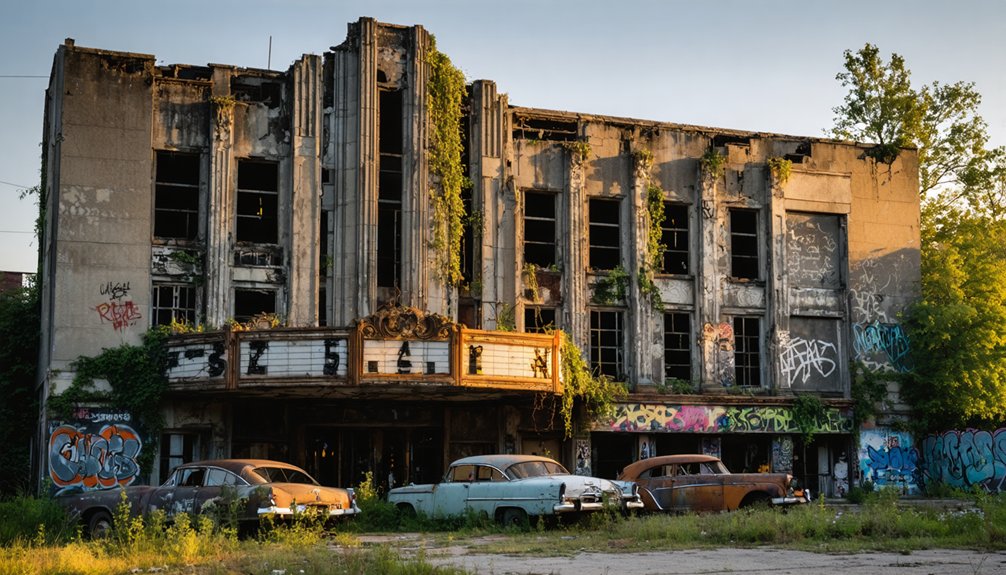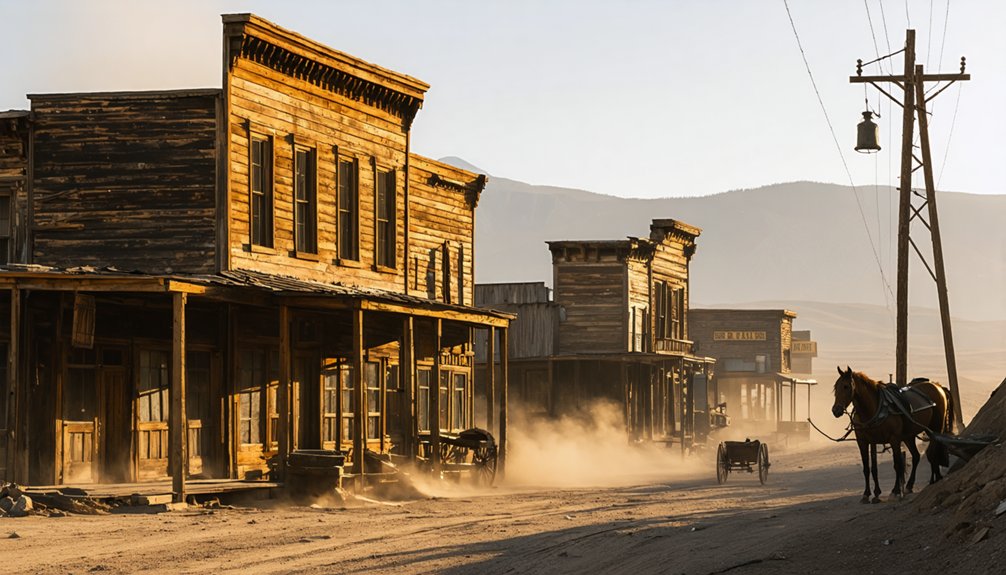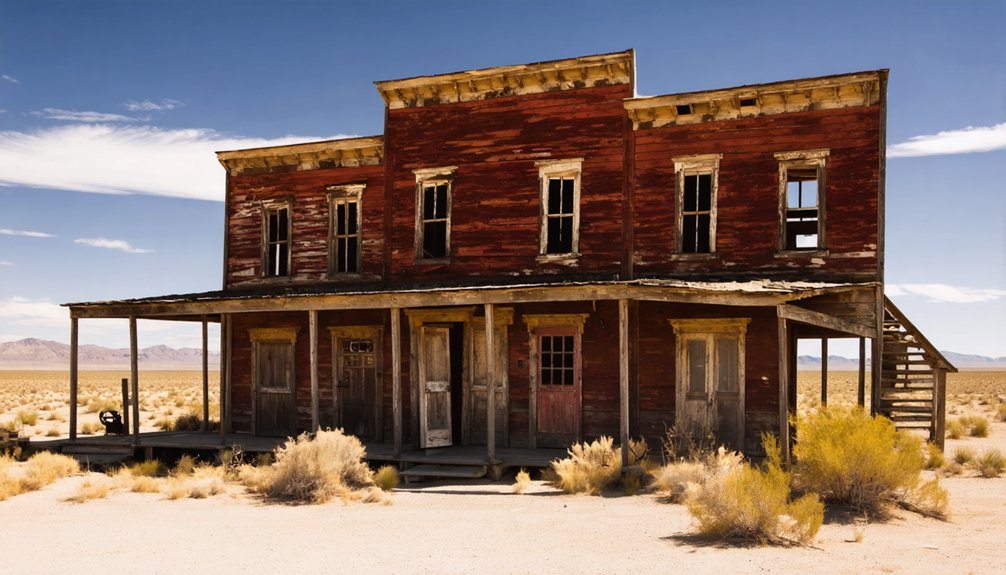
Ghost towns tell stories of abandoned communities shaped by economic booms, resource depletion, and environmental disasters. You’ll find these settlements marked by deteriorating structures that once housed thriving populations during gold rushes or industrial periods. Natural catastrophes like floods and toxic contamination have also forced communities to relocate, leaving behind haunting remnants. From Bodie’s “arrested decay” to Centralia’s underground fires, these forsaken places reveal humanity’s vulnerability to changing fortunes and nature’s power.
Key Takeaways
- Ghost towns emerge through boom-bust cycles of resource extraction, with most originating during 19th-century mineral rushes.
- Abandoned structures reveal economic and social history, showing rapid community formation followed by precipitous decline.
- Environmental factors like resource depletion, natural disasters, and toxic contamination frequently cause community abandonment.
- Notable sites like Bodie, California and Centralia, Pennsylvania preserve different stages of decay and abandonment.
- Modern ghost towns continue to form due to economic shifts, urban decay, and changing work patterns.
What Defines a Ghost Town: Beyond Empty Buildings

While many people imagine tumbleweeds rolling through dusty, abandoned streets when they hear “ghost town,” the definition extends far beyond this classic Western image. A ghost town doesn’t necessarily need to be completely deserted—some maintain skeleton populations or seasonal inhabitants while others are truly empty.
What truly defines these places is their loss of original purpose and economic viability. As T. Lindsey Baker aptly expressed, a ghost town exists when the reason for being no longer exists. You’ll find architectural remnants varying from intact structures to mere foundations, each telling stories of sudden abandonment or gradual decline.
These sites hold tremendous cultural significance as physical evidence of historical shifts, whether caused by economic collapse, natural disasters, war, or infrastructure changes. Abandoned buildings often evoke an uncanny feeling due to their history as former homes and gathering places.
The debate continues about whether a place must be entirely abandoned to qualify, but what’s undeniable is that ghost towns represent the vulnerability of human settlements when their reason for existence disappears.
Economic Booms and Busts: The Life Cycle of Resource Towns
You’ll find that most ghost towns began as boomtowns, rapidly expanding when valuable resources like gold, silver, or coal were discovered nearby.
As these resources were extracted and eventually depleted, the economic foundation that supported these communities crumbled, leading to mass exodus of workers and businesses.
This boom-bust pattern repeats throughout history, leaving behind abandoned structures as silent testimonies to the volatile lifecycle of resource-dependent settlements. Communities that fail to diversify their economic profile beyond a single sector often face long-term harm when the initial boom subsides. Julian exemplifies this cycle, as its growth was curtailed when limited gold reserves in the Cuyamacas couldn’t sustain long-term development.
Mining Rushes Ignite Communities
When mineral discoveries ignited the American West in the 19th century, they triggered explosive population movements that transformed empty landscapes into bustling communities virtually overnight.
These mining migrations brought waves of fortune-seekers—often unskilled, low-income individuals attracted by the accessibility of placer mining techniques.
You’d find economic ecosystems rapidly forming around these discoveries. While miners frequently moved from strike to strike, merchants and service providers established more lasting presences.
Towns materialized with remarkable speed, developing their own governance systems and property rights. Infrastructure followed as roads, railroads, and telegraph lines connected these remote outposts to civilization.
The California Gold Rush alone caused San Francisco’s population to surge from approximately 1,000 in 1848 to 25,000 by 1850, with miners living in makeshift tents and shanties throughout the region.
The Treaty of Guadalupe Hidalgo in 1848 made California part of the United States, creating a legal framework for the mining boom that followed.
Community resilience varied dramatically. Some settlements, like Denver and Sacramento, diversified and thrived beyond their mining origins.
Most, however, couldn’t survive the inevitable bust when deposits dwindled, becoming the abandoned ghost towns that dot the Western landscape today.
Depleted Resources Doom Towns
The economic prosperity of mining towns often contained the seeds of its own destruction. When resources run dry, these communities face a stark reality that highlights the importance of sustainable resource management.
The decline typically follows four predictable phases:
- Resource depletion – As minerals diminish, mining operations become economically unviable.
- Job losses – Without alternative industries, unemployment soars, affecting 11 million people near coal projects alone.
- Population exodus – Residents flee, leaving buildings vacant and deteriorating.
- Environmental deterioration – Nearly 39,000 abandoned mines in the US continue leaching toxins into soil and water.
Towns within reach of urban centers occasionally find new life through urban revitalization efforts, transforming into tourist destinations.
Most, however, fall into the “valley of death” – economic recession with no escape route, becoming the ghost towns you’ll find scattered across the landscape. Research shows that poorly planned mine closures can trigger social disintegration and community resentment and populism. This pattern has repeated since Neolithic times, when humans first began extracting minerals from the earth.
Boom-Bust Economic Patterns
Resource towns have historically followed predictable economic patterns that mirror the dramatic rise and fall of a roller coaster.
You’ll find these communities first experience explosive growth when valuable resources like oil, coal, or minerals are discovered. As word spreads, workers flood in, creating instant demand for housing and services. Tax revenues surge, land values skyrocket, and economic cycles accelerate.
You’re witnessing a town transformed overnight—buildings rise, businesses multiply, and prosperity seems unlimited.
But when resources deplete or prices collapse, the bust arrives with devastating swiftness. Jobs vanish, populations flee, and once-thriving communities hollow out. Property values plummet while infrastructure costs remain. The migratory nature of coal, oil, and gas workers creates a transient population that leaves when economic opportunities dry up, further destabilizing the social support systems that communities rely on.
Community resilience is severely tested during these downturns. Many towns never recover, becoming shells of their former selves—monuments to the inherent volatility of resource-dependent economies. Historically, these communities have struggled to develop economic diversity that might protect them from future busts.
Natural Disasters and Environmental Catastrophes
When you study ghost towns, you’ll find natural disasters have repeatedly transformed thriving communities into abandoned ruins through catastrophic events.
You can trace how wildfires have completely erased wooden settlements, while floods forced mass evacuations that became permanent as communities like Valmeyer and Burrwood surrendered to rising waters.
Beyond these acute disasters, towns have also been permanently evacuated due to toxic contamination, creating ghost towns where environmental hazards replaced human activity.
Fires That Erased Communities
Devastating wildfires have repeatedly transformed thriving communities into ghost towns throughout American history, leaving behind only skeletal remnants of once-bustling settlements.
The fire aftermath often reveals the harsh reality of nature’s power to erase human presence, as seen in places like Greenville, California, which suffered multiple destructive blazes 140 years apart.
When wildfire strikes, you’ll witness:
- Wooden structures consumed completely, with only brick chimneys and metal fixtures remaining
- Rapid evacuation followed by permanent abandonment as infrastructure crumbles
- Economic collapse as natural resources and businesses are destroyed
- Landscape transformation that prevents rebuilding and sustainable reoccupation
Despite occasional displays of community resilience, the combination of drought, high winds, challenging topography, and climate change has made many fire-ravaged towns impossible to resurrect, preserving them as historical ghost towns.
Floods and Population Exodus
Floodwaters have silently claimed countless communities throughout history, creating ghost towns as effectively as the fires that consume wooden settlements.
You’ll find evidence in places like Valmeyer, Illinois, which relocated after the Great Flood of 1993, and Vunidogoloa, Fiji, forced to move inland in 2014 due to rising seas and storm surges.
Some towns attempted flood mitigation strategies before surrendering. Foss, Oklahoma moved uphill after the 1902 flood killed nine people, yet its population still declined dramatically.
Others, like Harrisburg, Utah, were abandoned after repeated flooding and drought made life unsustainable.
Today’s climate resilience planning learns from these ghost towns. Modern relocations, such as Vunidogoloa’s carefully planned exodus, demonstrate how communities can adapt rather than simply disappear beneath the rising waters.
Toxic Contamination Evacuations
Unlike abandoned gold mines or flood-ravaged settlements, towns emptied by toxic contamination stand as sobering monuments to industrial negligence and environmental disaster.
Two stark examples illustrate the devastating impact of toxic exposure on American communities:
- Picher, Oklahoma – Once a thriving lead and zinc mining hub that produced $20 billion in ore, now a wasteland of chat piles laced with heavy metals that poisoned generations of children.
- Times Beach, Missouri – Evacuated in 1983 after dioxin levels reached 300 times safety limits from contaminated oil sprayed on roads.
- Both communities – Permanently relocated their residents after environmental justice efforts revealed the true extent of contamination.
- Long-term legacies – Include superfund designations, massive cleanup operations, and sobering reminders of industrial activities’ hidden costs.
Preserved in Time: Notable Ghost Towns Across America
America’s landscape is dotted with haunting remnants of once-thriving communities that now stand frozen in time.
From Bodie, California, with its 200 buildings in “arrested decay” to St. Elmo, Colorado, arguably the West’s best-preserved ghost town, these abandoned settlements offer windows into our past.
You’ll find remarkable diversity in these historical preservation sites.
Centralia, Pennsylvania continues burning underground since 1962, with eerie smoke rising from ground cracks.
Batsto Village, New Jersey showcases cultural significance through its Revolutionary War-era iron works.
Meanwhile, Terlingua, Texas has transformed from an abandoned mercury mining town into a tourist destination near Big Bend National Park.
Each ghost town tells a unique story of boom, bust, and the freedom-seeking pioneers who once called these places home.
Global Abandonment: Ghost Towns Around the World
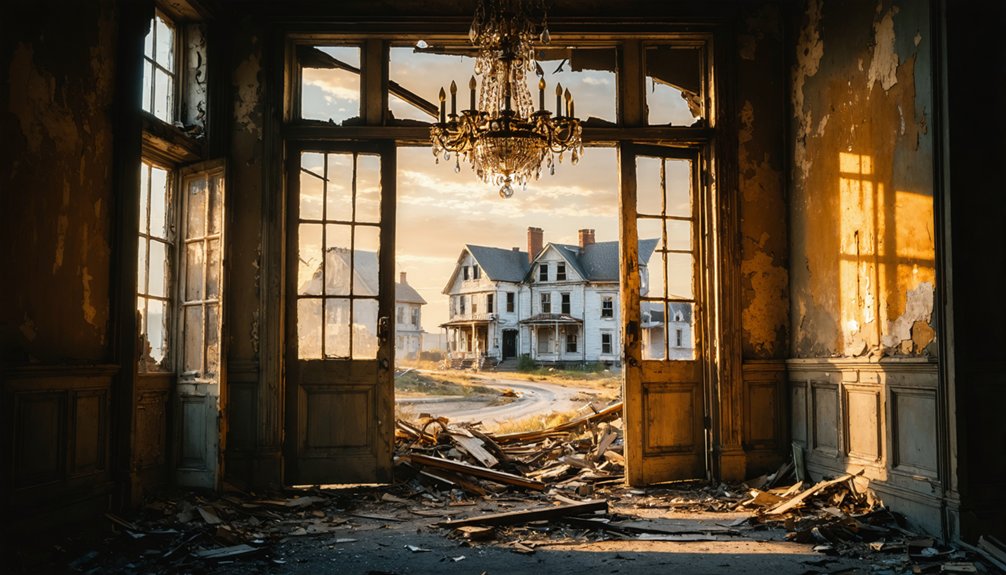
While ghost towns in America provide fascinating glimpses into the nation’s past, abandonment isn’t uniquely American—it’s a global phenomenon with countless stories of desertion across continents.
Around the world, you’ll find communities frozen in time due to:
- Violent conflict – Central African Republic villages like Goroumo sit empty from armed struggles, while Oradour-sur-Glane remains a war memorial in France.
- Resource depletion – Namibia’s Kolmanskop and Japan’s Hashima Island flourished with mining wealth before economic collapse.
- Environmental disasters – Pripyat’s evacuation after Chernobyl and Centralia’s underground fire demonstrate nature’s power.
- Political upheaval – Varosha in Cyprus and Kantubek in Uzbekistan represent Cold War casualties.
These sites hold immense cultural significance and tourism potential, attracting visitors seeking connections to authentic histories that transcend borders.
Modern Ghost Towns: The Continuing Phenomenon
The phenomenon of ghost towns persists into the modern era, with contemporary abandonment reflecting complex economic and demographic shifts rather than simple resource depletion.
Ghost towns today emerge from intricate socioeconomic patterns, not merely exhausted resources as in bygone eras.
You’ll find urban decay manifesting dramatically in cities like San Francisco, which lost 7.4% of its population from 2020-2023, and St. Louis, where retail vacancy rates exceed the national average by 35%.
Population shifts now create modern ghost towns in surprising places. ZIP codes in Toledo and Montgomery face vacancy rates approaching 20%, while formerly prosperous areas see building permits plummet.
Remote work has permanently altered where 30-35% of office workers live, driving migration from expensive urban cores.
Unlike historical ghost towns, today’s abandoned areas often exist within otherwise functioning regions—neighborhoods emptied by foreclosures, infrastructure loss, and economic stagnation while nearby suburbs continue growing.
Frequently Asked Questions
Can You Legally Explore or Live in Abandoned Ghost Towns?
You can’t legally explore ghost towns without permission or reside in them. Legal exploration requires owner consent, while ghost town residency demands ownership or authorization from proper authorities.
What Items of Value Are Commonly Left Behind in Ghost Towns?
Over 60% of ghost towns contain vintage artifacts like rare coins, bottles, and gold nuggets. You’ll find hidden treasures including jewelry, mining equipment, and everyday items preserved by time’s passage.
historical discoveries in abandoned towns can offer fascinating insights into past lifestyles and cultures. Exploring these remnants often reveals stories of hardship and triumph that shaped the communities. Each artifact found adds a layer to our understanding of history and the people who once thrived in these now desolate places.
How Do Ghost Towns Differ Culturally Across Different Continents?
You’ll find North American ghost towns reflect mining booms, while Asia’s showcase failed urban planning. Europe’s abandoned sites preserve medieval architecture, each region revealing distinct cultural significance through their architectural styles and socioeconomic contexts.
Are There Ghost Towns Underwater or Submerged by Reservoirs?
Yes, you’ll find numerous ghost towns submerged beneath reservoirs created by dam projects. Underwater archaeology reveals these submerged cities during droughts, with examples like Old Bluffton and Elbowoods still existing below the surface.
How Do Indigenous Communities View Ghost Towns on Their Ancestral Lands?
Over 90% of Indigenous communities view ghost towns as sites of both cultural significance and historical trauma. You’ll find they consider these places sacred, preserving ancestral connections while teaching younger generations about displacement histories.
References
- https://en.wikipedia.org/wiki/Ghost_town
- https://www.geotab.com/ghost-towns/
- https://www.christywanders.com/2024/08/top-ghost-towns-for-history-buffs.html
- https://artsandculture.google.com/story/7-ghost-towns-on-route-66-national-trust-for-historic-preservation/YAVR-Hg8Tq4gdg?hl=en
- https://www.legendsofamerica.com/gt-hiddentales/
- https://www.legendsofamerica.com/gt-emergingghosttowns/
- https://www.youtube.com/watch?v=dcc8nDh2N34&vl=en
- https://www.atlasobscura.com/lists/americas-best-preserved-ghost-towns
- https://en.wikivoyage.org/wiki/Ghost_towns
- https://www.britannica.com/topic/ghost-town