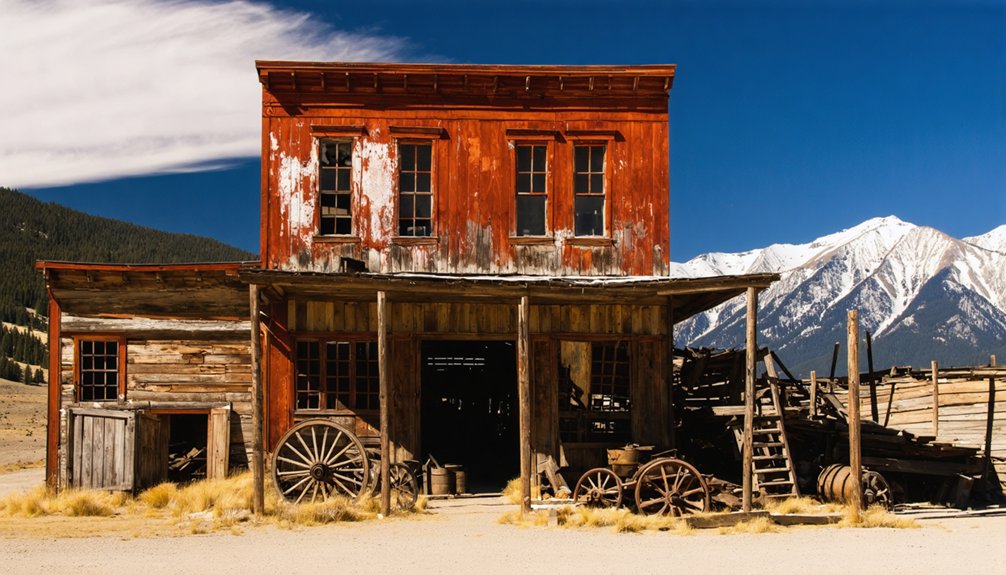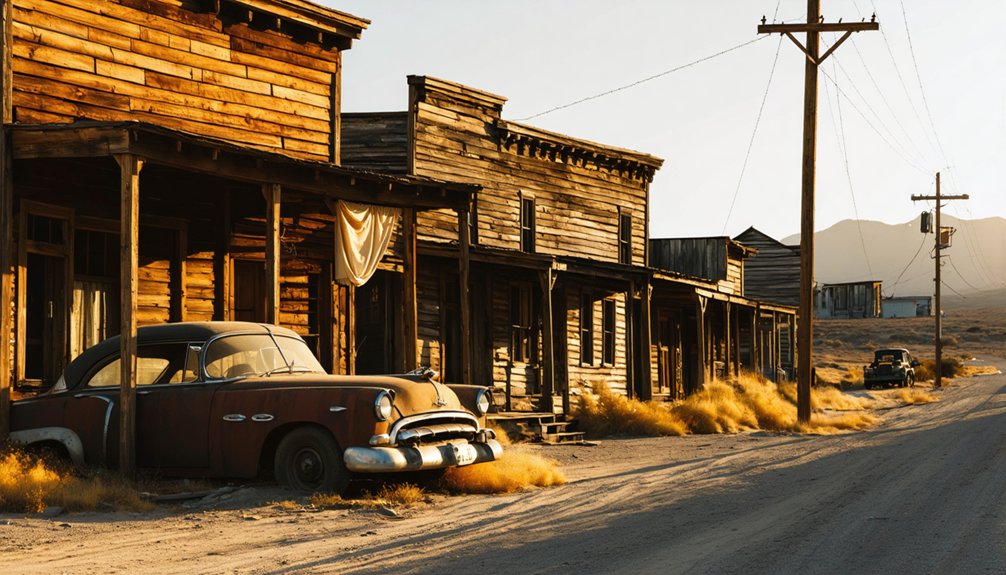
When you explore Wild West mining towns, you’ll witness the dramatic boom-and-bust cycle that transformed America’s frontier after 1848. Gold and silver discoveries sparked explosive population growth, with settlements like Victoria expanding from 500 to 20,000 residents in months. These communities evolved from tent cities to structured towns with distinct social hierarchies. Behind today’s ghost towns lies a complex legacy of wealth creation, environmental damage, and cultural patterns that continue to shape western identity.
Key Takeaways
- Gold and silver discoveries triggered rapid population growth, transforming small settlements into bustling towns within months during the mid-19th century.
- Mining towns evolved from tent cities to structured communities with hotels, saloons, and civic buildings as populations stabilized.
- Ethnic stratification characterized mining communities, with immigrants performing demanding labor while women transformed male-dominated camps into functional towns.
- The boom-bust cycle defined mining settlements, creating instant wealth for some while leaving ghost towns when resources depleted.
- Mining operations left lasting environmental scars, including contaminated water sources and toxic tailings that continue to affect community health today.
The Gold Rush Phenomenon: How Mining Towns Were Born

When gold was discovered in western North America during the mid-19th century, it triggered a series of rapid and transformative demographic shifts that would forever alter the region’s landscape. You’d have witnessed settlements like Victoria exploding from 500 to 20,000 inhabitants in mere months during the 1858 Fraser River rush, demonstrating the gold rush impacts on population movement.
Mining town dynamics evolved quickly from informal tent cities at arrival points to structured communities. Places like Barkerville grew around Williams Creek’s 1861 discoveries, while others evolved from ferry points like Galbraith’s Ferry (later Fort Steele). Yale, once a small outpost, became the largest town north of San Francisco during its peak with approximately 16,000 residents.
These settlements rapidly developed essential infrastructure—hotels, saloons, schools—as they transformed from transient camps to economic hubs. The economic magnitude was staggering, with gold rush peaks yielding over $80 million by 1852, funding further development and migration. Governor James Douglas helped maintain relative stability in these booming towns by constructing a 650-km road from Yale to the Cariboo Mountains.
From Tent Cities to Boomtowns: The Evolution of Mining Settlements
Though initially ephemeral in nature, the mining settlements of the Wild West evolved through distinct developmental phases that reflected their economic viability and population stability.
The tent city origins began with hastily constructed canvas shelters housing hundreds to thousands of prospectors gathered near promising claims. These makeshift communities offered minimal infrastructure but maintained proximity to mineral deposits. The California Gold Rush of 1848 served as the primary catalyst for growth that established this pattern of development throughout the western frontier.
As discoveries proved lucrative, you’d witness the remarkable transformation into established boomtown characteristics—wooden structures replacing tents, civic buildings emerging, and population spikes reaching thousands. These towns often became centers for gambling and brothels, reflecting their lawless nature during the height of mining operations.
Greenwater Valley exemplifies this rapid growth, expanding to over 2,000 residents with 73 mining companies within just one year. The economic landscape diversified beyond extraction to include trade, hospitality, and transportation, while immigrant workers from England, China, and Eastern Europe brought cultural diversity to these evolving settlements that operated on precarious boom-and-bust cycles.
Striking It Rich: Famous Mining Discoveries That Changed the West
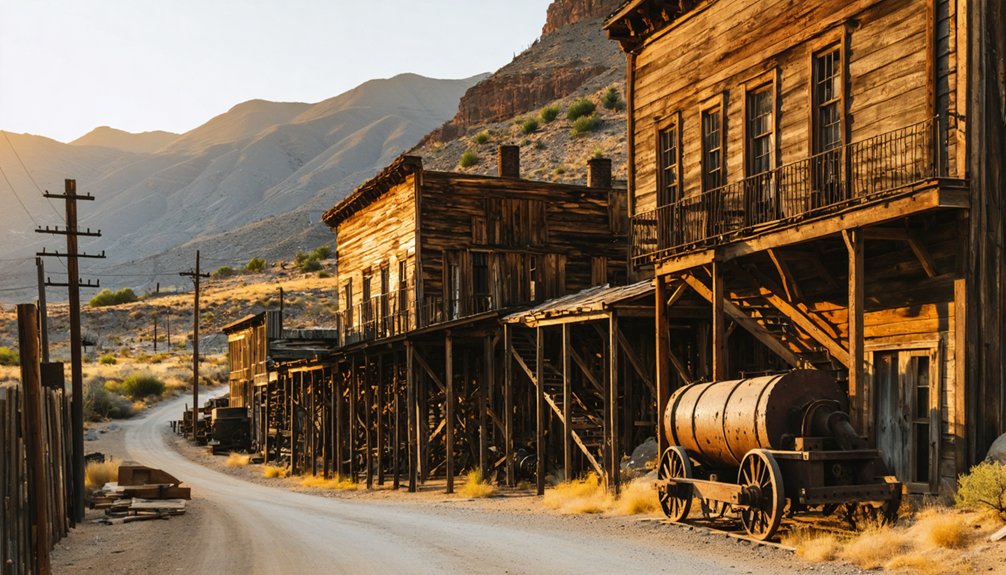
You’ll find that the West’s dramatic transformation began with James Marshall’s 1848 gold discovery at Sutter’s Mill, which triggered a migration wave that would permanently alter California’s demographic landscape.
The Comstock Lode’s massive silver deposits rivaled gold’s economic prominence by 1859, establishing Nevada’s mining significance and diversifying the mineral wealth powering western development.
These spectacular strikes created instant millionaires alongside countless disappointed prospectors, demonstrating the boom-to-bust pattern that would characterize western mining towns from Tombstone to Bodie throughout the latter half of the nineteenth century. Mining towns typically evolved from primitive tent camps to established communities as support services increased and populations stabilized. Before Marshall’s famous discovery, smaller gold finds were made by Francisco Lopez in 1842 at Rancho San Francisco, but these earlier discoveries attracted little attention compared to the subsequent rush.
Discovery Sparks Migration
The discovery of precious metals throughout the American West ignited one of history’s most transformative migrations, fundamentally altering the demographic, economic, and cultural landscape of a developing nation. When James Marshall found gold at Sutter’s Mill in 1848, you could witness the beginning of a movement that would bring 300,000 people to California within just a few years.
As a prospector, you’d likely start with simple prospecting tools like pans to sift river silt—placer mining required minimal equipment and offered independence. Just as websites collect data to enhance user experience, mining towns gathered information about new strikes through strictly necessary communication. The Comstock Lode discovery in Nevada in 1859 created another silver rush that saw Virginia City grow into a thriving community with over $500 million in precious metals extracted.
However, as surface deposits depleted, mining techniques evolved toward hard-rock extraction requiring greater capital investment. Chilean miners introduced influential tools like the batea and trapiche mill, enhancing extraction methods.
This evolution from individual prospecting to industrialized operations mirrors the West’s transformation from frontier to economic powerhouse.
Silver Rivals Gold
While gold initially captured public imagination during the westward expansion, silver discoveries across the American frontier ultimately rivaled—and in some regions surpassed—gold’s economic and social impact on the developing nation.
The 1859 Comstock Lode discovery marked the turning point, birthing sophisticated silver mining techniques that became industry standards. The introduction of square set timbering revolutionized underground mining safety and efficiency, allowing for extraction of previously inaccessible ore bodies. You’ll find the evidence in numerous “Silver Cities” that sprouted across Nevada, Idaho, New Mexico, and beyond.
Each boomtown reflected silver discovery impact through rapid urban development and economic diversification. Colorado’s Leadville and Utah’s Horn Silver Mine demonstrate how these deposits created commercial centers supporting entire regional economies. By 1879, the United States was producing half the world’s silver output, demonstrating its dominant position in the global precious metals market.
Unlike gold’s individualistic allure, silver mining employed larger populations and added value to broader territories. When the Sherman Silver Purchase Act’s repeal triggered the 1893 crash, these communities pivoted toward copper, displaying the resilience that defined the American West.
Boom-to-Bust Mining Tales
When James W. Marshall discovered gold at Sutter’s Mill in 1848, he unknowingly launched the most transformative mining boom in American history. This discovery spawned countless boomtown legends as 118 million troy ounces of gold were eventually extracted from California’s hills.
You’ll find similar patterns in mining folklore across the West—individual prospectors with simple tools making spectacular discoveries that quickly evolved into industrial operations. The Comstock Lode, Homestake Mine, and Butte’s copper deposits all followed this trajectory.
Initially thriving communities with hotels, saloons, and churches sprouted almost overnight. What began with lone panners in streambeds inevitably shifted to corporate-controlled operations requiring massive capital investment.
Places like Berlin and Goodsprings, Nevada demonstrate this boom-to-bust cycle, where once-prosperous towns emptied when deposits were exhausted or metal prices collapsed.
Life on the Mining Frontier: Society and Culture in Western Towns

As prospectors, entrepreneurs, and fortune-seekers flooded into Western mining territories throughout the 19th century, they created complex social landscapes that mirrored America’s broader cultural tensions and hierarchies.
You’d find distinct ethnic stratification in these communities, with British miners occupying managerial roles while immigrants from Italy, Eastern Europe, and Mexico performed backbreaking labor.
Community dynamics evolved as gender contributions transformed male-dominated camps into functioning towns—women established schools, churches, and civic organizations, fundamentally altering frontier life. The 9-to-1 male-to-female ratio gradually balanced as families arrived.
Despite company-sponsored amenities like sports teams and theaters, social divisions persisted. Churches and schools emerged as anchors of permanence, while company stores maintained economic control over workers.
These stratified communities reflected America’s contradictions—offering opportunity alongside rigid hierarchies that separated immigrants, minorities, and social classes.
The Economic Engine: How Mining Shaped Western Development
The economic trajectory of the American West can’t be understood without recognizing mining’s transformative role as the industrial catalyst that reshaped the region’s development patterns throughout the 19th and early 20th centuries.
You’ll find that mining discoveries triggered explosive boom-bust cycles that established settlement patterns still visible today. Mining technologies advanced rapidly, driving infrastructure development—particularly railroads—which integrated previously isolated territories into national markets.
Labor dynamics in these regions proved volatile, with workers migrating in response to wage fluctuations. While miners themselves often earned minimal returns, service sectors flourished.
The economic consequences extended beyond extraction, stimulating manufacturing, banking, and retail sectors. However, this dependency came at a cost, as mining counties later experienced sustained economic vulnerability, slower entrepreneurship growth, and challenges diversifying beyond resource extraction.
Diversity in the Diggings: Immigration and Ethnic Communities

If you’d traveled to Western mining towns in the 1800s, you’d have encountered a complex tapestry of immigrant communities, with Chinese districts like Central City’s Dostal Alley existing alongside European ethnic enclaves where workers maintained distinct cultural traditions.
British immigrants typically secured management positions while Chinese, Hispanic, and Eastern European laborers performed the grueling physical work, creating a socioeconomic hierarchy visibly reflected in the towns’ physical organization.
This ethnic stratification extended beyond labor to encompass all aspects of daily life, with religious divisions between Catholic and Protestant immigrants physically manifested in separate churches, further reinforcing the cultural boundaries that defined these diverse mining settlements.
International Mining Cultures
Mining towns across the American West reflected a surprisingly international character, transforming isolated frontier settlements into vibrant multicultural societies.
You’d find Chinese immigrants comprising nearly 30% of California’s Gold Rush population by 1852, while Central City, Colorado boasted significant Irish, Italian, and English communities among its 10,000 residents.
As miners flocked to California in search of wealth, many of them settled in the forgotten towns of california’s gold rush, where remnants of their dreams still linger today. These towns, once thriving with hopes and ambitions, are now shadowed by the passage of time, offering a glimpse into a vibrant past. Exploring these historic sites reveals not only the stories of those who sought fortune but also the diverse cultures that shaped the region.
These cross-cultural exchanges occurred within rigid labor hierarchies.
British and Northern Europeans typically secured supervisory roles, while Southern and Eastern Europeans, Chinese, and African Americans faced relegation to more dangerous, lower-paid positions.
Mine owners deliberately exploited these ethnic divisions to undermine unionization efforts.
Despite discrimination like California’s punitive Foreign Miners License Law targeting Chinese workers, immigrant communities established cultural institutions, churches, and fraternal organizations that preserved their traditions while adapting to frontier life.
Figures like Chin Lin Sou demonstrated how immigrants could achieve prosperity despite systemic barriers.
Ethnic Neighborhood Formation
While scattered throughout these frontier towns initially, diverse immigrant populations gradually coalesced into distinct neighborhoods that reflected deep ethnic stratifications and social hierarchies.
You’d find areas nicknamed “Hunk Town” for Eastern Europeans or “Colored Hill” for African Americans—spatial divisions reinforced by both company policies and community self-organization.
These ethnic enclaves featured distinctive cultural institutions—churches, fraternal lodges, and schools—that fostered community cohesion while preserving homeland traditions in isolated environments.
Chinese immigrants established Chinatowns with emporiums and boarding houses serving as crucial community hubs. Companies strategically created “judicious mixtures” of ethnic groups to maintain control while balancing productivity.
Despite strong neighborhood segregation, generations of intermarriage gradually blended cultures, transforming strictly divided settlements into more integrated communities while still honoring their diverse origins.
Ghost Towns and Survivors: The Aftermath of Mining Booms
As the precious metals dwindled beneath the earth, so too did the populations of once-thriving Western mining communities.
You’ll find these ghost towns scattered across the landscape—some preserved in “arrested decay” like Bodie with over 100 original structures, others repurposed as living museums.
The surviving residents in places like Jarbidge or Goodsprings adapted to new economic realities, often embracing tourism centered on their mining heritage.
Resilient mining communities reinvented themselves, turning underground fortunes into above-ground tourist attractions that celebrate their frontier past.
- Towns that diversified their mineral extraction, like Butte’s pivot to copper, survived the inevitable bust cycles.
- Many communities shifted from extraction to preservation, with annual heritage events and guided mine tours.
- The physical remnants tell a complex story of boom-and-bust economics that shaped Western American identity.
Environmental Legacy: How Mining Transformed Western Landscapes

The landscape of the American West bears permanent scars from the relentless pursuit of mineral wealth during the 19th and early 20th centuries. You can still witness how mining operations transformed entire ecosystems—creating barren pits, toxic tailings piles, and altered waterways that continue to leach heavy metals into groundwater systems.
The environmental destruction extended beyond visual impacts. Mining activities decimated biodiversity, contaminated soil with persistent pollutants, and disrupted natural water cycles. Communities downstream continue facing elevated cancer rates and compromised drinking water decades after mines closed.
Despite modern mining regulations requiring environmental restoration, the legacy challenges remain overwhelming. Reclamation efforts struggle against the scale of destruction, with acid mine drainage and heavy metal contamination representing seemingly intractable problems.
The environmental cost of the Wild West’s mineral extraction reveals the true price of the region’s economic development.
Frequently Asked Questions
What Specific Mining Technologies Revolutionized Wild West Extraction Methods?
You’ll find hydraulic mining revolutionized extraction by washing away hillsides with high-pressure water monitors, while stamp mills mechanized ore crushing, replacing labor-intensive arrastras and dramatically increasing processing capacity.
How Did Mining Towns Handle Water Supply in Arid Western Regions?
You’ll find mining towns implemented complex water conservation strategies through wells, catchment systems, and indigenous-influenced irrigation systems. They regulated consumption via costly per-gallon allotments while contending with unregulated mining operations that depleted aquifers.
What Role Did Women Entrepreneurs Play in Mining Town Economies?
Like startup incubators today, women’s businesses formed economic backbones of mining towns. You’ll find they operated essential services, created community hubs, and drove significant economic impact beyond their 50% population presence.
How Did Indigenous Peoples Respond to Mining Encroachment on Their Lands?
You’ll find Indigenous peoples defended their land rights through legal challenges, armed resistance, and cultural resistance, though ultimately facing treaty violations and forced removal despite diplomatic negotiations and sacred site protection efforts.
What Medical Challenges Plagued Mining Communities and How Were They Addressed?
Like canaries in coal mines, you’d face rampant disease outbreaks from typhoid to “mountain fever,” while primitive medical practices—bloodletting, mercury treatments, and whiskey prescriptions—offered limited relief against mining’s deadly health toll.
References
- https://www.deadwood.com/history/history-timeline/
- https://hobblecreek.us/blog/entry/mining-towns-of-the-old-west
- https://vintageantiquesgifts.com/blogs/news/evolution-of-wild-west-towns
- https://leadville.com/a-time-line-of-leadvilles-history/
- https://westernmininghistory.com/map/
- https://en.wikipedia.org/wiki/Timeline_of_the_American_Old_West
- https://www.travelsouthdakota.com/iconic-landmarks/deadwood/history-legacy
- https://www.legendsofamerica.com/mining/
- https://www.loc.gov/classroom-materials/united-states-history-primary-source-timeline/rise-of-industrial-america-1876-1900/american-west-1865-1900/
- https://www.bcmag.ca/33-british-columbia-gold-rush-towns/