Ghost towns across the American Plains emerged from railroad expansion and homesteading in the mid-nineteenth century, only to collapse due to environmental disasters like the Dust Bowl and economic shifts. You’ll find settlements like Dearfield, an African-American agricultural community that flourished briefly before succumbing to drought and Depression. These abandoned sites, with their weathered churches and crumbling foundations, preserve vital narratives of boom-and-bust cycles that shaped American development. Their silent ruins await your exploration.
Key Takeaways
- Railroad expansion created and destroyed Plains settlements, determining which communities thrived or became ghost towns.
- Environmental catastrophes like the Dust Bowl of the 1930s accelerated the abandonment of many once-prosperous agricultural communities.
- Physical remnants like foundation stones, wooden churches, and household artifacts provide evidence of former Plains settlements.
- Dearfield exemplifies a unique African-American agricultural settlement that flourished briefly before succumbing to economic and environmental pressures.
- Preservation efforts through museums, archaeological excavations, and oral histories help document the experiences of ghost town inhabitants.
The Birth and Death of Frontier Dreams
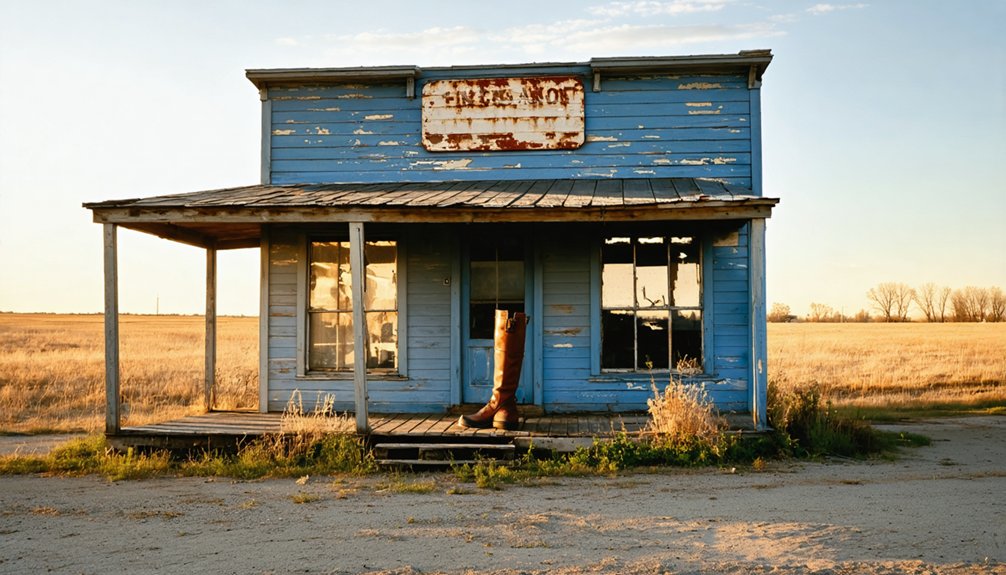
As the American frontier expanded westward in the mid-nineteenth century, a remarkable phenomenon unfolded across the Great Plains—the rapid emergence and subsequent decline of countless settlements that would later be abandoned to history.
The frontier’s ephemeral towns bloomed and withered across the Great Plains, leaving only whispers of ambition in their wake.
You’d recognize these frontier aspirations in the aftermath of the 1862 Homestead Act, which offered 160 free acres to those willing to work the land.
Railroad expansion created accessibility to once-isolated regions, transforming temporary camps into communities with schools, churches, and local governance. These early settlements often followed the pattern of clustering around navigable rivers, essential for transportation and communication before railroads became widespread. By 1880, these settlements had spread extensively into northern Michigan, Wisconsin, and Minnesota, creating a patchwork of settled areas that pushed the frontier line westward.
Settlement challenges emerged as towns competed for railroad access, economic viability, and population stability.
Dust Bowl Devastation: Environmental Causes of Abandonment
When the Great Plains transformed into a desolate wasteland during the 1930s, an environmental catastrophe of unprecedented scale unfolded, forcing the abandonment of countless rural communities.
You can trace this devastation to decades of intensive farming that stripped away native prairie grasses, leaving vulnerable topsoil exposed to erosion when drought struck in 1930.
The combination of overplowing, mechanized farming, and overgrazing created perfect conditions for environmental degradation. The federal land policies that encouraged homesteading by inexperienced farmers contributed significantly to these unsustainable practices. These massive dust storms transported soil particles over vast distances eastward, with dust reaching cities as far away as Chicago.
Without deep-rooted vegetation anchoring the soil, the region’s once-fertile land literally blew away in massive “black blizzards” that buried homes and farms.
Railroad Ghosts: When the Tracks Moved On
The iron rails that once stitched together the American Plains created an intricate web of commerce and community, determining which settlements would thrive and which would fade into obscurity.
Rusted spiderwebs of steel, dictating life or death for countless prairie towns beneath an unforgiving sky.
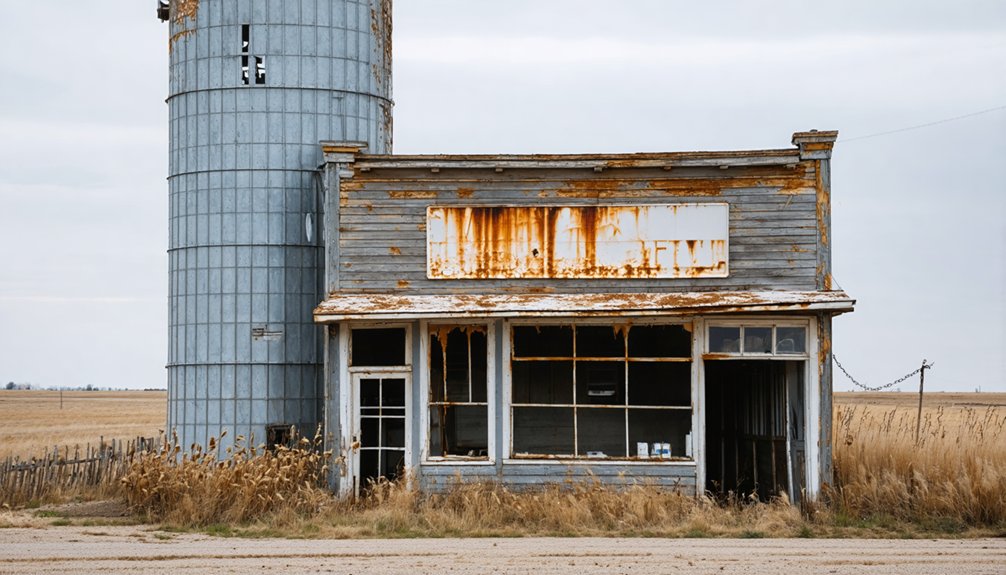
As you explore these forgotten landscapes, you’ll find that railroad nostalgia permeates the skeletal remains of once-bustling towns like Fort St. Vrain and Cherokee City, where abandoned grain elevators stand as monuments to prosperity lost.
When railroads withdrew their economic lifelines—often due to financial collapse or route changes—entire communities collapsed. The pattern repeats across thousands of ghost towns, particularly during 1880-1940.
Towns fortunate enough to maintain rail connections flourished; those bypassed withered. Ottawa exemplifies this relationship, as the arrival of the LL&G Railroad in 1868 transformed it from a small settlement into a prosperous town with 6,250 residents by 1872. Today, you can trace this deterministic relationship in the remnants of stations, post offices, and schools scattered across the Plains—physical evidence of how railroad abandonment reshaped the regional landscape. This economic devastation was particularly profound across the Interior Plains region, which depended heavily on rail transport for agricultural shipments and community survival.
Dearfield’s Legacy: African-American Pioneers of the Plains
If you travel 30 miles east of Greeley, Colorado, you’ll find the remnants of Dearfield, a once-thriving African-American agricultural settlement founded in 1910 by Oliver Toussaint Jackson who envisioned economic independence through farming.
The community flourished between 1917-1921 with nearly 700 residents who mastered dry farming techniques to grow diverse crops, only to face catastrophic decline when the Dust Bowl and Great Depression decimated their agricultural foundation.
Now listed on the National Register of Historic Places since 1995, Dearfield’s remaining structures stand as a symbol of a significant chapter in Black homesteading history that challenges conventional narratives of the American West. During its vibrant years, the settlement featured a rich social life with annual fairs and rodeos that strengthened community bonds among residents. The name “Dearfield” was thoughtfully chosen by Dr. J.H.P. Westbrook from Denver to represent how precious the land was to the African American settlers.
Black Agricultural Success Story
Dearfield, Colorado’s only all-Black agricultural colony, represents a remarkable success story that contradicts conventional narratives about African American agricultural ventures in the early twentieth century West.
The colony’s agricultural resilience shines through their mastery of dry farming techniques in challenging conditions, generating crop yields valued at $50,000 (approximately $1 million today) during peak years.
Four key elements underpinned Dearfield‘s agricultural triumph:
- Diversified crop portfolio including oats, corn, wheat, and even water-intensive melons
- Strategic adaptation to environmental conditions despite limited irrigation rights
- Collective equipment purchasing demonstrating community solidarity
- Cross-racial contract harvesting services extending economic reach
This economic self-determination fulfilled Jackson’s vision, inspired by Booker T. Washington’s philosophy of independence through land ownership—a reflection of what African American farmers could achieve when unhindered by systemic restrictions. During its prime, the community became a popular weekend destination for Denver residents seeking recreational activities like fishing, hunting, and dancing. Similar to themes explored in “Into the Wild” narratives, Dearfield’s story highlights the profound connection between people and the natural environment through agricultural perseverance.
Dust Bowl’s Fatal Impact
While Dearfield’s agricultural achievements demonstrated remarkable resilience in the 1910s and 1920s, this hard-won success would face an insurmountable environmental catastrophe that transformed the community’s destiny.
You’ll find in Dearfield a haunting example of environmental justice concerns before the term existed. When the Dust Bowl descended upon Colorado’s plains in the 1930s, it coincided cruelly with the Great Depression, creating a perfect storm of hardship.
The Black homesteaders who’d built this thriving community watched helplessly as relentless dust storms eroded their topsoil and drought rendered their fields barren. Their ambitious plans—a canning factory, a college—evaporated with their crops.
Preservation Efforts Today
Today’s preservation efforts at Dearfield stand as evidence to the enduring significance of this African-American agricultural settlement on Colorado’s plains. The site’s historical significance is reflected through its inclusion on the National Register of Historic Places and designation as a Colorado Registered Historic Landmark.
Community engagement manifests through multiple preservation initiatives:
- The Black American West Museum’s ownership and stewardship since 1998
- Archaeological excavations revealing cultural artifacts approximately one foot below the surface
- Educational programs connecting visitors to African-American pioneer experiences
- Collaborative partnerships between historical societies and academic institutions
The remaining structures—including the founder’s home, gas station, and diner—serve as tangible connections to this remarkable community that exemplified Black self-sufficiency and resilience.
This inspires continued research and commemorations of African-American agricultural settlements throughout the Great Plains.
Boom and Bust: The Economics of Desertion
The economic trajectory of ghost towns across the American Plains followed a predictable yet dramatic arc of boom and bust cycles that ultimately led to their abandonment.
You’ll find these communities initially thrived through singular economic drivers—railroads connecting isolated regions to markets, homestead legislation providing accessible land, and resource booms in mining or agriculture creating immediate prosperity.
What these towns lacked was economic resilience. When commodity prices collapsed or resources depleted, communities with undiversified economies couldn’t adapt. The mechanization of agriculture further reduced labor needs, while natural disasters like the Dust Bowl destroyed already vulnerable farming operations.
Within a decade, populations often plummeted by 50-90%, with residents migrating to urban centers offering stability. Those towns bypassed by developing infrastructure—particularly railroads and later highways—faced accelerated decline, unable to maintain resource management systems necessary for survival.
What Remains: Physical Traces of Vanished Communities
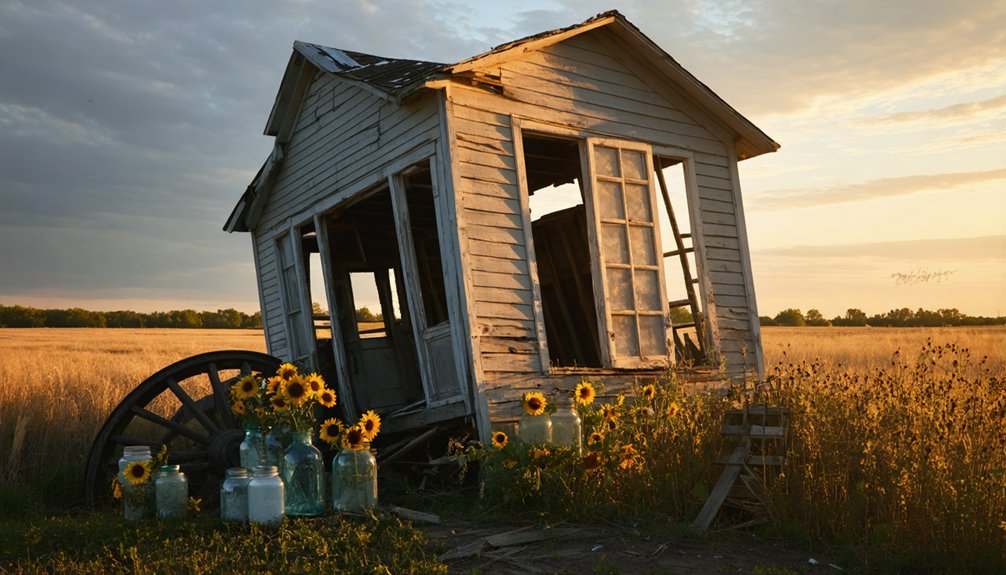
You’ll find the skeletal remains of these once-thriving communities most visibly represented in their weathered wooden churches and crumbling foundation stones.
These architectural fragments persist across the Plains states, with regional variations in preservation—Kansas sites often maintain partial structures while Arkansas ghost towns have deteriorated to mere foundations.
The physical vestiges reflect not only the economic collapse that precipitated abandonment but also serve as material archives of settlement patterns, construction techniques, and community priorities that shaped these short-lived municipalities.
Foundations and Ruins
Scattered across the windswept Plains, physical remnants of once-thriving communities persist as silent witnesses to America’s abandoned past.
When you explore these forgotten landscapes, you’ll encounter the skeletal framework of former societies—crumbling walls, exposed foundation preservation efforts, and ruin restoration projects that attempt to capture fading history.
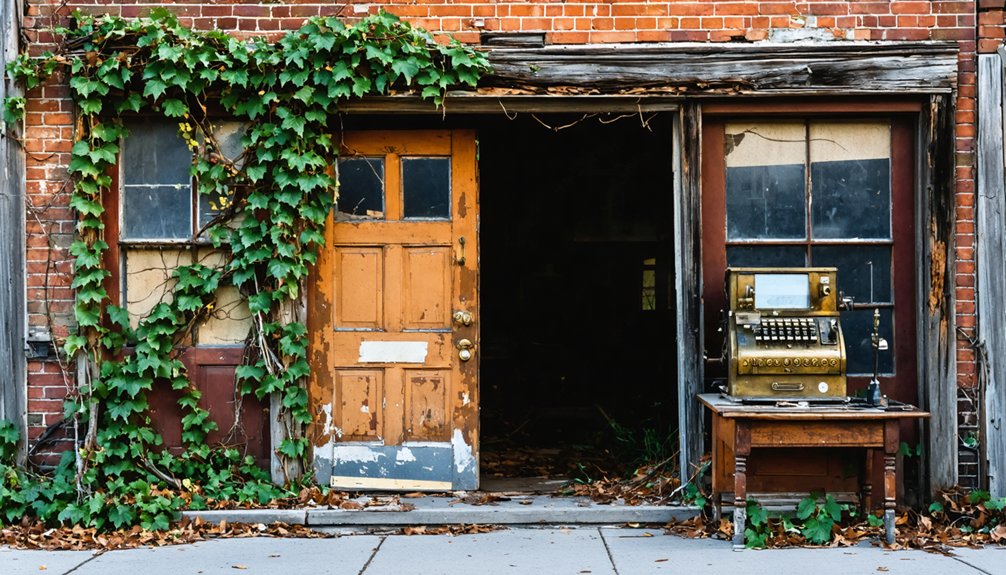
Main Street ruins tell the most compelling stories, with four distinct patterns emerging:
- Collapsed storefronts with intact façades
- Concrete foundations marking residential neighborhoods
- School and church remnants positioned at community centers
- Railroad infrastructure like depots and water towers
The Great Plains region has experienced particularly dramatic abandonment, with foundation cellars often the only evidence that communities once thrived.
These architectural footprints offer researchers vital insights into settlement patterns before rural exodus transformed the landscape.
Weathered Wooden Churches
Among the most poignant remains of ghost towns across the American Plains stand weathered wooden churches, their deteriorating frames reaching skyward like spiritual sentinels over abandoned communities.
These structures, primarily Gothic Revival or vernacular in style, exhibit a weathered beauty despite their advanced decay. You’ll find them concentrated throughout Montana, Kansas, Nebraska, and the Dakotas, often accessible only via remote dirt roads.
The architectural decay reveals their vulnerability to Plains extremes—tornados, blizzards, and relentless sun. Hand-hewn beams collapse while stained glass windows shatter.
Occasionally, preservation groups stabilize these former community centers, but most succumb to vegetation, wildlife infestations, and vandalism. Their skeletal remains, sometimes accompanied by adjacent cemeteries, chronicle the parallel decline of rural Plains communities and their once-vibrant spiritual centers.
Demographic Shifts: the Slow Exodus From Rural America
The demographic transformation of rural America represents one of the most profound yet underappreciated shifts in the nation’s population landscape.
You’re witnessing a dramatic population decline across America’s heartland, with over 77% of rural counties having fewer working-age residents than two decades ago. This creates fundamental challenges for rural revitalization efforts.
The data reveals four critical patterns:
- Rural working-age populations decreased from 30 to 28 million between 2010-2023.
- Deaths exceed births in rural counties for eight consecutive years.
- Farming-dependent counties show persistent 5% population declines.
- Post-pandemic migration has partially offset losses, particularly among 25-44 year-olds.
These shifts reflect deep economic transformations away from agriculture-based economies.
While recent migration trends offer hope, they don’t fully counterbalance decades of demographic erosion in America’s rural communities.
Preservation Challenges in the Face of Time and Weather
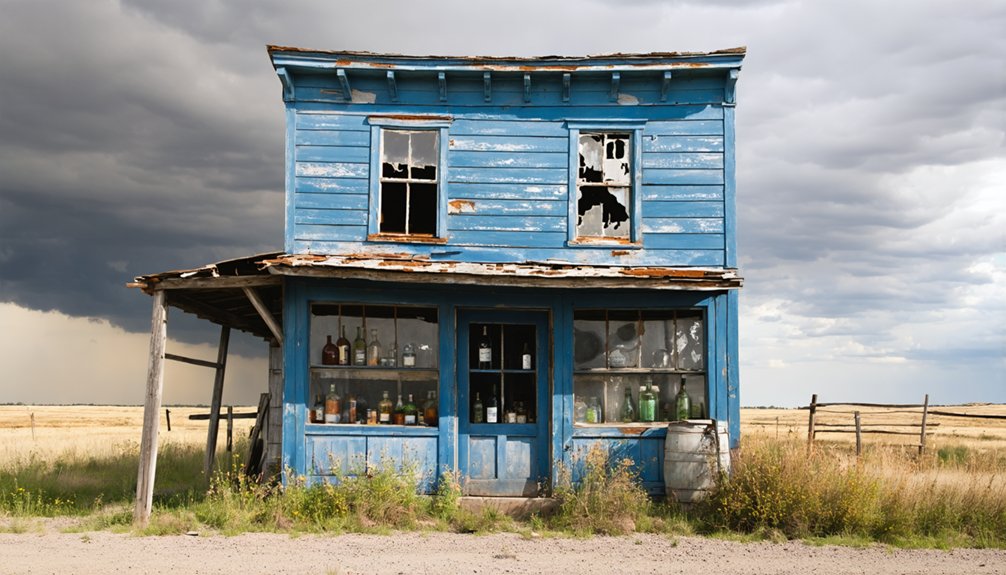
Preserving the physical remnants of America’s ghost towns presents a multifaceted challenge that extends beyond mere historical documentation.
You’re witnessing the accelerated decay of these historic sites as environmental forces relentlessly attack their structural integrity. Freeze-thaw cycles create foundation failures while sun exposure weakens building materials across the plains.
Weather impacts are particularly severe in remote locations where regular maintenance is impossible. You’ll find that many structures, originally built with temporary materials, succumb quickly to wind and rain damage. Meanwhile, vegetation overgrowth destabilizes foundations and walls.
Your preservation efforts face additional obstacles through human interference—vandalism and looting strip sites of authenticity, while limited funding hampers restoration initiatives.
The combination of natural degradation, wildlife incursions, and dwindling resources creates a preservation crisis that threatens these irreplaceable windows into American history.
Hidden Stories: Uncovering Daily Life in Abandoned Settlements
Archaeological fragments recovered from abandoned settlements like Dearfield offer tangible connections to complex daily routines and social interactions within these once-vibrant communities.
You’ll find these material traces—from household implements to commercial artifacts—function as physical testimonies to economic adaptations and cultural practices of residents who navigated both prosperity and hardship.
Oral histories complement these artifacts by preserving personal narratives and collective memories that illuminate the lived experiences of those who called these now-silent places home.
Artifacts Tell Tales
Everyday items, forgotten and buried beneath layers of prairie soil, serve as silent witnesses to the rich tapestry of human experience once thriving in ghost towns across the Plains.
These deserted settlements, remnants of bustling communities, evoke a sense of nostalgia for a time when they were filled with life and activity. The ghost towns of the great plains tell stories of hope and hardship, each crumbling building a testament to the dreams that once flourished there. As one explores these forgotten places, the echoes of laughter and the sounds of daily life seem to linger in the air, inviting reflection on the passage of time.
These artifact assemblages reveal nuanced cultural reflections of integrated communities often contradicting historical records.
When examining ghost town material culture, you’ll find:
- Chinese stoneware distribution patterns demonstrating social integration in 1880s mining settlements
- Currency and porcelain fragments revealing immigrant participation in local economies
- Spatial arrangement of artifacts showing racial and economic integration unusual for the period
- Food remains documenting diverse dietary practices and trade networks
The preservation context of these objects—how they’re buried, arranged, and transformed by environmental conditions—provides critical analytical frameworks for understanding the complex social dynamics of these abandoned communities.
Voices From Forgotten Places
How did ordinary citizens navigate daily existence in these now-abandoned settlements? Archival evidence reveals a stark reality of resilience amid hardship.
You’d find residents cooking on wood-burning stoves, using outhouses, and illuminating nights with gas lanterns. These forgotten stories emerge through communal practices—shoveling snow for packhorses, maintaining crucial supply routes, and gathering in repurposed saloons to share tales.
The lost voices of these communities speak through their economic adaptations: miners collapsing from exhaustion, log drivers commanding premium wages for “white water” work, and families leaving when resources depleted.
You’re witnessing a complex social ecosystem where children created imaginative campfire narratives while adults collaborated on unpaid infrastructure maintenance.
Despite lacking modern conveniences, these communities forged connections through shared challenges—a reflection of human adaptability in isolated frontiers.
Ghost Towns as Living History: Why These Places Matter
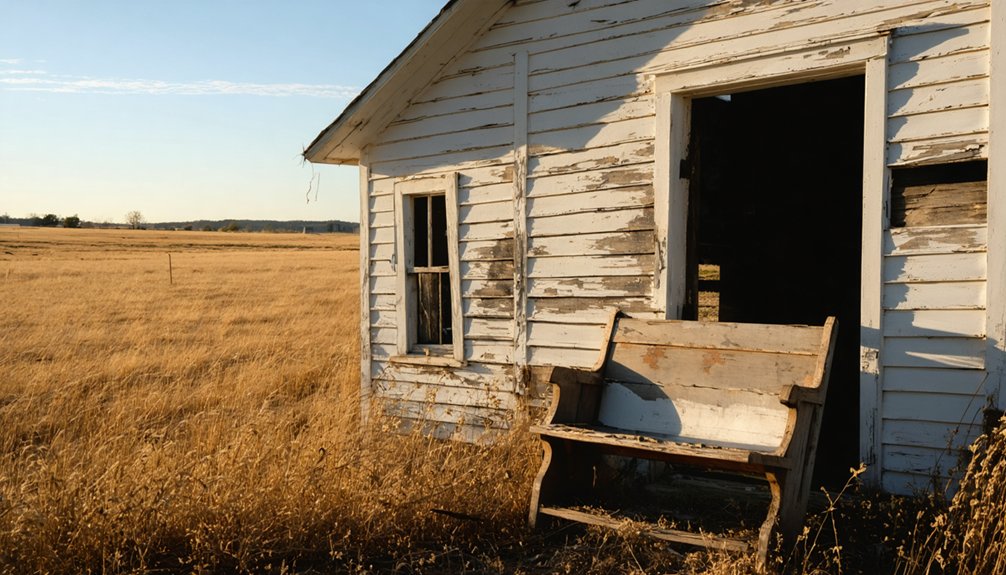
The remnants of once-thriving settlements across the American plains stand as physical archives that provide unparalleled insights into our national development and identity.
Through ghost town preservation efforts, you’ll discover tangible evidence of how Americans responded to economic and environmental challenges that shaped the nation.
Archaeological findings reveal four critical dimensions:
- The successful African-American farming community of Dearfield represents pioneering Black economic autonomy.
- Physical structures document the shift from railroad-dependent economies to automobile travel.
- Abandoned Main Streets preserve architectural evidence of frontier aspirations and values.
- Settlement patterns demonstrate how diverse immigrant populations built communities despite harsh conditions.
These sites matter because they capture authentic American experiences—showing how freedom, innovation, and resilience operated within the constraints of geography and economic forces throughout the 20th century.
Frequently Asked Questions
Can Visitors Legally Collect Artifacts From Ghost Town Sites?
No, you can’t legally collect artifacts without permission. Legal restrictions on federal, state and private lands prioritize artifact preservation over personal collection. Written authorization is essential for lawful acquisition.
How Do Researchers Identify Unmarked Ghost Town Locations?
You’ll find researchers identify unmarked ghost towns primarily through satellite imagery analysis and historical map comparison, layering multiple data sources to reveal landscape anomalies and settlement patterns invisible to casual observation.
Are There Ghost Towns That Successfully Revitalized?
Yes, you’ll find remarkable revitalization success in towns like Jerome, Arizona and Bodie, California, where community engagement through arts initiatives and heritage preservation transformed abandoned settlements into vibrant cultural destinations again.
What Role Did Indigenous Communities Play in Ghost Town Histories?
You’ll discover indigenous communities formed the original bedrock of many departed settlements, their cultural heritage establishing the foundation for later ghost towns through indigenous resilience and traditional knowledge of sustainable Plains habitation patterns.
How Do Property Rights Work in Abandoned Ghost Towns Today?
You’ll find property ownership in ghost towns governed by adverse possession laws, enabling claims on abandoned structures after statutory periods, while adhering to zoning regulations and maneuvering through complex title challenges that impact redevelopment rights.
References
- https://www.kbia.org/agriculture/2017-03-22/great-plains-ghost-town-sheds-light-on-forgotten-piece-of-african-american-history
- https://www.grandcountyutah.net/388/Ghost-Towns-Communities
- https://www.youtube.com/watch?v=zRfBNdUOgOQ
- https://plainshumanities.unl.edu/encyclopedia/doc/egp.ct.024.html?stream=top
- https://en.wikipedia.org/wiki/Ghost_town
- https://www.geotab.com/ghost-towns/
- https://www.legendsofamerica.com/gt-emergingghosttowns/
- https://www.legendsofamerica.com/we-americanfrontier/
- https://www.youtube.com/watch?v=jUiI0t3dB74
- https://www.historians.org/resource/the-significance-of-the-frontier-in-american-history/