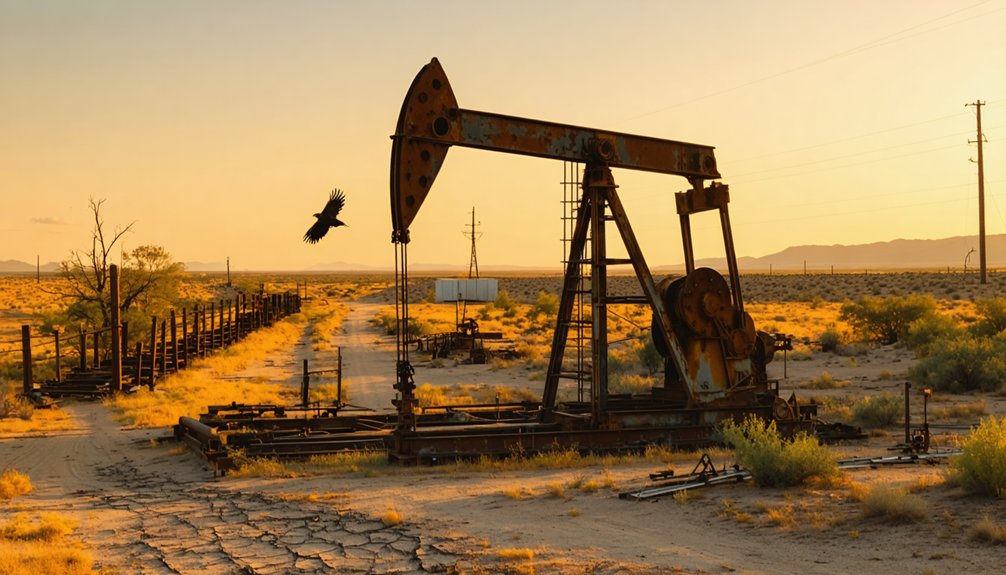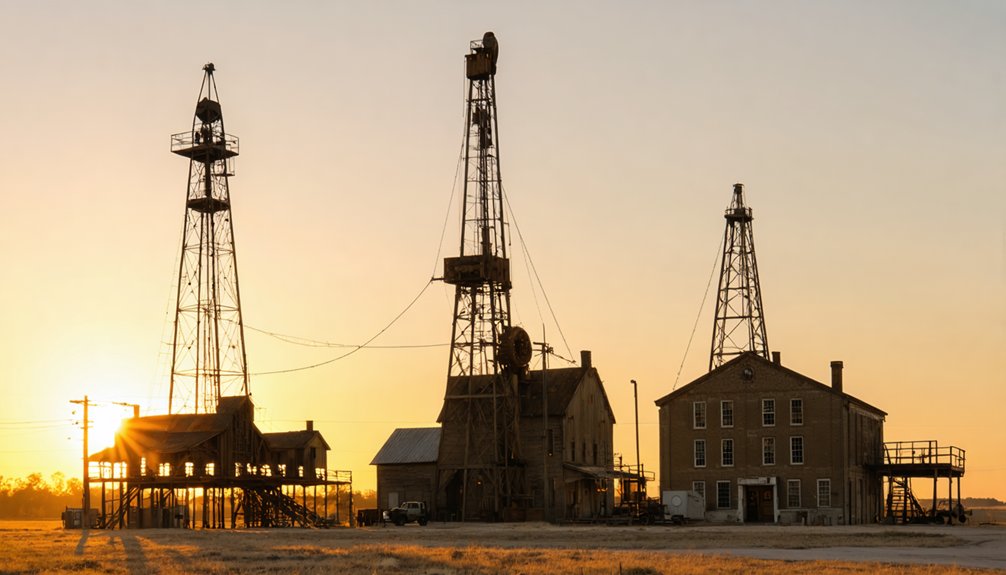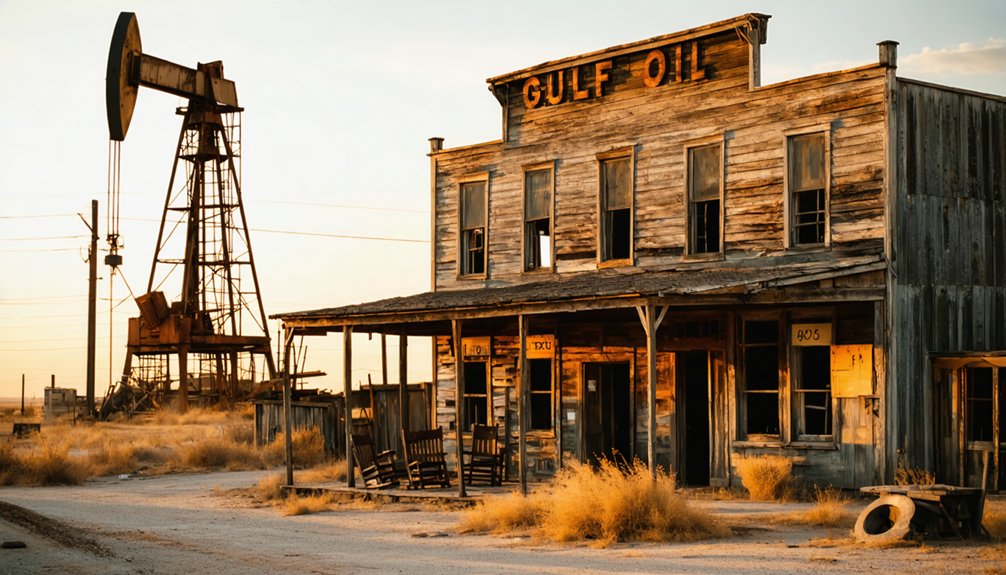
America’s abandoned oil towns emerged after Drake’s 1859 Pennsylvania discovery triggered nationwide petroleum fever. You’ll find these ghost towns scattered across states like Pennsylvania, Texas, and Oklahoma, where populations once exploded from mere dozens to thousands within months. When wells dried up or prices crashed, communities collapsed, leaving environmental hazards and decaying infrastructure. The rusted remnants tell a complex story of boom-and-bust cycles that shaped America’s industrial landscape and continue to impact surrounding communities today.
Key Takeaways
- Oil towns boomed after Drake’s 1859 discovery, transforming rural areas into boomtowns with populations growing from 15 to 15,000 in a year.
- Abandoned oil towns rapidly collapsed when fields depleted or prices crashed, leading to 70% unemployment and mass exodus.
- Approximately 4.6 million Americans live near orphaned wells, facing exposure to toxic pollutants with cleanup costs exceeding $4.7 billion.
- Railroad connections determined town survival, with those lacking access struggling as transportation networks declined mid-century.
- Environmental hazards from unplugged wells contribute 3-6% of U.S. methane emissions and threaten groundwater supplies in vulnerable communities.
The Birth of Black Gold Fever: How Oil Boomtowns Emerged
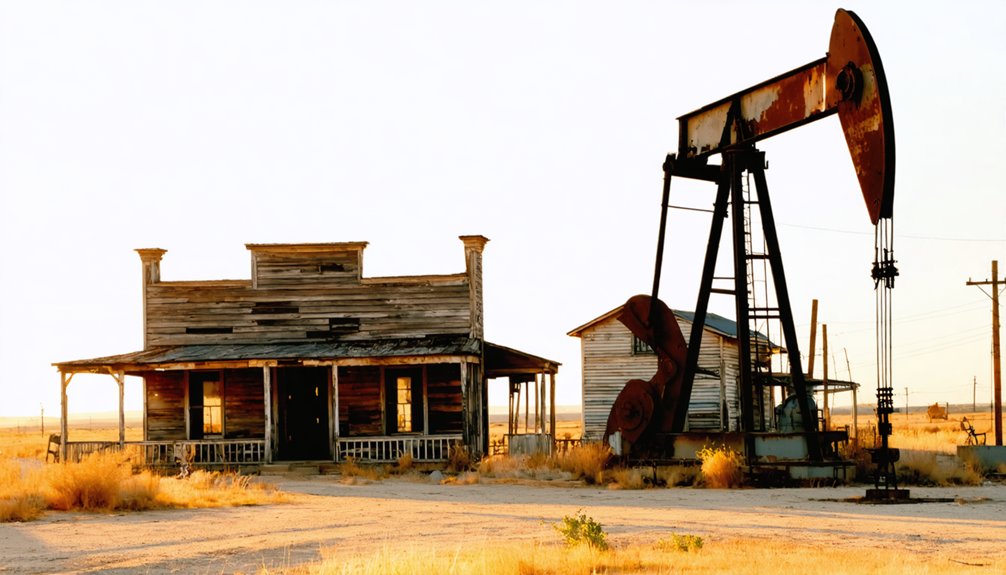
When Edwin L. Drake struck oil in Titusville, Pennsylvania in 1859, he unknowingly lit the fuse of America’s oil revolution. This first commercial well transformed sleepy rural areas into bustling centers of activity almost overnight.
The phenomenon accelerated after the 1865 Pithole Creek gusher produced 650 barrels daily, drawing thousands seeking fortune.
You’d have witnessed a remarkable pattern: oil discovery followed by frenzied wealth speculation. Civil War veterans with disposable income rushed alongside wildcatters to stake claims. Rural land values skyrocketed—in Louisiana’s Caddo Parish, prices jumped twentyfold between 1907-1908.
Boomtowns materialized with astonishing speed, complete with hotels, post offices, and newspapers. Pithole City exemplified this growth with 57 hotels and a thriving commercial district established within just four months of discovery. This transformation reached its zenith with 1901’s Spindletop gusher in Texas, which became a national energy turning point and cemented America’s “black gold fever.” The massive initial gusher at Spindletop triggered an unprecedented rush of prospectors hoping to capitalize on the newly discovered oil wealth.
From Thousands to Ghost Towns: The Rapid Rise and Fall Cycle
As boomtowns flourished across America’s oil regions, they demonstrated a dramatic and often devastating life cycle that mirrored the volatile nature of the resource itself.
You’d have witnessed breathtaking population dynamics—places like Borger, Texas exploding from just 15 residents to 15,000 within a single year after striking oil.
The collapse came just as swiftly. When fields depleted or prices crashed during the 1930s oil glut, these single-industry economies crumbled.
The promise of black gold proved fleeting—towns rose like specters only to vanish when wells ran dry or markets failed.
Unemployment rates soared above 70% in some communities, triggering mass exodus. Towns that once buzzed with activity saw their infrastructure abandoned, buildings decaying under harsh elements.
Community resilience was tested beyond breaking points. Schools closed, churches emptied, and social cohesion dissolved. Texas and California have the highest concentration of these abandoned settlements, creating a distinctive pattern on the American landscape.
What remained were environmental hazards—improperly sealed wells leaking contaminants into groundwater—and hollow shells of once-thriving societies. Today, an estimated 14 million Americans live within one mile of an abandoned well, facing potential health and safety risks from these industrial relics.
Railroad Connections: Lifelines That Determined Town Survival
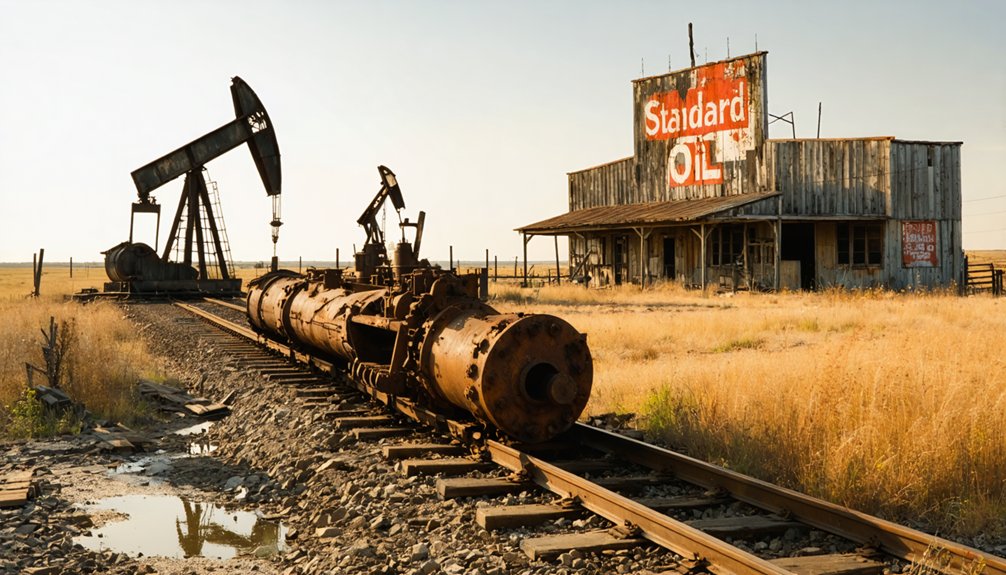
Railroad connections served as the critical arteries that determined life or death for America’s oil towns during the industry’s formative decades.
You’ll find that railroad expansion preceded or coincided with oil discoveries, establishing the essential infrastructure for transporting crude oil, equipment, and workers. Towns strategically positioned along standard gauge rail lines or at transportation networks’ junctions flourished, while those without rail access withered.
The physical layout of these communities mirrored this dependence, with main streets and commercial districts clustering around depots that became community hubs. In towns like Ely, Nevada, the copper transport created a bustling hub of activity with constant movement of ore cars through the valley. Many of these towns now face environmental challenges from abandoned wells leaking and contaminating local groundwater supplies, further complicating revitalization efforts.
When rail service declined mid-century as truck transport rose, many towns lost their economic lifeline.
Today, you can still trace this railroad legacy in abandoned towns’ layouts, preserved depots, and repurposed rail corridors—tangible reminders of how fundamentally railroad connections shaped boom-and-bust cycles.
Economic Impact and Secondary Industries in Petroleum Boomtowns
The economic footprint of petroleum boomtowns extends far beyond drilling rigs and wellheads, creating complex financial ecosystems that alter regional economies.
You’ll find these communities generate impressive economic activity—Western Pennsylvania’s conventional operations alone contribute $1.4 billion annually while supporting 5,600 jobs.
This prosperity, however, often breeds economic dependency. When production declines, you’ll witness communities struggling with population loss and employment contraction.
The Appalachian region exemplifies this vulnerability, with counties experiencing up to 8% job loss despite initial production booms. Despite generating 60% economic output growth in gas-producing counties, local communities saw minimal benefits from the natural gas boom.
Secondary industries temporarily flourish—construction, retail, and hospitality sectors expand to serve growing workforces.
Yet these sectors remain tethered to the volatile labor market of extraction. The emerging well cleanup industry offers promising shift opportunities, potentially creating 55,000 jobs nationwide while utilizing transferable skills from oil production.
The financial burden of abandoned wells—estimated at nearly $1 billion for thousands of orphaned wells—eventually falls on state agencies and taxpayers when operators disappear.
Environmental Legacy: Abandoned Wells and Modern Cleanup Challenges

Beneath the surface of America’s abandoned oil towns lies a troubling environmental legacy that continues to haunt landscapes and communities long after production has ceased.
These abandoned oil towns in Texas serve as stark reminders of the boom-and-bust cycle driven by the fossil fuel industry. Many of these communities struggle with economic stagnation, while residents grapple with the health effects of pollution and decaying infrastructure. As time passes, the scars of industrial activity become increasingly visible, raising urgent questions about sustainability and environmental justice.
You’ll find approximately 4.6 million Americans living within half a mile of orphaned wells, facing exposure to toxic pollutants including benzene, a known carcinogen.
These unplugged, nonproducing wells contribute 3-6% of total U.S. methane emissions, while threatening groundwater supplies for the 35% of wells located near domestic water sources. The alarming lack of groundwater quality data for 92% of these wells makes it impossible to fully assess contamination risks.
States like Ohio, Pennsylvania, Oklahoma, and Kentucky bear the highest concentration of documented orphaned wells, accounting for over half of all known cases nationwide.
The cleanup challenge is staggering—remediation costs exceed $4.7 billion, surpassing available federal funding by up to 80%.
Though the 2021 Bipartisan Infrastructure Law allocated resources for plugging these environmental hazards, the scope of contamination outpaces current remediation efforts, leaving communities to bear the environmental and health consequences of America’s fossil fuel past.
Notable Ghost Towns: Pennsylvania to California’s Forgotten Settlements
You’ll find America’s oil ghost towns concentrated primarily in Pennsylvania, where the industry began in 1859 with Drake’s Titusville discovery, and in lesser-known California settlements like Mentryville.
Pennsylvania’s abandoned towns, such as the infamous Pithole that grew and collapsed within months, represent the volatile eastern birthplace of America’s petroleum industry.
California’s forgotten oil settlements, including Mentryville established after Mentry’s 1876 breakthrough well, demonstrate how the industry spread westward despite receiving less historical recognition than the state’s gold rush.
Early Pennsylvania Pioneers
In 1859, when Edwin Drake drilled America’s first successful commercial oil well in Titusville, Pennsylvania, he couldn’t have foreseen the rapid rise and fall of the boomtowns that would follow.
This pioneering spirit transformed tiny hamlets into bustling centers of commerce virtually overnight.
Nowhere exemplified this phenomenon better than Pithole, which exploded from wilderness to 20,000 residents in mere months during 1865.
The early settlements throughout Pennsylvania’s oil region demonstrated America’s resource-driven development pattern:
- Rapid growth – Titusville itself surged from 250 to 10,000 residents by 1865
- Brief prosperity – Pithole’s boom lasted just 500 days before catastrophic decline
- Complete abandonment – By 1877, Pithole stood empty, its structures consumed by fire or decay
Indigenous Seneca peoples had utilized the region’s natural petroleum seeps long before these fleeting towns appeared—a proof of the land’s enduring resource value.
California’s Oil Legacy
While Pennsylvania’s oil towns wrote the opening chapters of America’s petroleum history, California soon developed its own distinctive legacy of boom-and-bust settlements.
Mentryville, founded in the late 1870s after Charles Mentry’s successful strike at Pico No. 4, became California’s first commercial oil town—complete with distinctive oil town architecture including bunkhouses, barns, and the region’s first schoolhouse.
Operating for over a century until 1990, Mentryville helped launch industrial giants like Standard Oil and Chevron before declining into abandonment by 1962.
Today, it stands as a monument to the state’s petroleum heritage, joining other abandoned settlements that blend industrial ruins with natural reclamation.
Ghost town folklore enhances these sites’ cultural significance, with tales of Charles Mentry’s spirit still wandering the grounds.
You’ll find these haunting landscapes now serve as historical tourism destinations and filming locations.
Social Displacement and Cultural Memory in Former Oil Communities

As former oil towns across America gradually emptied of residents, they left behind more than abandoned infrastructure; they created complex patterns of social displacement disproportionately affecting vulnerable populations.
You’ll find cultural erasure occurring as social networks disintegrate, with Black and Hispanic communities bearing heavier environmental and health burdens from abandoned wells.
Consider these critical impacts:
- Nearly 23% of Californians lived within 1km of abandoned wells (2015-2019), facing ongoing contamination risks.
- 4.6+ million Americans reside within half a mile of orphaned wells nationwide.
- Limited groundwater monitoring (only 8% of wells) leaves health risks largely unassessed.
When communities dissolve, collective memory weakens, yet community resilience emerges through preservation efforts despite institutional neglect.
Your connection to place becomes severed as economic collapse turns vibrant towns into symbols of environmental injustice.
Regional Variations: How Geology Shaped Boomtown Development Patterns
You’ll find dramatic differences in how oil towns developed across America, shaped directly by the underlying geological features that determined where and how petroleum accumulated.
In Pennsylvania, tightly concentrated sandstone bars created compact boomtowns like Pithole, while the stacked reservoir layers of the Permian Basin fostered sprawling, longer-lasting development patterns across West Texas.
Michigan’s reef-based oil accumulations required advanced seismic imaging and environmental considerations, creating a more measured development timeline than the rapid boom-bust cycles of single-reservoir regions.
Geological Resource Distribution
Beneath the American landscape lies a complex tapestry of geological formations that directly shaped the rise and fall of oil boomtowns across distinct regions.
You’ll find resource accessibility varies dramatically across America’s oil-producing regions, determining how communities developed and eventually declined.
The geological variations created distinct patterns:
- Permian Basin’s diverse formations enabled multi-layered extraction across 86,000 square miles, supporting sustained growth in West Texas towns.
- Bakken Formation’s tight oil geology required advanced drilling techniques, creating rapid but unstable boomtown development in North Dakota.
- Eagle Ford Shale’s unconventional geology transformed rural South Texas through hydraulic fracturing, yielding 10 billion barrels of recoverable oil.
These geological formations didn’t just contain oil—they fundamentally determined which towns would boom, sustain, or ultimately face abandonment.
Basin-specific Extraction Challenges
Each oil-producing basin across the American landscape faced distinct extraction challenges that directly influenced the lifecycle of nearby towns and settlements.
You’ll notice how tight sands basins like Piceance initially flourished with directional drilling but later declined as capital shifted to more profitable regions.
Meanwhile, coalbed methane production in the Black Warrior and San Juan basins collapsed after peaking around 2000, leaving communities economically vulnerable.
Infrastructure challenges created bottlenecks in promising areas like the Utica and deeper Permian benches, limiting development potential.
While unconventional resources revitalized regions like the Permian and Bakken, conventional fields in Central California and Southern Louisiana continued their decline trajectory without shale’s rejuvenating effects.
These geological and technological limitations created boom-and-bust cycles that determined which towns survived and which were ultimately abandoned.
Crude Types Impact Development
While the fate of American oil towns hinged on numerous factors, the geological composition and crude oil quality underlying these settlements may have played the most decisive role in their development trajectories. The crude quality directly influenced extraction efficiency and infrastructure investment patterns that determined boomtown resilience.
Three critical geological factors shaped urban development:
- Light sweet crude regions (like Bakken) experienced rapid growth due to easier refining and high market demand.
- Areas with multiple stacked pay zones (Permian Basin) supported sustained economic stability through longer production lifespans.
- Regions with structural traps typically developed more complex reservoirs, prolonging boomtown phases compared to areas with stratigraphic traps.
You’ll find that towns built around high-quality crude deposits attracted earlier, more intense infrastructure investments, while those in regions with accompanying natural gas developed more diversified economies.
Frequently Asked Questions
What Happened to the Wealthy Oil Barons After Towns Collapsed?
You’ll find oil baron legacies diversified—some went bankrupt, others reinvented themselves through investments, political influence, or new energy ventures as economic shifts forced adaptation or financial ruin.
Did Any Abandoned Oil Towns Successfully Transform Into Sustainable Communities?
Yes, you’ll find desolation transformed into possibility in places like Greensburg, Kansas, where sustainable redevelopment rebuilt tornado-ravaged streets, and Oakridge, Oregon, where community resilience turned timber collapse into mountain biking tourism.
How Did Racial Segregation Affect Oil Boomtown Development?
Racial segregation created dual societies in oil boomtowns, where you’d witness extreme racial inequality shaping community dynamics, limiting Black access to economic opportunities while simultaneously fostering resilient parallel Black economies under Jim Crow.
Were There Notable Women Entrepreneurs in These Oil Towns?
Against all odds, you’ll discover remarkable female pioneers like Madam C.J. Walker and Sarah Rector who leveraged entrepreneurial spirit to build empires through beauty products and oil investments despite racial and gender barriers.
How Did Oil Town Architecture Differ From Established Cities?
You’d notice oil towns’ industrial design featured hastily-built wooden structures with minimal foundations, unlike established cities’ ornate brick architecture. Their utilitarian, relocatable buildings reflected temporary prosperity rather than permanent architectural styles.
References
- https://aoghs.org/petroleum-pioneers/pithole-creek/
- https://www.okhistory.org/publications/enc/entry?entry=GH002
- https://www.geotab.com/ghost-towns/
- https://www.youtube.com/watch?v=oW66pgyhMYM
- https://www.thestoryoftexas.com/discover/campfire-stories/oil-worker
- https://grist.org/abandoned-oil-gas-wells-permian-texas-new-mexico/
- https://okmag.com/blog/a-ghostly-site/
- https://en.wikipedia.org/wiki/Pithole
- https://savingplaces.org/guides/ghost-towns-on-route-66
- https://www.resources.org/common-resources/spindletop-the-original-oil-quotboomtownquot/