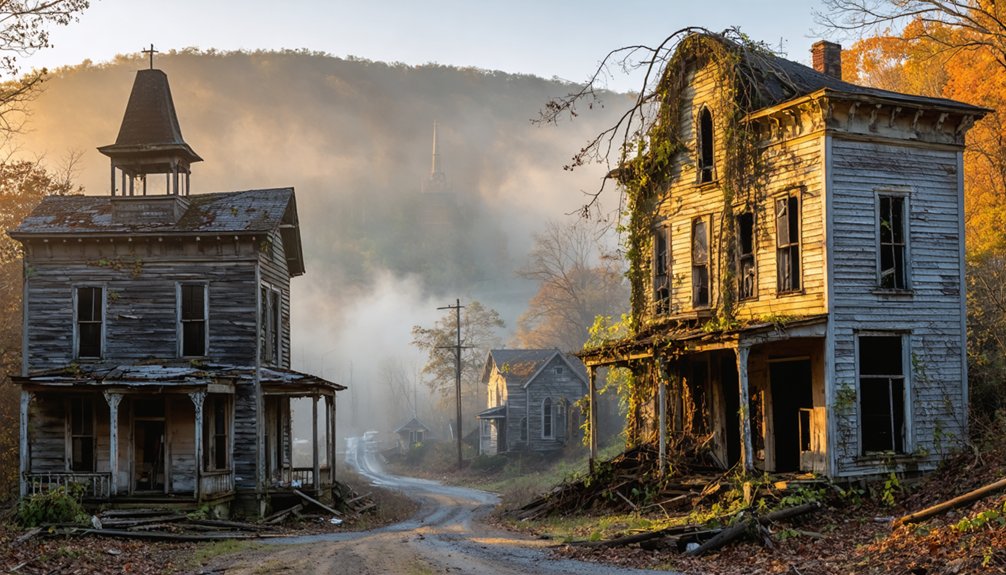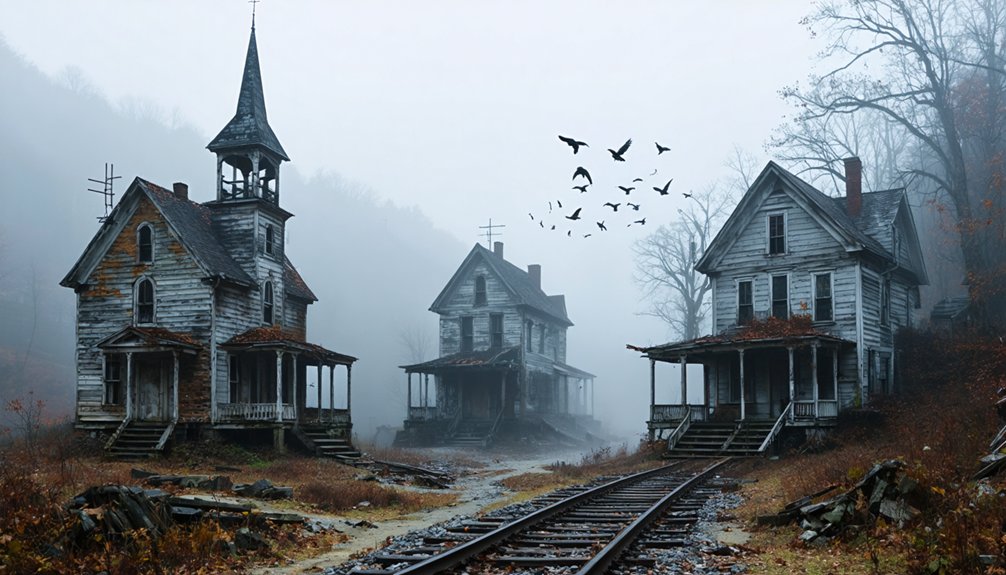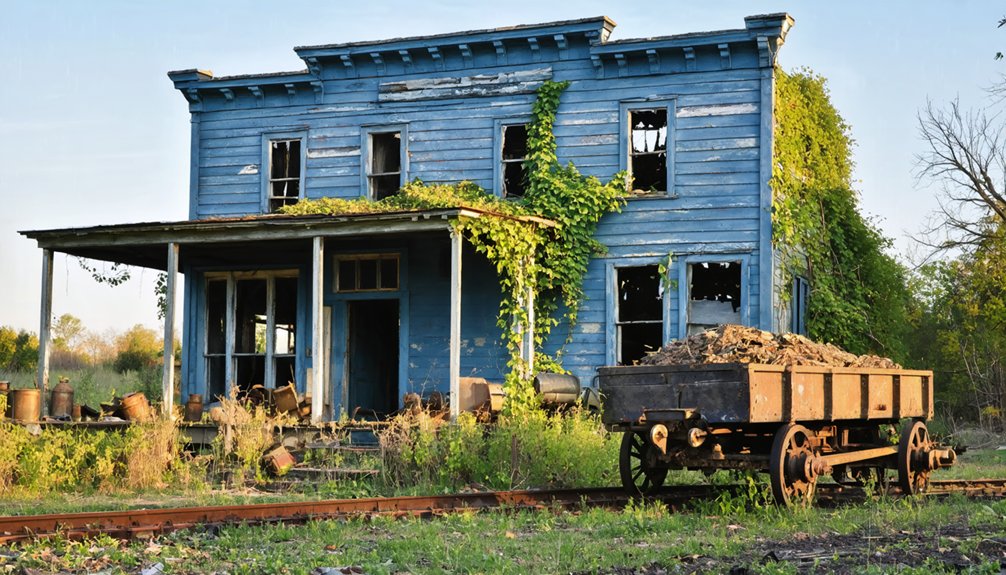
Appalachian ghost towns represent the complex boom-and-bust cycle of resource extraction that shaped the region. You’ll find communities once thriving around coal mining, timber operations, and railroads that declined when industries mechanized or resources depleted. These abandoned settlements preserve stories of company town life, cultural resilience, and communities displaced by modernization projects like dams. Beyond empty buildings, these sites embody the economic struggles and rich cultural heritage that continue to define Appalachian identity today.
Key Takeaways
- Appalachian ghost towns represent the boom-bust cycle of extractive industries like coal mining, which declined over 65% since 2005.
- Company towns operated as complete social ecosystems with corporate control over housing, commerce, and community life.
- Moonshine production became vital for informal economies in abandoned communities, reflecting cultural resistance and self-reliance.
- Eminent domain and modernization projects submerged entire communities, raising environmental justice concerns often overlooked during forced displacements.
- Former ghost towns now serve as heritage tourism sites, preserving cultural memory while creating economic opportunities for remaining Appalachian communities.
The Birth of Mountain Communities: Settlement Patterns in Appalachia
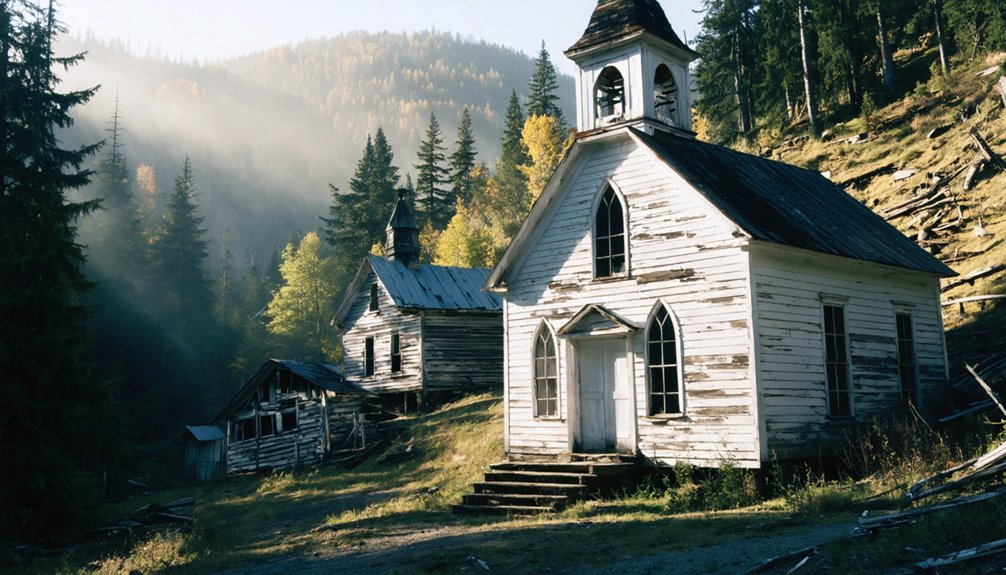
Long before European settlers carved homesteads into the Appalachian wilderness, this mountainous region thrived with diverse Native American cultures. Cherokee, Shawnee, and Muskogean tribes established complex agrarian societies along river valleys, creating settlement patterns that evolved around fertile soil and fishing grounds. The archaeological record reveals these Indigenous peoples inhabited Appalachia for over ten thousand years through various subsistence strategies.
When Europeans first penetrated the mountains in the 16th century, you’d witness the beginning of dramatic cultural adaptation. The Scotch-Irish, English, and German migrants who followed created new settlement evolution patterns, favoring the same fertile limestone valleys while introducing different land management approaches.
Your ancestors might’ve traveled through mountain gaps like Swannanoa or Deep Gap, forming small, dispersed communities centered on subsistence living. The establishment of Buncombe County in 1792 with Morristown, now known as Asheville, as its county seat provided a centralized location for settlers conducting business.
This convergence of peoples transformed the landscape as Native populations faced displacement, while European settlers established the foundations of what would later become ghost towns.
Resource-Driven Economies: Coal, Timber, and Local Industries
Beneath the rugged ridgelines of Appalachia, powerful economic engines once transformed isolated mountain hollows into bustling centers of industry and commerce.
You can trace the rise and fall of these communities through their relationship with resource extraction. Coal mining dominated the regional economy, reaching its zenith in 1947 with 630 million tons, before declining dramatically—over 65% since 2005 alone.
This extraction economy created complex systems of economic interdependence, as timber operations supplied mine supports, housing materials, and fuel while railroads connected once-isolated settlements.
As mechanization advanced, fewer workers were needed despite increasing production. The workforce shrank from 122,000 miners in 1985 to just 53,500 by 2005.
When these industries contracted, they left behind communities stripped of their economic foundation, creating the ghost towns you’ll find scattered throughout the region today.
Life in Company Towns: Social Structure and Community Bonds
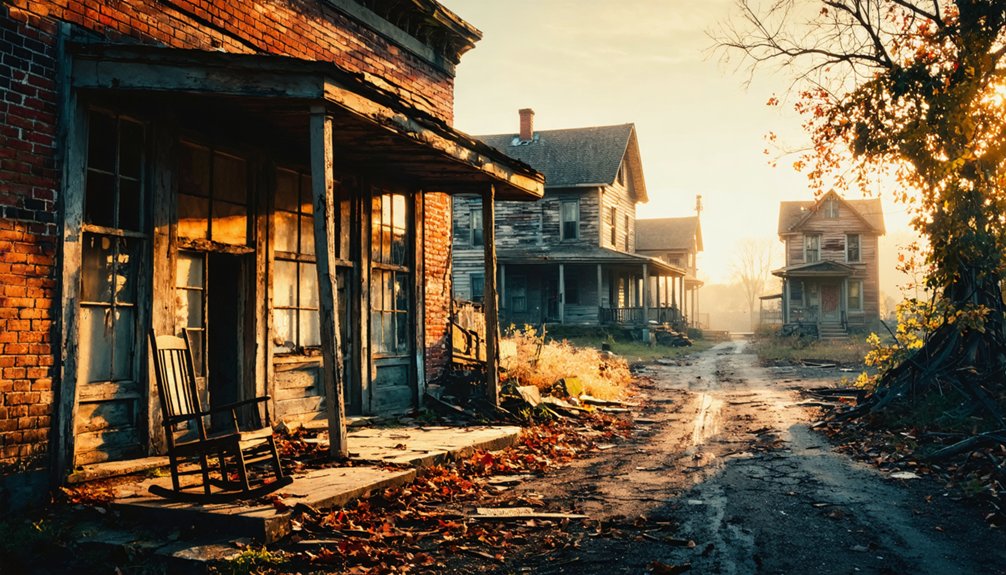
While outsiders might’ve viewed Appalachian company towns as mere collections of utilitarian structures scattered across mountainsides, these settlements functioned as intricate social ecosystems where every aspect of daily life operated under corporate oversight.
You’d quickly recognize the rigid social hierarchy by simply walking through town—executives lived in spacious homes with modern amenities, while your miner ancestors occupied basic dwellings lacking essentials.
Companies controlled your shopping, worship, and even your visitors, with payment in scrip ensuring your dependence on the company store. The truck system kept miners perpetually indebted to company stores where prices were artificially inflated.
Despite these constraints, community resilience flourished. Neighbors supported each other through shared gardens and informal networks.
African Americans and immigrants created cultural institutions that preserved identity amid segregation. Many company towns employed welfare capitalism strategies to prevent unionization efforts by providing limited benefits to workers. When facing hardship, these interconnected communities demonstrated remarkable solidarity, creating bonds that outlasted the companies themselves.
The Role of Transportation: Railroads and Isolation in Town Development
As railroad tracks carved through the rugged Appalachian terrain in the late 19th century, they didn’t merely transport coal and timber—they fundamentally reshaped human settlement patterns across the region.
The railroad impact transformed isolated mountain communities into vibrant economic centers, but geography dictated winners and losers.
You’ll notice that transportation challenges severely limited potential routes—fewer than 10 viable paths existed across 600 miles of mountain terrain.
Towns that secured rail connections flourished, while others withered. Companies like the Baltimore & Ohio and Southern Railway built entire communities around their operations, creating places like Etowah and Cass specifically for railroad functions. The Ghost Town Trail itself originated from the Ebensburg & Black Lick Railroad, which eventually became part of the larger Pennsylvania Railroad system in the early 20th century.
When railroads declined, these dependent communities often collapsed, becoming the ghost towns you can explore today on trails repurposed from the very tracks that once defined their existence. Grafton, West Virginia exemplifies this pattern, having risen to prominence as a B&O Railroad hub before experiencing economic shifts that altered its trajectory.
Moonshine and Mountain Culture: Informal Economies of Ghost Towns

Throughout the hollows and hidden valleys of ghost town Appalachia, moonshine production emerged as far more than an illicit business—it became the lifeblood of an informal economy that sustained entire communities.
In regions where formal employment was scarce, the moonshine economy provided vital cash income that supported families through generations of hardship.
You’ll find the roots of this practice in Scots-Irish traditions, where “uisce beatha”—water of life—transformed into a distinctly Appalachian craft.
These cultural traditions became embedded in local identity despite government persecution. The Whiskey Rebellion of the 1790s exemplified early resistance to government taxation attempts, as farmers defended their right to distill without interference.
Moonshiners ingeniously utilized caves and remote mountain hideaways to conceal their operations, leaving behind artifacts that now tell stories of resistance and survival.
The Red River Gorge area became particularly famous for its hidden production sites with natural springs providing essential water for the distilling process.
This complex legacy reflects both the economic necessity and cultural significance of moonshine—a representation of Appalachian self-reliance that continues to resonate through the remnants of these ghost towns.
When the Waters Rose: Towns Lost to Dam Projects and Reservoirs
As you travel Appalachia’s lakes and reservoirs, entire communities rest silently beneath the waters, sacrificed for flood control and hydroelectric power during the mid-twentieth century.
The Tennessee Valley Authority and Army Corps of Engineers systematically acquired land through eminent domain, forcing thousands from ancestral homes in places like Proctor, Loyston, and Gad.
These submerged settlements persist in memory through family stories, relocated cemeteries, and occasionally visible remnants during drought—ghostly monuments to communities erased by America’s modernization projects. Fontana Dam was rapidly constructed in 1944 to provide electricity for Oak Ridge during World War II, forever changing the landscape and displacing the residents of Proctor. Scuba divers today help preserve these lost histories by exploring and documenting the underwater ghost towns, contributing significantly to local heritage and collective memory.
Communities Beneath Waves
Beneath the placid waters of many Appalachian reservoirs lie the silent remains of once-thriving communities, intentionally submerged during the mid-twentieth century’s dam-building era.
You’ll find a complex legacy of cultural heritage sacrificed for “progress,” as government agencies like the TVA prioritized hydroelectric power and flood control over generational homesteads. Environmental justice concerns weren’t considered when authorities forced families from ancestral lands, often with minimal compensation and little regard for community input.
- Submerged church steeples occasionally becoming visible during droughts, haunting reminders of towns that once existed
- Family graveyards relocated to higher ground, sometimes hastily and incompletely
- Abandoned foundations and streets now explored only by divers, like underwater archaeological sites
These underwater communities represent the tension between technological advancement and the preservation of irreplaceable human connections to place.
Documenting Vanished Settlements
While the waters of Appalachian reservoirs concealed physical evidence of displaced communities, dedicated historians, photographers, and former residents have worked tirelessly to preserve their memories through various documentation efforts.
You’ll find these vanished legacies captured in oral histories, where former residents of towns like Loyston and Proctor share stories of life before the floods. Annual reunions serve as living archives where descendants gather to keep community connections intact despite physical separation.
Photographers have documented remaining structures and ruins that emerge during drought conditions, revealing ghostly echoes of settlements once vibrant with life.
These preservation efforts aren’t merely nostalgic—they’re acts of resistance against erasure, ensuring that government-mandated displacements don’t wash away cultural heritage alongside the physical landscape. Through documentation, communities assert their right to remember what was forcibly taken.
National Parks and Displacement: The Elkmont Story
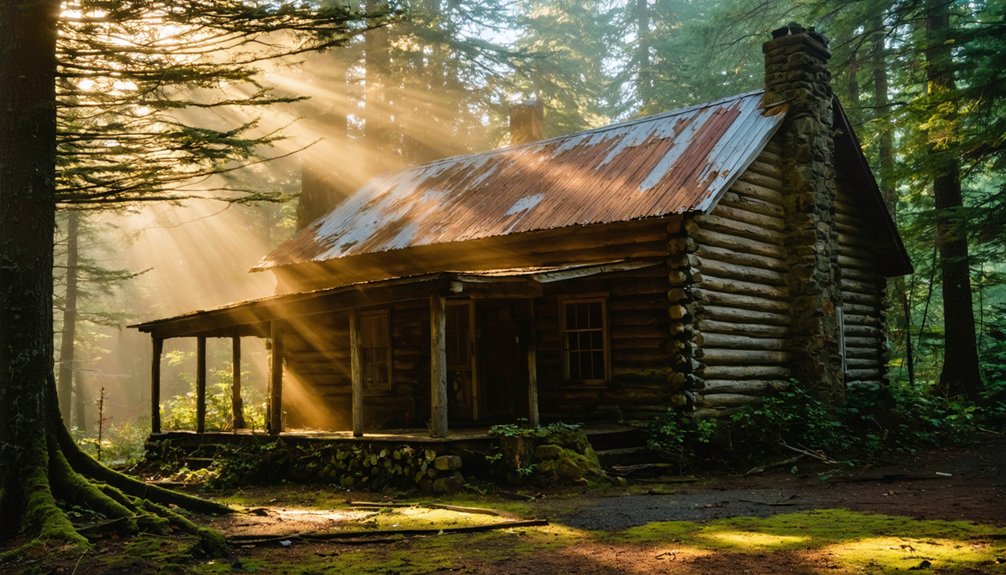
When the Great Smoky Mountains National Park was established in 1934, the residents of Elkmont faced a stark choice that would ultimately erase their community from the map.
This displacement narrative exemplifies the paradox of conservation: preserving wilderness often means sacrificing human settlements.
Elkmont’s transformation—from logging town to elite resort to ghost town—mirrors the shifting values of American conservation policy.
The visual remnants of this community resilience include:
Crumbling structures and fading pathways stand as silent monuments to those who once called Elkmont home.
- Abandoned “set-off houses” once moved by logging crews
- The weathered Wonderland Hotel ruins, where Knoxville’s wealthy once danced
- Overgrown paths where the Little River Railroad once carried both logs and weekend vacationers
You’re witnessing the physical embodiment of a community’s forced sacrifice for what the government deemed a greater good.
Preserving Vanishing History: Conservation Efforts and Documentation
When you explore Appalachia’s ghost towns today, you’re witnessing the fruits of intensive digital archiving efforts that preserve structural details and oral histories before they vanish completely.
Archaeological site protection measures now safeguard these vulnerable locations from both natural deterioration and human interference through carefully implemented conservation protocols.
These preservation initiatives represent a race against time as preservationists balance public access with protection, creating thorough digital records that future generations can study even if physical remnants eventually disappear.
Digital Archives Movement
As America’s industrial landscape evolved away from coal and timber, a different kind of preservation movement emerged across Appalachia’s forgotten communities.
Digital preservation efforts now capture what remains of these vanishing towns through archival technology at institutions like East Tennessee State University and Appalachian State University.
You’ll find these collections particularly essential for understanding Appalachia’s complex history:
- Over 1,000 oral histories documenting firsthand accounts of life in now-abandoned mining communities
- Digital repositories containing 1,500+ photographs showcasing daily existence before economic collapse
- Thunder Bay enclosure systems protecting digitized manuscripts and primary materials from environmental threats
Federal grants like the “Save America’s Treasures” program recognize these collections as crucial cultural heritage, enabling rapid digitization of materials that would otherwise deteriorate and disappear—much like the towns they document.
Archaeological Site Protection
The physical remnants of Appalachia’s ghost towns stand as fragile monuments to industrial history, their preservation now dependent on coordinated conservation efforts across multiple fronts. Organizations like SAHC and TVA have pioneered archaeological site protection through strategic land acquisition, placing ethics at the forefront of conservation planning.
Their collaborative work with federal agencies creates a protective framework against unauthorized development and vandalism.
The delicate balance between site accessibility and preservation poses ongoing challenges. When you visit places like Elkmont or Blue Heron, you’re witnessing the results of careful archaeological documentation—where test excavations, surveys, and oral histories have informed preservation strategies.
Despite harsh weather, limited funding, and remote terrain complications, these protected sites offer essential windows into Appalachia’s vanishing cultural landscapes—safeguarded through National Register listings and strategic public access protocols.
Tourism and Memory: Exploring Abandoned Appalachian Settlements Today
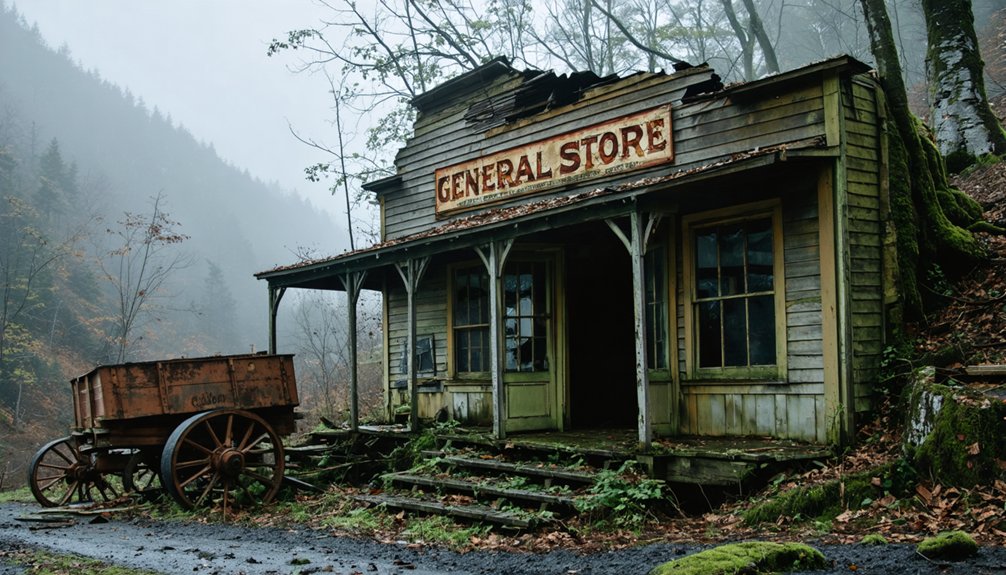
Once forgotten relics of a bygone era, abandoned Appalachian settlements have emerged as powerful sites of cultural memory and tourism development in recent decades.
Through thoughtfully preserved ghost town narratives, you’ll witness how these spaces transform into outdoor museums where cultural tourism connects visitors emotionally with the region’s complex social and economic history.
Stories etched in abandoned timbers invite modern pilgrims to confront the haunting reality of Appalachia’s boom-and-bust legacy.
When you explore these forgotten communities, you’ll experience:
- Stone chimneys and foundations that silently testify to resilient mountain communities along interpretive trails
- Restored cabins housing exhibits that bring to life the struggles and triumphs of former residents
- Immersive walking tours through abandoned streets where the eerie nostalgia evokes reflection on impermanence
These experiences don’t merely preserve history—they revitalize local economies, with sites like the Virginia Creeper Trail demonstrating how heritage can fuel sustainable economic renewal.
Frequently Asked Questions
What Diseases or Epidemics Affected Ghost Town Populations?
You’d find tuberculosis ravaged Appalachian coal towns, while polio turned communities into virtual ghost towns. Yellow fever, pellagra, smallpox, and modern disease outbreaks continue this pattern of devastating health epidemics.
How Did Weather Patterns and Natural Disasters Shape Town Abandonment?
While you might think climate change is recent, extreme weather devastated Appalachian towns for generations. Flooding from dams and catastrophic storms destroyed essential infrastructure, accelerating environmental impact and forcing communities to abandon their once-thriving homes.
Were Ghost Towns Sites of Civil War or Labor Conflict?
Yes, you’ll find both Civil War influences in places like Lost Cove and extensive labor conflict in coal towns like Thurmond, where workers’ struggles shaped their ultimate abandonment.
What Archaeological Methods Are Used to Study Appalachian Ghost Towns?
You’d think ghost towns vanish without a trace, but archaeologists uncover their secrets using remote sensing, LIDAR mapping, excavation techniques, artifact analysis, and oral histories—revealing forgotten communities beneath Appalachia’s reclaimed landscapes.
The ghost towns of the Civil War often serve as poignant reminders of the past, where entire communities were uprooted in the name of conflict. Exploring these abandoned settlements provides insights into the daily lives of those who once called them home, shedding light on personal stories and lost traditions. As these remnants are carefully studied, they reveal the complex interplay between war and community resilience in a changing landscape.
How Did Indigenous Populations Interact With These Settlement Communities?
You’ll find indigenous populations engaged in complex cultural exchange with settlers, trading goods while managing territorial conflicts. Settlement dynamics shifted from cooperation to displacement as European-American development intensified across Appalachia.
References
- https://appalachian.org/lost-cove-ghost-town-in-the-national-forest/
- https://www.blueridgeoutdoors.com/go-outside/southern-ghost-towns/
- https://appalachianmemories.org/2025/10/16/the-lost-towns-of-appalachia-the-forgotten-mountain-communities/
- https://www.thewanderingappalachian.com/post/the-underwater-towns-of-appalachia
- https://www.visitmysmokies.com/blog/smoky-mountains/about-elkmont-ghost-town/
- https://www.appalachianhistory.net/2021/04/the-vanished-community-of-lost-cove.html
- https://www.youtube.com/watch?v=3F_Gv_xp3Y4
- https://www.ncpedia.org/history/1776-1860/mountain-settlement
- https://manifold.open.umn.edu/read/complete-text/section/e33db79f-5a34-489e-a550-a0e034564e29
- https://fiveable.me/hs-appalachian-studies/unit-3/early-appalachian-settlements/study-guide/v51bmJKQKflQD5fq