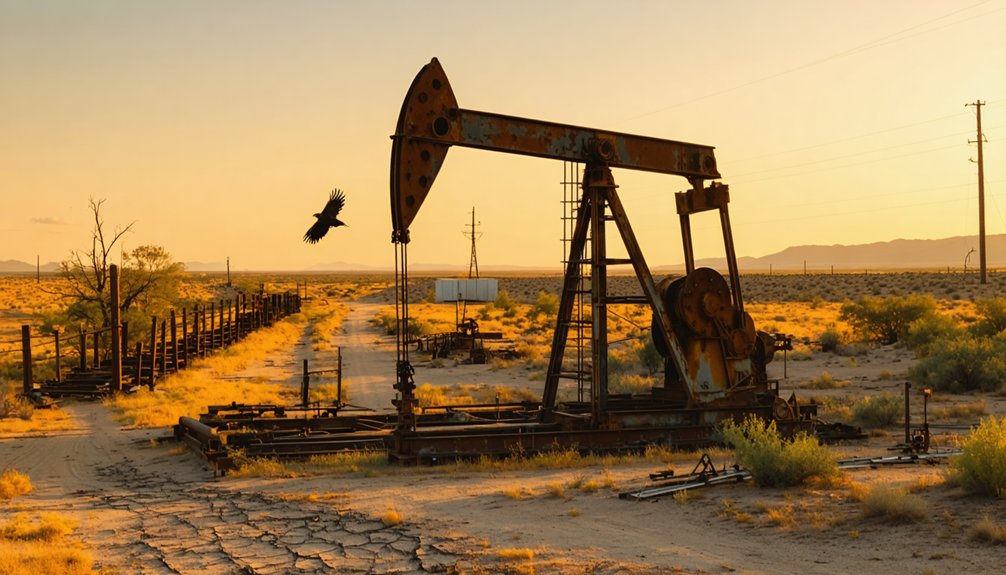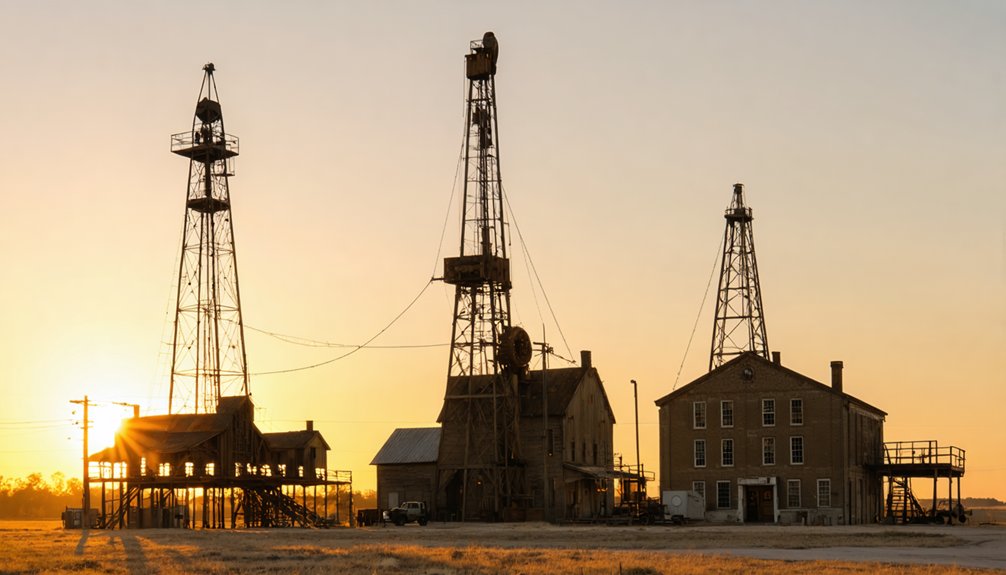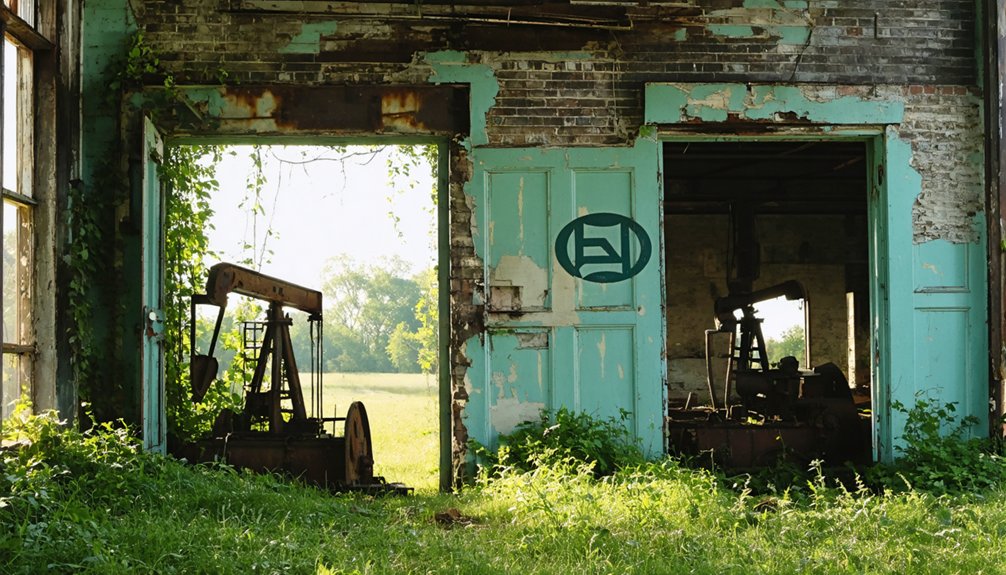
America’s lost oil towns reveal a fascinating chapter of boom-and-bust cycles, where settlements like Pithole exploded from wilderness to 15,000 residents in months before vanishing. You’ll find these petroleum-fueled communities left behind archaeological remnants, historical markers, and environmental legacies including thousands of abandoned wells that still impact landscapes today. Their stories offer vital insights into how extractive industries can swiftly build and abandon communities once resources deplete or markets shift.
Key Takeaways
- Archaeological exploration reveals rapid development patterns in abandoned oil towns like Pithole, where 15,000 residents once lived.
- Pennsylvania’s preservation efforts at former boomtown sites maintain physical remnants while interpreting the boom-bust cycle for visitors.
- Researchers study visible infrastructure ruins to understand how early petroleum communities managed explosive growth and eventual decline.
- Annual commemorative events like “Wildcatter Days” help connect modern Americans with their industrial heritage through abandoned town sites.
- Environmental scientists document legacy contamination at ghost town locations, where thousands of orphaned wells continue impacting surrounding ecosystems.
The 500-Day Wonder: Pithole’s Meteoric Rise and Fall

When the first oil well erupted along Pithole Creek in the summer of 1865, few could have anticipated the explosive urban development that would transform Thomas Holmden’s rural Venango County farmland into America’s most dramatic boomtown.
Within months, Pithole’s demographics shifted dramatically from empty land to a thriving metropolis of 15,000-20,000 inhabitants.
The town quickly established impressive infrastructure including streets, water works, and a fire department to support its rapidly growing population.
Samuel Van Syckel’s introduction of the first oil pipeline revolutionized transportation and dramatically reduced costs for producers.
Oil extraction operations expanded from a single 250-barrel-per-day well to a staggering industrial complex producing one-third of America’s total oil output.
You’d have witnessed 54 hotels, multiple churches, and a bustling post office handling 5,000 letters daily—Pennsylvania’s third busiest.
Black Gold Fever: What Drove the Rush to Pennsylvania’s Oil Fields
Although America’s first commercial oil well had been drilled in Titusville in 1859, it wasn’t until the convergence of multiple economic and social forces that Pennsylvania’s oil fields transformed into the epicenter of a national frenzy.
You’re witnessing a perfect storm in this historical moment: Civil War veterans seeking new fortunes, accessible drilling technology that reached shallow oil deposits, and soaring demand for kerosene as America industrialized.
The economic impact rippled through society as land values skyrocketed overnight. When Edwin Drake reached a depth of 69.5 feet with his pioneering well, he unleashed not just oil but a wave of exploration throughout the Allegheny River Valley. Newspapers amplified success stories, fueling public perception of oil as the quickest path to wealth.
What drove people wasn’t just profit but the promise of social mobility in a rapidly changing nation. The oil fields represented freedom from conventional social hierarchies—a place where laborers and immigrants could strike it rich through determination and luck. By 1862, the booming industry was producing three million barrels of oil annually, demonstrating the explosive growth of petroleum production.
A Boomtown’s Infrastructure: Building a City Almost Overnight

As Pennsylvania’s oil boom gained momentum in the late 19th century, the physical transformation of rural landscapes into functioning urban centers occurred at a pace previously unseen in American development.
The unprecedented metamorphosis of Pennsylvania’s countryside into industrial hubs rewrote the timeline of urban development in America.
You’d witness communities racing through developmental stages that normally took decades—compressed into months—as they constructed essential infrastructure for drilling operations and housing for incoming workers.
These boomtowns faced extraordinary infrastructure challenges: hastily built roads buckled under constant heavy transport, water systems struggled to serve industrial and residential needs simultaneously, and electrical grids expanded haphazardly.
This rapid development often outpaced regulatory frameworks, resulting in unsafe conditions and environmental concerns.
The municipalities that survived this tumultuous growth typically invested strategically in sustainable infrastructure, while those that merely patched together temporary solutions faced devastating consequences when production inevitably slowed. Similar to Texas oil towns, these areas experienced soaring real estate values as demand for housing and commercial space rapidly outstripped available supply.
The transition from initial exploration to mature production created a predictable four-stage development cycle that communities could anticipate as they evolved from boom to operational stability.
The Great Fire of 1866: Beginning of the End for Pithole
While the hasty infrastructure development of Pennsylvania’s boomtowns created inherent vulnerabilities, nowhere were these weaknesses more catastrophically exposed than in Pithole during the Great Fire of August 2, 1866.
This inferno destroyed several city blocks, consuming 27 oil wells and 13,000 barrels of oil, accelerating Pithole’s economic decline. The fire represented just one of seventeen documented fires that plagued the town between August 1865 and December 1866.
You’ll find the catastrophe reflected the town’s complete disregard for fire safety:
- 900 wooden structures packed on narrow streets
- Densely positioned oil derricks and wooden tanks
- Absence of safety protocols for oil storage
- Uncleared debris from previous fires
- Smoking prohibition enforced by lynching threats
The town’s rapid population collapse from 15,000 to just 2,000 by December 1866 was a direct consequence of these devastating environmental conditions.
Ghost Town Economics: How Market Forces Doomed Oil Boomtowns
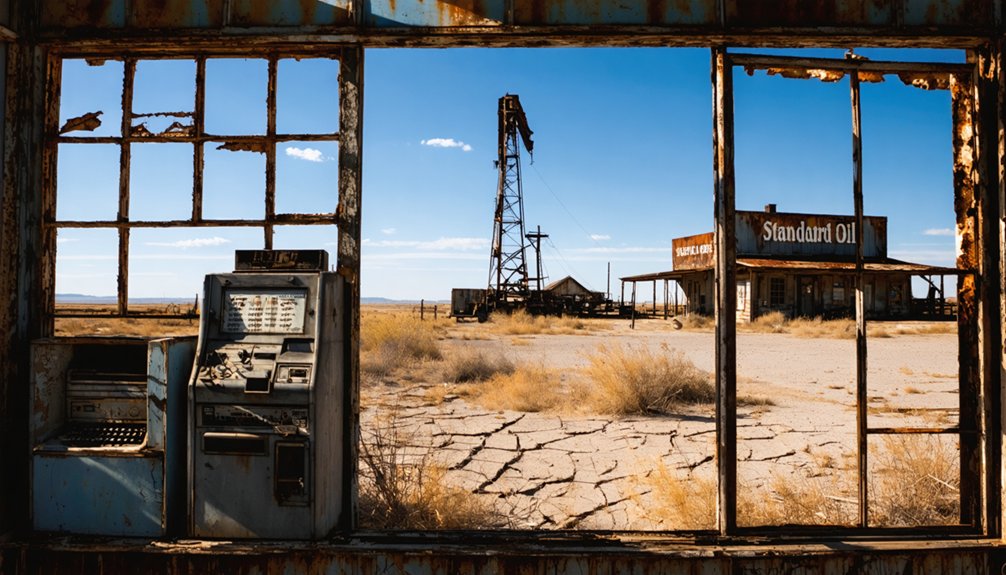
You’ll find that oil boomtowns followed predictable economic patterns where rapid growth invariably collapsed once drilling profitability plummeted.
These cycles left behind towns whose buildings held greater value as salvageable materials than as functional structures, creating economic incentives for dismantling rather than maintaining communities. Studies show that counties experiencing oil booms ultimately suffered from long-term decline in per capita income and educational attainment compared to similar non-boom communities. Employment statistics reveal a concerning trend where the US oil and gas industry witnessed a 40% job loss over the past decade, despite substantial increases in production.
The market forces that initially attracted capital and labor to these remote locations ultimately engineered their abandonment when extraction costs exceeded potential returns.
Boom-Bust Profit Cycles
The economic underpinnings of America’s ghost oil towns reveal a recurring pattern of unsustainable growth followed by devastating collapse. You’ll recognize this signature oil dependence in virtually every abandoned boomtown across Texas, Oklahoma, and beyond.
exploring oil fields in ghost towns often uncovers remnants of a thriving past, with rusty rigs and forgotten equipment standing as silent witnesses to their former glory. As history unfolds, these locations become a canvas for understanding the broader implications of resource exploitation and environmental impact. Residents who once flocked to these boomtowns now share stories that illuminate the harsh realities of economic instability and the fleeting nature of wealth tied to natural resources.
Markets once flush with capital quickly dried up when crude prices plummeted or wells ran dry, exposing communities with minimal economic resilience.
- Land speculation drove prices up tenfold within months
- Infrastructure developed exclusively for petroleum extraction
- Local businesses thrived solely on oil worker expenditures
- Municipal budgets became dependent on petroleum revenues
- Boom-cycle businesses closed rapidly during downturns
These profit cycles created a predictable trajectory: rapid wealth accumulation followed by devastating busts.
The absence of economic diversification meant that when oil went bust, everything collapsed—from tax bases to social institutions, leaving behind the haunting ruins you’ll find today.
Salvage Value Economics
Beyond the cyclical patterns of boom and bust lies the cold reality of salvage value economics—the final financial calculation determining a boomtown’s fate.
When extraction activities cease, you’ll find communities grappling with stranded assets—infrastructure built during prosperity that quickly becomes obsolete. The brick storefronts that replaced wooden structures and tent cities now stand empty, deteriorating monuments to failed economic sustainability.
In western North Dakota and across historical mining regions, fixed investments in housing and commercial properties often retain minimal salvage value once populations disperse. This economic endgame explains why approximately one-third of Williston’s population remained non-permanent—workers instinctively understood the impermanence.
Infrastructure that once symbolized prosperity transforms into financial liability when boom conditions evaporate, leaving behind physical remnants of market forces that communities couldn’t control or counterbalance through diversification.
Preserving America’s First Oil Rush: Pithole’s Modern Conservation
After the spectacular rise and fall of Pithole as an oil boomtown in the 1860s, preservation efforts began nearly a century later when the Commonwealth of Pennsylvania acquired the historic site in 1963, recognizing its significance in America’s petroleum history.
Modern conservation strategies focus on historical interpretation rather than traditional preservation, as few physical structures remain.
Revealing history through landscape and stories where physical structures have long since vanished into time.
When you visit today, you’ll find:
- A Visitor Center established in 1975 featuring exhibits and a detailed diorama
- Mowed pathways that delineate original street layouts
- Annual “Wildcatter Days” with guided tours and living history programs
- A 15-minute orientation film titled “Pithole USA”
- Archaeological remnants visible beneath recovered vegetation
The Drake Well Museum and Pennsylvania Historical Commission maintain this cultural landscape where America’s volatile oil industry first demonstrated the boom-and-bust cycle that would define resource extraction economics.
Walking Through History: Experiencing Pithole’s Grassy Streets Today
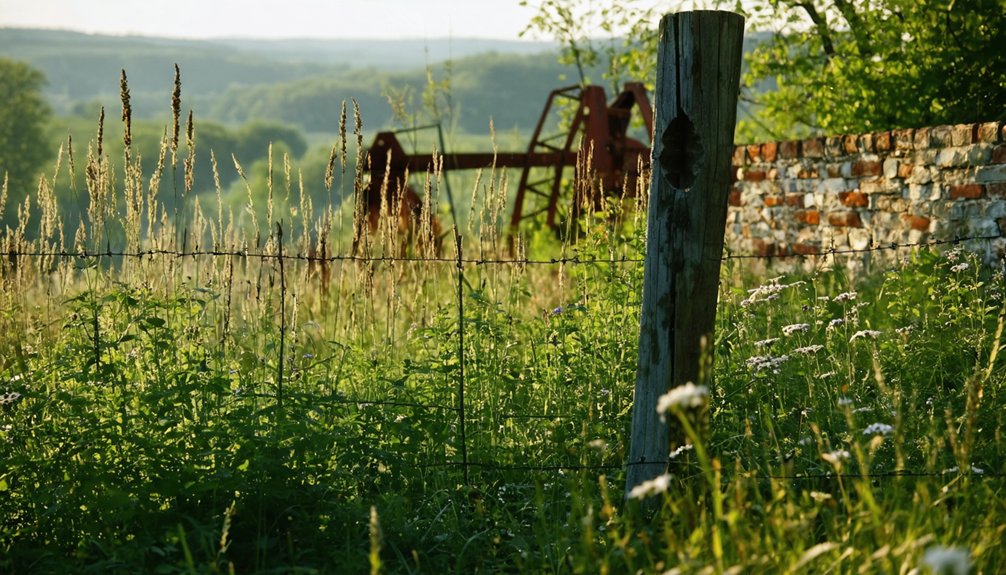
Visiting Pithole’s grassy streets today offers a striking contrast to the chaotic boomtown that once teemed with thousands of oil speculators, workers, and entrepreneurs between 1865-1866.
Where 900 wooden structures once crowded narrow thoroughfares, you’ll now find only foundations and interpretive markers across the 90-acre site. Pithole preservation efforts have maintained the ghostly grid pattern where the third-busiest post office in Pennsylvania once processed correspondence for 20,000 residents.
Historical reenactments occasionally breathe temporary life into this landscape where devastating fires consumed buildings “almost every day” during the town’s collapse.
Walking these grounds, you’re traversing the same paths where 54 hotels, an 1,100-seat theater, and countless oil derricks stood before the catastrophic economic dissolution reduced the population by over 90% within eighteen months.
From Pennsylvania to Texas: The Migration of American Oil Booms
While Pennsylvania’s oil boom laid the foundation for American petroleum production, the industry’s gravitational center progressively shifted southwestward to Texas by the early 20th century.
America’s petroleum epicenter migrated from Pennsylvania to Texas, reshaping the nation’s industrial landscape forever.
This economic migration transformed America’s industrial landscape as oil exploration techniques developed in Titusville found application in Texas’s vast petroleum reserves.
- Corsicana’s 1894 discovery marked Texas’s first significant entrance into the oil industry
- Spindletop’s 1901 gusher (100,000 barrels daily) triggered massive urban expansion
- Beaumont exploded from 10,000 to 50,000 residents virtually overnight
- East Texas Oilfield (1930) became America’s largest onshore reservoir with 5.2 billion barrels produced
- Former boomtowns like Pithole City declined while Texas centers like Houston evolved into industrial hubs
You’re witnessing a pivotal shift where technological innovations from Pennsylvania’s fields enabled Texas’s domination of American petroleum production for decades to come.
Environmental Legacy: The True Cost of Abandoned Oil Wells
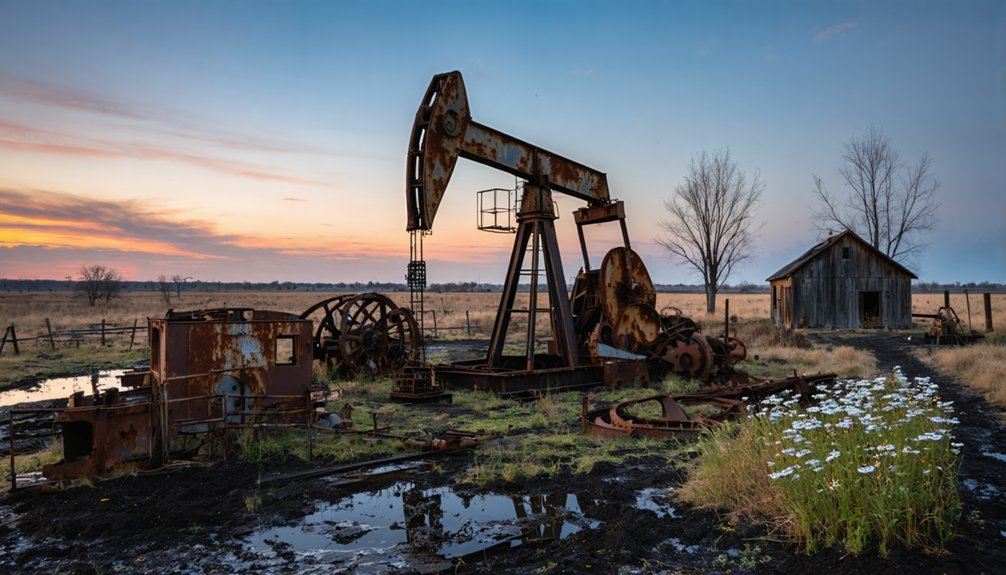
Beneath the nostalgic veneer of America’s oil boom legacy lies a troubling environmental reality: abandoned oil wells continue to exact severe ecological and economic costs decades after their productive lives end.
These orphan wells release methane equivalent to emissions from 2-5 million cars annually, with undocumented wells potentially contributing up to 36% of total U.S. methane emissions from abandoned sites.
You’ll find approximately 35% of documented orphan wells within 1km of drinking water sources, yet only 8% have nearby water monitoring—creating significant health risks.
The environmental impact extends beyond pollution; property values decline up to 50% in areas with high well density, while remediation costs average $75,000 per well but can exceed $1 million.
Despite nearly $4.7 billion in federal funding, estimates suggest this falls 30-80% short of total plugging costs needed to address this contamination crisis.
Lessons From Lost Towns: What Pithole Teaches About Resource-Dependent Communities
When examining the meteoric rise and catastrophic fall of Pithole, Pennsylvania, you’re witnessing a quintessential case study in resource-dependent community vulnerability.
Pithole’s trajectory illuminates critical failures in resource management and community resilience that remain relevant today.
- Economic monoculture created extreme vulnerability to market fluctuations
- Transient population lacked long-term investment in community sustainability
- Infrastructure built for speed rather than permanence accelerated decline
- Absence of economic diversification strategies guaranteed collapse when oil production waned
- Rapid abandonment prevented adaptive reuse or measured shift
The town’s collapse from 20,000 residents to virtual abandonment within 18 months represents the danger of boom-town development without strategic planning.
Pithole’s rapid demise serves as a stark warning against unsustainable economic development fueled by resource extraction fever.
Communities dependent on extractive industries must heed Pithole’s cautionary tale—prosperity built solely on resource extraction can’t withstand the inevitable bust.
Frequently Asked Questions
What Happened to Pithole’s Residents After the Town’s Collapse?
Like birds fleeing a withering tree, you’d have witnessed Pithole’s residential migration to other oil boomtowns, with survivors facing harsh economic aftermath—returning to farming or dispersing throughout Pennsylvania by 1870.
How Did Pithole Compare to Other Oil Boomtowns in Size and Production?
Pithole’s unparalleled growth to 20,000 residents and 1,200 barrels daily production exceeded most contemporary boomtowns, which typically developed over years rather than months and produced less oil initially.
What Daily Life Activities Occurred in Pithole During Its Peak?
You’d experience bustling commerce, mail services, banking transactions, religious gatherings, and robust leisure activities including theater performances, gambling, and social events within community establishments that fostered Pithole’s vibrant, albeit transient, collective life.
Were There Any Notable Inventions or Innovations Created in Pithole?
Iron snakes slicing through earth’s crust—you’ll find Van Syckel’s pioneering oil pipeline stands as Pithole’s most significant innovation, revolutionizing petroleum transport while eliminating dependence on costly teamsters. Water distribution systems followed this transformative Pithole invention.
Did Any Wealthy Oil Barons From Pithole Maintain Their Fortunes Afterward?
You’ll find virtually no oil baron legacies from Pithole survived the bust. Their fortunes evaporated with plummeting oil prices, destructive fires, and depleted wells—emblematic of fortune preservation challenges in early petroleum speculation.
References
- https://www.aapg.org/news-and-media/details/explorer/articleid/63602/pithole-the-rapid-rise-and-sudden-fall-of-an-oil-boomtown
- https://grist.org/abandoned-oil-gas-wells-permian-texas-new-mexico/
- https://aoghs.org/petroleum-pioneers/pithole-creek/
- https://www.geotab.com/ghost-towns/
- https://www.youtube.com/watch?v=oW66pgyhMYM
- https://okmag.com/blog/a-ghostly-site/
- https://en.wikipedia.org/wiki/Pithole
- https://savingplaces.org/guides/ghost-towns-on-route-66
- https://fee.org/articles/pithole/
- https://wordpress.lehigh.edu/specialcollections/2016/06/24/pithole-pennsylvania-oil-boom-ghost-town/