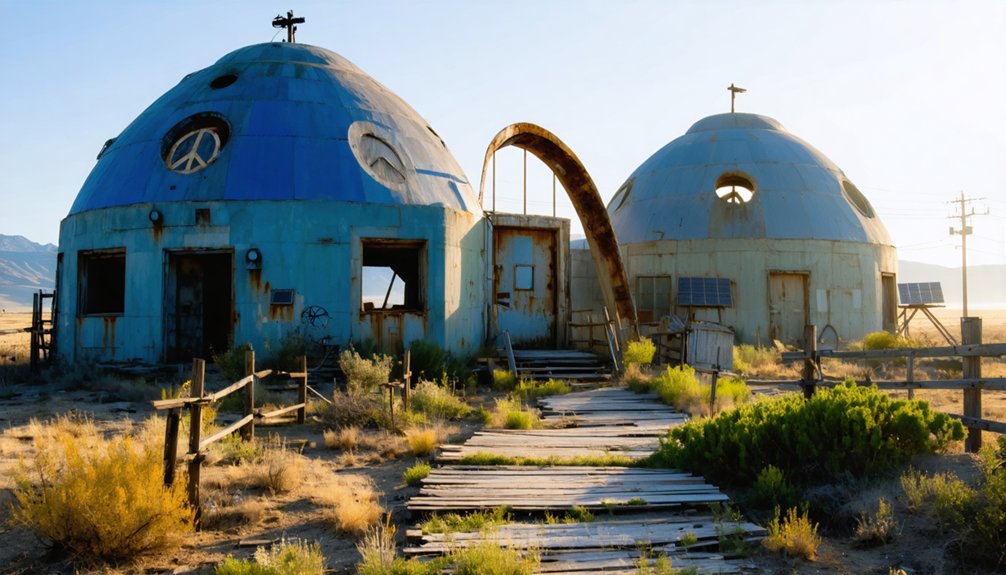
American ghost towns like Utopia, Ohio and Soul City reveal ambitious 19th and 20th century experiments in communal living. You’ll find remnants of societies founded on spiritual harmony, racial equality, and economic innovation—communities that ultimately collapsed due to environmental disasters, political opposition, and economic unsustainability. From California City’s vast empty grid to Allensworth’s Black autonomy vision, these abandoned sites offer physical evidence of America’s utopian impulse. Their ruins hold valuable lessons about collective dreams and practical realities.
Key Takeaways
- Failed utopian settlements like California City and Soul City reveal ambitious visions for social reform ultimately thwarted by economic, environmental, and political obstacles.
- Archaeological exploration of abandoned sites preserves craftsmanship and architecture that embodied radical philosophies of equality, collectivism, and spiritual harmony.
- Former utopian communities attract modern pilgrims seeking connection to alternative social models through physical engagement with historical spaces.
- Communal layouts featuring central meeting houses and clustered residences materialize foundational values of democratic participation and community bonding.
- Ghost towns like Utopia, Ohio and Allensworth preserve stories of communities that challenged mainstream society with experimental governance and economic systems.
The Rise and Fall of American Utopian Communities

While the American landscape is littered with forgotten towns and abandoned settlements, many of these places began with lofty ambitions far beyond mere economic prosperity.
You’ll find that 19th-century utopian communities emerged from religious sectarianism, social reform movements, and reactions against industrialization. Communities like the Rappites, Shakers, and Oneida sought to manifest utopian ideals through collective ownership and alternative social structures. The experimental communities reached their peak in the 1840s as Americans sought greater equality and harmony in response to rapid economic change. The freedom of religion guaranteed in the U.S. Constitution created fertile ground for these communities, attracting persecuted European groups seeking to establish self-contained societies away from urban centers.
The delicate community dynamics of these experiments often proved unsustainable. Robert Owen’s New Harmony collapsed after just two years due to internal conflicts. Similarly, Brook Farm’s intellectual aspirations couldn’t overcome financial realities.
Even successful communities like Oneida eventually transformed into conventional businesses. Most utopian settlements ultimately faltered from economic unsustainability, leadership disputes, or ideological fracturing—their lofty visions ultimately succumbing to practical challenges of maintaining alternative societies within the broader American context.
Similarly, abandoned communities in California serve as a testament to the difficulties of sustaining idealistic initiatives in a capitalist landscape. The remnants of these once-thriving enclaves reveal both the dreams they pursued and the stark realities that ultimately led to their decline. Each structure left behind tells a story of ambition thwarted by the pressing demands of economic viability and social cohesion.
Dreams Washed Away: The Tragedy of Utopia, Ohio
You’ll find few stories as tragically ironic as that of Utopia, Ohio, where John O. Wattles established a spiritualist commune in 1847 with grand visions for a 35,000-year era of peace.
The community’s hopeful future vanished on December 13, 1847, when a catastrophic Ohio River flood destroyed their town hall during a social gathering, killing most residents and cementing the settlement’s ghostly reputation. The floodwaters crested at 63 feet, causing devastating damage to the riverside settlement. This tragic event occurred after Wattles had relocated the community closer to the river in pursuit of better opportunities.
In the aftermath, survivors abandoned their utopian experiment, and despite modest attempts at reorganization in the 1850s, the combination of economic unsustainability and the lingering trauma transformed the once-idealistic community into what would eventually be renamed Smith’s Landing.
Spiritualist Commune Origins
After the collapse of the Clermont Phalanx in 1846, spiritualist leader John O. Wattles established Utopia on the banks of the Ohio River.
You’ll find his vision stemmed from experience with previous communal experiments, including Prairie Home Community. Purchasing part of the divided 1,140-acre Fourierist property, Wattles created a haven for spiritual practices and communal living experiments.
- Séances and spirit communications formed the core of their daily spiritual practices
- Their belief in a coming 35,000-year era of peace drove their optimistic worldview
- Despite advocating spiritual unity, they maintained private property systems
- The community’s resilience manifested when they moved essential buildings riverside just before a devastating flood
Unlike their predecessors, Utopia’s spiritualists embraced a unique economic model based on labor notes and equitable exchange, rejecting profit from others’ work while honoring individual liberty. The tragic December 13, 1847 flood claimed many lives as community members succumbed to drowning or hypothermia. This spiritualist community eventually failed, and the location was purchased by Josiah Warren in 1874.
Fatal Flood’s Aftermath
On the fateful night of December 13, 1847, Utopia’s spiritual vision drowned beneath the merciless surge of the Ohio River’s worst nineteenth-century flood.
You’d have witnessed the town hall—relocated days before to the river’s edge—collapse as icy waters rushed through its south wall. Most of Wattles’ Spiritualist followers perished, swept away by hypothermic currents during what began as an ordinary dance. The tragedy mirrored the 1913 disaster that would later strike Ohio, with seven inches of rainfall falling in just 36 hours.
The few flood survivors abandoned their utopian experiment, their community resilience shattered by profound loss. The communal building, which had been relocated brick by brick from its original location, became a symbol of misguided ambition. By 1875, only scattered original residents remained in what became Smith’s Landing. The underground ritual chambers and communal living spaces stood empty.
Today, you’ll find this ghost town remembered through local paranormal lore—mysterious dripping sounds and inexplicable noises haunt the site, especially on rainy nights, echoing the dreams that perished in Utopia’s watery grave.
California City: The Metropolis That Never Was
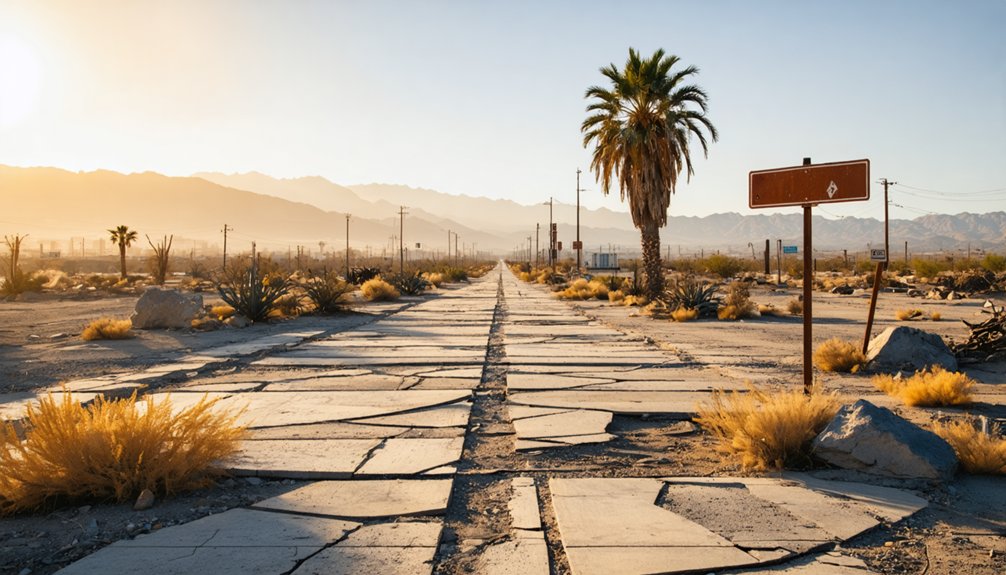
Driving through California City today, you’ll witness the skeletal remains of Nat Mendelsohn’s ambitious vision—a metropolis designed to rival Los Angeles with infrastructure for 400,000 residents.
The vast grid of empty streets etched into the Mojave Desert represents one of America’s largest land development failures, where despite millions invested in infrastructure between 1958-1974, population never exceeded a few thousand residents.
This desert ghost town exemplifies how speculative real estate ventures collapsed when corporate priorities shifted from community-building to asset extraction, leaving behind a haunting memorial to unfulfilled utopian aspirations. The city’s development was severely hampered by its remote location and persistent dust storms that discouraged potential residents from settling permanently. The city remains a cautionary tale of urban planning, with the eastern half largely undeveloped and empty while the western side contains the minimal infrastructure supporting its current 13,000 residents.
Desert Dreams Abandoned
When Nat Mendelsohn surveyed the vast Mojave Desert landscape in 1958, he didn’t see desolation but rather the canvas for what would become America’s next great metropolis. His desert aspirations envisioned a 400,000-resident city with seven distinct communities—university, medical, industrial, and residential districts meticulously planned.
Despite infrastructure investments and aggressive marketing, the vision failure became evident as population growth stagnated at 1,309 by 1970, far short of projections.
- Empty streets and cul-de-sacs stretch across the landscape like skeletal remains of unfulfilled promises
- 59,000 parcels sold to hopeful investors now languish in perpetual anticipation
- Water infrastructure built for thousands serves merely hundreds
- The sprawling street grid, visible from space, serves as a monument to capitalism’s speculative excess
Failed Futuristic Metropolis
Although Nat Mendelsohn’s ambition materialized on paper as a master-planned metropolis in the Mojave Desert, California City stands today as perhaps America’s most profound example of utopian urban failure.
When you drive through its vast grid of empty streets, you’re witnessing futuristic aspirations crumbled under corporate greed and regulatory intervention.
After Mendelsohn’s 1969 sale, the Hunt brothers’ hostile takeover decimated prospects for this would-be rival to Los Angeles. The FTC’s 1970s crackdown on deceptive marketing practices and subsequent class-action lawsuits sealed its fate.
Now, urban isolation defines this geographic giant with just 14,000 residents—a mere fraction of its projected 400,000 population.
The recent prison closure further challenges survival, while cannabis cultivation hopes withered from water scarcity.
California City reminds us how easily dreams of freedom can dissolve into desert dust.
Soul City: Black Empowerment and Broken Promises
Among the most ambitious yet ultimately doomed Black empowerment initiatives of the post-civil rights era, Floyd B. McKissick’s Soul City represented a radical vision of economic self-determination.
Built on former plantation land in rural North Carolina, this planned community sought to transform racial inequality through Black-led development and cultural pride.
You’ll find that Soul City’s utopian vision faced systematic political opposition, particularly from Senator Jesse Helms, whose efforts undermined federal support despite audits proving no financial misconduct.
- Streets named for African American heroes established a powerful community identity
- The vision of 50,000 residents with 24,000 jobs challenged economic segregation
- Federal funding withdrawal in 1979 crushed development momentum
- The project’s sabotage revealed America’s discomfort with Black economic autonomy
When Idealism Meets Reality: The Llano Commune Experiment

You’ll find few utopian experiments that embodied socialist idealism as thoroughly as the Llano Commune, founded by Job Harriman in 1914 on 20,000 acres of unforgiving Antelope Valley desert.
Despite its rapid growth to nearly 1,000 residents and impressive development of communal infrastructure—including farms, factories, and educational facilities—the colony struggled against the harsh realities of limited water resources and agricultural constraints.
The combination of environmental challenges, financial mismanagement, wartime pressures, and ideological conflicts ultimately transformed this ambitious socialist experiment into another ghost town, though its influence extended through the New Llano Colony established in Louisiana by departing members.
Socialist Vision Meets Adversity
When socialist visionary Job Harriman established the Llano del Rio Commune in 1914, he couldn’t have foreseen the profound challenges his utopian experiment would face. His cooperative community near Palmdale, California represented a bold manifestation of socialist principles in practice—equal wages, shared housing, and collective ownership through stock purchases.
You’d find approximately 900 to 1,500 residents at its peak, all united by their rejection of competition in favor of cooperation.
- The economic barrier of requiring 2,000 shares of stock contradicted the community’s egalitarian aspirations
- Residents sacrificed individual autonomy for collective security
- The experiment stood as America’s most ambitious attempt to validate socialism’s practicality
- Despite its idealism, the commune confronted the harsh realities of translating theory into sustainable community practice
Desert’s Unforgiving Reality
The harsh Antelope Valley desert swiftly undermined Llano’s utopian aspirations, revealing the gap between socialist ideology and environmental practicality.
As you explore the history of this socialist experiment, you’ll find that desert survival became Job Harriman’s most formidable opponent—not capitalism’s critics.
Despite investing in 20,000 acres of land, the colonists couldn’t overcome the harsh conditions that threatened their communal vision.
Water scarcity, poor soil, and extreme temperatures made agricultural self-sufficiency nearly impossible.
These environmental challenges forced a pragmatic decision: relocate or perish.
Allensworth: An African American Haven in the California Desert
Nestled within California’s Central Valley lies one of America’s most poignant utopian experiments—Allensworth, a town founded in 1908 by Colonel Allen Allensworth and four other visionary Black men who sought to create a self-governed African American community free from the oppressive racial discrimination that defined early 20th century America.
This remarkable symbol of African American resilience and utopian aspirations established an extensive community infrastructure with its own governance, school, and economic systems.
- You’ll find in Allensworth’s history the embodiment of post-Civil War Black autonomy dreams
- You’re witnessing the creation of California’s first town established and governed solely by African Americans
- You’re confronting the painful reality of how environmental and economic factors can undermine even the most noble social experiments
- You’re exploring a settlement that persists as a historical landmark, preserving a critical chapter in American freedom struggles
Environmental Factors in Utopian Community Collapse

Throughout the storied history of utopian settlements, environmental constraints have repeatedly emerged as decisive factors in community collapse, often undermining even the most idealistic social experiments like Allensworth.
You’ll find that climatic challenges—droughts, floods, and erratic weather patterns—intensify resource scarcity, destabilizing agricultural sustainability and water security. When poor soil quality combines with insufficient arable land, communities face imminent food shortages.
These environmental pressures magnify existing governance failures, as leadership struggles to maintain social cohesion under ecological stress. The relationship works bidirectionally: population pressures accelerate deforestation and water contamination, crossing critical ecological balance thresholds that make collapse inevitable.
Environmental justice concerns emerge as resource degradation disproportionately impacts vulnerable community members. History demonstrates that successful communities adapt socially and ecologically to environmental constraints, while those that fail to monitor and respond to ecological warning signs face rapid dissolution.
Architectural Remnants and Spatial Visions of Perfect Societies
While environmental constraints often delivered the final blow to utopian settlements, their architectural and spatial legacies endure as physical manifestations of once-vibrant idealistic visions.
When you explore these ghost towns, you’ll discover deliberate spatial arrangements that prioritized communal interaction through central plazas, grid layouts, and integrated public spaces. The architectural symbolism embedded in these settlements—from Gothic revival elements to vernacular adaptations—conveyed founders’ values of equality, spirituality, and collective purpose.
- Crumbling dining halls where residents once shared meals, embodying rejection of private ownership
- Workshop ruins revealing commitment to self-sufficiency and dignified labor
- Meeting houses positioned centrally, celebrating democratic participation as sacred practice
- Modest residential clusters demonstrating how spatial proximity was engineered to nurture community bonds
These communal spaces weren’t merely functional—they were physical manifestations of revolutionary social philosophies.
The Role of Government and Politics in Utopian Experiments
When utopian experiments flourished across America in the nineteenth century, their relationship with external governance structures created profound tensions that often determined their ultimate fate. Communities lacking formal legal frameworks, like Owen’s New Harmony, collapsed partially due to insufficient internal authority mechanisms.
You’ll find that utopian settlements operated on a spectrum of governmental interaction. Some secured remarkable autonomy—the Mormon community in Nauvoo wielded enough political power to maintain the state’s largest armed force.
Others, like the Inspirationists, faced persecution for refusing military service mandated by state authorities.
Colonial-era experiments operated under government charters that initially embraced utopian ideals through legal frameworks. Over time, political ideologies increasingly shaped these communities, as movements evolved from purely religious foundations toward addressing broader social reform, reflecting shifting American values around perfectibility and progress.
Modern Pilgrimages: Exploring America’s Abandoned Utopias Today
Ruins of America’s abandoned utopian experiments now attract a new kind of seeker—the modern pilgrim who approaches these ghost towns not merely as a tourist, but as one commencing on a transformative journey.
You’ll find these pilgrimages transcend conventional tourism when they connect you to collective memory through physical and spiritual engagement.
Modern pilgrimages led by figures like John Lewis forge dialogue across political and racial divides, offering redemptive narratives amid today’s social fractures.
- Walking the same paths as idealistic Shakers or Brook Farm intellectuals grounds you in their lived experience.
- Witnessing preserved craftsmanship reveals how utopian values materialized in daily objects.
- Standing in communal spaces evokes the tension between individual freedom and collective responsibility.
- Participating in commemorative events transforms historical appreciation into personal transformation.
Frequently Asked Questions
Were Any Utopian Communities Economically Successful for a Significant Period?
Like ships steering economic tides, you’ll find the Shakers, Rappites, and Mormons achieved remarkable economic sustainability through structured communal labor, producing quality goods and maintaining thriving communities for decades during the antebellum period.
How Did Children’s Education Function in These Experimental Communities?
You’d find children’s education centered on practical skills alongside academics, with curriculum development emphasizing self-reliance and pedagogical methods promoting natural learning through community participation rather than rigid discipline—all designed to cultivate freedom-minded future citizens.
Did Any Utopian Settlements Survive and Evolve Into Conventional Towns?
Yes, you’ll find utopian legacies persisting in places like the Amana Colonies and Bishop Hill, where idealistic communes evolved into conventional towns through cultural adaptations, shifting from shared ownership to private enterprise while preserving historical foundations.
What Role Did Women Play in Founding and Leading Utopian Communities?
Women leaders like Sophia Ripley co-founded communities such as Brook Farm, ensuring equal participation in communal roles while challenging gender norms through educational initiatives, religious mentorship, and preservation of utopian legacies.
How Did These Communities Address Healthcare and Aging Populations?
With 57% of rural healthcare infrastructure collapsed by 1980, you’ll find utopian communities pioneered remarkable healthcare innovations, including communal care systems for aging populations that challenged institutional models until economic resources diminished.
References
- https://www.youtube.com/watch?v=8imWf4vkOCQ
- https://archive.curbed.com/2019/5/31/18639098/california-city-failed-utopia-ghost-town
- https://www.messynessychic.com/2016/04/19/the-all-black-utopian-ghost-city-that-lost-its-soul/
- https://www.latimes.com/lifestyle/image/story/2023-05-11/architecture-of-communes-in-california-tells-a-story-of-utopia
- https://en.wikipedia.org/wiki/List_of_American_utopian_communities
- https://www.legendsofamerica.com/ah-utopias/
- https://www.ranker.com/list/american-ghost-towns/alby-thompson
- https://bellinghamalive.com/lifestyle/mines-utopias-tour-area-ghost-towns/
- https://open.baypath.edu/his114/chapter/utopian-communities/
- https://www.britannica.com/story/american-utopias