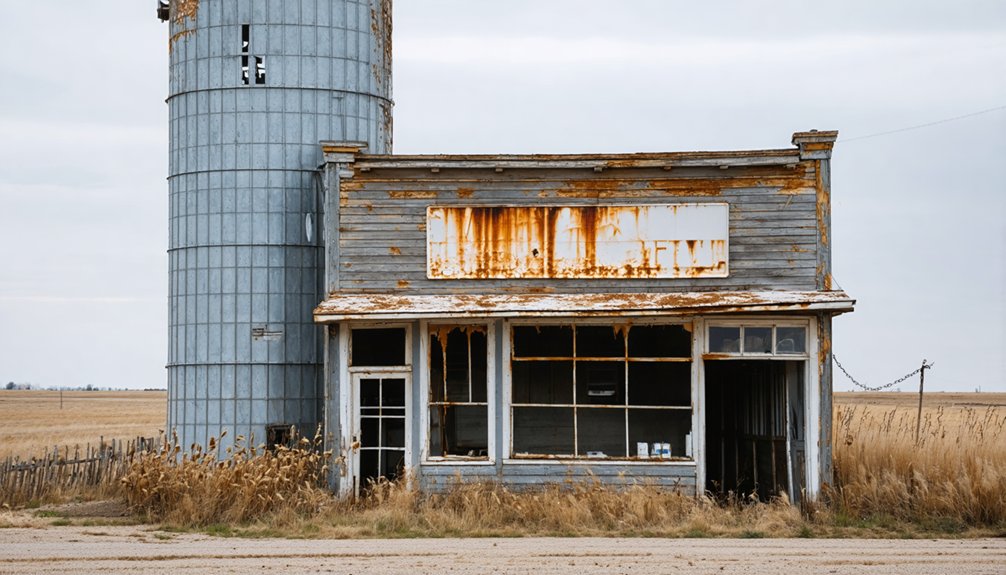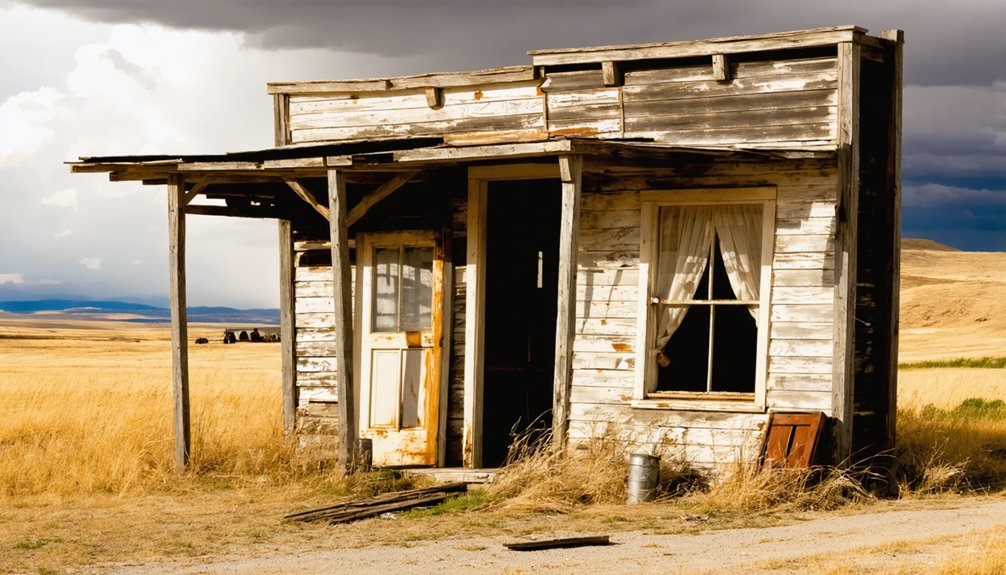
Great Plains ghost towns tell stories of communities abandoned due to environmental disasters like the Dust Bowl, railroad bypasses, and economic collapse. You’ll find grain elevators standing as lone sentinels where towns once thrived, alongside empty schoolhouses and churches that once formed essential social hubs. These forgotten places reflect generational exodus, agricultural mechanization, and the profound loss of community bonds. Their weathered structures hold untold histories waiting to be discovered.
Key Takeaways
- Abandoned grain elevators stand as silent sentinels across the Great Plains, marking sites of once-thriving agricultural communities.
- The Dust Bowl forced over 500,000 Americans into homelessness and precipitated the collapse of numerous rural settlements.
- One-room schoolhouses served as educational cornerstones and social hubs until their closures often spelled death for small towns.
- Photographers document deteriorating structures as historical time capsules, capturing the architectural details of places rendered obsolete.
- Some ghost towns transform into heritage tourism destinations, creating economic opportunities through preservation of authentic pioneer structures.
The Dust Bowl’s Forgotten Casualties: Towns Swallowed by Sand
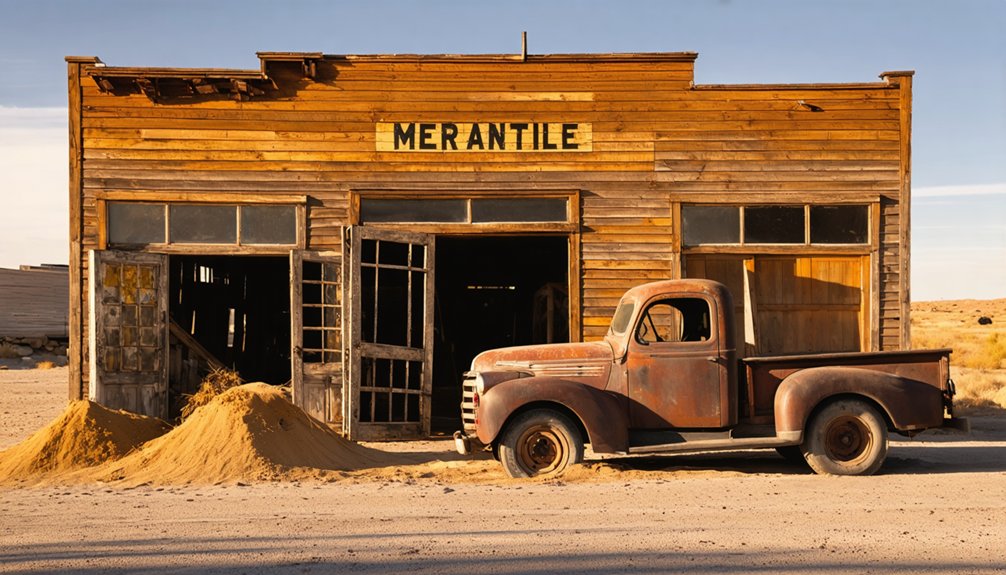
While the Dust Bowl’s environmental catastrophe is well documented in American history, the profound human toll on entire communities remains underexplored in popular narratives. You’d scarcely recognize these forgotten legacies—over 500,000 Americans rendered homeless and hundreds of houses destroyed in single storms.
The devastation spanned 100 million acres, with 16 million acres severely wind-eroded. Walk through these silent streets of abandoned towns like Dearfield, Colorado, and you’ll witness the ghosts of communities dismantled by ecological collapse.
These settlements didn’t simply fade—they were violently erased when 2.5 to 3.5 million people fled the Plains between 1930-1940. Water sources vanished, children developed fatal dust pneumonia, and grasshopper plagues destroyed what little remained. Once-thriving communities like Dearfield saw their seasonal creeks and wells dry up completely, making agriculture impossible. The infamous Black Sunday of April 14, 1935 created apocalyptic conditions with extreme winds and near-zero visibility, forcing many remaining residents to finally abandon their homes.
Communities weren’t just abandoned—they were obliterated, as millions fled ecological apocalypse and disease swept through what remained.
The collapse wasn’t gradual but catastrophic, swallowing entire towns beneath drifting dunes of soil.
Railroad Dreams: Communities That Died Waiting for Trains
Throughout the Great Plains, skeletal remains of once-hopeful communities dot the landscape, their existence predicated on railroad promises that never materialized.
Railroad speculation transformed the region’s settlement patterns, with thousands of towns established in anticipation of steel rails that would connect them to distant markets.
You’ll find their stories reflect both tragic miscalculation and remarkable community resilience.
These boom-and-bust cycles followed three distinct patterns:
- Towns that built complete infrastructure—schools, churches, hotels—only to be bypassed when routes changed
- Communities that thrived briefly before railroad companies abandoned or sold their lines
- Settlements like Yeso, New Mexico that collapsed from hundreds of families to near-desertion when diesel engines eliminated the need for frequent stops
Many of these abandoned settlements now exist as shadowy semblances of their former vibrant communities, with deteriorating structures standing as silent witnesses to unfulfilled economic dreams.
The Dust Bowl era of the 1930s further accelerated the abandonment of many Great Plains communities, turning economic hardship into complete desolation.
Grain Elevator Sentinels: Last Structures Standing

Sentinels of agricultural prosperity, grain elevators stand as the final architectural witnesses to countless disappeared communities across the Great Plains.
You’ll find these towering wooden structures—often six stories tall with capacities from 20,000 to millions of bushels—marking sites where vibrant towns once thrived. Built alongside railroad tracks, they served as both economic lifelines and social hubs where farmers gathered and information spread.
Despite their vulnerability to devastating fires and grain dust explosions, many elevators outlasted the towns they served, persisting after banks, schools, and post offices closed. In towns like Kevin in Toole County, these structures remain as lone sentinels of the once-bustling homesteading era.
Today, grain elevator preservation efforts represent more than architectural conservation—they embody rural identity revival movements across Oklahoma, Montana, and Alberta. Once positioned every six miles along railways to accommodate horse-drawn wagon travel, these structures tell the story of prairie settlement patterns.
These enduring landmarks tell stories of agricultural ambition, community resilience, and freedom etched against prairie horizons.
One-Room Schoolhouses: Education in Vanishing Communities
As the Great Plains developed in the early 1900s, one-room schoolhouses emerged as critical educational cornerstones, eventually numbering in the tens of thousands across the region’s vast landscape.
These humble structures cultivated an educational legacy that produced literacy rates exceeding many other regions, despite being staffed by young female teachers who often possessed only eighth-grade educations themselves.
When you explore these abandoned prairie sentinels today, you’ll discover how they served communities beyond basic education:
- Social hubs hosting weddings, funerals, and religious services
- Cultural centers where immigrant children assimilated through recitation and memorization
- Community anchors whose closures through mid-century consolidation often spelled death for the towns they served
This one-room nostalgia represents not merely educational institutions but the heartbeat of communities that vanished alongside them. Typically placed about 30 miles apart, these schools were strategically positioned to serve populations within reasonable traveling distance. The Federal Land Ordinance of 1785 initially established support for these rural public schools by setting aside specific township sections for educational purposes.
Boom and Bust: Mining Towns of the Plains
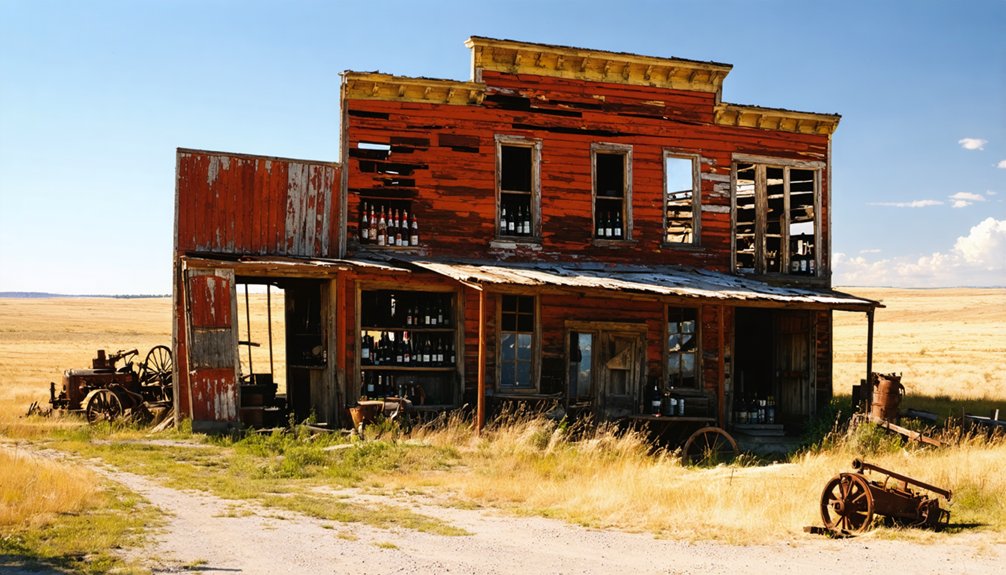
When the Great Plains yielded its buried treasures of gold, silver, lead, and copper in the late 19th century, a dramatic cycle of creation and abandonment reshaped the region’s landscape.
You can trace these mining legacies through places like the Black Hills, where towns exploded from nothing to thousands of residents within months. The discovery of placer gold in 1874 by General Custer’s expedition sparked a population boom with settlements appearing around the Homestake Mine, which ultimately produced over 40 million ounces of gold. The Comstock Lode area witnessed its population surge from 100 to 20,000 in just two years (1859-1861). Prospectors from around the world traveled great distances seeking fortunes in the Colorado Mineral Belt and other resource-rich areas.
Mining boomtowns transformed emptiness into metropolises overnight, with populations exploding from nothing to thousands in mere months.
These settlements followed predictable economic shifts—booming with mineral wealth, then collapsing when deposits depleted. Railroad connections determined which towns survived. Some vanished completely, while others evolved into tourist destinations.
Beyond their $50+ billion mineral output, these towns left complicated inheritances: multiethnic workforces, distinctive terraced layouts, environmental degradation, and displaced Native American communities.
Churches Without Congregations: Sacred Spaces Left Behind
While mining towns rose and fell with the fortunes of mineral wealth, the spiritual anchors of Great Plains communities met their own distinct fate.
These abandoned sanctuaries, once vibrant hubs of social and religious life, now stand as silent witnesses to demographic shifts, economic downturns, and cultural transformations. Their architecture—from modest wooden structures to imposing stone edifices with bell towers and stained glass—embodies the aspirations of early settlers.
When exploring these cultural legacies, you’ll discover:
- Former congregations often dissolved due to agricultural mechanization, railroad rerouting, and urban migration.
- Preservation efforts range from complete restoration to photographic documentation of deteriorating structures.
- These empty churches symbolize both loss of community identity and potential for heritage tourism.
These sacred spaces represent physical reminders of the freedom pioneers sought and the challenges rural America continues to face.
Ghost Towns Reborn: Heritage Tourism on the Plains
The transformation of abandoned settlements into heritage tourism destinations represents one of the most promising revitalization strategies for Great Plains ghost towns today.
You’ll find communities like Paxico, Kansas reinventing themselves through boutique shops and frontier festivals that celebrate their cultural heritage while stimulating local economies.
Ghost town revitalization often involves preserving structures in “arrested decay,” as seen in Bodie, California, offering authentic connections to pioneer life.
The heritage tourism impact extends beyond preservation—visitors to sites like Sand Creek Massacre spent nearly $392,000 in nearby communities in 2023.
These economic benefits create employment opportunities and increased demand for lodging and dining in remote areas.
While some communities resist tourism development, many embrace their frontier narratives, mining histories, and cultural identities as pathways toward sustainable economic futures.
Generational Exodus: Why the Young Never Returned
You’ll find that economic limitations across the Great Plains have created a persistent barrier for young adults, who seek diverse career opportunities unavailable in their rural hometowns.
Educational pathways frequently direct youth away from these communities, as higher education institutions concentrate in urban centers and rarely emphasize rural development or agricultural innovation.
The weakening of community bonds—through school consolidations, diminishing social institutions, and aging populations—further erodes the cultural infrastructure that might otherwise entice younger generations to return.
Economic Limitations Persist
Despite significant demographic shifts and economic changes throughout the Great Plains over the last century, fundamental economic limitations persist as the primary driver behind the region’s generational exodus.
Without sufficient economic infrastructure, rural communities can’t offset natural population dynamics that favor metropolitan areas, where 92% of regional growth occurs.
You’re witnessing the culmination of decades-long structural constraints:
- Agricultural mechanization eliminated traditional employment paths while consolidation closed entry points for new farmers.
- Metropolitan counties provide diversified career opportunities unavailable in rural areas where business development stagnated.
- Limited infrastructure connectivity isolates rural communities, preventing integration into broader economic networks.
When two-thirds of rural counties experience consistent population loss, the pattern becomes self-reinforcing.
Young adults seek economic liberation in urban centers, leaving aging populations without sufficient workforce to attract new enterprises.
Education Pathways Lead Away
When rural students graduate high school in the Great Plains, they face a pivotal decision that often leads them away from their hometowns permanently. This educational migration follows predictable patterns—you’ll notice the 20-30 age group consistently disappearing from census data.
Without local higher education institutions, you’re forced to pursue opportunities elsewhere, forming urban-based networks that rarely lead back home.
School consolidations compound this exodus, as shuttered institutions remove community anchors that might otherwise foster youth retention. Even if you return post-graduation, you’ll confront a job market ill-suited for your credentials. The positions available rarely match your qualifications or aspirations.
This cyclical departure of educated youth creates generational discontinuity, skewing demographics toward older residents and diminishing birth rates—ultimately accelerating the very decline that propelled your departure.
Community Bonds Weakened
The dissolution of community bonds throughout Great Plains ghost towns represents perhaps the most profound consequence of generational exodus.
As young adults migrated to urban centers seeking economic opportunities, the social networks that once defined rural resilience fractured irreparably.
Community resilience eroded through three critical breakdowns:
- Traditional mutual assistance systems collapsed as population densities fell below sustainable levels.
- Closure of schools and churches eliminated central gathering spaces that had fostered intergenerational relationships.
- Remaining elderly residents faced increasing isolation without family support structures.
What you witness today in these forgotten towns isn’t merely economic decline but the unraveling of social fabric itself.
The demographic vacuum left by departing youth—particularly those in their 20s and 30s—created a spiral of diminishing cohesion that proved impossible to reverse, even in historically tight-knit communities.
Photographic Time Capsules: Documenting Disappearing Places
How do photographers preserve the fading memory of Great Plains ghost towns before they vanish entirely? Through meticulous photographic techniques, they create visual time capsules—capturing wide-angle landscapes that dwarf abandoned structures against vast prairies.
Vanishing prairie towns forever frozen in time through the photographer’s careful lens—visual archaeology of America’s forgotten places.
These visual storytelling approaches deliberately exclude people, emphasizing the haunting emptiness that defines these forgotten places. Churches and communal buildings become focal points, with some structures dating back 150 years.
You’ll notice photographers spend hours composing each shot, using tripods to document both exteriors and interiors while highlighting architectural details, artifacts, and decay. Both color and black-and-white formats preserve the textural qualities that evoke historical authenticity.
These images ultimately serve as critical historical documentation, preserving places that environmental challenges and economic shifts have rendered obsolete—before they disappear forever.
The New Ghost Towns: Communities Currently Fading Away
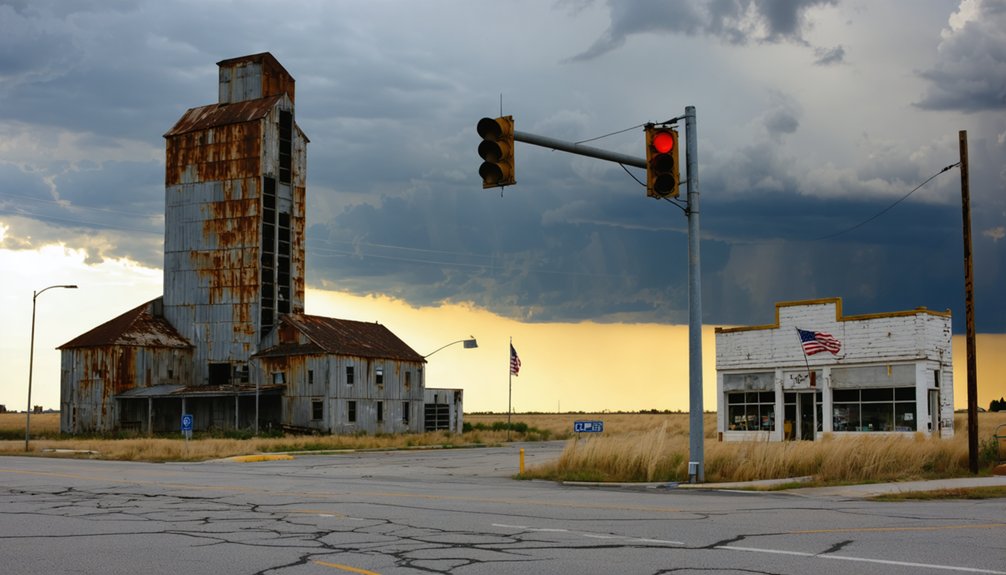
You’ll notice the telltale signs of emerging ghost towns when rural schools consolidate or close entirely, leaving behind empty buildings that once anchored community identity.
The final retail establishments—often a single gas station, post office, or general store—represent the last economic lifelines before complete commercial abandonment in these fading Great Plains communities.
These closing institutions not only eliminate essential services but also eradicate vital gathering spaces where social bonds once maintained population stability against the demographic decline exceeding 20% per decade in the hardest-hit areas.
Rural School Closures
Fading rural schoolhouses across America’s heartland represent a new generation of ghost towns, where economic decline and population loss manifest in educational infrastructure.
You’re witnessing the disintegration of rural education, with public school enrollment projected to fall below 47 million by 2031. When a community’s only school closes, the ripple effects devastate community resilience beyond mere educational disruption.
Consider these sobering realities:
- 68% of districts experienced enrollment declines between 2019-2024, losing approximately 2 million students.
- Seven states face double-digit enrollment declines, with California projected to lose nearly one million students.
- School closures in rural areas can force students into hour-long bus rides to reach the nearest educational facility.
This educational exodus reinforces a cycle of community dissolution, where closing schools accelerates population decline and economic hardship.
Last Businesses Standing
Three critical indicators signal a community’s imminent change to ghost town status: the closure of essential services, plummeting real estate values, and the tenuous survival of last-standing businesses.
Across the Texas High Plains, you’ll find this pattern intensifying as 27 counties experienced population decline from 2022-2023, shrinking customer bases that once sustained local commerce.
The remaining enterprises exhibit remarkable business resilience, typically providing essential services that residents can’t forego—grocery stores, gas stations, and emergency services.
These final establishments often serve wider geographical areas, offsetting local demographic losses. Your freedom to remain in these communities hinges on these businesses’ survival.
This precarious equilibrium faces mounting challenges: declining tax bases cripple infrastructure maintenance while aging buildings deter new investments, creating feedback loops that accelerate abandonment—particularly evident in Texas’s 558 officially recognized ghost towns.
Frequently Asked Questions
How Did Ghost Towns Affect Native American Communities?
You’ve experienced land displacement and cultural erasure as ghost towns signified colonial expansion, severed your connection to traditional territories, decimated resources, and fragmented tribal structures through forced assimilation and relocation.
What Role Did Women Play in Ghost Town Formation?
You’ll find pioneering women were essential community builders in ghost towns, staking land claims, establishing businesses, creating social structures, and fostering early advocacy for women’s rights amid harsh frontier conditions.
How Did Ghost Towns Impact Local Ecosystems?
You’ll find ghost towns created ecological mosaics: wildlife adaptation occurred in abandoned spaces, while soil regeneration followed agricultural cessation—though invasive species, persistent degradation, and climate stressors complicated ecosystem recovery throughout the Plains.
Did Ghost Towns Have Unique Architectural Styles?
Yes, you’ll find Great Plains ghost towns showcase distinctive architectural influences from Spanish Baroque to indigenous designs, though preservation challenges arise from deteriorating materials and limited funding for historic restoration efforts.
Exploring these abandoned spaces often reveals haunted tales from ghost towns that speak of their vibrant pasts and the lives once lived within their walls. The eerie remnants serve as a canvas for stories of hope and despair, drawing curious visitors eager to uncover the mysteries of these lost communities. As twilight descends, the atmosphere thickens with a sense of nostalgia, inviting reflection on the transient nature of history and the echoes of those who once called these towns home.
Were There Successful Resistance Movements Against Town Abandonment?
You’ll find Indigenous resistance movements were most successful, combining spiritual practices with armed defense, while modern town revitalization efforts and community preservation initiatives sometimes rescue declining settlements from complete abandonment.
References
- https://www.lincolninst.edu/publications/articles/new-american-ghost-towns/
- https://plainshumanities.unl.edu/encyclopedia/doc/egp.ct.024.html?stream=top
- https://www.geotab.com/ghost-towns/
- https://www.legendsofamerica.com/gt-emergingghosttowns/
- https://en.wikipedia.org/wiki/Ghost_town
- https://www.loveexploring.com/gallerylist/188219/the-us-state-with-the-most-ghost-towns-revealed
- https://jrap.scholasticahq.com/api/v1/articles/9543-the-economics-of-ghost-towns.pdf
- https://jasontdunn.com/files/ghost_towns_big_cities.pdf
- https://www.richmondfed.org/-/media/richmondfedorg/publications/research/econ_focus/2011/q3/pdf/feature2.pdf
- https://en.wikipedia.org/wiki/Dust_Bowl