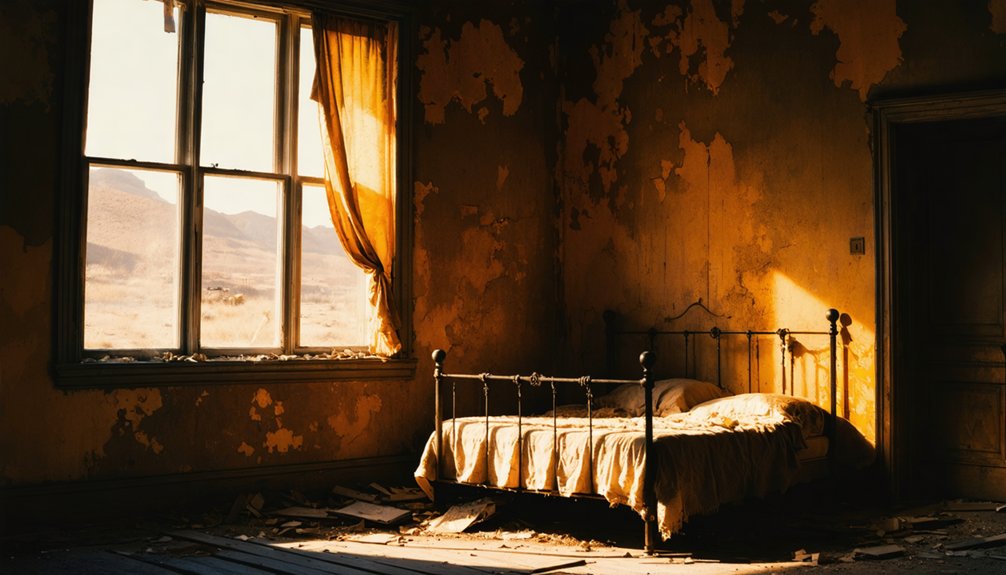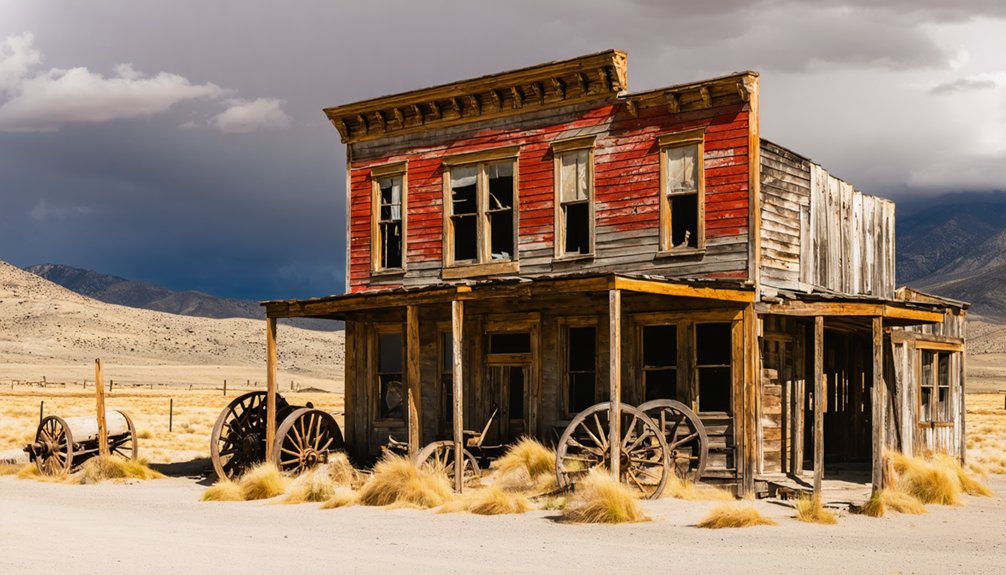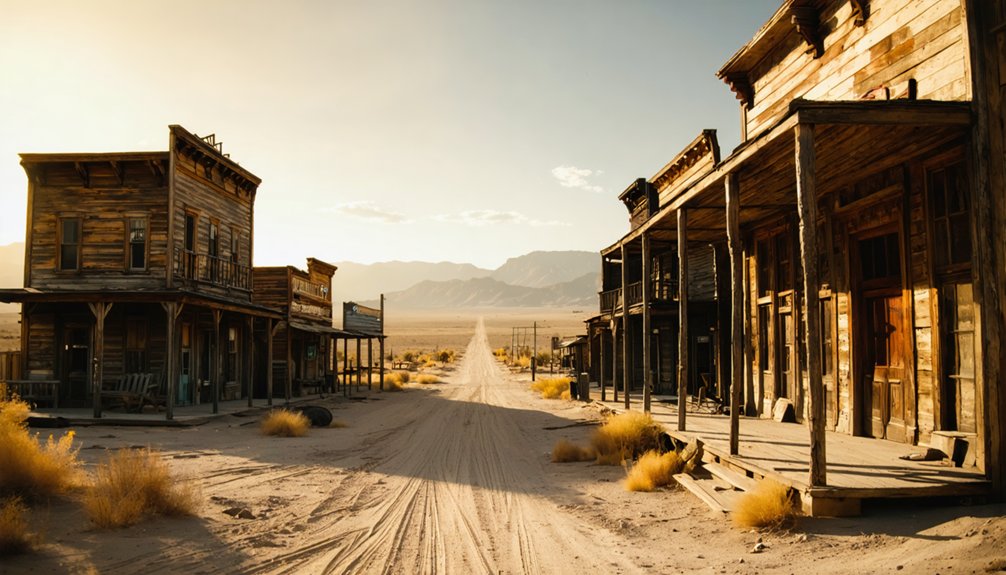
When you explore Western movies set in ghost towns, you’ll find locations that shaped the genre’s gritty authenticity. Filmmakers returned repeatedly to places like Grafton, Utah, Mescal, Arizona, and Contrabando, Texas, because genuine weathering and abandonment created atmosphere no studio set could replicate. Even constructed locations like Pioneertown and Spain’s Oasys MiniHollywood evolved into culturally significant landmarks. Each site carries its own cinematic legacy, and the stories behind them reveal far more than you’d expect.
Key Takeaways
- Paramount Ranch in Malibu served as an iconic Western filming location, featuring remnants of old sets still visible today.
- Pioneertown, established through Gene Autry’s 1952 film, served as a backdrop for over 50 Western productions before becoming a real community.
- Mescal, Arizona, built for *Monte Walsh*, accumulated 70 years of film history, featuring in classics like *Tombstone* and *Winchester ’73*.
- Grafton Ghost Town, abandoned after flooding, offered filmmakers authentic weathered structures and dramatic landscapes near Zion National Park.
- Spain’s Oasys MiniHollywood, located in Tabernas Desert, preserves intact Spaghetti Western sets and has transformed into a popular tourist destination.
Paramount Ranch: California’s Most Visited Western Filming Location
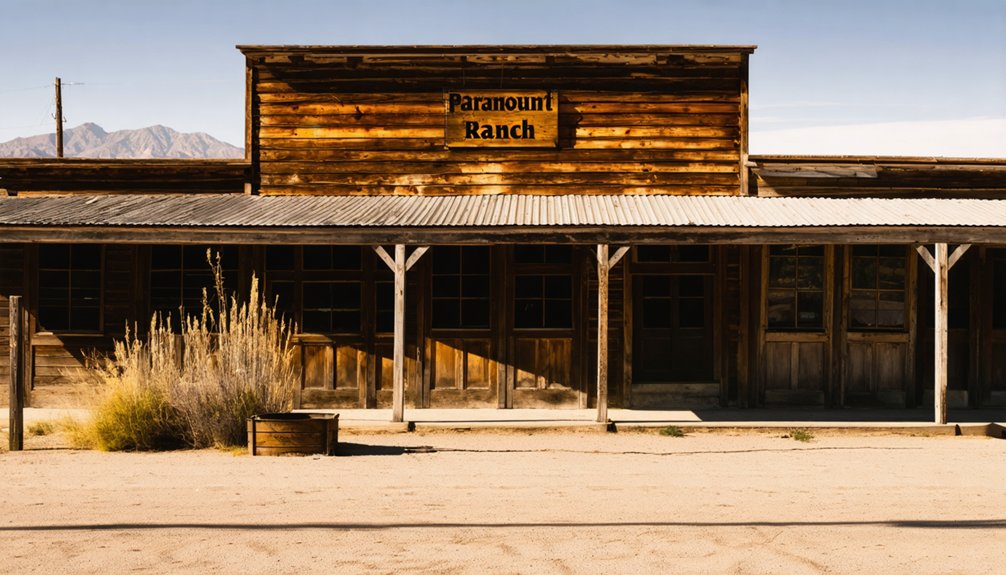
Nestled in the Malibu hills, Paramount Ranch stands as California’s most iconic Western filming location, drawing visitors to its free public park with hiking trails, a fake jail, and remnants of the sets that once brought the Old West to life.
You’ll find its historical significance rooted in TV Westerns like *The Rough Riders* and *Hotel de Paree*, where filming logistics shaped its architectural styles. HBO’s *Carnivàle* temporarily remodeled the ranch into 1930s aesthetics before preservation efforts restored its Western aesthetics.
Today, the remaining train station and church evoke cinematic nostalgia while weeds reclaim forgotten building sites. The ranch’s cultural impact endures through its open access, inviting you to explore spaces where storytelling once defined America’s frontier identity on screen.
Pioneertown: From Gene Autry’s Movie Set to Living Community
When you examine Pioneertown’s origins, you’ll find that Gene Autry’s 1951 film *Silver Canyon* established the location as a premier Western backdrop, launching a legacy that would see the site reused over 50 times for similar productions.
You can trace a clear trajectory in which the town’s identity shifted from active film set to tourist attraction as Hollywood’s appetite for Westerns declined.
What makes Pioneertown particularly distinctive is that, unlike most abandoned film locations, it evolved into a functioning community of roughly 400 residents, blurring the line between cinematic artifice and lived reality.
Gene Autry’s Silver Canyon
Pioneertown served as the backdrop for Gene Autry‘s *Silver Canyon* (1951), a Western featuring Autry alongside Gail Davis and Jim Davis, in which the narrative centers on Union Scouts during a Civil War storyline.
When you examine *Silver Canyon*, you’ll recognize it as a defining example of how purposefully constructed sets shaped the Western genre‘s visual identity. Gene Autry’s production team didn’t stumble upon Pioneertown accidentally — they selected it deliberately for its authentic frontier aesthetic.
The film demonstrates how location choices directly influenced storytelling credibility. You can trace Pioneertown’s cinematic legacy directly through productions like *Silver Canyon*, understanding that Autry’s work here established the town’s reputation as a reliable Western backdrop, ultimately drawing over 50 subsequent productions to its streets.
Pioneertown’s Western Film Legacy
Built as a purpose-designed Western film set, Pioneertown’s trajectory from active production hub to living community reflects a broader pattern in Hollywood’s relationship with physical locations.
You can trace Pioneertown history through its remarkable versatility—the location appeared in over 50 Westerns, demonstrating how studios maximized purpose-built infrastructure.
Yet as Western culture’s commercial dominance faded, the set’s identity shifted fundamentally. Rather than facing abandonment, Pioneertown absorbed approximately 400 permanent residents, transforming from controlled cinematic environment into an authentic community.
This change distinguishes Pioneertown from comparable locations that became either ghost towns or tourist attractions. The site’s evolution reveals how economic forces ultimately determine a film location’s fate—when production revenue dried up, human settlement provided an alternative sustainability that pure preservation efforts rarely achieve independently.
Film Set Turned Community
You can see this evolution clearly: what began as deliberate cinematic artifice gradually attracted 400 permanent residents who chose authenticity over nostalgia.
Film nostalgia certainly draws visitors, but the community itself has transcended its constructed origins.
When Western filmmaking declined, Pioneertown didn’t collapse into abandonment like so many ghost towns. Instead, residents reclaimed the architecture, the streets, the very identity Hollywood manufactured.
The set became home. That transformation represents a rare, counterintuitive victory — cinema accidentally creating genuine community where it once staged fiction.
Mescal, Arizona: From Monte Walsh to Tombstone
Although constructed between 1968 and 1969 specifically for Monte Walsh starring Lee Marvin and Jack Palance, the Mescal area in Arizona quickly transcended its origins as a single-production set, accumulating over 70 years of film history through productions like Winchester ’73 with Jimmy Stewart, The Big Country with Gregory Peck, and ultimately Tombstone in 1993.
Mescal history demonstrates how deliberately built environments can achieve genuine Western authenticity over time. Unlike naturally occurring ghost towns, Mescal’s physical town set earned its credibility through repeated cinematic use, each production layering additional cultural weight onto its structures.
When you examine Tombstone’s success, you’ll recognize that Mescal’s weathered landscape contributed greatly to the film’s atmospheric tension. The location’s longevity proves that constructed spaces can eventually rival historically organic settings in dramatic and cultural significance.
Why Filmmakers Kept Returning to Grafton Ghost Town
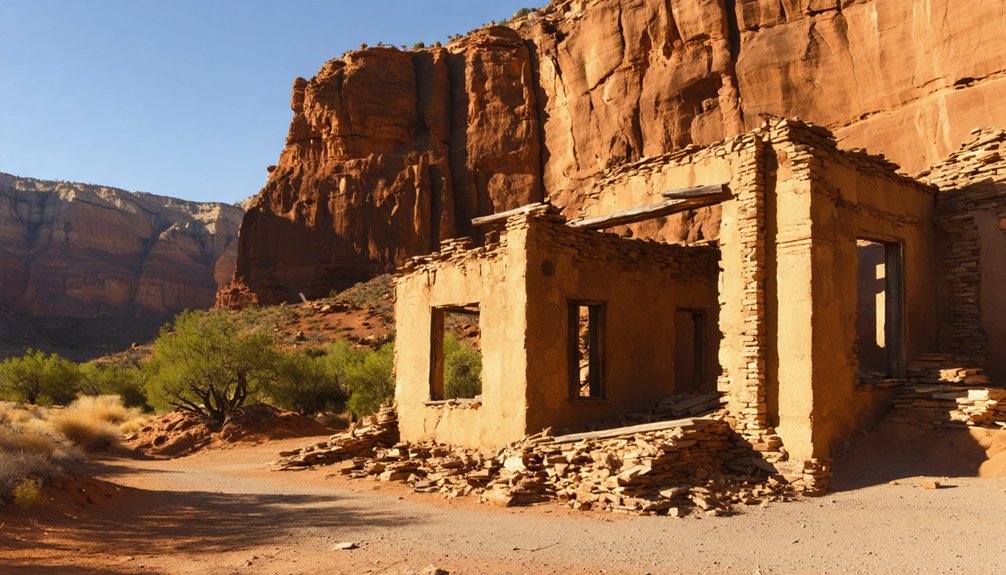
Grafton Ghost Town’s enduring appeal to filmmakers stems from a convergence of historical authenticity and dramatic landscape that purpose-built sets simply can’t replicate.
When you examine filmmaker choices across decades, from *In Old Arizona* to *Butch Cassidy and the Sundance Kid*, you’ll recognize a consistent pattern: directors sought locations where Grafton history speaks visually without manipulation.
Settled in 1859 under Brigham Young’s direction, abandoned after flooding and the Black Hawk War, Grafton carries genuine weathering that costume departments and set designers can’t manufacture.
Its position south of Zion National Park delivers breathtaking natural backdrops that amplify dramatic tension organically.
You’re fundamentally witnessing filmmakers exploiting a site where authentic American hardship literally shaped the physical environment, making every frame inherently credible and emotionally resonant.
Contrabando, Texas: The Ghost Town Clark Gable Left Behind
When you examine Contrabando, Texas, you’ll find a ghost town whose cinematic legacy rests primarily on the 1952 film *Lone Star*, in which Clark Gable and Ava Gardner brought this remote stretch of Texas landscape to life.
Unlike many Western filming locations that evolved into tourist attractions, Contrabando was left fully abandoned after production ended, its silence broken only by the enduring presence of the original Casita building.
You can still visit this deserted land today, where that solitary structure stands as a tangible remnant of Hollywood’s brief but consequential claim on the site.
Clark Gable’s Texas Filming
Nestled in the rugged landscape of Texas, Contrabando served as the backdrop for the 1952 film *Lone Star*, starring Clark Gable and Ava Gardner. This Texas location offered authenticity that studio sets couldn’t replicate, grounding Gable’s legacy in real, untamed terrain.
You can trace the film’s production to this remote stretch of land, where the original Casita building still stands as a silent memorial to Hollywood’s presence. Gable’s work here reflects a broader tradition of filmmakers seeking genuine Texas locations to capture the West’s raw spirit.
Today, Contrabando sits fully abandoned, its desolate atmosphere preserving history without active maintenance. You’re fundamentally walking through cinematic history when you visit, experiencing firsthand how a ghost town shaped one of classic Hollywood’s defining Western productions.
Contrabando’s Abandoned Legacy
This ghost town preservation requires no intervention because abandonment itself preserves the film legacy here.
The original Casita building still stands on deserted land, a tangible artifact connecting 1952’s production to the present.
Unlike managed heritage sites, Contrabando demands that you interpret its silence directly, confronting what remains when commercial interest withdraws and time takes ownership.
The Original Casita Remains
Among Contrabando’s remnants, the original Casita building anchors the site’s identity more concretely than any historical marker could. Unlike reconstructed sets that sanitize history, this structure stands as authentic testimony to the location’s cinematic and cultural past.
You’re looking at a building that survived both Hollywood’s attention and its abandonment—a rare convergence of durability and neglect.
As a ghost town, Contrabando doesn’t romanticize its emptiness. It simply exists, indifferent to your interpretation.
The Casita’s persistence on this deserted Texas land challenges the assumption that abandoned spaces lose meaning. They don’t. They accumulate it.
The original Casita represents what remains when commercial interest evaporates—an unmediated artifact you can examine without institutional framing, offering a direct encounter with history that no curated museum experience replicates.
Oasys MiniHollywood: Where Leone Filmed the Spaghetti West
Deep in the Tabernas Desert of Spain, the barren landscape that Sergio Leone chose for *The Good, the Bad and the Ugly* (1966) still stands as Oasys MiniHollywood, a preserved relic of Spaghetti Western filmmaking.
You’ll find the abandoned town’s buildings, signs, and props remarkably intact, transforming one of cinema’s most Iconic Locations into a thriving tourist destination.
Leone’s vision redefined Spaghetti Westerns, stripping away Hollywood’s romanticized heroism and replacing it with moral ambiguity and raw survival.
When you walk through Oasys MiniHollywood today, the eerie atmosphere reinforces what made these films culturally significant — they challenged conventional narratives of freedom and justice.
The site doesn’t merely preserve history; it actively confronts you with the unfiltered spirit Leone captured on screen.
Frequently Asked Questions
What Safety Precautions Should Visitors Take When Exploring Abandoned Western Ghost Towns?
When exploring ghost towns, you’ll need proper exploration gear and must follow safety guidelines. Wear sturdy boots, carry water, avoid unstable structures, stay on marked paths, and you’re responsible for respecting preserved historical sites.
Are Any of These Ghost Town Filming Locations Available for Private Event Rentals?
While some sites welcome crowds, others stay silent — the knowledge base doesn’t confirm ghost town rentals or private events availability. You’ll want to contact each location’s managing authority directly for accurate rental information.
How Do Ghost Town Locations Obtain Permits for Modern Film Productions Today?
You’ll navigate ghost town permits by coordinating with landowners, local governments, and preservation bodies. Film location regulations typically require environmental impact assessments, historical preservation compliance, and liability insurance before modern productions can legally begin filming.
Which Ghost Town Filming Locations Offer Guided Historical Tours for Visitors?
You’ll find guided tours exploring ghost town history at Grafton Ghost Town, preserved since 1997, and Oasys MiniHollywood, transformed into a tourist attraction. Both sites let you independently explore their rich, cinematic Western heritage.
What Preservation Laws Protect These Historic Western Filming Locations From Development?
Like shields guarding ancient warriors, historic preservation laws and ghost town regulations protect these sites. You’ll find the National Historic Preservation Act and local zoning codes actively defend these landmarks from unwanted development.
References
- https://californiathroughmylens.com/paramount-ranch-old-movie-town/
- https://theutahfilmfestival.com/abandoned-western-movie-sets/
- https://www.youtube.com/watch?v=mlEJqs3gj9E
- https://www.youtube.com/watch?v=6bV00GWSTe0
- https://en.wikipedia.org/wiki/Category:Films_set_in_ghost_towns
- https://www.themoviewaffler.com/2015/09/5-iconic-filming-locations-in-american.html
- https://www.youtube.com/watch?v=DzlJWdyLdr4
- https://bathroomreader.com/blog/2014/06/hollywoods-ghost-towns/