Nevada’s abandoned mines harbor numerous ghostly manifestations you’ll encounter across the state. The Comstock Lode’s Yellow Jacket Mine, where 35 miners perished in 1869, exhibits persistent spectral activity. You’ll find similar phenomena in Goldfield’s underground passages, Tonopah’s silver mines, and Rhyolite’s abandoned complex, where acoustic anomalies peak between midnight and 3:00 AM. These paranormal manifestations correlate directly with historical mining disasters and unresolved violent deaths throughout Nevada’s mineral-rich terrain.
Key Takeaways
- Comstock Lode’s Yellow Jacket Mine harbors spirits of 35+ miners who perished in the 1869 disaster.
- Goldfield’s abandoned mines connect to the haunted Goldfield Hotel where Elizabeth’s ghost resides in Room 109.
- Rhyolite’s mining complex features “The Lost Prospectors” who create distinctive midnight sounds between 12-3 AM.
- Eureka District tunnels are haunted by phantom miners from unsealed shafts and deadly labor disputes.
- Montgomery Shoshone Mine exhibits spectral claims correlating with miners’ final moments before abandonment.
The Haunted Chambers of Comstock Lode
The subterranean labyrinth of the Comstock Lode constitutes a pivotal nexus in American mining history, fundamentally altering Nevada’s socioeconomic trajectory. Your exploration of these abandoned chambers reveals the specters of America’s first major silver discovery that generated over $700 million in precious metals and catalyzed Nevada’s statehood in 1864.
The Yellow Jacket Mine fire of 1869 spawned numerous ghost stories, as at least 35 miners perished at the 800-foot level—some bodies never recovered. These narratives reflect the profound industrial transformations that occurred when surface deposits depleted, necessitating dangerous deep tunneling operations. The innovative square set timbering technique invented by Philip Deidesheimer prevented countless cave-ins and allowed miners to safely extract ore from the unstable ground.
Virginia City’s population collapse from 25,000 to 3,500 by 1900 demonstrates how this magnificent wealth engine ultimately faltered. The sealed-off, still-hot sections of Kentucky and Crown Point mines stand as evidence to the volatile nature of humankind’s quest for mineral liberation. The Big Bonanza discovery by John William Mackay and his partners in 1873 represents the most lucrative period in the region’s history, yielding over $100 million in precious metals over just nine years.
Whispers From Tonopah’s Silver Depths
When Jim Butler stumbled upon rich silver ore in May 1900 while pursuing his wayward burro, he inadvertently inaugurated Tonopah’s transformation from desolate desert outpost to Nevada’s second significant mineral boom.
Fate directed a burro’s wandering hooves to unearth the silver treasure that would transform Tonopah forever.
The district’s extensive underground network—comprising three deep shafts reaching 1,500 feet and 46 miles of lateral tunnels—generated $150 million in precious metals before operations ceased in 1947.
This labyrinthine subterranean architecture now harbors what locals describe as Tonopah spirits, audible mining echoes reverberating through abandoned chambers. The Historic Mining Park preserves these sonic phenomena alongside physical artifacts, allowing you to experience both tangible and intangible remnants of extraction methodologies. During the town’s earliest days, the population exploded from just 14 people to 250 within weeks as news of Butler’s discovery spread across the region. The town reached its production peak between 1910 and 1914, generating over 8 million dollars annually from its rich silver and gold deposits.
Howard Hughes’ acquisition of 100 claims in 1968 failed to revitalize production, leaving these silver depths as repositories of historical resonance rather than industrial utility.
Phantom Miners of Eureka District
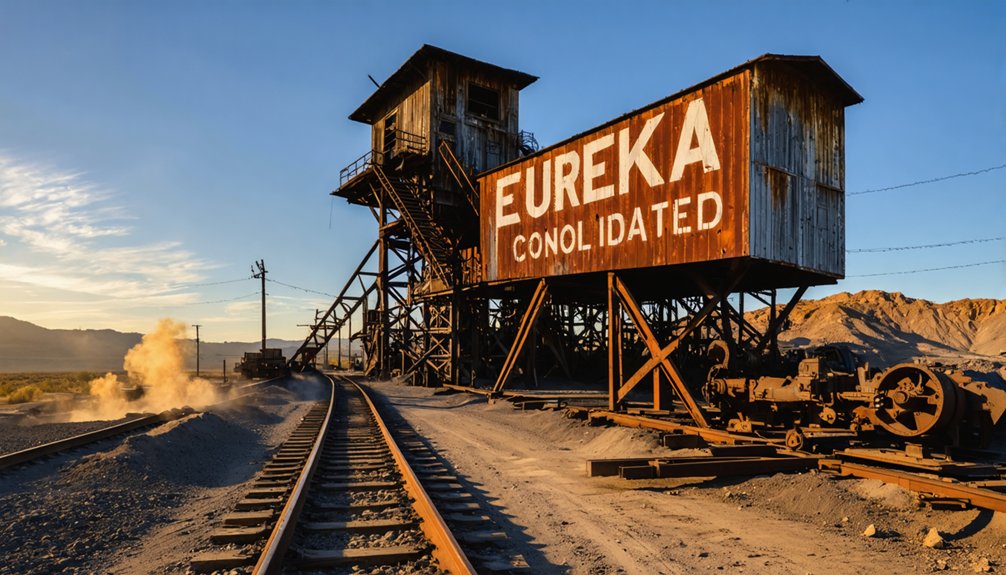
Silver-laden hills surrounding Eureka District conceal more than abandoned mines—they harbor persistent accounts of spectral miners who allegedly haunt the network of subterranean passages.
Hydrological catastrophes that plagued the district’s mining operations, particularly evident in the Fad Shaft’s premature abandonment, contribute greatly to these paranormal narratives.
The propagation of phantom miner mythology stems from three primary factors:
- Numerous unsealed shaft entrances creating acoustic anomalies that mimic human activity
- Historical documentation of miners lost to flooding and structural collapses
- Minimal contemporary human presence amplifying psychological responses to environmental stimuli
These apparitional accounts correlate with mining’s decline after the 1880s when water infiltration rendered extraction economically unfeasible.
The district’s change from a 10,000-resident boomtown to near abandonment provides fertile phenomenological context for ghostly apparitions reported near historical extraction sites.
A devastating labor dispute in the area resulted in multiple casualties, adding another layer to the haunting legends of the region.
The once-thriving district produced an estimated $68 million in gross yield by 1881, making the ghostly tales even more poignant against the backdrop of lost prosperity.
Goldfield’s Underground Passages and Paranormal Activity
You’ll encounter Goldfield’s extensive underground tunnel network connecting the hotel’s basement to the red light district, where wealthy patrons once traversed in secrecy.
The Goldfield Hotel, with its documented paranormal phenomena, contains eerie artifacts like dolls and toys reportedly placed to entertain spirits of children wandering the halls. The hotel was featured in Ghost Adventures episodes that highlighted its reputation for unusual supernatural activity. The once-luxurious establishment opened in 1908 with 150 private rooms and cutting-edge amenities for its time.
Mining tragedy narratives permeate local folklore, reinforced by the town’s dramatic population collapse from 30,000 to approximately 200 residents following resource depletion and the devastating 1923 fire.
Haunted Goldfield Hotel
Perhaps the most intriguing aspect of Nevada’s mining heritage manifests in the paranormal phenomena associated with the Goldfield Hotel, where subterranean passages and spectral activity converge to create a nexus of supernatural intrigue.
Constructed in 1908 by banking magnate George Wingfield, this once-luxurious establishment harbors numerous ghostly sightings linked directly to its hotel history.
The paranormal taxonomy includes:
- Elizabeth’s entity in Room 109, where temperature anomalies and photographic disturbances occur
- The Stabber’s apparition in the Gold Room, manifesting aggressive but non-injurious confrontations
- Tertiary manifestations including disembodied infant vocalizations and olfactory phenomena (particularly cigar smoke)
While empirical documentation remains elusive, the hotel’s underground tunnels connecting to Goldfield’s red-light district suggest a labyrinthine complex where historical trauma and metaphysical energy persist despite recent architectural modifications. In 1923, the property was sold to Newton Crumley, who attempted to conduct mining operations directly beneath the hotel structure. The once-thriving establishment has remained closed since 1945 after briefly serving as accommodations for military personnel.
Mining Tragedy Tales
The subterranean labyrinth beneath Goldfield’s surface conceals not only rich mineral deposits but also a complex historical tapestry of tragedy and supernatural phenomena intrinsically linked to mining operations during the area’s industrial apex.
When you explore these abandoned tunnels, you’re traversing spaces where Deidesheimer’s revolutionary square-set timbering attempted to mitigate the persistent cave-in hazards that claimed numerous lives. Ghostly apparitions reportedly manifest in areas where miners perished while extracting the glittering ore visible by candlelight.
The forgotten tragedies of labor violence that necessitated federal military intervention in 1907 have imprinted energetic residue throughout the underground infrastructure. These tunnels—where miners once secreted valuable ore in lunch pails—now harbor manifestations that contemporary paranormal investigators attribute to traumatic events embedded within the geological strata.
The Lost Prospectors of Rhyolite
You’ll discover that Rhyolite’s spectral mining claims persist through reported apparitions of deceased prospectors who vanished during the 1904-1911 boom period.
These manifestations frequently correlate with accounts of miners’ final moments, particularly near the Montgomery-Shoshone mine where extraction operations ceased abruptly as ore quality diminished.
Unexplained midnight sounds—pickaxes striking stone, distant explosions, and miners’ calls—permeate the abandoned structures, suggesting residual auditory phenomena consistent with traumatic historical events during the town’s rapid economic collapse.
Spectral Mining Claims
Among the most enigmatic aspects of Rhyolite’s mining history are the numerous spectral mining claims—properties once valued at astronomical sums that vanished into historical obscurity alongside their ambitious prospectors.
You’ll encounter ghostly echoes of financial hubris throughout the Bullfrog district, where over 2,000 claims once represented incalculable wealth. The Montgomery Shoshone Mine exemplifies this precarious valuation paradigm, evolving from multimillion-dollar acquisition to abandonment within five years.
These spectral treasures manifest in three distinct patterns:
- Initial overvaluation based on isolated high-grade ore stringers
- Precipitous devaluation following expert geological assessment
- Complete abandonment after capital flight triggered by macroeconomic destabilization
The economic trajectory of these claims demonstrates the ephemeral nature of extractive prosperity—a cautionary economic model applicable to contemporary resource speculation ventures.
Miner’s Final Moments
Deep within the gold-laden recesses of Rhyolite’s abandoned mines, tragic narratives of lost prospectors pervade the historical record, immortalizing their final moments through both documented accounts and persistent local mythology.
The rapid economic decline following the Panic of 1907 forced abrupt exodus from mining operations, leaving countless souls stranded in the unforgiving Bullfrog Hills terrain.
You’ll find evidence of these desperate final endeavors throughout the Montgomery Shoshone Mine complex, where desert echoes still resonate with their struggles.
Technical analyses of mortality patterns indicate a correlation between mine closures and increased disappearances, particularly when prospectors ventured deeper into unmapped shafts.
These lost souls, overcome by extreme dehydration and isolation, often perished while seeking elusive gold veins or attempting treacherous desert crossings—their remains sometimes discovered years later, fostering Rhyolite’s reputation as a nexus of spectral activity.
Unexplained Midnight Sounds
The nocturnal acoustic phenomena emanating from Rhyolite’s abandoned mining complex constitute one of Nevada’s most compelling paranormal enigmas, characterized by distinctive auditory patterns occurring primarily between midnight and 3:00 AM.
You’ll encounter acoustical manifestations attributed to “The Lost Prospectors”—miners who vanished during the town’s precipitous economic collapse following the 1907 Panic.
The midnight echoes you may perceive include:
- Subterranean machinery sounds reverberating through Montgomery-Shoshone’s extensive tunnel network
- Ghostly whispers carried via naturally-formed acoustic chambers within abandoned mine shafts
- Footstep-like percussions produced by thermal rock expansion and contraction
These auditory anomalies are amplified by Rhyolite’s unique architectural and geological configuration, where desert wind currents interact with remaining structures to produce acoustic anomalies that transcend conventional environmental explanation.
Eerie Encounters in the Tunnels of Pioche
While historical accounts of Pioche’s mining operations focus primarily on industrial achievements and economic implications, numerous documented reports suggest that the abandoned tunnels beneath this once-thriving Nevada boomtown harbor inexplicable phenomena that defy conventional explanation.
You’ll find the 1870s peak violence period has spawned ghostly encounters throughout the 8,000-foot tunnel connecting Pioche to Caselton. The remarkable concentration of violent deaths—commemorated in Boot Hill Cemetery‘s stark epitaphs—correlates with anomalous auditory and visual phenomena reported within these subterranean passages.
Eerie legends persist particularly near the aerial tramway, Nevada’s sole surviving mining tramway structure, where witnesses describe unexplained apparitions reminiscent of miners who perished during the town’s lawless era. These manifestations arguably represent psychic imprints preserved within the environment’s mineral composition, a hypothesis meriting further investigation.
Virginia City’s Supernatural Mine Shafts
Virginia City’s abandoned mine shafts, particularly the Consolidated Virginia and Chollar-Potosi locations, harbor complex paranormal phenomena attributed to miners who perished in collapses, accidents, and extreme environmental conditions.
You’ll encounter reports of spectral activity at the Combination Mine, where 130°F temperatures and catastrophic flooding created conditions for persistent hauntings of miners trapped during the 1886 shutdown.
The New Savage Mine exhibits more recent supernatural manifestations, specifically the spirits of two men who died in 1983 after disregarding safety protocols—their presence allegedly detected through unexplained sounds and temperature fluctuations near the submerged equipment where they met their end.
Comstock Lode Hauntings
Beneath Virginia City’s weathered facades lies a complex network of abandoned mine shafts where supernatural phenomena have persisted since the height of the Comstock Lode‘s silver boom in the mid-nineteenth century.
This $400 million silver deposit catalyzed significant historical events while simultaneously generating conditions conducive to paranormal manifestations.
Analysis of Comstock Lode hauntings reveals three primary epicenters:
- Yellow Jacket Mine – Site of the catastrophic 1869 fire where 35 miners perished, yielding frequent reports of disembodied voices and ghostly apparitions.
- Old Washoe Club – Acknowledged as a paranormal nexus with documented EVP evidence.
- Mackay Mansion – Exhibits consistent manifestations attributed to mining-era trauma.
The convergence of violent mining conditions, rapid wealth accumulation, and tragic deaths has created an environment where spectral phenomena persist with remarkable consistency, challenging conventional explanations while offering glimpses into Virginia City’s tumultuous past.
Miners’ Final Moments
As miners descended into the treacherous depths of Virginia City’s labyrinthine tunnel systems, they frequently encountered conditions that precipitated their demise—a phenomenon now manifested through persistent paranormal activity.
Analysis of miners’ last moments reveals a pattern of fatal circumstances: suffocation from toxic gases, entrapment during cave-ins, and immolation in underground fires. The 1869 Yellow Jacket Mine disaster exemplifies this tragic reality, where 35 miners perished in flames or were entombed alive.
Contemporary paranormal manifestations—temperature anomalies, disembodied voices, and spectral apparitions—correlate with documented mining accidents.
The physiological and psychological trauma experienced during these tragic mining accidents appears to have imprinted energetic residue within the mine infrastructure.
You’ll encounter evidence of this phenomenon in locations like the Chollar and Potosi, where witnesses report auditory phenomena resembling pickaxes striking stone—echoes of industrious spirits still laboring underground.
Unexplained Phenomena at Ely’s Copper Mines
The abandoned copper mines surrounding Ely, Nevada have become epicenters for unexplained phenomena that defy conventional scientific explanation.
Empirical observations from multiple witnesses suggest manifestations of paranormal activity within these abandoned shafts, corroborated by recurrent testimonials spanning decades. The ghostly legends permeating local discourse maintain remarkable consistency in their phenomenological characteristics.
Analysis reveals three primary categories of unexplained occurrences:
- Auditory anomalies including disembodied voices and antiquated machinery sounds in non-operational areas
- Thermal fluctuations presenting as localized cold spots unattributable to ambient temperature variations
- Electromagnetic disturbances affecting modern recording equipment and photographic documentation
While geological explanations (methane emissions, structural settling) have been proposed, they fail to adequately account for the totality of reported phenomena, suggesting alternative interpretive frameworks may be required for thorough understanding.
Spectral Sightings in the Abandoned Workings of Searchlight
While Ely’s copper mines exhibit documented anomalous phenomena, Searchlight’s abandoned gold workings present an equally compelling case study in spectral manifestations. The district’s 145 hazardous mine sites, particularly the historically significant Duplex and Quartette operations, have yielded consistent reports of paranormal activity since their closure in 1953.
You’ll encounter accounts of ghostly apparitions near the Oakland Group’s 4-stamp mill, where miners who perished in structural collapses allegedly manifest.
Spectral encounters frequently include auditory phenomena—disembodied voices and footsteps—concentrated in areas of high fatality rates during the 1897-1907 boom period. Contemporary paranormal investigators document these occurrences with increasing methodological rigor.
The juxtaposition of physical danger (collapsing shafts, unstable structures) with metaphysical phenomena creates a uniquely liminal space where conventional epistemological frameworks prove insufficient for thorough analysis.
The Mysterious Deaths and Lingering Spirits of Aurora
Emerging from the mineral-rich landscape of western Nevada in 1860, Aurora rapidly transformed from barren terrain to a thriving settlement of 5,000-10,000 inhabitants before succumbing to resource exhaustion and abandonment by 1870.
The mainly male population fostered exceptional volatility, with numerous violent altercations occurring amidst the town’s ubiquitous saloons and brothels.
Contemporary visitors to this ghost town frequently report ghostly encounters among the scattered haunted relics:
Explorers are drawn to ghost towns in Arizona for their eerie atmosphere and rich history. The remains of old mines and dilapidated homes evoke a sense of nostalgia for a bygone era, while the vast desert landscape adds to the overall mystique. As the sun sets, the surroundings transform, making it a perfect setting for those seeking adventure and the paranormal.
Modern explorers routinely describe spectral experiences amid Aurora’s weathered artifacts and forsaken structures.
- Apparitions of miners and women in period attire manifest near abandoned shaft entrances
- Auditory phenomena including disembodied voices and phantom mining equipment
- Anomalous cold spots and shadowy figures congregating in the cemetery
These persistent supernatural manifestations likely stem from unresolved violent deaths and mining accidents, their spiritual residue imprinted upon Aurora’s decaying foundations and scattered ruins.
Frequently Asked Questions
Can Tourists Legally Explore Abandoned Mines With Proper Equipment?
No. You’re legally restricted from mine exploration without authorization, regardless of equipment. Legal regulations mandate specific permits, landowner permission, and professional guidance for accessing abandoned mining infrastructure.
How Do Paranormal Investigators Distinguish Mine Gases From Genuine Hauntings?
You’ll distinguish authentic paranormal phenomena through systematic elimination protocols—deploying mine gas detection equipment first to rule out methane/CO₂ before attributing manifestations to non-corporeal entities through specialized paranormal equipment and cross-validated environmental readings.
What Indigenous Spirits Are Believed to Guard Nevada’s Ancient Mining Territories?
You’ll encounter ancestral guardians throughout Nevada’s mining territories—these spirit legends manifest as territorial protectors connected to natural elements, maintaining Indigenous cultural legacy while actively resisting desecration of their sacred ancestral lands.
Do Mining Claim Owners Still Encounter Unexplained Phenomena on Their Properties?
Yes, you’ll frequently encounter documented ghost sightings on your claims, with EVP recordings, temperature anomalies, and apparitions constituting empirical phenomena consistent with established mining folklore patterns across Nevada’s historical extraction territories.
Have Satellite Imaging Technologies Revealed Previously Undocumented Mine Entrances?
Hidden beneath our eyes, satellite mapping has indeed revealed numerous undocumented mine entrances. You’ll find these discoveries revolutionize mine exploration techniques, liberating researchers from traditional ground-based constraints while enhancing geological databases.
References
- https://thenevadaindependent.com/article/nevada-has-the-most-abandoned-mines-in-the-nation-why-is-it-taking-so-long-to-seal-them
- https://www.thefallonpost.org/article/8232
- https://www.reviewjournal.com/local/local-nevada/all-the-ways-a-mine-can-kill-you-nevadas-abandoned-mines-pose-endless-risks-2914561/
- https://minerals.nv.gov/uploadedFiles/mineralsnvgov/content/Programs/AML/2017_NDOM_AML_Report_Final.pdf
- https://nbmg.unr.edu/mining/MiningRecords.html
- https://www.blm.gov/sites/default/files/uploads/AML_PUB_Inventory.pdf
- https://pubs.usgs.gov/publication/fs20253003/full
- https://savingplaces.org/stories/explore-wild-west-mining-history-in-nevada-ghost-towns
- https://data-ndom.opendata.arcgis.com/pages/mining-claims
- https://en.wikipedia.org/wiki/Comstock_Lode