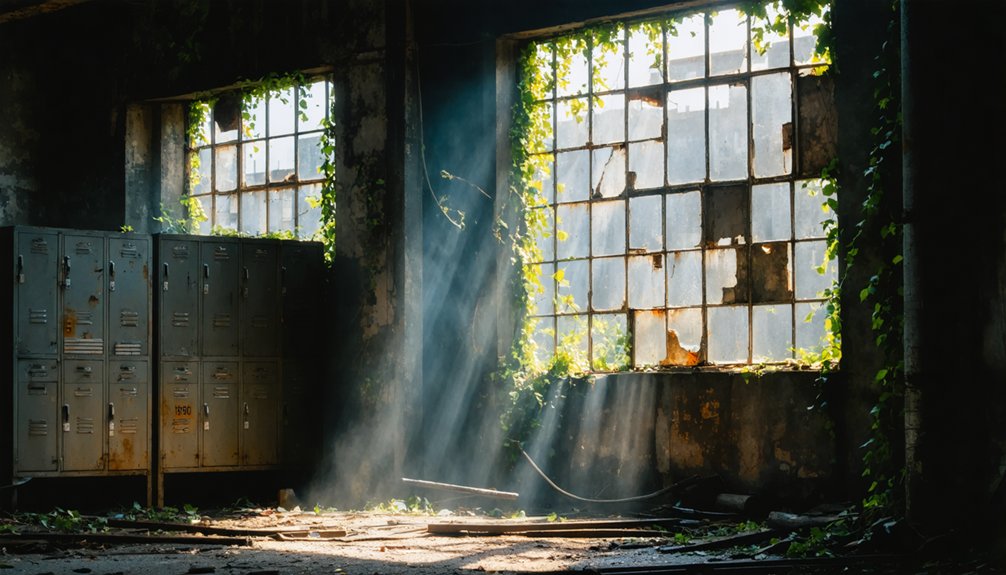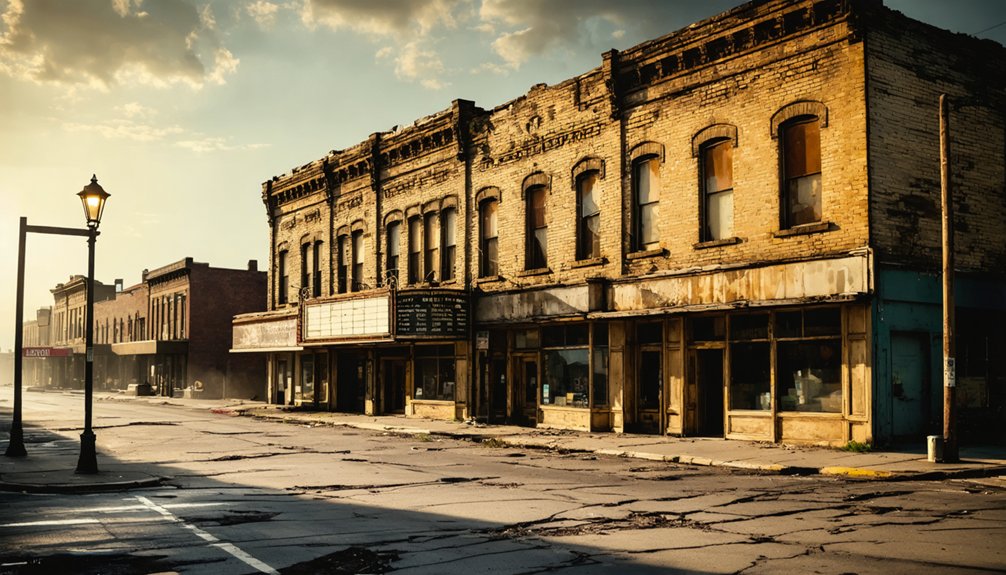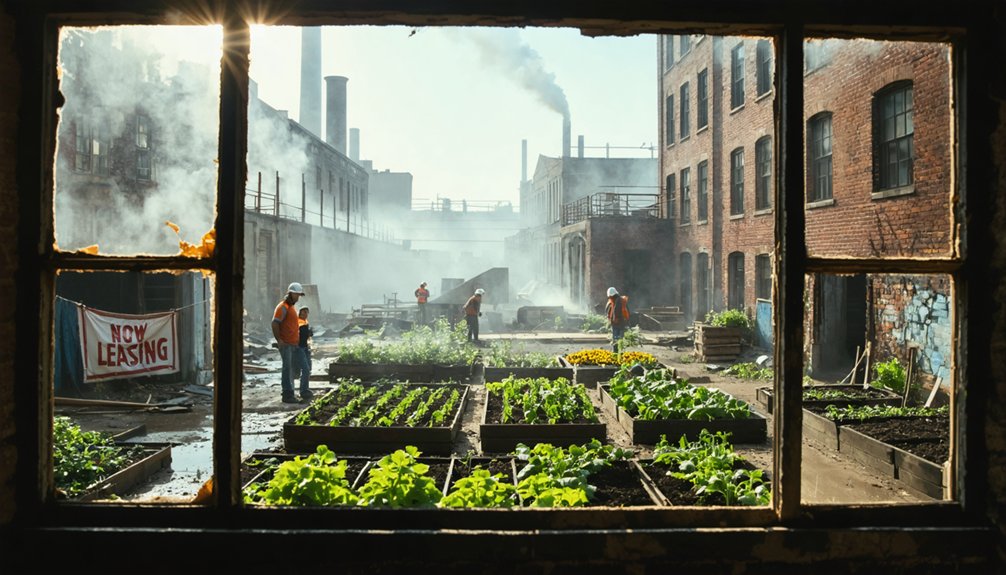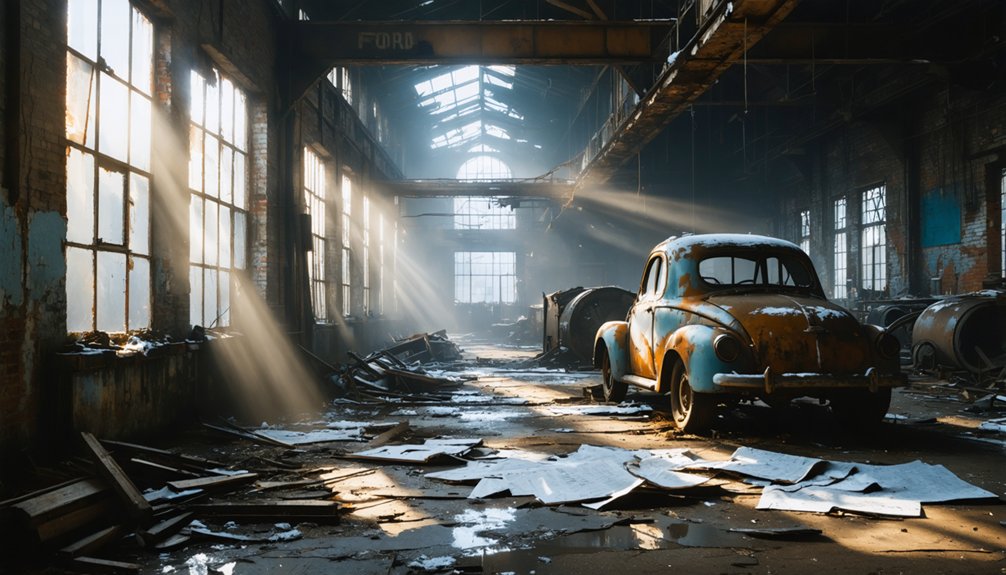
Rust Belt ghost towns emerged when once-thriving industrial cities collapsed under economic pressures from the 1970s-80s. You’ll recognize these former manufacturing powerhouses by their abandoned factories, declining populations, and vacant properties. Cities like Youngstown and Detroit lost their economic foundations when steel mills and auto plants closed due to globalization and competition. Though devastated by “Black Monday” and similar events, many communities are now mounting surprising comebacks through creative revitalization efforts.
Key Takeaways
- Rust Belt ghost towns emerged when industries like steel and auto manufacturing collapsed, exemplified by Youngstown’s “Black Monday” in 1977.
- These towns experienced population losses exceeding 40% between 1970-2006 as residents fled collapsing economic opportunities.
- Abandoned infrastructure characterizes these communities, with places like Detroit containing nearly 5,000 vacant properties in single ZIP codes.
- Ghost towns resulted from globalization, labor disputes, and corporations seeking cheaper overseas manufacturing options from the 1950s onward.
- Some former industrial centers have transformed through community-driven revitalization, like Buffalo’s cultural initiatives and Johnstown’s outdoor recreation focus.
The Birth of Industrial Giants: Rise of Manufacturing Cities (1825-1950)
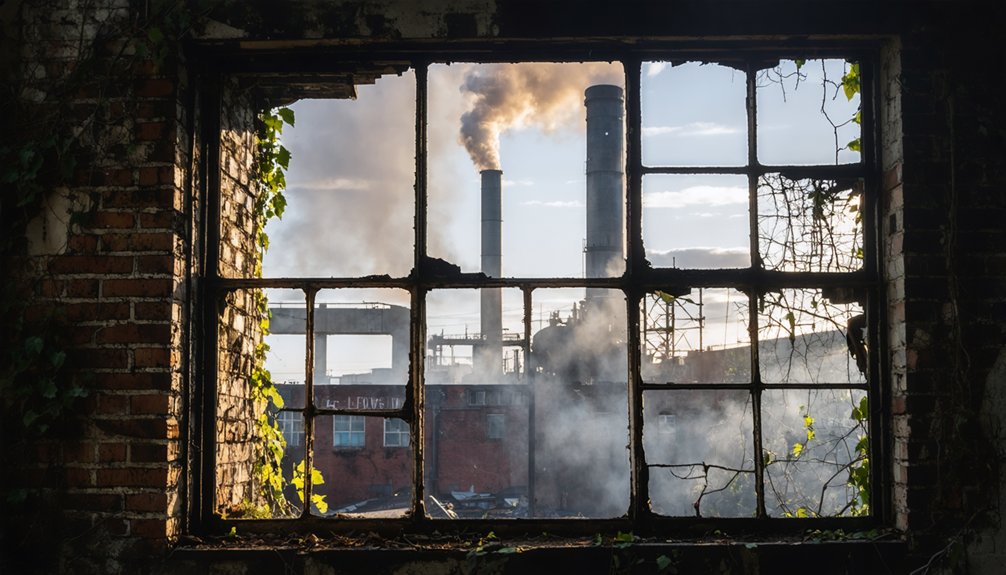
As the first quarter of the nineteenth century drew to a close, a powerful confluence of transportation innovations, natural resource availability, and strategic geography began transforming America’s Midwest and Northeast into industrial powerhouses.
The Erie Canal‘s completion in 1825 connected raw materials to manufacturing centers, while railroads like the B&O created essential arteries for commerce.
You’d witness rural outposts evolving into manufacturing behemoths between 1825-1950. Pittsburgh became the “Steel City” through its access to iron ore and coal, while Detroit emerged as “Motor City” through industrial innovation in automotive production.
These urban transformations attracted millions of European immigrants and African Americans seeking opportunity, fueling rapid growth and powering labor movements. The region’s prosperity derived from abundant natural resources and favorable transportation routes that facilitated industrial expansion. Cities like Chicago, Cleveland, and Buffalo flourished around Great Lakes shipping routes, strategically positioned to receive resources and distribute finished goods throughout America’s expanding markets. The consolidation of the New York Central Railroad in 1875 further accelerated industrial development throughout the region.
Black Monday and Beyond: Key Moments in Rust Belt’s Decline
You’ll find that Black Monday of 1987 catalyzed Youngstown’s industrial decline, as the 22.61% stock market crash devastated manufacturing investments and accelerated plant closures throughout the Rust Belt.
This financial panic triggered a chain reaction of outsourcing, with companies shifting production overseas to recoup losses, resulting in the elimination of over 40,000 steel-related jobs in the Mahoning Valley alone. The Federal Reserve’s emergency announcement to provide liquidity helped stabilize financial markets nationally but came too late for many Rust Belt manufacturing operations. The crash wiped out an estimated US$1.71 trillion in global market value, with a disproportionate impact on manufacturing-heavy regions.
Manufacturing cities that once symbolized American industrial might transformed into economic casualties, as corporations abandoned their workforce in pursuit of cheaper labor markets abroad, leaving behind shuttered factories and communities stripped of their economic foundations.
Youngstown’s Industrial Collapse
The thunderous shuttering of Campbell Works steel mill on September 19, 1977—a day that would become infamously known as “Black Monday”—marked the beginning of Youngstown’s precipitous industrial decline and signaled a watershed moment in American deindustrialization.
Without warning, 5,000 workers lost their livelihoods overnight, initiating a cascade of closures that ultimately eliminated 40,000 manufacturing jobs and collapsed 400 supporting businesses.
You’ll find Youngstown’s response particularly notable for its steelworker activism and innovative community ownership proposals.
Workers and local activists united to develop feasibility studies for worker-controlled alternatives to corporate abandonment. An ecumenical coalition of religious leaders joined with steelworkers to propose a bold worker-community ownership model for the mill.
Though ultimately defeated by political opposition and corporate interests, these grassroots efforts represented a bold challenge to the prevailing economic system that sacrificed community welfare for shareholder profits.
The population plummeted from a thriving 170,000 during industrial peak to below 70,000 by 2020, leaving behind abandoned neighborhoods and architectural ghosts of former prosperity.
Outsourcing’s Cascading Effects
While “Black Monday” in Youngstown referred to the 1977 steel mill closures, a second economic catastrophe bearing the same name struck a decade later with far-reaching implications for Rust Belt communities already reeling from deindustrialization.
The October 19, 1987 crash—when markets plummeted 22% in a single day—accelerated corporate outsourcing strategies that devastated Rust Belt economies.
As automated trading systems triggered a $1.71 trillion global meltdown, companies sought stability through access to cheaper global labor markets. The crash was intensified by widespread use of portfolio insurance hedging that automatically sold futures as prices fell. Circuit breakers were later implemented by the NYSE to reduce market volatility in response to the crash. This technological and financial restructuring permanently altered America’s manufacturing landscape, deepening economic inequality in former industrial centers.
Though markets recovered within two years, manufacturing jobs never returned.
The crash revealed how globalization had fundamentally transformed economic relationships, making it impossible for struggling Rust Belt communities to compete in an increasingly interconnected financial system that prioritized profit over place.
The Economic Forces Behind Deindustrialization
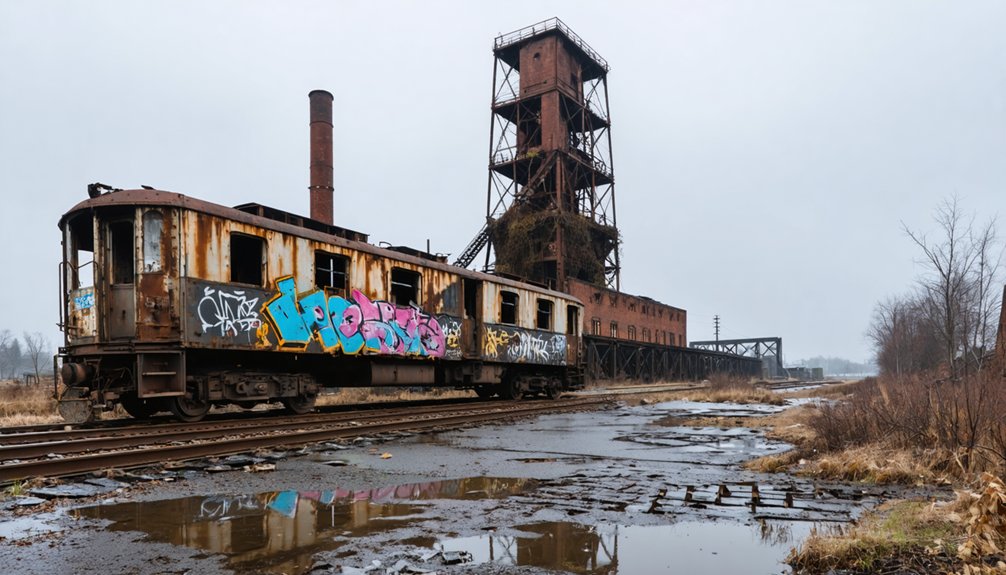
Beneath the rusted facades of abandoned factories and silent manufacturing plants lies a complex web of economic forces that gradually unraveled the industrial might of America’s Rust Belt.
You’re witnessing the aftermath of economic globalization that exposed once-dominant American manufacturers to fierce international competition. As trade barriers fell, companies faced rivals with significant labor cost advantages, particularly in Asia.
Meanwhile, the relationship between management and labor unions created a paradoxical “tax on innovation” – when firms invested in productivity improvements, unions captured returns through higher wages, dampening incentives for technological advancement.
This innovation stagnation proved fatal as manufacturers grew complacent during post-war prosperity. Without competitive pressure forcing modernization, Rust Belt companies maintained outdated facilities and practices while global competitors surged ahead with newer production capabilities. The decline began much earlier than commonly thought, with the Rust Belt’s economic deterioration starting in the 1950s, not the late 1970s as many assume.
The prolonged economic devastation has resulted in approximately 3.4 million white-collar jobs being outsourced between 2003 and 2015, extending the pain beyond traditional manufacturing sectors.
Abandoned Landscapes: Physical Remnants of Industrial Collapse
Today’s Rust Belt ghost towns offer haunting panoramas where economic collapse manifests physically across crumbling urban landscapes.
Many of these haunted locations in the Rust Belt are steeped in stories of the past, drawing in urban explorers and paranormal enthusiasts alike. As the sun sets, the eerie silence is often punctuated by the whispers of long-gone residents, adding to the charm of these forgotten places. Each site tells a unique tale, blending history with mystery in a region forever marked by its industrial legacy.
You’ll find commercial districts lined with neoclassical bank facades now stained and deteriorating, while former five-story hotels display ragged awnings over shattered windows.
The community impact extends beyond urban decay to structural integrity failures, with hospital facilities showing entire rooms collapsed into basements.
Residential abandonment presents a particularly stark reflection of historical significance, with thousands of vacant homes following manufacturing closures.
Industrial infrastructure remnants—empty steel mills and shuttered auto plants—dominate these landscapes, creating environmental hazards through exposed materials and structural dangers.
The scale of deterioration presents formidable redevelopment challenges, with communities like Johnstown facing 1,800 properties requiring demolition.
These physical remnants embody the economic implications of deindustrialization in concrete form.
Population Exodus: The Human Story Behind the Numbers
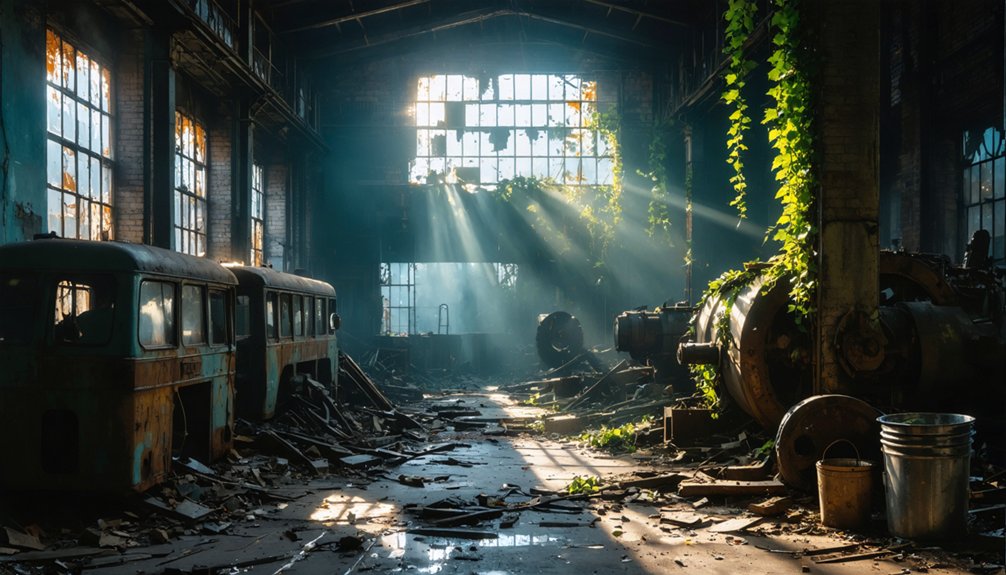
Beyond the haunting physical landscapes of abandoned buildings lies a profound demographic upheaval that transformed the Rust Belt into a region of exodus.
You’re witnessing the aftermath of a massive urban migration that saw major cities lose over 40% of their populations between 1970 and 2006, with Detroit experiencing a staggering 29% drop between 2000 and 2016 alone.
The Rust Belt’s hollowing out represents one of America’s most dramatic demographic collapses in modern history.
This population drain wasn’t uniform—lower-income neighborhoods suffered the steepest declines while middle-tier areas faced sharper income drops, reversing typical gentrification patterns.
The exodus began as early as the 1950s, accelerating as manufacturing jobs vanished and the region’s share of U.S. population plummeted from 27% to 19%.
Population demographics shifted dramatically as younger, educated workers left first, creating a brain drain that further limited recovery potential in communities already devastated by economic collapse.
From $100 Houses to Empty Skyscrapers: Real Estate in Former Boomtowns
The mass exodus of people from Rust Belt cities left behind a real estate landscape as desolate as the shuttered factories that triggered the decline.
You’ll find entire neighborhoods where investor ownership dominates—84.7% to 86% of vacant Muncie properties and 82.1% in Detroit’s hardest-hit areas belong to speculators, far exceeding the national average of 75.5%.
- Detroit’s ZIP code 48206 contains nearly 5,000 vacant properties—25.9% of all residential buildings
- Youngstown recorded 6,000 abandoned structures by 2013, becoming synonymous with crime and drug trade
- Investor strategies target systematic acquisition of deteriorating properties without improvement
Real estate trends follow predictable cycles: abandonment leads to stripping of valuable materials, followed by arson or decay, culminating in demolition.
Where manufacturing once built middle-class neighborhoods, vacant lots now outnumber occupied homes across vast urban territories.
Signs of Rebirth: Communities Fighting Against Ghost Town Status

While many Rust Belt cities slid toward ghost town status during the late 20th century, numerous communities have mounted remarkable resistance against complete abandonment through strategic revitalization efforts.
You’ll find Marion, Ohio’s Founders Park exemplifying community engagement through brick sales and collaborative planning that maintained morale during reconstruction phases.
Local entrepreneurship has proven essential as business owners invested in declining downtowns despite pessimistic outlooks.
Small business visionaries staked their futures on forgotten mainstreets when others saw only decay.
Buffalo’s Muslim communities replicated earlier Polish neighborhood-building models, stabilizing population hemorrhages through cultural infrastructure.
Meanwhile, Detroit transformed from bankruptcy to budget surplus within a decade through strategic demolition and reconstruction.
Johnstown capitalized on geographic advantages by repositioning as an outdoor recreation destination with excess infrastructure now serving as an asset rather than liability—proving that with vision, even rust can reveal underlying strength.
Frequently Asked Questions
What Environmental Legacies Did Industries Leave in Rust Belt Towns?
You’re facing a pollution legacy of air contamination, contaminated soil, water pollution, and persistent industrial waste that continues to affect ecosystems, community health, and redevelopment efforts across Rust Belt towns.
How Did Organized Crime Evolve During Rust Belt’s Decline?
As urban decay intensified, you’d observe organized crime transforming from traditional rackets into diverse enterprises. They exploited the economic void, expanding mob influence where industrial collapse had weakened social institutions and community resilience.
What Cultural Contributions Emerged From Rust Belt’s Immigrant Communities?
You’ll find that 45% of the region’s Fortune 500 companies were founded by immigrants who also enriched Rust Belt cities through vibrant cultural festivals and distinctive immigrant art that transformed declining neighborhoods.
How Did Educational Institutions Adapt to Manufacturing’s Collapse?
You’ll find schools pivoted dramatically, implementing curriculum changes focused on core academics while establishing community partnerships to provide essential services as manufacturing’s collapse devastated local tax revenues and heightened student poverty.
What Role Did Local Politics Play in Accelerating Decline?
You’ll find that local corruption scandals and policy failures accelerated urban decline by depleting resources, discouraging investment, and undermining public trust, while fragmented governance prevented coordinated regional responses to manufacturing’s collapse.
References
- https://www.youtube.com/watch?v=HZFw7MZFycU
- https://allthatsinteresting.com/rust-belt
- https://www.britannica.com/place/Rust-Belt
- https://en.wikipedia.org/wiki/Rust_Belt
- https://www.bread.org/sites/default/files/downloads/briefing-paper-23.pdf
- https://www.industryweek.com/talent/article/22028380/the-abandonment-of-small-cities-in-the-rust-belt
- https://rustbeltrecruiting.com/a-history-of-the-rust-belt-and-why-its-important/
- https://study.com/academy/lesson/rust-belt-history-cities-decline.html
- https://fiveable.me/key-terms/united-states-history-since-1945/rust-belt-decline
- https://www.youtube.com/watch?v=orM7mOwy11k