North America’s lost fur trading outposts include Fort Union at the Missouri-Yellowstone confluence, Fort Henry in the Three Forks region, and hundreds of Hudson’s Bay Company posts along northern waterways. You’ll find Cabanné’s Post along the Missouri River and military-trading complexes like Fort Snelling dotting the Mississippi frontier. These abandoned sites once facilitated vital economic relationships between European traders and Native American tribes, forming the backbone of early commercial expansion across the continent.
Key Takeaways
- Fort Henry was a short-lived 1810 outpost abandoned after Blackfeet attacks, leaving few physical traces today.
- Cabanné’s Post operated from 1822 until being absorbed into Fontenelle’s Post, its original structures no longer standing.
- Fort Union dominated fur trading for four decades before being dismantled in 1867 for Fort Buford’s construction.
- Many Hudson’s Bay Company’s 494 trading posts were abandoned as the fur trade declined, becoming lost historical sites.
- Several military-trading complexes along the Mississippi frontier were abandoned as settlements expanded westward.
Fort Union: The Upper Missouri’s Trading Empire
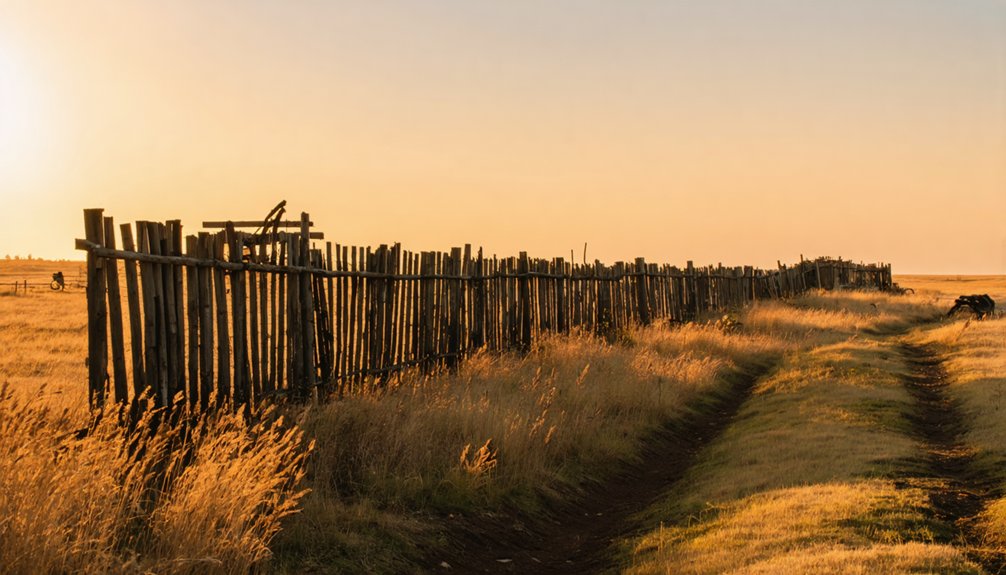
While the wilderness of the Upper Missouri seemed untamed and isolated in the early 19th century, Fort Union emerged as a commercial powerhouse that transformed the region’s economy and cultures. Founded in 1828 by the American Fur Company, this strategically positioned outpost near the Missouri-Yellowstone confluence dominated fur trade dynamics for nearly four decades.
You’d find the fort’s 240-foot quadrangle bustling with activity as Assiniboine, Blackfoot, Lakota, and other tribes exchanged over 25,000 buffalo robes annually for guns, blankets, and cookware.
These cultural exchanges introduced new technologies to Plains peoples while providing enormous profits for traders. Notable visitors like painter George Catlin and naturalist John James Audubon documented the vibrant frontier life at the fort. The fort operated in a distinctive Greek Revival style that reflected its importance as a symbol of American sovereignty near the northern border. The fort’s peaceful operation and economic success established it as the region’s commercial heart until 1867, when the Army dismantled it for Fort Buford’s construction.
As urbanization continues to reshape landscapes, initiatives focused on preserving structures in abandoned towns have gained traction. These efforts not only honor historical legacies but also offer opportunities for revitalization and tourism. Communities are increasingly recognizing the value of their heritage, leading to collaborative restoration projects that breathe new life into forgotten areas.
The Strategic Outposts of the Three Forks Region
Three distinct rivers—the Jefferson, Madison, and Gallatin—converge at the strategically significant Three Forks region to form the headwaters of the Missouri River, creating what became one of the most contested fur trading territories in the American West.
In 1810, Pierre Menard and Andrew Henry established Fort Henry (also called Fort Three Forks), but this ambitious venture faced immediate challenges:
- The post was staffed by 32 men, including veterans of Lewis & Clark’s expedition.
- Constructed primarily of cottonwood, it served as a hub for beaver pelt trading.
- Persistent Blackfeet attacks forced abandonment after just five months.
- Only a blacksmith’s anvil survived, now displayed at Headwaters Heritage Museum.
The Three Forks region later attracted famous mountain men including Kit Carson, Jim Bridger, and Jedediah Smith, all maneuvering the dangerous yet profitable fur trading frontier. Similar to the Chouteau family’s expansion of trading operations along the Verdigris River in Indian Territory, these pioneers sought to establish economic nodes in strategic waterway locations. John Colter, who had previously explored the area with Lewis and Clark, returned to the region and became known for his infamous naked run from pursuing Blackfoot warriors in 1808.
Hudson’s Bay Company’s Network of Northern Trading Hubs
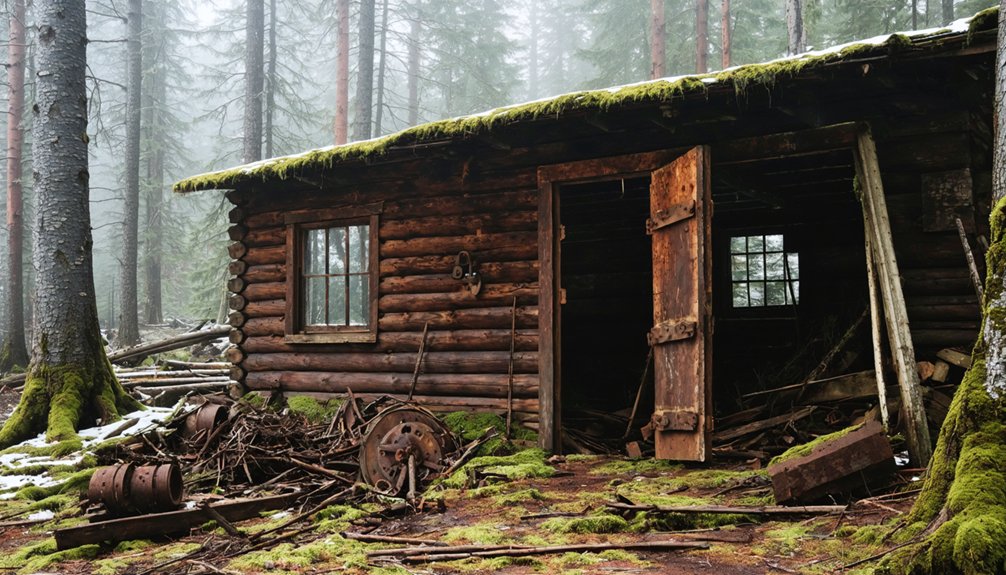
The vast northern frontier may have challenged fur traders at Three Forks, but far to the north, the Hudson’s Bay Company (HBC) established a more extensive and enduring trading empire. Spanning from the 17th century onward, HBC’s network comprised nearly 494 trading posts strategically positioned along major waterways like the Churchill and Albany Rivers.
While Three Forks traders struggled, the Hudson’s Bay Company built a vast northern empire spanning waterways across Canada’s frontier.
These Northern Trade hubs weren’t just commercial centers—they represented freedom in the wilderness, serving as administrative outposts and supply depots across Manitoba, Saskatchewan, and beyond.
After merging with North West Company in 1821, Hudson’s Bay’s influence expanded dramatically, though many remote posts like Fort Nascopie and Nachvak eventually vanished due to changing trade routes and political boundaries.
The posts employed diverse workforces, including indigenous peoples, creating economic ecosystems that shaped Canada’s development for centuries.
Cabanné’s Post: Gateway to the Western Fur Trade
Along the Missouri River in what’s now North Omaha, Nebraska, Cabanné’s Trading Post emerged in 1822 as a strategic outpost of the American Fur Company’s western expansion.
Under Jean Pierre Cabanné’s management until 1833, the post facilitated essential commerce with Native American tribes and nearby Fort Atkinson.
The post’s significance in fur trade dynamics can be understood through:
- Its strategic location along major water routes that maximized trading opportunities
- The diverse range of furs collected, including wolf, bear, and bison pelts
- Its role in the competitive consolidation of fur trading companies
- Its eventual absorption into Fontenelle’s Post as the industry evolved
When Cabanné returned to St. Louis in 1833, the outpost’s decline mirrored the shifting economic patterns across the region, eventually earning recognition on the National Register of Historic Places in 1972.
The trading post served as an informal diplomatic hub where Cabanné hosted various travelers and Prince Maximilian of Wied-Neuwied during his visit in 1823.
Like the Northwest and Hudson’s Bay Companies’ posts at Fort Vermillion, Cabanné’s Post was part of the extensive network of rival trading operations that characterized the North American fur trade during the early 1800s.
Military-Trading Complexes Along the Mississippi Frontier
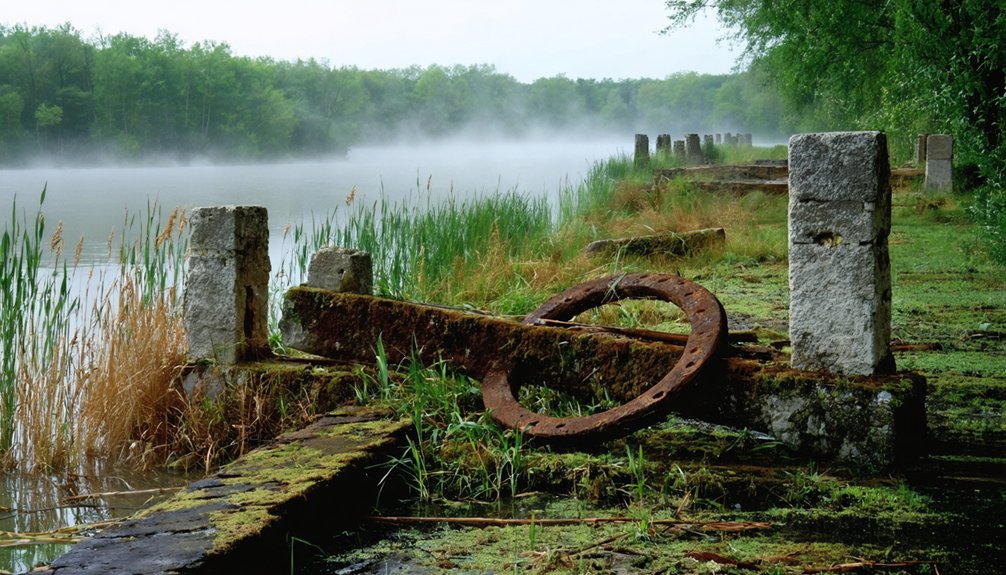
You’d find these complexes enforcing trade regulations while limiting British influence in the fur trade.
Military alliances formed at these sites helped mediate conflicts between Native groups and settlers pushing westward.
Fort Snelling controlled essential waterways at the Mississippi-Minnesota confluence, while Fort Madison established America’s presence on the Upper Mississippi.
Fort Madison was constructed despite the Sauk and Fox resentment, who viewed the military installation as an unauthorized invasion of their territory.
Fort Ripley was strategically positioned near the settlement of Crow Wing, enhancing government control over the expanding frontier region.
The system ultimately declined as treaties opened more territory and the frontier pushed further west.
Frequently Asked Questions
How Did Native Americans View the Fur Trade’s Environmental Impact?
Over 90% of Native Americans recognized the fur trade’s devastating environmental consequences. You’ll find native perspectives centered on ecological imbalance, species decline, and disruption of traditional sustainable management practices they’d developed over generations.
What Happened to Trading Post Employees After the Trade Declined?
When fur trade declined, you’d see widespread employee relocation as workers sought new livelihoods. They faced challenging economic changes, becoming farmers, independent hunters, guides, or laborers in frontier settlements.
How Were Women Involved in Fur Trading Post Operations?
Like hidden hands of Artemis, women weren’t just wives but crucial economic contributors. You’ll find female traders preparing food, crafting essential gear, bartering goods, serving as translators, and forging diplomatic alliances.
Did Trading Posts Maintain Communication Networks Between Each Other?
Yes, you’ll find trading posts maintained extensive communication networks using waterways and Indigenous intermediaries. Their communication strategies guaranteed information flowed through trading post networks, coordinating supplies, sharing intelligence, and maintaining alliances across vast territories.
What Diseases Besides Smallpox Affected Trading Post Communities?
You’d encounter numerous diseases at trading posts: tuberculosis outbreaks ravaged confined winter quarters, influenza spread rapidly, measles decimated communities, syphilis and gonorrhea transmitted through sexual contact, and alcohol-related health complications weakened immune responses.
References
- https://www.crazycrow.com/site/history-of-fort-union-trading-post/
- https://northomahahistory.com/2017/02/17/a-history-of-cabannes-trading-post-in-north-omaha/
- https://www.historymuseum.ca/virtual-museum-of-new-france/economic-activities/fur-trade/
- https://iowasportsman.com/the-history-of-the-fur-trade-in-iowa-part-two/
- https://www.okhistory.org/publications/enc/entry?entry=FU004
- https://en.wikipedia.org/wiki/North_American_fur_trade
- https://www.wisconsinhistory.org/Records/Article/CS3585
- https://npshistory.com/publications/fous/index.htm
- https://www.mnhs.org/usdakotawar/stories/history/newcomers/traders
- https://www.legendsofamerica.com/we-furtradingposts/