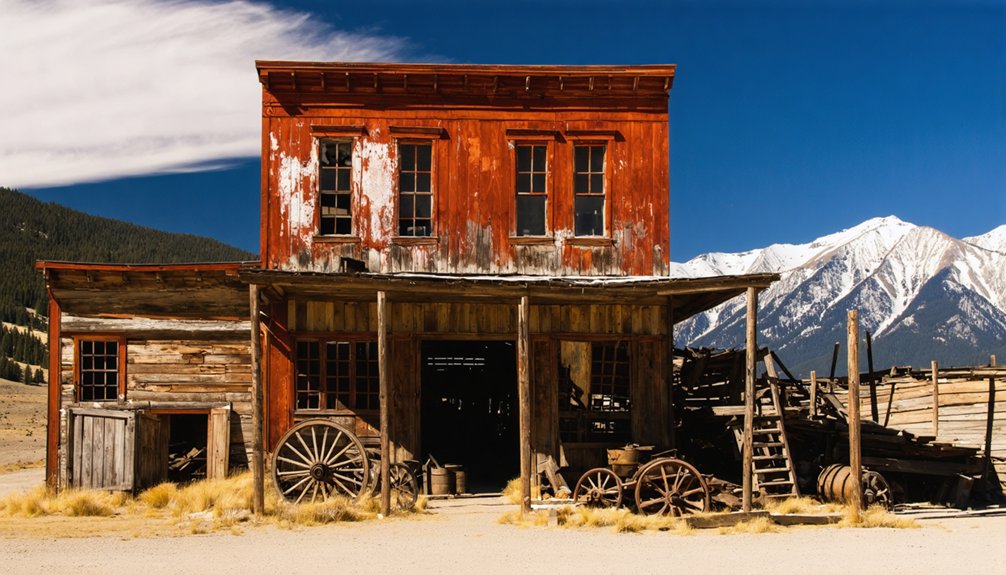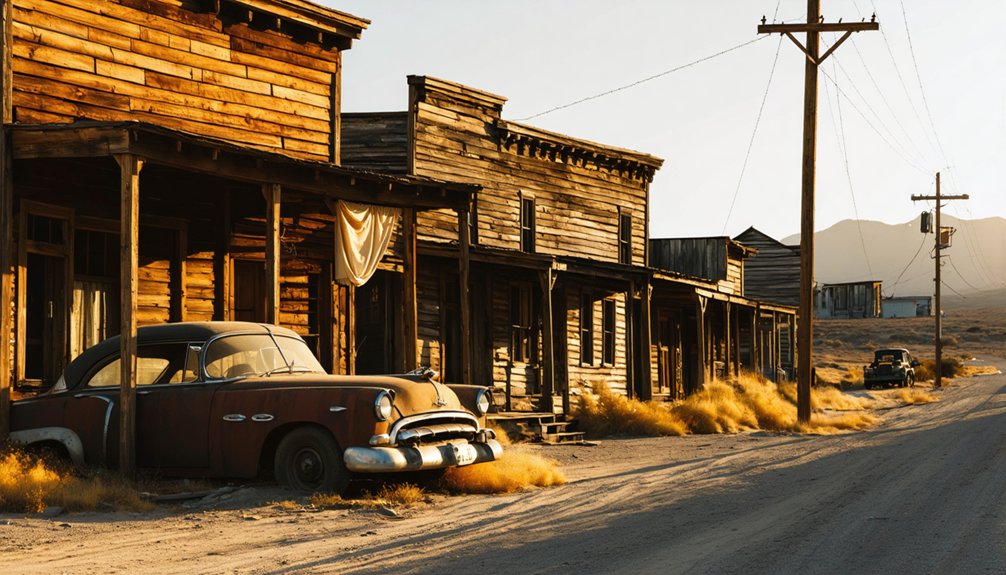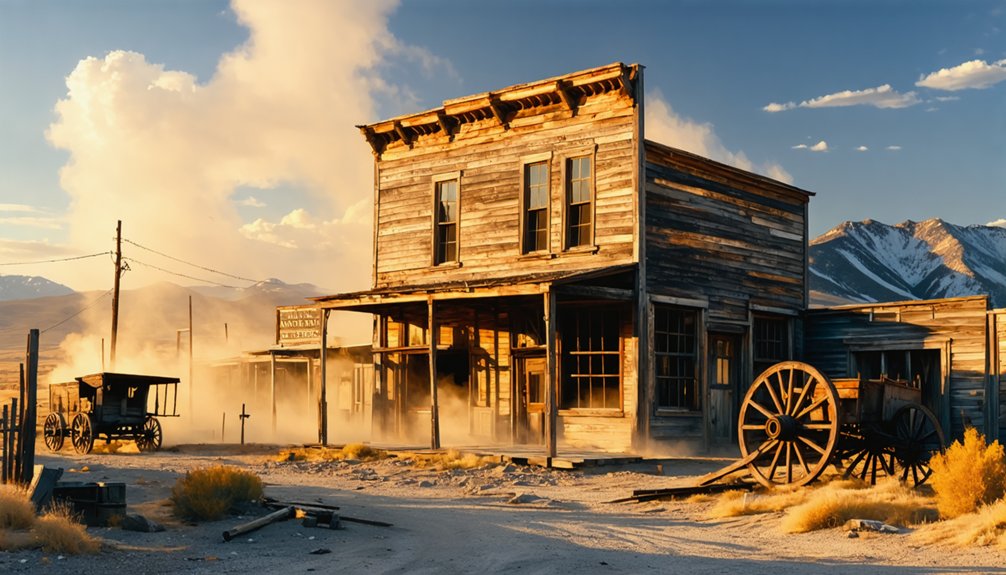
You’ll discover six iconic Wild West ghost towns across America’s frontier landscape: Bodie (California), with 200,000 annual visitors exploring its perfectly preserved wooden structures; Tombstone (Arizona), famous for its silver boom and legendary gunfights; Deadwood (South Dakota), where Wild Bill Hickok met his end; St. Elmo (Colorado), a former railway hub; Kennecott (Alaska), with its striking 14-story red mill; and Garnet (Montana), where thirteen saloons once thrived. Each abandoned settlement tells a unique story of boom-and-bust America.
Key Takeaways
- Bodie, California preserves 110-200 original wooden structures from its 1870s gold rush heyday when it housed 10,000 residents.
- Tombstone, Arizona grew from 100 to 14,000 residents after silver discovery in 1879 and now thrives on tourism.
- Deadwood, South Dakota attracted notorious figures like Wild Bill Hickok and became a National Historic Landmark in 1961.
- St. Elmo, Colorado maintains 43 original structures from its 1880s mining boom when 2,000 residents enjoyed hotels and saloons.
- Kennecott, Alaska features a massive 14-story red mill building that processed $200 million in copper between 1911-1938.
Bodie: California’s Perfectly Preserved Mining Settlement
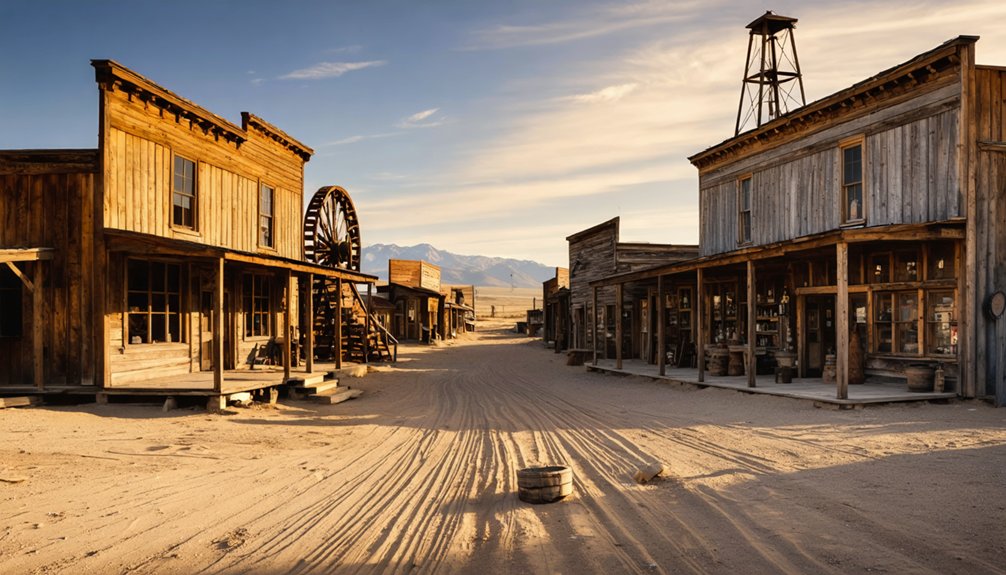
A time capsule frozen in the Sierra Nevada mountains, Bodie stands as the quintessential Wild West ghost town. Founded after William Bodey’s 1859 gold discovery, this settlement transformed from a small camp into a booming metropolis of 10,000 residents after a rich ore vein was found in 1876.
Bodie history exemplifies the Wild West’s lawless nature—with up to 65 saloons, rampant violence, and a reputation so notorious that children wrote, “Goodbye God, I’m going to Bodie.”
Lawlessness thrived in Bodie—a place where God seemed absent and saloons, gunfights, and sin ruled the mountainside.
The town’s architecture remains remarkably intact, with approximately 110-200 original wooden structures preserved in “arrested decay.” Inside these buildings, you’ll find abandoned furniture, goods, and mining equipment exactly as they were left decades ago.
The site is meticulously managed by California Parks and Recreation, maintaining its authentic historic character for future generations.
Now California’s official gold rush ghost town, Bodie attracts 200,000 visitors annually seeking glimpses of authentic frontier life.
Visitors should note that Bodie refers to multiple locations, making it important to specify this place name when researching its fascinating history.
Tombstone: The Town Too Tough to Die
Why is Tombstone called “The Town Too Tough to Die”? This resilient moniker was earned after the town rebuilt from two devastating downtown fires in 1881-1882, each time rising from ashes within six months.
Founded in 1879 by Ed Schieffelin who discovered rich silver veins, Tombstone rapidly evolved from a 100-person settlement called Goose Flats into a booming metropolis of 14,000.
Silver mining defined Tombstone’s economy, with claims like Lucky Cuss and Tough Nut fueling its prosperity. The discovery was initially mocked by soldiers who told Schieffelin he’d only find his own tombstone there. Today, the town’s primary source of revenue comes from tourism attractions that showcase its Wild West heritage. You’d find a vibrant yet volatile society with over 100 saloons, 14 gambling halls, and thousands of prostitutes alongside churches and schools.
Despite engineering marvels like Cornish pumps that removed 2.5 million gallons of water daily from mines, Tombstone eventually faced decline when its economic foundation weakened.
Deadwood: Legends and Lawlessness in the Black Hills
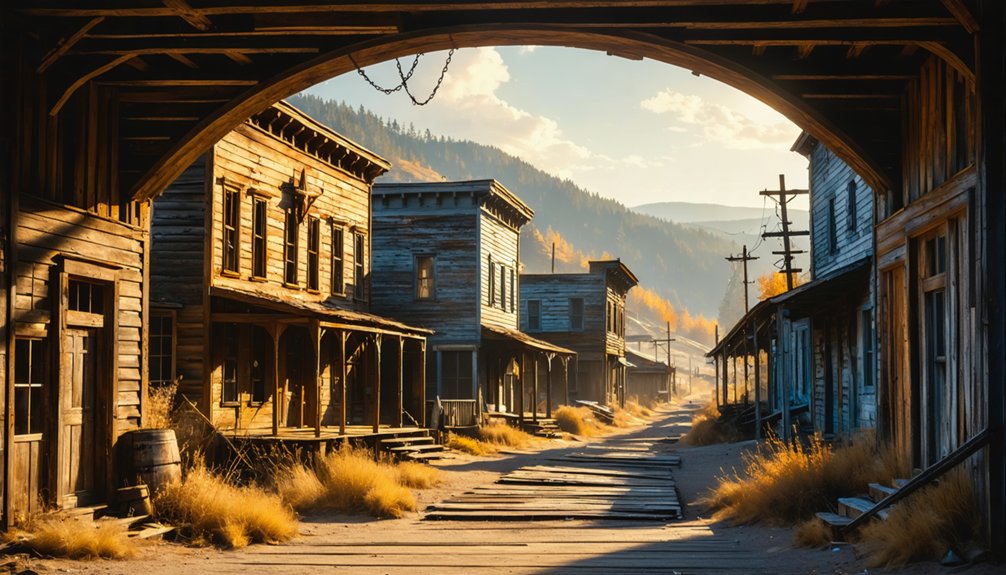
When gold was discovered in the northern Black Hills in 1876, Deadwood quickly transformed from a gulch filled with dead trees into a booming settlement of 5,000 residents within months.
Ironically, this establishment violated the 1868 Fort Laramie Treaty protecting these lands.
Deadwood history exemplifies the untamed frontier spirit. The town attracted outlaws, gamblers, and gunslingers, operating virtually without law enforcement.
Legendary figures like Wild Bill Hickok (killed in a saloon in August 1876), Calamity Jane, Seth Bullock, and Al Swearengen shaped the town’s notorious reputation. The Gem Variety Theater, which opened in 1878, became one of the most notorious entertainment venues in the Wild West.
Despite devastating fires in 1879, 1959, and 1987, Deadwood persevered.
The 1879 fire was particularly destructive, destroying over 300 buildings and leaving approximately 2,000 people homeless.
Designated a National Historic Landmark in 1961, the town’s preservation received a boost when limited gaming was legalized in 1989, funding restoration of its historic core.
St. Elmo: Colorado’s Railway Ghost Town
Perched at nearly 10,000 feet in Colorado’s breathtaking Sawatch Range, St. Elmo stands as one of the state’s most perfectly preserved ghost towns. Founded in 1880 as a mining settlement originally called Forest City, the town quickly boomed when gold and silver drew prospectors to the area.
At its peak, St. Elmo’s 2,000 residents enjoyed five hotels, numerous saloons, and a bustling railroad connection. The Denver, South Park & Pacific Railroad reached the town in 1881, becoming a vital lifeline for surrounding settlements.
When mining declined in the 1920s, so did St. Elmo’s fortunes. The railroad ceased operations in 1922, and by 1930, just seven souls remained.
The dedicated Stark family maintained the town for decades, with ghost town legends claiming Annabelle Stark’s spirit still watches over the historic district. The area produced an astonishing sixty million dollars worth of gold during the Mary Murphy Mine’s operation.
Today, you can explore 43 original structures in this National Historic District, where St. Elmo history comes alive amid mountain silence.
Kennecott: Alaska’s Frozen-in-Time Copper Mining Community
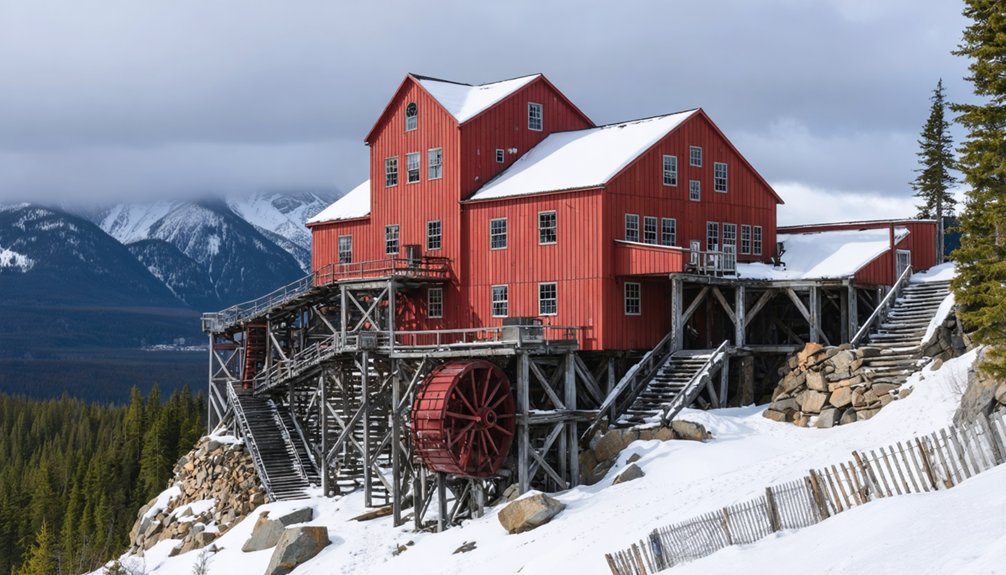
When you visit Kennecott, you’ll find Alaska’s most impressive copper mining ghost town dominated by its massive 14-story red mill building, an engineering marvel that processed $200 million in copper during its 1911-1938 operation.
The site’s remote wilderness location within Wrangell-St. Elias National Park offers a striking contrast of industrial ruins against pristine Alaskan landscapes, accessible only via McCarthy Road or bush plane. The National Park Service acquired many of the historic wooden frame buildings in 1998 to preserve this unique slice of industrial history. Unlike Kennecott with its strict regulations, the nearby town of McCarthy developed as a place where miners could enjoy prohibited activities that weren’t allowed in the company town.
Kennecott’s National Historic Landmark status has preserved its company town layout, including the iconic mill, power plant, and workers’ quarters that tell the story of America’s most productive copper mining operations in the early 20th century.
Massive Red Mill Legacy
Towering against the Alaskan wilderness, Kennecott’s iconic red mill stands as a monument to one of America’s most profitable copper operations of the early 20th century. This massive structure processed ore so rich that workers initially just shoveled it into sacks without processing—a demonstration of the extraordinary 70% copper content that helped generate over $200 million (about $3 billion today).
You’ll find pioneering mining technology throughout the complex, including the world’s first ammonia-leaching plant, introduced in 1915 to extract copper from lower-grade ores. This innovation extended the mine’s life and profitability.
The copper legacy of this operation required a staggering $25 million investment (equivalent to $730 million today) before shipping its first ore, funding not just the mill but a 196-mile railroad connecting this remote outpost to civilization.
Alaskan National Landmark Status
After decades of abandonment following its 1938 closure, Kennecott achieved National Historic Landmark status in 1986, recognizing its exceptional significance in American industrial history.
You’ll find the impressive 14-story mill building standing as the crown jewel among preserved structures that tell the story of Alaska’s mining heritage.
In 1998, the National Park Service took ownership of key buildings within the site’s nearly 3,000-acre boundary, integrating Kennecott into Wrangell-St. Elias National Park.
Their preservation efforts include stabilizing historic structures and rehabilitating buildings like the Recreation Hall for visitor use.
When you visit, you’re experiencing a carefully managed piece of Alaskan history that reflects the territory’s economic evolution from Russian fur trading to industrial copper mining—an authentic glimpse into frontier resource development.
Remote Wilderness Location
The journey to Kennecott demands extraordinary determination, situated in one of Alaska’s most isolated wilderness regions at the edge of the Wrangell-St. Elias National Park.
This remote wilderness setting contributed to both the town’s challenging operations and its remarkable preservation after abandonment. The mining legacy remains largely intact due to this isolation, with buildings standing frozen in time since 1938.
To appreciate Kennecott’s remoteness:
- The town required a specialized railroad built by Michael J. Heney just to transport copper ore out of this wilderness.
- Workers earned premium wages due to the extreme isolation and harsh conditions.
- The isolated location required a completely self-sufficient community with all essential services.
When the copper deposits were exhausted, the town’s remote location guaranteed it would remain largely undisturbed—a pristine historical capsule.
Garnet: Montana’s Hidden Gem of the Old West
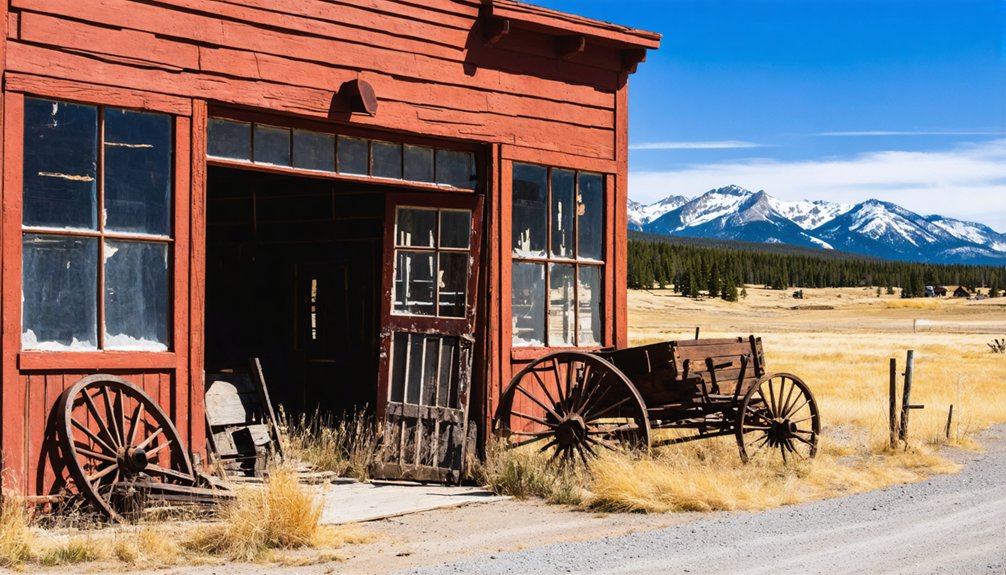
At Garnet’s peak in the 1890s, you’ll find a classic gold rush boomtown where nearly 1,000 residents generated impressive wealth, with the Nancy Hanks Mine alone producing $690,000 in gold during 1896.
The town’s social life centered around its thirteen saloons, where miners could drink, gamble, and socialize after long days extracting ore from the surrounding mountains.
Today, you can experience this well-preserved ghost town through self-guided trails maintained by the Bureau of Land Management, walking among the approximately 30 remaining structures that offer a genuine glimpse into Montana’s mining heyday.
Gold Rush Prosperity
Founded in 1895 during Montana’s hard rock mining boom, Garnet transformed from a small settlement originally named Mitchell into a thriving gold rush town virtually overnight.
The discovery of a rich ore vein at the Nancy Hanks Mine triggered an economic explosion that drew nearly 1,000 residents seeking fortune in this mineral-rich landscape.
Gold mining dominated Garnet’s economy and culture, with the precious metal comprising 95% of all minerals extracted from the area’s 50 mines.
You’ll appreciate how this wealth supported:
- A bustling commercial district with four stores, seven hotels, and 13 saloons
- The Nancy Hanks Mine alone producing $690,000 in 1896 (equivalent to millions today)
- A vibrant social scene featuring gambling, dances, and parties that defined mining culture
Thirteen Saloons Standing
Thirteen saloons lined the rugged streets of Garnet during its heyday, serving as the beating heart of this Montana mining community’s social life. When you explore Garnet’s history, you’ll discover these establishments weren’t just drinking holes—they represented the core of frontier nightlife dynamics where hard-working miners unwound after grueling shifts.
Despite the demanding physical labor, Garnet maintained a surprisingly low crime rate, with saloon culture fostering camaraderie rather than conflict. Alongside these drinking establishments, bawdy houses operated openly, while gambling and dances provided additional entertainment options.
The remarkable density of saloons—thirteen for a population of nearly 1,000—exemplifies the town’s embodiment of Wild West values, where freedom, recreation, and social connection helped residents endure the harsh realities of mining life in this remote mountain setting.
Annual Time Travel
Today’s visitors to Garnet can experience a remarkable connection to the past through the town’s immersive “Annual Time Travel” event, where Montana’s best-preserved ghost town comes alive with historical reenactments.
These time travel experiences transport you to Garnet’s gold rush heyday, offering authentic glimpses into frontier life among the preserved cabins, store, and saloon ruins.
During your visit, you’ll find:
- Self-guided tours with interpretive signage detailing mining operations and community life
- Educational programs highlighting how national events like Roosevelt’s gold policies and world wars impacted this remote mining community
- Opportunities to explore the surrounding Garnet Mountain Range where miners once sought their fortunes
The Bureau of Land Management and Garnet Preservation Association maintain this National Register site, ensuring its stories remain accessible for generations seeking connections to Montana’s mining heritage.
Why Ghost Towns Captivate Our Imagination
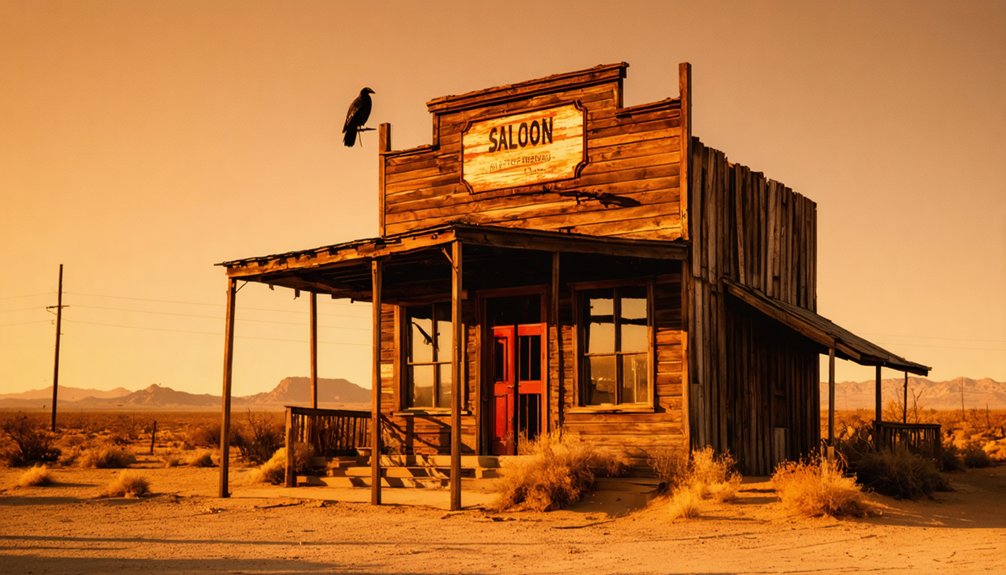
Standing before the weathered remains of a once-thriving Wild West town, you can’t help but feel a magnetic pull toward its silent stories. These abandoned settlements exist in a liminal space between history and legend, where cultural significance and historical narratives intertwine.
Ghost towns appeal to your sense of adventure and contemplation. You’re experiencing places frozen in time—where miners sought fortunes, outlaws fled justice, and pioneers built lives. Their palpable atmosphere lets you connect with characters like Wild Bill Hickok and Calamity Jane beyond textbooks.
The visual power of decay against rugged landscapes strikes an emotional chord. You’re witnessing the impermanence of human endeavor while simultaneously celebrating the spirit that drove Western expansion—a contradiction that keeps you coming back for more.
Visiting Tips: How to Experience the Authentic Wild West
When planning your journey to America’s abandoned frontier settlements, preparation makes the difference between a superficial glimpse and an immersive historical experience.
Understanding historical context before arrival enhances your connection to these time capsules, while practicing proper exploration etiquette guarantees they remain intact for future generations.
Knowledge before exploration transforms abandoned settlements from crumbling structures into meaningful narratives of America’s pioneering spirit.
- Time your visit during late spring through early fall for ideal weather conditions and accessibility; early mornings offer the best photography lighting.
- Research the town’s backstory beforehand and consider joining guided tours for deeper insights beyond what’s visible to casual observers.
- Respect preservation principles by staying on marked paths, never removing artifacts, and following “Leave No Trace” practices—these aren’t just guidelines but essential responsibilities for maintaining these fragile windows into the past.
Preservation Efforts: Saving America’s Western Heritage
Beyond experiencing these historic frontiers lies the fundamental work of guaranteeing they remain for future generations.
Preservation challenges include weather damage, vandalism, and natural decay, which organizations like the Ghost Town Club of Colorado have tackled since 1971. Their dedicated Preservation Fund channels donations directly to qualified projects.
You’ll find various approaches to conservation, from “arrested decay” maintenance in Wyoming towns to complete board-by-board restoration efforts in places like Breckenridge.
Community engagement remains vital, with volunteer groups like the Santiago Mill Stewards partnering with the U.S. Forest Service to stabilize historic structures.
Many sites secure protection through national or state historical landmark status, while tourism revenue helps fund ongoing preservation.
These combined efforts guarantee America’s western heritage survives through both legal protections and passionate local stewardship.
Frequently Asked Questions
Are Ghost Towns Haunted or Known for Paranormal Activity?
Many ghost towns feature haunted legends and paranormal tours. While historically violent places like Tombstone’s Birdcage Theater claim spectral residents, these stories often enhance tourism rather than reflect documented phenomena.
What Should You Pack When Visiting Remote Ghost Towns?
Like a desert survivor, you’ll need essential gear: sturdy boots, offline maps, first aid kit, water (1 gallon/day), protective clothing, emergency supplies, camera, and vehicle maintenance tools for remote ghost town exploration.
Can You Camp Overnight in Any of These Towns?
You can’t camp overnight in most iconic ghost towns due to preservation regulations. Bodie, St. Elmo, and Kennecott prohibit camping, while Tombstone and Deadwood offer nearby accommodations and ghost town amenities instead.
Which Ghost Towns Are Most Accessible During Winter Months?
Winter’s icy grip loosens in the Southwest. You’ll find Terlingua, Goldfield, and Rhyolite most accessible for winter travel, offering desert freedom while northern ghost towns require specialized winter accessibility equipment like snowmobiles.
Are Any Ghost Towns Completely Abandoned With No Tourism Management?
Yes, you’ll find several abandoned settlements without tourism impact like Garnet (Montana), Mortimer (North Carolina), and Harrisburg (Utah), where decay progresses naturally without management, preservation efforts, or visitor facilities.
These places reflect the rise and fall of industrial towns, showcasing how economic shifts can lead entire communities to become relics of the past. The stories of these locales serve as reminders of the challenges faced by once-thriving industries and the people who depended on them. As these towns fade, they leave behind a significant cultural and historical legacy that continues to intrigue those who stumble upon their remnants.
References
- https://www.mentalfloss.com/geography/american-ghost-towns-can-still-walk-through
- https://www.americansky.co.uk/travel-inspiration/top-10-wild-west-towns-in-america
- https://www.aol.com/20-towns-where-lawless-wild-170000198.html
- https://www.geotab.com/ghost-towns/
- https://en.wikipedia.org/wiki/Lists_of_ghost_towns_in_the_United_States
- https://www.atlasobscura.com/lists/americas-best-preserved-ghost-towns
- https://wildwestcity.com/old-west-ghost-towns/
- https://featured.com/questions/spotlight-ghost-towns-american-west
- https://www.bodiehistory.com
- https://en.wikipedia.org/wiki/Bodie