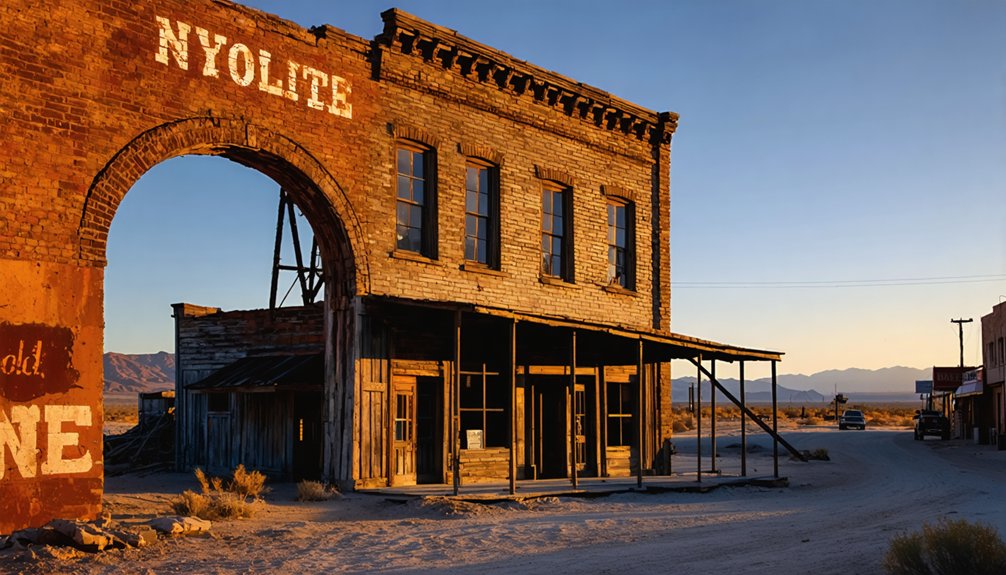
Industrial ghost towns declined primarily due to their over-reliance on single industries. You’ll find these communities couldn’t adapt when manufacturing decreased by 35% between 1979-2019. Resource depletion, catastrophic environmental events, shifting transportation networks, and youth exodus created perfect storms of economic collapse. As working-age populations left, tax bases shrank, infrastructure crumbled, and essential services disappeared. These abandoned landscapes reveal how quickly prosperity vanishes when an economic foundation collapses.
Key Takeaways
- Over-reliance on a single industry left towns vulnerable when that sector experienced downturns or technological changes.
- Resource depletion forced mining and extraction communities to close when the natural resources they depended on were exhausted.
- Environmental damage from industrial activities created uninhabitable conditions and costly cleanup challenges that prevented revitalization.
- Changes in transportation networks isolated communities when new highways, railroads, or shipping routes bypassed former industrial centers.
- Mass exodus of working-age populations following primary industry collapse created a cycle of disinvestment and infrastructure decay.
The Rise and Fall of Single-Industry Economies
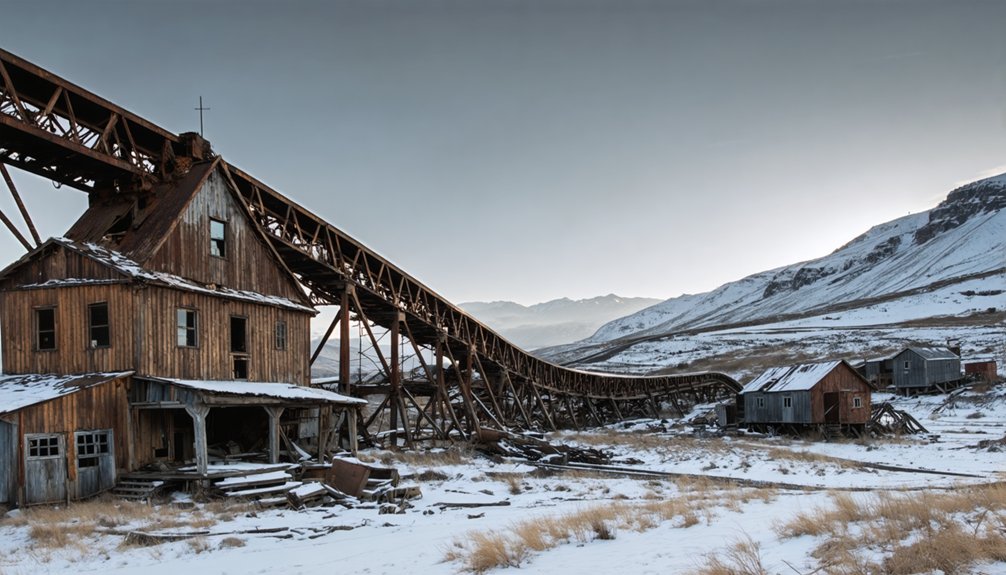
When industrial towns emerged across America in the late 19th and early 20th centuries, few could predict the precarious foundations upon which these communities were built. The economic policies that once favored concentrated production created towns entirely dependent on single industries, leaving them vulnerable to external shocks and lacking community resilience.
You can see the pattern clearly: when one industry dominates a local economy, any sector-specific downturn triggers widespread unemployment with few alternatives. Global shifts in demand, technological changes, and foreign competition hit these towns with disproportionate force. Apparel and textile communities were particularly devastated as their industries experienced drops of 50% or higher in firm numbers. The transportation and warehousing sector’s recent loss of 25,000 jobs highlights how industry-specific declines continue to threaten vulnerable communities today.
Without economic diversification, these communities couldn’t adapt when manufacturing declined by 35% between 1979 and 2019. Their narrow industrial base—whether in textiles, metals, or electronics—couldn’t withstand the economy’s structural shift toward services, leaving once-thriving communities as shells of their former prosperity.
When the Resources Run Dry: Exhaustion of Natural Assets
You’ll find that many ghost towns followed a predictable boom-to-bust cycle when their single extractive resource—whether coal, gold, or saltpetre—eventually depleted beyond economical recovery.
This single-source dependency trap left towns like Bodie, California and Humberstone, Chile particularly vulnerable, as they lacked economic diversification to weather the inevitable resource exhaustion. Economic fluctuations have significantly impacted traditional employment sectors in these areas, accelerating their transformation into ghost cities.
Many states like Oregon and Alaska have numerous ghost towns that testify to this resource-dependent vulnerability across the American landscape.
The environmental aftermath often compounded recovery challenges, with contaminated landscapes and ecological damage creating obstacles that further prevented revitalization long after the mines closed.
Boom-to-Bust Resource Cycles
The relentless cycle of resource depletion represents perhaps the most fundamental driver behind industrial ghost towns worldwide.
the history of industrial towns in America reveals how rapid economic growth can lead to significant environmental and social challenges. As industries evolve or relocate, these towns often suffer from abandonment and economic decline, leaving behind a stark reminder of their once-thriving existence. Understanding these patterns is essential for developing strategies that can revitalize these communities and prevent further degradation.
You’ll find this pattern repeated across continents and centuries, from American West gold rush settlements to Russian coal towns like Vorkuta, where a quarter-million population has dwindled dramatically since the 1980s.
These resource cycles create profound economic volatility. When mines become unprofitable or minerals are exhausted, operations cease immediately.
The ripple effects devastate entire communities as their economic foundations crumble. In Humberstone, Chile, saltpetre mining sustained life for decades until extraction stopped mid-century.
Similarly, synthetic fertilizers rendered natural nitrate extraction obsolete, abandoning dependent settlements practically overnight.
Towns built solely around a single economic activity often face complete abandonment when that activity becomes unsustainable, reflecting a common pattern in ghost town formation.
California’s Bodie and Calico represent well-preserved examples of once-thriving mining towns that collapsed after their gold and silver deposits were depleted.
The harsh reality is that when the primary resource disappears, so does the town’s reason to exist.
Communities built on single resources become casualties of their own specialized success.
Single-Source Dependency Trap
Industrial ghost towns exemplify the devastating impact of single-source dependency in resource-based economies. When you examine places like Bodie, California or Humberstone, Chile, you’ll find communities that collapsed entirely when their singular economic foundation—gold and saltpetre, respectively—disappeared.
This resource dependency created extreme economic vulnerability. Towns designed with temporary extraction in mind lacked infrastructure for alternative activities. When mines emptied or timber vanished, the specialized labor force found their skills suddenly worthless, with no secondary sectors to absorb workers. Many of these settlements fit T. Lindsey Baker’s definition of ghost towns as places where the reason for being no longer exists.
You can see how economic rents vanished rapidly as deposits depleted, triggering accelerated population exodus. The absence of diversification meant these settlements couldn’t pivot when their foundational industry collapsed.
What remained were abandoned structures—physical monuments to the dangers of building communities around finite resources without planning for inevitable depletion. Even settlements near major mining operations like those in Zambia face potential decline when economic activity slows, leading to gradual abandonment of once-thriving communities.
Environmental Aftermath Challenges
When resources are exhausted and industrial operations cease, ghost towns face a devastating environmental aftermath that often persists for generations.
You’ll find these abandoned landscapes scarred by mining waste, contaminated groundwater, and degraded soil—a pollution legacy that outlives the industries that created them.
Heavy metals seep into aquifers, while acid drainage transforms waterways into toxic streams.
The physical remnants—open pits, waste dumps, and subsiding land—render once-thriving areas hazardous and unusable.
Without clear ownership, environmental remediation becomes a regulatory quagmire. With several million abandoned mines worldwide, the scale of this problem is staggering and difficult to fully address.
The burden falls disproportionately on those with fewest resources to escape.
Communities that once prospered from extraction now suffer its aftermath, drinking bottled water and watching as reclamation efforts struggle against decades of accumulated damage.
Northern Liberties exemplifies how relic sites accumulate over time, with 224 abandoned industrial locations identified between the 1950s and 2017.
This environmental debt represents the true cost of industrial boom-and-bust cycles.
Catastrophic Events and Their Long-Term Impact
Throughout human history, catastrophic events have proven to be relentless catalysts for the abandonment of once-thriving industrial settlements.
When examining the catastrophic events behind ghost towns, you’ll find underground coal fires that rendered entire communities uninhabitable for decades, as witnessed in Centralia, Pennsylvania. The long-term impact of these disasters extends far beyond immediate evacuation—radiation from Chernobyl’s 1986 meltdown still prevents resettlement of Pryp’yat nearly four decades later.
Natural disasters create equally devastating outcomes, with droughts eliminating agricultural viability and floods destroying critical infrastructure. Fire damage combined with economic collapse sealed the fate of towns like St. Elmo, Colorado.
These calamities don’t merely disrupt communities temporarily; they fundamentally alter landscapes and permanently sever the human connection to places once called home.
Left Behind: The Effects of Changing Transportation Networks
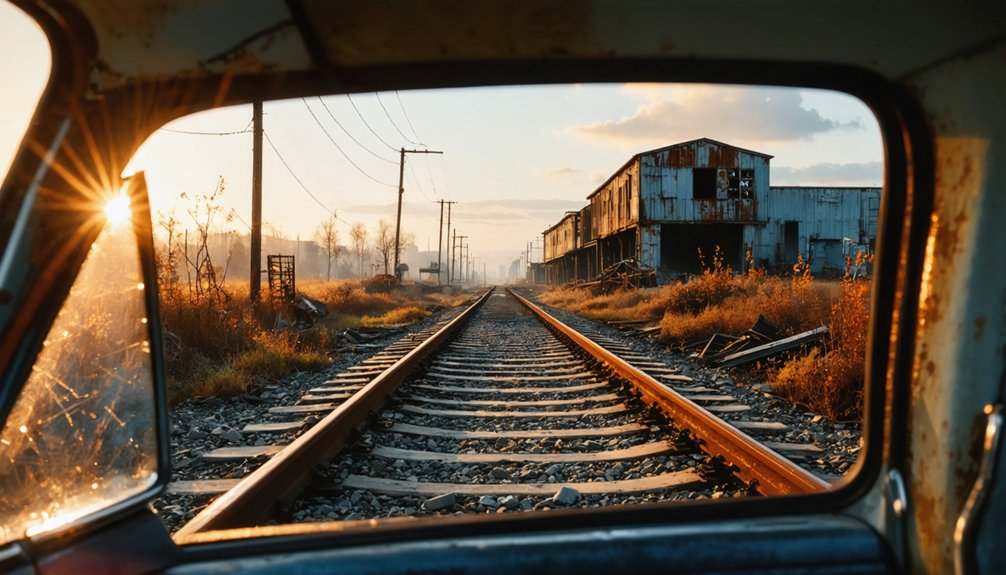
Changes in transportation networks have repeatedly reshaped America’s economic landscape, leaving countless communities to wither in their wake. You can trace this transportation evolution through once-thriving towns like Thurmond, West Virginia, which collapsed when rail routes bypassed them, or along Route 66 where Glenrio, Texas now stands abandoned after Interstate 40 diverted travelers elsewhere.
America’s transportation shifts leave ghost towns in their wake—monuments to prosperity that vanished when progress chose a different path.
The shift from steam to diesel locomotives eliminated the need for frequent stops, while the Interstate Highway System redirected America’s economic circulatory system. Towns not positioned on these new arteries faced economic isolation.
Businesses that once served travelers—hotels, restaurants, banks—shuttered their doors as the flow of commerce shifted.
These ghost towns serve as stark monuments to how quickly prosperity can vanish when transportation networks evolve and communities are left behind.
The Exodus: Workforce Migration and Population Decline
When manufacturing jobs disappeared across America’s industrial regions, you’d witness the 15-24 age group departing first, creating a youth vacuum that older residents couldn’t counterbalance.
Your once-vibrant communities began showing telltale signs of exodus—from Johnstown’s 4,600 abandoned properties to Beardstown’s precipitous 17% population decline—revealing the physical manifestation of economic collapse.
You’ve lost not just population but human capital, as college-educated workers who left the Rust Belt achieved 51% income growth compared to just 31% for those who remained, cementing a brain drain that further diminished economic recovery prospects.
Young Workers Flee First
As industrial regions begin to decline, young workers aged 15-24 constitute the initial wave of out-migration, establishing a pattern that accelerates community collapse.
You’ll notice this youth migration follows predictable economic incentives—those with minimal relocation costs and few community ties depart first, particularly single males seeking better wages elsewhere.
When young workers leave, they take their spending power and labor with them, triggering a domino effect. Support businesses lose their customer base, service jobs disappear, and the town’s economic ecosystem unravels.
Data confirms this rational calculation—Rust Belt emigrants achieved 94% real income growth compared to just 31% for those who stayed.
What remains is an aging population in communities increasingly unable to attract replacements for the departed youth—a demographic death spiral that historically sealed the fate of single-industry towns.
Empty Houses, Empty Futures
The mass exodus of working-age populations from industrial towns transforms once-vibrant neighborhoods into ghostly landscapes of vacant properties.
When you examine these communities, you’ll find housing markets in freefall as supply drastically outpaces demand, creating blocks of empty houses that silently testify to economic collapse.
The departure pattern follows clear demographic lines—young workers aged 15-24 leave first, creating future uncertainty as reproductive-age populations vanish.
Without them, communities can’t sustain basic services. Those who stay face dramatically lower income growth (31% versus 51% for those who leave), trapping them in declining economies.
This demographic transformation creates a downward spiral: as service infrastructure deteriorates, even stable residents begin contemplating departure, accelerating population decline and leaving behind merely the skeleton of once-thriving industrial communities.
Brain Drain Effects
Industrial ghost towns face a devastating brain drain that hollows out their economic and social cores.
When manufacturing collapses, as witnessed in southwestern Pennsylvania’s 24.3% job loss since 2001, talent exodus follows—particularly among young adults aged 15-24 who seek education and careers elsewhere.
You’ll find this pattern repeated across America’s industrial landscape: highly mobile workers, especially single males, depart first while families and older residents remain behind.
This selective migration fundamentally alters demographic composition, leaving communities notably older and economically weaker.
The consequences cascade beyond population statistics.
Each departing worker represents lost consumer spending, diminished tax revenue, and unrealized human potential.
As Youngstown’s population plummeted from 82,000 to 66,000 between 2000-2010, it lost not just numbers but its future workforce and innovators.
Crumbling Cities: The Cycle of Disinvestment and Decay
When primary industries collapse, they trigger a devastating cascade of economic and social decline that transforms once-thriving urban centers into crumbling shells of their former selves.
You’re witnessing the brutal mechanics of disinvestment cycles, where job losses prompt population exodus, shrinking tax bases while leaving behind vacant properties that attract vandalism and further urban neglect.
This self-reinforcing deterioration follows a predictable pattern:
- Infrastructure crumbles as municipal budgets shrink, leaving roads unrepaired and utilities unreliable.
- Community institutions disappear as schools close, hospitals relocate, and public services diminish.
- Economic opportunities vanish when businesses can’t sustain operations, deepening poverty’s grip.
These cities become trapped in a downward spiral where each departure further weakens remaining systems.
Breaking free requires radical rethinking of urban planning approaches that address shrinkage rather than presuming growth.
Frequently Asked Questions
Can Ghost Towns Legally Be Purchased and Revitalized by Individuals?
Yes, you can legally purchase ghost towns, but you’ll face revitalization challenges including unclear title ownership, infrastructure restoration costs, and restrictive historical preservation regulations that limit your development freedom.
How Long Does It Typically Take for a Town to Become Abandoned?
While you might expect a fixed abandonment timeline, most towns experience urban decay over 5-20 years following their economic collapse, though some persist for decades with dwindling populations before complete abandonment.
What Happens to Property Records and Land Deeds in Ghost Towns?
Property records survive in county offices despite abandonment. You’ll find land ownership documented through deeds, showing property transfer history that remains legally valid even as towns deteriorate into historical artifacts.
Are There Successful Examples of Fully Revived Former Ghost Towns?
Yes, you’ll find Jerome, Arizona and Barkerville, British Columbia exemplify successful ghost town revivals through community involvement, heritage tourism, and diverse revival strategies incorporating arts, culture, and historical preservation.
What Psychological Impacts Do Ghost Towns Have on Remaining Residents?
You’ll experience profound isolation effects as community ties dissolve around you, while nostalgia feelings for industrial identity intensify hopelessness. Visible decay reinforces your powerlessness, greatly increasing depression as social capital disintegrates.
References
- https://history.howstuffworks.com/history-vs-myth/ghost-towns.htm
- https://www.citymonitor.ai/analysis/these-modern-ghost-towns-show-danger-undiversified-economy-3578/
- https://jrap.scholasticahq.com/api/v1/articles/9543-the-economics-of-ghost-towns.pdf
- https://www.britannica.com/topic/ghost-town
- https://www.voanews.com/a/hidden-secrets-of-america-s-ghost-towns/4636610.html
- https://historycollection.com/ghost-town-boom-bust-instant-cities-that-vanished/
- https://peoples-things.ghost.io/disinvestment-and-decline-in-infrastructure-studies/
- https://www.lincolninst.edu/publications/articles/new-american-ghost-towns/
- https://www.visualcapitalist.com/the-decline-of-u-s-manufacturing-by-sector/
- https://1si.org/the-no-hire-no-fire-economy-what-the-latest-data-really-shows/