Ghost towns emerged when communities couldn’t adapt to resource depletion, economic collapse, or population outflows. You’ll find that mining towns like Bodie failed when minerals were exhausted, while agricultural communities declined as mechanization reduced labor needs. Transportation shifts, particularly the Interstate Highway System, bypassed many small towns, accelerating their demise. The inability to diversify beyond single industries left these communities vulnerable when their economic foundations crumbled. The haunting remnants tell deeper stories of adaptation and resilience.
Key Takeaways
- Resource depletion, particularly when mines became unprofitable, caused economic collapse in single-industry towns like Bodie and Calico.
- Failure to diversify local economies left communities vulnerable to boom-bust cycles and unable to sustain themselves after primary industries collapsed.
- Agricultural mechanization and farming efficiency reduced labor needs, forcing rural workers to migrate to urban centers for employment.
- Transportation changes, especially when highways bypassed small towns, diverted customer traffic and accelerated economic decline.
- Environmental disasters like the Dust Bowl and lingering contamination from mining operations made some areas uninhabitable and prevented redevelopment.
The Exhaustion of Natural Resources and Industry Collapse
When examining the decline of rural ghost towns across America and beyond, the exhaustion of natural resources emerges as the primary catalyst in a cascade of economic and social collapse.
You’ll find that once a town depletes its coal seams, mineral veins, or fertile soil beyond 70% of original levels, the foundation of its existence crumbles. Resource management failures become evident as single-resource economies like Bodie and Calico collapsed when mining became unprofitable. These outcomes mirror what happened in areas where economic fluctuations severely impacted traditional job sectors, ultimately contributing to population flight.
The ripple effects are devastating—primary industries shut down, support businesses follow suit, and workers migrate elsewhere. Without economic sustainability plans, these communities face rapid deterioration. Recent research shows that poorly planned mine closures can trigger not only job losses but also social disintegration and community resentment, potentially leading to populism in affected regions.
When single-resource towns collapse, a domino effect ensues—businesses shutter, residents flee, and communities wither without economic alternatives.
Infrastructure falls into disrepair as tax bases shrink. The environmental damage from intensive extraction often prevents new development, leaving towns with no viable path forward except abandonment—a predictable fate when communities fail to diversify before their primary resource disappears.
Migration Patterns: The Rural-to-Urban Exodus
The depletion of natural resources represents only one dimension of ghost towns’ collapse; an equally powerful force emerges in population movement patterns that have transformed rural landscapes.
Since 2000, rural areas have experienced persistent population outflows, with young adults particularly likely to depart for urban centers offering greater economic prospects. These areas reflect five distinct migration patterns including Youth Migration counties with severe population losses among emerging adults. Despite higher rural fertility rates, job scarcity has accelerated this exodus, creating significant shifts in rural demographics as communities age disproportionately. Data shows half of rural counties have reported fewer residents than in 2000.
You’ll notice this trend isn’t uniform—rural counties adjacent to metropolitan areas often benefit from spillover effects, gaining residents seeking lower housing costs while maintaining access to urban amenities.
The COVID-19 pandemic temporarily reversed some migration patterns, with remote work enabling movement to less dense areas. However, this hasn’t fundamentally altered the long-term trajectory of rural depopulation in more isolated regions, where economic competitiveness continues to drive outmigration.
Technological Advances and Agricultural Mechanization

You’ll find agricultural mechanization revolutionized farming efficiency while simultaneously disrupting rural communities through widespread labor displacement.
The introduction of tractors, combines, and other machinery enabled fewer farmers to cultivate larger areas, reducing the need for farm workers by as much as 50% in some regions.
This technological transformation, while increasing agricultural productivity, catalyzed a profound restructuring of rural economies as displaced workers migrated to urban centers seeking alternative employment. This migration pattern, exacerbated by low agricultural income, contributed to an aging agricultural workforce in many regions. The crisis led to the emergence of vacant store buildings throughout formerly vibrant main streets as rural businesses closed due to reduced spending power in farming communities.
Labor Force Displacement
Rural America’s transformation through technological advancement has fundamentally disrupted traditional labor patterns, creating unprecedented workforce displacement across the heartland.
You’ve witnessed communities that once thrived on manufacturing suddenly lose thousands of jobs, as happened in Muncie where 10,000 factory positions vanished after 1970.
This worker displacement has decimated rural economies dependent on single industries. When jobs disappear, populations follow, triggering cascading failures in local services.
The job scarcity forces those who stay to accept new positions paying merely 40% of their previous wages. Agricultural mechanization has similarly eliminated manual labor opportunities that historically anchored rural employment structures.
Manufacturing employment plummeted from 19.5 million jobs in 1979 to fewer than 11.5 million during the pandemic, representing a massive industrial decline that devastated countless rural communities.
Between 1980-2010, rural municipalities experienced a 0.59 log point decline in working-age populations, as both youth and experienced workers fled areas where economic prospects had evaporated.
Texas exemplifies this trend with an estimated 511 ghost towns reflecting historical shifts where communities like Gomez disappeared when the railroad’s arrival redirected economic prosperity elsewhere.
Farming Efficiency Revolution
Technological revolution in farming lies at the core of rural America’s demographic transformation, fundamentally reshaping landscapes once dotted with family-operated agricultural operations.
You’re witnessing an extraordinary efficiency revolution where a 66% decline in farm numbers since 1950 coincides with dramatic production increases. Since 1961, livestock production has doubled while greenhouse gas emissions from this sector have actually decreased by 11%. Single operators now manage vast acreages using GPS-guided equipment and precision agriculture techniques.
This sustainable farming change delivers remarkable resource efficiency—cropland needed per $1,000 of crops has nearly halved since 1990.
While rural innovation through mechanization and biotechnology created unprecedented productivity, it’s simultaneously accelerated consolidation. Larger operations leverage economies of scale, reducing per-unit costs while small family farms disappear. The shift toward million-dollar-plus farms now represents 79% of agricultural production value in 2022, further concentrating the industry.
The consequences ripple through communities as fewer farms mean fewer people, transforming once-vibrant towns into shells of their former selves.
Transportation Evolution: When Highways Bypassed Small Towns
While the Interstate Highway System revolutionized America’s transportation landscape in the mid-20th century, it simultaneously triggered the decline of countless rural communities across the nation.
When highways bypassed small towns, they diverted essential customer traffic, devastating local economies dependent on travelers. You’d have seen gas stations, diners, and shops close as transportation impact shifted away from Main Streets.
The new high-speed corridors sacrificed rural connectivity for efficiency, leaving communities isolated with limited access to education, healthcare, and economic opportunities.
Without interstate exits nearby, towns lost their lifelines to the broader economy. Local infrastructure suffered as heavy trucks damaged roads not designed for such loads, while declining tax bases couldn’t fund repairs.
This isolation accelerated population migration to urban centers, leaving behind shells of once-thriving communities.
Economic Diversification Failure and Single-Industry Dependence
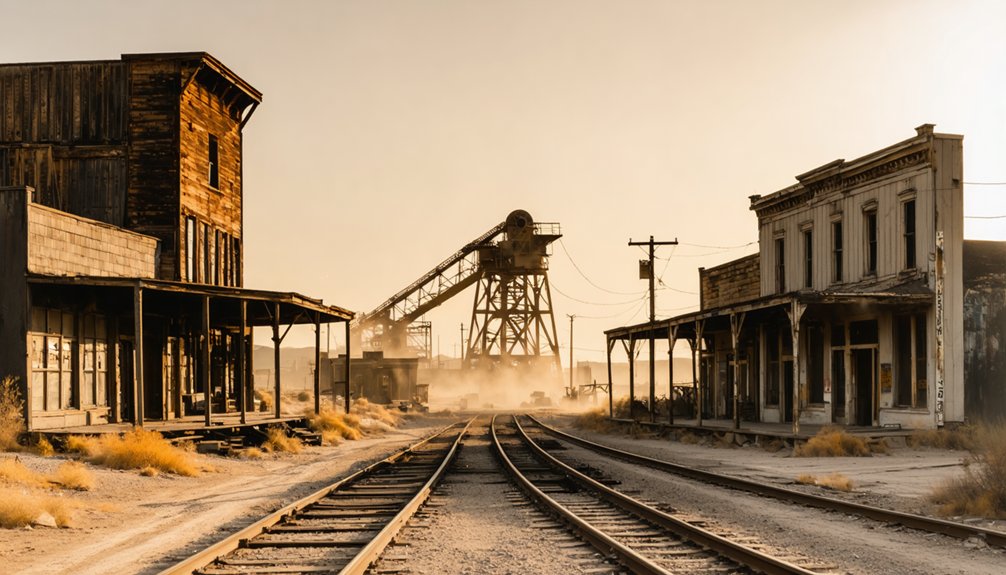
The fragility of small-town economies becomes most apparent when examining their overdependence on a single industry. When one employer—often a school district, hospital, or mining operation—dominates the local economy, communities face extreme economic vulnerability when that sector falters.
You’ll find this precarious arrangement manifested in classic boom-bust cycles, where prosperity vanishes overnight following resource depletion or price collapse.
Without diversification, these towns lack community resilience to withstand shocks. The subsequent chain reaction is predictable: labor demand plummets, working-age residents leave, and supporting businesses close.
Tax revenues evaporate, undermining essential services and accelerating decline. Most troubling, the transient development typical in single-industry towns leaves little long-term investment in infrastructure, housing, or alternative industries—ensuring the downward spiral continues unabated when the dominant employer falters.
Environmental Challenges and Natural Disaster Impacts
Environmental challenges represent a dual threat to rural communities—both causing and accelerating their decline into ghost towns. When rural areas face environmental degradation, they enter a downward spiral where ecological damage and depopulation reinforce each other.
- Abandoned agricultural land triggers ecosystem breakdown, invasive vegetation growth, and increased wildfire risks—ultimately accelerating rural desertification and biodiversity loss.
- Mining operations leave behind toxic legacies of mercury, arsenic, and selenium contamination in soil and water tables, creating uninhabitable zones with limited remediation options.
- Natural disasters (volcanic eruptions, floods, earthquakes, wildfires) render settlements permanently unsafe when recovery costs exceed perceived benefits.
- Climate change intensifies soil erosion and land degradation processes, diminishing agricultural viability and forcing remaining populations to relocate from increasingly barren landscapes.
Generational Shifts and the Allure of City Life

Beyond environmental threats, generational demographics have emerged as a powerful force reshaping rural landscapes across America.
You’re witnessing a fundamental shift as younger generations gravitate toward urban centers, attracted by career opportunities and lifestyle preferences unavailable in their hometowns.
Data reveals over 77% of rural counties have fewer working-age residents than two decades ago, with approximately 700,000 people departing for cities.
When young adults leave for education, they rarely return, creating generational gaps that accelerate decline.
Urban amenities—healthcare access, entertainment options, and broadband connectivity—have become essential expectations rather than luxuries.
Though COVID-19 temporarily slowed this exodus, the long-term urban pull persists.
Limited economic reinvention in rural areas guarantees this migration pattern continues, as younger Americans seek environments aligned with their evolving values and aspirations.
Infrastructure Deterioration and Public Service Decline
As critical lifelines to prosperity and stability deteriorate, America’s rural landscape suffers from a compounding infrastructure crisis that threatens the very existence of many small towns.
You’re witnessing a cascading infrastructure collapse that creates unsustainable conditions for rural communities:
- Structurally deficient bridges (7.5% nationally) and deteriorating roads (12% in poor condition) directly increase transportation costs and isolate communities.
- Rural hospital closures—over 120 nationwide since 2010—remove both essential healthcare and major employers.
- Water infrastructure failures result in massive resource loss, with North Texas alone losing 23.5 billion gallons in 2023.
- Service reduction follows population decline, creating a negative feedback loop where fewer residents justify fewer services.
This deterioration disproportionately affects vulnerable populations and discourages external investment, accelerating the transformation of once-thriving communities into ghost towns.
Government Policy Effects on Rural Sustainability
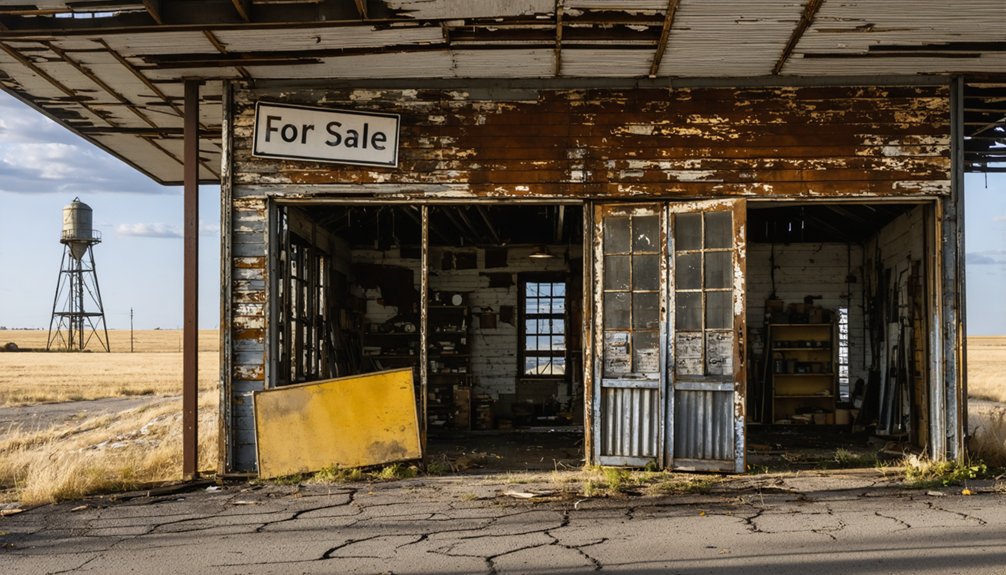
While rural communities face accelerating infrastructure decline, government policies have often compounded rather than alleviated their struggles. Federal and state overregulation has devastated rural economies dependent on industries like mining and energy extraction, transforming once-vibrant towns into abandoned shells.
Policy neglect manifests through regulations that prioritize national goals without adapting to local needs, creating economic disparities that drive population exodus.
One-size-fits-all regulation crushes rural communities while serving distant urban priorities.
Investment disparities are equally damaging—fiscal austerity has weakened rural public services while policies like NAFTA accelerated manufacturing job losses.
Financial capital expansion has dismantled locally-owned cooperatives and credit unions that once circulated wealth within communities.
With over 77% of rural counties losing working-age residents over two decades, these areas have become “sacrifice zones” where assets are systematically expropriated.
The removal of burdensome regulations and targeted reinvestment could potentially reverse this decline.
Historical Events That Accelerated Town Abandonment
You’ll find that major historical disruptions acted as powerful catalysts for town abandonment across rural America.
This phenomenon was particularly evident in areas affected by lost towns from the Civil War era, where communities once thrived but were ultimately left to decay. As soldiers returned home, many found their towns unrecognizable or entirely gone, leading to a demographic shift that reshaped the landscape of the nation. The echoes of these lost towns serve as a poignant reminder of the human cost of such conflicts and the enduring impact on the fabric of American society.
The devastation of war left communities like Oradour-sur-Glane permanently scarred, while widespread population displacements followed military conflicts and resource appropriation for training grounds.
During the Great Depression, economic collapse triggered mass exodus from farming communities as agricultural prices plummeted and bank foreclosures forced families to abandon generations-old homesteads.
War-Ravaged Communities
Throughout human history, armed conflicts have transformed once-thriving communities into desolate ghost towns, creating an indelible mark on rural landscapes worldwide.
You’ll find these abandoned settlements bear witness to humanity’s darkest chapters, preserved as stark reminders of war’s devastating impact.
- Military evacuations forced residents from villages like Tyneham and Imber during WWII, with 225 and 150 residents respectively permanently displaced for training grounds.
- Massacre sites such as Oradour-sur-Glane remain frozen in time after 643 residents were killed, their watches stopped at the moment of tragedy.
- Ethnic cleansing in conflict zones like Shusha resulted in cyclical population removals across decades, deliberately preventing return.
- Battle-induced abandonment occurred in frontier regions like Owens Valley, where military orders evacuated entire communities until conflicts ceased.
Depression-Era Exodus
Beyond the devastation of armed conflict, economic collapse delivered an equally powerful blow to America’s rural landscape during the 1930s. The Great Depression accelerated fundamental agricultural transformations as mechanization reduced labor needs and farm incomes plummeted.
You’d find the Dust Bowl‘s environmental catastrophe particularly devastating, with approximately 2.5 million people fleeing states like Oklahoma and Texas. Population declined by 19.2% in the hardest-hit counties, while Oklahoma lost 18.4% of its residents overall.
Economic hardship forced difficult choices—abandon land or face starvation. Though some reverse migration occurred as urban unemployed sought rural subsistence, the exodus ultimately proved permanent.
Many communities never recovered, especially when officials erected barriers limiting newcomers’ access to relief. Deportations further depleted the agricultural labor force, leaving once-thriving towns permanently abandoned.
Frequently Asked Questions
Can Ghost Towns Be Successfully Revitalized?
Yes, you can revitalize ghost towns through urban renewal strategies that balance adaptive reuse with heritage tourism, fostering economic revitalization while preserving authentic cultural identity that attracts visitors seeking historical experiences.
What Happens to Property Ownership in Abandoned Towns?
Property rights in abandoned towns often fragment among multiple stakeholders. You’ll find ownership may transfer through adverse possession, intestate succession, or municipal acquisition. Abandoned properties frequently suffer from unclear titles and restrictive zoning regulations.
How Do Ghost Towns Affect Surrounding Communities?
Ghost towns disrupt community dynamics through economic impacts like business closures, tax revenue losses, property devaluation, and job scarcity. You’ll observe health hazards, crime increases, and cultural fragmentation in surrounding areas.
Do Indigenous Communities Experience Ghost Town Phenomena Differently?
Yes, you’ll find indigenous communities experience ghost towns uniquely through forced displacement rather than economic cycles, maintaining cultural preservation despite physical abandonment, while demonstrating indigenous resilience through continued spiritual connections to ancestral sites.
What Psychological Impacts Do Ghost Towns Have on Former Residents?
You’ll experience trauma from lost nostalgic memories, eroded community identity, heightened anxiety, persistent fear, and fractured place attachment. These psychological wounds manifest through social withdrawal, chronic stress, and disrupted self-concept.
References
- https://jrap.scholasticahq.com/api/v1/articles/9543-the-economics-of-ghost-towns.pdf
- https://www.explore.com/travel/25-ghost-towns-around-us-and-history-behind-them/
- https://en.wikipedia.org/wiki/Abandoned_village
- https://www.youtube.com/watch?v=lBP97B2Pc3s
- https://www.nature.com/articles/s41467-022-35391-2
- https://www.ube.ac.uk/whats-happening/articles/ghost-cities/
- https://www.britannica.com/topic/ghost-town
- https://appliedgeographic.com/2021/09/23/boom-and-bust-towns/
- https://pmc.ncbi.nlm.nih.gov/articles/PMC9779337/
- http://www.ers.usda.gov/data-products/charts-of-note/chart-detail?chartId=108716