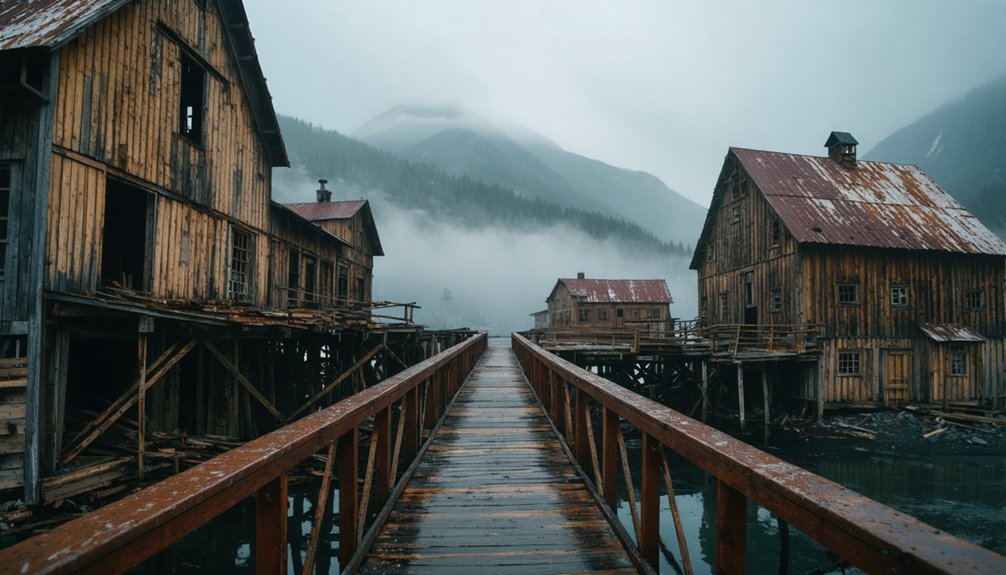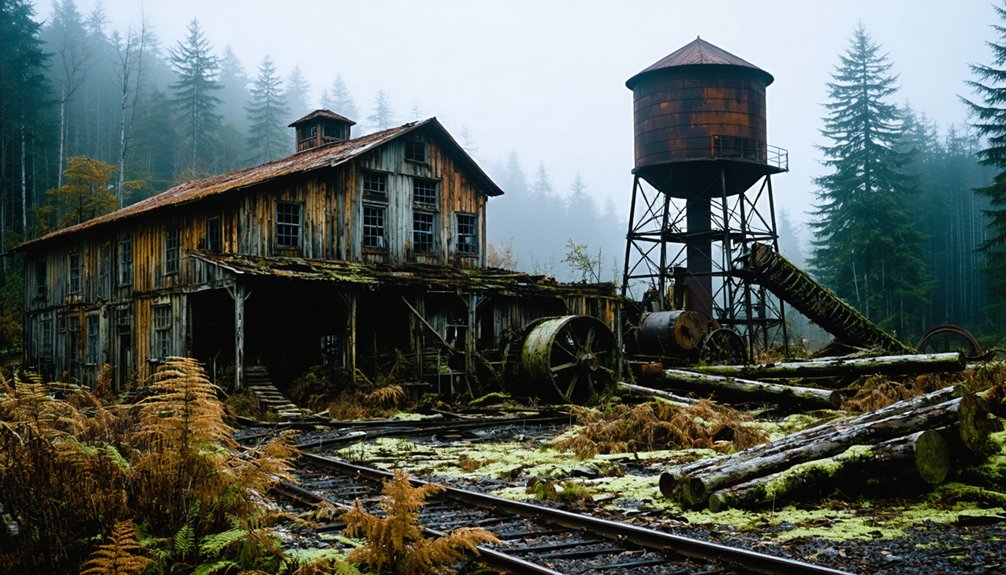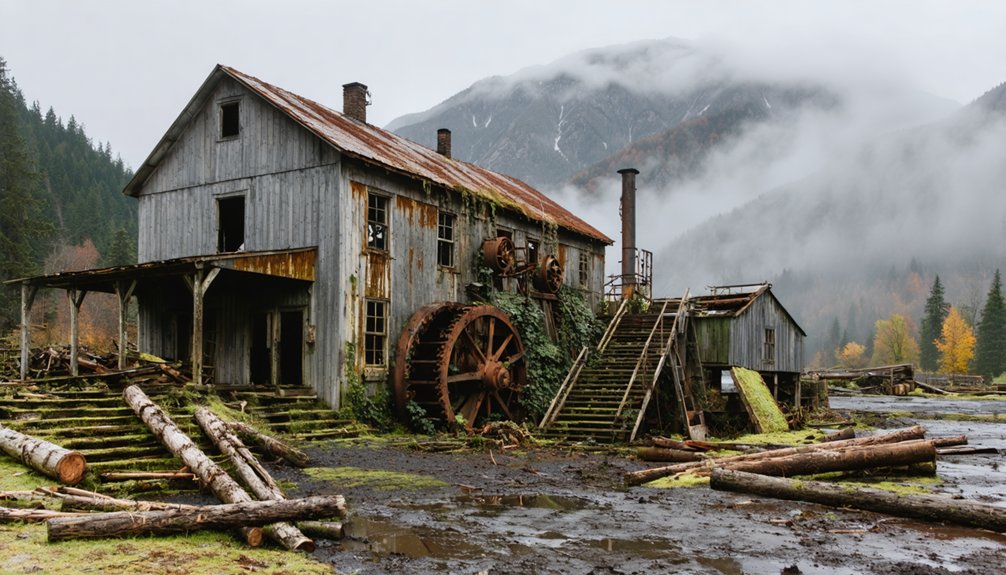
Sawmill communities declined due to multiple forces converging since the 1980s. You’ll find economic pressures like the 2008 housing crash and global competition devastated local markets. Simultaneously, resource depletion, environmental regulations, and climate change altered harvesting practices. Automation eliminated jobs while younger workers abandoned the industry, creating severe labor shortages. These once-thriving company towns couldn’t adapt quickly enough to survive the perfect storm of challenges they faced.
Key Takeaways
- Economic collapse following the 2008 housing bubble burst devastated timber markets, reducing production by nearly 50% and forcing mill closures.
- Global competition, especially after trade quota removals, allowed foreign producers to flood markets with cheaper lumber than local operations.
- Environmental regulations, particularly those protecting species like the northern spotted owl, dramatically restricted logging access to forests.
- Automation increased production efficiency but eliminated skilled jobs, contributing to unemployment and community economic decline.
- Unsustainable harvesting practices led to resource depletion, leaving formerly timber-rich regions without raw materials for continued operation.
The Collapse of Timber Markets in the Great Recession
When the housing bubble burst in 2008, it triggered a devastating chain reaction throughout the timber industry that would fundamentally reshape forest-dependent communities across North America.
U.S. housing starts plummeted to a 50-year low of 554,000 in 2009, creating unprecedented timber market fluctuations. The housing demand collapse drove lumber production in the western U.S. down by nearly 50%, reaching historic lows between 2005-2009.
You could see the devastating impact as approximately 30 large western mills closed permanently, with timber-processing capacity utilization dropping from 80% to a meager 56%.
The industry’s value proposition collapsed alongside demand—western sawmills saw their production value plummet over 60%, from $8 billion down to under $3 billion. Pine saw timber prices experienced a nearly 50% decline, falling drastically from $49 to about $26.45 per unit.
These weren’t mere economic statistics; they represented the dismantling of communities built around timber production. Canadian lumber production experienced a similar catastrophic decline, falling from 81.2 million cubic metres in 2006 to just 45.5 million cubic metres in 2009—a 44% reduction that devastated forestry-dependent communities across the country.
Resource Exhaustion and Unsustainable Harvesting
Long before the Great Recession delivered its fatal blow to many timber-dependent economies, a more insidious crisis had been brewing in America’s sawmill communities.
The fundamental issue wasn’t market dynamics but rather catastrophic resource management failures that stripped regions of their economic foundation.
Failed stewardship of natural resources, not market forces, devastated entire regions by destroying their economic lifeblood.
When you examine the collapse of towns like Aldridge, Texas, you’ll find stark visual evidence:
- Barren hillsides where majestic old-growth forests once stood, clear-cut without consideration for forest restoration
- Abandoned mill equipment rusting beside dried-up log ponds, monuments to short-term thinking
- Ghost towns with crumbling infrastructure, their populations scattered after timber depletion made operations unviable
The unsustainable harvesting practices created a predictable trajectory – rapid extraction followed by economic collapse when accessible timber vanished, leaving communities without the natural resources their freedom and prosperity depended upon. The decline of lumber production and sawmill operations happened drastically in the early 1930s due to severe deforestation and shifting market demands. The massive scale of this destruction is evident in the fact that approximately 18 million acres of timber in Texas alone had been cut by 1930.
Automation’s Double-Edged Sword in Mill Operations
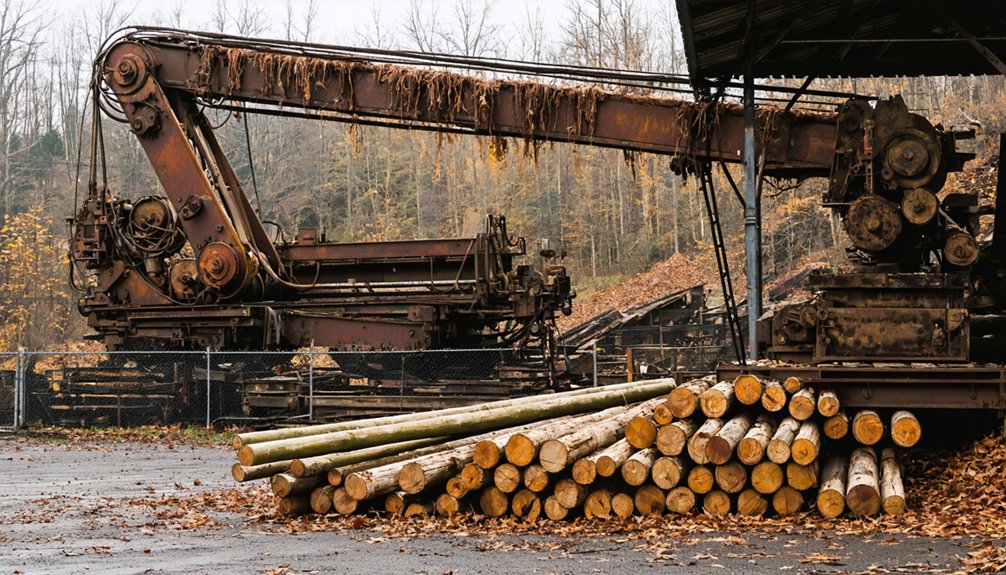
As mill owners sought to maximize efficiency and remain competitive during the mid-twentieth century, automation emerged as both salvation and harbinger of decline for traditional sawmill communities.
You’d witness production capacity triple as continuous feeding systems and automated carriages eliminated physical bottlenecks, dramatically boosting automation efficiency.
Yet this progress came at profound social cost. Labor displacement decimated skilled positions like head sawyers and graders, eroding community identity and employment stability.
The substantial capital investment required for modernization created barriers that favored large operations, triggering industry consolidation and small-town mill closures. The transition from labor-dependent logging to mechanized operations with internal combustion engines significantly accelerated this industry transformation.
Technological complexity introduced operational challenges requiring specialized maintenance and technical expertise. Automated mills demonstrated substantially higher productivity, producing 10,000 board feet per man per shift compared to just 5,000 in conventional operations.
As traditional skillsets lost value and workforce structures shifted, sawmill towns faced accelerating social and economic decline—casualties of an industrial evolution that prioritized productivity over community sustainability.
Many of these forgotten logging towns in America, once vibrant centers of activity, now stand as reminders of a bygone era. With emptied streets and abandoned homes, they illustrate the profound impact of economic shifts on small communities. Efforts to revitalize these areas often focus on attracting new industries while preserving their rich histories and unique identities.
Environmental Regulations and Changing Forest Management
You’ve witnessed the timber industry transform dramatically following the Northern Spotted Owl controversy of the 1990s, when protection of the endangered species severely restricted logging in old-growth forests.
This watershed moment catalyzed a broader change toward sustainable harvesting practices, forcing mills to adapt to reduced timber volumes and stricter environmental compliance standards. Compliance with NFPA codes is crucial for modern sawmills navigating these changing regulations. Many former timber communities experienced economic instability similar to today’s challenges balancing housing affordability with new industry development.
The resulting shift prioritized selective cutting, longer growth cycles, and ecological preservation—fundamentally altering the economic equation for sawmill operations across the country.
Spotted Owl Controversy
When the northern spotted owl emerged as a flashpoint in Northwest forest management during the late 1980s, few anticipated the cascading socioeconomic upheaval that would follow.
The spotted owl’s listing as threatened under the ESA triggered unprecedented habitat protection measures, reducing timber harvests by over 75% and devastating mill-dependent communities.
What you’ll find examining this controversy:
- Federal court injunctions that halted logging across 80% of national forests in three states, creating immediate economic shockwaves
- Empty mill yards where logs once stood stacked in abundance, now silent monuments to regulatory change
- Protest signs and bumper stickers declaring “Save a Logger, Eat an Owl” that captured the bitter division in once-thriving timber towns
The conflict pitted ecological preservation against economic survival, transforming both forest management and rural community identities. The annual harvest from national forests in Oregon and Washington had increased dramatically from 900 million to over 5 billion board feet between 1946 and 1986 before restrictions were imposed. Judge William Dwyer’s March 1991 ruling that the Forest Service Management Plan was inadequate further cemented restrictions on timber harvesting.
Sustainable Harvesting Shifts
The dramatic shift toward sustainable harvesting practices, following the spotted owl controversy, fundamentally transformed Northwest forestry operations and accelerated sawmill closures throughout the region.
You’re witnessing the consequences of ecosystem-based management that prioritizes biodiversity and habitat protection over maximum timber yield.
These sustainable practices have greatly reduced clear-cutting while emphasizing selective harvesting and forest restoration.
The impact on sawmills has been severe—reduced timber volumes mean less profitable operations, while compliance with stricter environmental regulations has increased operational costs.
Many rural communities with high percentages of low-income residents have suffered economically as hundreds of facilities closed.
While these policies aim to guarantee long-term forest health and address historical environmental damage, they’ve created immediate economic hardships for communities that once thrived on timber harvesting.
Climate Change Impacts on Logging Operations
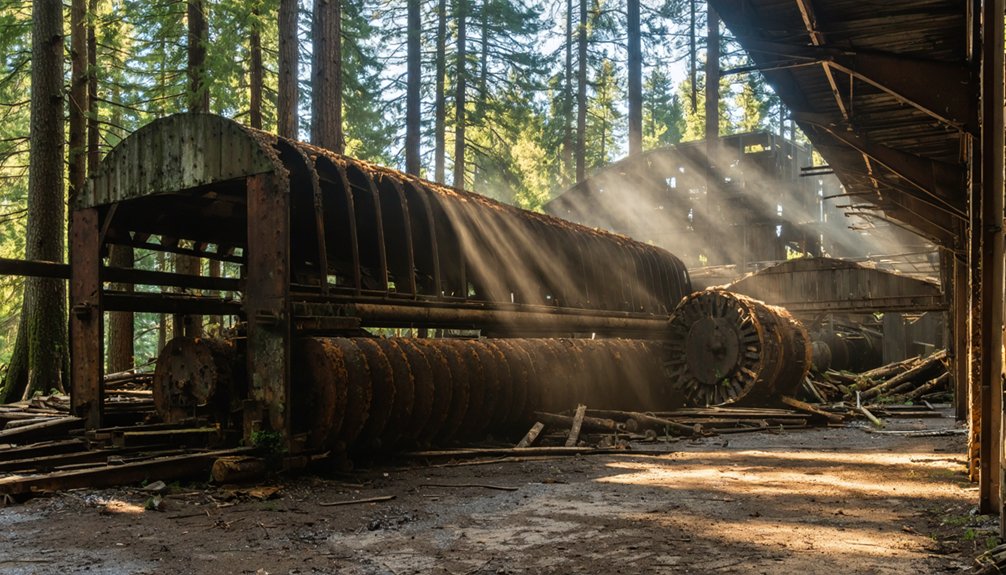
Climate change has fundamentally altered the operational landscape for logging communities, transforming previously reliable forest ecosystems into increasingly unpredictable environments.
You’re witnessing climate impacts that diminish forest resilience through multiple pathways – temperatures rising at twice the global average in northern forests while precipitation patterns become erratic.
These shifts disrupt traditional timber harvesting schedules and force operational adaptations that many communities can’t financially sustain.
- Warmer winters reduce snowpack that once protected forest roads, creating muddy, impassable conditions that halt logging operations.
- Extended fire seasons transform productive stands into charred, economically worthless landscapes almost overnight.
- Pest outbreaks move through weakened forests like invisible tsunamis, degrading timber quality before harvesters can salvage value.
The economic viability of sawmill communities now hangs precariously on increasingly unstable ecological foundations.
Labor Shortages and Workforce Demographic Shifts
The timber industry’s workforce crisis stems from an aging employee population that isn’t being adequately replaced as retirement rates accelerate.
You’ll find that young workers increasingly reject sawmill careers, perceiving the industry as outdated and lacking growth potential despite competitive wages.
This demographic imbalance has created a severe deficit of skilled workers capable of operating increasingly technical equipment, further constraining production capacity when demand for lumber remains relatively strong.
Aging Timber Workforce
As timber-dependent communities face increasing economic pressure, workforce demographics have emerged as a critical challenge for sawmill operations nationwide.
You’ll find an industry grappling with aging demographics—41% of hardwood sawmill workers are 40-49 years old, with another 25% aged 50-59. This age distribution threatens workforce sustainability as retirement-eligible employees exit faster than younger workers enter the field.
Three vivid realities of today’s timber workforce:
- Small crews of 22-35 employees per operation, with nearly one-third over age 55
- Limited ethnic diversity (65-77% White) restricting potential labor pools
- Older workers struggling with physical demands while possessing specialized knowledge that’s disappearing with retirement
The industry now faces a critical juncture: adapt workforce strategies or watch generational knowledge vanish alongside declining rural economies.
Youth Career Exodus
Young people are abandoning sawmill careers at unprecedented rates, creating a workforce crisis that threatens the very survival of timber-dependent communities.
You’ll find this exodus driven by multiple factors: sawmills suffer from poor career visibility among youth who seek diverse, fulfilling work with relocation opportunities—not the repetitive tasks traditionally associated with timber processing.
Rural outreach efforts have failed to communicate the sector’s benefits, while urban migration pulls youth toward metropolitan areas offering higher wages and cultural amenities.
Counties like Coos (16.5% poverty) and Humboldt (18%) exemplify the socioeconomic challenges accelerating workforce depletion.
When you examine employment trends, the pattern becomes clear—declining replacement of retiring workers creates persistent labor gaps, while competing industries with better perceived work-life balance continue attracting the limited rural youth population.
Skilled Worker Deficit
Declining precipitously over the past three years, sawmill sector employment has reached critical deficiency levels that threaten both production capacity and community stability.
This skilled worker deficit stems from demographic shifts, insufficient skills training, and market volatility impacting retention.
The consequences manifest in three stark realities:
- Aging workforces retiring without trained replacements, leaving specialized equipment idle despite product demand.
- Technical skills gaps widening as vocational education programs fail to address industry-specific needs.
- Rural outmigration patterns creating persistent labor shortages unresolved by conventional labor initiatives.
You’re witnessing a profound transformation where traditional knowledge transfer mechanisms have broken down.
Sawmill operations that once supported entire communities now struggle to maintain baseline staffing, despite machinery capacity.
Market pressures exacerbate this deficit, drawing potential workers toward competing industries with perceived greater stability.
Foreign Competition and Global Market Pressures
While globalization fundamentally transformed traditional sawmill industries throughout the late 20th century, the resulting market pressures created unprecedented challenges for local communities dependent on timber processing.
You’ve witnessed the expansion of economic unions and trade pacts that intensified competition from foreign producers with lower costs and abundant resources. Countries like Chile, Brazil, and China leveraged their competitive advantages, while foreign investment accelerated market volatility that domestic mills couldn’t weather.
The flood of Canadian lumber into U.S. markets after quota removals devastated American sawmills, closing facilities and eliminating jobs.
Meanwhile, Southern Hemisphere nations with fast-growing plantations exported high volumes at prices local operations couldn’t match.
These global forces, combined with shifts toward alternative building materials, created a perfect storm that overwhelmed many traditional sawmill communities‘ capacity to adapt.
The Death of Company Towns and Rural Economics
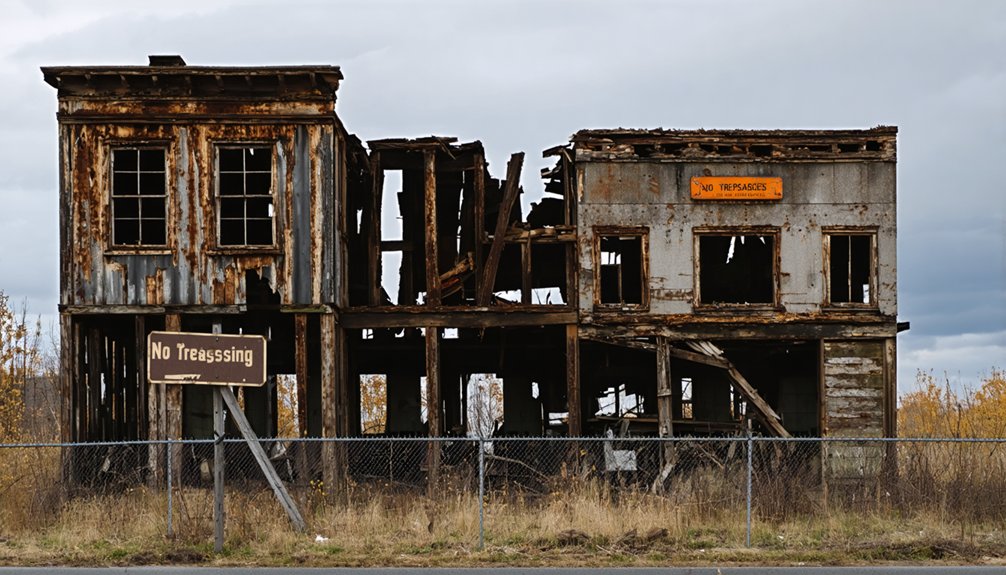
As company towns began to disappear from the American landscape in the mid-twentieth century, they left behind economic voids that many rural communities have never recovered from.
This company town decline reflected broader rural economic shifts driven by depleted natural resources, technological advancement, and changing labor relations. When single-industry employers departed, they took with them the economic foundation that sustained entire communities.
- Empty storefronts lining main streets where bustling commercial activity once thrived
- Abandoned company houses gradually reclaimed by nature as families relocated
- Silent mill buildings standing as hollow monuments to vanished livelihoods
You’ve witnessed similar patterns across America as transportation improvements, labor union successes, and New Deal policies freed workers from geographic dependence on single employers.
Resource exhaustion—particularly in timber regions—sealed the fate of many sawmill communities when forests could no longer sustain operations.
From Timber to Tourism: The Painful Transition
The shift from timber-dependent economies to tourism-focused development represents one of the most wrenching economic transformations in America’s rural landscape.
You’ve witnessed communities struggle through painful changes as mills closed, leaving environmental scars and economic voids. The path forward often requires balancing economic diversification with historical preservation.
Successful communities have embraced adaptive reuse of industrial spaces, transforming sawmills into cultural heritage sites that promote community engagement.
Collaborative planning between government, developers, and residents has proven essential for tourism development that honors authentic local identity.
While new economies offer recreational opportunities through environmental remediation, they frequently provide lower wages than timber jobs once did.
This fundamental restructuring demands local empowerment and creative approaches to preserve community cohesion while adapting to new economic realities.
Frequently Asked Questions
How Did Sawmill Communities Impact Native American Tribal Lands?
You’ll be alarmed that 60% of Indian timber was processed off-reservation. Sawmill communities exploited tribal land use through stumpage agreements, causing extensive cultural disruption while profits flowed away from Indigenous control.
What Psychological Effects Did Mill Closures Have on Workers?
You’ll experience significant mental health deterioration when mill closures occur, including depression and anxiety. Your community identity fractures as you face unemployment, financial strain, and the profound loss of workplace-based social connections.
Did Government Assistance Programs Successfully Help Displaced Sawmill Workers?
Government support programs achieved mixed results. While they provided worker retraining opportunities, their effectiveness varied regionally. You’ll find these initiatives often fell short of addressing all displaced workers’ complex needs.
How Did Women’s Roles Evolve in Traditional Sawmill Communities?
You’ll notice women shifted from marginalized domestic roles toward essential productive contributors, fundamentally altering gender dynamics while strengthening community resilience through their expanded economic participation during wartime industrial demands.
What Innovative Forest Products Replaced Traditional Lumber Manufacturing?
In Oregon’s timber country, you’ll see cross-laminated timber and engineered wood products revolutionizing forest utilization. These mass timber innovations offer structural advantages while supporting sustainable forestry practices and expanding economic opportunities beyond conventional sawmills.
References
- https://www.srs.fs.usda.gov/pubs/gtr/gtr_srs257.pdf
- https://www.sevendaysvt.com/news/vermonts-sawmills-are-closing-which-is-bad-for-forests-43013550/
- https://www.oregonhistoryproject.org/articles/restructuring-the-timber-economy/
- https://headwaterseconomics.org/wp-content/uploads/Lessons_Timber_Transition.pdf
- https://en.wikipedia.org/wiki/History_of_the_lumber_industry_in_the_United_States
- https://smart.dhgate.com/why-did-the-mcnary-sawmill-shut-down-history-arizona-town/
- https://wou.edu/history/files/2015/08/Ron-Vorderstrasse.pdf
- https://www.nrs.fs.usda.gov/pubs/gtr/gtr-nrs-p-105papers/02keegan-p-105.pdf
- http://www.bber.umt.edu/FIR/..pubsForestcapacitypro-61-08-pg625-634.pdf
- https://www150.statcan.gc.ca/n1/pub/11-626-x/11-626-x2013028-eng.htm