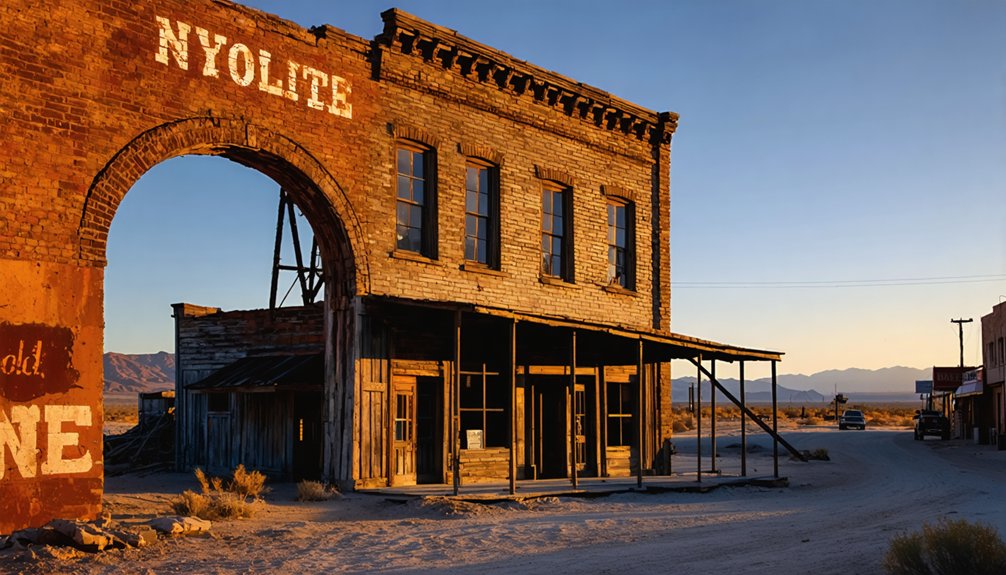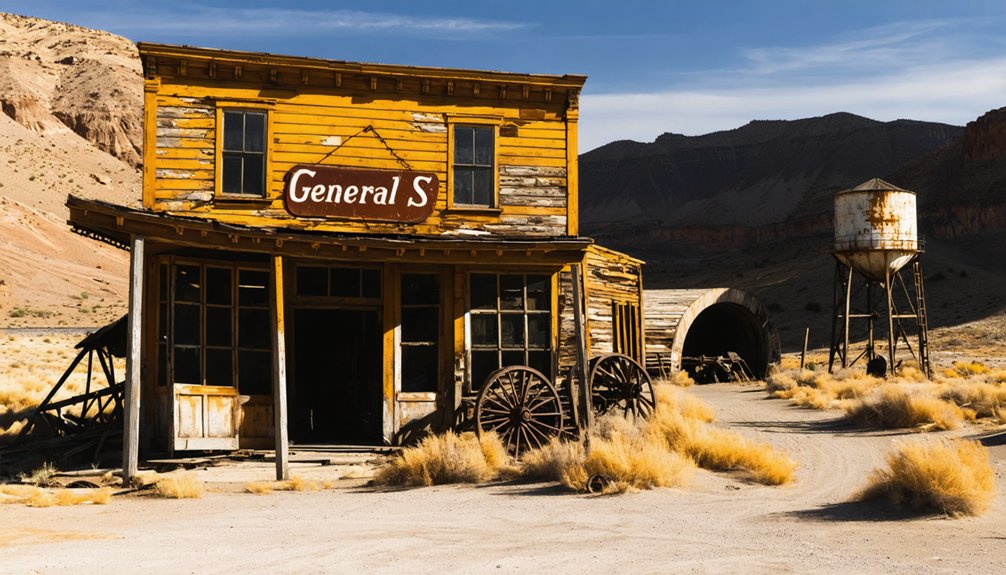
Ghost towns emerged primarily from boom-bust cycles in extractive industries like mining. You’ll find these abandoned settlements resulted from depleted resources, railway bypasses, and economic isolation. Company towns trapped workers in exploitative systems, while environmental catastrophes rendered some areas uninhabitable. Technological advancements made older production methods obsolete, and single-industry towns couldn’t survive market shifts. These silent remnants tell compelling stories about America’s industrial past that explain today’s economic landscapes.
Key Takeaways
- Resource depletion caused boom-bust cycles when gold, silver, or coal deposits were exhausted in towns like Bodie and Calico.
- Economic dependency on single industries created fragility when market conditions changed or resources were depleted.
- Transportation abandonment, especially railway closures, severed vital economic connections and accelerated community decline.
- Company-owned towns collapsed when corporations abandoned less profitable locations without concern for community sustainability.
- Environmental catastrophes rendered some industrial areas uninhabitable through underground fires, toxic waste, and mining-related hazards.
The Rise and Fall of Extractive Resource Economies
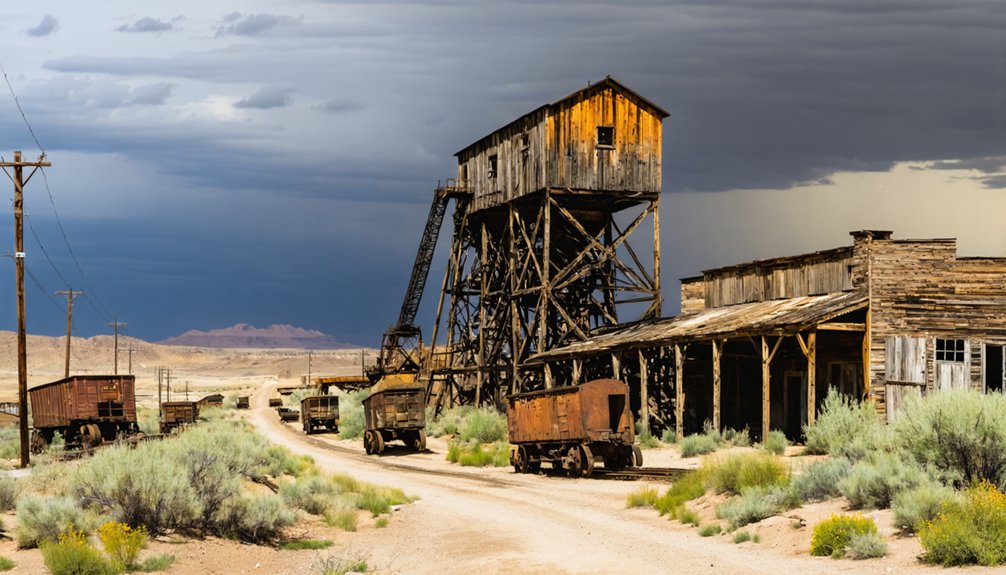
The extractive resource economies that flourished during the Industrial Revolution ultimately created a landscape dotted with ghost towns, abandoned as quickly as they emerged. You can trace their rapid decline to the fundamental problem of resource management—once gold, silver, or coal deposits were depleted, these single-industry towns lost their economic foundation.
Towns like Bodie and Calico in California exemplify this boom-bust pattern. Their economies surged with resource discovery but collapsed when extraction became unprofitable. Without economic diversification, businesses that served mining operations couldn’t survive independently.
The speed of abandonment was striking—investors withdrew capital almost overnight when profits diminished, leaving infrastructure to decay rapidly. These towns often faced additional challenges when they were bypassed by railroads, further isolating them from vital economic connections. Harsh living conditions in remote locations further accelerated the exodus, as workers saw little reason to remain in inhospitable environments once financial incentives disappeared. Many of these abandoned settlements now serve as popular heritage tourism destinations, preserving their historical and architectural features for future generations.
When the Railways Moved On: Transportation Abandonment
You’re looking at the skeletal remains of once-vibrant communities that withered when railway companies rerouted lines or abandoned service altogether.
These transportation decisions severed the essential economic arteries that connected industrial towns to distant markets, suppliers, and the outside world. Union Level exemplifies this pattern, as the cessation of train services in the mid-1980s contributed significantly to its decline into a ghost town. Many of these abandoned communities were established during the 1880-1940 period when railroads fueled westward expansion and industrial development across America.
When the last train departed, it often marked the beginning of a town’s transformation into a ghost town as businesses shuttered, populations fled, and physical infrastructure crumbled into ruins.
Bypassed Communities Collapse
When railway companies abandoned or rerouted their lines throughout the late 19th and early 20th centuries, communities built around these essential transportation arteries faced catastrophic economic and social collapse.
You could witness economic decline unfold rapidly as businesses lost their ability to ship and receive goods, forcing closures that decimated local tax bases. The Industrial Revolution significantly shaped these communities’ rise and ultimate abandonment as economic priorities shifted.
Community fragmentation followed as younger residents migrated to rail-connected towns or cities, leaving aging populations behind in increasingly isolated areas. Schools and post offices shuttered as populations dwindled.
Examples like Union Level, Virginia and Bodie, California illustrate this pattern—once-thriving centers reduced to ghost towns within decades after rail abandonment. Many retired steam trains were left to rust in these abandoned towns, becoming overgrown with vegetation as nature gradually reclaimed the forgotten industrial sites.
With the rise of highways and trucking, towns not positioned on new transportation networks became casualties of industrial evolution, their physical infrastructure gradually reclaimed by nature.
Arteries of Commerce Severed
Lifelines of economic prosperity, railways served as the critical arteries through which the lifeblood of commerce flowed during America’s industrial expansion.
When these transportation networks were severed, entire communities slipped into economic isolation and eventual abandonment.
You can trace this pattern of decay through:
- The rapid abandonment of up to 50% of railroad tracks across America, particularly after diesel engines replaced steam locomotives.
- The closure of essential community institutions like banks and post offices following railway departure.
- The elimination of freight and passenger services that had connected rural communities to larger markets.
- The visible remnants of “ghost tracks” marking where thriving commerce once existed.
This transportation abandonment created a feedback loop – without railways, businesses failed, populations fled, and towns disappeared from the map. Many ghost towns were founded along railways that lost their relevance with the rise of dieselization and changing transportation technologies. New Jersey exemplifies this trend, having the highest number of abandoned railroads in the United States by the early 20th century.
Last Train Home
As railways gradually disappeared from America’s industrial landscape, they left behind a scattered trail of dying communities that had once thrived on their economic promise. You can trace this forgotten journey across towns like Union Level, Virginia, where tobacco farming prosperity evaporated when rail service halted.
When companies rerouted lines or abandoned unprofitable routes, they severed the arteries of commerce that kept these settlements alive.
The railway nostalgia that lingers in these ghost towns masks harsh economic realities. When trains stopped running, businesses shuttered rapidly—general stores, banks, hotels—triggering population flight. This pattern was dramatically illustrated when the establishment of the Lehi and Sasana Railroad in 1869 contributed to Luzan’s decline, eventually burying the town under coal breaker waste.
Coal towns like Lausanne, Pennsylvania lost strategic importance as transport networks evolved. Similar to Bannack, Montana, these settlements experienced rapid abandonment when their primary resources were depleted. The Depression amplified these effects, creating cascading failures in single-commodity communities.
Eventually, even post offices closed, finalizing their shift to ghost town status.
The Perils of Company-Owned Communities
Despite their superficial allure, company-owned industrial towns represented a dangerous economic trap for the workers who inhabited them. Behind the façade of paternalism and community planning lurked systematic economic exploitation and social engineering designed to maintain company control while limiting worker autonomy.
These communities institutionalized oppression through:
- Economic bondage via inflated prices at company stores and mandatory housing rentals
- Strategic isolation that prevented workers from seeking better opportunities elsewhere
- Rigid racial segregation in housing, education, and social services
- Suppression of labor unrest through a mix of amenities and force
While companies provided schools, parks, and healthcare, these “benefits” masked the reality that workers traded basic freedoms for employment.
Cultural conflicts simmered beneath the surface as diverse populations struggled against both company domination and internal divisions.
Environmental Catastrophes and Uninhabitable Settlements
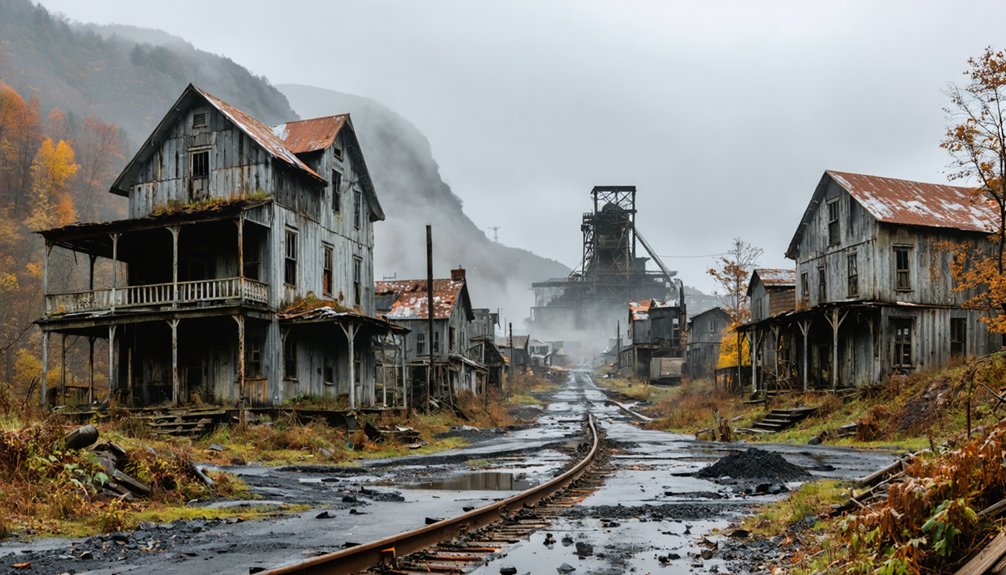
You’ll find numerous ghost towns created not by economic decline, but by environmental disasters that rendered settlements completely uninhabitable.
Underground coal fires, such as Centralia’s decades-long inferno, released toxic gases through ground fissures while creating dangerous sinkholes that eventually forced complete evacuation of residents.
Mining operations left behind mountains of toxic waste and acid drainage that poisoned water supplies, while catastrophic dam failures submerged entire communities beneath artificial lakes, permanently erasing their existence from the landscape.
Coal Fires Below Ground
Beneath the abandoned streets of once-thriving industrial towns, an invisible menace continues to burn relentlessly, transforming vibrant communities into uninhabitable wastelands.
These underground fires consume coal seams for centuries, creating lethal conditions you’d never suspect from the surface.
The catastrophic dangers include:
- Sudden sinkholes that can collapse beneath your feet without warning
- Toxic gas emissions, particularly carbon monoxide, seeping into homes
- Ground temperatures reaching 350°F, hot enough to ignite buildings and infrastructure
- Environmental devastation that renders surrounding landscapes barren for generations
Most fires begin through human carelessness—hot ash dumped into abandoned mines or improperly managed waste disposal.
Despite extensive containment efforts, these fires resist extinguishing, with Centralia’s infamous underground inferno expected to burn for another 250 years.
Toxic Mining Residue
While coal fires silently consume towns from below, the visible scars of industrial mining operations present an equally devastating threat through toxic residue that poisons landscapes for generations.
You’ll find former mining communities like Picher, Oklahoma surrounded by mountains of chat—over 100 million tons of lead and zinc tailings that contaminate everything they touch.
These toxic legacies release deadly cocktails of lead, mercury, arsenic, and selenium into soil and groundwater, creating uninhabitable wastelands. When acid mine drainage occurs, sulfuric acid and heavy metals pour into waterways at rates of millions of gallons daily, destroying aquatic ecosystems and water supplies.
The toxic exposure extends beyond environmental damage to severe health risks: respiratory diseases, cancer, and lead poisoning plague former residents, often forcing government-mandated evacuations and creating ghost towns where prosperity once thrived.
Dam Failures Flood Towns
When massive walls of water tore through the Conemaugh Valley in 1889, they transformed Johnstown from a thriving industrial center into America’s deadliest dam disaster, claiming 2,209 lives and demolishing 1,600 homes in minutes.
The catastrophic failure of industrial-era dams permanently altered America’s landscape, devastating communities dependent on water power:
- The South Fork Dam’s collapse released 10-foot floodwaters through Johnstown’s streets, prompting modern flood infrastructure including 15-foot river walls.
- Lawrence, Kansas narrowly avoided destruction when ice jams damaged the Bowersock Dam in 1888, threatening the city’s water supply.
- Towns like Kennett and Enfield were deliberately sacrificed to create reservoirs for urban centers.
- Dam failures spotlighted critical dam safety issues, as poor design and maintenance converted life-sustaining infrastructure into deadly threats.
Market Forces and Economic Competition Between Towns
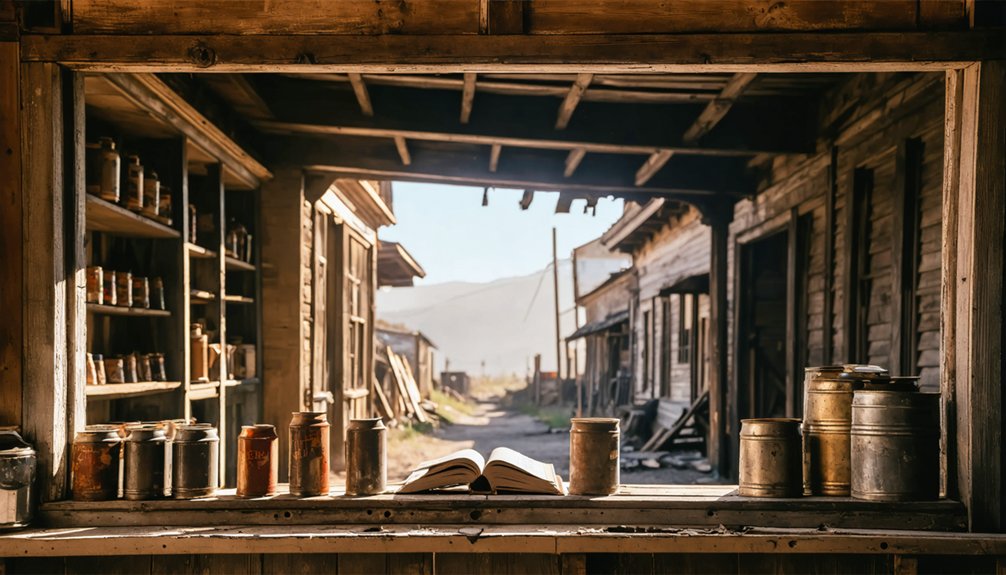
Although industrial boomtowns proliferated rapidly during the 19th century, their long-term survival hinged on complex market dynamics that favored some locations while dooming others to abandonment.
Towns dependent on single industries—whether mining, railroads, or manufacturing—suffered extreme economic fragility when resources depleted or technologies evolved.
You’ll find that locations with access to transportation networks thrived while isolated communities withered. Market competition favored towns with diversified economies and strategic positioning near commercial hubs.
When monopolistic corporations consolidated operations, they’d abandon less profitable locations without concern for community impacts.
The invisible hand of commerce was merciless: towns unable to adapt as economic conditions shifted simply disappeared.
Those that survived typically developed diverse commercial activities beyond their original industrial purpose, creating resilience against the boom-and-bust cycles that claimed so many frontier settlements.
Labor Unrest and Worker Exodus in Industrial Communities
As industrial towns expanded rapidly in the nineteenth century, the volatile relationship between labor and management often determined whether communities would thrive or collapse into abandonment.
You’ll find that labor strikes and economic migration fundamentally shaped the demographic destiny of these industrial centers.
Four key factors driving worker exodus from industrial towns:
- Brutal working conditions—13-hour workdays coupled with dangerous environments—sparked labor unrest that often led to community instability.
- Racial and ethnic tensions intensified as African Americans fled Southern violence and European immigrants competed for limited opportunities.
- Employer suppression of union organizing through violence and intimidation prompted workers to seek less contentious environments.
- Economic downturns created widespread unemployment, triggering mass migrations as workers abandoned industrial communities in search of stability elsewhere.
The Impact of Technological Obsolescence on Manufacturing Towns
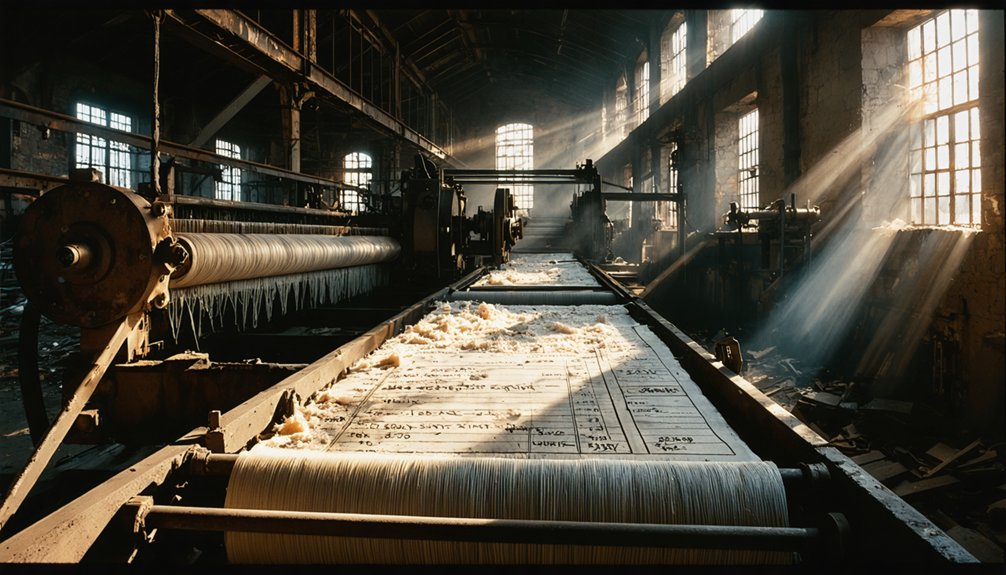
Once revolutionary production methods became outdated, technological obsolescence transformed thriving industrial centers into abandoned shells across America’s manufacturing landscape.
You’d see this in factory towns where automation and improved manufacturing processes eliminated the need for large labor forces that once supported entire communities.
As technological advancements shifted from coal-fired to diesel locomotives, towns like Thurmond, WV lost their economic purpose when rail yards and service stops became unnecessary.
Similarly, manufacturing decline accelerated when older factories couldn’t compete with centralized, modern facilities that utilized just-in-time production and advanced machinery.
Towns dependent on single industries suffered most dramatically—whether coal mining communities whose extraction methods became unprofitable, or textile mills rendered obsolete by newer production technologies.
Without the ability to diversify or adapt quickly, these industrial communities simply faded away.
Boom-to-Bust Cycles in Single-Industry Settlements
When resource-dependent communities emerged during the Industrial Revolution, they typically followed a predictable boom-to-bust pattern that would ultimately lead to their abandonment.
These single-industry settlements exhibited extreme economic vulnerability, often collapsing entirely when their foundational resource was depleted or when market forces shifted.
The fatal cycle of these towns included:
- Rapid growth around a single resource extraction activity (mining, logging, etc.)
- Development of company-controlled infrastructure with minimal long-term planning
- Complete dependency on fluctuating commodity prices and company fortunes
- Sudden population exodus following resource exhaustion or economic shifts
You’ll find places like Bodie, California exemplify this pattern perfectly.
Towns bypassed by new transportation routes faced similar fates, as commerce diverted elsewhere, leaving these once-thriving communities isolated and economically irrelevant.
Migration Patterns and Demographic Shifts in Rural America

The dramatic transformation of America’s demographic landscape during the Industrial Revolution stemmed from complex migration patterns that fundamentally altered the nation’s rural-urban balance. Between 1880-1920, agricultural workers declined from triple to merely equal the number of industrial workers, as economic necessity pushed rural families toward urban opportunities.
Initially, immigrants filled dangerous factory jobs, but after 1920s restrictions, poor whites and Blacks from the South became the new industrial workforce. Rural migration accelerated through improved transportation systems that connected previously isolated communities.
For six decades (1950-2010), rural America experienced persistent out-migration of young adults seeking better prospects, with particularly severe losses during the farm crises of the 1980s. Only in the 1970s did rural areas briefly flourish demographically.
Later, baby boomers reversed some trends by returning to rural counties in their 50s and 60s, creating new demographic shifts.
The Legacy of Ghost Towns as Historical Artifacts
Ghost towns across America function as living museums where you’ll find tangible evidence of economic cycles, settlement patterns, and industrial innovation preserved through strategic tourism initiatives.
These abandoned settlements serve as educational time capsules that reveal social structures, ethnic dynamics, and labor conditions from America’s industrial past in ways that complement traditional archival records.
You can observe how preservation efforts, including adaptive reuse projects and heritage tourism, have transformed these historical artifacts into economic assets for surrounding communities while maintaining their value as authentic environments for historical study.
Preservation Through Tourism
Industrial heritage sites abandoned during economic downturns have found new purpose through tourism-based preservation efforts that transform historical tragedy into cultural opportunity.
When you visit ghost towns like Bodie, California or Thurmond, West Virginia, you’re participating in heritage tourism that directly funds cultural preservation initiatives while experiencing authentic American industrial history.
This tourism-based preservation model offers four critical benefits:
- Economic revitalization through visitor spending in regions that lost traditional industries
- Creation of seasonal employment opportunities for local communities
- Funding for architectural restoration that maintains historical authenticity
- Educational platforms that interpret boom-and-bust cycles for public understanding
The delicate balance between accessibility and preservation presents ongoing challenges, but tourism remains the most viable path for ensuring these fragile historical treasures endure as tangible reminders of America’s industrial development.
Educational Time Capsules
Frozen in time, abandoned industrial settlements serve as unparalleled three-dimensional textbooks where history’s physical remnants tell stories that written accounts alone can’t convey.
You’re witnessing the educational significance of these sites whenever you walk past preserved company stores, segregated housing quarters, or shuttered mines.
These locations document America’s industrial evolution—from boom-to-bust cycles following mineral discoveries to the impacts of technological shifts like railroad rerouting and dieselization.
They’re cultural preservation repositories where ethnic enclaves, company-built recreation facilities, and labor relation artifacts remain intact.
When you explore a ghost town’s layout, you’re studying more than abandoned buildings; you’re examining the physical manifestation of industrial paternalism, immigrant experiences, and environmental consequences of resource extraction that shaped the nation’s development through critical economic transformations.
these remnants often tell haunting tales from abandoned factories, where echoes of labor and dreams linger in the decaying walls. Each structure holds stories of resilience and loss, reflecting the lives once intertwined with the machinery of progress. As you roam through these silent spaces, the past whispers secrets waiting to be uncovered.
Frequently Asked Questions
How Did Ghost Towns Impact Surrounding Native American Communities?
You’ve witnessed your land’s transformation as ghost towns severed cultural exchange networks, disrupted traditional land use, and left economic voids where sustainable tribal commerce once flourished.
Were Ghost Towns Deliberately Preserved or Left to Decay Naturally?
Both outcomes occurred. You’ll find preservation efforts like Batsto Village’s government restoration alongside unplanned urban decay in places like Silver City, where economic collapse led to natural abandonment.
Did Any Ghost Towns Successfully Reinvent Themselves With New Industries?
Over 30% of ghost towns achieved revival through tourism. You’ll find successful ghost town revitalization in places like Kennicott, Alaska, where industrial diversification through heritage tourism created sustainable economic alternatives.
How Did Religion and Churches Influence Ghost Town Social Structures?
Churches wielded significant influence by fostering community cohesion through social gatherings, moral guidance, and mutual aid systems. You’d find they often remained the last functioning institutions during economic decline.
What Role Did Women Play in Ghost Town Economies?
Like invisible threads in economic tapestry, you’d find women’s labor woven throughout ghost towns. You’ll see their economic contributions in textile work, domestic service, small businesses, and household management—sustaining communities through boom-and-bust cycles.
References
- https://www.youtube.com/watch?v=d0Fba_lQqYI
- https://history.howstuffworks.com/history-vs-myth/ghost-towns.htm
- https://www.britannica.com/topic/ghost-town
- https://www.voanews.com/a/hidden-secrets-of-america-s-ghost-towns/4636610.html
- https://socialwelfare.library.vcu.edu/organizations/labor/company-towns-1890s-to-1935/
- https://jrap.scholasticahq.com/api/v1/articles/9543-the-economics-of-ghost-towns.pdf
- https://historycollection.com/ghost-town-boom-bust-instant-cities-that-vanished/
- https://texashighways.com/culture/history/what-the-heck-is-a-ghost-town/
- https://www.loveexploring.com/gallerylist/188219/the-us-state-with-the-most-ghost-towns-revealed
- https://www.youtube.com/watch?v=lBP97B2Pc3s