You’ll find ghostly geodesic domes at Drop City and crumbling medieval structures at Ephrata Cloister. Shaker villages stand with empty workshops, their foundations repurposed for gas stations. Brook Farm’s charred Phalanstery disappears beneath forest growth while Oneida’s communal sleeping quarters whisper of radical social practices. Rusted plows mark agricultural failures, and Arcosanti’s unfinished concrete curves remain frozen in time. These architectural skeletons hold untold stories of collapsed dreams and abandoned ideals.
Key Takeaways
- Geodesic domes of Drop City stand as decaying skeletal frames, transforming America’s first rural hippie commune into a geodesic ghost town.
- A ritually buried glass trumpet at Ephrata Cloister remains unexplained, its purpose lost to history despite preservation efforts since 1941.
- Brook Farm’s charred Phalanstery footprint peeks through forest undergrowth, marking the site where financial collapse and fire ended utopian dreams.
- Oneida Community’s partner selection rooms and communal sleeping quarters reveal unsettling social engineering practices and suppression of individualism.
- Abandoned sacred spaces across multiple communities stand in suspended decay, no longer serving their spiritual purposes but witnessing utopian failure.
The Decaying Domes of Drop City
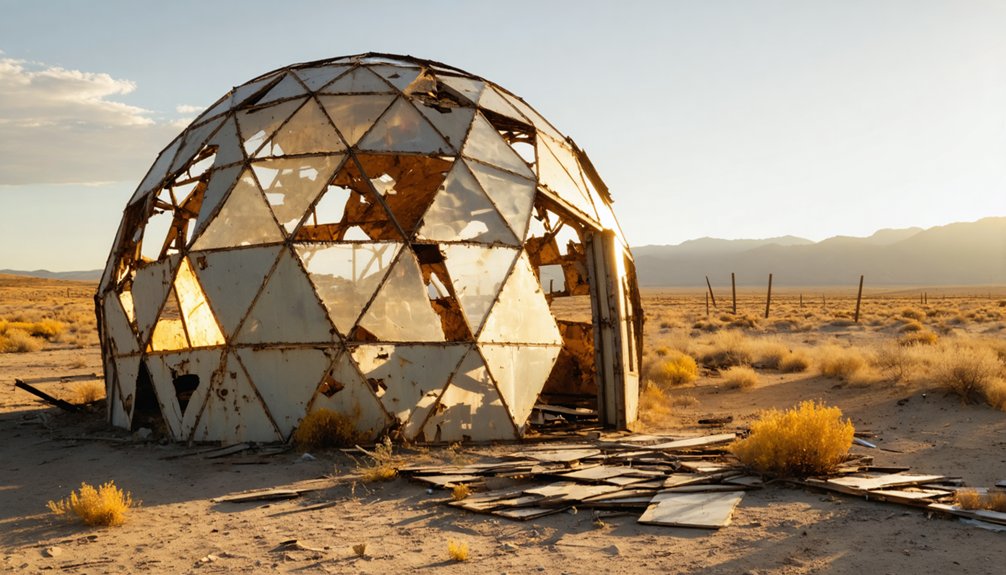
While the rocky plains of southern Colorado shelter many forgotten treasures, none capture the paradox of utopian decay quite like Drop City’s skeletal domes.
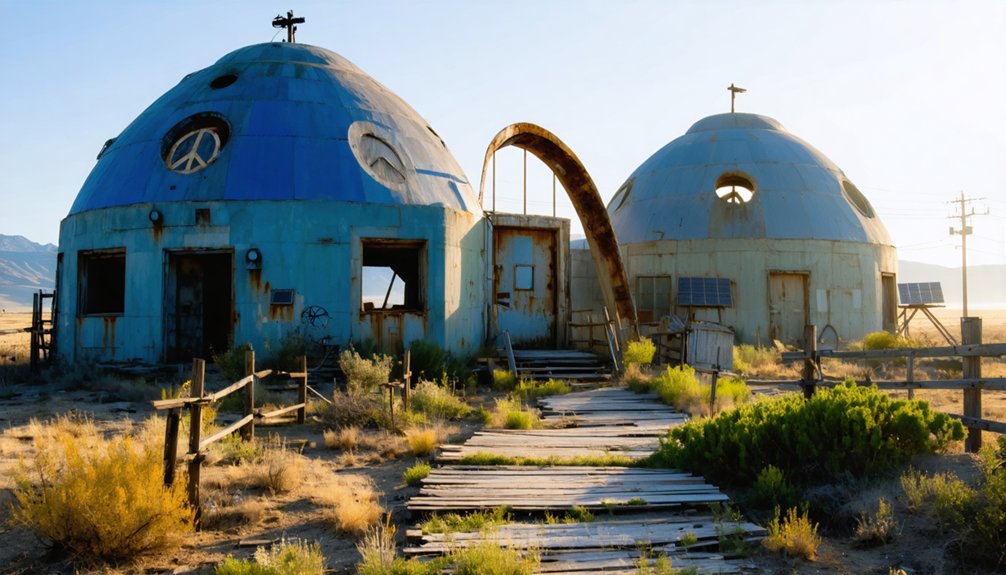
You won’t find anything but ghosts at the seven-acre plot where America’s first rural hippie commune once thrived. Established in 1965 for a mere $500, these pioneering geodesic structures—built from junked car roofs and salvaged lumber—earned Buckminster Fuller’s Dymaxion Award in 1966.
By 1973, the site earned a new title: “the world’s first geodesic ghost town.”
The geodesic decay happened swiftly. After the 1967 Joy Festival brought hundreds to the settlement, founding members began departing. The site was financially supported by selling artistic works like the Ultimate Painting, which featured a rotating motor and strobe light for cosmic visual effects. The original site was eventually sold to a neighboring cattle rancher and all structures were gradually dismantled.
Paradise collapsed under its own weight, leaving behind geometric shells that whispered of abandoned dreams.
Communal nostalgia remains the only inhabitant of these experimental dwellings that once housed twelve core residents living without hierarchy—a rusted monument to freedom’s brief flowering.
Silent Halls of Shaker Villages
Unlike Drop City’s idealistic experiment that flared and faded within a decade, the Shaker communities’ decline stretched across generations, leaving behind a more complex architectural legacy.
Walking through Pleasant Hill today, you’ll find just 30+ original structures of the 260 once built by Shaker hands. What remains speaks of silent rituals now vanished – buildings repurposed as gas stations, restaurants, and Baptist churches. Restoration efforts commenced in 1966, led by a nonprofit organization focused on preserving Shaker heritage.
The limestone tombstones weather away in Shaker cemeteries, their simplicity fighting against erasure.
The remnants of bygone eras are often highlighted by the presence of historic buildings in Detroit. These architectural treasures serve as a testament to the city’s rich heritage and resilience, standing strong against the passage of time. Each structure tells a story, inviting both locals and visitors to explore the layers of history that shaped the community.
The communal legacy disintegrated slowly – Pleasant Hill’s vibrant population of 491 dwindled to merely 12 by its 1910 closure. Manufacturing ceased. Farmland returned to nature.
At Shirley, only 8 buildings stand on original foundations, while Mount Lebanon retains fewer than 40 structures on a fraction of its former acreage. The Harvard Shaker Village Cemetery contains the remains of over 300 Shaker members who once lived and worked in the community.
Crumbling Remnants of Religious Zeal at Ephrata Cloister
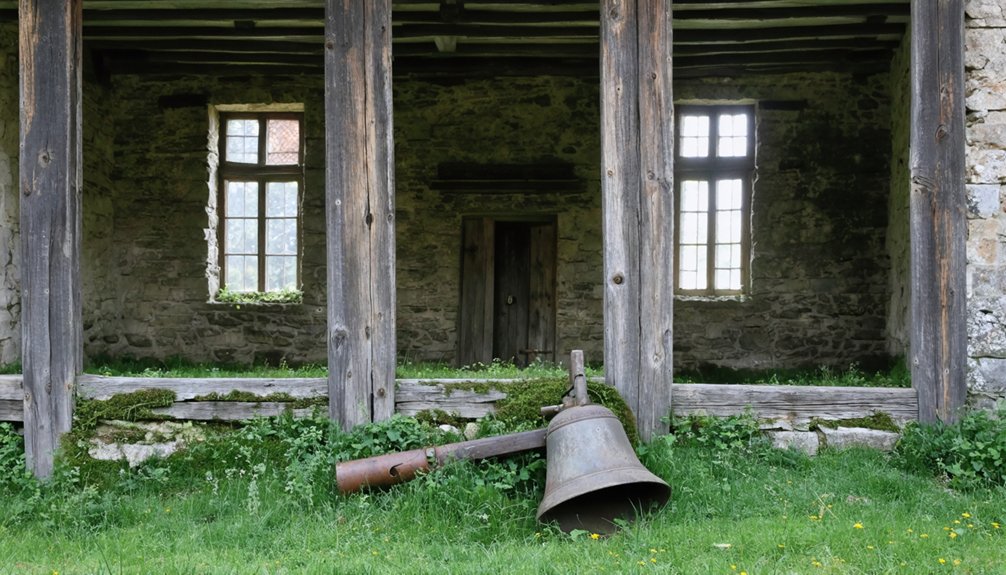
Hidden within Pennsylvania’s verdant Cocalico Valley, Ephrata Cloister stands as a monument to religious devotion turned to dust, its weathered buildings housing ghosts of ascetic fervor.
You’ll feel the weight of spiritual isolation in the semi-circular arches and thick stone walls of the medieval-inspired structures built between 1748-1751.
The Sisters’ House and Meetinghouse preserve the rigid ascetic discipline of Conrad Beissel’s German pietists—80 celibate brothers and sisters who once inhabited these austere quarters.
The steep-roofed buildings, preserved since 1941, reveal communal sleeping arrangements and kitchens where members practiced their hermetic lifestyle.
Most haunting is a ritually buried glass trumpet, mouthpiece missing, its purpose lost to time—a silent artifact of a utopian experiment that dwindled to just 11 members by 1934.
The original buildings showcase remarkable durability through centuries, constructed with sturdy logs and stone that exemplify the extraordinary craftsmanship of the era.
The community’s artistic legacy lives on through their intricate Fraktur art and over a thousand original a cappella musical compositions, representing America’s earliest illuminated manuscripts.
Ghostly Agricultural Landscapes of Failed Communes
Across the abandoned communes of America’s utopian experiments, forsaken farmland tells the most honest story of ideological collapse.
You’ll find tangible evidence of agricultural neglect in rusted plows half-buried in soil that once promised abundance but delivered scarcity. Communes crumbled when crop abandonment accelerated—fields of rotting vegetables revealing the gap between revolutionary theory and farming practicality. The Fruit Hills Commune particularly struggled due to members’ lack of experience in agricultural methods. Brook Farm’s demise was hastened by a destructive fire in 1846 that devastated their remaining agricultural infrastructure.
Utopian dreams withered alongside unharvested crops, ideology proving no match for agriculture’s unforgiving reality.
- Overgrown orchards with twisted, unpruned branches that haven’t felt shears in decades
- Empty barns with collapsing roofs where communal tools rust in corners, still arranged for tomorrow’s work that never came
- Irrigation ditches now clogged with decades of sediment, revealing how quickly agricultural infrastructure fails without constant maintenance
These ghostly farmlands stand as silent witnesses to utopian communities that starved amid potential plenty.
Architectural Whispers of Utopian Dreams

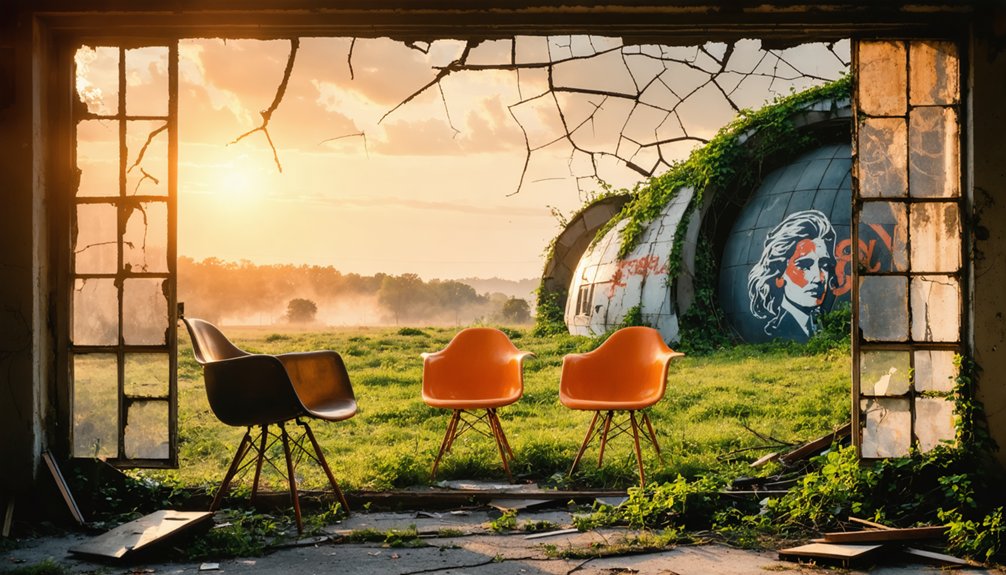
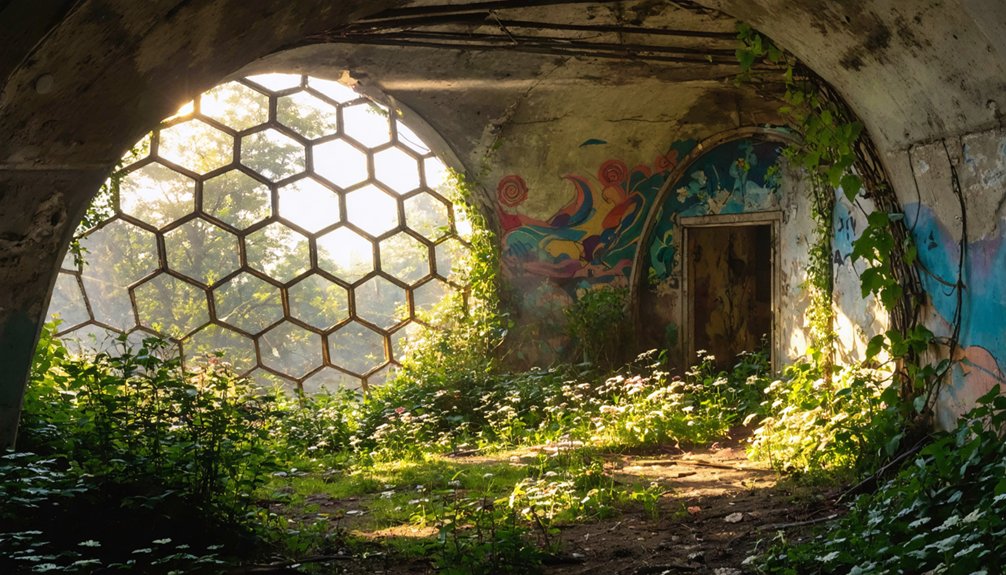
You’ll find the skeletal remains of dome communities where experimental architects once pursued geometric perfection, their cracked fiberglass panels now bleached by decades of sun.
The sacred spaces—meditation halls, community centers, ceremonial gathering spots—stand in suspended decay, their spiritual purpose nullified by abandonment. These silent structures were once designed to embody human unity and peace, particularly evident in the largely unrealized vision of Auroville in India.
These hollow structures, designed for bustling communes of hundreds, now house nothing but dust and wildlife, their ambitious blueprints for human connection evident in every communal kitchen and open-concept living space. Palmanova’s star-shaped design, with its high defensive walls, illustrates how even utopian communities were built with protection from external threats in mind.
Dome Dreams Abandoned
Standing in stark contrast to their once-vibrant ambitions, the skeletal remains of geodesic domes at Drop City and the partially-realized concrete apses of Arcosanti now whisper tales of architectural revolution abandoned mid-sentence.
You’ll find these dome aesthetics deteriorating—faded multi-colored triangular panels collapsing into rusted heaps at Drop City, while Arcosanti’s concrete curves stand eerily incomplete.
These geodesic innovations offered glimpses of alternative futures now frozen in time:
- Drop City’s car-roof domes – America’s first rural hippie settlement, now a hazardous “geodesic ghost town”
- Arcosanti’s soaring apses – Soleri’s vertical city experiment, partially inhabited yet permanently unfinished
- Communal spaces – Once alive with collective meals and artistic production, now silent reminders of utopian fragility
Sacred Spaces Decaying
The skeletal remains of religious sanctuaries tell their own harrowing stories within abandoned utopian settlements.
You’ll find sacred architecture crumbling under nature’s persistent assault—vines crawling through shattered stained glass, rainwater pooling on warped wooden pews. These structures once embodied community ideals through their labyrinthine layouts and soaring domes, now standing as silent witnesses to failed spiritual aspirations.
The architectural decay accelerates with each passing season, complicated by vandalism and material scavenging.
What you’re witnessing isn’t just physical deterioration but the erosion of cultural heritage. Repurposing challenges abound—how to preserve historical significance while finding new function.
The emotional resonance of these spaces stems from their stark evidence to abandoned utopian visions, their weathered facades embodying the fragility of even our most ambitious collective dreams.
Structures Without Inhabitants
Across forgotten landscapes of once-ambitious social experiments, ghostly architectural remnants persist as mute testimony to utopian dreams abandoned mid-sentence.
You’ll find Paolo Soleri’s concrete shells at Arcosanti standing at just 3% completion, while Llano del Rio’s forgotten foundations trace a circular city that never materialized beyond rocky outlines.
- Deserted designs like Drop City’s collapsing geodesic domes fade into the Colorado landscape, their recycled materials returning to earth.
- Pruitt-Igoe’s scattered concrete stairwells emerge through reclaiming vegetation, tombstones of urban renewal’s failure.
- At Octagon City, not even dust remains—a complete erasure where utopian ideals existed only briefly before vanishing.
These architectural whispers stand frozen in time, waiting for an audience that never arrived.
The Haunting Echoes of Complex Marriage at Oneida
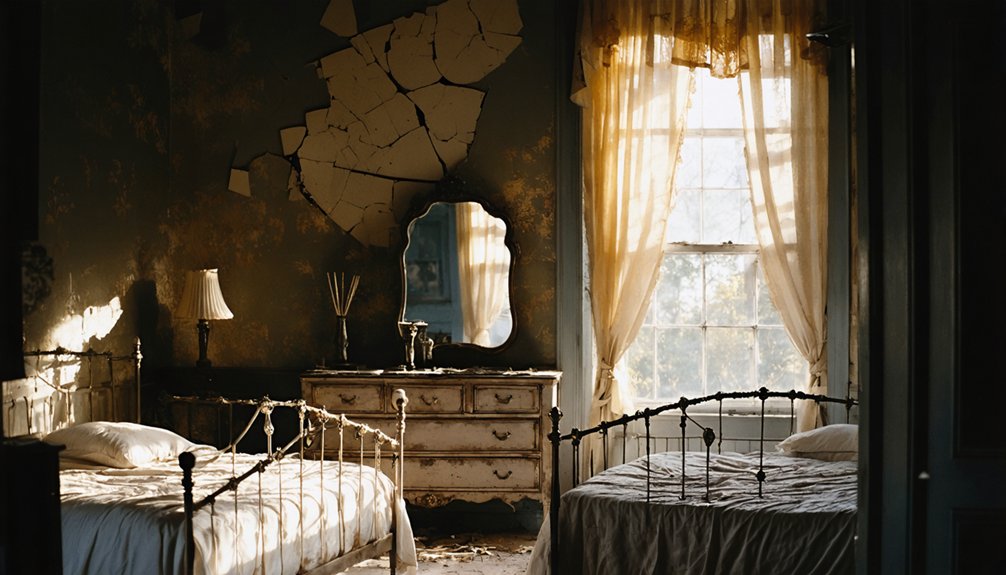
You’ll find Oneida’s sprawling communal sleeping quarters still intact, silent witnesses to a utopia where “complex marriage” replaced exclusive relationships and elder members selected spiritual matches through ritualized “interviews.”
The abandoned selection rooms, where a committee once determined who could procreate through their stirpiculture program, retain an unsettling emptiness that speaks to the community’s failed attempt at perfecting humanity.
These physical spaces, stripped of their former inhabitants but not their history, embody the tension between Noyes’s radical vision and the inevitable human desire for personal attachment that ultimately fractured this bold social experiment.
Communal Sleeping Quarters
Stepping into Oneida’s communal sleeping quarters today, you’re confronted with dozens of small, austere rooms that once housed America’s most notorious experiment in shared sexuality.
These tight, spartan spaces—designed between 1861-1878—rejected conventional marriage through architectural transparency, with bedrooms opening onto communal areas for constant surveillance.
The eerie remnants reveal a calculated design to suppress individualism and cultivate communal identity:
- Single beds only, intentionally small and plain to discourage exclusive coupling
- Minimal personal possessions allowed, preventing attachment to objects or spaces
- Regular rotation of sleeping quarters to prevent emotional “stickiness” between members
You’ll notice the stark contrast between these disciplined sleeping cells and the mansion’s lavish communal areas—a physical manifestation of Oneida’s dual commitment to sexual freedom and strict social control.
Spiritual Selection Criteria
The most unsettling artifacts in Oneida’s archives aren’t physical objects but the meticulously kept ledgers documenting what the community euphemistically called “interviews.”
These clinical records—dating from 1848 to 1879—reveal how complex marriage operated not through spontaneous attraction but via a carefully engineered spiritual selection system.
You’d find your potential partners chosen by community elders—often older women—who evaluated your spiritual compatibility against communal standards.
Your desires mattered less than the community’s pursuit of collective love.
Walking through the abandoned meeting rooms, you can almost hear the committee deliberations determining who’d share your bed, who could father your children, and how your sexuality would serve the group’s divine purpose.
This wasn’t free love—it was love by committee, documented with bureaucratic precision.
Failed Social Experiment
While most failed utopias leave behind only crumbling architecture, Oneida’s complex marriage system haunts the community’s remaining structures with an almost palpable psychic residue.
You’ll sense the failed ideals in the communal spaces where members once practiced their radical sexual philosophy, now silent witnesses to a bold experiment that ultimately collapsed.
- Bedrooms still contain the original layout designed for rotating partners rather than nuclear families.
- Children’s quarters stand empty, their communal cribs evidence of the stirpiculture program’s disturbing eugenic ambitions.
- Noyes’s office, where he controlled sexual pairings before fleeing to Canada, remains preserved like a crime scene.
The community dissolution in 1881 marked more than an organizational change—it represented the death of a vision that couldn’t withstand both internal dissent and external moral outrage.
Abandoned Infrastructures of New Harmony
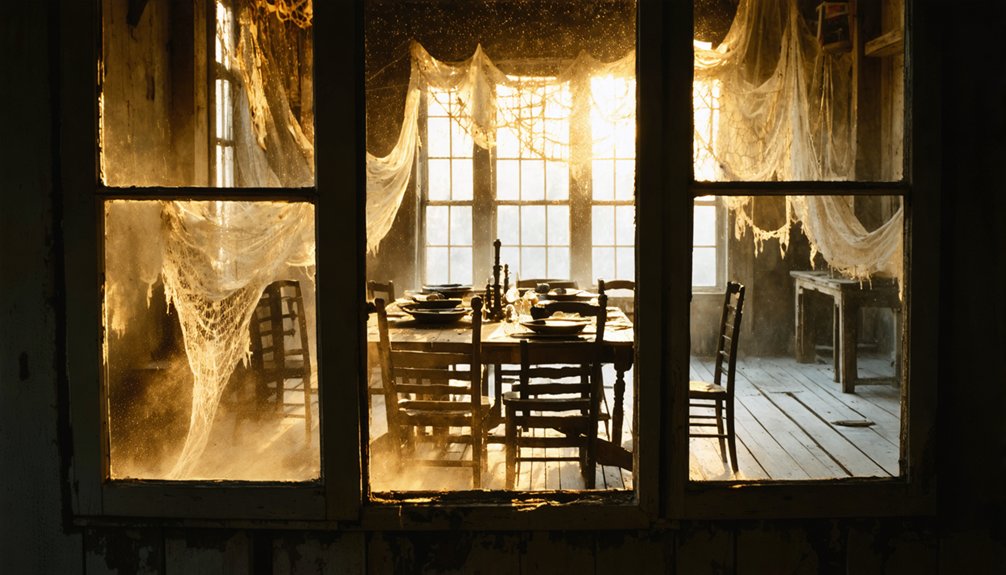
Founded by George Rapp and the Harmony Society in 1814, New Harmony rose from Indiana’s swampland as an ambitious experiment in communal living, its infrastructure emerging with remarkable speed and precision.
Within a decade, over 180 structures stood where wilderness once dominated—brick homes, workshops, factories, and churches, all communally owned under strict Articles of Agreement.
When Robert Owen acquired the settlement in 1825, his socialist vision quickly faltered, leaving buildings to shift through multiple owners before eventual abandonment.
You’ll find echoes of utopian dreams in crumbling walls that once housed 730 residents.
The Ribeyre Gymnasium sat vacant for years before historic preservation efforts reclaimed it.
Dormitory Number Two transformed repeatedly—school, inn, telephone office—each iteration marking another failed vision.
Today’s preservation maintains these physical reminders of communal living’s fragile nature.
The Reclaimed Wilderness of Brook Farm
Beneath layers of encroaching Massachusetts forest lie scattered ruins of Brook Farm, a once-vibrant utopian experiment that flourished briefly in West Roxbury between 1841 and 1847.
As you walk the grounds today, wilderness reclamation has transformed the original 175-acre agricultural commune into a haunting tableau of nature’s victory over idealistic human endeavor.
- Foundation stones of the Hive, Eyrie, and Cottage peek through undergrowth, fragmentary utopian remnants marking where transcendentalists once dreamed of perfect society.
- The Phalanstery’s charred footprint remains visible—its 1846 fire hastened the community’s financial collapse.
- Native Massachusetts flora now blankets former communal fields where Hawthorne, Fuller, and the Ripleys once labored for $1 daily while producing intellectual works like *The Harbinger*.
Frequently Asked Questions
How Do Utopian Communities Handle Dissent and Ideological Conflicts?
You’ll witness varied dissent resolution approaches—from Brook Farm’s democratic dialogues to Oneida’s rigid enforcement. Most communities faltered when balancing ideological diversity against communal cohesion, ultimately suppressing or expelling dissenters to preserve their vision.
What Security Measures Did These Communities Implement Against Outside Threats?
While idealists dreamt, guards patrolled. You’d find their security protocols minimal but tactical—communal watches, strategic positioning near access points, and rudimentary external surveillance systems protecting their hard-won freedom from societal intrusion.
How Were Children Educated Within These Experimental Social Structures?
You’d find children raised collectively in “children’s houses,” educated through alternative pedagogy focused on practical skills, creative expression, and communal values. Child-centered learning emphasized multiple intelligences over rigid academics, preparing youth for community roles.
What Communication Technologies Connected These Isolated Communities to Wider Society?
You’d find telegraph systems strung through wilderness, connecting isolated dreamers to civilization. Later, radio broadcasts pierced the silence, bringing distant voices—freedom’s whispers—into communal halls where outsiders couldn’t tread.
Did Any Utopian Communities Successfully Transition to Sustainable Modern Towns?
Yes, you’ll find Arcosanti, Findhorn, and Auroville defied utopian doom. Their sustainable practices and modern governance evolved from idealistic experiments into functioning townships where communal vision meets practical reality—freedom through structure.
References
- https://study.com/academy/lesson/utopianism-definition-communities.html
- https://en.wikipedia.org/wiki/List_of_American_utopian_communities
- https://tools4literature.weebly.com/utopia-failures.html
- https://courses.lumenlearning.com/wm-ushistory1/chapter/religious-utopian-societies/
- https://www.nps.gov/articles/utopias-in-america.htm
- https://arkinetblog.wordpress.com/2010/04/15/drop-city/
- https://5280.com/colorados-famous-historic-artist-commune/
- https://arte-util.org/projects/drop-city/
- https://en.wikipedia.org/wiki/Drop_City
- https://westernartandarchitecture.com/features/the-rise-and-fall-of-drop-city