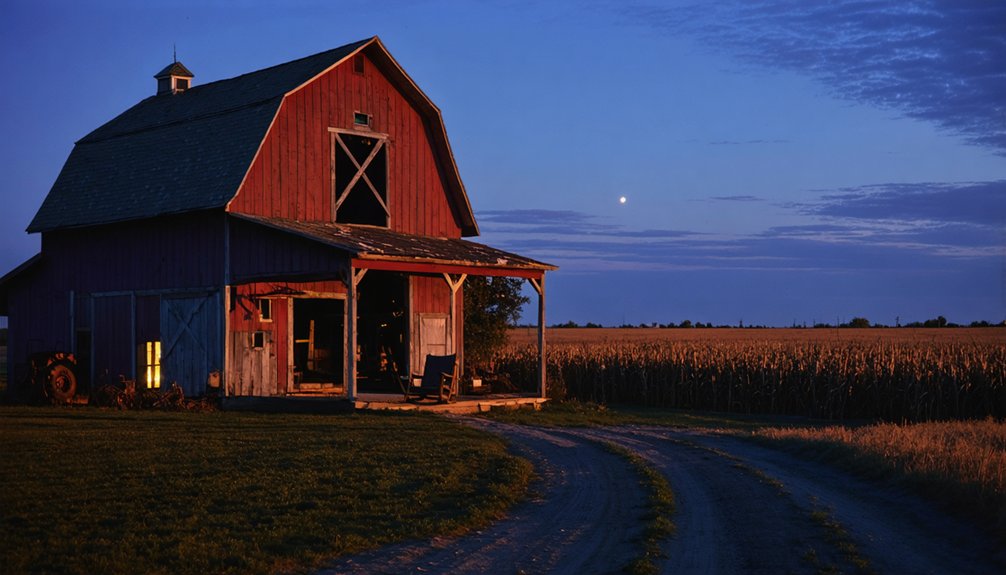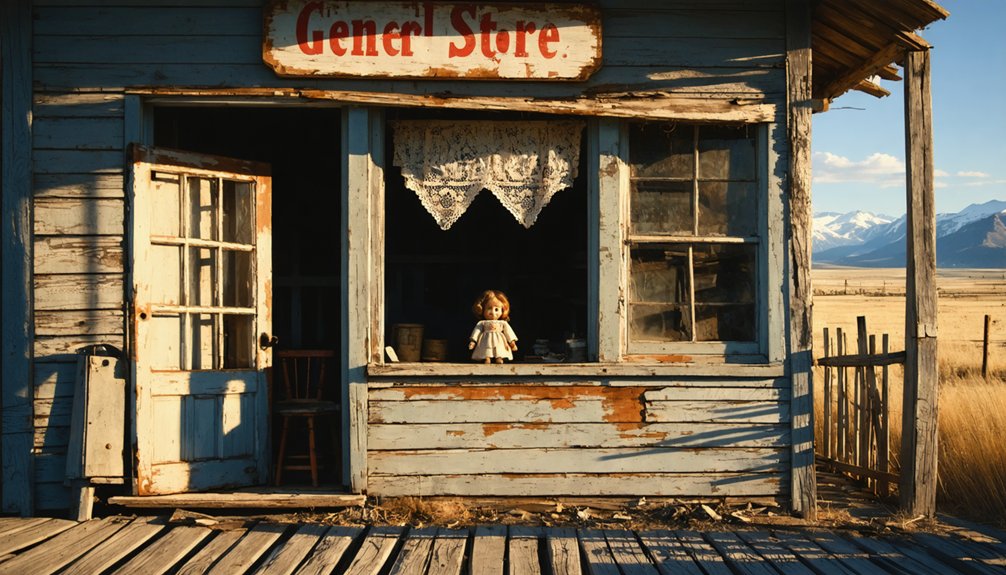
America’s ghost towns hide more than crumbling buildings—they reveal economic collapse, environmental devastation, and human resilience. You’ll find evidence of hasty departures in mining towns of the Southwest and abandoned farmsteads across the Dust Bowl region. These silent streets tell stories of single-industry failures, natural disasters that erased entire communities, and the struggles of those left behind. Each weathered structure holds clues to how quickly prosperity can vanish when foundations prove unsustainable.
Key Takeaways
- Abandoned structures in over 3,800 American ghost towns silently preserve stories of sudden departures and desperate circumstances.
- Mining towns like Bodie, California contain over 100 buildings frozen in time, offering glimpses into 19th-century life suddenly interrupted.
- Personal belongings left behind in Dust Bowl-era farmhouses reveal families who fled with minimal possessions during economic collapse.
- Isolated micro-populations of elderly residents face profound social isolation as essential services disappear around them.
- Natural disasters have completely erased communities, leaving behind ruins that highlight human vulnerability against nature’s forces.
The Silent Streets of America’s 4,500 Abandoned Communities
Across the vast American landscape lie over 4,500 abandoned communities, with approximately 3,800 officially documented as ghost towns.
You’ll find these silent witnesses concentrated in the Southwest, where mining operations once flourished during gold and silver rushes before collapsing entirely. Texas and California host the highest numbers, remnants of extractive boom-bust cycles.
The Great Plains presents another concentration, where Dust Bowl-era farming communities stand as ghostly encounters with economic devastation. Population centers like Detroit and St. Louis face similar challenges with high vacancy rates evident across residential and commercial properties.
Towns like Bodie, California preserve over 100 buildings from their gold rush heyday, offering glimpses into 19th-century boom town life.
Many structures remain in various states of decay—roofs collapsed, walls crumbling, nature reclaiming human ambition. While some towns have been absorbed by expanding settlements, others remain isolated time capsules.
A select few now attract heritage tourists seeking connections to pivotal moments in American history and development.
Economic Ghosts: How Industry Collapse Empties Towns
Behind every ghost town lies an economic tragedy. You’ll find these communities were typically built around a singular industry—mining, oil, or agriculture—leaving them vulnerable when market forces shifted. Without economic diversification, the collapse of a primary employer triggers a devastating chain reaction.
When the main industry fails, employment opportunities vanish overnight. Residents flee in search of work, businesses lose customers, and essential services deteriorate. The tax base erodes, making infrastructure maintenance impossible. Rural hospitals close—over 120 nationwide since 2010—removing both healthcare access and jobs. Texas leads the nation with 26 rural closures, further accelerating population decline in affected communities.
The case of Kitakyushu illustrates this vulnerability, where employment in steel manufacturing dropped from 50,000 jobs at its peak to just 4,200 today.
What remains are aging buildings, insufficient housing stock, and deteriorating infrastructure that deters new investments.
While some towns attempt reinvention through tourism or niche industries, successful revitalization requires strategic planning that matches local resources with sustainable economic activities.
Dust Bowl Legacy: The Great Plains’ Lost Settlements
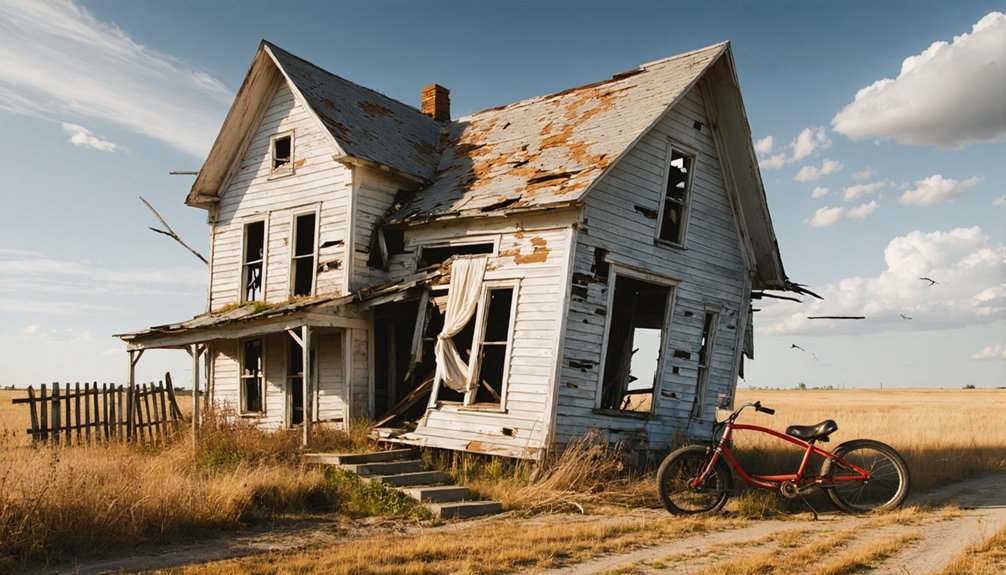
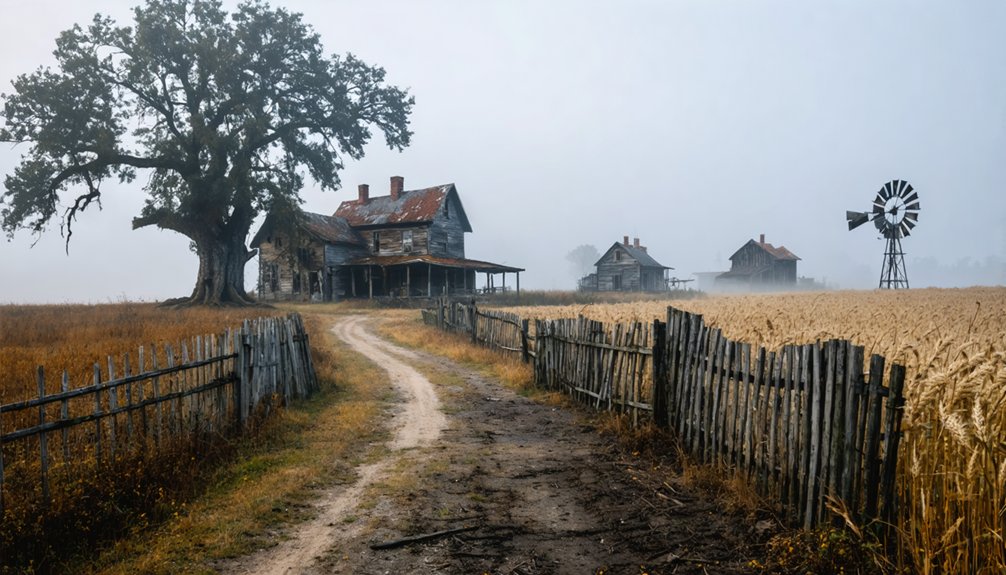
You’ll find that abandoned farmhouses across the Great Plains tell poignant stories of withered dreams that once flourished before the devastating dust storms of the 1930s.
These skeletal structures, with their collapsed roofs and wind-swept porches, represent families who invested everything in agricultural ventures that ultimately succumbed to ecological disaster and economic depression. One such community was Dearfield, Colorado, where African-American settlers created a thriving farming community until drought destroyed their livelihood. Over 700 Black Americans found hope and opportunity in this unique settlement east of Greeley, though only three buildings remain today as testament to their pioneering spirit.
The vast empty fields surrounding these deteriorating homesteads—where wheat once swayed and children played—now serve as silent monuments to America’s greatest environmental catastrophe and the communities it erased.
Abandoned Farmhouse Stories
During the devastating Dust Bowl era of the 1930s, thousands of farmhouses across America’s Great Plains were abandoned as ecological catastrophe collided with economic depression.
These structures tell haunted histories of nearly 750,000 family farms that vanished between 1930-1935 through foreclosure or bankruptcy.
When you visit these sites today, you’ll find remnants of forgotten families who fled with minimal possessions.
Poorly constructed homes couldn’t withstand the relentless black blizzards that darkened skies for days. Dust penetrated even well-sealed dwellings, making them uninhabitable as topsoil vanished and infrastructure crumbled.
The exodus created “Okie” migrant populations seeking work elsewhere, leaving behind ghostly settlements. Farmers faced impossible choices between continuing to farm with diminishing returns or abandoning generations of family heritage.
What remains serves as physical evidence of government policies that encouraged unsustainable farming practices and the subsequent environmental collapse that forced over 500,000 Americans into homelessness. Health consequences were severe, with many residents suffering from dust pneumonia that particularly affected children and caused numerous fatalities.
Withered Dreams, Empty Fields
As the Great Depression tightened its grip on America in the early 1930s, thousands of once-thriving settlements across the Great Plains transformed into hollow shells of their former selves.
You’ll find places like Dearfield, Colorado—once home to 700 African-American farmers with withered aspirations—now just weathered remnants.
When native prairie grasses were plowed under for wheat cultivation, the stage was set for ecological disaster. The devastating dust storms of 1936 stripped away topsoil, livelihoods, and empty dreams simultaneously.
Your freedom to explore these ghost towns reveals the stark consequences of agricultural mismanagement. The aftermath of prolonged drought turned fertile regions into desert-like conditions, forcing mass abandonment of communities. These dust storms, known as black blizzards, created massive clouds that devastated visibility and air quality throughout the region. Over 500,000 Americans were displaced as inappropriate farming techniques collided with drought conditions.
The abandoned churches, schools, and businesses stand as empirical evidence of how quickly prosperity can vanish when environmental realities are ignored.
When Nature Reclaims: Disasters That Erased Entire Towns
Nature’s destructive power has methodically erased entire communities throughout history, leaving behind eerie reminders of human vulnerability.
You’ll find the disaster impacts most dramatically illustrated in places like Beichuan, China, where aftershocks prevented rebuilding after a devastating earthquake killed thousands. Similarly, Plymouth, Montserrat vanished beneath volcanic ash, while rising seas forced Vunidogoloa, Fiji to relocate entirely.
Water’s relentless force claimed Valmeyer along the Mississippi and Thistle, Utah, where landslides and floods buried homes.
Wildfires repeatedly ravaged Greenville and other California mining towns, leaving only skeletal remains.
In each case, nature reclamation proceeds unimpeded—vegetation overtakes foundations, shorelines erode, and structures slowly return to earth.
These ghost towns stand as stark testimonies to nature’s supremacy over human settlement.
Last Residents Standing: Life in Towns of Fewer Than 100 People
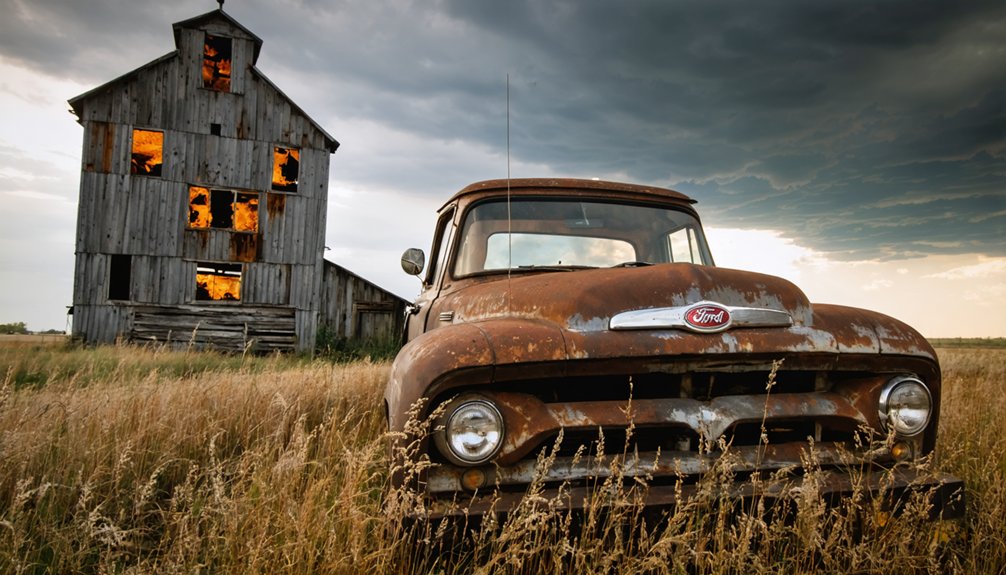
While abandoned towns illustrate nature’s conquest over human settlement, equally compelling are the communities where a handful of resolute residents remain.
In these micro-populations, you’ll witness profound isolation challenges as essential services disappear. Grocery stores close, schools consolidate elsewhere, and healthcare facilities become distant necessities. The remaining inhabitants—often elderly—face increasing social isolation as neighbors depart and community gatherings dwindle.
Life shrinks inward as services vanish and neighbors leave, creating islands of existence where community once flourished.
Despite these hardships, community resilience emerges through creative adaptation. Multi-use facilities maximize limited resources, while tourism provides supplemental income. Remaining residents develop stronger bonds through shared hardship, preserving local history against significant odds.
Economic realities remain stark: few job opportunities exist, infrastructure deteriorates without adequate maintenance funds, and utility costs per capita rise as fewer residents shoulder fixed infrastructure expenses.
Yet these determined few maintain their freedom to choose place over convenience.
The Domino Effect: How Hospital Closures Seal a Town’s Fate
When rural hospitals shut their doors, you’ll witness healthcare professionals leaving in droves, creating vast medical deserts where residents must travel excessive distances for basic care.
Your community’s economic significance diminishes as the healthcare workforce exodus triggers cascading business closures, transforming once-bustling main streets into vacant corridors.
You can trace this downward spiral to financial instability, where low patient volumes and insufficient reimbursements force hospitals to first eliminate crucial services like obstetrics before ultimately closing entirely.
Last Doctor Leaves Town
The devastating cascade of economic and healthcare decline begins when the last doctor departs a rural town following hospital closure. This healthcare migration creates immediate care deserts where emergency services become distant memories and chronic conditions go unmanaged.
You’ll witness how physician exodus triggers closure of satellite clinics and pharmacies, compounding the doctor shortage across entire regions. When hospitals fold, nearly 220 direct healthcare jobs vanish, with another 73 community positions disappearing shortly thereafter.
Local businesses—from restaurants to gas stations—suffer substantial revenue losses. Your community’s per-capita income drops approximately $700 (4%) while unemployment rises 1.6 percentage points.
The ripple effects extend beyond economics: remaining medical staff face burnout, elderly residents encounter transportation barriers, and emergency response times lengthen—directly impacting mortality rates in critical situations.
Rural Healthcare Deserts Expand
As rural hospitals across America shutter their doors, healthcare deserts expand relentlessly across the countryside, creating vast regions where medical services have vanished entirely.
You’re witnessing the systematic erosion of rural healthcare, where over 700 hospitals teeter on the brink of closure and 300 face immediate risk. These closures force you to travel twice as far as urban residents—averaging 18 miles—for essential care.
The domino effect of Medicaid cuts intensifies access disparities through:
- Elimination of critical services like obstetrics and behavioral health
- Loss of emergency care facilities in communities with no alternatives
- 14% reduction in local employment, accelerating economic decline
- Increased travel distances that delay treatment and worsen health outcomes
This healthcare vacuum isn’t merely inconvenient—it’s life-threatening.
Empty Beds, Empty Streets
Rural hospital closures trigger a cascade of effects that extend far beyond healthcare itself, transforming once-vibrant communities into what locals often describe as “ghost towns.”
You’ll recognize the pattern across America’s countryside: first a hospital closes, then businesses shutter, property values plummet, and residents—particularly young families—relocate to areas with medical services.
The hospital impacts ripple through every economic layer: direct job losses reduce local spending, businesses dependent on hospital traffic fold, and tax revenues diminish.
Your community’s social fabric unravels simultaneously—emergency services deteriorate, maternity care vanishes, and mortality rates climb.
This rural decline creates a self-reinforcing cycle: fewer healthcare options drive away younger residents, accelerating demographic aging and poverty.
Without this anchor institution, you’re left with longer drives for basic care while watching your town’s infrastructure crumble around you.
Forgotten Architecture: What Abandoned Buildings Reveal
Wandering through the skeletal remains of forgotten ghost towns, you’ll find that abandoned buildings serve as silent historians of America’s past.
These architectural storytelling elements reveal more than just construction methods—they expose the aspirations, struggles, and cultural reflections of communities long dispersed.
Every crumbling wall and sagging roofline tells a chapter in our collective memory.
- Weathered materials expose technological shifts—from hand-hewn timber frames to mass-produced brick and early concrete applications.
- Spatial arrangements reveal social hierarchies, with grand civic buildings dominating modest worker housing.
- Structural modifications indicate economic changes, often telling stories of boom-bust cycles.
- Environmental reclamation shows nature’s persistent claim on human endeavors, with vegetation reclaiming built spaces.
These structures stand as monuments to American freedom’s endless frontier pursuit.
Tourism in Tragedy: The Ethics of Ghost Town Exploration

When you venture into abandoned towns as a dark tourist, your presence transforms tragedy into entertainment, creating ethical tensions that demand examination.
You must recognize that ghost towns represent local communities’ lived realities—places where economic collapse and environmental degradation forced residents to abandon generational homes and businesses.
The Appalachian Mountains ghost towns history reveals narratives of struggles and resilience, often overlooked in mainstream discourse. Exploring these abandoned sites allows us to connect with the past and understand the socioeconomic factors that led to their decline. Each ghost town tells a story of a once-thriving community, echoing the themes of loss and transformation that define the region’s history.
Your responsibility extends beyond capturing decay on camera to preserving the dignity of these sites through respectful exploration that acknowledges the human stories embedded in crumbling walls.
Dark Tourism’s Moral Compass
As visitors tread upon the weathered floorboards of abandoned mining settlements or photograph crumbling facades of once-thriving communities, they inadvertently participate in a complex ethical landscape that defines dark tourism.
Steering through ghost towns with respectful engagement requires understanding your role in preserving rather than exploiting these remnants of history.
When exploring these haunting locales, adhere to these dark tourism ethics:
- Learn the authentic history of the town and its former inhabitants before visiting
- Support community-led preservation efforts rather than commercial exploitation
- Refrain from taking “souvenirs” or disturbing the physical integrity of structures
- Approach photography thoughtfully—document history without trivializing tragedy
Your choices directly impact how communities process their own tragic histories, determining whether your visit honors or commodifies their past.
Respecting Locals’ Lived Reality
Behind every ghost town’s decaying facade exists a community whose memories, trauma, and connection to place demand ethical consideration from visitors. When you explore these sites, you’re walking through spaces that hold deep meaning for locals who either witnessed their decline or maintain cultural ties to them.
Effective community engagement requires your participation in a social contract: respect the stories as they’re told by those who lived them, not as you wish to interpret them. Local voices must guide preservation efforts and tourism parameters.
You’ll find greater authenticity in experiences where residents have shaped the narrative.
Remember that emotional sensitivity isn’t optional—it’s essential. The economic benefits you bring by visiting must be balanced against the potential harm of commodifying others’ pain. Your respectful presence acknowledges the lived reality that transcends the eerie appeal.
Decay Versus Dignity
The tension between decay’s haunting allure and the dignity of human experience forms the core ethical dilemma in ghost town tourism. When you explore these abandoned spaces, you’re participating in a delicate balance between appreciation of decay aesthetics and dignity preservation of those who once lived there.
- Historic towns often underwent reconstruction after devastating fires, replacing wooden structures with brick—a symbol of resilience rarely highlighted in “haunted” narratives.
- Preservation costs compete with tourism revenue potential, creating difficult choices about what to maintain versus what to let deteriorate.
- Excessive restoration risks sanitizing authentic history, while neglect allows important structures to collapse entirely.
- Your interest in physical deterioration may fund conservation efforts when tourism is managed ethically.
Texas Ghost Trail: Following America’s Most Abandoned State

Texas stands as America’s epicenter of abandoned settlements, with over 900 ghost towns scattered across its vast landscape—more than any other state in the nation. These remnants tell a tale of boom-and-bust cycles tied to America’s westward expansion.
You’ll discover ghost town origins rooted in railroad junctions, mining operations, and frontier seaports. Towns like Indianola once thrived as commercial hubs before hurricanes in 1875 and 1886 erased them from prosperity.
Natural decline struck others through drought, fire, and harsh winters—Medicine Mound’s ceremonial hills witnessed its population plummet from 500 to nearly zero.
Follow the Texas Ghost Trail to witness how rerouted highways and closed railroads severed lifelines to communities like Lobo and Toyah, where abandoned buildings stand as monuments to economic shifts and environmental challenges that transformed vibrant towns into historical footnotes.
Preservation vs. Decay: The Battle to Save Rural History
Across America’s fading ghost towns, a quiet battle unfolds between preservation and natural decay as communities and organizations work to rescue rural history from permanent loss.
Since 2001, over $1.6 billion in Historic Preservation Fund appropriations has supported efforts despite growing decay management challenges and declining local agency funding.
- “Arrested decay” conservation approaches maintain authentic weathered aesthetics while preventing structural collapse.
- Communities in places like Animas Forks secured $330,000 in grants through collaborative stakeholder action.
- Financial burdens include 40% local matching requirements and high restoration costs ($3.5 million for Thurmond, WV buildings).
- Successful preservation balances tourism economic benefits with sustainability concerns, as visitor numbers can reach 250,000 annually.
Preservation challenges require adaptive strategies that honor rural architectural integrity while creating sustainable futures for these haunting historical landscapes.
Frequently Asked Questions
Do Ghost Towns Harbor Paranormal Activity or Documented Hauntings?
Yes, ghost towns frequently harbor paranormal activity. You’ll find numerous documented hauntings through paranormal investigations, with abundant witness testimonies and haunted legends tied to their tragic histories and sudden abandonment.
What Legal Rights Do Squatters Have in Abandoned Ghost Towns?
You’ll find squatter rights limited in abandoned ghost towns. You must occupy property continuously for 7-10 years, demonstrating visible possession with legal implications if owners contest your presence through formal eviction procedures.
How Do Remaining Residents Access Healthcare Without Nearby Hospitals?
While many assume isolation means abandonment, you’re not without options. You’ll rely on telehealth services, mobile clinics, emergency transport systems, distant hospital trips, community health workers, and periodic specialty care visits to manage health needs.
Can Modern-Day Homesteaders Legally Reclaim Abandoned Ghost Town Properties?
You can legally reclaim ghost town properties through adverse possession, quiet title actions, or limited homesteading laws. However, you’ll face challenges with unclear ownership records, property taxes, and infrastructure rehabilitation requirements.
What Environmental Contamination Persists in Former Mining Ghost Towns?
Like invisible ghosts lurking underground, you’ll find toxic waste from abandoned mines contaminating soil and water decades later. Mining pollutants—heavy metals, acid drainage, mercury—persist, threatening your health and restricting land freedom.
References
- https://247wallst.com/special-report/2023/07/11/americas-modern-ghost-towns/
- https://www.loveexploring.com/gallerylist/188219/the-us-state-with-the-most-ghost-towns-revealed
- https://devblog.batchgeo.com/ghost-towns/
- https://www.tpr.org/economy-and-labor/2024-11-14/texas-uneven-population-boom-is-creating-ghost-towns-in-many-rural-counties
- https://www.youtube.com/watch?v=UujbImwiLfA
- https://www.geotab.com/ghost-towns/
- https://joybird.com/blog/top-ghost-towns-in-america/
- https://en.wikipedia.org/wiki/Lists_of_ghost_towns_in_the_United_States
- https://themortgagepoint.com/2024/10/25/americas-new-ghost-towns/
- https://www.travelandtourworld.com/news/article/how-california-leads-the-way-in-ghost-towns-for-hunting-in-2025-explore-the-haunting-beauty-of-abandoned-places-from-the-golden-state-to-nevada-and-arizona-in-us/