You’ll find America’s abandoned factory towns haunted by their industrial past. In Lowell, spectral mill workers reportedly wander dormitories at midnight. Lynch’s ghostly miners’ lanterns still flicker in abandoned shafts. El Segundo residents speak of phantom workers near the 2025 refinery explosion site. In Pullman, whispers of striking laborers echo through empty train yards. These spectral tales preserve the trauma of workplace disasters, labor violence, and economic collapse that transformed vibrant communities into hollow shells.
Key Takeaways
- Abandoned textile mills in Lowell, Massachusetts are reportedly haunted by the spectral workers of the industrial era.
- After the El Segundo refinery explosion, residents reported ghostly apparitions and shadowy figures moving through phantom smoke at 3:10 AM.
- “Ghost workers” became a children’s game in factory towns, referencing employees who perished in industrial accidents.
- Garnet, Montana residents claim to hear phantom celebrations in empty saloons, echoing the town’s vibrant gold rush past.
- Company towns like Pullman and Lynch harbor tragic histories of labor strikes, violence, and worker oppression that fuel modern ghost stories.
The Ghostly Looms of Lowell: When Machines Fall Silent
As you wander through Lowell today, it’s hard to imagine that this quiet Massachusetts town once thundered with the deafening roar of 32 textile mills, transforming from a sleepy farming community of just 200 souls in 1820 to an industrial powerhouse of 33,000 residents in merely three decades.
The Merrimack River‘s power and Francis Cabot Lowell’s 1813 power loom invention created perfect conditions for America’s first large-scale mill town. By 1823, the Merrimack Manufacturing Company established an integrated system processing raw cotton to finished cloth under one roof. This revolutionary approach made Lowell the first American factory owner to achieve vertical integration in textile production.
The Concord River also played a crucial role, with Thomas Hurd’s acquisition of the first major textile factory in 1818 marking the beginning of industrial development along this vital waterway.
Now, these abandoned factories stand as monuments to faded glory. Some locals swear the haunted machinery still clicks at night, while others claim to glimpse spectral workers—young women who once toiled 13 brutal hours daily—moving between shadows of the Boott Mills.
Pullman’s Phantom Railway: Echoes of Labor Unrest
When you stand amid the red-brick remnants of Pullman today, located on Chicago’s Far South Side, you might hear phantom whistles echoing across the once-bustling railway yards.
These labor ghosts date back to 1894, when workers faced cruel economic pressures. George Pullman, having built his model company town in the 1880s, slashed wages during the Panic of 1893 while maintaining high housing rents.
The resulting strike, led by Eugene Debs, paralyzed America’s railways as workers refused to handle Pullman cars. Federal troops arrived, violence erupted, and railcars burned while African American porters faced a different struggle for dignity through the Brotherhood of Sleeping Car Porters.
The Pullman legacy remains potent—a cautionary tale of corporate control and worker resistance that continues to haunt American industrial memory. The bloodiest confrontation occurred on July 7th when National Guard troops fired into the crowd after rioters pelted them with stones near 49th Street. A. Philip Randolph later emerged as a powerful voice for these African American railway workers, leading the first Black labor union to successfully negotiate with a major corporation.
The Dark Depths of Lynch: Coal Dust and Forgotten Souls
The mist-shrouded mountains of southeastern Harlan County harbor Lynch, Kentucky—a coal town whose haunting remains tell a story different from Pullman’s labor unrest, yet equally chilling.
Founded in 1917 by U.S. Steel’s subsidiary, Lynch grew into the world’s largest coal camp, where 10,000 souls from 38 nations toiled in America’s first fully electric mine.
As you walk past the stone buildings today, you’ll sense the presence of ghostly miners who once shipped record-breaking 12,880 tons in a single shift. The company built an impressive coal tipple with 15,000 ton capacity, showcasing its industrial might and ambition.
These immigrant workers lived under the company’s watchful eye while “Bloody Harlan” erupted around them—violence born from desperate attempts to unionize amid dangerous conditions. The company maintained armed police forces to keep union organizers out and intimidate miners who showed interest in organizing.
The segregated community thrived until the 1950s, when coal’s decline began transforming this industrial marvel into a memorial for forgotten souls who sacrificed everything for America’s steel.
Segundo’s Smoldering Secrets: Life After the Great Fire
If you’re walking El Segundo’s refinery perimeter today, you’ll notice the eerie silence where once stood the ISOMAX unit—ground zero of the catastrophic October 2, 2025 fire that forever changed this coastal industrial town.
Locals still describe how the 100-foot flames illuminated their bedrooms at midnight while toxic smoke forced them to seal windows with duct tape, actions that would become routine in the years following. The explosion originated from a processing unit in the refinery’s Isomax complex, triggering widespread panic throughout the community.
This disaster marked one of the worst incidents in the refinery’s 114-year history, leaving lasting scars on both the facility and surrounding neighborhoods.
Children now play a macabre game called “ghost workers” near the rebuilt section, mimicking the twelve employees who reportedly never emerged from the inferno, despite Chevron’s official statements claiming zero casualties.
Factory’s Deadly Fumes
Shrouded in blue-tinged smoke that rolled across El Segundo on that fateful October morning in 2025, Chevron’s refinery explosion sent toxic plumes billowing into neighborhoods while residents scrambled for safety.
The ISOMAX unit’s failure released a chemical nightmare—volatile compounds and sulfur that mirrored the horrors of Gateshead’s 1854 disaster, when burning sulfur created rivers of blue flame.
You’ve inherited this toxic legacy through aging infrastructure and corporate negligence. Similar to how the Great Fire of 1854 had its final explosion heard 20 miles away, the impact of modern industrial accidents extends far beyond their immediate vicinity. The tragedy claimed fifty-three lives and left hundreds injured, many of whom were simply onlookers gathered to witness the spectacle.
- Hydrofluoric acid exposure causes immediate respiratory distress, burning eyes, and lung damage
- VOCs released during the fire penetrated homes within a one-mile radius despite evacuation orders
- Safety valves that could have prevented the disaster had eroded from years of deferred maintenance
The South Coast Air Quality Management District detected dangerous levels for hours before the winds mercifully dispersed the worst of it.
Ghosts in the Ash
Months after the 2025 Chevron inferno subsided, residents of El Segundo began reporting strange occurrences that couldn’t be explained by science or reason.
You’d hear whispers of ghostly apparitions near the crater where the ISOMAX unit once stood—shadowy figures moving through plumes of phantom smoke at 3:10 AM, precisely when the Gateshead explosion had occurred 171 years earlier.
Walking past the refinery at night, you might glimpse spectral memories playing out—workers running from blue flames or reaching out with charred limbs.
Some claim to hear explosions that shake no windows. Others swear they’ve seen burning sulphur flow where there’s none.
These hauntings echo the 1854 Newcastle tragedy, both serving as grim reminders of industrial dangers and the spirits of those whose lives were claimed by corporate negligence.
Gold Fever Haunts Garnet: Saloons Without Patrons
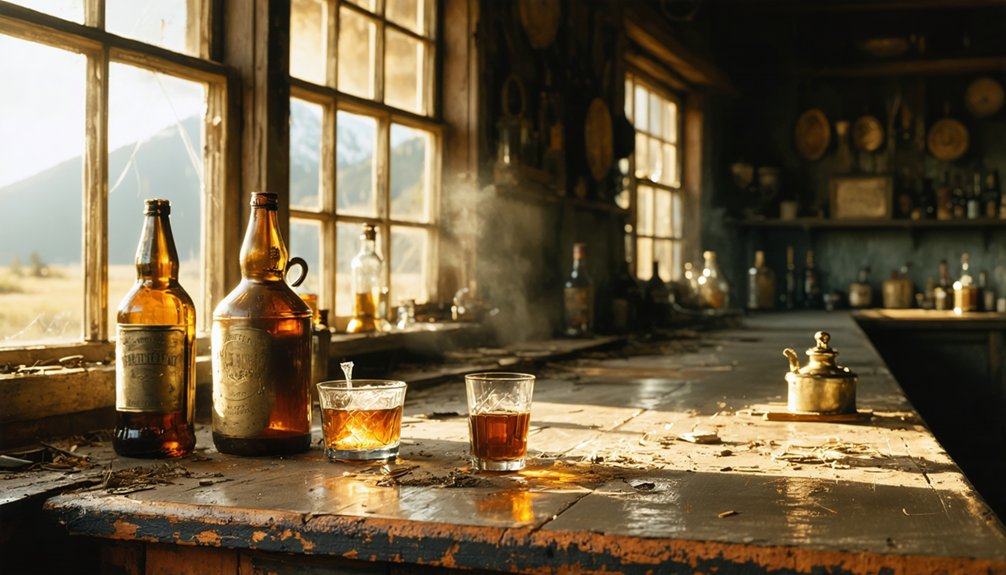
As you wander the lonely streets of Garnet, Montana, you’ll find thirteen empty saloons where gold miners once celebrated their $950,000 fortune with whiskey and wild dreams after grueling shifts in the Nancy Hanks mine.
The 1898 peak saw a thousand residents pack these wooden establishments nightly, their raucous laughter echoing through a mountain town flush with gold-bearing quartz and limitless possibility.
After the devastating 1912 fire and the gradual exhaustion of accessible gold, these once-vibrant gathering spots fell silent, their abandoned bars now collecting dust instead of coins from thirsty prospectors who’ve long since vanished into history.
Whiskey-Fueled Mining Dreams
When gold fever struck the hills surrounding Garnet in the mid-1860s, miners flocked to this remote Montana outpost with dreams fueled by whiskey and the promise of untapped riches.
As placer mining gave way to lode mining in the 1870s, the town’s character took shape through its numerous saloons, where whiskey tales and mining camaraderie offered respite from the brutal work underground.
- By 1898, saloons outnumbered most other businesses, serving a population that had swelled to 1,000 following Sam Ritchie’s Nancy Hanks strike in 1895.
- The 1893 silver crash drove desperate miners to Garnet, transforming drinking establishments into information exchanges where fortunes were planned.
Despite the revelry, these saloons emptied rapidly after 1900 as gold became scarcer, leaving behind ghostly remnants of once-vibrant gathering places.
Thirteen Empty Saloons
The thirteen saloons of Garnet stood as silent witnesses to the town’s dramatic reversal of fortune.
By 1900, gold yields plummeted, transforming these once-bustling establishments into haunted saloons where only mining ghosts remain.
Kelly’s Bar survived the devastating 1912 fire that consumed half the town, including the popular Lyle & Fitzgerald Saloon in the Garnet Hotel.
With no water to fight the flames, businesses crumbled into ash.
You can still sense the abrupt abandonment as Garnet’s population nosedived from 1,000 to just 150 by 1905.
Souvenir hunters later stripped away stained glass and woodwork from these vacant shells.
The final commercial holdout—Frank Davey’s store—was auctioned in 1948, leaving a ghost town where your footsteps echo where miners once laughed and drank.
Phantom Mountain Celebrations
Phantom miners still celebrate in Garnet’s empty saloons—if you believe local legends that emerged after the town’s collapse in the early 1900s.
After the devastating 1912 fire destroyed most commercial buildings, residents fled, leaving furnished cabins as if expecting to return.
Today, the Bureau of Land Management preserves these time capsules where spectral gatherings allegedly occur.
- Listen carefully on winter nights for phantom festivities in the shells of those 13 once-bustling saloons
- Search for ghostly remnants of the 1,000 residents who vanished after gold veins depleted by 1900
- Explore cabins with plates still on tables—silent witnesses to the abrupt end of Garnet’s heyday
The juxtaposition between Garnet’s vibrant past—with miners celebrating in bawdy houses after dangerous shifts—and today’s haunting silence creates the perfect setting for mountain folklore.
Melmont’s Vanishing Act: When Railroad Dreams Derailed
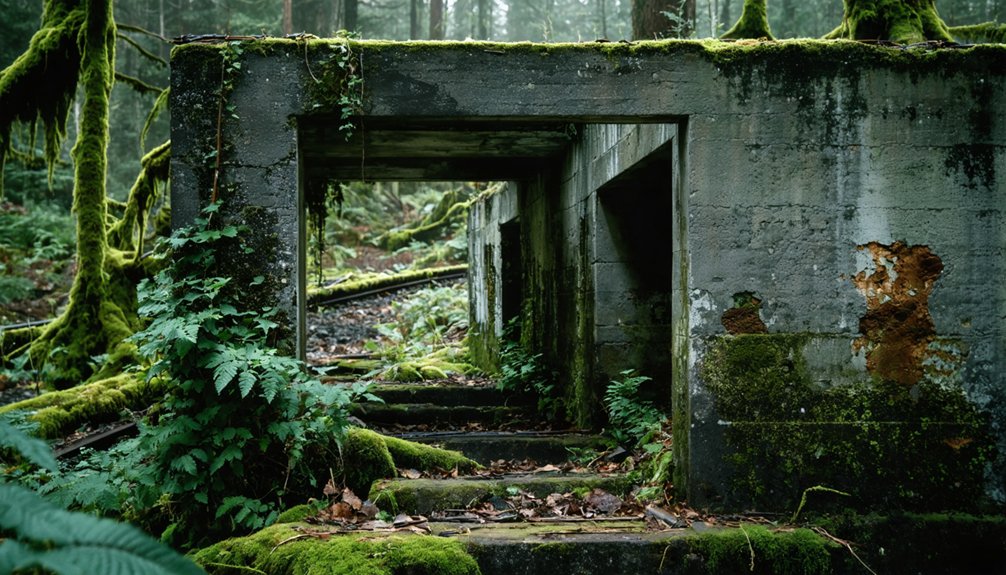
Nestled among the rolling hills of Pennsylvania’s coal region, Melmont’s rise and fall mirrors the heartbreaking trajectory of countless American railroad towns whose fortunes were inextricably tied to the tracks that birthed them.
You can still find remnants of this once-thriving community—abandoned rail beds and crumbling structures that whisper tales of railroad nostalgia.
Founded strategically around coal mining, Melmont flourished when Pennsylvania and Reading Railroads connected it to broader markets.
The town’s very layout embraced the rails that fed its economy.
Company Towns: Paradise or Prison?
When you stepped into an American company town during the industrial heyday of the late 19th century, you weren’t just entering a community—you were crossing into a carefully constructed world where one corporation controlled nearly every aspect of daily life.
From Pullman, Illinois to Lowell, Massachusetts, these industrial experiments offered remarkable amenities unavailable in typical working-class neighborhoods, yet at a steep price: your autonomy.
By 1916, one-third of manufacturing workers lived under company control, facing strict rules governing everything from housing to personal conduct.
Company towns weren’t just workplaces—they were elaborate systems where corporations dictated the rhythms of both public and private life.
- Housing segregated by race and ethnicity reinforced social hierarchies
- Company stores often charged inflated prices, trapping workers in cycles of debt
- Any challenge to company authority could result in losing both your job and home
The question remains: Were these planned communities benevolent havens or sophisticated systems of control?
Voices From the Ruins: Preserving Industrial Heritage
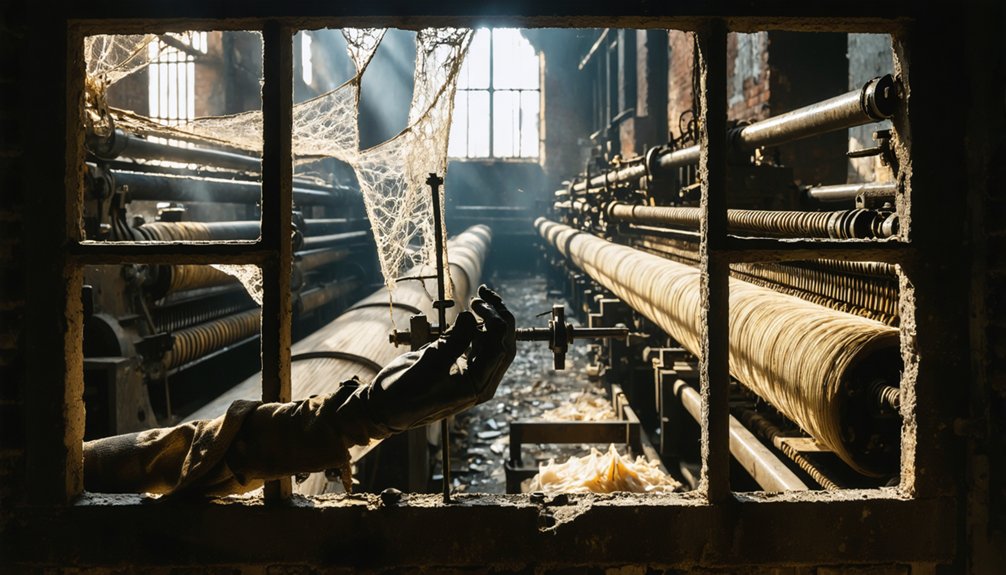
The rusted gears and crumbling brick facades of America’s industrial past stand as silent witnesses to an era when manufacturing might defined national identity.
When you walk through these spaces today, you’re experiencing the ongoing battle between decay and rebirth.
Since the 1960s, industrial preservation has evolved from simple legal protections to sophisticated adaptive reuse strategies that maintain authenticity while creating new purpose.
You’ll find former factories transformed into museums and creative studios, their weathered exteriors sealed and stabilized before interior work begins.
The best preservation approaches don’t erase history but integrate it—keeping minimal, reversible interventions that honor both the structural integrity and the stories embedded in these spaces.
Through thoughtful rehabilitation, these industrial monuments continue to shape community identity rather than vanish into forgotten ruins.
Modern Hauntings: Urban Explorers in Abandoned America
Through silent hallways and cavernous factory floors, urban explorers—known as “urbexers” in online communities—have created a modern pilgrimage to America’s industrial ruins.
You’ll find them documenting Gary’s skeletal mills or Cincinnati’s forgotten Cold War bunkers, capturing what remains of America’s manufacturing might. Their photographs reveal not just decay but spectral encounters with our industrial past.
- Detroit’s Packard Plant, abandoned since 1958, hosts weekend warriors seeking urban legends behind its crumbling walls.
- In Youngstown, where population dropped by 16,000 between 2000-2010, explorers navigate empty factories that once employed generations.
- Gary, Indiana’s ghost town status attracts those willing to risk trespassing charges to document America’s rapid deindustrialization since 1979.
Frequently Asked Questions
What Paranormal Phenomena Have Been Reported in These Abandoned Towns?
Like ghostly guardians of forgotten industry, you’ll encounter spectral sightings in haunted factories, underground fires creating eerie mists, apparitions in period clothing, mysterious hissing sounds, cursed souvenirs, and unexplained lights across these abandoned towns.
Were Any Mass Graves or Cemeteries Discovered Near These Locations?
Yes, you’ll find mass burial sites across America’s industrial landscape—from Texas’s 95 Black convict laborers to Missouri’s workhouse graves, discovered through historical excavations that finally exposed these long-suppressed freedom stories.
Did Any Famous Murders or Disappearances Occur in These Towns?
You’ll find infamous murders like Sacco and Vanzetti’s 1920 case in Braintree and mysterious disappearances connected to H.H. Holmes’ Chicago factory in the 1890s haunt America’s industrial past.
What Toxic Chemicals Still Contaminate These Abandoned Industrial Sites?
You’ll find arsenic, lead, mercury, TCE, PCBs, and VOCs silently poisoning these sites since the mid-1900s, creating dangerous chemical exposure zones and persistent industrial pollution that threatens your community’s water and soil.
How Have These Ghost Towns Influenced Modern Horror Films?
Over 85% of horror filmmakers scout ghost towns for inspiration. You’ll find abandoned aesthetics from places like Centralia, PA directly influencing Silent Hill’s haunting atmosphere, where real-world industrial decay transforms into cinematic dread.
In addition to Centralia, filmmakers also explore haunted saloons in Colorado ghost towns, where the echoes of the past blend with chilling tales. These forgotten locations serve as a rich backdrop that enhances the storytelling, invoking a sense of eerie nostalgia. Each creaky floorboard and shadowy corner amplifies the supernatural elements in their narratives, leaving audiences captivated and unsettled.
References
- https://www.smithsonianmag.com/travel/americas-company-towns-then-and-now-180956382/
- https://www.geotab.com/ghost-towns/
- https://www.youtube.com/watch?v=dSzyFAws9ts
- https://en.wikipedia.org/wiki/Company_town
- https://stateofwatourism.com/ghost-towns-of-washington-state/
- https://www.loveexploring.com/gallerylist/131658/abandoned-in-the-usa-92-places-left-to-rot
- https://socialwelfare.library.vcu.edu/organizations/labor/company-towns-1890s-to-1935/
- https://www.atlasobscura.com/things-to-do/united-states/abandoned
- https://lhrp.georgetown.edu/collections-group/lowell-mills/
- https://lowelllandtrust.org/greenwayclassroom/history/industrialization.htm