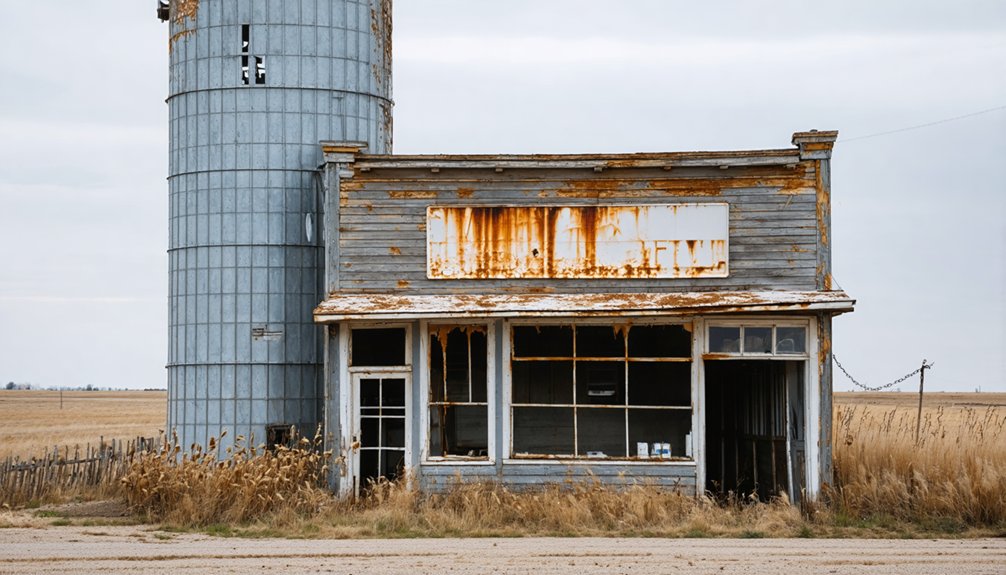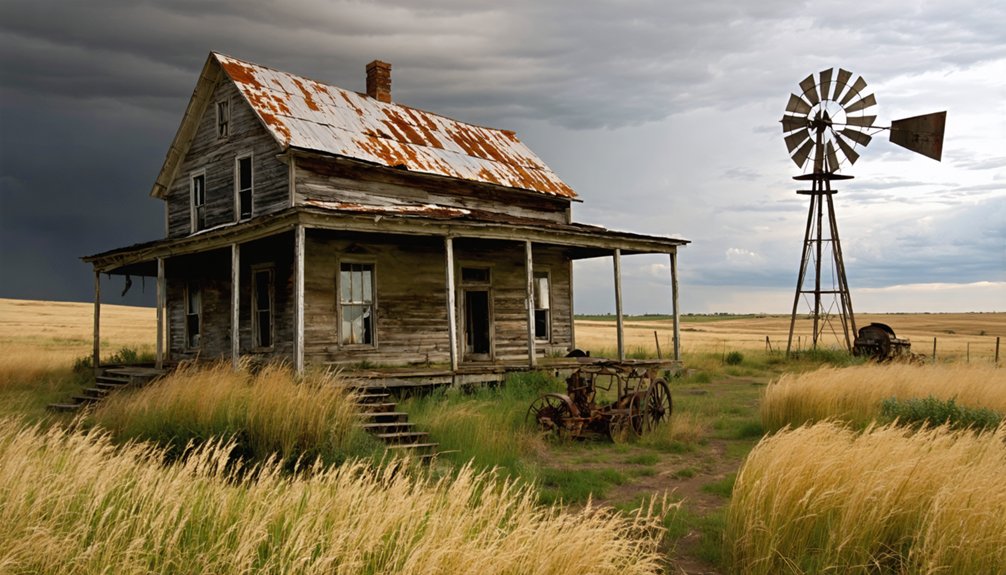
Great Plains communities are vanishing due to significant young adult out-migration (43% per decade since 1950), farm mechanization (45% job loss since 1969), and consolidation of agricultural operations. You’ll find deteriorating infrastructure, closing hospitals (28 shuttered since 2005), and disappearing retail (43% of grocery stores lost). Economic vulnerabilities, limited municipal tax bases, and declining public services further accelerate this cycle. Understanding these interconnected factors reveals the full scope of this regional transformation.
Key Takeaways
- Persistent out-migration of young adults (20-34 year-olds) weakens demographic foundations and creates gender imbalances in rural areas.
- Agricultural mechanization has drastically reduced farm employment while driving consolidation that diminishes community economic viability.
- Infrastructure deterioration and public service cuts accelerate as shrinking tax bases cannot sustain basic community needs.
- Healthcare accessibility crisis deepens with rural hospital closures, reducing both medical services and economic opportunities.
- Retail consolidation eliminates local businesses while housing markets stagnate from declining population and economic opportunity.
The Exodus of Young Adults From Agricultural Communities
While the Great Plains has historically sustained vibrant agricultural communities, recent decades have witnessed an alarming exodus of young adults that threatens the very existence of these rural areas.
The statistics are stark—rural counties lost approximately 7% of adults aged 20-34 during the 1990s, with some areas experiencing twice that loss. More troubling, migration loss among 20-24-year-olds has averaged 43% per decade since 1950.
Rural America’s future walks out the door as nearly half its young adults leave each decade.
This exodus isn’t random. You’ll find young adults following migration incentives toward education and employment that their home communities can’t provide. These areas often experience a devastating Rural Exodus pattern characterized by high out-migration rates exceeding 37% among young adults.
The absence of social opportunities further accelerates departures, particularly in remote counties where 65% are non-adjacent to metropolitan areas. This selective out-migration distorts age structures, reduces birth rates, and creates a gender imbalance—leaving many agricultural communities struggling to maintain their workforce and community viability.
Economic Vulnerabilities in Isolated Rural Counties
The exodus of young adults from Great Plains communities isn’t happening in isolation—it’s both symptom and cause of deeper economic vulnerabilities that plague isolated rural counties.
These areas face stark economic disparities, with higher poverty rates and lower household incomes limiting their climate resilience when agricultural crises hit. Recent research utilizing CCVI methodology has revealed that these communities often score higher on vulnerability indices due to their limited economic diversification.
Agricultural dependency creates fragility, as climate change threatens crop yields and water resources while limiting diversification options.
Rural investment is hampered by what economists call the “social costs of space”—lower population density makes infrastructure and services prohibitively expensive per capita. Federal assistance programs often prove inadequate as they are distributed through 88 different programs across 16 federal agencies, creating coordination challenges for resource-strapped communities.
Demographic shifts compound these challenges, as communities with higher proportions of disabled, elderly, and minority residents often have less social capital to weather economic shocks.
Limited municipal tax bases create a downward spiral: fewer services lead to more outmigration, further eroding economic stability.
Mechanization’s Double-Edged Sword in Farm Employment
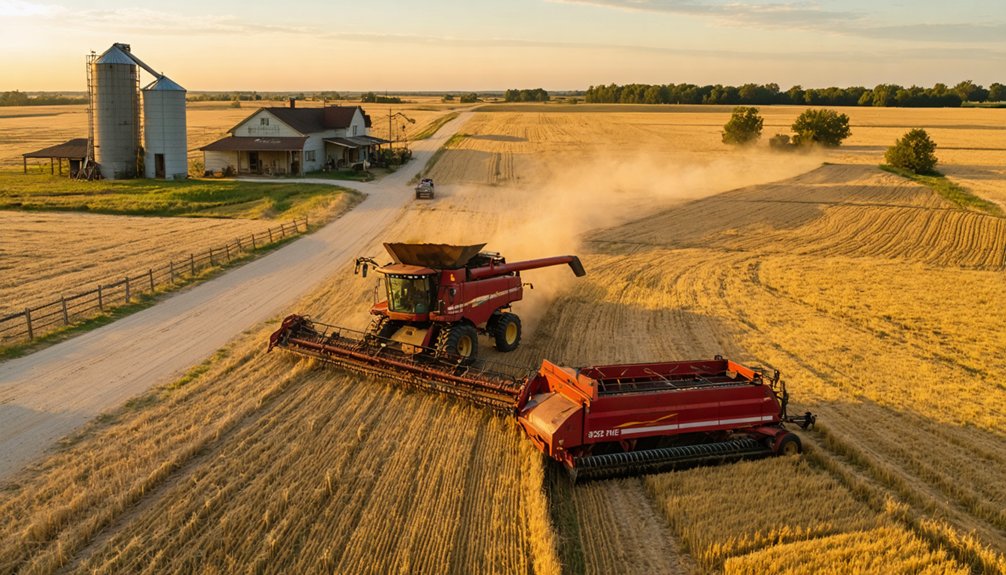
You’ve witnessed how agricultural mechanization across the Great Plains created a paradox of greater productivity alongside steep job losses, with farm employment plummeting 45% since 1969—representing 630,000 fewer positions.
This technological transformation enabled remaining farmers to manage ever-larger operations with minimal labor, accelerating consolidation as small farms couldn’t compete with mechanized economies of scale.
The ripple effects extended beyond individual farms, fundamentally reshaping rural communities as displaced workers migrated away, weakening the demographic foundation of countless small towns dependent on agricultural employment. The Plains region now has 49 people for every farm job, more than double the 21:1 ratio that existed in 1969.
Workers Replaced By Technology
Throughout the last century, American farms have undergone a dramatic transformation as mechanization revolutionized agricultural production while simultaneously decimating rural employment opportunities.
You’ve witnessed technological unemployment reshape your communities—farm labor in the U.S. plummeted from 22% of total employment in 1820 to just 7% by 1940. Nebraska alone saw farm workers decrease from 215,599 in 1935 to a mere 25,627 by 1987. Each tractor eliminated roughly 850 hours of manual labor.
These labor market shifts fundamentally altered rural life. The traditional seasonal peaks in spring planting and fall harvest have flattened, reducing demand for immigrant and seasonal workers.
Meanwhile, expensive equipment ($800,000-$1 million for combines) squeezes farm profits, further limiting hiring capacity. This financial pressure intensifies as farmers face a third consecutive year of selling corn below production costs. As machines replace human hands, rural communities continue shrinking—casualties of agriculture’s technological revolution.
Bigger Farms, Fewer Jobs
As farms grew larger, the relationship between agricultural land and human labor fundamentally changed.
Farm mechanization revolutionized productivity, with modern tractors saving approximately 850 hours of manual labor compared to animal-powered methods. By 1945, workers produced 29% more while working only 11% more hours.
The Great Plains experienced profound employment shifts:
- Farm employment fell from 4.4% of total U.S. employment in 1969 to just 1.3% by 2021
- The Plains and Great Lakes regions lost 630,000 farm jobs since 1969—nearly 45% of their agricultural workforce
- North and South Dakota maintained the nation’s highest farm employment concentration at 5.2% in 2021
This agricultural productivity transformation enabled fewer farmers to work more land, fundamentally restructuring rural communities while simultaneously increasing output—a double-edged sword for regional sustainability.
Farm Consolidation Effects
Mechanization’s impact on Great Plains agriculture represents one of the most transformative forces reshaping rural communities since the Dust Bowl era.
As tractors and automated systems replace manual labor, productivity rises while employment plummets—each machine effectively eliminates multiple farm jobs.
You’ll notice this restructuring erodes traditional farm identity as fewer families can sustain livelihoods on smaller operations.
When large farms absorb more land and water resources, they centralize control while diminishing community resilience.
The demographic consequences are equally stark: with the average farmer’s age increasing and younger generations unable to enter farming, many towns lose their economic foundation.
This consolidation creates a cascade effect—fewer farm jobs mean fewer people, shrinking local markets, and declining service businesses, ultimately threatening the existence of once-vibrant rural communities.
The dramatic decline from 1.7 million farms in 1935 to just 646,000 by 1992 demonstrates how farm number reductions fundamentally altered the social fabric of the Great Plains region.
Earl Butz’s Get big or get out philosophy from the 1970s accelerated this consolidation, reshaping the agricultural landscape for decades to come.
Infrastructure Decline and Rural Abandonment
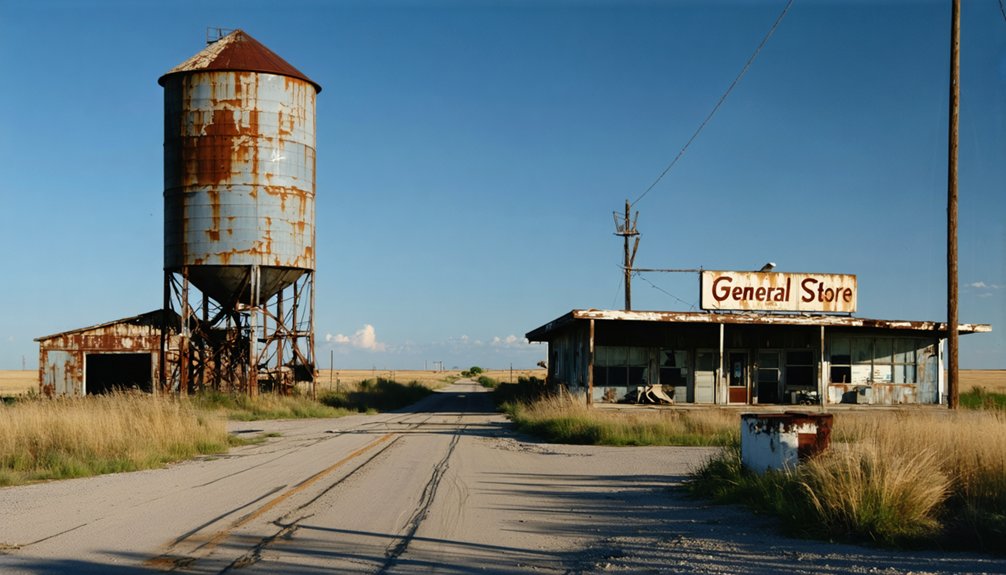
You’ll find the stark reality of infrastructure decline evident in the 12% of Great Plains rural roads in poor condition and nearly 1-in-12 bridges requiring rehabilitation or replacement.
This deterioration compounds the social erosion experienced in communities where population losses have exceeded 60-80% in many counties, leaving behind abandoned buildings and vacant lots that silently testify to former liveliness.
The Dust Bowl years marked a critical acceleration point in the ongoing depopulation trend that began in the early 1900s and continues to this day.
With local governments struggling under shrinking tax bases, these communities can’t maintain basic services or repair the $198 billion backlog of needed rural infrastructure improvements, accelerating a cycle of decline that pushes remaining residents toward larger population centers.
Forgotten Public Services
Behind the fading storefronts and empty streets of Great Plains communities lies a crisis largely invisible to outsiders: the collapse of essential public infrastructure.
You’re witnessing public service neglect accelerating as population losses exceed 40% in many counties since 1950. This infrastructure decay creates a self-reinforcing cycle—fewer residents means higher per-capita costs for maintaining roads, utilities, and emergency services.
- School systems face catastrophic funding shortfalls, forcing consolidations that leave children traveling hours daily for education.
- Emergency response times lengthen dramatically as sheriff departments struggle with vast territories and diminishing resources.
- Water and sewage systems designed for larger populations operate inefficiently, deteriorating without adequate maintenance funding.
The freedom to live in these communities increasingly comes at the cost of basic services most Americans take for granted.
Empty Buildings Everywhere
Crumbling facades and shuttered storefronts now dominate the landscape of Great Plains communities, serving as stark monuments to decades of rural exodus.
Amidst this decline, there is a growing movement dedicated to exploring cultural heritage in Detroit, highlighting the importance of preserving history despite present challenges. This initiative not only aims to document the rich tapestry of experiences that shape the community but also seeks to inspire future generations to reconnect with their roots. As forgotten stories are brought to light, the resilience of the city is revealed, showcasing a vibrant legacy waiting to be rediscovered.
You’ll find visible symbols of depopulation everywhere—vacant storefronts that once housed vibrant local businesses and abandoned homes that tell the story of families who’ve moved on.
With population densities dropping below two persons per square mile in some counties, the financial burden of maintaining infrastructure falls on fewer shoulders.
As you travel through these communities, you’ll notice how economic consolidation has decimated main streets. When farms consolidated and populations departed, they took with them the customer base that kept local economies afloat.
This infrastructure deterioration creates a self-reinforcing cycle, as declining tax revenues make it increasingly impossible to maintain the physical framework of these once-thriving communities.
Climate Extremes Accelerating Regional Out-Migration
Climate extremes accelerated regional out-migration during the Dust Bowl era, creating one of the largest internal population displacements in American history.
When you examine the data, counties experiencing severe erosion saw population declines of 12%, while areas with extreme environmental degradation lost nearly 20% of residents—a stark contrast to the overall 4.8% growth in surrounding states.
Climate variability impacts forced difficult choices as drought resilience strategies failed. The reciprocal relationship between human actions and environment shaped population dynamics throughout the Great Plains region.
- Migration rates spiked even among those typically unlikely to relocate—families with young children and lifelong residents.
- Nearly half a million Oklahomans, mainly tenant farmers, fled with approximately 250,000 settling in California’s agricultural regions.
- Economic factors alone didn’t drive this exodus, as non-Dust Bowl rural areas showed remarkably lower migration rates during the same period.
The Urban-Rural Divide in Great Plains Population Growth
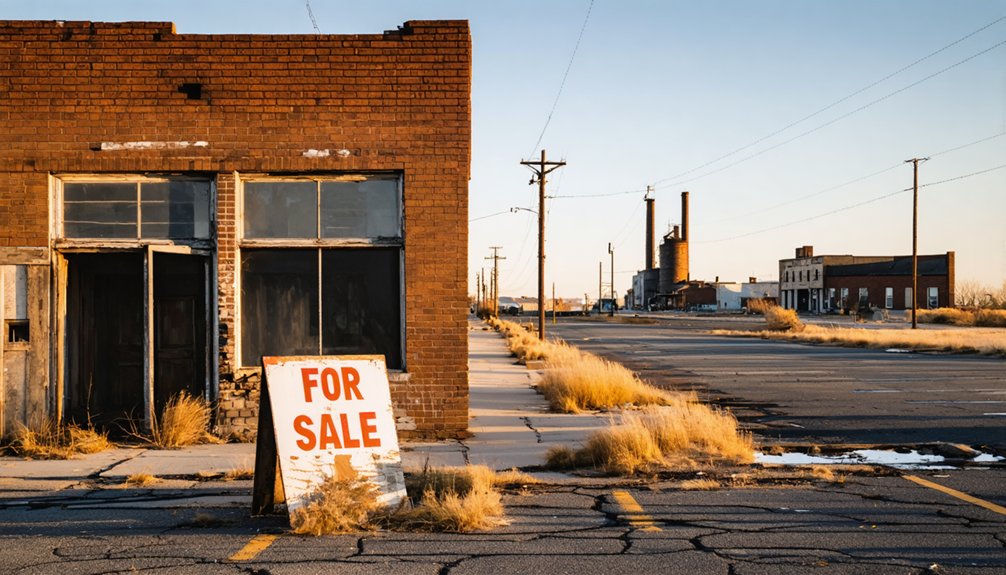
While rural counties across the Great Plains have experienced persistent population decline since the mid-20th century, urban centers have flourished, creating a stark demographic divide that continues to reshape the region.
You’ll find that urban migration patterns have consistently favored metropolitan areas like Denver, which gained 631,000 residents in the 1960s alone while rural counties lost 72,000 people.
This divide stems from rural economic disparities, with agricultural employment decreasing and poverty increasing since the 1930s.
Jobs concentrate in urban and energy-boom areas, attracting working-age adults seeking opportunity.
Meanwhile, rural communities face accelerating demographic challenges—fewer young families, declining birth rates, and aging populations create a cycle of natural decrease.
The demographic shift is particularly dramatic when comparing 1870, when 80% of residents lived in rural areas, to modern times when metropolitan areas dominate the population distribution.
Without economic diversification, the gap between thriving cities and vanishing rural communities will likely widen further.
Housing Market Stagnation in Depopulating Areas
Despite modest increases in housing inventory across the Great Plains from 29,150 to 31,600 homes between 2024-2025, depopulating rural communities face a troubling housing market paradox.
When people leave and don’t return, housing demand collapses while supply remains static or grows, creating a market absorption crisis.
- Existing home inventory surged 26.3% while new construction grew only 2.6%, revealing imbalanced market dynamics.
- Days on market increased nearly 37% for some new homes, indicating weak buyer interest in declining areas.
- Despite regional average home price increases of 5%, many rural properties sit unsold or sell below replacement cost.
You’ll find mortgage rate sensitivity (6-7% throughout 2025) exacerbates these challenges, particularly in communities experiencing economic outmigration and limited job growth of just 0.4% year-over-year.
Natural Population Decline: When Deaths Exceed Births

Beyond the outmigration patterns depressing Great Plains communities, a more fundamental demographic crisis has emerged: natural population decline, where deaths consistently outpace births.
You’ll find this trend in 76% of nonmetro counties, with 1,492 experiencing natural decrease between 2023-2024. The region’s aging population—disproportionately 55 and older with fewer residents aged 15-54—creates a perfect demographic storm.
While COVID-related deaths have decreased since 2022, the underlying structural aging continues unabated. This natural decline compounds the challenges of out-migration, creating shrinking labor pools and reduced economic significance.
Without youth engagement initiatives and community resilience strategies that specifically target younger families, this pattern will persist. Rural counties simply can’t offset their population losses, threatening the very existence of communities that have defined the Great Plains landscape for generations.
The Failure of Economic Incentives to Reverse Depopulation
For decades, economic incentives aimed at reversing Great Plains depopulation have largely failed to deliver their promised results. Government misallocation of resources has created unsustainable economic models, with EDA programs showing no significant impact on income growth rates. The $67 million invested in tribal tourism projects quickly deteriorated into $5 million annual deficits by 1977.
- Agricultural subsidies create artificial profitability, masking the true economic realities while accelerating environmental degradation.
- Tourism and recreational alternatives can’t absorb displaced agricultural workers or overcome geographical isolation.
- Geographic disadvantages make rural entrepreneurship difficult, with communities too distant from markets and lacking adequate workforce.
You’re witnessing a fundamental disconnect between top-down economic planning and local conditions. The failure of these programs isn’t merely administrative—it reflects deeper market realities that bureaucratic initiatives consistently fail to address or overcome.
The Erosion of Essential Services in Shrinking Communities
You’ll find healthcare facilities shuttering across the Great Plains, with rural hospitals and clinics closing as population density falls below sustainable thresholds for medical services.
School districts have consolidated dramatically, forcing children to travel greater distances while communities lose their educational anchors and gathering places.
Local retail establishments continue to disappear, creating “food deserts” and requiring residents to travel extensive distances for basic necessities that once formed the commercial backbone of small towns.
Healthcare Facility Closures
The alarming rate at which healthcare facilities are disappearing from America’s Great Plains represents one of the most notable threats to rural community survival today.
The Plains region alone suffered 28 hospital closures between 2005-2023, despite receiving $1.8 billion in federal investments. When your local hospital closes, your insurance coverage becomes practically meaningless—you’re left with no healthcare access within reasonable distance.
- Texas leads with 20 rural hospital closures since 2010, exemplifying the crisis concentration in the Plains region.
- Over 30% of all rural hospitals nationwide face closure risk, with 360 in immediate danger.
- States without Medicaid expansion show considerably higher closure rates, further limiting service availability.
This healthcare exodus forces you to travel farther for emergency treatment while eliminating specialized care options that once anchored your community.
School Consolidation Patterns
School consolidation represents another devastating blow to Great Plains communities already reeling from healthcare losses.
You’re witnessing the dramatic reshaping of rural education as districts plummeted from 117,108 in 1940 to just 13,551 in 2018, with closures continuing today.
When your school vanishes, your community suffers tangible economic damage. Property values drop over $11,000 for each mile farther from a school, while per capita income falls by $1,000.
Despite claims about efficiency, consolidation rarely delivers promised financial benefits—districts that absorb others actually spend more per student without improving academic outcomes.
Beyond finances, these closures erode community engagement and social capital, eliminating essential spaces where citizens collaborate on shared concerns.
As school funding mechanisms favor larger districts, rural communities face existential threats to their very survival.
Retail Access Decline
Grocery stores, once fixtures in every small Plains town, have vanished at an alarming rate, creating retail deserts across the region’s landscape.
You’ve likely witnessed this grocery store decline firsthand—rural counties lost 43% of single-location stores between 1990-2015, while supercenters grew by 150-350%, drawing shoppers away from local options.
- Economic restructuring concentrates retail in urban centers, forcing you to travel 10+ miles to access essential services.
- Farm consolidation and population decline shrink the customer base, making rural retail financially unsustainable.
- Dollar stores and convenience outlets replace full-service groceries but offer limited selection.
This retail transformation disproportionately affects vulnerable residents without reliable transportation.
As your community loses these essential services, the cycle of decline accelerates—fewer jobs lead to less spending power, further diminishing local retail options.
Frequently Asked Questions
How Do Native American Reservations Compare in Population Trends?
You’re seeing contrasting reservation demographics – a 4.3% population decline on reservations despite overall Native growth, challenging cultural preservation efforts as 78% of Native Americans now live outside traditional tribal lands.
What Role Does Broadband Access Play in Community Retention?
In Nebraska’s Cherry County, you’ve seen broadband challenges create a 213% growth gap. Access directly impacts your community’s survival through business retention, income stability, and entrepreneurship opportunities—a digital divide that determines whether rural residents stay or leave.
How Do International Immigrants Impact Great Plains Demographics?
International immigrants counterbalance rural depopulation, comprising 48% of recent nonmetro migration gains. You’ll find they enhance cultural diversity while boosting demographic sustainability. Their integration strengthens communities that would otherwise vanish from declining native-born populations.
Can Tourism Development Revitalize Declining Rural Communities?
Like seeds in fertile soil, you’ll see renewal when eco tourism initiatives and cultural heritage preservation take root, strengthening your community’s economy while empowering locals to shape their future independently.
What Psychological Effects Occur in Residents of Disappearing Towns?
You’ll experience lost community identity, deteriorating mental health, chronic stress, and deep-seated defeatism. The trauma of watching your town disappear creates isolation and breaks cultural bonds you’ve cherished for generations.
References
- https://www.huduser.gov/portal/periodicals/USHMC/reg/Great-Plains-rr-2Q2025-prod.pdf
- https://www.ndsu.edu/sites/default/files/fileadmin/csr/Archived_Research/Reports/ChangingPopulationPaper.pdf
- https://en.wikipedia.org/wiki/Depopulation_of_the_Great_Plains
- https://www.census.gov/library/stories/2021/04/northern-great-plains-population-gains-higher-than-united-states-last-decade.html
- http://www.ers.usda.gov/topics/rural-economy-population/population-migration
- http://www.ers.usda.gov/data-products/ag-and-food-statistics-charting-the-essentials/rural-economy
- https://southcentralclimate.org/wp-content/uploads/2025/08/NCA5_Ch26_Southern-Great-Plains.pdf
- https://www.audubon.org/magazine/sweeping-new-report-shows-us-birds-declining-sharply-across-range-habitats
- https://www.worldwildlife.org/places/great-plains/
- https://w3001.apl.wisc.edu/b03_16