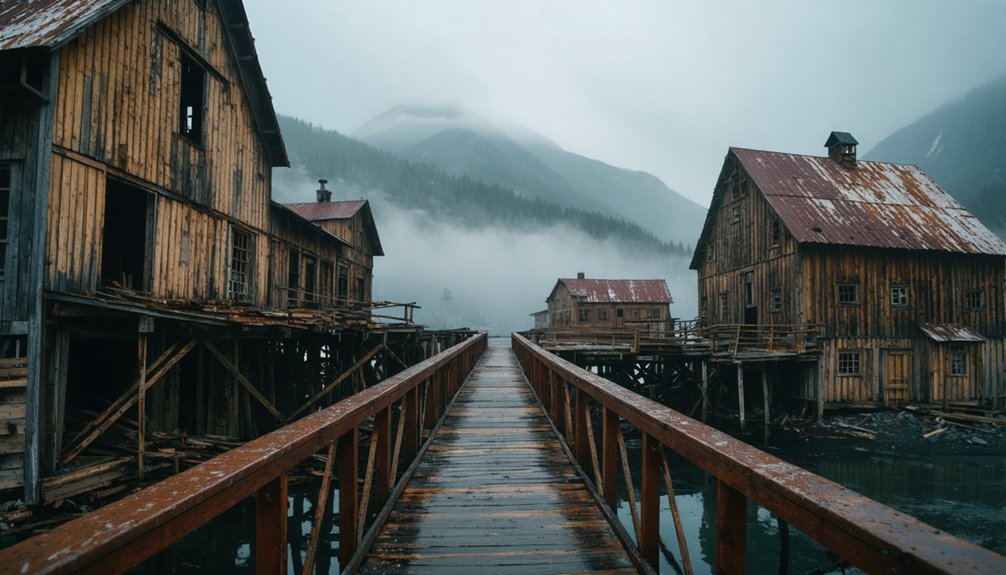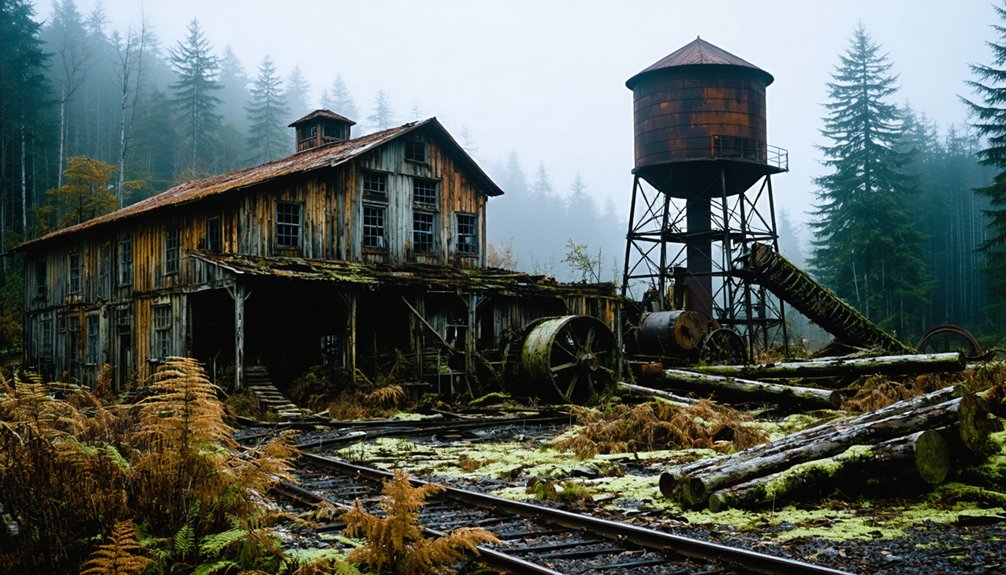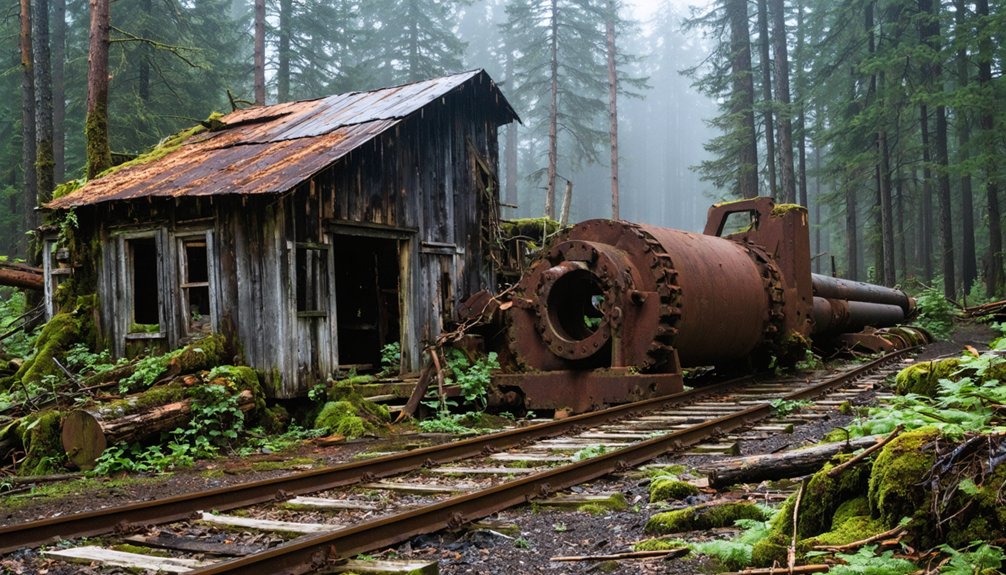
Abandoned logging towns in the US have followed three paths: some dissolved into ghost towns after resources depleted, others transformed into tourist attractions celebrating their heritage, and many became conservation areas. You’ll find these settlements in various states of preservation—from National Park Service sites like Kennicott that maintain buildings in “arrested decay” to overgrown ruins with only concrete foundations remaining in regenerating forests. The stories hidden within these forgotten communities reveal America’s complex relationship with its natural resources.
Key Takeaways
- Many logging towns became ghost towns after timber resources were depleted, triggering economic collapse and population exodus.
- Mill closures caused cascading unemployment, with some towns experiencing 25% job loss and significant wage decreases.
- Physical remnants like concrete foundations, earthen berms, and altered terrain mark where these communities once thrived.
- Some abandoned cutover lands were transformed into federally protected conservation areas through programs like the Forest Legacy Program.
- Towns with economic diversity survived, while others like Valsetz, Oregon completely disappeared after mill closures.
The Rise of America’s Logging Boom Towns
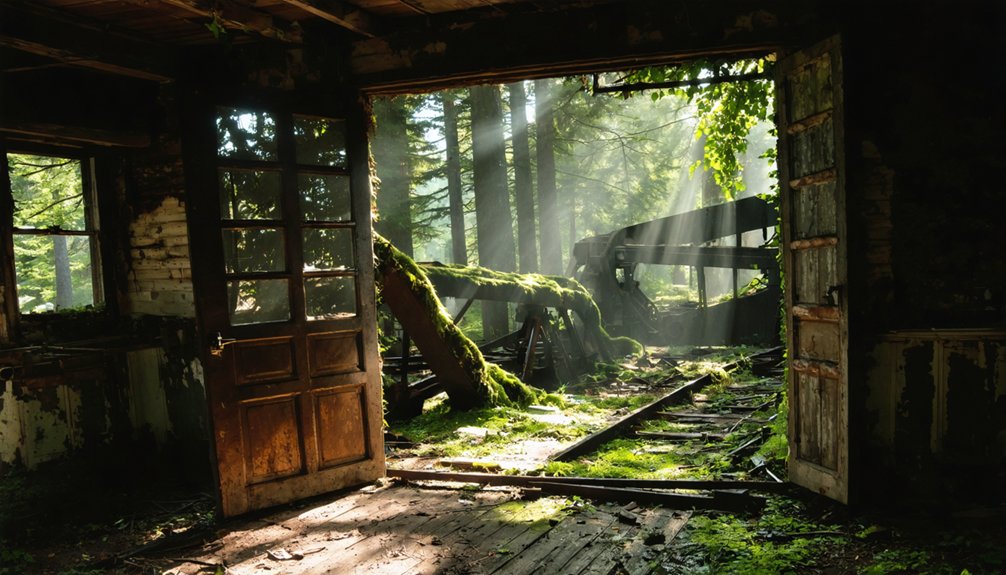
As America entered the mid-nineteenth century, logging boom towns began to emerge across the nation’s landscape in direct response to the insatiable demand for timber. You can trace this development to places like Teekalet (now Port Gamble), Washington Territory’s first purpose-built company town founded in 1853.
The California Gold Rush dramatically accelerated this expansion, with California investors establishing over two dozen steam sawmills on Puget Sound by 1860. As traditional timber supplies depleted in New England, the industry migrated westward—first to Michigan’s white pine forests, then to the Pacific Northwest. The Homestead Act of 1862 further supported this westward movement by allowing families to claim 160-acre plots, often heavily forested land that contributed to the logging industry.
This nomadic industry created a unique logging culture characterized by arduous work in harsh conditions. Despite high turnover and transient workforces, community resilience emerged in these settlements, providing employment opportunities for diverse groups and establishing economic foundations for America’s growing cities. The introduction of revolutionary technologies like the Shay locomotive transformed logging operations by enabling access to previously unreachable timber stands on difficult terrain.
How Railroad Expansion Fueled Timber Town Growth
When railroad networks began expanding across the American landscape in the 1880s, they transformed the timber industry by connecting once-isolated forests to burgeoning national markets. You could witness this revolution across regions like east Texas and the Pacific Northwest, where transcontinental lines penetrated previously inaccessible timberlands.
The railroad influence extended beyond mere transportation. Technological innovations like donkey-engine-powered winches and Shay locomotives allowed timber companies to harvest deeper in the woods, liberating them from dependence on waterways.
This expansion required substantial capital, which only corporations and wealthy investors could provide—men like Herman Kountze and John Kirby who built private rail lines specifically for timber extraction. In Pennsylvania, these logging railroads advanced extraction technology throughout the northern forests of the state.
Where these rail lines intersected, towns sprouted overnight. Some grew into thriving urban centers while others existed solely to service the timber industry’s insatiable appetite. By the early 1860s, sawmills on Puget Sound alone produced an impressive 71 million board feet of lumber annually, demonstrating the explosive growth of the industry.
The Economics Behind Logging Community Development
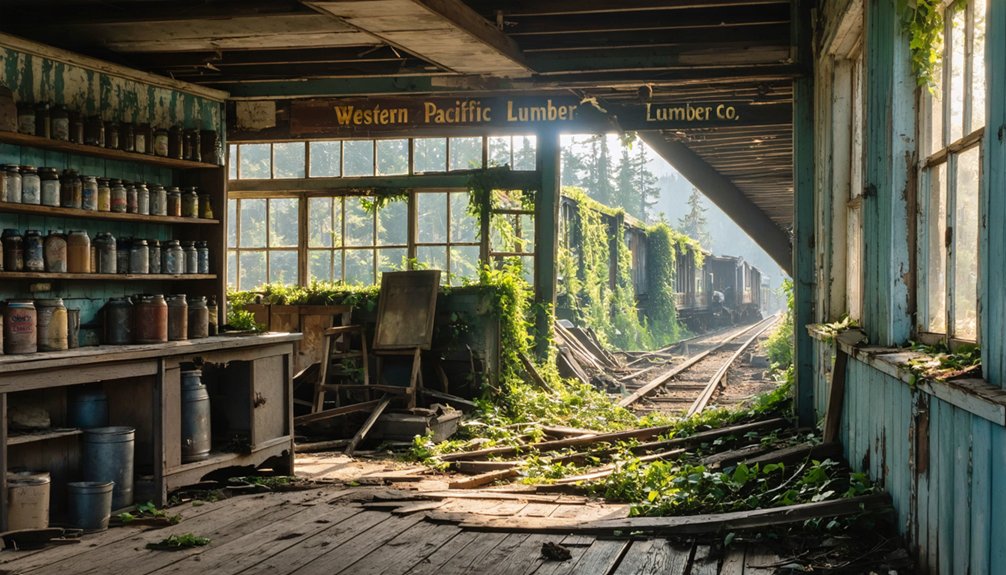
You’ll find that timber companies employed strategic land acquisition tactics, often purchasing vast tracts at minimal costs through government land grants or buying from cash-strapped homesteaders.
These corporate holdings established the foundation for boom-bust settlement patterns, where towns emerged rapidly around harvesting operations but disappeared once the profitable timber was exhausted.
The economic lifespan of these communities directly corresponded to the extraction timeline—flourishing during intensive cutting periods and collapsing when companies relocated to virgin forests elsewhere. This vulnerability persists today as the logging sector still faces challenges from worker shortages and rising business costs that threaten community stability.
When these communities decline, the impact ripples through local economies, as the forestry industry currently generates over $250 billion in economic activity across the Southern United States alone.
Corporate Land Acquisition Tactics
The transformation of America’s forest ownership over the last half-century reveals a calculated corporate strategy that has fundamentally reshaped rural economies.
You’ve watched giants like Weyerhaeuser systematically acquire over 600,000 acres from small landowners in western Oregon alone, targeting the most productive lands with superior soil quality and favorable topography.
This corporate consolidation isn’t random—it’s strategic. Just ten corporations now control 81% of western Oregon’s industrial forestland.
Their land management approaches prioritize shareholder returns over community wellbeing, often converting traditional timber companies into REITs that maximize profits for Wall Street investors rather than local economies.
When corporations acquire these forests, they’re not just buying trees—they’re securing power over rural communities whose economic futures become increasingly dictated by distant boardrooms. The resulting tax cuts have deprived rural counties of billions in revenue that would otherwise support essential local services. Similar to New York City’s watershed management strategy, these acquisitions typically occur only through purchases from willing sellers at market prices, avoiding contentious eminent domain processes.
Boom-Bust Settlement Patterns
Beyond corporate acquisition tactics lies a historical pattern of creation and collapse that defined America’s relationship with its forests. You’d witness logging community dynamics unfold predictably: rapid settlement near accessible timber and transportation routes, followed by inevitable decline once resources vanished.
These communities flourished at the intersection of virgin forests and efficient transport systems—rivers and railroads—creating economic hubs that attracted diverse workforces. The timber industry’s dramatic growth during the American Industrial Revolution meant that over 90 percent of the nation’s energy came from wood before the Civil War. As timber resource management was virtually nonexistent, towns expanded wildly during boom periods, with infrastructure and services developing to support swelling populations. This was especially evident in the South where by 1919, the region produced 37 percent of the country’s lumber supply.
When forests were depleted, these same communities collapsed just as quickly as they’d risen. Workers migrated elsewhere seeking opportunity, leaving behind deteriorating infrastructure and dwindling populations.
This pattern repeated across America’s forested regions, transforming prosperous communities into ghost towns within a generation.
the haunted histories of ghost towns reveal the stories of resilience and despair that echo through abandoned streets. As nature reclaims these once-thriving settlements, whispers of their past linger, inviting exploration and reflection. Each site tells a unique tale of dreams deferred and the relentless passage of time.
When the Trees Disappeared: The Beginning of the End
As you examine the pattern of logging town abandonment, you’ll notice a remarkably consistent timeline—most communities collapsed within just 20-30 years after their founding once nearby timber resources were exhausted.
This resource depletion triggered predictable economic collapse patterns where initial job losses in logging operations quickly cascaded to affect supporting businesses, schools, and social institutions.
The exodus typically occurred in phases, with single workers departing first, followed by families, and finally essential service providers, leaving behind the ghost towns that now dot America’s former timber regions.
Resource Depletion Timeline
While America’s vast forests once seemed inexhaustible to early settlers, systematic deforestation began well before the industrial era, permanently altering the landscape of what would become ghost logging towns.
By 1860, you’d have witnessed 25% of eastern forests already cleared, with early logging technology advancements like steam engines and circular saws accelerating this timeline.
The real devastation unfolded in predictable waves: first New England, then Great Lakes forests, finally pushing into the Pacific Northwest.
You’d have seen lumber production peak dramatically in the 1920s—Washington state alone produced 7 billion board feet annually—before crashing during the Depression.
Despite early timber conservation policies, by the 1950s, logging operations increasingly relied on federal lands as private resources dwindled, leaving behind hollow communities when the trees disappeared.
Economic Collapse Patterns
Once thriving communities built on seemingly endless timber resources faced predictable economic death spirals when the trees finally disappeared.
You’d recognize the pattern: mill closures triggered cascading unemployment, reaching 25% in some coastal towns during the 1980s recession when lumber prices plummeted 48%.
These economic factors created ripple effects throughout local economies. Average annual wages dropped by $3,916 in timber-dependent counties, considerably outpacing the $1,558 decline in diversified areas.
As families relocated for work, populations dwindled, decimating tax revenues and starving public services.
External pressures—Canadian competition, Japanese export markets, and high interest rates—compounded local vulnerabilities.
Towns like Valsetz, Oregon simply disappeared after their mills closed in 1978, revealing how community resilience depended on economic diversity that most logging towns never developed.
Ghost Towns in the Making: The Process of Abandonment

The transformation of thriving logging communities into ghost towns followed a predictable pattern marked by rapid resource depletion and mass exodus. You’d witness entire towns emptying as timber supplies vanished, with companies abandoning infrastructure rather than investing in depleted regions.
When timber disappeared, so did entire communities—leaving behind empty shells of once-bustling logging towns.
Economic decline happened swiftly—often within decades—as the lifeblood of these communities literally disappeared into sawmills.
- Workers and families relocated to newly opening frontier logging regions, following the “westward march” from Maine to the Pacific Northwest.
- Infrastructure was dismantled or abandoned, with temporary railroad lines and sawmills left to decay.
- Some communities attempted conversion to alternative resources like hardwood extraction, but these efforts rarely sustained original population levels.
This cycle of boom-and-bust created a landscape dotted with ghost towns—physical reminders of America’s resource-extraction economy.
What Remains Today: Archaeological Evidence of Logging Communities
Across America’s forgotten logging landscapes, physical remnants tell stories that historical records alone can’t capture.
You’ll find earthen berms marking former bunkhouses and concrete foundations revealing where communities once thrived. These archaeological features create a readable map of daily life in these vanished towns.
Material culture offers intimate glimpses into workers’ lives—charred animal bones in kitchen middens show dietary patterns, while decorated glass fragments and Levi Strauss rivets illustrate domestic spaces.
The cement foundations of schoolhouses, churches, and dance halls demonstrate how these weren’t merely work camps but functioning communities with complex social structures.
Even as forests reclaim these spaces, trained eyes can still detect the altered terrain, soil disturbances, and stream modifications that bear witness to humanity’s presence and the environmental transformation wrought by logging operations.
Federal Conservation and the Fate of Cutover Lands
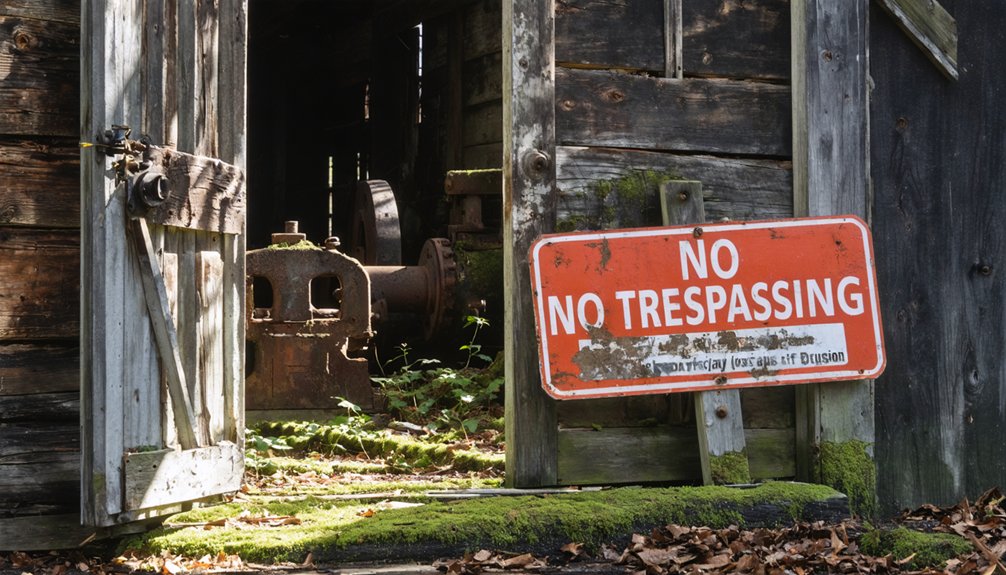
As federal conservation efforts expanded throughout the twentieth century, vast cutover lands abandoned by timber companies underwent remarkable transformation.
Many former logging areas found new purpose through conservation easements that balance timber production with ecological protection. You’ll find these working forests now support local economies while safeguarding critical watershed functions.
The federal approach to restoring these landscapes embraces ecological partnerships through programs like:
Federal restoration efforts prioritize ecological partnerships, leveraging diverse programs to rebuild forest health through collaborative stakeholder engagement.
- The Forest Legacy Program, which has protected over 3 million acres across 53 states and territories
- Collaborative Forest Landscape Restoration initiatives bringing together diverse stakeholders including timber industry and conservationists
- Partners for Fish and Wildlife efforts restoring riparian zones with thousands of native trees annually
These collaborative models represent a pragmatic path forward, recognizing that sustainable forestry and conservation aren’t mutually exclusive endeavors but complementary strategies for long-term forest health.
Forgotten Stories: Documenting America’s Lost Logging Heritage
While federal conservation efforts reshaped cutover lands physically, beneath these restored landscapes lies another dimension requiring preservation—the human stories of America’s vanished logging communities.
You’ll find these narratives preserved through fragmented means: photographic archives, oral histories, and occasional museum exhibits that capture logging traditions now lost to time.
Unlike mining ghost towns that often attract preservation funding, logging heritage sites frequently suffer from neglect and physical deterioration. Many company towns were deliberately dismantled after operations ceased, leaving only foundations and scattered artifacts as evidence of once-vibrant communities.
The cultural heritage of these settlements—shaped by immigrant labor patterns and regional identities tied to forest economies—risks permanent erasure without documentation.
When you explore places like Elkmont in Tennessee’s Great Smoky Mountains, you’re witnessing rare examples where preservation succeeded, allowing these forgotten stories to endure.
Visiting Former Logging Settlements: What You Can Still Find
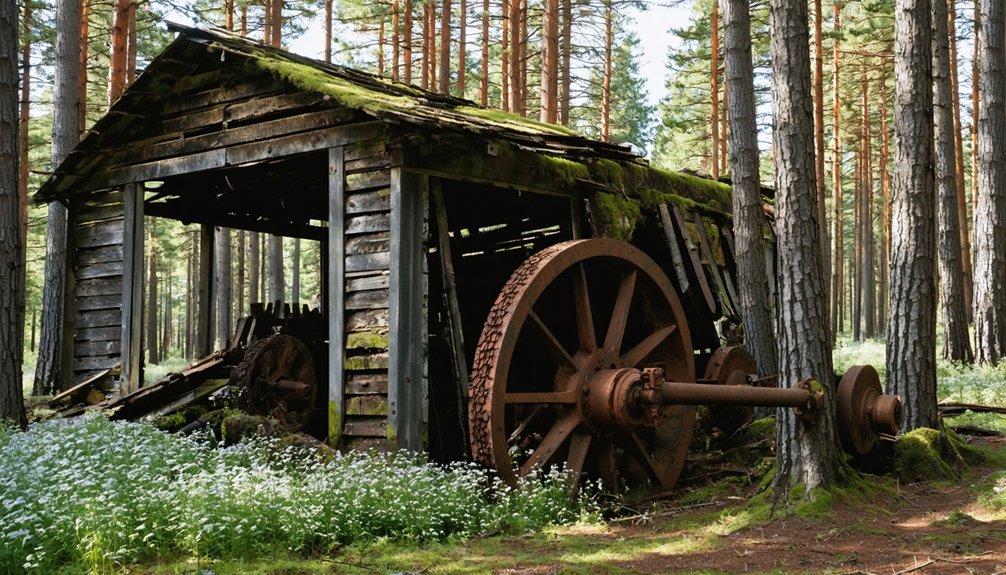
Where can you still experience America’s vanished logging heritage firsthand? When visiting ghost towns like Falk or Elkmont, you’ll discover that many historic structures remain accessible despite decades of abandonment.
The architectural remnants provide a glimpse into the daily lives of logging communities that once thrived across the country.
From timber baron mansions to humble worker cabins, these silent structures tell the story of America’s logging frontier.
- Elkmont Historic District in Tennessee preserves over 60 buildings within Great Smoky Mountains National Park, offering easy access for history enthusiasts.
- Former company towns like Kennicott have transformed into popular tourist destinations attracting thousands of visitors annually.
- Sites managed by the National Park Service maintain buildings in “arrested decay,” preserving authentic conditions while ensuring safe exploration.
While exploring historic structures, you’ll find everything from general stores and post offices to residential buildings—tangible connections to America’s industrial past.
Frequently Asked Questions
Did Any Abandoned Logging Towns Successfully Transition to Different Industries?
Yes, you’ll find former timber towns thrived through tourism, eco-friendly redevelopment, and recreational attractions. Some succeeded by preserving their heritage while others integrated mining operations or small-scale agricultural enterprises.
What Happened to Residents Who Stayed After Logging Operations Ceased?
You’d face serious economic challenges, adapting to subsistence living or alternative local jobs. You’d witness community resilience through multi-generational ties, despite diminishing services, aging populations, and deteriorating infrastructure around you.
Were Any Ghost Logging Towns Later Resettled or Restored?
You’ll be astounded by the countless ghost logging towns transformed! Many became resettled communities or restored heritage sites like Kennecott and Bodie, through government preservation efforts and tourism-driven economic revivals.
How Did Native American Communities Interact With Logging Settlements?
You’ll find Native Americans engaged in complex relationships with logging towns, working as laborers despite wage discrimination, while experiencing cultural exchanges and significant economic impacts on their traditional land management practices.
What Role Did Women and Children Play in Logging Communities?
You’ll find women’s contributions extended beyond cooking to camp management and operational roles, while children participated in community life and received makeshift education within these isolated, self-sufficient logging settlements.
References
- https://www.whitemountainhistory.org/abandoned-towns
- https://www.geotab.com/ghost-towns/
- https://albiongould.com/ghost-towns-to-visit-in-the-states/
- https://www.mentalfloss.com/geography/wanderlust/creepiest-ghost-towns-united-states
- https://www.christywanders.com/2024/08/top-ghost-towns-for-history-buffs.html
- https://www.youtube.com/watch?v=yeTVfoQxqJc
- https://en.wikipedia.org/wiki/Lists_of_ghost_towns_in_the_United_States
- https://www.atlasobscura.com/lists/americas-best-preserved-ghost-towns
- https://www.smithsonianmag.com/travel/americas-coolest-ghost-towns-180952954/
- https://www.notesfromthefrontier.com/post/untitled