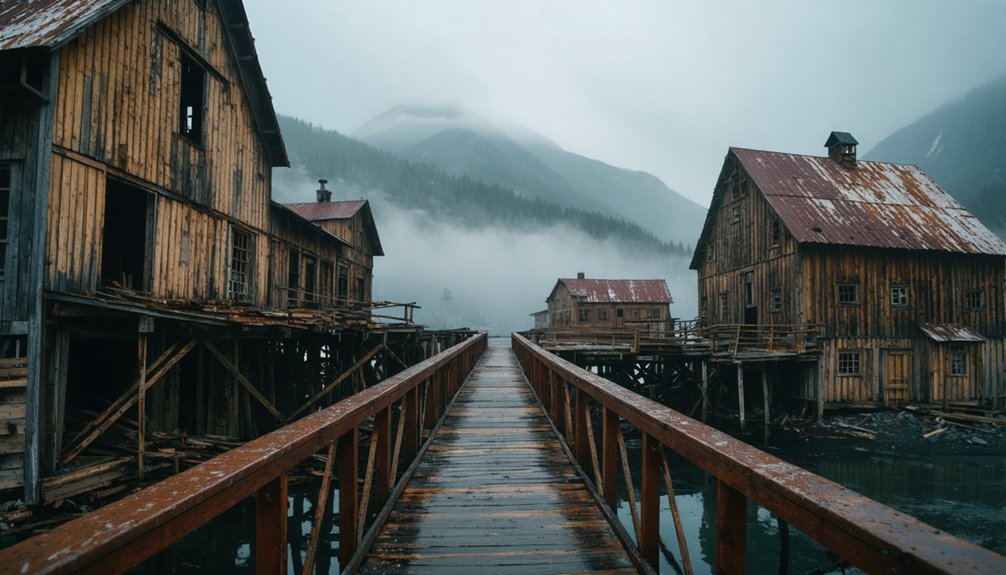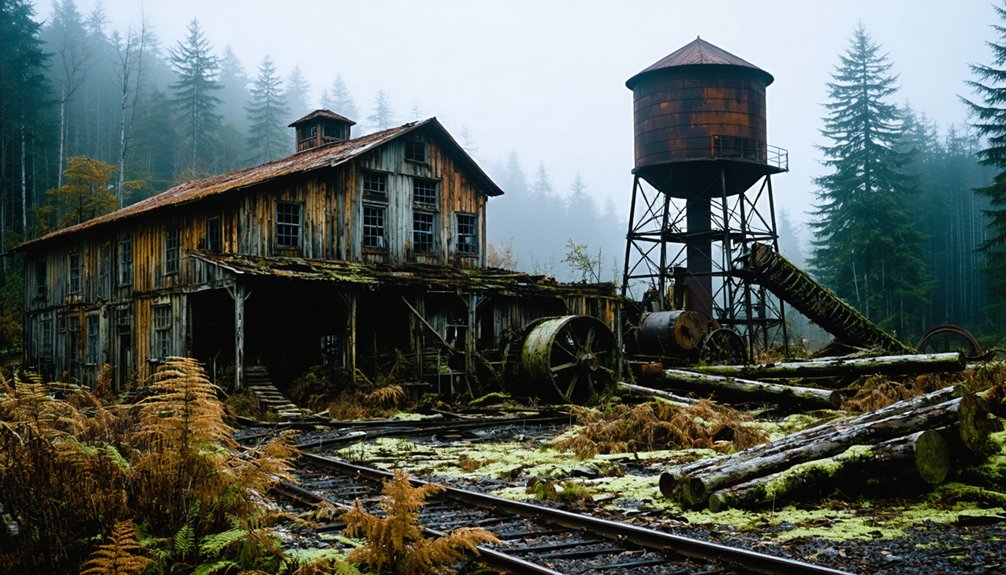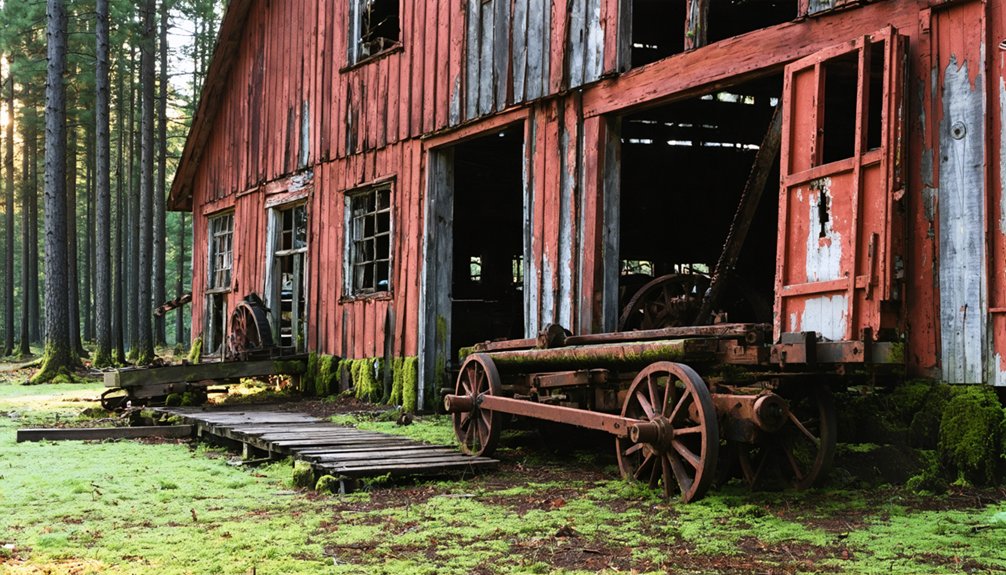
America’s abandoned sawmill towns were once thriving communities built around timber operations in the 19th and early 20th centuries. You’ll find their remnants scattered across forests nationwide—concrete foundations, cellar holes, and rusting machinery now reclaimed by nature. These towns collapsed when unsustainable logging practices exhausted old-growth forests, forcing rapid exodus of workers and their families. Their ghostly remains tell a sobering tale of boom-and-bust economics where extraction triumphed over stewardship.
Key Takeaways
- Resource depletion and unsustainable logging practices exhausted timber supplies, forcing towns to close when forests were depleted.
- Physical remnants include concrete foundations, cellar holes, and dam structures slowly being reclaimed by nature.
- Economic collapse occurred when single-industry towns couldn’t diversify after timber resources vanished.
- Company-owned infrastructure and housing were abandoned when operations ceased, leaving entire communities deserted.
- Many towns vanished entirely while others adapted through tourism, historic preservation, or alternative industries.
The Rise of Company-Owned Timber Communities
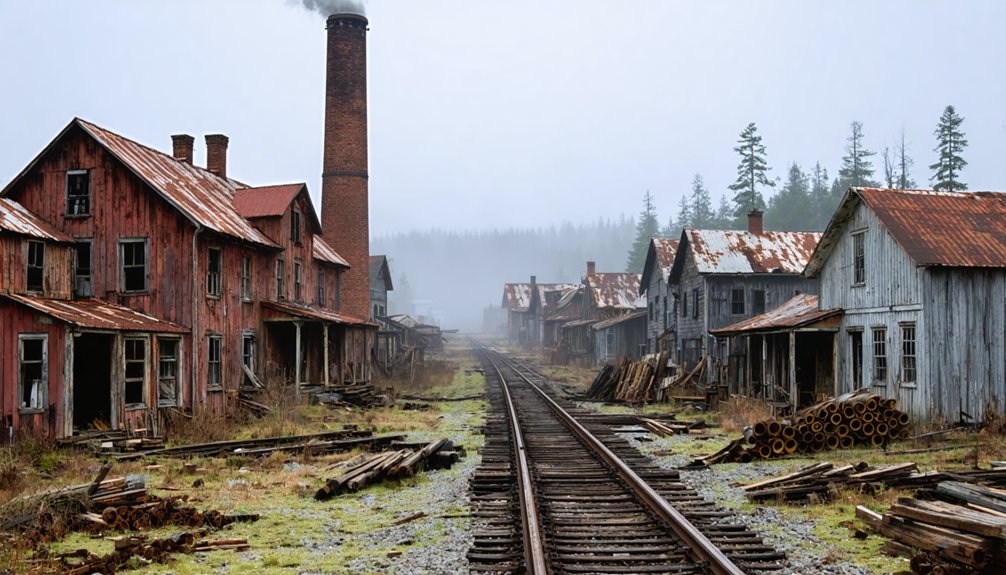
As the American frontier pushed westward in the mid-19th century, timber barons established what would become a defining feature of the nation’s industrial landscape: the company-owned timber town.
These settlements, like Teekalet (now Port Gamble) founded in 1853, served as centralized hubs where the timber industry controlled every aspect of life. You’d find company-built housing hierarchies—from basic bunkhouses for laborers to elegant homes for managers—alongside stores, churches, and schools all under company oversight. The California Gold Rush of 1848 triggered a surge in lumber demand that accelerated the development of these communities throughout the Pacific Northwest.
What began as small family operations soon transformed into vast corporate empires. By 1914, Weyerhauser alone controlled over 2 million acres of timberland.
The extensive infrastructure created economic dependency by design, with workers’ wages often directly reduced by inflated prices at company stores, binding laborers to an inescapable cycle of debt and obligation. In Humboldt Bay, the timber industry grew dramatically with nine operating mills by 1854, establishing Eureka as a prominent lumber production center.
When the Trees Disappeared: Causes of Sawmill Town Abandonment
While standing amid the ghostly remnants of once-bustling sawmill towns today, you’ll find it difficult to imagine their former liveliness—a reflection of their swift and often complete abandonment. The primary culprit was catastrophic resource management failure; once the longleaf pine and old-growth forests were exhausted—typically within just 20 years—mills closed without raw materials.
The forsaken timber mill towns history serves as a cautionary tale about the consequence of unsustainable practices. As these communities faded into obscurity, many stories of resilience and hardship were lost alongside the mills. Today, remnants of their past offer a poignant reminder of the importance of responsible resource management.
You can trace these towns’ collapse to their fundamentally unsustainable economic model. Without replanting practices, cutover lands lost commercial value. When timber vanished, so did jobs, infrastructure, and population. The introduction of railroad expansion in the late 19th century initially stimulated growth but ultimately hastened their decline by allowing for more extensive logging operations. Company owners often dismantled machinery and buildings, relocating to fresh forests elsewhere.
War-time demand accelerated deforestation, while post-war market shifts eliminated alternatives for economic sustainability. This was particularly evident in places like Fullerton, where demand for lumber increased dramatically during and after World War One to rebuild war-torn Europe.
What remains are haunting reminders of communities that vanished when their single resource disappeared—victims of short-sighted extraction rather than stewardship.
What Remains: The Physical Legacy of Ghost Mill Towns
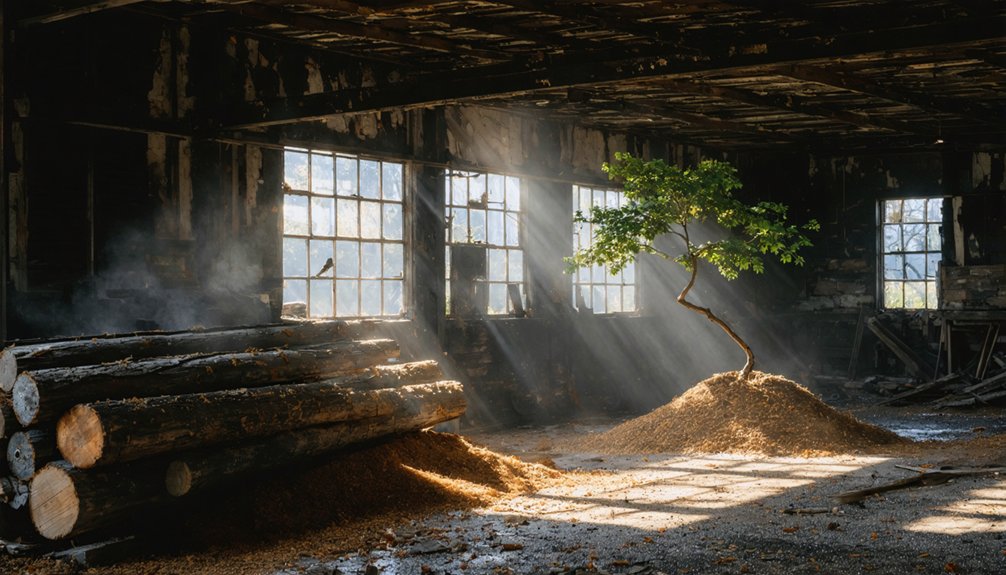
When you explore the physical remnants of America’s abandoned sawmill towns today, you’re encountering a landscape where human industry and nature exist in haunting dialogue.
Concrete walls, often adorned with graffiti, stand as defiant remnant structures amid forests that have reclaimed their territory. These forgotten landscapes reveal cellar holes, dam foundations, and stonewalls partially hidden beneath decades of vegetation.
While most wooden buildings have collapsed from neglect, more durable materials tell stories of industrial ambition. Over 600 documented cellar holes in some national forests mark communities that once thrived.
Railroad sidings and rusting equipment peek through undergrowth, silent witnesses to bygone prosperity. At Aldridge Sawmill, the hand-poured concrete walls of three buildings remain as the most visible evidence of the town that once employed 500 workers.
In locations like Avery Town, evidence of the past includes holding ponds that were once used for log storage before processing at the mill.
Climate plays a vital role in preservation—wetter regions accelerate decay while drier areas better preserve these physical legacies of America’s lumber boom.
Life and Loss in Timber-Dependent Communities
Beyond the physical remnants of America’s sawmill towns lies a more profound human narrative of community formation, prosperity, and eventual decline. You’d have found these communities pulsing with life—families gathered around company-built housing, children attending schools, and workers streaming to mills at dawn.
These weren’t merely workplaces but complete social ecosystems. Workers often relied on the company scrip system for purchasing necessities at town-owned stores. In places like Mono Mills, laborers earned approximately $3 daily while receiving housing and meals as part of their compensation.
When timber resources vanished, you’d witness the unraveling of entire social fabrics. Company-provided services disappeared alongside jobs, triggering rapid population exodus.
Despite these challenges, community resilience emerged in some towns where economic adaptation took hold. Residents diversified local economies or repurposed facilities.
For many towns, however, the inexorable link between forest resources and community survival meant that when the trees disappeared, so too did their reason for being.
Notable Sawmill Towns Across American Regions

Throughout America’s diverse geographical landscape, a constellation of sawmill towns once dotted forests from coast to coast, each reflecting regional characteristics yet sharing common patterns of boom and decline.
In sawmill history, you’ll find regional differences shaped distinctive communities. Port Gamble, Washington operated for 142 years, while Onalaska collapsed after WWII when Japanese workers were interned. Southern towns like McNary and Centralia boasted populations of 3,000 with full amenities until “cut-out and get-out” practices depleted forests. The Cady Lumber Company exemplifies this pattern, facing closure in Louisiana when old-growth pine was exhausted by 1924.
In New England, over 600 cellar holes mark vanished White Mountain lumber settlements.
East Texas’s Aldridge exemplifies the common trajectory—advanced technology producing 125,000 board feet daily before fires and deforestation led to abandonment, leaving only concrete ruins where a thriving community once stood. Florida’s Centralia followed a similar path, growing to around 2,000 residents before valuable Cypress depletion caused its abandonment by 1922.
Frequently Asked Questions
Could Abandoned Sawmill Towns Be Legally Reclaimed by New Residents?
No, you can’t legally reclaim abandoned sawmill towns without acquiring property rights. Legal implications include private ownership, tax liabilities, historic preservation restrictions, and regulatory hurdles—despite their nostalgic allure of freedom.
What Happened to Cemetery Sites in Abandoned Sawmill Towns?
You’ll find these sacred grounds overtaken by nature, with headstones damaged and markers lost. Despite minimal cemetery preservation efforts, they maintain profound historical significance as the last tangible vestiges of vanished communities.
Did Any Sawmill Towns Successfully Transition to Different Industries?
Where there’s a will, there’s a way. You’ll find many sawmill towns achieved remarkable industrial shift through economic diversification into tourism, manufacturing, and tech-driven wood processing, preserving their heritage while embracing freedom from single-industry dependence.
How Did Indigenous Communities Interact With Sawmill Town Development?
You’ll find Indigenous communities responded to sawmill encroachment through resistance, adaptation, and negotiation, while witnessing their traditional resource management practices disrupted and experiencing limited cultural exchange amid displacement from ancestral lands.
Were There Significant Differences Between Northern and Southern Sawmill Towns?
Like two trees in different soils, you’d find northern towns had more diversified economies and longer lifespans, while southern operations followed “cut and get out” practices with starker economic disparities and cultural influences from racial segregation.
References
- https://www.whitemountainhistory.org/abandoned-towns
- https://www.historylink.org/File/23208
- https://floridatrailblazer.com/2018/01/25/centralia-ghost-town-in-hernando-county/
- https://www.youtube.com/watch?v=mQJonzJBYK8
- https://www.whitemountainhistory.org/abandoned-towns/livermore
- https://www.sfasu.edu/heritagecenter/9862.asp
- http://www.texasbeyondhistory.net/aldridge/
- https://www.srs.fs.usda.gov/pubs/gtr/gtr_srs257.pdf
- https://blackdiamondhistory.wordpress.com/2019/05/23/old-sawmill-town-remembered/
- https://www.timberheritage.org/local-history