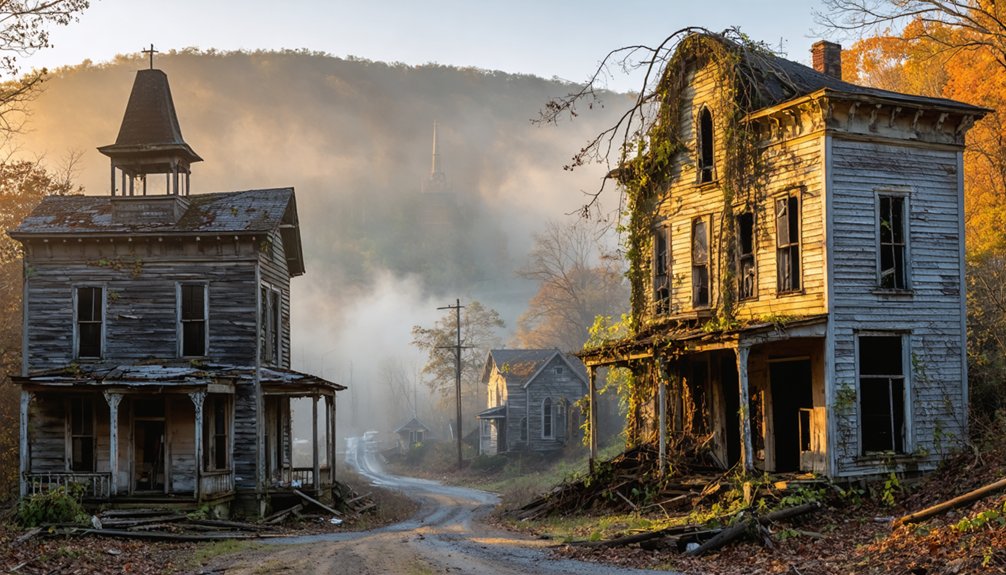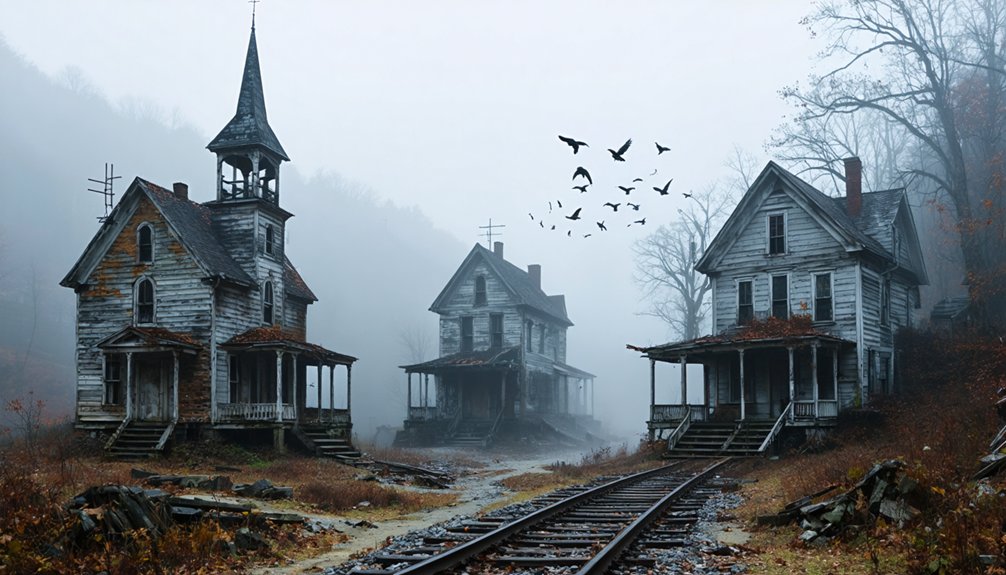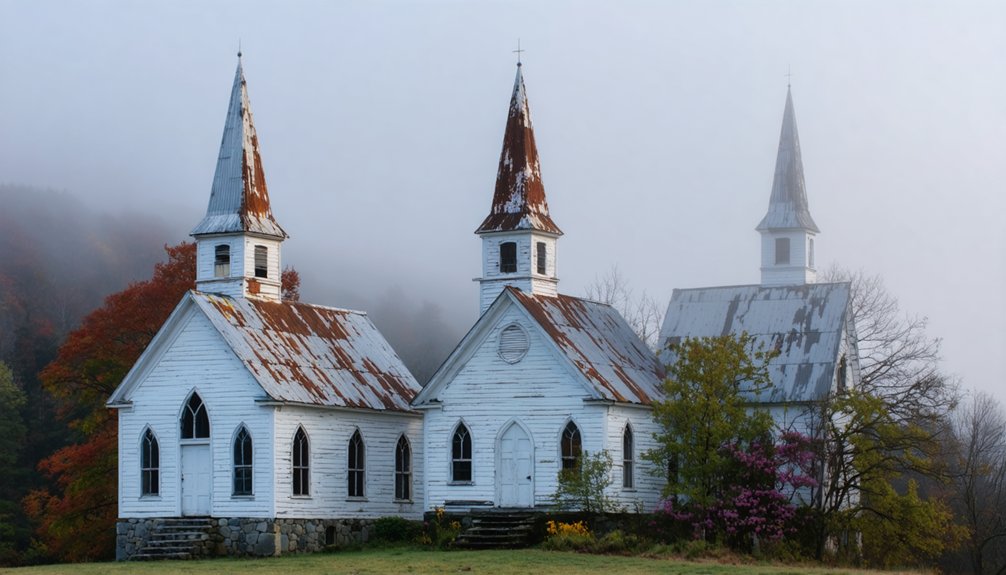
Appalachian ghost town residents primarily experienced two major migration waves during the 20th century. You’ll find they left their communities due to collapsing coal economies, with nearly 7 million relocating to industrial centers like Cleveland and Detroit. They faced stereotypes but formed tight-knit communities elsewhere as their hometowns emptied. Their departure triggered widespread cultural disintegration, with abandoned churches, schools, and gathering places. The full story reveals a complex intersection of economic necessity and cultural loss.
Key Takeaways
- Mass migration occurred in two major waves, with nearly 7 million Appalachians relocating to industrial cities like Cleveland and Detroit.
- Economic necessity forced residents to leave as coal mining jobs declined by 85% in the early 2000s.
- Residents who remained faced severe health challenges, including respiratory diseases and elevated cancer rates.
- Community fragmentation followed as churches, schools, and gathering spaces were abandoned.
- Some residents’ stories are preserved through restoration projects that maintain ghost town structures and cultural heritage.
The Great Migration: How Families Left Coal Country Behind

As the coal industry’s grip on Appalachia began to weaken in the early 20th century, a remarkable demographic transformation took shape that would forever alter the region’s cultural and economic landscape.
You’d have seen this exodus unfold in two distinct waves – first after World War I, then intensifying between 1940 and 1970 when nearly 7 million mountaineers relocated northward.
Your fellow Appalachians flocked to industrial centers like Cleveland, Detroit, and Cincinnati, often clustering in neighborhoods mockingly labeled “hillbilly heavens.”
Despite facing cruel Appalachian stereotypes as “freeloaders” or “job stealers,” migrants created tight-knit communities preserving mountain traditions.
Migration narratives reveal how economic necessity drove this mass departure, with younger residents seeking opportunity while coal towns gradually emptied.
Mechanization and unstable coal prices pushed families to leave, transforming vibrant communities into ghost towns as industry recruiters actively lured workers northward. This pattern mirrored the larger Great Migration occurring simultaneously as African Americans sought better opportunities outside the South.
Among those who remained in the mining regions were approximately 1.3 million Black residents whose experiences in Appalachia were often overlooked in historical accounts.
Economic Hardships and the Search for New Opportunities
When coal’s dominance began to crumble across Appalachia in the early 2000s, a devastating economic cascade swept through once-thriving mining communities. You witnessed an 85% decline in coal mining jobs—roughly 150,000 positions vanished between 1980 and 2017.
Your communities contracted rapidly; for each percentage point drop in coal’s economic share, local employment fell by 3.1%.
Economic diversification proved elusive. Few counties successfully shifted to new industries as working-age populations fled, creating aging demographic profiles in towns that lost up to 10% of their residents. This population decline was notably uneven, with younger educated residents leaving at significantly higher rates than other demographic groups.
Despite efforts toward community resilience, financial distress spread beyond miners, affecting household credit scores and increasing dependence on government assistance. Within just two years following coal demand shocks, residents experienced significant deterioration in their financial well-being.
The limited success stories—small-scale growth in tourism, healthcare, and education—highlight the immense challenge of rebuilding economies constructed around a single, declining industry.
Health Challenges Faced by Former Mining Communities
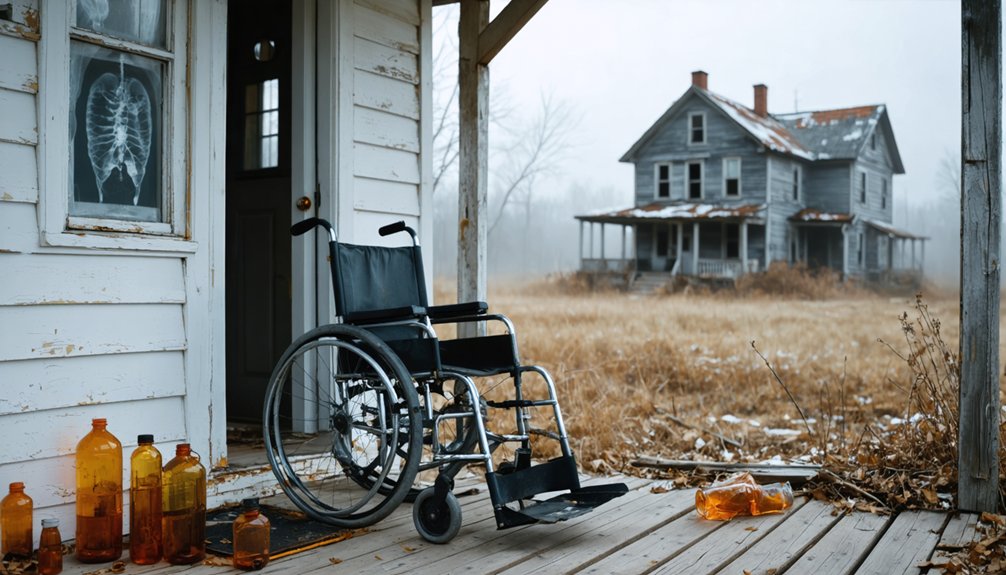
The legacy of coal mining extends beyond economic devastation into profound health crises that continue to haunt former mining communities long after the last coal car departed.
Coal’s aftermath lingers invisibly, poisoning communities with a toxic inheritance that outlasts the industry itself.
You’ll find staggering health disparities throughout Appalachia, where respiratory diseases strike former miners at eight times the rate of the general population.
Cancer rates in mountaintop removal counties nearly double those of nearby non-mining areas, with up to 60,000 additional cancer cases linked directly to mining activities.
Cardiovascular disease claims 700 excess lives annually, while birth defects occur at rates 181% higher near mining operations—six times the impact of maternal smoking.
These communities face a toxic inheritance: uncurable coal mine dust lung disease, elevated cancer mortality, and persistent reproductive health challenges that transcend generations, creating a devastating public health crisis. The greatest suffering occurs in Central Appalachian states, where miners face the highest risk of developing fatal respiratory conditions. The reduced life expectancy trends in these regions starkly contrast with national improvements, with some counties ranking among the bottom percentile nationwide.
Cultural and Social Dissolution in Abandoned Towns
Cultural and social disintegration in Appalachia’s ghost towns represents far more than physical abandonment—it embodies the unraveling of generational social fabric that once bound these communities together.
In these desolate landscapes, ghost stories in rural communities often emerge as a means of preserving the past, offering a glimpse into the lives and dreams of those who once inhabited these spaces. These tales, steeped in local history, serve not only to entertain but also to foster a sense of identity and continuity among the remaining residents. As the echoes of laughter fade, the haunting narratives become vital threads that weave together the fading memories of a once-thriving culture.
As you explore these hollows, you’ll find evidence of profound community fragmentation where vibrant societies once thrived.
Four devastating losses these communities experienced:
- Dissolution of churches and schools that served as community anchors
- Disappearance of gathering spaces like dance halls and stores that fostered social cohesion
- Severing of intergenerational knowledge transfer systems
- Dispersal of shared cultural practices that maintained collective identity
This cultural nostalgia isn’t merely sentimental—it represents lost systems of mutual support and resilience.
When towns emptied, they didn’t just lose buildings and businesses; they lost living repositories of regional traditions, dialects, music, and communal knowledge developed over centuries. The rapid abandonment occurred as mines ran dry and families were forced to leave their homes behind in search of new opportunities. In places like Elkmont, the transition from logging community to resort destination fundamentally altered the town’s original character before its eventual decline.
Preservation Efforts and Modern Revivals of Ghost Towns

Despite decades of neglect threatening to erase these mountain communities entirely, preservation efforts across Appalachian ghost towns have evolved into sophisticated, multi-faceted campaigns that balance historical authenticity with practical sustainability.
The forgotten whispers of Appalachia find new voice through preservation that honors both past authenticity and future viability.
You’ll find the National Park Service‘s approach has transformed dramatically since 1992, when over 70 abandoned structures stood deteriorating after the expiration of lifetime leases.
The National Register’s designation saved numerous cottages from demolition, creating legal obligations for maintenance rather than destruction.
Through Friends of the Smokies’ $9 million endowment, cottage restoration projects meticulously match original paint colors and source period-authentic materials.
Professional carpenters have preserved the historical significance of 19 structures in Elkmont alone, with 16 now open for your exploration via walking trails that reveal both preserved buildings and the poignant remnants of those too far gone.
Elkmont’s transformation reflects its rich past as a logging community that later became a popular vacation destination for wealthy residents.
In 2012, the Southern Appalachian Highlands Conservancy purchased a 95-acre portion of Lost Cove to protect its natural and historical significance for future generations.
Frequently Asked Questions
Did Ghost Town Residents Maintain Connections With Those Who Stayed Behind?
Yes, you’ve maintained strong social networks through family gatherings, annual homecomings, and mutual aid systems. Letters, phone calls, and reunions preserved emotional bonds despite geographical separation and economic challenges.
What Happened to Elderly Residents Who Couldn’t Relocate?
Elderly residents faced dire outcomes as you’d expect—many perished from isolation and inadequate care, while others relied on fragmented community support networks or reluctantly entered unfamiliar institutional settings against their wishes.
How Did Children Adapt to New Schools After Relocation?
You’d face school integration challenges including curriculum differences, accent discrimination, and disrupted education. Your peer relationships often suffered as you were viewed as outsiders, though community support sometimes eased these difficult changes.
Were There Government Assistance Programs for Displaced Mining Families?
Like a safety net beneath a tightrope walker, you’d find government programs supporting displaced mining families through the Federal Black Lung Benefits, Assistance to Coal Communities, AMLER, and POWER Dislocated Worker initiatives.
How Did Religious Practices Change in Transitioning Communities?
You witnessed ritual adaptations as traditional Christianity declined, while indigenous practices and folk beliefs persisted. Your community beliefs evolved toward individual nature-based spirituality, with syncretistic elements maintaining cultural continuity during changes.
References
- https://icatchshadows.com/jellico-the-appalachian-coal-mining-town-with-an-explosive-past/
- https://newrivergorgecvb.com/abandoned-wv-coal-towns/
- https://appalachianmemories.org/2025/01/08/coal-camps-in-appalachia-in-the-1940s-life-in-the-shadows-of-industry/
- https://scholarworks.law.ubalt.edu/cgi/viewcontent.cgi?article=1789&context=all_fac
- https://www.youtube.com/watch?v=3F_Gv_xp3Y4
- https://www.appalachianhistory.net/2014/07/ghost-towns-cumberland-plateau.html
- https://www.georgiaencyclopedia.org/articles/history-archaeology/great-migration/
- https://www.aaihs.org/documenting-black-appalachia/
- http://expatalachians.com/when-mountaineers-were-americas-migration-crisis
- https://en.wikipedia.org/wiki/Hillbilly_Highway