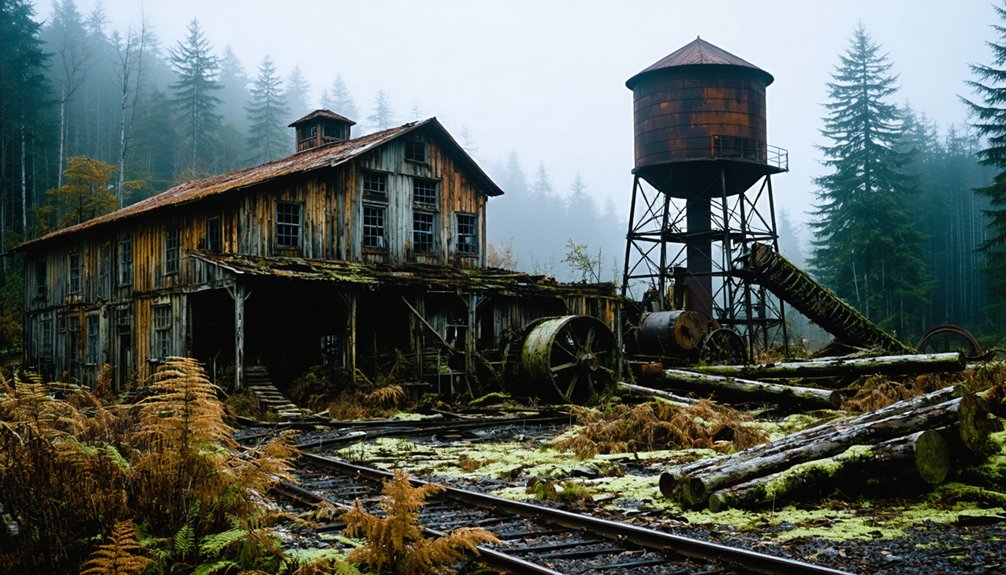
America’s timber mill towns collapsed under the weight of rapid technological change and resource depletion. You’ll find these communities suffered catastrophic economic fallout when mills closed, with unemployment rates soaring above 25% and downtown vacancy rates reaching 55%. Each lost mill job triggered three additional community job losses, driving population exodus and service decline. Forests that once fueled these economies now stand depleted, their stories preserved in the rusting remains of once-thriving industrial centers.
Key Takeaways
- Mill closures eliminated thousands of jobs, triggering unemployment rates exceeding 25% and causing economic ripple effects throughout communities.
- Downtown districts suffered 55% vacancy rates with abandoned mill buildings becoming environmental hazards and attracting crime.
- Population exodus followed mill closures, with some towns losing up to 37% of residents and experiencing dramatic declines in services.
- Economic devastation was widespread, with total output declining by $211.55 million and average earnings dropping by $64 million in affected counties.
- Some communities attempted revitalization through heritage preservation, adaptive reuse of mill buildings, and economic diversification into new industries.
The Rise and Fall of America’s Sawmill Empires
While the American landscape was still being shaped by European colonization, the first sawmills emerged in the early 1600s, establishing what would become a transformative industry for the continent.
You’d find these early operations using simple water-powered sash saws along rivers, where logs could be easily transported.
As the 19th century progressed, sawmill innovations revolutionized production—circular saws replaced primitive methods, while steam power freed operations from riverbank constraints.
The timber trade boomed with railroad expansion, allowing lumber to reach distant markets and fueling Frederick Weyerhauser-type empires.
But this prosperity contained seeds of its own destruction.
Forests disappeared faster than they could regrow.
Minnesota’s first commercial sawmill at Marine-on-St-Croix demonstrated remarkable longevity by operating continuously for over 75 years despite initial challenges.
These mills were vital community establishments, often built before schools and churches, with their absence considered a serious evil inconsistent with civilized colonial life.
Once-bustling mill towns faced abandonment as timber reserves vanished, with operations shifting westward in search of untouched woodlands.
When the Last Whistle Blew: Economic Aftermath of Mill Closures
You’ll find it hard to overstate the economic devastation when a mill town’s primary employer shuts down, as witnessed in Haywood County where the Canton Paper Mill’s closure threatened 1,883 jobs and $134.2 million in labor income—11% of the county’s total.
Your once-bustling Main Street businesses quickly empty as displaced workers, facing sudden financial hardship, drastically cut spending—creating a domino effect that ripples through retail shops, restaurants, and service providers. Michigan State University research reveals that for every direct job lost in sawmills, nearly three additional positions vanish in related sectors.
This mirrors Maine’s experience, where the logging and forest industry supports approximately 5,600 jobs throughout the state’s economy. Without intervention, these communities face a rapid paycheck-to-poverty shift, with tax revenues plummeting by millions (Haywood County risked $47.5 million in annual tax losses) and further eroding the public services needed most during economic crisis.
Immediate Mass Unemployment
When the final whistles blew at sawmills across America’s timber regions, communities faced an economic apocalypse that arrived without warning or mercy.
The job displacement hit like a tsunami—Michigan lost 273 sawmill jobs, triggering 820 additional losses across related sectors.
You’d have seen the devastation in Montana, where Pyramid Mountain and Roseburg closures eliminated 250 positions overnight, or in Oregon’s timber towns, where unemployment soared past 25%.
The economic repercussions extended far beyond mill gates, with two-thirds of job losses occurring in adjacent industries like logging, transportation, and retail. The total economic blow resulted in output decline of $211.55 million, devastating local economies dependent on timber production.
Recent closures—Georgia-Pacific’s Foley Mill (535 jobs), International Paper’s Orange facility (900 jobs), and Alleghany Wood Products (800 jobs)—have transformed once-thriving communities into ghost towns seemingly overnight, leaving families and futures hanging in the balance.
As these towns face economic decline, their rich history remains a poignant reminder of what once was. Exploring historic sites in Virginia City offers a glimpse into the past, revealing stories of resilience and community spirit. However, without urgent revitalization efforts, these landmarks may also fade into obscurity, much like the industries that once supported them.
This recent wave of shutdowns coincides with lumber prices plummeting from pandemic highs of $1,400 to just under $400 per thousand board feet in 2024.
Downtown Emptying Patterns
After the mills closed, downtown districts transformed from vibrant community centers into bleak landscapes of emptiness and decay.
You’d recognize the stark visual evidence of urban decay in the staggering 55 percent vacancy rates that plagued these once-thriving commercial hubs. Boarded-up storefronts created ripple effects, driving away remaining businesses as customers disappeared.
The massive mill buildings that once anchored your community’s economy sat idle for decades. In Youngstown, former steel sites remained barren thirty years after demolition.
Environmental contamination rendered large land parcels unusable, while historic structures deteriorated before your eyes.
This physical deterioration systematically eroded community identity rooted in timber and manufacturing heritage.
Drug dealers occupied abandoned properties while thieves stripped buildings of valuable materials. Your downtown transformed into a place that appeared unsafe and unwelcoming, driving further exodus and investment decline.
Rural communities experienced dramatic economic transitions as they shifted away from natural resource extractive industries toward new economic foundations.
The loss of timber jobs triggered long-term unemployment, with many workers unable to find comparable employment even years after mill closures.
Paycheck-to-Poverty Pipeline
The devastating economic tsunami released by mill closures swept through timber communities, transforming stable middle-class households into economic casualties overnight.
You’ve witnessed how $87.2 million in labor income vanished, throwing families from paycheck stability into poverty cycles. When a mill shutters, the impact multiplies threefold beyond its walls—every direct job lost triggers three more throughout your community. The Hardwood Federation’s estimation that one sawmill closes every week in the United States highlights the accelerating rate of this economic devastation.
- Single mill closures jeopardize 11% of county labor income, with ripple effects reaching $9 billion industry-wide.
- Supply chain collapse hits hardest in logging, transportation, and forestry, where each lost job represents $235,130 in economic value.
- Your household spending power diminishes by $0.90 for every $1 in lost mill wages, creating a domino effect that endangers $803 million in regional economic output.
Ghost Towns in the Forest: Abandoned Communities Left Behind
Deep within America’s forested regions, once-thriving timber communities now stand as haunting monuments to industrial collapse.
North Fork lost over half its population after its mill closed in 1994, while Gary shrank from tens of thousands to just 772 residents by 2020. The ghost stories that echo through these abandoned towns reflect the harsh reality of economic devastation.
When mills shuttered, they triggered cascading failures—banks closed, doctors left, restaurants disappeared.
Main Streets became rows of boarded-up storefronts as unemployment soared to 17%. The exodus forced remaining residents to commute 75 minutes to larger cities for work, while schools and essential services vanished.
Despite these challenges, community resilience emerges through salvage operations and diversification attempts, though recovery remains elusive for most former timber towns. At Mono Mills, nearly 200 workers once earned $3-$6 daily cutting timber to supply Bodie’s insatiable wood demands before operations ceased entirely in 1917.
From Vast Forests to Barren Lands: Resource Depletion and Its Consequences
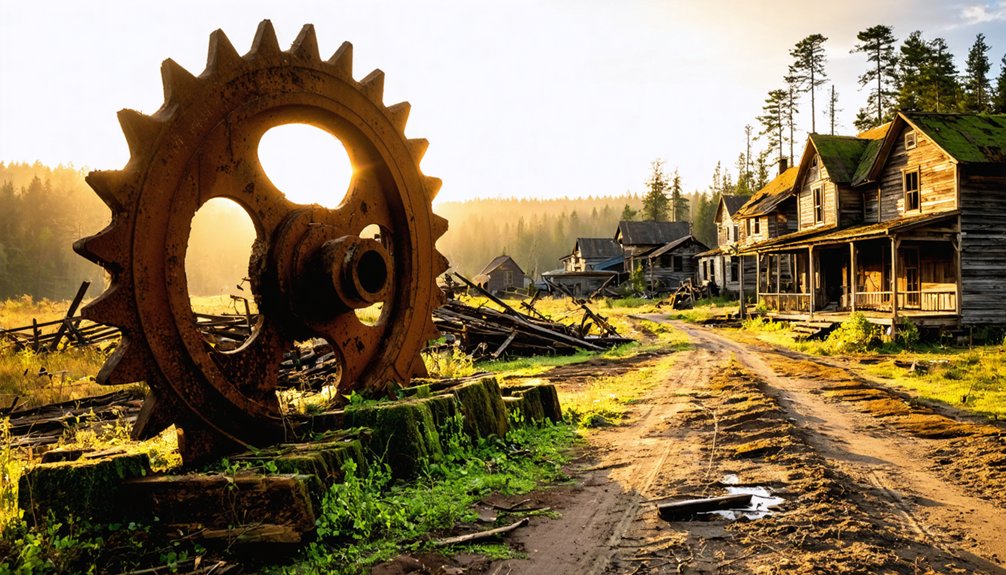
You’d hardly recognize the lush forests that once surrounded mill towns like Millville and Grayson, now reduced to sparse second-growth stands after decades of over-harvesting and devastating wildfires.
Your grandparents’ generation witnessed 18.5–24.7 million hectares of timber-producing forest disappear between 2001 and 2021 alone, an area roughly the size of Great Britain.
The transformation from resource abundance to scarcity hasn’t just changed the landscape—it’s fundamentally altered these communities’ economic foundations, with timber establishments dropping 9% in five years and thousands of forestry jobs vanishing.
Forests Beyond Recovery
While once-towering forests blanketed our continent from coast to coast, many regions have now crossed ecological thresholds from which recovery seems impossible.
You’re witnessing the aftermath of systematic destruction—75% of America’s virgin forests have vanished since the 1600s, with old-growth forests in the Pacific Northwest declining by 13% in just one decade.
Forest restoration faces nearly insurmountable challenges as ecological balance continues to deteriorate:
- Degraded landscapes have increased from 11.3% to 15.5% globally between 2015-2019, threatening 3.2 billion people’s livelihoods.
- Tropical forests now disappear at the rate of 18 soccer fields per minute.
- The carbon released—3.1 gigatonnes annually—equals India’s fossil fuel emissions.
Your community’s timber heritage hasn’t just vanished—it’s been sacrificed to unsustainable extraction that’s permanently altered our landscapes.
Towns Without Trees
As forests disappeared from the landscape, entire communities built around the timber industry withered into shells of their former vibrant selves.
You’d scarcely recognize these places today—where once-thriving mills employed hundreds, now urban decay marks abandoned buildings and empty storefronts.
When timber resources vanished, so did livelihoods. Average earnings plummeted by $64 million in many western counties, with wages dropping nearly $4,000 annually per worker.
The exodus was swift and devastating, with some towns losing up to 37% of their population.
The environmental toll proved equally severe. Barren lands replaced dense forests, with erosion preventing natural regrowth.
Without ecological restoration, these stripped landscapes couldn’t support wildlife or new economic opportunities.
As tax bases collapsed, schools closed and healthcare vanished—completing the cycle of abandonment.
The Machine That Changed Everything: Technology’s Role in Mill Town Decline
Once the gentle hum of human labor filled the timber mills of America’s forest towns, but since the 1970s, a technological revolution has fundamentally transformed the industry’s landscape.
The automation impact has been swift and unforgiving—where dozens of workers once processed timber, computer-controlled systems now optimize every cut with clinical precision, causing technological displacement on an unprecedented scale.
Automation swept through timber country like wildfire, leaving only the cold efficiency of machines in its wake.
You’ll find three major shifts that devastated mill town employment:
- Computer-controlled sawmills using Best-Opening-Face technology increased lumber recovery while slashing workforce needs.
- Drones and GIS tools replaced teams of forest surveyors, centralizing decision-making away from local communities.
- Robotics in processing facilities eliminated dangerous but steady jobs that once supported middle-class families.
This transformation mirrors America’s broader industrial story—efficiency gained at the cost of community prosperity.
Life in the Company’s Shadow: Social Structures of Timber Communities

Beyond the mechanization that hollowed out mill jobs, the very social fabric of timber towns operated under the long shadow of company control.
You’d find your entire existence shaped by company policies—living in their housing, shopping at their stores, and attending their churches and schools.
Community dynamics reflected rigid hierarchies. Managers resided in ornate homes while you occupied modest dwellings or bunkhouses.
Companies segregated workers by race and ethnicity, with separate neighborhoods for African Americans, immigrants, and Native Americans.
Labor relations were characterized by dependency. Your paycheck might come as scrip, redeemable only at company stores.
Even recreation wasn’t truly free—company-sponsored baseball teams and dances served to discourage drinking and labor organizing.
Women maintained homes while men worked the mills, reinforcing traditional gender roles that served company interests in workforce stability.
Boom to Bust: How Global Economic Shifts Dismantled Local Timber Economies
While timber towns once thrived as economic powerhouses across America’s forested regions, global economic shifts since the 1980s have systematically dismantled these local economies.
You’ve witnessed your community’s foundation crumble as revenue projections plummet by $15.7 billion through 2027, with paper mills suffering a staggering 22% decline in establishments.
Three factors accelerated this collapse:
- Asia’s emergence as the dominant wood consumer, redirecting trade flows away from traditional Western markets
- Currency fluctuations making U.S. timber exports less competitive while advantaging producers in countries like Brazil
- Evolving timber sustainability practices and regulations that increased operational costs for American producers
Global trade dynamics haven’t just shifted markets—they’ve transformed entire communities, leaving behind economic casualties where prosperity once flourished, forcing mill towns to either adapt or fade into history.
Forgotten Legacies: Preserving the Cultural Heritage of Mill Towns
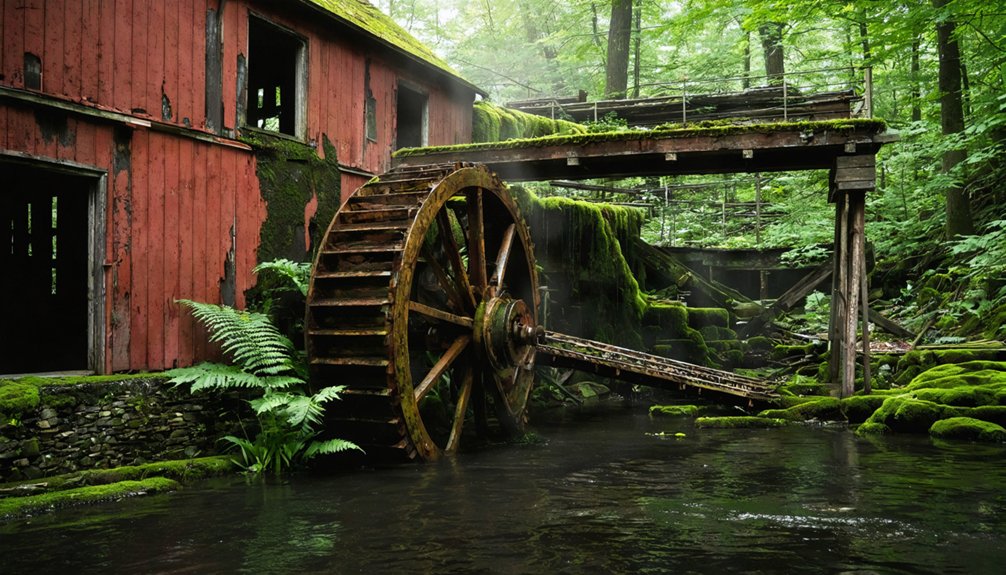
As timber mills fell silent across once-thriving towns, local communities have rallied to preserve their rich cultural heritage through museums, restored buildings, and documented oral histories.
You’ll find purpose-built museums like the Southern Forest Heritage Museum in Louisiana maintaining authentic sawmill machinery and structures that tell the story of early 20th-century operations. These cultural preservation efforts connect you with the immigrant laborers and families who shaped regional identities.
When you explore these communities today, you’ll notice the challenges they face: wooden structures succumbing to fire and decay, funding shortages, and documentation gaps where towns disappeared before their stories could be recorded.
Despite these obstacles, heritage education programs and festivals keep mill town legacies alive, allowing you to experience the economic and social foundations that built America’s timber regions.
Beyond the Sawdust: Attempts at Revitalization and Reinvention
Despite decades of economic decline, former timber mill towns across America have begun remarkable journeys of reinvention through adaptive reuse and economic diversification.
You’ll find communities transforming abandoned sawmills into vibrant mixed-use developments that honor their industrial heritage while meeting modern needs.
The most successful revitalization efforts share key elements:
- Community engagement that brings together residents, developers, and local officials to create shared visions addressing affordable housing and minority business support.
- Adaptive reuse of distinctive mill architecture, preserving brick facades and timber frames while reimagining interior spaces.
- Economic reinvention through emerging industries like mass timber manufacturing that reconnect towns to their forestry resources.
These transformations aren’t just about buildings—they’re about reclaiming community identity while creating sustainable futures that respect both heritage and innovation.
Frequently Asked Questions
What Happened to Native American Communities When Timber Towns Expanded?
Like victims of a callous march, you’d witness your people suffer Cultural Displacement as timber towns expanded. Your communities faced forced removal, resource loss, and violation of Land Rights, decimating traditional economies and spiritual connections.
How Did Women’s Roles Evolve in Timber Mill Communities?
You’ll find women’s labor expanded beyond domestic spheres into mill operations during labor shortages, while they simultaneously developed essential community leadership roles organizing childcare, strikes, and mutual aid networks.
What Environmental Restoration Efforts Succeeded in Former Logging Areas?
You’ve witnessed remarkable reforestation projects and wildlife conservation efforts transform former logging areas through native species plantings, invasive species removal, and community-driven management that increased biodiversity by up to 84% while rebuilding sustainable local economies.
How Did Timber Town Educational Systems Compare to Urban Schools?
Your timber town schools achieved higher graduation rates than urban counterparts, despite fewer resources. You’ll find rural education offered smaller classes but limited advanced coursework, while facing persistent challenges in college enrollment and resource allocation.
What Religious Institutions Thrived in Timber Communities?
In your timber towns, Methodist and Presbyterian denominations dominated through strategic church growth and community outreach. They utilized railroads for expansion while timber-framed buildings served both religious needs and cultural identity markers in your communities.
References
- https://nvtami.com/2024/11/07/bodies-mono-mills/
- https://scottprudham.org/wp-content/uploads/2017/01/Timber-and-Town.pdf
- https://www.richmondfed.org/publications/research/econ_focus/2023/q3_economic_history
- https://en.wikipedia.org/wiki/History_of_the_lumber_industry_in_the_United_States
- https://wou.edu/history/files/2015/08/Ron-Vorderstrasse.pdf
- https://nbc16.com/news/local/oakridge-then-and-now-we-dont-live-in-an-industrial-age-anymore-its-just-the-facts
- https://www.dnr.state.mn.us/forestry/history/sawmills.html
- https://www.engr.psu.edu/mtah/articles/colonial_wood_water.htm
- https://mff.forest.mtu.edu/TreeBasics/History/LogEra.htm
- https://historictoxaway.org/logging-1900-1920/