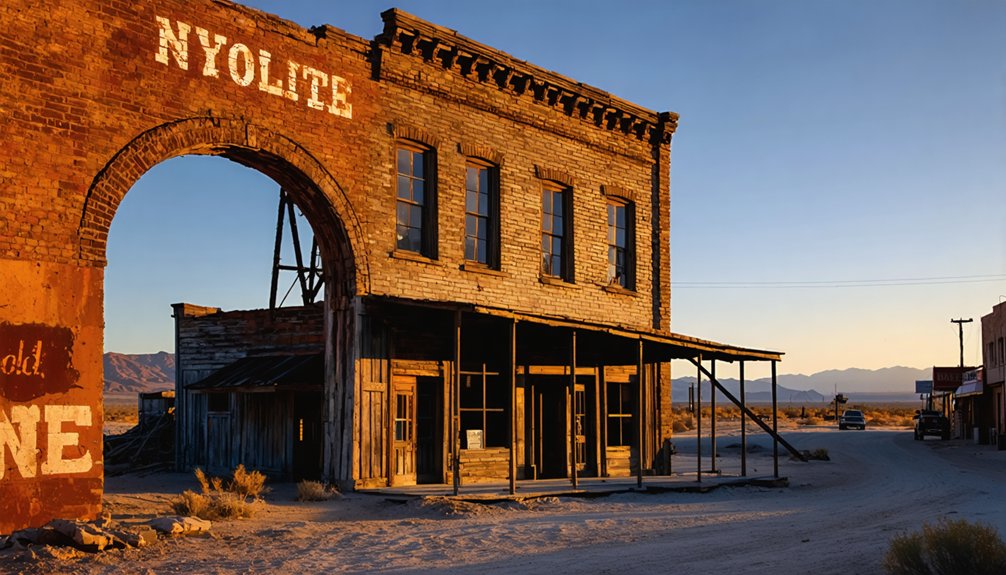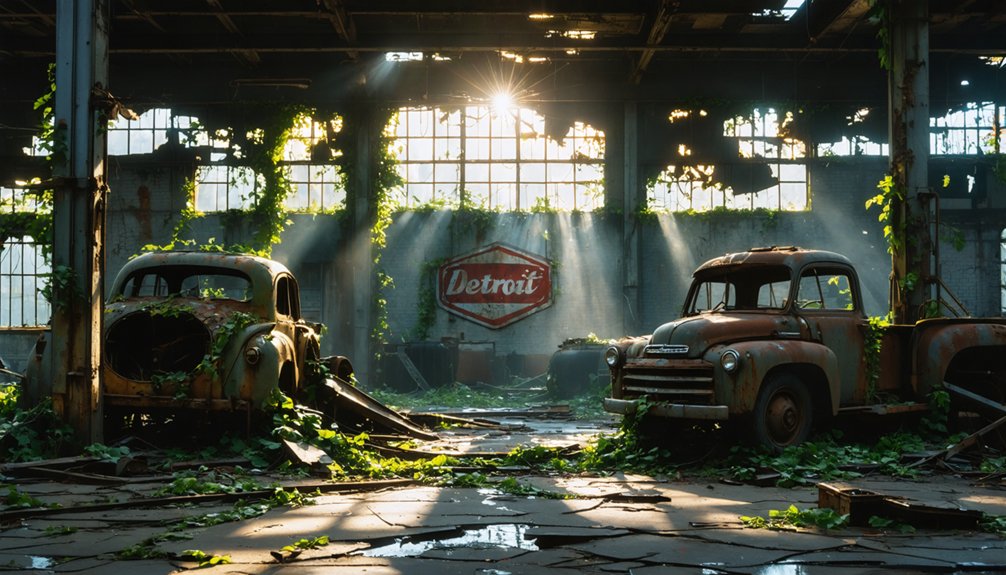
American industrial settlements collapsed due to economic globalization, automation, and improved transportation after World War I. You’ll find abandoned factories, contaminated sites, and diminished populations in former company towns across the Rust Belt. These communities lost 40-60% of residents as manufacturing jobs plummeted from 26% to 8.5% of employment between 1970-2019. Many sites now struggle between decay and preservation, while some transform into heritage tourism destinations through innovative partnerships and remediation approaches.
Key Takeaways
- Economic forces including globalization, automation, and trade policies led to mass manufacturing job losses exceeding 5 million since the 1970s.
- Physical decay manifested in abandoned factories with chemical contamination, collapsing structures, and nature reclaiming industrial spaces.
- Population exodus began with young workers leaving, causing tax base erosion and creating aging populations with reduced public services.
- Communities experienced generational trauma with 31% higher anxiety and depression rates, affecting financial stability and childhood development.
- Some settlements found new purpose through heritage tourism, adaptive reuse projects, and public-private partnerships supporting historic preservation.
The Rise and Fall of Company Towns in Industrial America
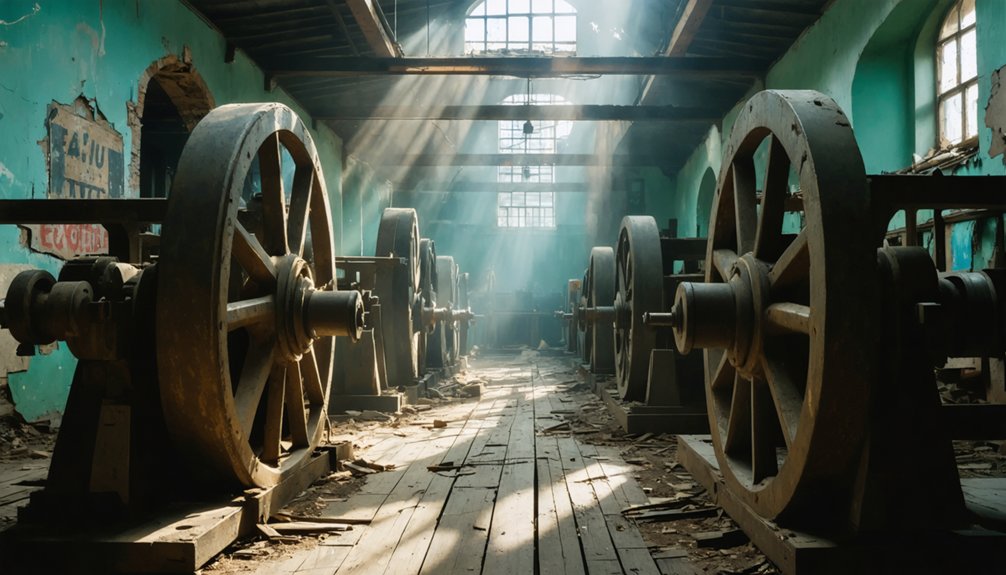
While America’s industrial landscape was still taking shape in the late 19th century, company towns emerged as a solution to the practical challenges of industrialization in remote locations. You’d find these settlements springing up around coal mines, lumber operations, and railroad junctions where existing infrastructure couldn’t support industrial development.
Company town dynamics typically involved a trade-off: you’d receive progressive amenities like indoor plumbing and recreational facilities, but at the cost of worker autonomy. Companies owned everything—your home, the store where you shopped, even the church you attended. Workers were often paid with company scrip instead of regular currency, forcing them to shop at inflated company stores.
This paternalistic control occasionally sparked major conflicts, like the 1894 Pullman Strike.
After World War I, these industrial settlements began declining as transportation improved, worker purchasing power increased, and New Deal labor laws strengthened employee rights, gradually freeing workers from company dependence. Approximately 2,000 company towns have existed throughout American history, ranging from harsh mining settlements to more idealized communities.
Economic Forces That Emptied America’s Factory Communities
Although America’s industrial might seemed unassailable in the mid-20th century, powerful economic forces have systematically emptied factory towns across the nation since the 1970s.
You’ve witnessed how trade policies facilitated the exodus of over 5 million manufacturing jobs and nearly 70,000 factories overseas, with China alone accounting for 3.7 million displaced American jobs between 2001-2018.
Economic globalization created a perfect storm as companies relocated to low-wage countries while currency manipulation undermined domestic competitiveness.
Meanwhile, automation effects transformed production floors, requiring fewer workers with different skills. The labor market shifted dramatically as unions weakened, allowing companies to accelerate technological adoption without protecting workforce stability.
The consequences were devastating: unemployment rates exceeding 25% in places like Flint and Youngstown, collapsing tax bases, deteriorating public services, and communities trapped in seemingly irreversible decline. Manufacturing employment in the U.S. has dramatically decreased from 26% in 1970 to just 8.5% in 2019. This trend represents a new phase of deindustrialization affecting not just manufacturing but increasingly white-collar and service sector jobs as well.
What Remains: Physical Artifacts of Abandoned Industrial Settlements
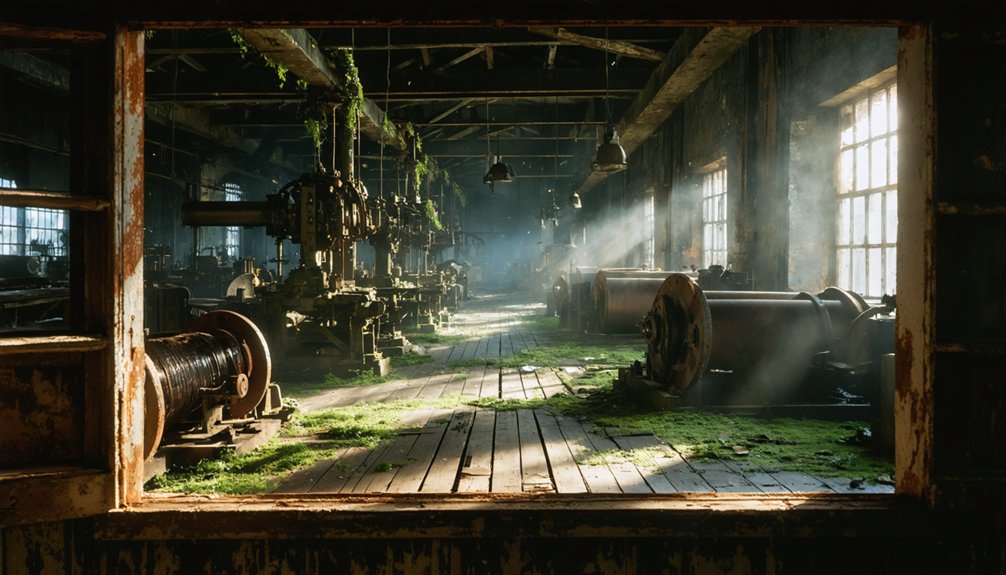
The physical remnants of America’s industrial past dot the landscape like tombstones of a bygone era.
You’ll find massive complexes like Detroit’s Fisher Body Plant and Buick City sitting vacant for decades, their cleanup stalled by chemical groundwater contamination. These contaminated sites, like Buick City with its high chemical readings in groundwater, have hindered sales and redevelopment efforts for over two decades.
These industrial remnants tell decay narratives through rusted machinery, collapsing floors, and iconic artifacts like the giant Dixie Cup atop an abandoned beverage plant.
Nature aggressively reclaims these spaces—vegetation breaks through concrete foundations, accelerating structural deterioration. Many abandoned textile mills stand as brick monuments near rivers that once powered their operations, highlighting their historical dependence on water resources.
While some sites face slow demolition spanning decades, others like Pennsylvania’s Carrie Furnaces have been stabilized for public engagement.
What remains varies dramatically: from intact equipment layouts preserving manufacturing processes to mere skeletal structures and rubble fields, each revealing the complex aftermath of America’s industrial exodus.
The Human Cost: Demographic Shifts in Post-Industrial Regions
If you’ve ever witnessed an industrial town’s collapse, you’ll recognize the signature population exodus that follows—young workers flee first for economic opportunity, leaving behind aging populations and shrinking communities.
This demographic hollowing creates a cascade of challenges: tax base erosion, public service cuts, and housing market collapses that trap remaining residents in depreciating assets. Post-industrial regions often face economic strain from maintaining social services for a growing percentage of oldest old citizens, a demographic group expanding faster than the general elderly population. Many of these areas, particularly in the Rust Belt cities, experienced significant population loss as manufacturing jobs disappeared and residents moved to southern cities with better economic prospects.
The trauma of these shifts persists intergenerationally, as children inherit both the economic limitations and collective memory of prosperity lost—a psychological burden that shapes identity long after factories close.
Population Exodus Patterns
When industrial centers across America began their steep decline in the mid-20th century, they triggered population exodus patterns that would transform entire regions demographically, economically, and socially.
You’d witness this urban migration first in Detroit, Cleveland, and Pittsburgh, where manufacturing collapses sent populations plummeting by 40-60%. White flight accelerated this trend as residents fled to suburbs.
The exodus created stark economic disparities, with those left behind facing poverty rates nearly triple the national average. Cleveland’s population dramatically fell from 915,000 in 1950 to just 397,000 by 2006, demonstrating the severe population decline typical of Rust Belt cities.
This pattern repeated internationally in Eastern Europe after the Soviet collapse, where 20 million people emigrated amid economic turmoil. The industrial centers mirrored the same sub-replacement fertility patterns observed in other economically challenged regions worldwide.
The consequences are profound—aging populations strain remaining resources while younger workers seek opportunity elsewhere. As labor forces shrink, these once-thriving industrial zones face increasingly difficult paths to recovery.
Lingering Generational Trauma
Beyond the physical abandonment of America’s industrial centers lies an invisible legacy that shapes entire generations.
When you examine post-industrial communities today, you’re witnessing the psychological impact of economic collapse that continues to reverberate through families and neighborhoods. This generational trauma manifests in measurable ways: former industrial regions show 31% higher rates of anxiety and depression, with decreased conscientiousness affecting residents’ ability to plan and manage finances.
- Families in these areas experience 33% higher neuroticism scores, creating cycles of emotional instability.
- Childhood trauma rates have risen dramatically, linked to concentrated poverty and vanishing opportunities.
- Black communities that once relied on industrial jobs face compound trauma from economic and social marginalization.
- Systemic cuts to public programs since the 1970s have intensified financial stress and limited access to mental health support.
Preserving Industrial Heritage: Challenges and Opportunities
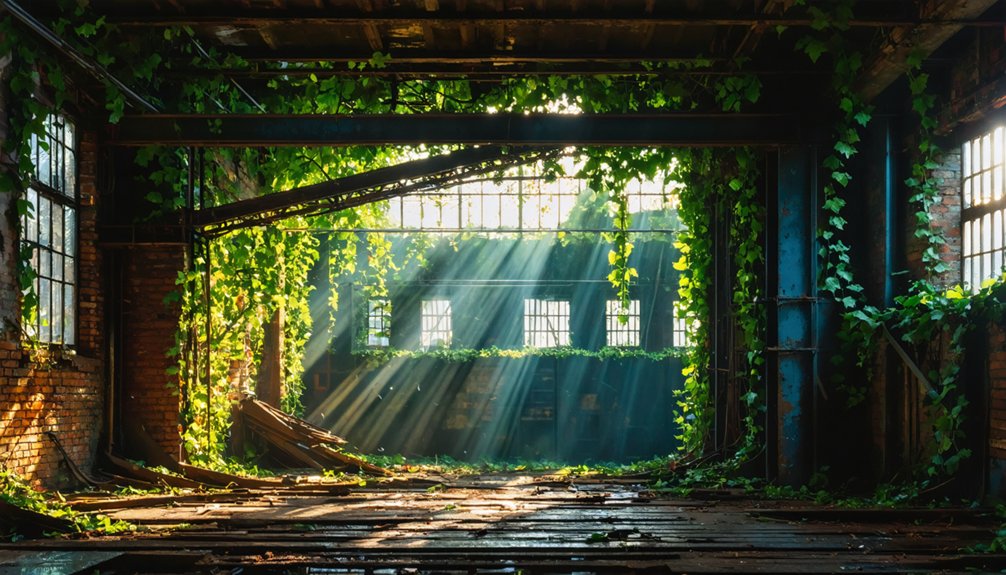
You’ll find industrial heritage preservation projects often stalled by funding shortfalls, where economic viability must compete with real estate speculation and land banking interests.
These financial constraints force difficult choices between complete restoration and partial conservation, particularly when contamination remediation costs can quickly deplete limited budgets.
Despite these challenges, industrial sites successfully transformed into heritage tourism destinations demonstrate potential economic benefits through increased visitation, cultural programming, and integration with regional tourism strategies.
Economic Preservation Barriers
Despite significant historical and cultural value, the preservation of America’s industrial heritage faces formidable economic barriers that threaten these sites’ very existence. Funding scarcity and policy inconsistencies have created a preservation crisis where sites like Carrie Furnaces require $75-100 million for basic stabilization—exceeding many national park budgets.
You’ll find these economic challenges compounded by environmental remediation costs that must precede any preservation efforts.
- Preservation costs typically exceed available resources, forcing gradual approaches rather than thorough restoration.
- Economic instability plagues industrial museums and public initiatives struggling to generate sustainable revenue.
- Structural challenges limit adaptive reuse options without significant modifications.
- Community engagement becomes difficult when industrial closures have already created economic and social distress.
These barriers create a troubling cycle where America’s industrial past faces incremental loss through neglect and demolition.
Heritage Tourism Potential
While America’s industrial settlements face significant preservation challenges, their potential as heritage tourism destinations offers a promising pathway for revitalization and cultural conservation.
You’ll find growing support through government initiatives like the Great American Outdoors Act, which allocates $1.3 billion annually through 2025 for historic site restoration. These funds help transform deteriorating factories into vibrant industrial tourism attractions.
The $128.66 billion heritage tourism market, growing at 4.2% annually, reflects Americans’ increasing desire for authentic heritage experiences. From Boeing factory tours to Kentucky’s Bourbon Trail, industrial tourism creates jobs and reverses urban decline in former manufacturing regions.
Tax incentives for adaptive reuse projects further enable these transformations.
Public-private partnerships are emerging as sustainable models for preserving these cultural assets while creating educational opportunities that connect younger generations with America’s industrial past.
From Ruins to Renewal: Modern Approaches to Industrial Landscapes
As industrial centers across America declined throughout the late twentieth century, they left behind complex landscapes of abandonment that presented both challenges and opportunities for renewal.
Today’s approach to these sites balances adaptive reuse with historical documentation, preserving industrial aesthetics while creating sustainable landscapes. You’ll find community engagement at the heart of successful transformations, where designers embrace creative design solutions that honor the past while serving present needs.
- Gas Works Park in Seattle pioneered industrial preservation by maintaining structures as historical markers
- UNESCO recognition has elevated industrial heritage sites, challenging designers to overcome negative perceptions
- Bioremediation and green infrastructure transform contaminated areas into ecologically vibrant spaces
- Preservation planning involves detailed documentation through advanced mapping techniques, balancing historical significance with new functionality
Frequently Asked Questions
What Role Did Labor Unions Play in Company Town Survival?
You faced company towns’ survival through labor negotiations that challenged exploitative practices and union strikes that demanded better living conditions, ultimately hastening their demise while improving worker rights until towns’ economic relevance faded.
The economic factors behind prairie town decline encompass a range of issues, from dwindling job opportunities to shifts in agricultural practices. As industries moved towards urban centers, many residents were left without essential services, further exacerbating the community’s struggles. A lack of investment in infrastructure only intensified the problems, leaving prairie towns vulnerable to economic shifts.
How Did Environmental Damage Affect Abandoned Industrial Settlements?
Over 80% of abandoned industrial sites face persistent contamination. You’ll find these areas plagued by soil toxins, water pollution, and air quality issues, creating costly urban decay that requires extensive environmental remediation before reclaiming freedom.
Where Are America’s Most Intact Abandoned Industrial Settlements Today?
You’ll find America’s most intact abandoned industrial settlements at Bodie (California), Henry River Mill Village (North Carolina), Berlin (Nevada), and Lonaconing’s Silk Mill (Maryland), preserved through historical preservation efforts and attracting urban exploration enthusiasts.
Did Company Towns Exist Outside Mining and Manufacturing Industries?
In summary, yes. Beyond mining and manufacturing, you’ve seen agricultural company towns spring up around farming operations and retail company towns develop where businesses like Hershey and Disney controlled entire communities.
How Have Artists Contributed to Preserving Industrial Settlement History?
Artists have preserved industrial settlement history through artistic murals depicting factory life, historical documentaries capturing workers’ experiences, and detailed paintings that chronicle the shift from agrarian to industrial communities you’d recognize today.
References
- https://socialwelfare.library.vcu.edu/organizations/labor/company-towns-1890s-to-1935/
- https://www.loveexploring.com/gallerylist/131658/abandoned-in-the-usa-92-places-left-to-rot
- https://www.midstory.org/urbexers-are-documenting-americas-post-industrial-past/
- https://historycollection.com/rust-and-ruin-12-industrial-landmarks-america-left-behind/
- https://www.youtube.com/watch?v=dSzyFAws9ts
- https://hiddencityphila.org/2015/03/surveying-the-damage-with-abandoned-america-the-age-of-consequences/
- https://www.atlasobscura.com/lists/industrial-wonders-united-states
- https://plantandmachinery.caboodleai.net/article/166865/20-forgotten-industrial-sites-in-the-u.s.-that-are-eerily-beautiful
- http://abandonedonline.net/industrial/
- https://www.smithsonianmag.com/travel/americas-company-towns-then-and-now-180956382/