Mining camps across the U.S. followed a predictable lifecycle from boom to abandonment. You’ll find these settlements initially sprouted around mineral discoveries, quickly transforming from makeshift encampments into organized towns with businesses and diverse populations. When ore deposits depleted, economic sustainability collapsed, often accelerated by industrial disasters. While many camps were completely abandoned, others have found new purpose through tourism and historical preservation efforts, offering glimpses into America’s frontier past.
Key Takeaways
- Resource depletion caused mining camps to become economically unsustainable as extraction costs exceeded mineral values.
- Environmental contamination from mining operations rendered many camps uninhabitable long after resources were depleted.
- Catastrophic disasters like explosions and structural failures triggered mass exodus and community abandonment.
- Some mining camps transformed into ghost town tourist destinations, maintained in “arrested decay” as heritage sites.
- Mining communities without economic diversification were particularly vulnerable to becoming ghost towns after mine closures.
The Birth of America’s Mining Boomtowns
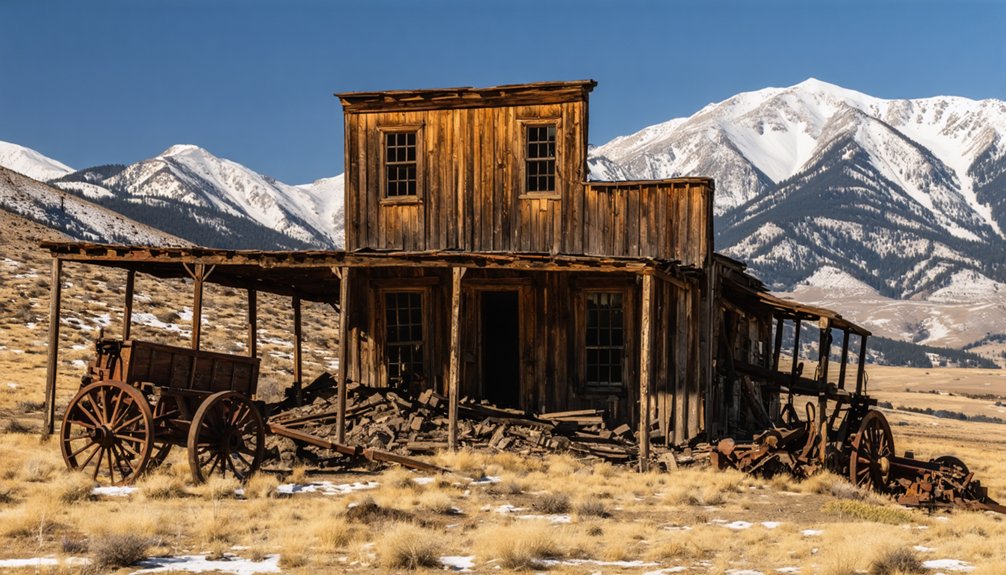
When the first glints of gold were discovered in California in 1848, few could have predicted the transformative wave of migration and development that would sweep across America.
This watershed moment triggered one of the nation’s greatest migrations, as prospectors rushed westward to stake their claims. What began as makeshift tent settlements quickly evolved into vibrant towns with wooden structures housing essential services.
The evolution of mining techniques paralleled this growth, shifting from simple surface panning to sophisticated underground extraction requiring specialized skills. The Comstock Lode discovery in Nevada in 1859 generated significant wealth and further fueled western expansion.
As simple pans gave way to complex shafts, the craft of mining evolved from amateur pursuit to industrial enterprise.
The community dynamics of these settlements were initially male-dominated and transient, but many evolved into stable towns with families and diversified economies. San Francisco exemplifies this transformation, as its non-native population soared to 100,000 by 1849 during the California Gold Rush.
As discoveries spread to Nevada, Colorado, and Montana, each boomtown followed a similar pattern: prospectors staked claims, investors purchased them, and mining companies established operations that would reshape the American West.
From Tent Camps to Thriving Communities
The journey from raw wilderness to organized settlement unfolded rapidly in America’s mining regions, transforming the landscape both physically and socially.
You’d witness tent changes occurring within months as canvas dwellings gave way to wooden structures—stores, hotels, and post offices materializing where only stakes and ropes had stood before.
Community evolution accelerated when mining companies established control, building housing and infrastructure that attracted families.
Women arriving in these previously male-dominated spaces catalyzed demands for schools, churches, and civic institutions. The demographic shift from transient workers to settled households fundamentally altered these towns’ character.
Railroad connections and industrial development supported this growth, turning isolated outposts into regional hubs.
What began as sparse tent camps evolved into organized communities with distinct neighborhoods, reflecting the ethnic diversity of workers who made these mining towns their home.
Many workers faced financial hardship due to exorbitant costs at company stores that maintained monopolies and often paid employees in scrip rather than cash.
These settlements were often characterized by squalid living conditions where company influence dominated social life and restricted workers’ freedoms.
When the Mines Ran Dry: Patterns of Decline
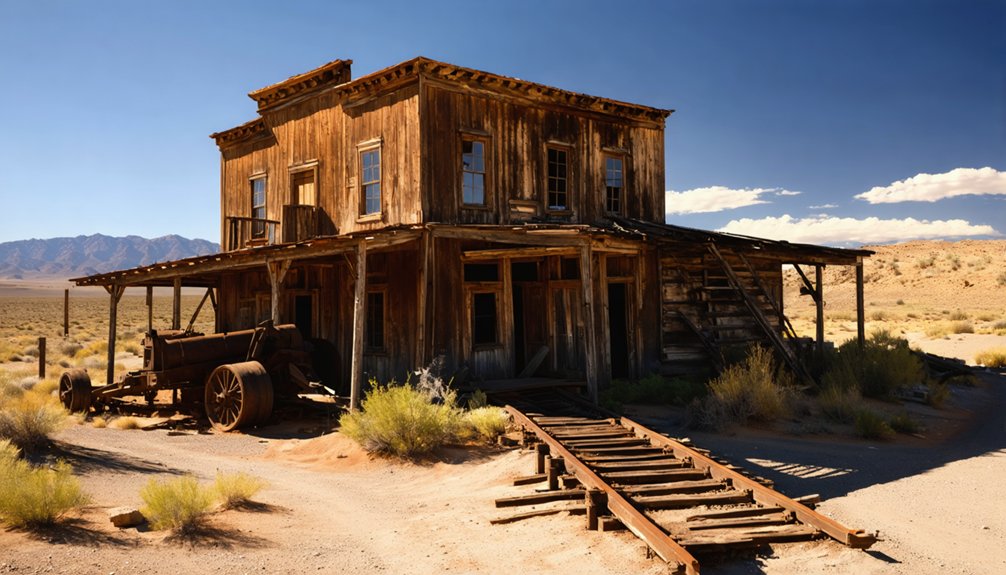
When examining why mining camps faded, you’ll find that ore depletion created fundamental economic unsustainability as extraction costs exceeded mineral values.
You’ll notice catastrophic industrial disasters, from mine collapses to explosions, accelerated abandonment by destroying infrastructure and diminishing investor confidence.
Environmental challenges including tailings pollution, unstable ground, and depleted water sources often rendered these settlements increasingly uninhabitable long after mining operations ceased.
The widespread mechanization of mining that reduced the need for manual labor contributed significantly to the decline of company-controlled communities as fewer workers were required to maintain production levels.
In West Virginia, the mine death rate remained the highest in the country between 1890 and 1912, prompting many miners and their families to eventually abandon these dangerous mining communities for safer opportunities elsewhere.
Ore Depletion Economics
Mining communities across the United States have experienced dramatic economic downturns as ore deposits eventually reached depletion, creating a predictable yet devastating pattern of decline.
You’ll find these regions trapped in economic stagnation with unemployment rates 2-3 times higher than state averages.
When the mines closed, you’d witness per capita income growth lag approximately 25% behind non-mining counties. Similar to Appalachia, these communities remain trapped in a cycle of poverty due to historical corporate practices. The data reveals a stark reality: mining-dependent communities that once flourished now face persistent poverty, population decline, and limited opportunities. Recent analysis shows over half of former coal towns report zero production by 2024, indicating complete abandonment of once-thriving operations.
Unlike areas that diversified, single-resource communities became vulnerable “ghost towns.”
The ore depletion cycle creates long-term economic impacts that ripple through generations. Counties with high mining employment consistently show lower entrepreneurship rates and fewer pathways to economic mobility, a reflection of how extraction-based economies create wealth that ultimately leaves the region.
Catastrophic Industrial Disasters
Throughout America’s mining history, catastrophic industrial disasters frequently accelerated the decline of once-thriving camps, creating sudden economic shocks that communities couldn’t absorb. When disasters struck—explosions, cave-ins, or floods—surviving workers often abandoned these dangerous sites permanently, hastening community collapse before safety regulations could improve conditions.
These catastrophic events typically triggered:
- Mass exodus of workers and families, depleting the camp’s economic foundation
- Prolonged mine closures during disaster recovery efforts, severing income streams
- Government inquiries that eventually led to stricter regulations, but too late for many camps
The lack of modern safety protocols in early mining eras meant disasters occurred with devastating frequency. The industry’s dramatic employment decline from 863,000 miners in 1923 to just 69,000 by 2023 reflects both improved mining efficiency and the permanent abandonment of numerous mining camps after disasters. Despite recent executive orders designating coal as a critical mineral, the declining production numbers show that many historic mining regions continue to face significant economic challenges.
You’ll find this pattern repeated across America’s mining landscape, where catastrophic events often served as the final blow to camps already struggling with depleting resources.
Environmental Habitability Challenges
Unlike the sudden, catastrophic disasters that struck many mining operations, environmental degradation became a silent, insidious force that ultimately rendered numerous mining camps uninhabitable long after the ore ran dry.
You’ll find the pollution effects remain visible today—40% of U.S. rivers and 50% of lakes contaminated by abandoned mines. Water contamination persists as acid drainage leaches toxic metals into watersheds, causing biodiversity decline and habitat loss.
Communities faced displacement as health impacts mounted; Oklahoma’s Tar Creek residents suffered elevated lead levels in children’s blood, causing nerve damage.
Soil degradation continues decades later, with some sites remaining barren after 35 years. Ecosystem restoration proves challenging when topsoil has vanished and heavy metals poison the substrate.
The legacy of mining persists in these ghost towns, where nature struggles to reclaim what industry destroyed.
Catastrophic Events That Emptied Mining Towns
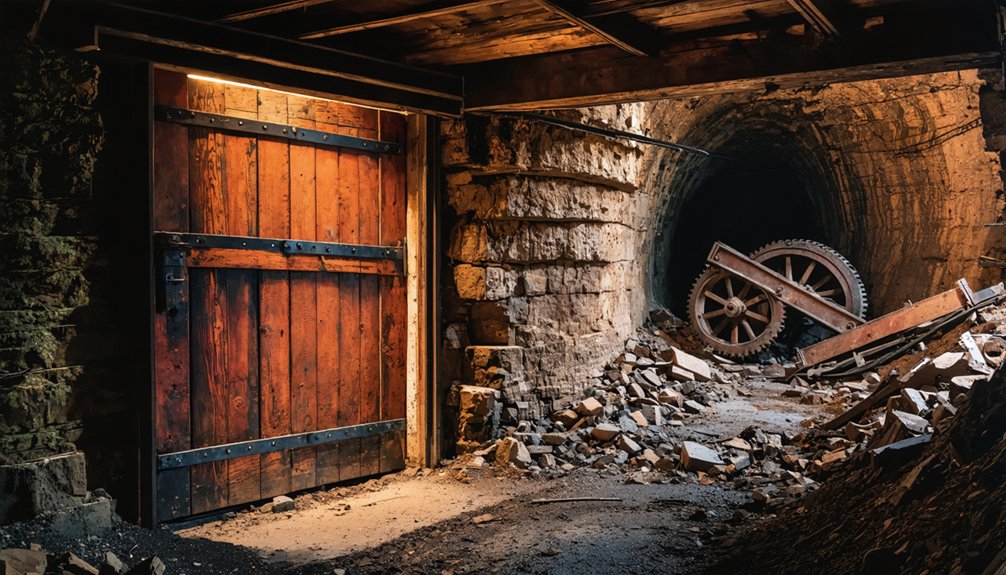
While numerous mining towns gradually faded as resources depleted, many communities met more sudden and tragic ends through catastrophic disasters that claimed dozens or even hundreds of lives at once.
These devastating mining accidents often occurred despite minimal safety regulations, leaving entire camps abandoned as survivors fled the traumatic memories.
Consider these catastrophic events that emptied mining towns:
- Explosive disasters like the 1907 Monongah tragedy that killed at least 362 miners, devastating the community beyond recovery
- Underground fires that produced deadly afterdamp, such as the 1917 Speculator Mine disaster where 168 miners suffocated
- Structural failures including dam collapses like the 1972 Buffalo Creek Flood that killed 125 people and destroyed over 500 structures
These sudden tragedies often permanently wiped communities from the map, leaving only ghostly remnants behind.
Ghost Towns: What Remains Today
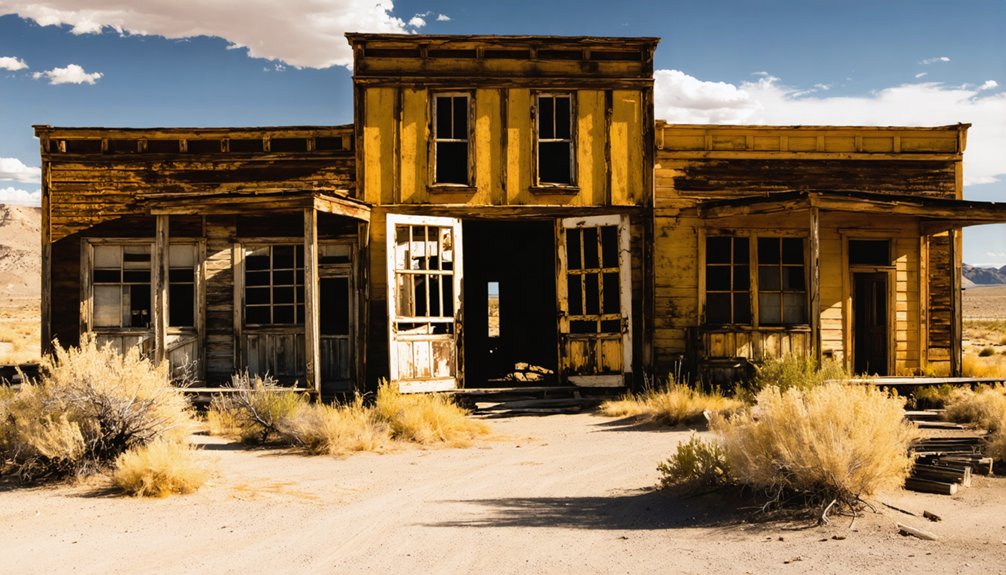
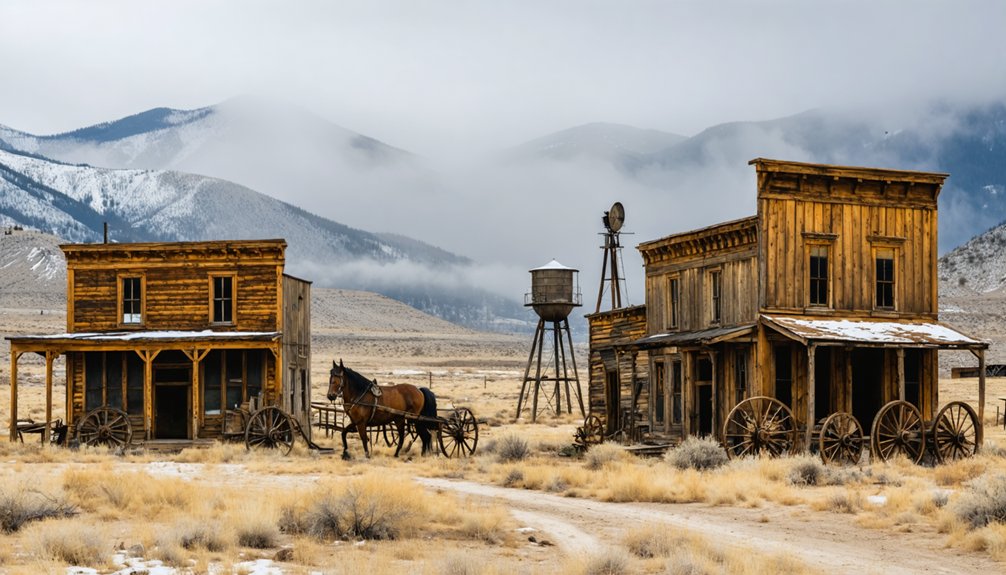
Walking through America’s abandoned mining towns today, you’ll encounter a striking contrast between meticulously preserved sites like Bodie, California—maintained in “arrested decay” with dishes and books exactly as they were left—and places like Picher, Oklahoma, where buildings sag beneath orange X’s marking condemned structures.
Tourism has transformed some ghost towns into heritage destinations, with Bodie receiving thousands of visitors annually and St. Elmo offering guided explorations of its picturesque setting.
The ongoing tension between preservation and natural reclamation shapes these historical landscapes, as vegetation steadily reclaims streets while museums and restored storefronts work to protect mining artifacts and tell the stories of boom-and-bust communities.
Physical Remains and Structures
As you explore the lonely remnants of America’s forgotten mining camps, the physical structures and artifacts tell a compelling story of boom-and-bust economies that once thrived in remote landscapes.
Abandoned structures reveal technological innovation and daily life, with foundations of mills, headframes, and administrative buildings often still visible against rugged backdrops.
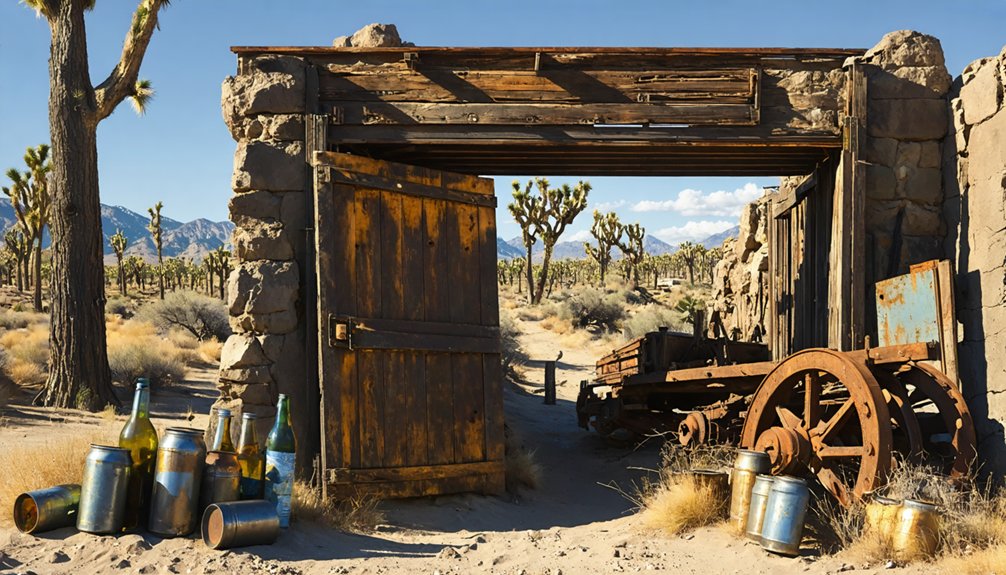
The most common mining artifacts you’ll encounter include:
- Mill remnants featuring concrete engine pads, leaching vats, and furnace ruins
- Transportation elements like rail segments, ore cart chassis, and wooden tramways
- Industrial tools such as galvanized buckets, shovel heads, and ventilation equipment
These physical remains are more than mere curiosities—they’re archaeological treasures that document America’s industrial heritage.
Waste rock deposits and tailings piles further mark these landscapes, creating distinctive topographical features that persist long after the last miner departed.
Tourism and Exploration
Once thriving centers of industry and community life, America’s abandoned mining camps have transformed into haunting attractions that draw thousands of visitors annually.
You’ll find iconic destinations like Bodie, California and Rhyolite, Nevada offering glimpses into authentic frontier life through preserved buildings and artifacts.
Ghost town tourism presents unique exploration challenges. Most sites offer limited amenities and seasonal accessibility, with some locations completely inaccessible during winter months.
In addition to ghost town tourism, ghost tours in New Orleans provide a captivating glimpse into the city’s haunted history. These tours often blend storytelling with local folklore, allowing visitors to explore the eerie streets and historic locations under the moonlight. As a result, participants can experience both the thrill of the paranormal and the rich cultural heritage that New Orleans has to offer.
While you can experience these historical treasures through self-guided exploration or structured tours, their remote locations and deteriorating conditions demand preparation.
Despite their historical significance, these sites generate minimal revenue for surrounding communities.
Local economies struggle to capitalize on visitor interest without proper infrastructure investment, creating a tension between preservation needs and economic sustainability.
Preservation Versus Decay
Beyond their tourist appeal, America’s ghost towns confront a fundamental tension between preservation and natural decay. The fate of these historic mining camps hinges on resource allocation, community engagement, and environmental realities.
Sites like Bodie State Historic Park maintain authenticity, while others like Oregon Caves Chateau remain closed due to costly structural needs.
Three key factors determining a ghost town’s survival:
- Financial support – preservation requires substantial funding often unavailable in economically depressed regions
- Environmental hazards – abandoned mines present dangers from toxic contamination to unstable ground
- Local advocacy – grassroots efforts often determine whether sites receive protection or succumb to vandalism
You’ll find the balance between safety concerns and historical conservation creates difficult choices for communities trying to preserve their mining heritage while addressing practical limitations.
Environmental Legacy and Toxic Aftermaths
The environmental devastation left by abandoned mining camps represents one of America’s most enduring toxic legacies. As you travel across America’s landscape, you’ll encounter the invisible threats where these ghost towns once thrived—40% of U.S. rivers and 50% of lakes contaminated by acid mine drainage and heavy metals like lead, arsenic, and mercury.
These toxic legacies continue releasing poisons decades after operations ceased. When rain falls on abandoned tailings, contaminants leach into groundwater and nearby streams, causing massive fish kills and ecosystem collapse.
The environmental degradation extends beyond water, with barren landscapes where topsoil was stripped away and contaminated soil prevents regrowth. Communities near these sites face generational health consequences including elevated blood lead levels, increased cancer risks, and kidney disease—the price paid for America’s mineral wealth.
The Immigrant Experience in Mining Communities
While the environmental scars of abandoned mining camps persist in America’s landscape, human stories of struggle and resilience shaped these same communities. Immigrant laborers faced systemic exploitation through contract labor systems that prioritized production over safety while enduring ethnic hierarchies that relegated them to the most dangerous, lowest-paying positions.
Despite these immigrant struggles, communities developed remarkable resilience through:
- Mutual benefit societies that provided essential financial safety nets when accidents or deaths occurred
- Religious institutions serving as cultural anchors and community gathering spaces
- Ethnic businesses and newspapers that maintained cultural connections while meeting practical needs
This stark contrast between exploitation and community-building reflects how mining camps functioned as both sites of oppression and solidarity, where immigrants created support systems while steering through discrimination’s harsh realities.
Preserving Mining History for Future Generations
Preserving America’s mining heritage requires coordinated efforts between government agencies, historical societies, and local communities to guarantee these vanishing landscapes aren’t permanently lost to time.
The National Register of Historic Places has established essential criteria for evaluating mining properties, while cultural resource management practices document everything from prehistoric quarries to 20th-century operations.
You’ll find innovative historic mining preservation techniques that balance environmental concerns with heritage protection. Mine sealing programs developed in Pennsylvania during the 1930s mitigated acid mine drainage while preserving underground structures.
At sites like California’s Malakoff Diggings, you can explore hydraulic mining remnants that tell stories of technological evolution and environmental impact.
These preservation efforts assure future generations can experience firsthand the authentic mining camps that helped build America, complete with their physical artifacts, landscapes, and cultural significance.
Frequently Asked Questions
Can You Legally Salvage Items From Abandoned Mining Camps?
No, you don’t have salvage rights to abandoned mining camp items. Legal implications include criminal charges under ARPA and state laws unless you’ve obtained specific permits from landowners or managing agencies.
Were Women and Children Common in Early Mining Communities?
In a world of endless male faces, you’d rarely find women and children in early mining camps. Family dynamics evolved slowly as communities stabilized, with gender roles defining women’s contributions through cooking, laundering, and boarding houses.
How Did Mining Camps Handle Law Enforcement and Crime?
You’d find mining camps created their own justice systems through camp regulations and community-enforced crime prevention. From miners’ courts to vigilante committees, these self-governing communities maintained order without formal government intervention.
What Happened to Mining Camp Cemeteries After Abandonment?
Like forgotten sentinels of the past, you’ll find mining camp cemeteries succumbed to physical deterioration, lost historical records, and environmental threats. Some found salvation through community restoration efforts preserving their historical significance despite development pressures.
Did Any Indigenous Communities Participate in American Mining Booms?
Yes, Indigenous peoples worked in mines despite abrogation of their treaty rights. You’ll find Navajo uranium miners and other tribal workers participated, though often without mining rights or fair compensation.
References
- https://hobblecreek.us/blog/entry/mining-towns-of-the-old-west
- https://albiongould.com/ghost-towns-to-visit-in-the-states/
- https://en.wikipedia.org/wiki/Ghost_town
- https://www.businessinsider.com/life-in-these-american-towns-before-abandoned-2019-5
- https://westernmininghistory.com/map/
- https://savingplaces.org/stories/explore-wild-west-mining-history-in-nevada-ghost-towns
- https://www.blackhillsbadlands.com/blog/post/old-west-legends-mines-ghost-towns-route-reimagined/
- https://www.loveexploring.com/gallerylist/67994/americas-eeriest-gold-rush-ghost-towns
- https://www.youtube.com/watch?v=gdnGoH9Xb74
- https://www.michigan.org/article/three-abandoned-mining-towns