Uninhabited frontier outposts typically followed predictable paths after abandonment. You’ll find these structures succumbed to natural decay from weather and time, with outer defenses crumbling first before core systems failed. Military withdrawals occurred as railroads expanded and strategic needs shifted. Some sites were dismantled, while others were repurposed for civilian use or reclaimed by indigenous populations. These abandoned outposts now serve as archaeological treasures where complex frontier histories continue to unfold.
Key Takeaways
- Abandoned frontier outposts deteriorate through natural forces like weather, with outer defenses crumbling first followed by core systems.
- Military withdrawal occurred following railroad expansion, reduced threats from Native tribes, and strategic consolidation to larger installations.
- Wildlife and vegetation reclaim abandoned spaces, with plants establishing territories and animals inhabiting the ruins.
- Many outposts were dismantled for materials, left to decay naturally, or repurposed for civilian use as communities adapted.
- These sites now serve as archaeological resources revealing insights into frontier life while representing contested historical narratives.
Abandonment: Natural Decay and the Elements
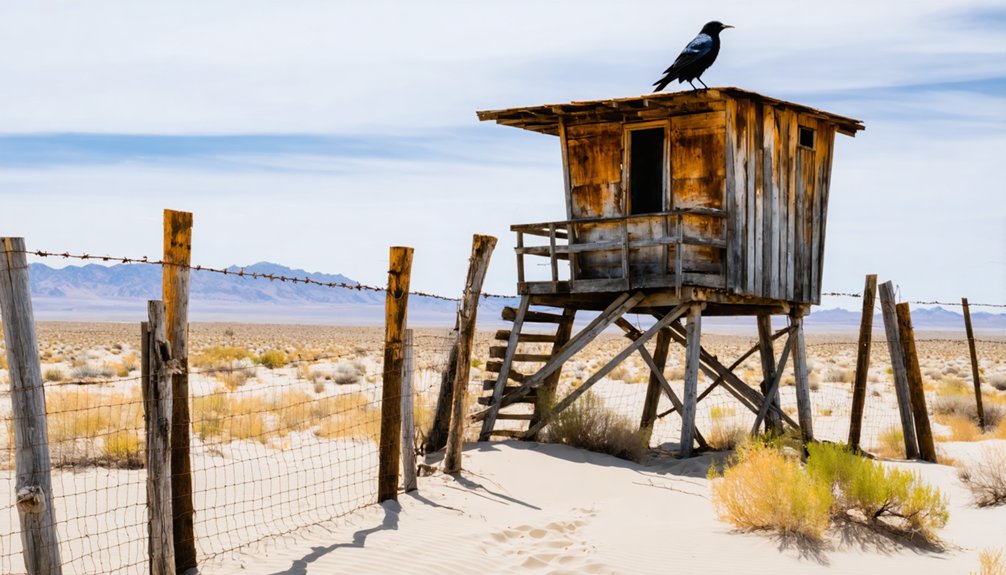
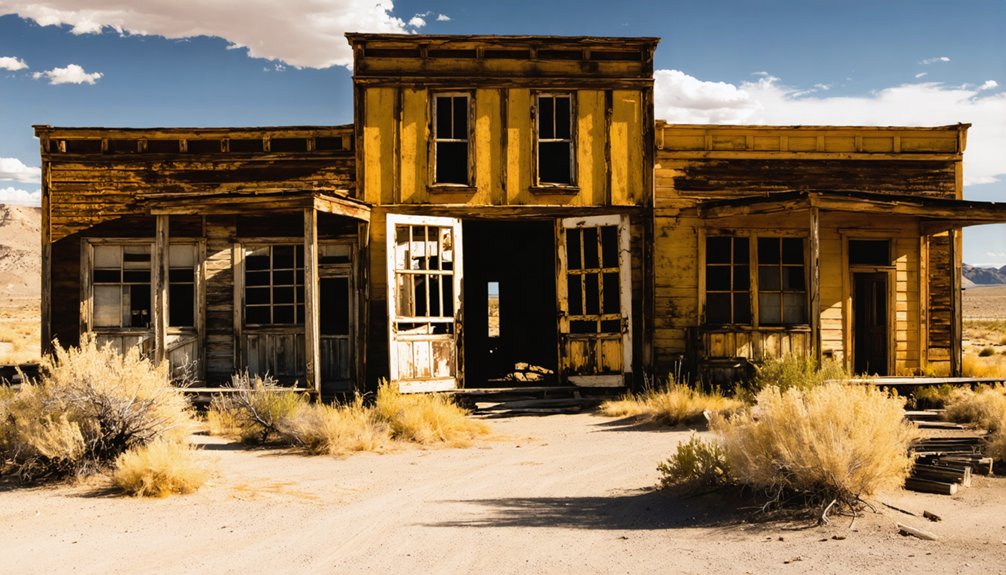
As abandoned frontier outposts stand exposed to the relentless assault of natural elements, they undergo a predictable yet fascinating process of structural deterioration.
You’ll notice how wind and rain gradually erode these once-fortified positions, while extreme temperature fluctuations accelerate the decay of even the most resilient materials.
The structural integrity of these frontier monuments fails systematically—first the outer defenses, then core systems.
As defenses crumble and foundations yield, nature’s siege claims each outpost through methodical structural surrender.
Freeze-thaw cycles crack concrete foundations, while UV radiation degrades synthetic components.
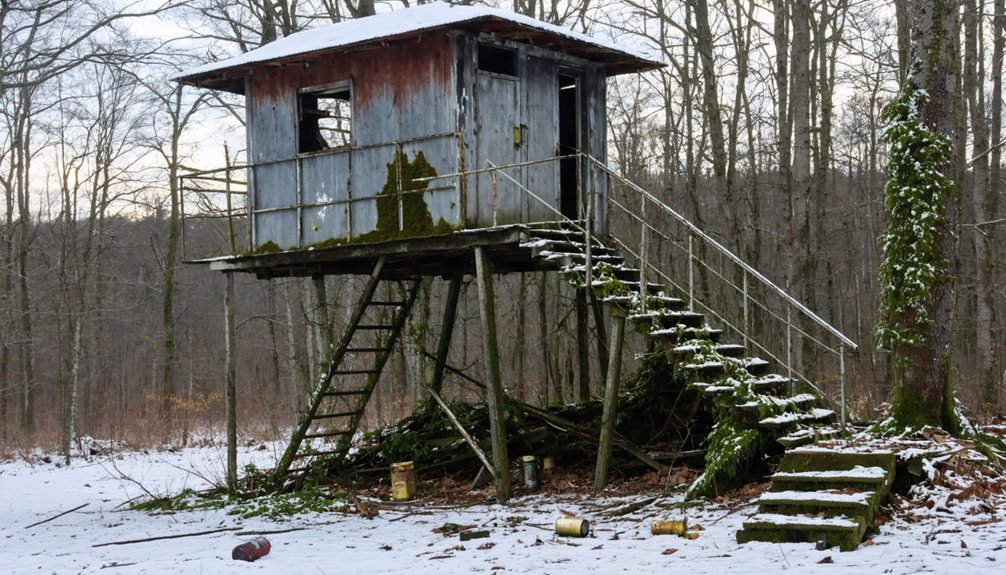
Without human intervention, wildlife reclaims these spaces; plants thrust roots through floors, and animals establish territories within crumbling walls.
Metal components rust and warp under seasonal pressures, particularly in coastal locations where salt intensifies corrosion. Without JavaScript enabled, many digital archives documenting these abandoned outposts remain inaccessible to modern researchers.
What you’re witnessing isn’t simply decay, but nature’s methodical reclamation of human outposts at the edge of civilization.
The unnamed abandoned outpost on Yela moon showcases this environmental degradation process approximately 24.2 km from the Talarine Divide Aid Shelter.
Military Withdrawal and Strategic Shifts
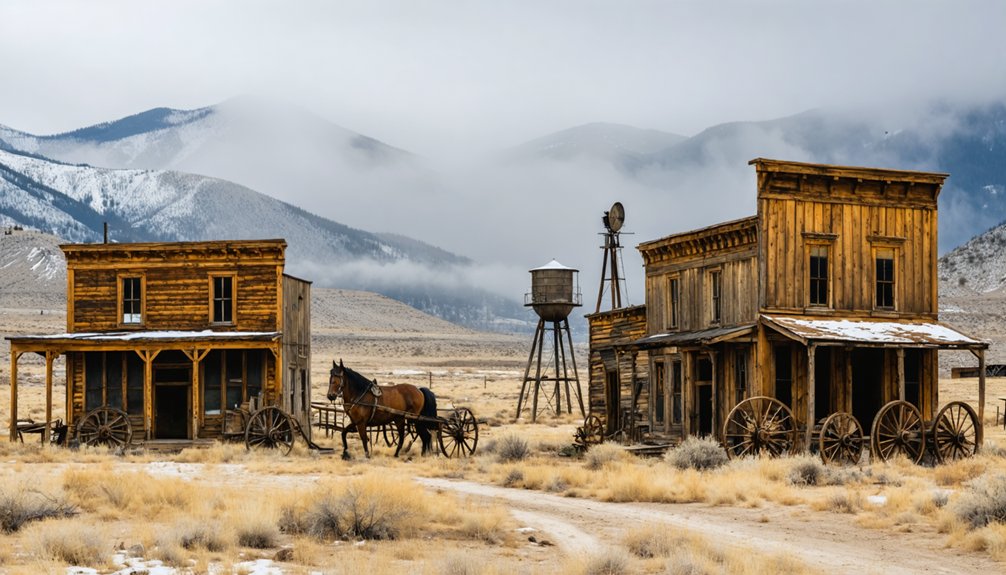
Military abandonment of frontier outposts often followed the establishment of reservation systems that reduced perceived threats from Native American tribes, rendering many forts strategically irrelevant in pacified territories.
You’ll notice a significant shift in the 1870s-1880s when railroad expansion transformed military logistics, allowing for rapid troop deployments that eliminated the need for numerous isolated garrisons.
This transportation revolution prompted army planners to consolidate forces at fewer, larger installations along rail corridors, leaving dozens of once-critical frontier outposts to deteriorate as their military purpose vanished. As the westward expansion of settlement progressed, many older forts were abandoned or consolidated, mirroring the pattern seen in 1852 with Fort Gates and Fort Lincoln. The post-Civil War reduction in Army strength from 57,000 to 26,000 soldiers by 1898 further accelerated the closure of remote outposts that could no longer be adequately staffed.
Abandonment After Pacification
Once frontier regions achieve sufficient stability, the strategic imperative for maintaining outposts dramatically diminishes, triggering systematic withdrawal processes that fundamentally alter local power dynamics.
You’ll find that as military forces depart, these installations face three common fates: dismantlement, abandonment, or repurposing for civilian use.
The cultural significance of these outposts often persists long after soldiers leave, manifesting in local memories and sometimes preservation as historical sites.
You’ll notice that without maintenance, physical deterioration quickly follows abandonment, while surrounding communities must adapt to new security realities and economic conditions. Following the U.S. implementation of Vietnamization policy, numerous military installations across South Vietnam were transferred to local forces who often lacked resources to maintain them effectively.
This shift frequently creates temporary power vacuums where insurgent forces may attempt reassertion of control.
The process represents more than physical withdrawal—it’s a profound recalibration of territorial relationships as indigenous populations reclaim spaces once dominated by military presence.
Many frontier outposts established by the U.S. Army were originally staffed by small units of 50-200 soldiers strategically positioned across the vast western territories to maintain control.
Railroad Era Consolidation
The arrival of transcontinental railroad networks fundamentally reshaped America’s frontier defense strategy in the post-Civil War era, rendering the previous constellation of scattered outposts increasingly obsolete.
You’ll notice this railroad expansion triggered strategic consolidation of military assets rather than widespread abandonment. As rail lines advanced westward, military logistics evolved from relying on numerous isolated forts to fewer, larger installations with rail connections.
Forts like Quitman (1882), Stockton (1886), and Davis (1891) closed as their functions became redundant. In Oklahoma Territory, several military posts like Fort Washita were abandoned as the concept of a permanent Indian frontier eroded. The military redeployed forces to protect economic corridors rather than dispersed settlements, allowing civilian governance to replace military authority.
This shift coincided with the conclusion of the Indian Wars, transforming remaining installations from defensive outposts to training centers and transportation hubs. Fort Bliss exemplifies this evolution, adapting from frontier garrison to modern military complex.
Ghost Outposts: Archaeological Treasures of the Frontier
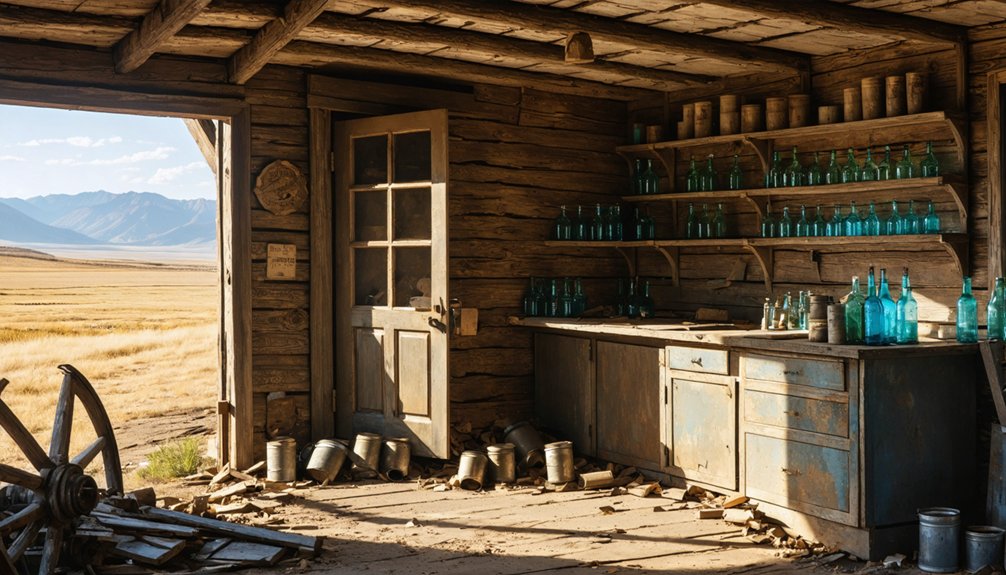
Scattered across remote landscapes and forgotten territories, ghost outposts represent some of archaeology’s most valuable research sites, offering unparalleled windows into frontier life through their abandoned structures and artifact assemblages.
abandoned towns across the united states also offer significant insights into the social dynamics and economic challenges faced by earlier settlers. Each dilapidated building tells a story of resilience and desolation, revealing the passage of time in a rapidly changing landscape. The remnants of daily life found within these towns serve as poignant reminders of the hopes and dreams that once thrived in these now-silent communities.
These ghost landscapes preserve material culture reflecting military, economic, and social histories that challenge dominant narratives through alternative storytelling. You’ll discover how social memory manifests through ruins that communicate forgotten histories of displacement, conflict, and cultural transformation. These sites can be understood as spaces where cultural haunting manifests through the material remains that connect past experiences to present interpretations. The study of these abandoned outposts requires critical archaeological approaches to unveil truths hidden by supermodern power structures.
- Material remains reveal chronological records from prehistoric through historic periods, illustrating cultural shifts and exchange networks.
- Artifact assemblages—including military equipment, domestic tools, and trade goods—reconstruct daily life and social organization.
- Digital technologies now facilitate non-invasive exploration of sites threatened by natural decay and development pressures.
From Cavalry Posts to Cultural Heritage Sites
You’ll find that America’s frontier outposts exist in a constant tension between physical preservation and natural decay, with each site representing a calculated investment in particular historical narratives.
The transformation of military structures into heritage landmarks often privileges certain perspectives while marginalizing others, particularly indigenous experiences that challenge traditional frontier mythology.
These sites now function as contested spaces where preservationists, historians, and diverse stakeholders negotiate which stories merit commemoration and how accurately these cultural heritage designations reflect the complex realities of frontier interactions. Many frontier outposts have been transformed into living history destinations where visitors can experience historical reenactments that attempt to recreate authentic frontier life, from fur trading activities to military operations.
Preservation Versus Decay
While abandoned for decades or even centuries, many frontier outposts exist in a precarious balance between preservation and inevitable decay, presenting both challenges and opportunities for cultural heritage management.
The structural integrity of these sites faces constant threats from natural elements—freeze-thaw cycles, vegetation encroachment, and wildlife infestation accelerate deterioration without human intervention.
Preservation challenges are partially mitigated through adaptive reuse strategies that focus on durable components:
- Food preservation structures like smokehouses and ice houses often survive longer due to robust construction
- Archaeological investigations enable targeted stabilization of significant features
- Repurposing sites as historical parks maintains physical layouts while educating visitors
This delicate equilibrium between decay and conservation reveals how frontier ingenuity continues to resonate through surviving structures, especially those related to food preservation and storage technologies.
Contested Historical Narratives
The physical structures of frontier outposts tell only part of their complex story, as these sites have transformed from active military installations into contested spaces where competing historical interpretations clash.
When you visit these heritage sites today, you’re encountering Frederick Jackson Turner’s “frontier thesis” in physical form, yet this narrative often minimizes indigenous resistance and contributions.
The struggle for historical accuracy intensifies as preservationists work to balance romanticized frontier mythology with the reality of cultural blending and conflict.
Cultural memory at these locations reveals the tension between celebrating westward expansion and acknowledging the displacement of Native peoples.
These outposts now serve as physical reminders of America’s contested past—spaces where you’ll find both triumphant tales of national development and sobering acknowledgments of colonial violence, reflecting our nation’s ongoing struggle to reconcile its complex origins.
Repurposing Historic Frontier Structures

Throughout America’s frontier history, abandoned military outposts and trading centers have experienced remarkable transformations that preserved their historical significance while adapting to evolving societal needs. Through adaptive reuse initiatives, these structures have found new purposes as commercial enterprises, private residences, and educational facilities.
The Alamo’s Long Barrack, for instance, transformed from a military structure into a thriving merchant store under Honore Grenet before Hugo & Schmeltzer continued its commercial evolution in 1882.
From military bastion to commercial hub, the Alamo’s Long Barrack exemplifies frontier architecture’s remarkable adaptability through changing times.
- Military quarters like the Burt House at Fort Laramie shifted into preserved historic structures that maintain architectural integrity.
- Abandoned mission houses along the Alamo’s western wall became private dwellings and business properties through historic preservation.
- Former fortifications like Bent’s Fort were reconstructed using archaeological evidence to create immersive educational experiences for visitors.
Forgotten Guardians: The Environmental Reclamation of Outposts
Abandoned for decades and left to surrender to natural forces, frontier outposts now face significant environmental challenges that extend far beyond their crumbling structures.
These sites harbor toxic legacies—heavy metals leaching into groundwater, acid mine drainage poisoning watersheds, and physical hazards threatening both wildlife and curious visitors.
Federal agencies like OSMRE, BLM, and EPA now serve as forgotten guardians, implementing ecological restoration programs that combine innovative reclamation techniques with substantial funding mechanisms.
You’ll find extensive approaches integrating physical stabilization, chemical remediation, and biological revitalization working in concert to heal these wounded landscapes.
The $119 million allocated for 2025 underscores the commitment to transforming hazardous wastelands into functioning ecosystems.
These nature-based solutions represent a new frontier in environmental stewardship, where responsible reclamation guarantees these outposts’ stories continue without their ecological scars.
Frequently Asked Questions
Did Frontier Outposts Maintain Supply Caches After Abandonment?
Ironically, you’d expect supply cache locations to thrive post-abandonment, yet they didn’t. Abandoned outpost inventories typically suffered from neglect, looting, and environmental degradation, as no caretakers remained to maintain these resources.
Were Indigenous Peoples Involved in Preserving Abandoned Outpost Sites?
Yes, indigenous peoples often practiced traditional stewardship by reoccupying abandoned outposts, preserving cultural knowledge through oral histories, and later participating in formal archaeological collaborations to protect their heritage at these sites.
How Did Civilians Acquire Abandoned Frontier Outpost Lands?
You’d acquire abandoned frontier lands through Homestead Act claims, military land sales, or direct purchase from the government, often repurposing structures while participating in historical preservation of America’s expanding frontier.
Which Outposts Became Targets for Treasure Hunters?
You’ll find treasure hunters targeting Fort Grant, Tumacacori, Taos, Canyon Diablo, and ghost towns like Bannack, using treasure maps and hunting techniques ranging from metal detection to historical research.
Did Any Outposts Serve as Emergency Shelters Post-Abandonment?
Urban barracks thrived, rural outposts withered; you’ll find military installations in Toronto served as emergency shelters post-abandonment, while remote frontier outposts rarely fulfilled this function due to their isolated, impractical locations.
References
- https://en.wikipedia.org/wiki/Timeline_of_the_American_Old_West
- https://www.parks.ca.gov/pages/22491/files/CA_State_Parks_Archaeological_Report_VOL29_CarrizoCreek.pdf
- https://www.texasbeyondhistory.net/forts/56-65.html
- https://en.wikipedia.org/wiki/American_frontier
- https://www.archives.gov/publications/prologue/2009/fall/frontier.html
- https://www.oldfortniagara.org/old-fort-niagara-s-long-history
- https://www.legendsofamerica.com/we-timeline/
- https://ia800308.us.archive.org/32/items/forthuachucathes00wash/forthuachucathes00wash.pdf
- https://www.samsonhistorical.com/blogs/reliving-history/frontier-forts
- https://fortdallesmuseum.org/historical-resources/category/Pre-Civil+War+forts