Colonial ghost town remnants harbor haunted tales rooted in historical trauma and unresolved conflicts. You’ll encounter spectral soldiers at Revolutionary battlefields like Yorktown, phantom patrons in colonial taverns, and manifestations of enslaved individuals at plantation quarters. Maritime settlements reclaimed by nature preserve stories of disease outbreaks that decimated populations by 50-90%. Archaeological investigations continue to uncover evidence that contextualizes these hauntings, revealing how America’s violent past manifests in supernatural phenomena today.
Key Takeaways
- Abandoned colonial towns like Bodie feature apparitions of past residents linked to economic collapse, violence, and natural disasters.
- Ghost towns serve as repositories of haunting folklore where unresolved conflicts manifest as spectral soldiers, phantom music, and unexplained sounds.
- Former plantation slave quarters reveal supernatural activity connected to historical injustices, with manifestations near unmarked burial sites.
- Submerged coastal towns preserve ghostly maritime narratives of disease outbreaks that decimated populations and forced community abandonment.
- Archaeological excavations provide context for hauntings, uncovering physical evidence that correlates with reported spectral manifestations in historic locations.
The Whispers of Colonial Settlements: Vanished But Not Forgotten
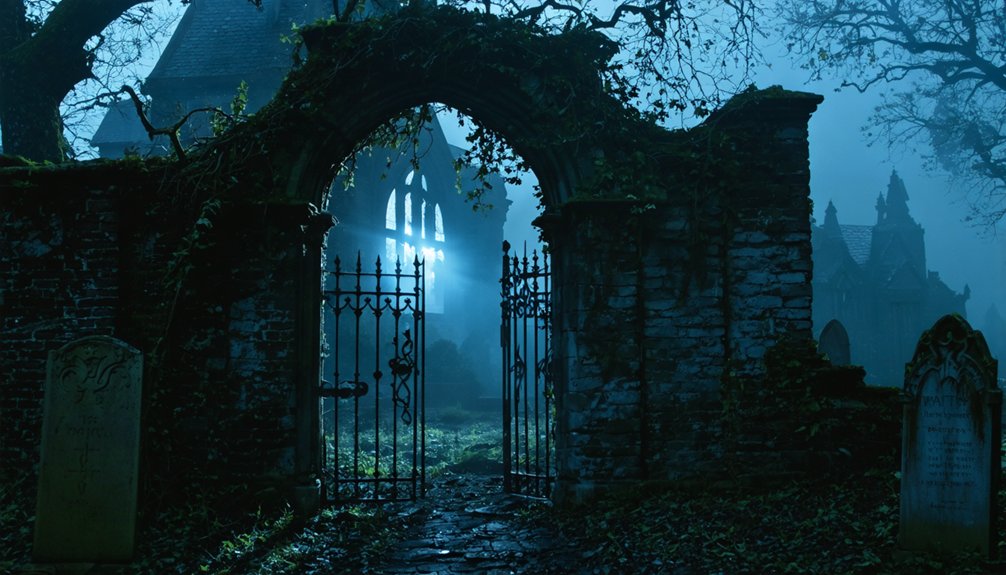
While standing as haunting monuments to America’s westward expansion, colonial ghost towns primarily emerged as resource-driven boomtowns that flourished briefly before succumbing to economic collapse.
You’ll find their skeletal remains scattered across the American landscape—testaments to humanity’s pursuit of mineral wealth and subsequent abandonment when mines ran dry.
These settlements didn’t simply disappear; they transformed into repositories of haunted folklore.
When you walk their deserted streets, spectral whispers seem to emanate from bullet-riddled buildings and decrepit graveyards.
Towns like Bodie, California and Centralia, Pennsylvania tell stories through their physical decay—some destroyed by natural disasters, others by violence or agricultural failure. Places like Frisco, Utah earned reputations for extreme levels of gun violence during their brief existence.
The United States contains approximately 3,800 ghost towns, spanning from California’s abandoned mining camps to the drought-stricken settlements of the Dust Bowl.
Their rapid depopulation left behind not just physical artifacts but also persistent legends of curses and apparitions that continue to fascinate historical scholars and freedom-seeking explorers alike.
Revolutionary Shadows: Sites of Historic Uprisings and Warfare
The battlefield at Yorktown offers compelling evidence of spectral phenomena, including phantom soldiers and the ghostly strains of “The World Turned Upside Down” reported at surrender sites where no musicians are present.
You’ll find revolutionary spirits most active at locations of heightened emotional conflict, such as the Nelson House where both Revolutionary and Civil War soldiers reportedly manifest in areas of their greatest suffering.
Revolutionary-era taverns and meeting houses where insurrection was planned frequently exhibit paranormal activity consistent with residual emotional energy theories, suggesting that independence movements leave spiritual imprints that transcend temporal boundaries.
Fort Columbia’s abandoned officers’ homes and military structures have become a focal point for paranormal enthusiasts seeking evidence of lingering presences from its coastal defense history.
At Cornwallis’ Cave, visitors have reported hearing eerie whispers and ghostly moans emanating from the sealed entrance, believed to be the voices of British troops who sought shelter during the 1781 bombardment.
Colonial Battlefield Hauntings
Across the weathered landscapes of America’s colonial battlegrounds, echoes of the Revolutionary War manifest in persistent paranormal phenomena that have defied conventional explanation for centuries.
Your visits to Yorktown might reveal spectral soldiers in the form of transparent Redcoats dashing among trees, or you’ll hear phantom musketfire and drums resonating across empty fields.
At Jockey Hollow, where starvation claimed 96 lives in the harsh winter of 1780, you may encounter shadowy figures marching in formation or glimpse the woman in white carrying her eternal lantern.
The Nelson House, standing three stories tall and overlooking the York River, holds memories of wounded soldiers who died in their sleep, with visitors reporting the smell of rotting flesh and mysterious gusts of wind in empty hallways.
Cornwallis’s Cave, now gated due to unexplained nocturnal voices, harbors layered histories of military refuge, smuggling operations, and alleged occult activities.
Fort Mifflin’s haunting bears witness to casualties from both the Revolution and its later incarnation as a Civil War prison. Visitors often report hearing the distant sounds of screaming and hammering, thought to be connected to Elizabeth Pratt’s tragic suicide following her daughter’s death.
Tavern Specter Encounters
Colonial taverns, serving as hubs of revolutionary planning and community gathering, harbor spectral residents whose manifestations continue centuries after their mortal lives ended.
Your investigation into these establishments reveals spectral patrons like John Marot at Shields Tavern, still checking his premises, while Founding Fathers wander as residual hauntings among modern visitors.
At Market Square Tavern, wounded Civil War soldiers manifest from the adjacent makeshift hospital, their agonized cries documenting battlefield amputations.
Meanwhile, Chowning’s Tavern hosts colonial spirits and phantom barmaids who rearrange furniture after hours. The tavern is also haunted by a slave girl’s spirit who is frequently seen moving through the kitchen area.
Pennsylvania’s Shank’s Tavern features the Lady in Black—Barb Hauer—who watches from upstairs windows, while visitors have reported unexplained heavy knocks on doors with no visible source. Concord Colonial Inn presents bloodied revolutionaries in Room 24, where Dr. Timothy Minot once treated North Bridge skirmish casualties.
These tavern spirits preserve America’s struggle for liberty.
Independence Insurrection Spirits
Deep within America’s forgotten ghost towns, revolutionary spirits linger where independence was violently contested through uprisings and warfare that shaped the nation’s destiny.
Your exploration of these haunted battlegrounds reveals insurrection echoes particularly concentrated in sites like Cahaba, Alabama, where Civil War prisoners reportedly manifest as spectral presences amid the ruins of what was once Alabama’s capital.
At Fort Jefferson, Florida, the disembodied voices of political detainees pierce the abandoned fortress walls. Archaeological evidence supports these paranormal claims, as mass casualties created lasting traumatic imprints on the physical landscape.
The independence spirits of Bannack, Montana—once labeled “Toughest Town in the West”—emerge from its violent history of territorial gunfights. Annual Bannack Days festival recreates the frontier atmosphere with dramatic historical reenactments, allowing visitors to experience the town’s tumultuous past.
Visitors to Centralia, Pennsylvania often report eerie sensations near the still-burning underground coal fire that has been consuming the abandoned mining town since 1962.
Research indicates these manifestations often coincide with documented areas of highest human suffering, suggesting unresolved historical trauma perpetuates these hauntings.
Plantation Remnants and Their Restless Past
You’ll find that colonial plantation ruins harbor some of the most persistent paranormal phenomena, with documented sightings of apparitions in former slave quarters occurring as recently as 2018.
Historical records from Virginia’s Ferry Plantation House reveal consistent reports of unexplained footsteps and disembodied voices emanating from the overseer’s quarters, particularly during autumn months.
Archaeological evidence uncovered during restoration projects suggests many of these hauntings correlate with unmarked burial sites and locations of documented violence, reinforcing theories that traumatic historical events leave spiritual imprints.
Colonial Plantation Hauntings
Among the darkest chapters of America’s colonial past, plantation estates stand as both architectural marvels and repositories of supernatural activity, where centuries of tragedy have seemingly imprinted themselves upon the landscape.
Plantation folklore consistently reveals patterns of spectral legacies tied to violent deaths and unresolved injustice.
You’ll discover these manifestations take specific forms:
- Family tragedies echo through time, as with Stephen Henderson at Destrehan Plantation and the vanished Pierre d’Trepagnier of Ormond Plantation.
- Violent deaths catalyze paranormal activity, exemplified by Basile LaPlace Jr.’s murder and subsequent hauntings.
- Cultural trauma materializes through apparitions of Native American children and enslaved people whose suffering continues to reverberate through these properties.
These manifestations represent more than mere ghost stories—they constitute historical testimony to America’s unreconciled past.
Slave Quarter Apparitions
Beneath the weathered remains of plantation quarters, where the physical evidence of enslavement has been meticulously excavated, another layer of historical testimony emerges through reported spectral manifestations that continue to haunt these spaces.
Archaeological discoveries at sites like St. Mary’s College and Pompeii’s Civita Giuliana reveal cramped living conditions where enslaved spirits once maintained spiritual resistance through conjure bottles and star-like Anansi symbols.
You’ll find reports of apparitions near subfloor pits where spirit bundles were hidden—places where protective Nkisi energies were invoked against dehumanization. These haunting memories materialize most frequently near artifacts of daily existence: the 170-square-foot quarters, wooden beds with rope bases, and corners where amphorae stored meager provisions.
Rather than physical restraints, evidence suggests psychological control mechanisms maintained bondage—perhaps explaining why restless spirits remain tethered to these spaces.
Overseer House Mysteries
Standing between the grand plantation house and the slave quarters, overseer residences occupy a liminal space in both the physical landscape and haunted folklore of colonial estates.
Archaeologists have documented numerous overseer house hauntings where the instruments of oppression manifest in supernatural phenomena. You’ll discover that these modest dwellings, strategically positioned for surveillance, have become focal points for spectral activity.
- Excavated overseer houses reveal significant artifact concentrations coinciding with reported spectral overseer encounters.
- Architectural modifications often trigger increased paranormal activity, as if disturbing the residual energy.
- Written accounts document unexplained sounds of discipline implements and apparitions appearing at former punishment locations.
The persistence of these hauntings suggests unresolved historical trauma, with supernatural manifestations serving as echoes of the overseer’s role in maintaining the plantation’s brutal social order.
Coastal Ghosts: Maritime Colonial Towns Reclaimed by Nature
Along the Eastern seaboard of North America, maritime colonial towns have slowly surrendered to nature’s relentless forces, leaving behind submerged archaeological treasures that document America’s earliest European settlements.
Evidence of this relentless reclamation appears in coastal relics like La Fortuna, the Spanish privateer shipwreck that exploded near Brunswick Town in 1748, now exposed through environmental degradation after centuries beneath protective marsh.
The archaeological record reveals complex maritime networks, with over 350 ships annually visiting colonial ports from destinations worldwide.
These thriving communities have faced devastating erosion—Roanoke Island lost 928 feet of shoreline between 1851-1970, while Portsmouth, North Carolina gradually emptied until complete abandonment.
Maritime folklore suggests these ghost towns persist beneath the waves, their timber wharves and shipwrecks preserving tales of colonial maritime commerce.
Spiritual Encounters in Religious Settlements of Early America
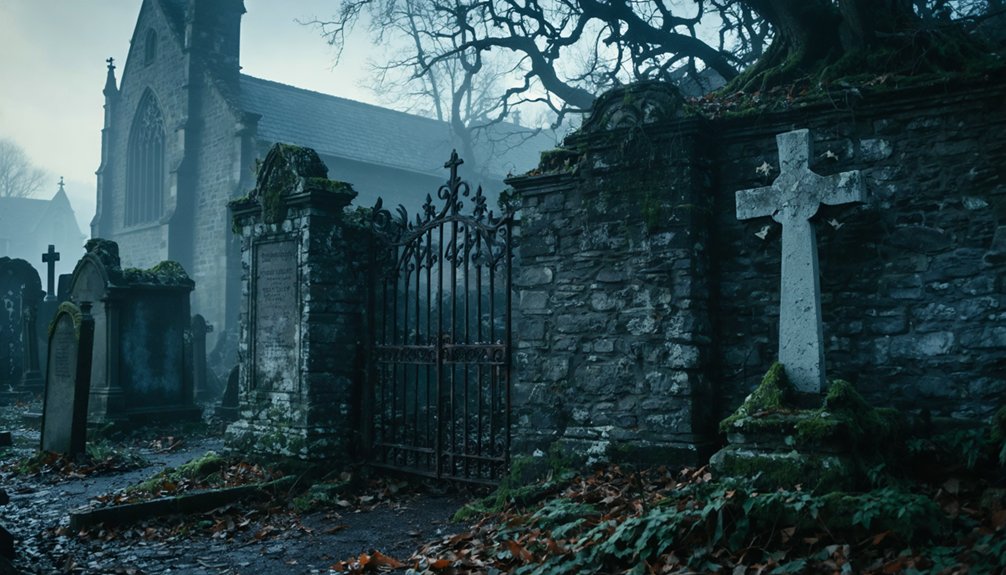
Throughout early American religious settlements, spiritual phenomena transcended mere folklore, becoming integral components of colonial identity and communal experience.
These sacred spaces—abandoned through persecution, conflict, or societal evolution—harbor profound metaphysical testimonies.
- Mormon hauntings pervade Utah’s ghost towns like Grafton, where apparitions and unexplained voices echo the harsh pioneer existence and tensions with indigenous peoples.
- Praying Indians who perished in internment camps like Deer Island manifest as ancestral presences in former New England praying towns—silent witnesses to cultural erasure.
- Utopian spirits linger in the Amana Colonies, where communal religious fervor created an atmosphere conducive to otherworldly encounters, while Methodism encounters at the Burning Bush Colony demonstrate how rigid spirituality can imprint itself upon physical space.
You’ll find these settlements reveal how religious devotion shaped America’s spiritual landscape.
The Impact of Disease and Disaster on Colonial Abandonments
While spiritual forces shaped the abandonment of religious settlements, the biological onslaught of disease and environmental catastrophes proved far more devastating to colonial populations across America.
You’ll find evidence of entire communities vacated following deadly disease outbreaks, with mortality rates reaching a staggering 50-90% among native populations.
Archaeological excavations reveal abrupt desertion—possessions left behind, skeletal remains indicating rapid mortality.
Colonial authorities implemented forced relocations, establishing quarantined settlements that became infection hotbeds through overcrowding. Hawaiian leprosy colonies exemplify this practice, where hundreds were exiled to remote islands.
The combination of epidemics with natural disasters like drought created insurmountable challenges.
Sanitation inadequacies in early colonial towns fostered ideal conditions for contagion, resulting in ghost towns that stand as evidence to biological catastrophe rather than supernatural phenomena.
Exploring Archaeological Evidence of Paranormal Claims
In examining the archaeological foundation of paranormal claims at colonial ghost towns, researchers confront a complex interplay between physical evidence and folklore traditions. Ground-penetrating radar studies at Colonial Park Cemetery have disproved some paranormal claims while validating others through physical confirmation of mass burials and ritual activities.
When you explore these haunted colonial remnants, you’ll discover:
- Archaeological features like cellar holes and stone walls in abandoned settlements such as Monson, NH provide tangible anchors for ghostly folklore.
- Documented ritual practices, including Voodoo ceremonies using grave soil, bridge material culture and paranormal archaeology.
- Mass burial sites at locations like Coles Hill and Burial Hill correlate with reported paranormal activity, suggesting trauma-based hauntings.
Physical evidence doesn’t always validate paranormal claims, but these archaeological investigations offer critical context for understanding how colonial-era suffering manifests in contemporary ghostly narratives.
Modern Preservation Efforts and Ghostly Tourism Experiences
Modern preservation efforts targeting colonial ghost towns have evolved beyond mere structural maintenance into complex cultural enterprises that balance historical authenticity with tourism demands.
preserving ghost town history in california involves engaging local communities to share their stories and experiences, enriching the historical narrative. This approach not only fosters a sense of ownership but also encourages sustainable tourism that respects the delicate balance between the past and present. As visitors explore these remnants of history, they gain insights into the lives of those who once inhabited these now-silent landscapes.
You’ll find the Historic Preservation Fund has invested over $1.6 billion since 2001, with $900 million specifically supporting SHPOs that oversee colonial remnants.
Tourism balance remains a critical preservation challenge, as sites like Bodie State Historic Park showcase original structures while managing visitor impact.
Community-driven initiatives, exemplified by “Dearfield Day,” demonstrate effective grassroots approaches to conservation alongside tourism development. These efforts often incorporate ghostly narratives into interpretive experiences, leveraging supernatural lore to engage visitors while funding ongoing preservation work.
Despite increased federal appropriations reaching $173 million by 2022, many sites remain vulnerable to climate damage, vandalism, and development pressure—requiring continuous vigilance from preservationists and supporters.
Frequently Asked Questions
Can Ghost Hunting Equipment Detect Colonial Spirits Differently Than Modern Ghosts?
Your equipment might detect different spectral frequencies from colonial spirits versus modern ghosts, though this remains speculative. Colonial spirit resonance could theoretically vary due to environmental factors rather than temporal distinctions.
Were Colonial Burial Practices Responsible for Increased Paranormal Activity?
Like seeds of unrest sown in shallow soil, you’ll find colonial burial rituals—particularly mass graves, improper interments, and desecrated sites—significantly contributed to increased spirit manifestations according to contemporary paranormal evidence analysis.
Did Native American Interactions Affect Haunting Patterns in Colonial Towns?
Yes, you’ll find that cultural exchanges between settlers and tribes shaped haunting narratives, while conflicting spiritual beliefs created energetic imprints that manifest as persistent paranormal phenomena in contested colonial spaces.
How Do Colonial Ghosts Communicate Versus Spirits From Other Eras?
While skeptics doubt their existence, you’ll find colonial ghosts communicate through ghostly whispers and environmental interactions reflecting colonial folklore, whereas modern spirits typically leverage electronic devices—evidencing distinct temporal communication patterns across haunting phenomena.
Can Specific Architectural Features Amplify Paranormal Energy in Colonial Structures?
You’ll find rounded corners, spirit walls, and coquina stone considerably amplify paranormal energy through their architectural symbolism and historical significance, creating resonant environments where colonial trauma manifests as measurable electromagnetic disturbances.
References
- https://nightofthejack.com/2025/01/23/top-creepy-ghost-towns-in-america/
- https://www.geotab.com/ghost-towns/
- https://www.christywanders.com/2024/08/top-ghost-towns-for-history-buffs.html
- https://www.tnmagazine.org/19-ghost-towns-in-tennessee-that-are-not-underwater/
- https://www.legendsofamerica.com/gt-hiddentales/
- https://www.youtube.com/watch?v=Gf9rL4_d_sw
- https://en.wikipedia.org/wiki/Lists_of_ghost_towns_in_the_United_States
- https://www.atlasobscura.com/lists/americas-best-preserved-ghost-towns
- https://www.ghosttowns.com
- https://www.notesfromthefrontier.com/post/untitled