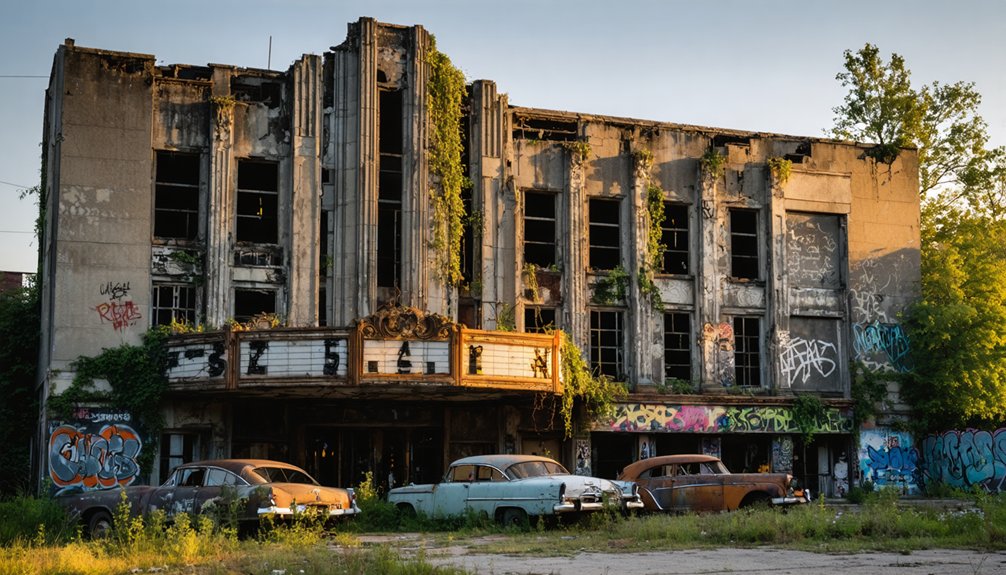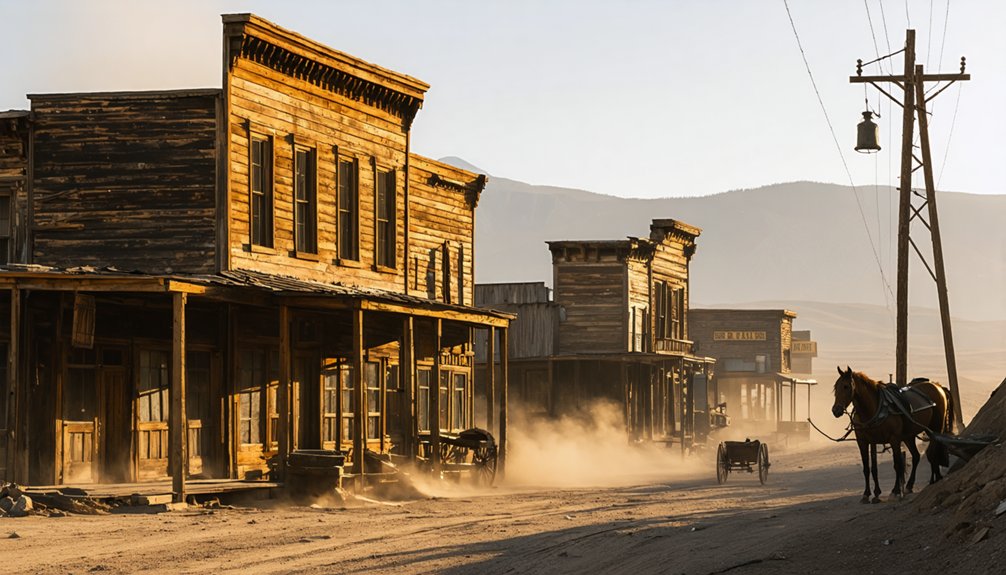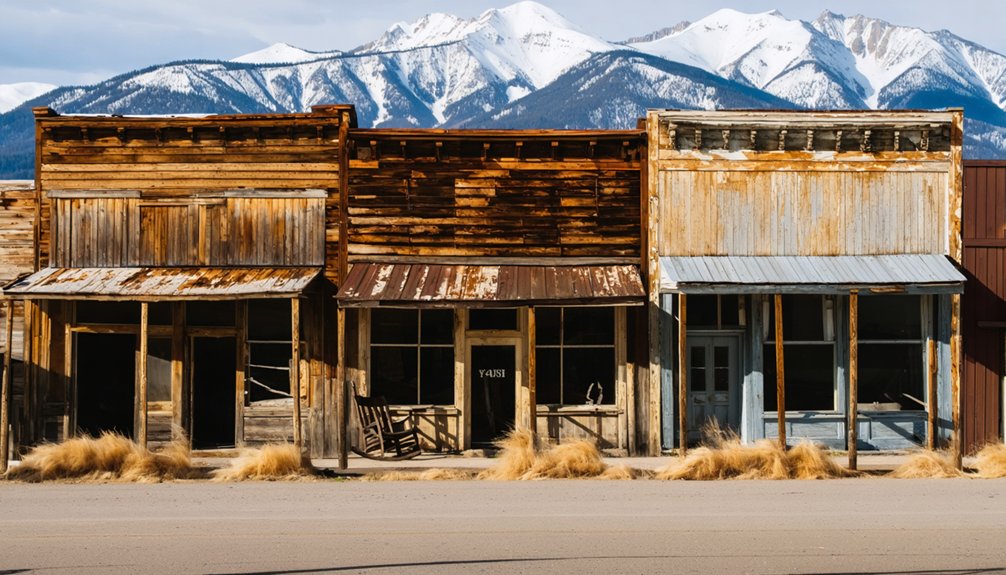
You’ll discover haunting ghost towns that reveal civilization’s impermanence through silent streets and crumbling facades. From Bodie’s gold mining relics in “arrested decay” to Kolmanskop’s grand structures disappearing beneath Namibian desert sands, these abandoned landscapes tell compelling stories. Soviet settlements like Pyramiden stand frozen in time, while tragedy-preserved towns remain exactly as disaster left them. Each forgotten place exists between human achievement and nature’s relentless reclamation.
Key Takeaways
- Bodie, California preserves 110 structures in “arrested decay,” frozen since the 1940s when the last gold mine closed.
- Kolmanskop, Namibia features luxurious German colonial buildings being reclaimed by desert sands since its 1956 abandonment.
- Pripyat near Chernobyl remains untouched since 1986, with an abandoned amusement park symbolizing evacuation urgency.
- Pyramiden in the Arctic Circle contains preserved Soviet architecture and artifacts, potentially remaining intact for 500 years.
- Underwater ghost towns like Shi Cheng in China showcase submerged civilizations visible beneath lake surfaces following dam construction.
Gold Mining Relics: Frozen Moments of the American West
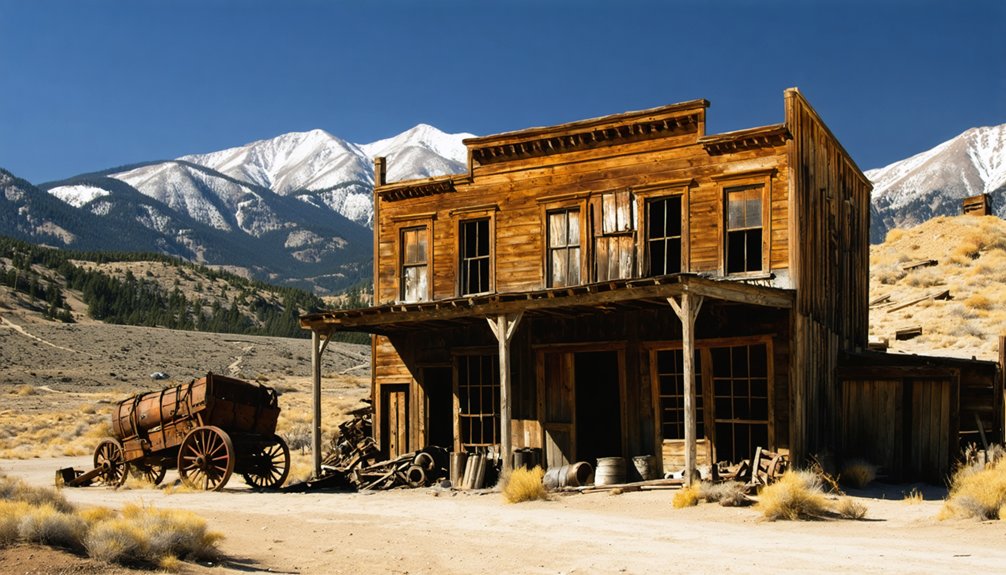
While wandering the weathered remnants of America’s western mining towns, you’ll encounter a visual archive of 19th-century ambition frozen in time.
Bodie’s 110 preserved structures—from schoolhouses to saloons—offer intimate glimpses of the 10,000 souls who sought fortune there before the final mine closed in 1942.
Within Bodie’s weathered facades lies the ghostly echo of 10,000 dreams that vanished when the last mine whispered closed.
These gold rush remnants tell stories of boom-and-bust cycles that defined the frontier.
In Goldfield, once Nevada’s largest city, Victorian buildings stand as silent witnesses to wealth’s fleeting nature.
Meanwhile, Locke preserves a uniquely Chinese-American mining heritage as the only such community still standing.
Many ghost towns date from the period of westward expansion and industrialization that transformed America between 1880-1940.
The devastating fire that swept through Goldfield, Arizona in 1943 destroyed much of the original town, leaving behind only traces of its 4,000 former residents.
Each weathered clapboard and rusted mineshaft cart you’ll discover isn’t merely decay—it’s evidence of an unfettered pioneering spirit that transformed the American landscape.
Desert-Reclaimed Diamond Towns of Namibia
Unlike the gold-fevered settlements that defined America’s western expansion, Namibia’s diamond ghost towns reveal a different facet of resource-driven ambition.
When railway worker Zacharias Lewala discovered diamonds in 1908, the ensuing diamond rush transformed Kolmanskop into one of the world’s richest towns. German colonists erected a European oasis amid the Namib Desert, complete with bowling alleys and modern plumbing. The luxurious town even featured the first X-ray station in the southern hemisphere. Diamonds were so plentiful that miners collected nearly half a million carats in 1909 alone. By 1950, richer deposits at Oranjemund lured miners away, leaving Kolmanskop abandoned by 1956.
- Sand dunes cascading through doorways of once-elegant German homes
- Window frames framing nothing but encroaching desert landscape
- Hospital corridors half-buried in rippling sand waves
- Former bowling alley floors now textured with wind-swept dune patterns
- Peeling wallpaper in master bedrooms where sand reaches toward ceilings
Today, the desert systematically reclaims what human ambition briefly conquered—a haunting reminder of prosperity’s impermanence.
Soviet Ghosts: Abandoned Communist Settlements
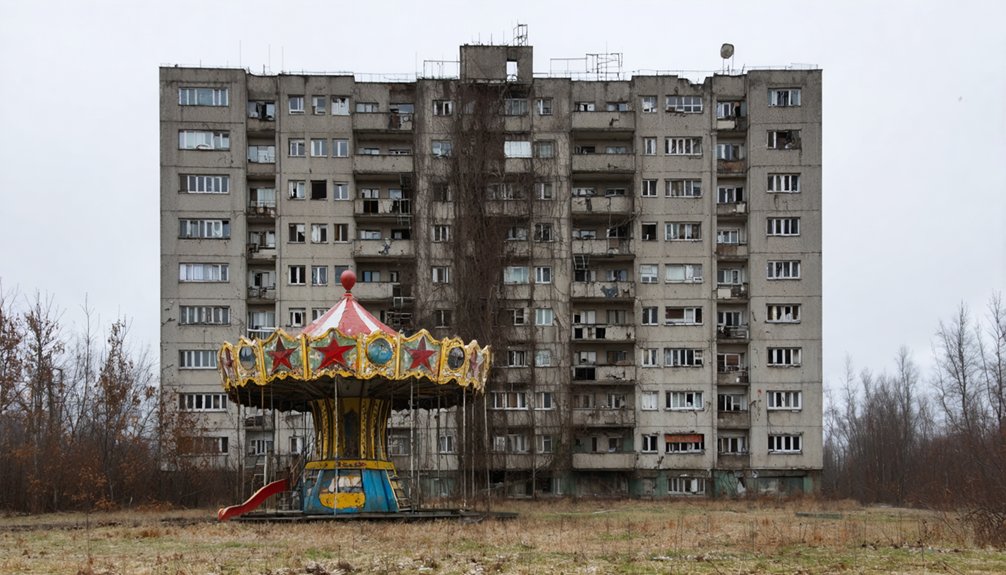
As the Soviet Union expanded its ideological footprint across remote territories during the mid-20th century, it established hundreds of purpose-built settlements that now stand as frozen tableaux of communist ambition.
You’ll find Pyramiden in the Arctic Circle eerily preserved—its utilitarian Soviet architecture intact, with cultural artifacts like costumes and film reels untouched since 1998. Arctic temperatures have considerably slowed the process of decay, with scientists predicting the town’s structures may remain standing for up to 500 years as a time capsule of Soviet life.
Meanwhile, Latvia’s Skrunda-1, once housing 5,000 residents in its military radar complex, slowly deteriorates as trees reclaim rooftops of Brezhnev-era flats. The site spans 100 acres of dilapidated buildings including apartment blocks, factories, and underground bunker networks.
Nature silently reclaims Soviet ambitions as trees puncture the concrete dreams of Skrunda-1’s abandoned utopia.
These abandoned outposts represent failed utopian experiments but generate surprising cultural nostalgia among former inhabitants.
Walking through these settlements, you’ll encounter propaganda mosaics and communal living spaces that tell stories of isolated communities where socialism “actually existed” physically.
Now open-air museums of Soviet collapse, they attract visitors seeking freedom to explore ideological ruins.
Silent Witnesses: Towns Preserved by Tragedy
The architectural skeletons of Soviet utopian projects weren’t the only ghost towns that captivate modern explorers. Across the globe, tragedy preservation has frozen moments in time, creating poignant conflict memorials that speak volumes about humanity’s darkest hours.
- Bodie’s gold rush buildings stand in “arrested decay,” their interiors suspended in the 1940s when mining restrictions emptied the town.
- Varosha’s luxury resorts remain untouched since 1974, furniture gathering dust as political divisions keep 40,000 residents exiled.
- Oradour-sur-Glane’s charred ruins memorialize 642 massacre victims, deliberately unchanged as testimony to wartime brutality.
- Pripyat’s abandoned amusement park rusts silently, evacuation’s urgency visible in scattered belongings following Chernobyl.
- Belchite’s war-torn structures crumble slowly, their bullet-riddled facades documenting Spain’s civil conflict.
- Centralia’s infrastructure continues to deteriorate as an underground fire that began in 1962 still burns beneath the Pennsylvania town, forcing almost all residents to permanently relocate.
- Quneitra stands as a deliberate war memorial, with preserved ruins and billboards marking building remains to commemorate the destruction caused during the Six-Day War and Yom Kippur War.
Islands of Emptiness: Abandoned Maritime Communities
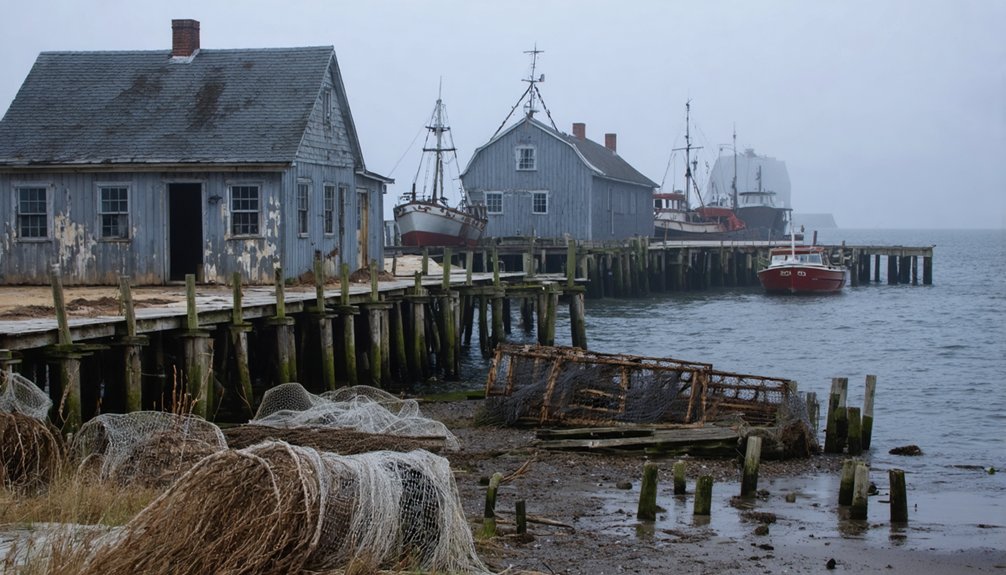
Maritime communities, once vibrant centers of coastal commerce and cultural exchange, now stand as haunting reminders to humanity’s precarious relationship with the sea.
You’ll find these island mysteries scattered across the globe—from Ross Island’s colonial structures surrendering to ficus roots, to the Inupiat Aseuluk’s remarkable stilt dwellings at Ukivok, suspended in time along Alaskan cliffs.
Venice’s San Giorgio in Alga reveals a millennium of human presence now crumbling in isolation, while Hallsands in Devon represents nature’s relentless conquest through coastal erosion.
In British Columbia, a cluster of seaside cottages sits frozen in abandonment, only accessible during low tide and increasingly consumed by the surrounding wilderness.
The lost village of Kenfig in South Wales now lies beneath shifting dunes, with only the ruined keep visible as testament to its medieval prosperity.
Perhaps most poignant is Binnend in Scotland, where industrial ambition created then abandoned an overcrowded village of 750 souls.
These maritime legacies remain frozen in their final moments—ghostly settlements where waves crash against empty harbors and wind whistles through structures that once sheltered thriving communities.
Medieval Ruins: Villages Claimed by Time and Nature
Scattered across Europe’s countryside, medieval ruins stand as silent witnesses to centuries of human struggle and adaptation, their crumbling walls and earthen mounds telling stories of communities that flourished before succumbing to forces beyond their control.
You’ll find over 3,000 deserted medieval villages in England alone, abandoned due to the devastating Black Death, economic shifts, and natural disasters. At sites like Wharram Percy, archaeologists have uncovered the skeletal remains of village life—medieval architecture preserved in stone foundations and earthworks.
England’s medieval landscape cradles thousands of ghost villages, erased by plague, economics, and nature’s fury.
- Stone church remains rising from overgrown fields where villagers once prayed
- Hollow-ways worn deep into the landscape by countless footsteps
- Fishponds now silted over, once essential food sources for the community
- Collapsed timber-framed houses, their outlines visible only as subtle depressions
- Field boundaries marking ancient agricultural patterns, visible only from above
Industrial Dreams Gone Bust: Failed Company Towns
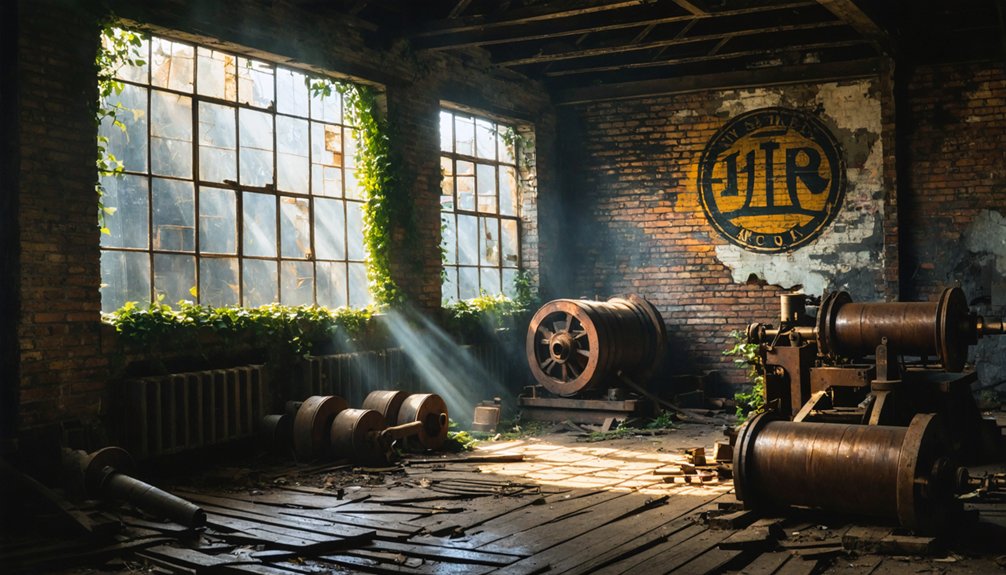
You’ll find ghostly manufacturing equipment and crumbling administrative buildings amid America’s failed company towns, where industrial visions like Consolidation Coal’s Buxton, Iowa and Arkadelphia Lumber’s Graysonia, Arkansas once promised prosperity.
These corporate utopias, built around single industries—coal mining in Blue Heron, Kentucky and lumber production in Cass, West Virginia—collapsed when resources depleted or economic conditions shifted, leaving behind rusted machinery and empty worker housing.
Whether abandoned due to the Great Depression’s devastating impact, as with Graysonia’s thousand-strong workforce, or through gradual decline following mine closures, as witnessed in Elcor, Minnesota, these industrial landscapes stand as monuments to capitalism’s boom-and-bust cycles.
Corporate Utopias Deserted
Across the American landscape, hundreds of abandoned company towns stand as weathered monuments to corporate experiments in utopian living that ultimately failed.
These once-thriving communities, constructed to maximize efficiency and worker productivity, crumbled under economic pressures and the fundamental tension between corporate control and worker autonomy.
- Rusting water towers bearing faded company logos loom over empty streets
- Identical worker cottages with sagging porches and broken windows line symmetrical grids
- Abandoned company stores with dusty shelves that once held everything workers were permitted to buy
- Empty churches and recreation halls where mandatory social gatherings reinforced company values
- Administrative buildings positioned on hills overlooking worker housing, symbolizing the hierarchical power structure
When market forces shifted, these carefully engineered societies quickly dissolved, leaving behind architectural skeletons of industrial ambition.
Manufacturing Ruins Remain
Massive brick chimneys and skeletal steel frames punctuate the horizons of America’s failed company towns, silent monuments to industrial ambitions that couldn’t withstand economic realities.
You’ll find these industrial decay landmarks in places like Pullman, Illinois, where the Palace Car Company’s model town now stands partially preserved after infamous labor strikes exposed the dark side of corporate paternalism.
Walking through Haydenville, Ohio, you’ll discover remnants of a once-thriving manufacturing hub where fewer than 400 residents remain amid crumbling infrastructure.
The most dramatic failures, like Ford’s Fordlândia in Brazil, showcase grand industrial experiments abandoned to jungle reclamation after just six years of operation.
Urban exploration enthusiasts document these spaces where company stores, worker housing, and factory floors tell stories of controlled environments where corporate power constrained the very freedom workers sought through employment.
Submerged Communities: When Waters Rose Over Civilization
You’ll find an eerie time capsule beneath the placid waters of America’s reservoirs, where entire communities like Tennessee’s Loyston and Massachusetts’ Dana now rest in suspended animation.
These submerged towns—victims of mid-20th century dam projects—left behind underwater ruins ranging from building foundations to occasionally visible church steeples when water levels drop.
The flooding of these settlements represents a unique form of ghost town where preservation occurs through submersion rather than abandonment, with detailed documentation existing for communities like Loyston where sociologists and photographers captured final images before the waters claimed streets, homes, and histories forever.
Villages Beneath The Waves
As rising seas gradually consume coastal communities worldwide, silent landscapes of abandonment have emerged where thriving villages once stood.
In Fiji, 42 villages await relocation while six have already surrendered to the waves—their flooded heritage now marked only by submerged legacies.
You’ll find similar ghost towns forming in Southeast Asia, where Bangkok risks losing one-third of its landscape by 2050, displacing 11 million people.
- Wooden homes partially collapsed into murky waters, only rooftops visible at low tide
- Former village squares transformed into reef-like ecosystems where fish dart through window frames
- Cultural artifacts—temples, gravestones, community centers—slowly degrading underwater
- Abandoned infrastructure with electricity poles standing sentinel in waist-deep water
- Ancient pathways and roads disappearing beneath silt, visible only as darker lines beneath the surface
Drowned History Preserved
While modern coastal communities face gradual submersion, their underwater fate connects them to a rich tapestry of drowned civilizations throughout human history.
You’re witnessing the culmination of natural forces—rising seas, tectonic shifts, tsunamis—that transformed vibrant settlements into submerged archaeological treasures.
Little Salt Spring in Florida reveals 12,000-year-old Paleo-Indian activity, while Mediterranean sites like Atlit-Yam stand frozen in time after catastrophic tsunamis.
These underwater time capsules offer unprecedented prehistoric preservation. Unlike land sites, submerged settlements often maintain organic materials intact, providing essential insights into ancient climate patterns, diets, and technological adaptations.
The seafloor cradles evidence from Pavlopetri’s Bronze Age structures to Roman Baiae’s colonial luxuries—each site a liberation from historical obscurity.
As you explore these drowned worlds, you’re connecting with humanity’s resilience against nature’s overwhelming forces.
Dam-Created Underwater Ruins
Unlike natural disasters that gradually claim coastlines, dam construction represents humanity’s deliberate reshaping of landscapes—often at the expense of entire communities.
From Italy’s medieval Fabbriche di Careggine to China’s ancient Shi Cheng, these dam floodings have created haunting underwater museums of submerged civilizations.
Mexico’s experience is particularly poignant, with El Temascal displacing 22,000 people and El Infiernillo’s “drowned church” standing as a monument to sacrificed heritage.
- White stone structures of Shi Cheng glowing eerily beneath 130 feet of Qiandao Lake
- Medieval church tower of Mediano breaking the water’s surface in Spain
- Ancient tombs and artifacts preserved in perfect stillness under reservoir waters
- Empty streets of Vilarinho das Furnas emerging during summer droughts
- Forsaken homes of Ontario’s “Lost Villages” frozen in 1958’s final moments
Eerie Modern Ruins: Recently Abandoned Architectural Wonders
When did magnificent architectural achievements transform from symbols of innovation to haunting markers of societal change?
Architecture’s transition from innovation to haunting relic marks the moment when human ambition collides with environmental reality.
You’ll find the answer in structures like Cape Romano Dome House, where futuristic modules now succumb to Florida’s relentless shoreline erosion, and Michigan Theatre, a lavish 1920s venue repurposed into an uncanny parking garage.
Modern design failures reveal our vulnerabilities to environmental and technological shifts.
Villa Savoye’s celebrated modernist minimalism couldn’t overcome basic habitability issues, while Teufelsberg’s geodesic domes—once cutting-edge surveillance technology—now stand graffiti-covered atop Berlin’s wartime rubble.
These abandoned architecture sites tell stories beyond their physical decay.
Cold War tensions, economic collapses, and experimental construction techniques all conspired against these structures, transforming visionary designs into eerie monuments that document our fleeting technological optimism.
Frequently Asked Questions
How Dangerous Is It to Explore Abandoned Ghost Towns?
With 11 deaths in Utah mines alone since 1982, you’re gambling with your life. Urban exploration requires strict safety precautions: permissions, group travel, communication devices, and avoiding unstable structures.
Can You Legally Collect Artifacts From Ghost Town Sites?
No, you can’t legally collect artifacts from ghost towns without proper permits. Removal violates federal and state preservation laws, bringing serious legal ramifications including hefty fines and potential imprisonment for disturbing historical sites.
Which Ghost Towns Allow Overnight Camping or Paranormal Investigations?
You’ll find ghost town camping at Calico, Ballarat, and Ruby, while paranormal tours operate in several Nevada mining ruins, Terlingua, and Holy Ghost Campground—each offering distinctly unregulated access to historic structures.
For those seeking more adventure, hiking trails in Pacific Northwest provide breathtaking views and diverse landscapes that are perfect for exploration. Many trails wind through lush forests and lead to stunning waterfalls, making them a must-visit for outdoor enthusiasts. Whether you’re a seasoned hiker or a beginner, this region offers options that cater to all skill levels while immersing you in the natural beauty of the area.
Are There Still Undiscovered Ghost Towns Awaiting Formal Documentation?
Yes, you’ll find numerous undiscovered ghost towns awaiting documentation across America’s remote landscapes. These forgotten settlements contain hidden histories in inaccessible terrain, obscured by nature’s reclamation and incomplete historical records.
How Do Local Indigenous Communities View Tourism at Nearby Ghost Towns?
You’ll find indigenous communities utterly divided on ghost town tourism—some embrace it for cultural preservation opportunities, while others condemn tourism impact as exploitative colonialism that commercializes their sacred heritage without proper control.
References
- https://www.loveexploring.com/gallerylist/66971/frozen-in-time-the-worlds-most-fascinating-ghost-towns
- https://en.wikipedia.org/wiki/List_of_ghost_towns_by_country
- https://www.afar.com/magazine/beautiful-abandoned-places-around-the-world-that-you-can-actually-visit
- https://www.youtube.com/watch?v=tyXDXQSsuwA
- https://www.geotab.com/ghost-towns/
- https://allthatsinteresting.com/wild-west-mining-towns
- https://westernmininghistory.com/map/
- https://hobblecreek.us/blog/entry/mining-towns-of-the-old-west
- https://www.atlasobscura.com/itineraries/the-wildest-west
- https://www.tripadvisor.com/Articles-loOISRppph64-American_ghost_towns.html