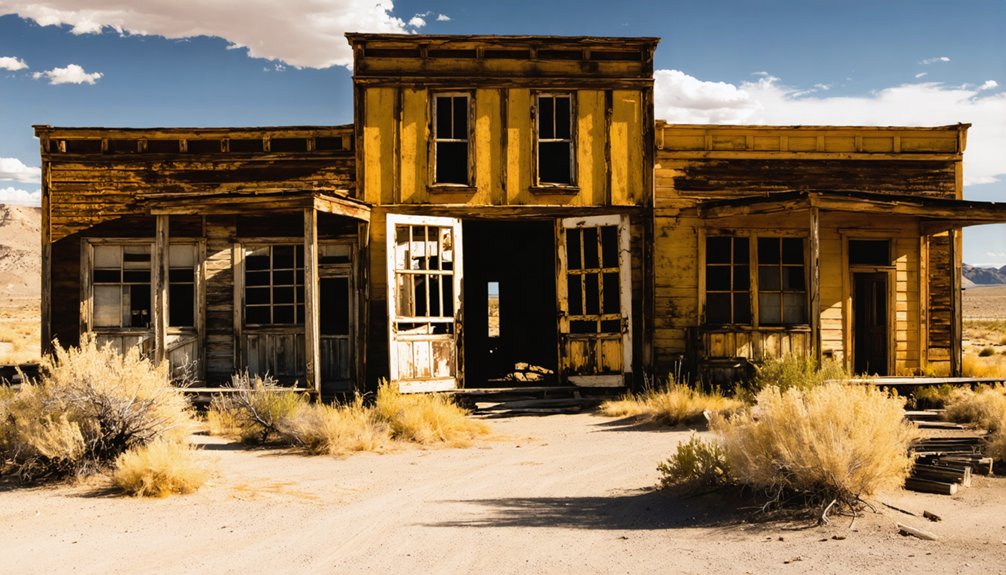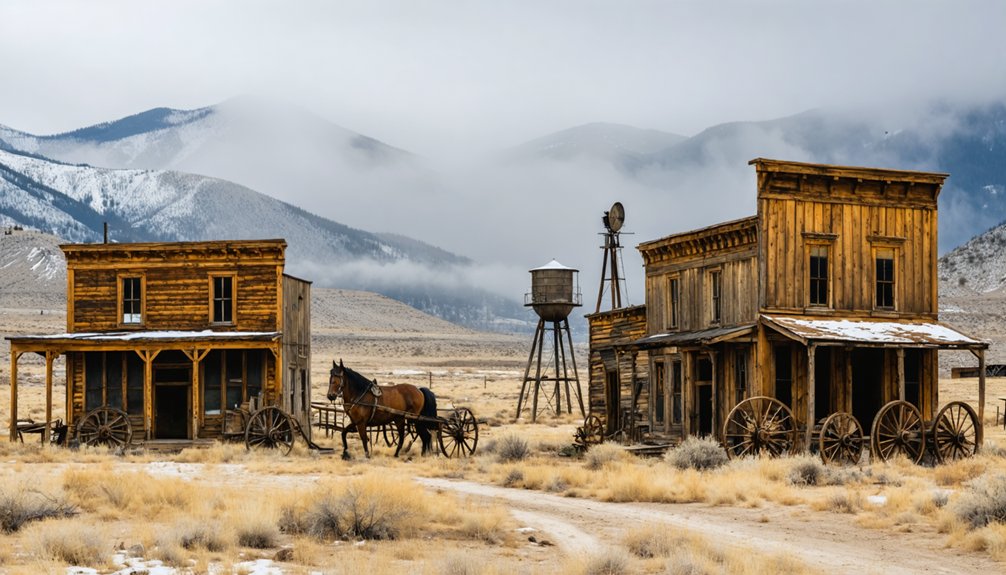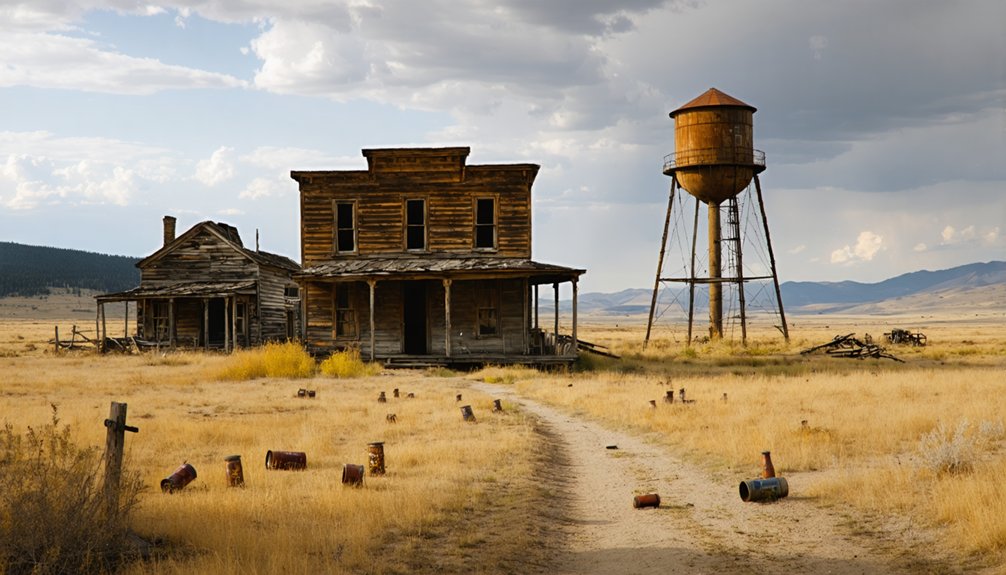
You’ll find over 4,500 ghost towns across America, with Texas leading at 511 abandoned settlements. Some hide beneath reservoir waters, revealed only during severe droughts, while others stand frozen in time across mountainous mining regions and failed farming plains. These forgotten places tell America’s boom-and-bust economic story through preserved structures, reported hauntings, and distinctive regional patterns. Explore these hidden histories to uncover the untold chapters of America’s development.
Key Takeaways
- The U.S. contains 4,531 ghost towns, with Texas (511), California (346), and Kansas (308) leading in abandoned settlements.
- Numerous forgotten towns lie underwater beneath lakes and reservoirs, occasionally revealed during severe droughts.
- Western mountain ranges host dense concentrations of mining ghost towns across California, Nevada, Colorado, and Arizona.
- Kern County, California features the highest concentration of ghost towns with 113 abandoned settlements.
- Many ghost towns have transformed into tourist destinations, including preserved locations like Bannack, Montana and Bodie, California.
America’s Underwater Past: Ghost Towns Beneath the Waves
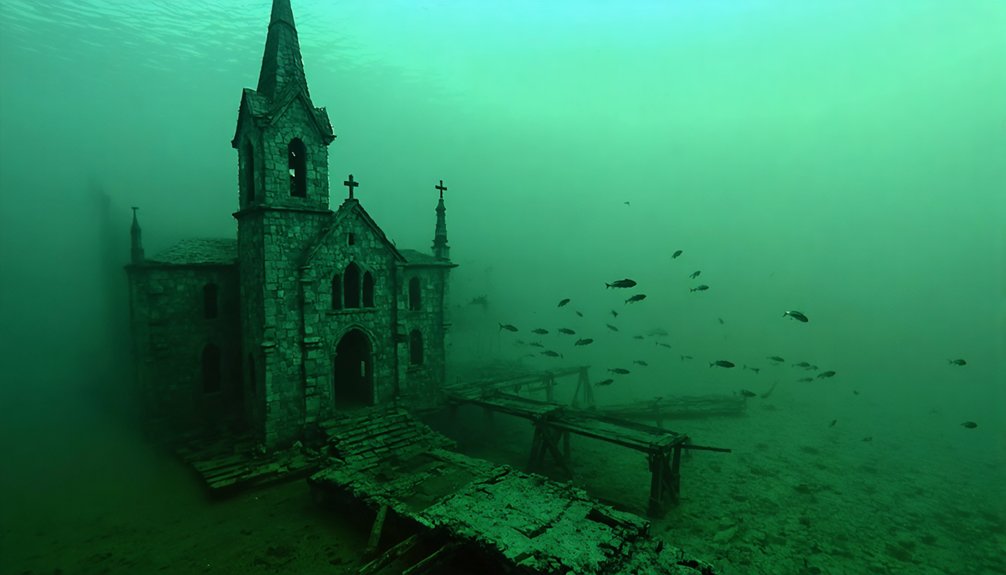
While many Americans explore ghost towns in the desert or abandoned mining communities in the mountains, a more mysterious category of forgotten settlements lies hidden beneath the nation’s lakes and reservoirs.
Across Appalachia, towns like Proctor, Andersonville, and Loyston vanished during the mid-20th century when dams flooded valleys for hydroelectric power and flood control.
These submerged secrets aren’t limited to one region. From Old Bluffton in Texas to St. Thomas in Nevada, dozens of communities rest silently underwater.
During severe droughts, these aquatic archaeology sites occasionally resurface, revealing preserved structures, tombstones, and remnants of daily life.
Some locations, like Fontana Lake in North Carolina, feature clear waters that allow glimpses of the past through small watercraft explorations—windows into America’s sacrificed communities. This historic lake, created when the Fontana Dam completed in 1944, was built specifically to supply electricity for Oak Ridge during World War II.
In Texas, Old Bluffton typically remains hidden beneath 30 feet of water in Lake Buchanan since its submersion following the Buchanan Dam construction in 1937.
The Haunted Remains: Spectral Stories From Abandoned Settlements
You’ll encounter midnight whispers lingering at historic sites like Bodie, California, where abandoned belongings and intact structures fuel persistent hauntings.
Spectral miners continue their underground work in forgotten towns like Custer, Idaho, where mysterious noises near old shafts suggest restless spirits remain tied to their former livelihoods.
The drowning echoes below Fort Jefferson and former settlements near water sources carry their own haunted elements, from Civil War prisoners’ apparitions to the displaced spirits of Native American burial grounds disturbed by development.
The devastating 1928 hurricane that destroyed Fruitcrest and other Florida settlements has left paranormal investigators reporting unusual electromagnetic activity where these towns once thrived.
Many ghost towns now serve as educational sites, showcasing American history through preserved structures and organized events that allow visitors to experience the past.
Midnight Whispers Linger
When the last residents depart from a once-thriving settlement, they leave more than just empty buildings and forgotten possessions—they leave stories that transform into legends and ghostly encounters.
As you walk through Bodie’s eerily preserved streets, midnight legends take physical form—furniture awaits owners who’ll never return.
In Centralia, spectral encounters seem inevitable as smoke rises from the earth itself, creating nature’s haunted stage.
St. Elmo’s ghostly resident, Annabelle Stark, reportedly lingers among well-preserved structures that attract paranormal investigators.
Frisco’s violent past manifests in spectral figures haunting its cemetery, while Cahaba’s ruins host apparitions of children, slaves, and prisoners.
The physical conditions of these towns—underground fires, floods, and violent histories—amplify their hauntings.
These aren’t just abandoned places; they’re chapters of American history where the veil between worlds grows thin.
Rhyolite’s haunting beauty is accentuated by its dramatic rise and fall, with rapid decline occurring just twelve years after its founding during the Gold Rush.
Ruby, Arizona’s abandoned mines echo with supernatural activity following a series of gruesome murders that marked the town’s dark history.
Spectral Miners Underground
Beneath America’s surface lies a shadow world of abandoned mines where thousands of spectral stories have emerged from the darkened tunnels and collapsed shafts that once fueled the nation’s industrial growth.
You’ll find these haunting remains concentrated in Appalachian coal country, Western gold rush territories, and Midwestern mining districts. Company towns like Lynch, Kentucky once thrived with schools, hospitals, and stores before abrupt abandonment. Mine number 31 in Lynch established an impressive record when it produced 12,820 tons mined in just a single 9-hour shift on February 12, 1923.
Now they’re home to spectral echoes of tragic accidents and hard-lived lives.
These underground settlements harbor serious dangers—unmarked shafts, toxic metal contamination, and structural collapses. Yet they continue to fascinate with miner legends passed through generations.
The eerie sounds and apparitions reported near abandoned tunnels connect to real histories of workers who vanished into the earth, leaving their stories etched in America’s industrial memory.
Drowning Echoes Below
Across America’s flooded valleys and man-made lakes, approximately 46 submerged ghost settlements lie preserved in watery graves, their stories echoing from beneath the surface.
These drowned memories resulted primarily from mid-20th century dam construction that sacrificed towns for hydroelectric power and flood control.
You’ll find these underwater time capsules throughout the country, where entire communities were erased as waters rose above streets, homes, and businesses.
In some locations, divers can explore submerged history—building foundations, cemetery headstones, and period artifacts frozen in time. These underwater sites often feature vacant homes empty for decades, similar to the surface ghost towns experiencing population decline.
When reservoir levels drop during droughts, ghostly remnants sometimes resurface, briefly revealing what lies below.
These submerged towns represent the human cost of infrastructure development, with each ripple above concealing communities that once thrived before government intervention transformed landscapes forever.
Like Oklahoma with its 236 ghost towns primarily abandoned after land runs, underwater settlements tell a parallel story of communities lost to progress.
Ghost Town Geography: Where America’s Lost Communities Cluster
If you’re hunting America’s ghost towns, you’ll find Texas leads with over 550 abandoned settlements, while Western states harbor hundreds of mining ghost towns that collapsed after resource depletion.
The geographical distribution reveals fascinating patterns: mountainous regions contain mining and logging settlements, plains host failed farming communities, and Pennsylvania uniquely features submerged towns that occasionally resurface when reservoir waters recede. A total of 4,531 ghost towns exist throughout the United States, each with its own story of rise and fall.
These ghost town clusters tell America’s economic story through geography—where boom-and-bust cycles, natural disasters, and changing industries have left their skeletal remains across the landscape.
Regional Hotspots Revealed
America’s ghost town landscape reveals distinct geographic patterns, with remarkable concentrations in specific states and counties across the nation.
You’ll find Texas dominating with 511 ghost towns, while California (346) and Kansas (308) follow closely behind. The most striking concentration appears in Kern County, California, with an astonishing 113 abandoned settlements.
These ghost town origins often trace back to specific economic decline patterns.
Western clusters emerged from failed mining ventures and obsolete railroad stops, while Great Plains abandonments largely resulted from the devastating 1930s Dust Bowl. Texas showcases both oil boom-bust cycles and agricultural failures.
Even naming patterns tell a story—”Center Point” towns cluster throughout Texas, while “Hopewell” settlements appear across multiple southern states, reflecting regional migration patterns and shared settlement histories.
Mining Town Concentration
The Western mountain ranges harbor America’s densest concentration of ghost towns, remnants of once-thriving mining communities that rose and fell with mineral fortunes.
You’ll find these clusters primarily in California, Nevada, Colorado, Montana, and Arizona, where mining town dynamics followed predictable boom-bust patterns.
The Comstock Mining District in Nevada exemplifies this ghost town evolution, where Virginia City once flourished before declining as silver deposits depleted.
Similar patterns emerged throughout the Rockies and Sierra Nevada, where towns like Bodie, Leadville, and Cripple Creek experienced explosive growth followed by abandonment.
These settlements clustered tightly around rich mineral veins, constrained by water access and favorable topography.
While many stand frozen in time as authentic ghost towns, others have reinvented themselves, preserving their Victorian architecture while adapting to new economic realities.
Underwater Communities Mapped
Dozens of American communities now lie silently beneath reservoir waters, creating a unique category of ghost settlements that remain largely hidden from public view. Underwater archaeology reveals these submerged history sites primarily resulted from government dam projects of the mid-20th century.
- Summersville Lake covers West Virginia’s farming community of Gad, revealing foundations every decade when drained.
- Old Bluffton, Texas emerges during droughts, exposing tombstones and structures beneath Lake Buchanan.
- Appalachian underwater towns (Proctor, Loyston, and Andersonville) showcase regional displacement patterns.
- St. Thomas, Nevada occasionally resurfaces from Lake Mead during severe drought conditions.
- Many submerged settlements originated as mining outposts or agricultural centers before becoming casualties of water management initiatives.
You’ll find these aquatic ghost towns concentrated in the Appalachian region, Texas reservoirs, and western states where water infrastructure development radically altered landscapes.
From Ruins to Revenue: Ghost Towns Reborn as Tourist Destinations
While once abandoned and desolate, former ghost towns across the United States have experienced remarkable transformations into thriving tourist destinations, generating substantial revenue for local economies.
You’ll find compelling examples of economic revitalization through historical preservation in places like Bannack, Montana and Bodie, California, where over 110 original structures still stand from its gold mining heyday.
Fort Jefferson in Florida, despite its origins as a Civil War prison, now operates as a National Monument attracting visitors year-round.
This trend spans the nation, with all 50 states containing at least one ghost town among the 4,530 documented nationwide.
Texas leads with 550 abandoned settlements, while California, Oklahoma, Kansas, and Florida each boast hundreds—many now capitalizing on their picturesque settings and preserved historical narratives to draw tourism.
Why They Left: The Forces Behind Ghost Town Formation
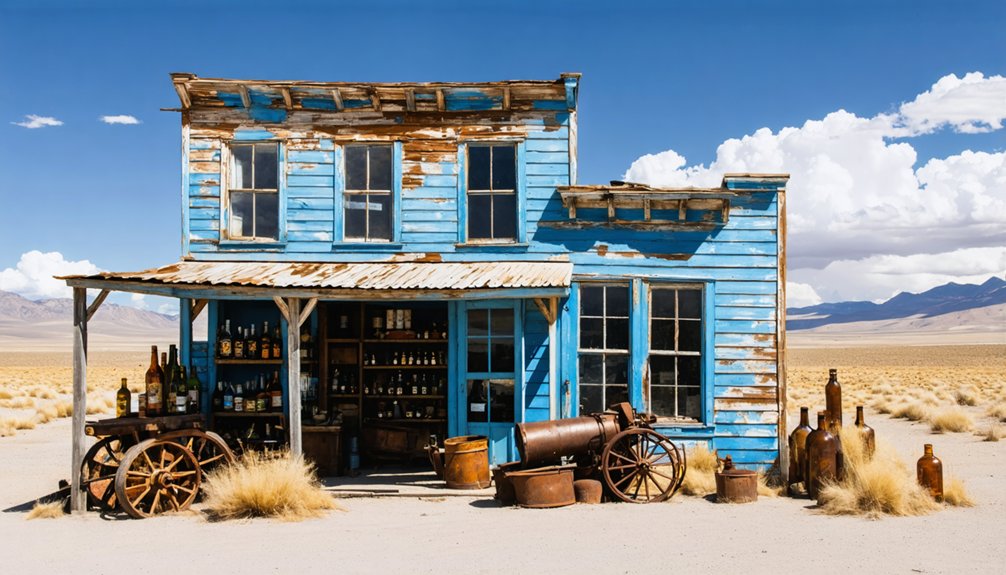
Behind every abandoned storefront and crumbling facade lies a complex story of human departure.
These settlements didn’t simply vanish—they were abandoned as economic foundations crumbled beneath them. Understanding why communities dissolve reveals patterns that continue to shape America’s landscape.
- Resource depletion forced mass exodus when mines exhausted their gold, silver, or coal reserves.
- Transportation shifts like interstate highways and railroad reroutings bypassed once-thriving towns.
- Natural disasters including floods and fires rendered some locations permanently uninhabitable.
- Economic competition from neighboring settlements with better infrastructure drew populations away.
- Environmental contamination, particularly from industrial activities, created toxic conditions that prompted evacuations.
You’ll find these patterns repeated across America’s 500+ ghost towns, where prosperity vanished as quickly as it appeared, leaving only silent reminders of frontier ambition.
Hidden in Plain Sight: Lesser-Known Ghost Towns Worth Exploring
Beyond the well-documented ghost towns that attract thousands of tourists annually, America’s landscape hides hundreds of lesser-known abandoned settlements waiting to be discovered.
One can find these abandoned towns across the US nestled in remote areas, often surrounded by stunning natural beauty. Exploring these locations offers a glimpse into the past and reveals fascinating stories of the people who once called them home. As nature reclaims these spaces, they become hauntingly beautiful reminders of a bygone era.
In Colorado, you’ll find St. Elmo with 200 preserved buildings from the 1880s and Animas Forks, abandoned after brutal winter conditions in 1884.
Arizona’s hidden treasures include Ruby and Kentucky Camp, which once housed 500 gold miners.
Pennsylvania offers unique experiences with Centralia, where an underground coal fire has burned since 1962, and several submerged towns that occasionally reveal themselves when water levels drop.
For forgotten histories frozen in time, visit California’s Bodie, where 200 frontier buildings remain with undisturbed personal belongings—just don’t remove souvenirs, or local legend warns you’ll be cursed.
Modern Ghosts: Recently Abandoned Communities Across America
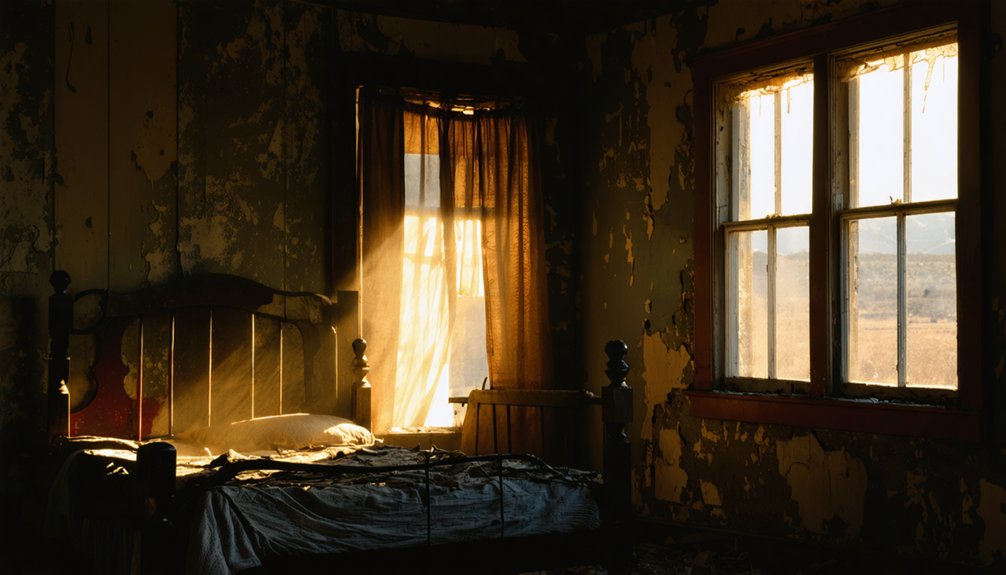
Unlike America’s historical ghost towns that evoke the Old West, a new generation of abandoned communities has emerged across the country in just the past few decades.
These modern ghost settlements offer fascinating opportunities for urban exploration while raising questions about community revival potential.
- Cities like Detroit exemplify this trend with nearly 30% of homes vacant for two+ years.
- Economic devastation has struck places like Flint, MI, where home values plummeted to 14% of state median.
- Retirement communities have experienced 40%+ population decreases as residents age out.
- ZIP codes in Montgomery, AL and Robbins, IL show vacancy rates exceeding 19%.
- Former institutional areas like Old Joliet Prison stand as monuments to abandonment.
These communities tell a different story of decline – not from depleted gold mines, but from economic shifts, aging populations, and industrial collapse.
Preserving the Past: Conservation Efforts for Historic Ghost Towns
As ghost towns across America face inevitable decay, preservation efforts have emerged to protect these physical monuments to the nation’s complex past. The National Park Service has invested millions—$7 million for Thurmond, West Virginia alone—to stabilize historic structures essential to ghost town preservation.
You’ll find local communities partnering with federal agencies to secure diminishing conservation funding, often supplemented by private partnerships and fundraising initiatives.
Heritage conservation typically combines tourism development with educational programs that highlight mining history and cultural legacies.
When you visit these preserved settlements, you’re supporting sustainable tourism practices that balance preservation with economic resilience.
The most successful projects actively involve local communities, ensuring these forgotten places maintain their authenticity while generating new economic opportunities through responsible heritage tourism.
Frequently Asked Questions
Are There Legal Protocols for Exploring Abandoned Ghost Towns?
Yes, you must obtain permission from property owners for urban exploration, as trespassing carries legal ramifications. Research ownership records, secure written consent, and only explore publicly accessible ghost towns.
How Do Underwater Ghost Towns Affect Local Ecosystems?
Like sunken treasure chests, underwater ghost towns create complex habitats where underwater flora flourishes and aquatic fauna diversifies. You’ll find they alter water quality, create artificial reefs, and influence local food webs through changed nutrient cycles.
Can You Legally Claim Property in Abandoned Ghost Towns?
Yes, you can legally claim ghost town property through adverse possession, not mere squatting. You’ll need continuous occupation, tax payments, and formal land reclamation procedures following your state’s specific timeline requirements.
What Indigenous Histories Exist in Ghost Town Territories?
Like faded footprints beneath newer trails, you’ll find rich indigenous heritage throughout ghost towns. The Four Corners region alone contains 600+ Ancestral Puebloan sites, reflecting complex cultural preservation predating European arrival.
How Do Ghost Towns Impact Surrounding Property Values?
You’ll face property depreciation of nearly 9.4% within 500 feet of vacant properties. Ghost towns crush investment potential, creating a cyclical decline that reduces tax bases and deteriorates nearby neighborhoods.
References
- https://devblog.batchgeo.com/ghost-towns/
- https://www.mythfolks.com/haunted-us-ghost-towns
- https://albiongould.com/ghost-towns-to-visit-in-the-states/
- https://www.frrandp.com/p/ghost-towns-map.html
- https://www.geotab.com/ghost-towns/
- https://www.loveproperty.com/gallerylist/83211/modern-ghost-towns-where-noone-lives
- https://www.youtube.com/watch?v=o9MTF3S_-Uk
- https://en.wikipedia.org/wiki/Lists_of_ghost_towns_in_the_United_States
- https://www.legendsofamerica.com/gt-hiddentales/
- https://www.thewanderingappalachian.com/post/the-underwater-towns-of-appalachia