Appalachian ghost towns harbor tales of industrial boom and human sacrifice beneath their crumbling foundations. You’ll discover remnants of company towns where over 70,000 miners died fueling America’s growth, secret underground networks that fostered resistance against corporate control, and abandoned structures telling stories of moonshining and self-sufficiency. From Blair Mountain’s bloody labor battles to forgotten cemeteries, these silent hollows whisper secrets of resilience that shaped mountain culture for generations.
Key Takeaways
- Secret underground tunnel networks served as transportation, social hubs, and union organizing spaces for mining communities.
- Over 70,000 miners died during the coal boom, with their stories preserved in forgotten cemeteries and oral histories.
- Abandoned structures like stone chimneys and company stores reveal economic paternalism and control by coal operators.
- Moonshining operations and agricultural tools illustrate resilience and self-sufficiency of mountain communities facing hardship.
- Hidden architectural remnants across 3,800 ghost towns document the dramatic lifecycle from industrial prosperity to resource-driven abandonment.
The Rise and Fall of Appalachian Company Towns

As the Industrial Revolution spread its mechanical fingers through America’s rugged eastern mountains in the late 19th century, company towns sprouted like determined wildflowers across the Appalachian landscape.
You’d find coal operators building entire communities around mine shafts, controlling everything from the store where you’d buy your flour to the doctor who’d set your broken arm.
These company towns emerged across all thirteen Appalachian states, creating industrial hubs that ranged from thriving communities to struggling settlements.
These company town dynamics transformed isolated hollers into bustling industrial centers, with railroads carving paths to previously unreachable terrain in places like Johnson City and Roanoke. The arrival of railroad networks after 1880 dramatically opened the region to outside investors seeking to exploit its rich natural resources.
The economic paternalism was a double-edged sword—you might enjoy company-built schools and hospitals, but you’d pay for it with your freedom.
When outside competition and mechanization arrived, companies abandoned their “utopian” experiments, leaving behind empty streets and hollow buildings as silent witnesses to a vanished way of life.
Secret Underground Networks of Mining Communities
When you walk through an Appalachian ghost town today, you’re standing above an invisible world of tunnels where miners once moved coal, secrets, and solidarity beneath your feet.
These underground networks weren’t just for hauling coal—they became the veins of miners’ social lives, places where union whispers spread and workers crafted their own rules away from company eyes. Before modern safety innovations, miners relied on primitive detection methods like canaries to alert them to deadly methane gas accumulation. These underground operations were later replaced as companies shifted to surface mining techniques that transformed the landscape.
You’ll never see most of this hidden infrastructure now, but these subterranean passages tell more about Appalachian mining life than the weathered buildings that remain above ground.
Hidden Tunnels, Vibrant Lives
Beneath the weathered hills of Appalachia, where daylight never reached, sprawled intricate labyrinths of tunnels that served as the lifeblood of coal country.
You’d find not just coal seams but entire hidden passageways—six to eight interconnected tunnels reinforced with roof bolts and sturdy pillars of unmined coal.
These weren’t merely workspaces; they were vibrant communities. Miners spent more hours below ground than above, creating underground economies and social networks amid the hum of continuous miners and clanking shuttle cars.
Mules trudged through dimly lit corridors while men communicated through a language of signals unique to their subterranean world. These dangerous conditions contributed to miners rarely living past 30 years of age during the early days of coal mining. The devastating black lung disease plagued countless miners who survived the immediate dangers of cave-ins and explosions.
Secret “needle” tunnels allowed safe blasting, while engineered escape routes offered hope during disasters.
Every tunnel told stories of lives lived in darkness, breathing the same heavy air, facing the same dangers together.
Miners’ Invisible Social Webs
While the tunnels themselves ran deep into Appalachian mountains, the invisible networks binding miners ran deeper still. You wouldn’t see these social webs on any company map, but they sustained communities against corporate control.
Miners shared coded language and secret meeting spots to organize resistance networks while evading company spies. When payday scrip trapped families in debt, mutual aid systems provided what company stores wouldn’t. Workers organizing these networks risked immediate eviction from housing if company officials discovered their involvement. The early 20th century mine wars exemplified these communities’ determination in their struggle against exploitation by coal companies.
- Hand-delivered notes passed between shifts coordinated miners’ solidarity actions despite bosses’ surveillance.
- Sunday gatherings after church served as cover for organizing resistance while appearing as simple social events.
- Women’s sewing circles preserved cultural traditions while secretly distributing resources to striking families.
These invisible connections formed the true foundation of mining communities—a parallel society where freedom survived despite company control.
Submerged Settlements: Ghost Towns Beneath Appalachian Lakes

Deep under the placid waters of Appalachia’s vast lakes lie the remnants of once-thriving communities, their stories preserved like time capsules beneath the surface.
These submerged histories include Gad, West Virginia, purchased by the Army Corps in the 1960s before Summersville Lake swallowed it whole. Every decade, draining reveals ghostly roadways and foundations.
You’ll find similar forgotten legacies at Lake Jocassee, where scuba divers glimpse the community with remarkable clarity—sometimes seeing 50 feet deep. The historical Attakulla Lodge still stands intact underwater, having resisted bulldozers during the initial flooding of the valley.
Proctor, once a bustling lumber town, now rests under Fontana Lake, its residents promised a road home that never materialized.
Meanwhile, Yale sleeps beneath massive Lake Cumberland, occasionally revealing itself during low water.
These underwater towns tell a recurring Appalachian tale—communities sacrificed for flood control and power generation. Summersville Lake’s crystal-clear waters earned it the nickname Little Bahamas of the East, attracting scuba divers to explore its underwater ghost town.
The Forgotten Railroad Hubs That Built America
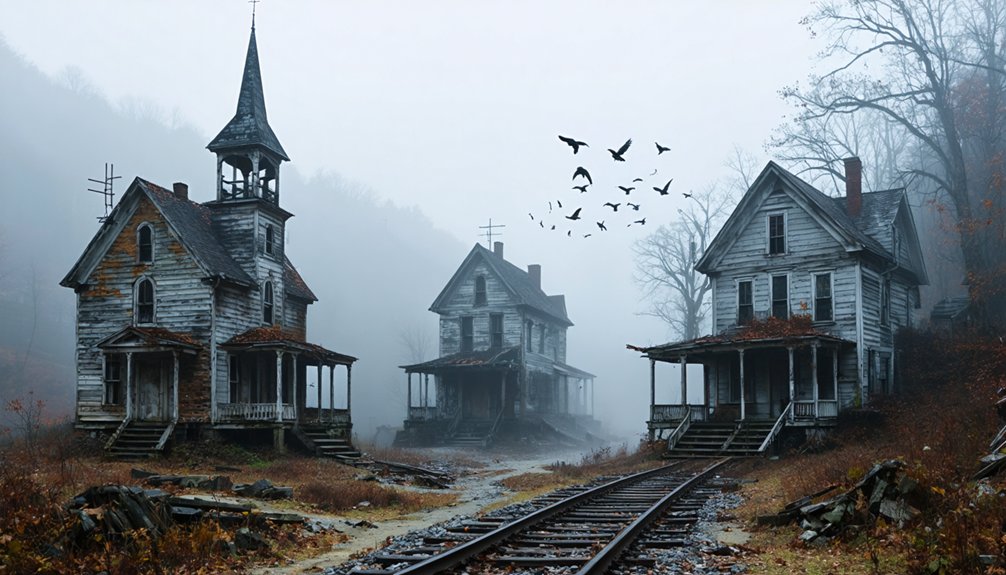
Throughout the rugged valleys and winding mountain passes of Appalachia, abandoned railroad towns stand as silent witnesses to America’s industrial coming-of-age.
You’re walking in the footsteps of convict laborers who toiled and died creating the Swannanoa tunnel, completed in 1879. Railroad innovation transformed places like Elkmont from timber outposts to thriving resort communities, while bypassing others like Andersonville, dooming them to fade away.
- The Little River Railroad’s ingenious routes carried both logs and tourists, doubling its economic impact.
- Wealthy vacationers flocked to the “Elkmont Special,” turning former logging camps into pleasure grounds.
- Blood-bought tunnels and tracks connected isolated communities to America’s industrial heartland.
These ghostly depots whisper stories of brutal labor, booming commerce, and the freedom of the rails.
Untold Labor Struggles in Mountain Coal Communities
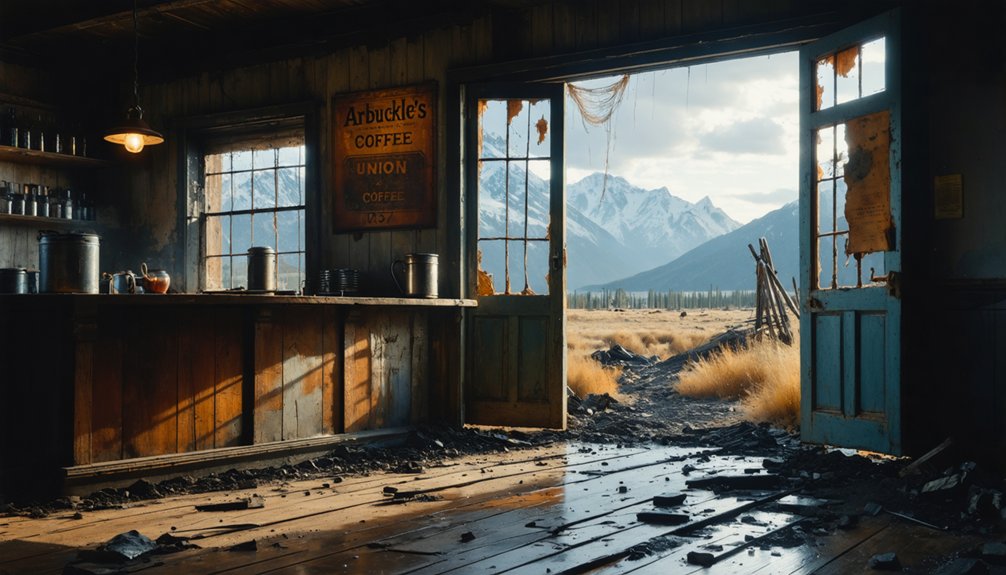
Hidden beneath the coal-blackened hills of Appalachia lies a history written in blood and solidarity.
Hidden beneath Appalachia’s scarred mountains, generations of miners wrote their legacy with courage and collective resistance.
You’d walk these abandoned company towns today without knowing that over 70,000 miners died during the industrial coal boom, their sacrifice fueling America’s growth while their families fought for basic dignity.
When miners secured their first wage agreements after the New Deal, it represented liberation from company control. Their labor rights came at a terrible cost—the Battle of Blair Mountain in 1921 left 133 dead, mostly workers standing against coal companies and their armed enforcers.
As mechanization replaced men with machines, mining employment plummeted from 122,102 in 1985 to just 53,509 twenty years later, leaving union struggles and economic hardship in its wake—ghostly reminders of Appalachia’s unfinished fight for justice.
From Boom to Abandonment: The Lifecycle of Resource Towns
While coal seams beckoned beneath the ancient mountains, company men arrived with surveying equipment and bold promises, transforming pristine hollows into instant towns that sprang up like mushrooms after a spring rain.
You’d witness Appalachian slopes soon lined with cookie-cutter company houses while rail lines snaked through wilderness, connecting these isolated communities to the nation’s industrial heartbeat.
The lifecycle followed a predictable pattern:
- First came the surge—towns like Thurmond and Clinchco bustling with 26,000 souls crammed into mere square miles
- Then came resource scarcity—when seams thinned and profits dwindled
- Finally, exodus—families uprooting generations of mountain heritage, dismantling homes board by board for firewood
Despite everything, community resilience remained, etched in the weathered faces of those who refused to leave their mountain homes.
Cultural Landmarks Lost to Time and Nature
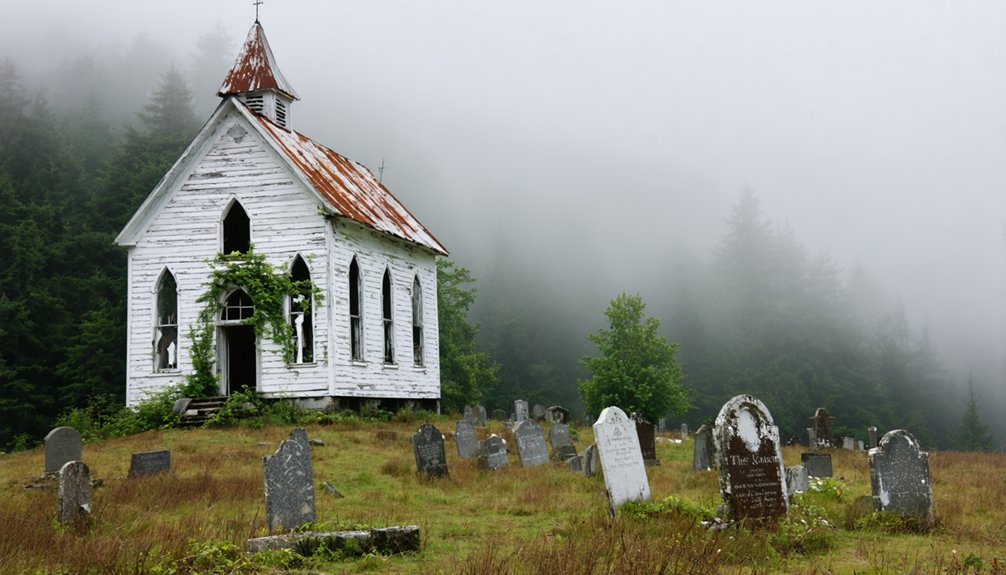
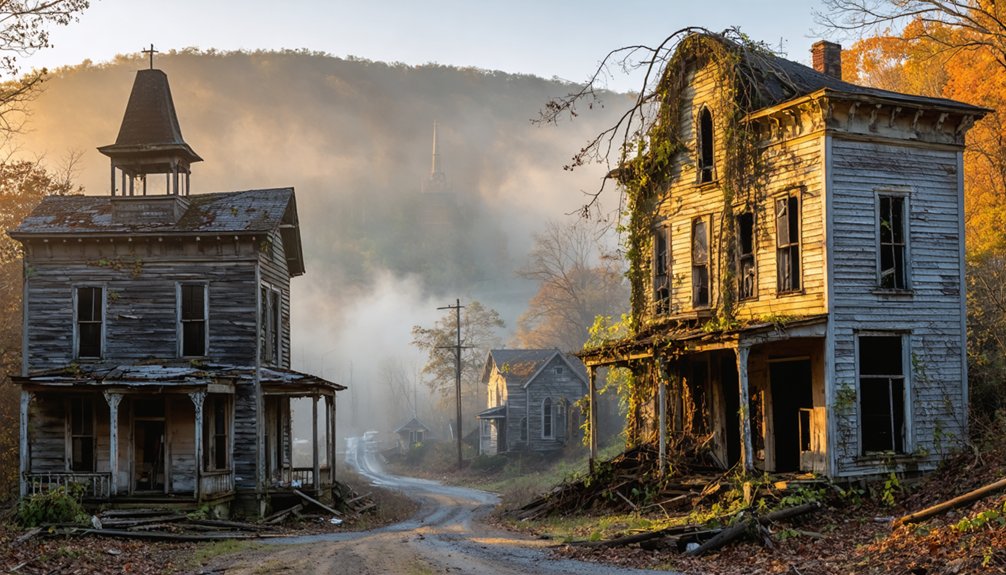
As autumn’s golden light filters through leaf-bare branches, you’ll find the ghosts of Appalachian culture standing silent against time’s relentless march—stone chimneys rising from forest floors like lonely sentinels, forgotten cemeteries where names fade from weathered markers, and abandoned rail lines swallowed by kudzu and mountain laurel.
These places hold immense cultural significance beyond their crumbling structures. You might stumble upon the rusted remains of a moonshiner’s still or discover agricultural tools that tell stories of self-sufficient mountain families.
Local volunteers work tirelessly in historical preservation, documenting burial grounds where epitaphs reveal the hardships and triumphs of those who came before. The names of these communities survive primarily through oral histories passed down generations—fragile threads connecting you to a freedom-loving past that refuses to be entirely forgotten.
Photography and Documentation of Vanishing Mountain Heritage
You’ll find stories etched in the weathered timbers and stone foundations that photographers race to document before mountain rains and tenacious kudzu claim the last standing structures of these forgotten communities.
Through careful framing and patient observation, your camera becomes a time machine, preserving visual histories of company stores, one-room schoolhouses, and coal tipples that once buzzed with life.
Mountain ruins, when captured in morning mist or golden hour light, transform into haunting portraits of Appalachian resilience, revealing both the harsh realities and quiet dignity of those who called these vanishing places home.
Capturing Last Structures
Weathered timber and rusting metal reveal stories that words alone can’t tell in Appalachia’s vanishing communities. When you stand before Elkmont’s preserved cabins or Thurmond’s empty storefronts, you’re witnessing the last chapters of mountain cultural significance.
Photographers and explorers document these fading historical narratives before nature reclaims them completely.
- Stone chimneys standing like sentinels where family homes once bustled with life
- Abandoned mining equipment rusting quietly along overgrown paths, evidence of industrious hands
- Wooden stairs at Kaymoor descending to nowhere, connecting present visitors to past laborers
These structures—whether the collapsed Wonderland Hotel or submerged towns like Proctor—aren’t just buildings; they’re physical memories of mountain folk who lived, worked, and built communities that deserve remembering.
Preserving Visual Histories
While the last stone foundations crumble into forest floors, dedicated photographers and filmmakers race to capture Appalachia’s vanishing communities through thoughtful visual documentation.
You’ll find their visual storytelling techniques elevate these forgotten places—wide-angle shots frame entire streetscapes while close-ups of weathered door handles and ornate window frames reveal the craftsmanship that once defined mountain life.
Documentary preservation efforts like “Almost Ghost Town” capture Thurmond’s transformation through resident narratives, letting mountain folks tell their stories in authentic voices.
Black-and-white photography alongside color creates both historical gravity and present-day urgency. Through digital archives, over 3,800 ghost towns now exist online, their memories preserved before collapse.
Walking tours led by local historians guide you through rusted mining equipment and forgotten cemeteries—tangible connections to a heritage that refuses to vanish quietly.
Mountain Ruins Reimagined
As morning light spills through broken windows onto warped floorboards, photographers armed with specialized equipment transform Appalachia’s forgotten places into powerful visual testimonies.
You’ll find haunted histories captured through wide-angle shots of entire streetscapes alongside close-ups that reveal architectural echoes in doorways and window frames.
- Black and white photography strips away time, revealing the stark bones of jails, churches, and coal company stores that once bustled with mountain life.
- Interior shots document the silent stories told by abandoned possessions—a child’s toy, a mining ledger, a faded calendar still hanging in a post office.
- Specialized techniques capture submerged towns like Loyston and Proctor, where underwater preservation creates time capsules of mountain communities sacrificed for progress.
How Tourism Transformed — Then Abandoned — Appalachian Getaways
In the early twentieth century, affluent families seeking refuge from crowded cities discovered Appalachia’s pristine wilderness, forever changing the region’s economic landscape.
You’d have found places like Elkmont’s Daisy Town and the Wonderland Hotel catering to blue-blood families building exclusive cabins in these mountain retreats.
Tourism trends transformed remote outposts into thriving destinations.
Thurmond became the Chesapeake & Ohio Railroad’s most profitable stop, while Ghost Town in the Sky’s chairlift shuttled 1,200 visitors hourly through Maggie Valley.
These economic shifts created prosperity that seemed permanent.
But paradise didn’t last.
The Great Depression, diesel replacing coal, and shifting transportation patterns abandoned these once-bustling getaways.
When the National Park Service acquired much of this land, they extinguished lifetime leases, leaving ghost towns where laughter once echoed through Appalachian hollows.
Walking Through History: Exploring Preserved Ghost Town Ruins Today
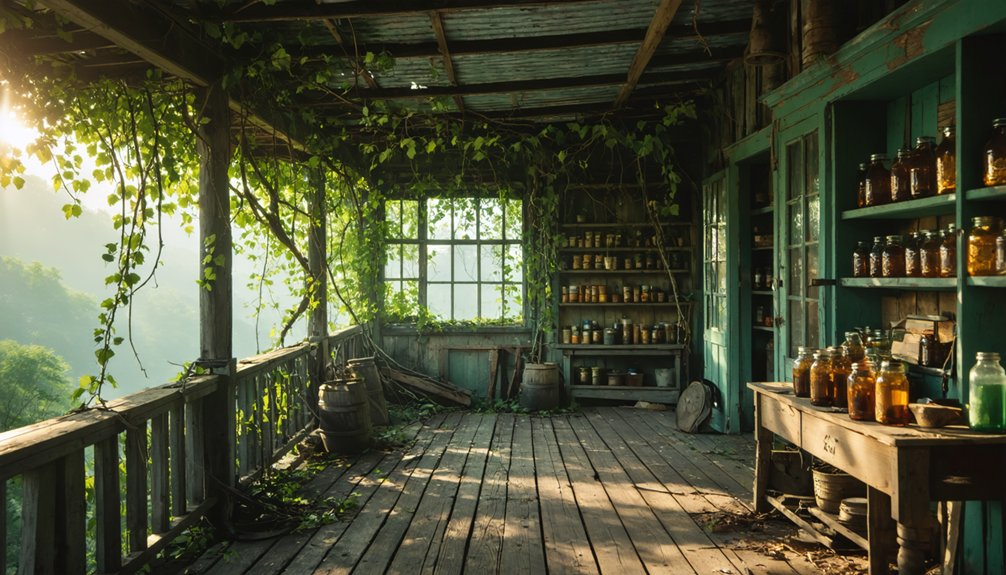
Today, these forgotten corners of Appalachia stand frozen in time, waiting for visitors to uncover their secrets.
You’ll find hidden histories etched into architectural remnants at places like Elkmont’s preserved Appalachian Club buildings, where wealthy families once escaped summer heat, or in Thurmond’s narrow streets where coal dust still seems to hang in the air.
These ghost towns tell tales of boom-and-bust cycles that defined mountain life.
- Trek wooden stairs at Kaymoor to discover moss-covered mining tipples where generations of miners once toiled
- Paddle to Andersonville Island when Hartwell’s waters recede, revealing foundations of a community that refused to be forgotten
- Follow backcountry trails to No Business, where scattered stone ruins whisper stories of moonshining and mountain resilience
Frequently Asked Questions
Did Ghost Towns Have Paranormal Activity or Haunting Legends?
Like moths to a flame, you’ll find ghost towns crawl with paranormal activity. Point Pleasant’s abandoned TNT area buzzes with ghost sightings, while haunting legends thrive in Thurman’s forgotten hollows and Little River’s empty cabins.
Explorations often lead adventurers to abandoned towns in the American South, where time seems to stand still. Each decaying structure tells a story of those who once called it home, their whispers lingering in the air. The remnants of these towns serve as a haunting reminder of a bygone era, evoking both curiosity and unease among visitors.
How Did Natural Disasters Affect the Abandonment of These Towns?
You’ll find natural catastrophes like dam-built floods, raging fires, and economic collapse hollowed these mountain communities right out. Disasters washed away homes, burned businesses, and hastened town decline when folks couldn’t rebuild their lives.
What Indigenous Histories Existed Before These Towns Were Established?
Before your ghost towns sprouted, you’d have found Cherokee, Shawnee, and other indigenous tribes livin’ off this land for thousands of years, leavin’ behind mounds of cultural significance and intricate trade networks.
Were There International Immigrant Communities in Appalachian Ghost Towns?
You’ll find whispers of Italian, German, and Eastern European immigrant narratives echoing through these forgotten hollers. Coal companies recruited foreign workers who brought their cultural influences—enriching Appalachian towns with diverse traditions we’ve nearly lost.
How Did Prohibition Impact Social Life in Isolated Mining Communities?
You’d find bootlegging culture thrived in them hollers, where moonshine stills replaced legal taverns. Social gatherings moved underground, with folks risking raids just to share a jar and mountain music together.
References
- https://www.youtube.com/watch?v=4oHlJFXbrCk
- https://www.geotab.com/ghost-towns/
- https://appalachianmemories.org/2025/10/16/the-lost-towns-of-appalachia-the-forgotten-mountain-communities/
- https://www.blueridgeoutdoors.com/go-outside/southern-ghost-towns/
- https://www.thewanderingappalachian.com/post/the-underwater-towns-of-appalachia
- https://jrap.scholasticahq.com/api/v1/articles/9543-the-economics-of-ghost-towns.pdf
- https://www.appalachianplaces.org/post/appalachia-s-other-company-towns
- https://npshistory.com/publications/usfs/region/8/history/intro.htm
- https://www.fs.usda.gov/nrs/pubs/jrnl/2021/nrs_2021_zipper_001.pdf
- https://www.100daysinappalachia.com/2021/09/commentary-appalachia-can-prove-company-towns-dont-lift-the-working-class/