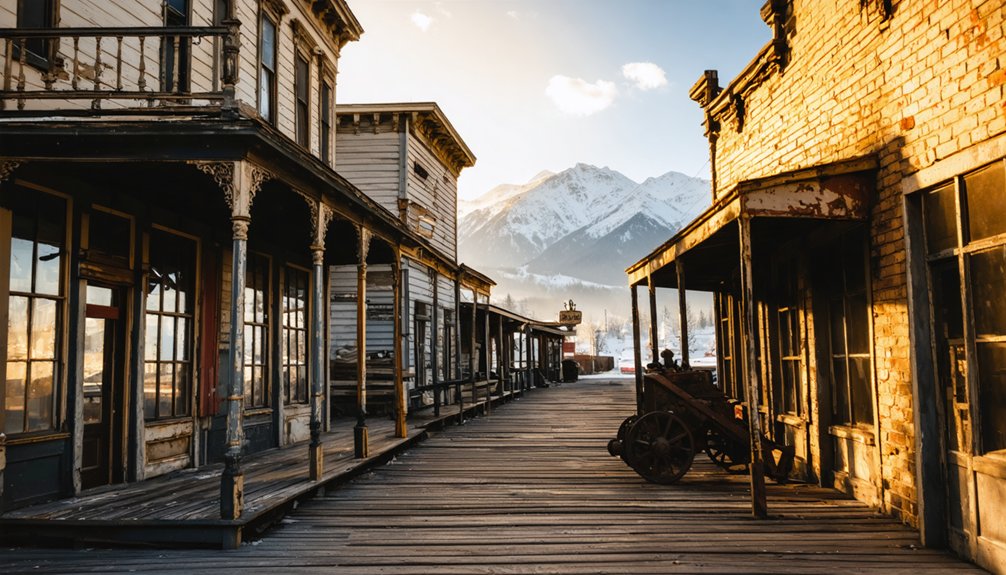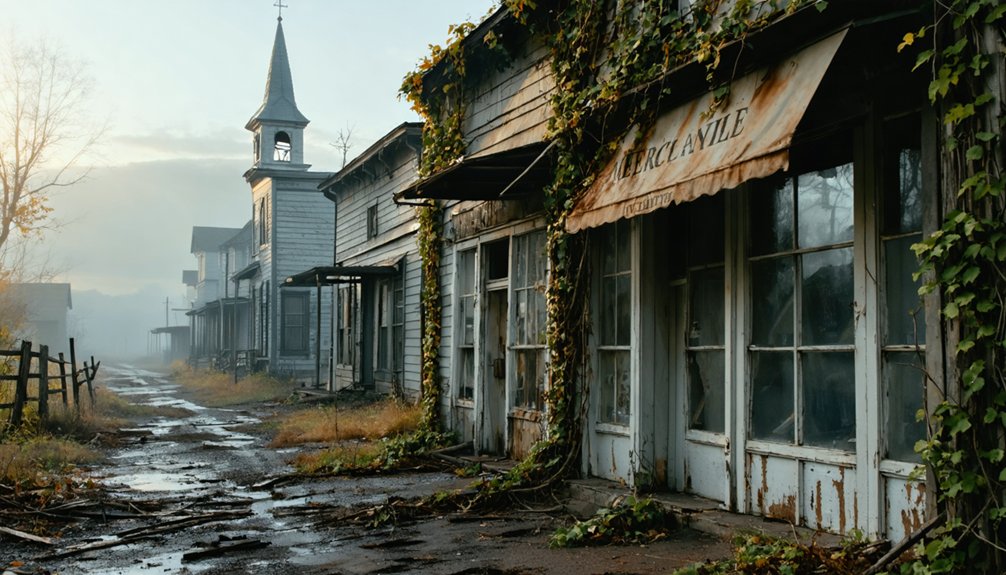
You’ll discover remarkable Victorian ghost towns across America’s rugged landscapes, from Alaska’s red-painted Kennecott Mine buildings to Colorado’s well-preserved St. Elmo. These abandoned 19th-century settlements showcase ingenious architecture that withstood extreme conditions during gold and silver rushes. Idaho’s twin towns of Custer and Bonanza feature intact saloons and schoolhouses, while Elkmont’s decaying cabins hide in Appalachian forests. Each site reveals compelling stories of boom-to-bust cycles that shaped American frontier history.
Key Takeaways
- Kennecott Mine in Alaska offers preserved red buildings with $32.4 million peak production history in Wrangell-St. Elias National Park.
- Elkmont’s Silent Cabins in Great Smoky Mountains showcase decaying vacation retreats abandoned after lifetime leases expired in 1992.
- Animas Forks sits at 11,200 feet with preserved Duncan House and evidence of tunnel systems built for surviving harsh winters.
- St. Elmo features 43 original Victorian structures from the 1880s gold rush and is listed on the National Register of Historic Places.
- Twin towns Custer and Bonanza in Idaho maintain original saloons and schoolhouses with summer caretakers offering tours of seven historically registered structures.
The Copper Kingdom: Kennecott Mine’s Rise and Fall
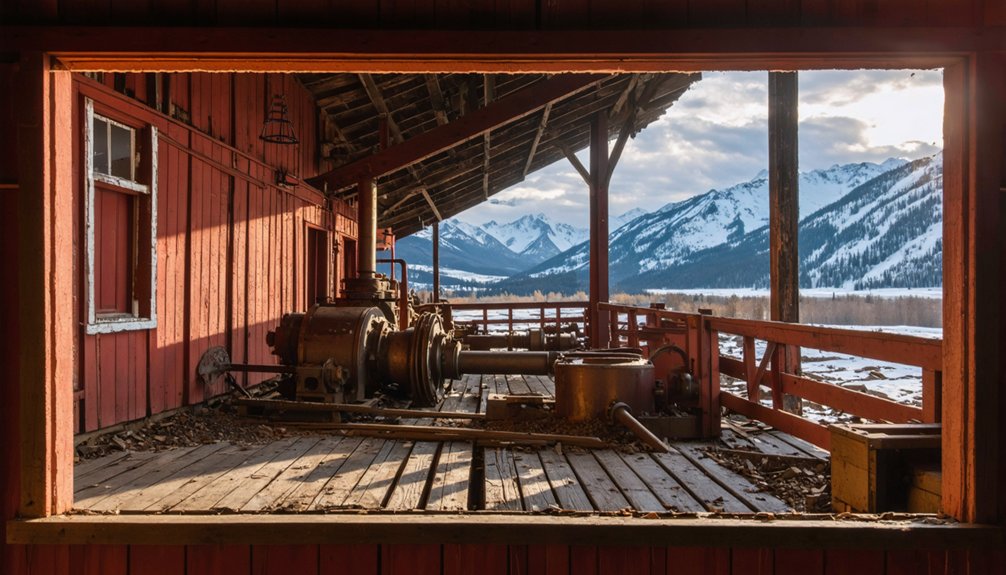
While the American West is renowned for its gold rush ghost towns, the story of Kennecott Mine in Alaska offers a fascinating glimpse into America’s lesser-known copper boom. Discovered in 1900 near Kennicott Glacier, this copper extraction powerhouse began operations in 1911 after the Alaska Syndicate invested $25 million in infrastructure.
At its peak in 1916, the mine produced ore worth $32.4 million, ultimately yielding 4.6 million tons valued at over $200 million before closing. The mining technology required steamship equipment to be transported piece by piece over mountains before railway completion. Today, the site’s iconic red-painted buildings remain preserved within Wrangell-St. Elias National Park, serving as a striking reminder of this once-thriving industrial complex. During its operational years from 1911 to 1938, Kennecott was the largest copper mine in the world, showcasing America’s industrial might in one of its most remote territories.
Elkmont’s Silent Cabins: From Logging Hub to Forgotten Community
Deep in the heart of what’s now Great Smoky Mountains National Park, Elkmont emerged in 1908 as a thriving logging settlement that would eventually transform into one of America’s most hauntingly preserved ghost towns.
The Little River Lumber Company established this once-bustling hub where you’ll now find abandoned Victorian architecture quietly decaying among forest regrowth. It’s worth noting that multiple geographic locations share the Elkmont name across the United States, though this particular ghost town in Tennessee is perhaps the most historically significant.
When logging operations ceased in 1926, Elkmont’s history took a surprising turn as wealthy Knoxville residents purchased plots to create exclusive vacation retreats.
The Appalachian Club and Wonderland Hotel became social centers for the elite until the national park’s establishment in 1934. The Appalachian Club initially served as a gathering place for wealthy men who enjoyed hunting and fishing expeditions before eventually welcoming families.
Residents accepted half-price buyouts with lifetime leases that eventually expired in 1992, leaving behind silent cabins that stand as time capsules of early 20th century leisure culture.
Animas Forks: The Mining Town Buried by Winter’s Wrath
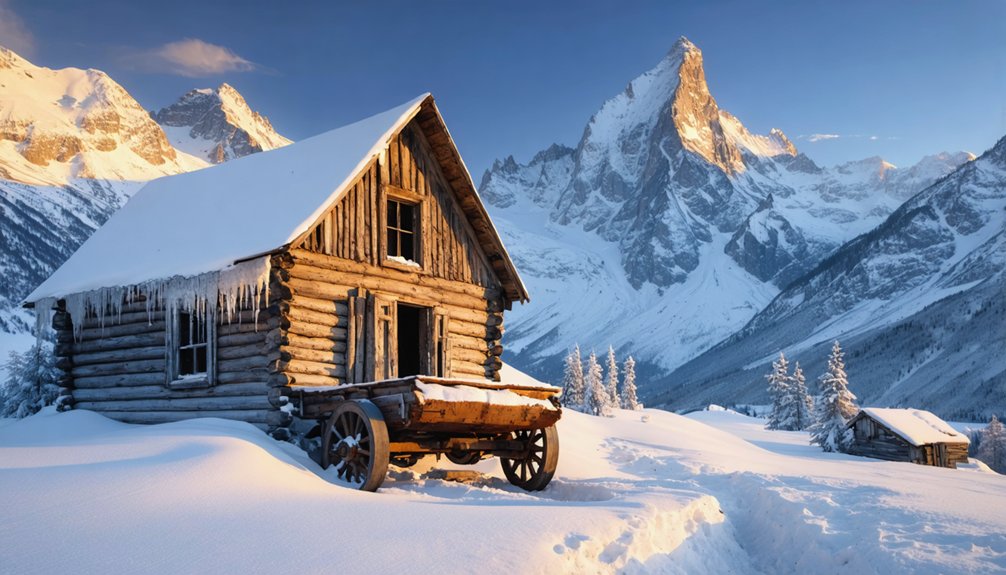
When you visit Animas Forks today, you’ll find a reflection of Victorian ingenuity in the face of 25-foot snowfalls that once buried the entire settlement for weeks at a time.
The town’s preserved structures, including the distinctive two-story Duncan House with its bay windows and the remnants of the once-massive Prince Gold Mill, reveal sophisticated architectural elements unusual for such a remote location at 11,200 feet elevation. Visitors exploring the Alpine Loop can witness one of the most well-preserved ghost towns in the Western United States.
These remaining buildings highlight how residents engineered spaces to withstand crushing snow loads and bitter cold while maintaining Victorian aesthetic sensibilities, despite knowing they’d abandon their homes each winter for warmer Silverton. The devastating blizzard of 1884 left the community snowbound for 23 days, demonstrating the extreme conditions these hardy miners routinely faced.
Extreme Weather Survival
Perched at an elevation of over 11,000 feet in the treacherous San Juan Mountains, Animas Forks exemplifies perhaps the most extreme case of weather-related hardship in American ghost town history.
You’ll find evidence of extreme resilience in the town’s response to the devastating 1884 blizzard that buried structures under 25 feet of snow. Residents engineered tunnel systems between buildings—a remarkable feat of weather adaptation. The historic Duncan house, built in 1879, still stands today as testimony to the sturdy construction needed to withstand such brutal alpine conditions.
The town’s relationship with winter proved persistently challenging. In 1877, a catastrophic avalanche obliterated essential infrastructure, including the smelting works and sawmill, causing $30,000 in losses. Mining activity remained robust despite these challenges, but eventually declined significantly by the turn of the 20th century.
Even during Animas Forks’ boom years, practical residents established a seasonal migration pattern, retreating to Silverton during the harshest winter months rather than battling the alpine elements that repeatedly threatened their existence.
Hidden Architectural Treasures
Amid the harsh conditions that challenged Animas Forks’ survival, remarkable architectural achievements emerged that still stand as symbols to 19th-century innovation and frontier resourcefulness.
You’ll find Victorian architecture that thrived despite the 11,200-foot elevation, including a sophisticated infrastructure network of electricity, telephones, and telegraph systems by the 1880s.
The town’s mining heritage is preserved in the Gold Prince Mill, once Colorado’s largest and most expensive mill, capable of processing 500 tons daily. Visitors can explore the remaining nine preserved buildings that offer a glimpse into the town’s prosperous past.
The 12,600-foot aerial tramway that connected the mill to its mine exemplifies the engineering prowess of these mountain entrepreneurs.
Otto Mears’ essential transportation developments—first with wagon roads in 1875, then the Silverton Northern Railroad by 1904—transformed this remote outpost into a connected economic hub where Victorian sensibilities flourished alongside industrial innovation.
St. Elmo: Colorado’s Best-Preserved Mountain Settlement
The rugged wilderness of Colorado’s Sawatch Mountain Range harbors St. Elmo, debatably the state’s most intact ghost town sitting at nearly 10,000 feet elevation. Founded in 1880 during the gold and silver boom, this Victorian settlement once housed 2,000 residents before mining declined in the 1920s.
You’ll find 43 original structures still standing, offering an authentic glimpse into mining heritage that earned St. Elmo a spot on the National Register of Historic Places. The Denver South Park & Pacific Railroad once connected this remote outpost to civilization until tracks were removed in 1926. The town’s economy thrived with the Mary Murphy Mine shipping up to 75 tons of ore daily during peak operations.
The Stark family’s preservation efforts saved this mountain time capsule from deterioration. While exploring the well-preserved buildings, you might experience the ghostly encounters that have made Annabelle Stark’s spectral presence famous among paranormal enthusiasts.
Idaho’s Silver Legacy: Custer and Bonanza Ghost Towns
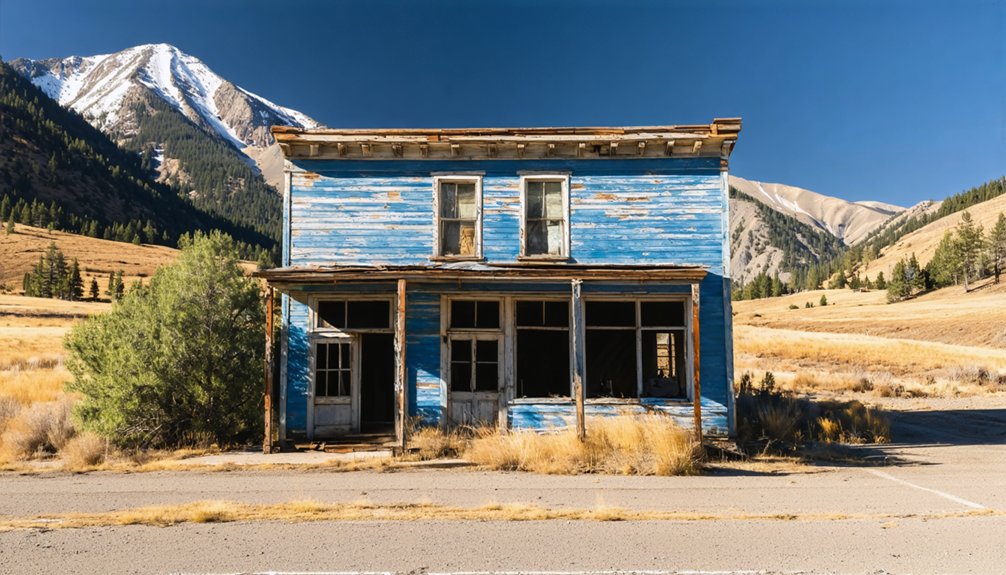
In Idaho’s remote Yankee Fork region, you’ll encounter the remarkable twin ghost towns of Custer and Bonanza, where mining prosperity turned to ruin when gold and silver operations ceased in the early 1900s.
The towns’ histories intertwine through devastating fires that destroyed Bonanza in 1889 and 1897, prompting residents to migrate to Custer, which grew to 600 residents with a thriving Main Street before being largely abandoned by 1910.
Today, dedicated summer caretakers maintain Custer’s preserved structures—including the Empire Saloon, schoolhouse museum, and miners’ cabins—as part of the National Register-listed historic district that showcases Idaho’s Victorian mining heritage.
Mining Prosperity to Ruin
Founded in the wake of significant gold discoveries near the Yankee Fork River, Custer and its neighboring settlement Bonanza epitomize the classic American mining boom-to-bust narrative that characterized the late 19th century frontier.
Visiting these ghost towns reveals the dramatic arc of western mining communities where prosperity vanished almost as quickly as it appeared. The remaining ghost town architecture—weathered saloons, a schoolhouse, and miners’ cabins—stands as evidence of both ambitious enterprise and ultimate abandonment.
When exploring, you’ll encounter three stark reminders of this volatile era:
- Gravestones chronicling mining disasters and avalanches that claimed numerous lives
- The ambitious 3,200-foot aerial tram system that once transported ore
- The 20-stamp mill where millions in gold was processed before economic collapse
Hidden Yankee Fork History
Nestled within Idaho’s rugged central mountains, the Yankee Fork mining district reveals a complex legacy spanning multiple boom-and-bust cycles that transformed this remote valley into a vibrant economic center before its eventual abandonment.
You’ll find Bonanza (established 1877) and Custer (founded 1879) as twin testimonies to gold-driven prosperity, each reaching populations of about 600 during their prime.
After devastating fires struck Bonanza in 1889 and 1897, commercial activity shifted primarily to Custer. By 1911, these once-thriving communities had become ghost towns when major mining operations ceased.
Today, the Land of the Yankee Fork State Park preserves these settlements alongside Bayhorse with its distinctive stone buildings.
The colossal 988-ton gold dredge stands as an industrial monument near the ghost towns, illustrating the evolution from traditional to mechanized mining techniques.
Summer Caretakers Preserve Past
Today, dedicated summer caretakers serve as essential stewards of Idaho’s vanishing Victorian past, safeguarding the fragile remnants of Custer and Bonanza against time’s relentless erosion.
Since 1990, these seasonal guardians have collaborated with the Friends of Custer Museum, Idaho Parks, and the U.S. Forest Service to maintain the Land of the Yankee Fork Historic Area.
When you visit between Memorial Day and Labor Day, you’ll experience summer preservation efforts through:
- Guided tours of seven meticulously maintained structures that qualify for the National Register of Historic Places
- Access to the restored schoolhouse and Empire Saloon with interpretive exhibits detailing mining heritage
- Caretaker stories illuminating the challenges of protecting these sites from weather damage and vandalism
These preservation initiatives guarantee you can still witness these ephemeral symbols to America’s frontier mining legacy.
The Phantom Base: Elko Tract’s Secret Military Past
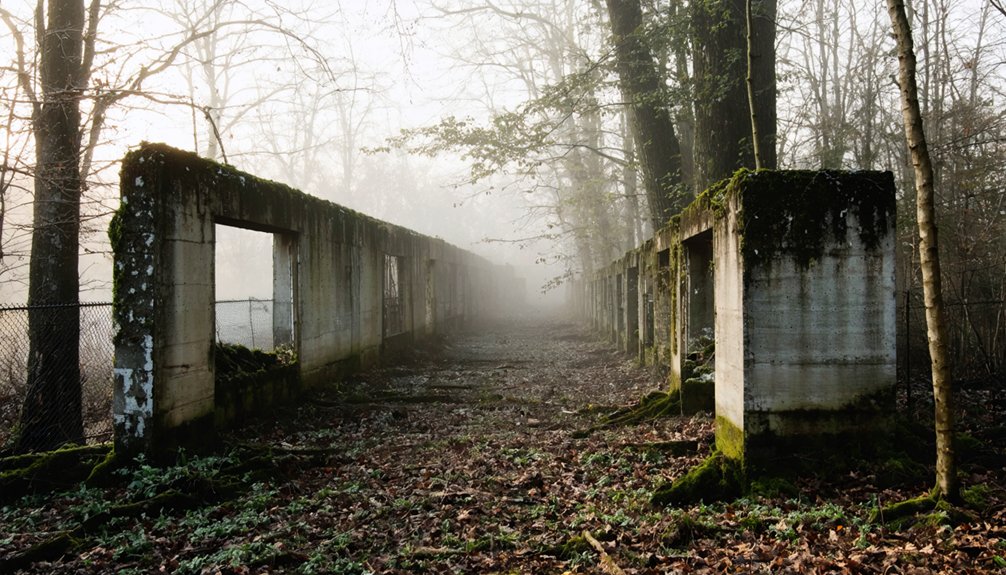
While most Americans associate World War II defense efforts with distant battlefields, the intriguing story of Elko Tract reveals a sophisticated military deception that unfolded on U.S. soil.
This 1942 decoy airfield near Richmond, Virginia, protected critical infrastructure from potential German air attacks through ingenious wartime deception. You’ll find the fingerprints of theatrical expertise throughout the site—plywood aircraft, canvas backdrops, and strategically trimmed vegetation creating bomber-visible shadows.
The U.S. Army’s 1896th Engineer Aviation Battalion constructed this elaborate ruse, displacing local families in secrecy.
Under cloak of wartime necessity, the 1896th Battalion relocated American families, sacrificing their homes for national deception.
After serving its defensive purpose, the tract transformed into a Cold War bombing practice site before being largely abandoned.
Today, “The Lost City” lingers in local mythology while industrial parks rise where fake runways once deceived from above—a reflection of America’s homeland defense ingenuity.
Lost Cove: The Vanishing Appalachian Community
Deep within the remote borderlands of North Carolina and Tennessee lies Lost Cove, an abandoned community whose history epitomizes the complex patterns of Appalachian settlement and decline. Established around 1864 when Morgan Bailey purchased land for a mere $10 and a shotgun, this isolated enclave thrived in self-sufficiency without paved roads.
Lost Cove history reflects Appalachian culture through:
- Economic adaptation – from timber harvesting to moonshine production during Prohibition
- Geographic isolation – situated in disputed territory between states, fostering unique cultural development
- Community resilience – maintaining social structures through church and school despite challenging conditions
You’ll find only ruins today, as the last family departed on January 1, 1958, unable to sustain their lifestyle as modernization rendered their traditional ways economically unviable.
Grafton: The Mormon Ghost Town That Hollywood Rediscovered
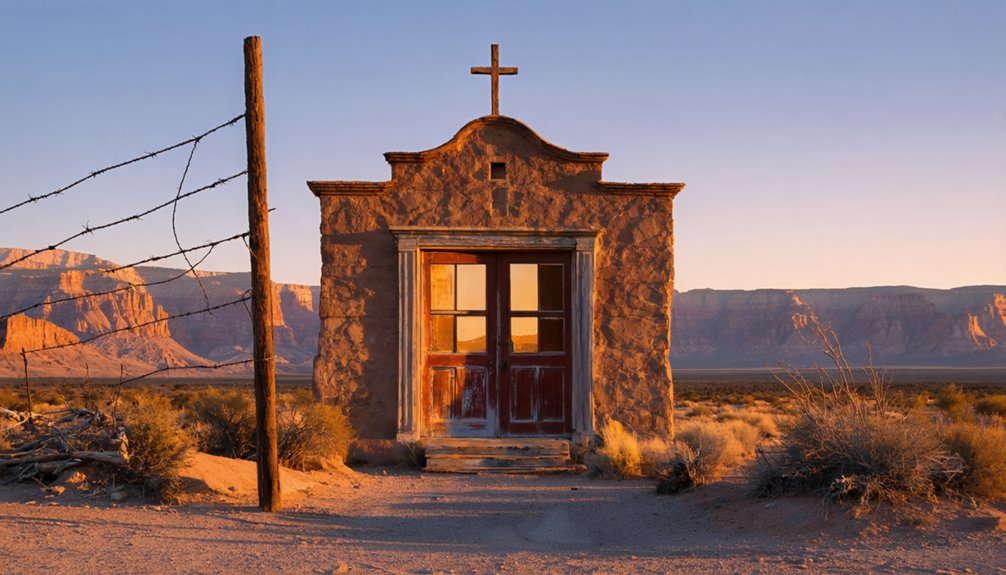
Unlike Lost Cove’s remote Appalachian setting, Grafton stands as a demonstration of Mormon pioneering ambition in Utah’s arid landscape. Founded in 1859 as part of Brigham Young’s Cotton Mission, this settlement along the Virgin River showcases the determination of Mormon pioneers seeking self-sufficiency and religious freedom.
Grafton’s history reveals the harsh realities of frontier life. After a devastating 1862 flood destroyed the original site (then called Wheeler), settlers relocated upstream and renamed it after their Massachusetts hometown.
Despite persistent challenges—recurring floods, irrigation difficulties, and violent conflicts with Southern Paiute and Navajo peoples—the community persisted until the early 20th century. By 1944, the last resident departed, leaving behind the iconic two-story adobe schoolhouse that now attracts photographers and history enthusiasts to this symbol of Mormon settlement resilience.
Gold Rush Remnants: South Pass City’s Mining Heritage
When gold was discovered along Willow Creek in 1867, South Pass City erupted into existence as Wyoming’s quintessential boom-and-bust mining settlement. The Carissa mine, initially located as the “Carisa lode,” became the district’s most significant gold mining operation, yielding over $15,000 in its first year despite primitive extraction methods.
You’ll find this remarkably preserved slice of Western history showcases:
- Original structures from its 3,000-resident heyday, including hotels, saloons, and government buildings from when it served as Carter County’s seat
- The Carissa mine complex with intact stamp mills demonstrating 19th-century ore processing techniques
- Artifacts documenting daily life amid Native American conflicts that necessitated Fort Stambaugh’s establishment in 1870
Today’s historical preservation efforts maintain South Pass City as a living museum of America’s frontier gold rush experience, offering you authentic glimpses into Victorian-era mining life.
Frequently Asked Questions
Can Visitors Stay Overnight in Any American Ghost Towns?
Yes, you can enjoy ghost town accommodations in several locations, including St. Elmo and Dunton in Colorado, and Gold Point in Nevada, offering authentic overnight experiences with historical ambiance.
What Paranormal Activity Is Commonly Reported in These Victorian Settlements?
Over 75% of visitors to Victorian ghost towns report paranormal encounters. You’ll experience disembodied voices and temperature drops at haunted locations like abandoned mines and saloons, where spectral sightings of miners and settlers are commonplace.
Exploring hidden ghost towns in California takes you deeper into the eerie history of the Wild West. Each corner of these deserted streets tells a story, inviting you to uncover the mysteries of those who once thrived there. As you walk among the crumbling structures, you might just sense the lingering presence of the past.
How Are Artifacts Protected From Theft and Vandalism?
You’ll find artifacts protected through legal frameworks like ARPA, physical security measures including surveillance, community education programs, and conservation practices—all working together for effective theft prevention and artifact preservation at these historic sites.
Do Any Ghost Towns Offer Guided Tours With Historical Reenactments?
Yes, you’ll find guided experiences in Virginia City, Calico, and Bodie featuring costumed interpreters who demonstrate Victorian mining life, providing immersive historical education through authentic reenactments of 19th-century daily activities.
Which Ghost Towns Are Accessible for Visitors With Mobility Limitations?
Virginia City (Nevada) offers the best accessibility with free shuttles, while Jerome (Arizona) and Virginia City (Montana) provide paved access. You’ll find limited accessible trails but typically no wheelchair rentals.
References
- https://albiongould.com/ghost-towns-to-visit-in-the-states/
- https://devblog.batchgeo.com/ghost-towns/
- https://www.mythfolks.com/haunted-us-ghost-towns
- https://www.blueridgeoutdoors.com/go-outside/southern-ghost-towns/
- https://mwg.aaa.com/via/places-visit/western-ghost-towns
- https://www.geotab.com/ghost-towns/
- https://en.wikipedia.org/wiki/Lists_of_ghost_towns_in_the_United_States
- https://www.atlasobscura.com/lists/americas-best-preserved-ghost-towns
- https://www.legendsofamerica.com/gt-hiddentales/
- https://www.youtube.com/watch?v=ONtJ-QTcMWo