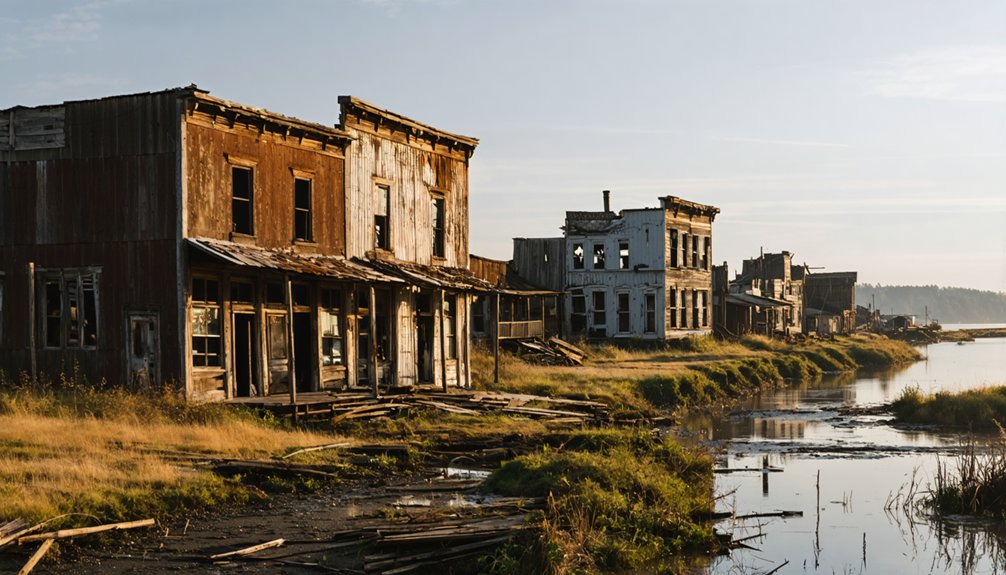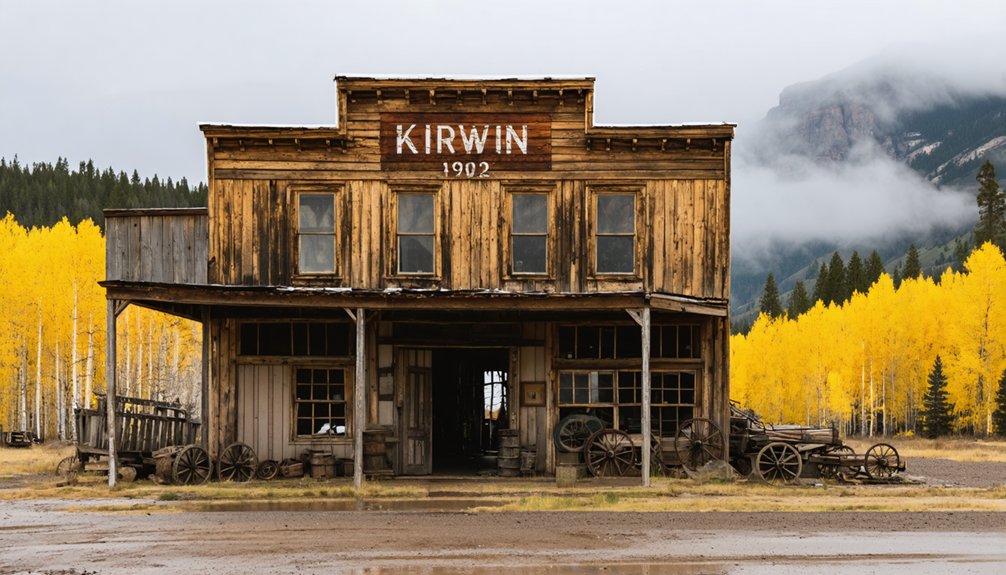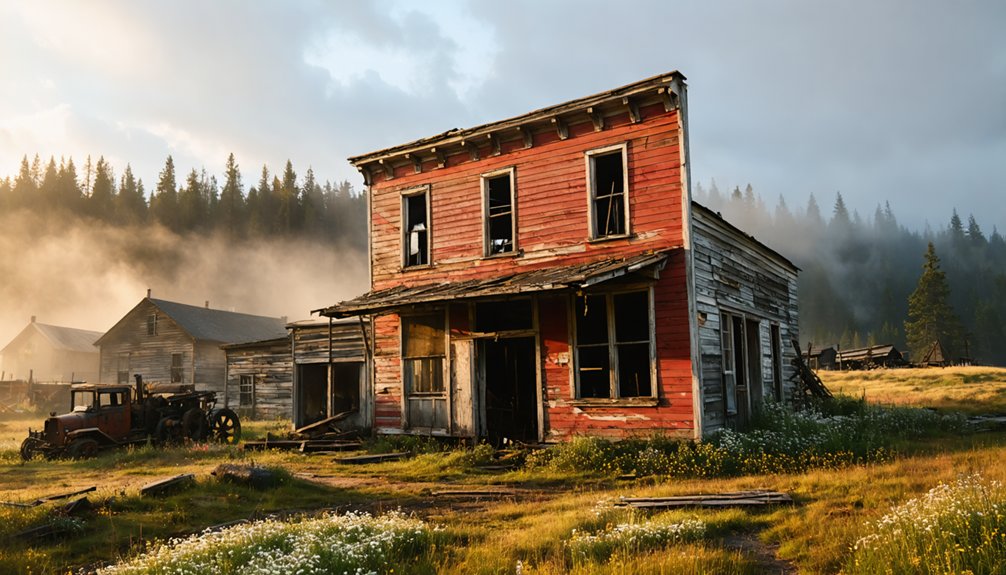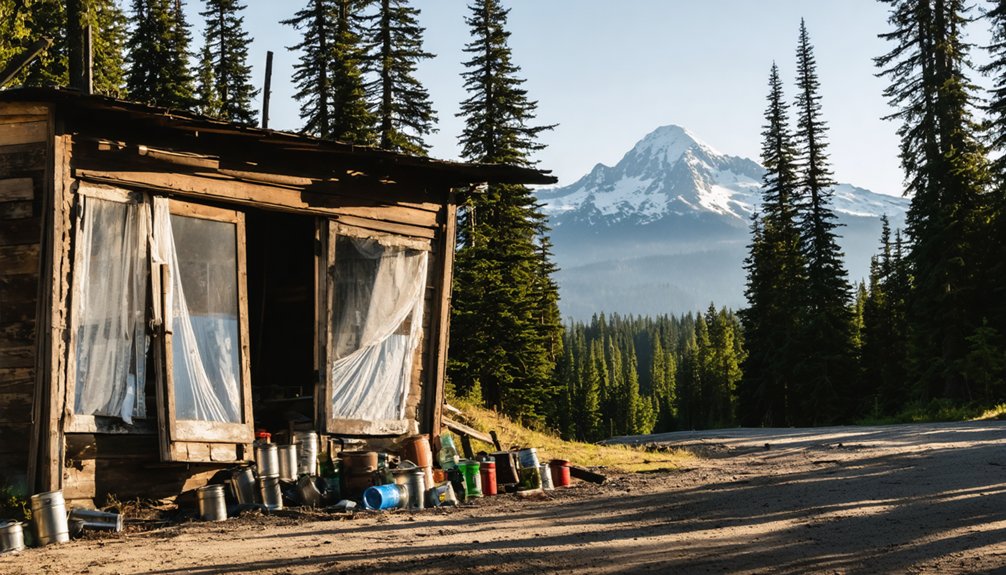
You’ll discover numerous fascinating ghost towns scattered across the Pacific Northwest, each with unique stories. Liberty features Washington’s oldest mining settlement with crystalline gold, while Melmont’s coal history ties to the Northern Pacific Railway. Monte Cristo preserves silver mining ruins, and Claquato showcases an 1858 church—the state’s oldest building. Oregon’s Shaniko, once the “Wool Capital of the World,” and Idaho’s copper mining corridors offer glimpses into the region’s boom-and-bust heritage.
Key Takeaways
- Liberty, Washington’s oldest mining town (1873), features preserved 1890s architecture and crystalline wire gold deposits from its gold rush era.
- Melmont served as a coal hub for the Northern Pacific Railway (1902-1918) until a devastating fire in the 1920s left only stone foundations.
- Monte Cristo boomed after an 1889 silver discovery, reaching 1,000 residents by 1894 before abandonment following recurring avalanches and floods.
- Claquato contains Washington’s oldest standing building, an 1858 Methodist church now on the National Register of Historic Places.
- Shaniko, once the “Wool Capital of the World” with $5 million annual wool sales by 1904, declined after its economic boom ended.
The Golden Legacy of Liberty: Washington’s Oldest Mining Town
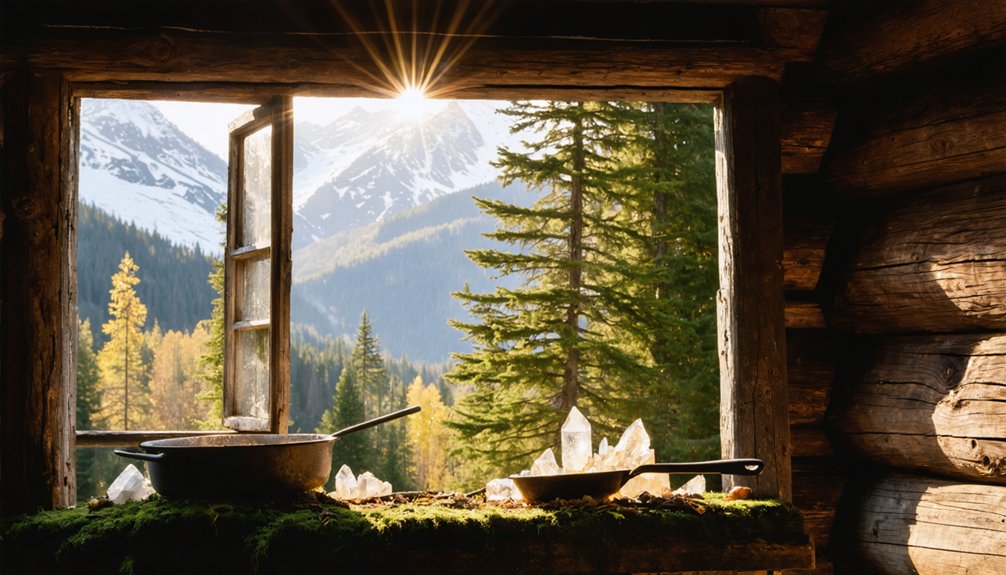
Nestled among the rugged landscapes of the Pacific Northwest, Liberty stands as Washington’s oldest mining town, a proof of the region’s rich gold mining heritage that began with a fortuitous discovery in Swauk Creek in 1873.
This “living ghost town” emerged from two settlements—”Old Liberty” and “Meaghersville”—the latter renamed when the post office was established in 1892.
Unlike typical rowdy gold rush camps, Liberty fostered a stable, family-centered community spanning three generations of miners.
Liberty defied gold rush stereotypes, building a wholesome community where mining traditions passed through generations.
You’ll find distinctive crystalline wire gold and rare Ellensburg Blue Agates in this area where mining techniques evolved from simple placer operations to hydraulic methods.
The town’s preserved 1890s frontier architecture and functioning Virden arrastra grinding mill offer authentic glimpses into Washington’s mining past, maintaining Liberty’s status as a testament to frontier ingenuity. The historic Assay Office building, constructed before 1895, exemplifies early architectural techniques utilizing locally available materials. Today, the town sits at 2,674 feet elevation in Kittitas County, making it a truly mountainous mining settlement.
Coal Dust Memories: Exploring Melmont’s Railroad History
When you trek to Melmont Ghost Town, you’ll witness how the Northwest Improvement Company’s railroad infrastructure transformed a remote Carbon River location into a critical coal supply hub for the Northern Pacific Railway between 1902 and 1918.
The abandoned rail grades you now hike upon once facilitated the town’s economic lifeblood, connecting coal mines to broader markets in an era when steam locomotives demanded constant fuel. The trail’s moderate difficulty level makes it accessible for most history enthusiasts seeking to explore this industrial heritage site. Visitors can experience this historical journey by taking the abandoned rail line from Carbonado, which offers a leisurely stroll through the area’s industrial past.
While Melmont’s steady decline began as coal production waned, historians note that a devastating fire ultimately delivered the decisive blow to what remained of this once-thriving railroad community.
Railroads Driving Coal Economy
Throughout the carbon-rich valleys of the Pacific Northwest, railroads became the economic lifeblood that transformed remote coal deposits into viable industrial centers, with Melmont serving as a prime example of this symbiotic relationship.
You’ll find that Melmont’s entire existence hinged on Northern Pacific Railway‘s strategic decision to establish mining operations there in 1900. The company didn’t just build tracks—it created an entire economic ecosystem.
The railroad’s dual role as both infrastructure provider and primary customer guaranteed a captive market for Melmont’s high-ash coal. This vertical integration typified many mining towns in the region.
Similar mining economies developed in nearby communities like Spiketon, where companies such as Coast Coal Co. produced an impressive 78,000 tons of coal in 1909 with over 120 miners working the seams.
The town’s self-segregating miners with diverse backgrounds contributed to the unique cultural landscape that characterized Melmont during its operational years.
Railroad connections weren’t merely transportation links but economic lifelines that determined a settlement’s fate. When Northern Pacific’s demand for coal diminished after 1918, Melmont’s reason for existence vanished along with the railroad’s interest.
Fire’s Final Blow
The devastating fire that swept through Melmont in the early 1920s represented the final chapter in the town’s brief but significant coal mining history.
After mining operations ceased and residents departed, flames consumed nearly all wooden structures, transforming an abandoned settlement into the ghost town you’ll find today. The fire aftermath left behind only stone foundations and concrete walls as silent witnesses to Melmont’s industrial past.
The historical significance of this destructive event includes:
- Accelerated the erasure of Melmont’s physical presence
- Preserved only the most durable structural elements
- Created the stark juxtaposition between natural reclamation and human engineering
- Established the site’s current archaeological character, where you’ll discover only scattered ruins amidst regenerating forest
Walking through the old railroad grade where the Northwest Improvement Company once transported coal, visitors can appreciate how completely nature has reclaimed this once-bustling industrial site.
The town’s decline began earlier when coal prices dropped significantly, causing economic hardship before the final abandonment.
Monte Cristo’s Silver Dreams and Sudden Abandonment
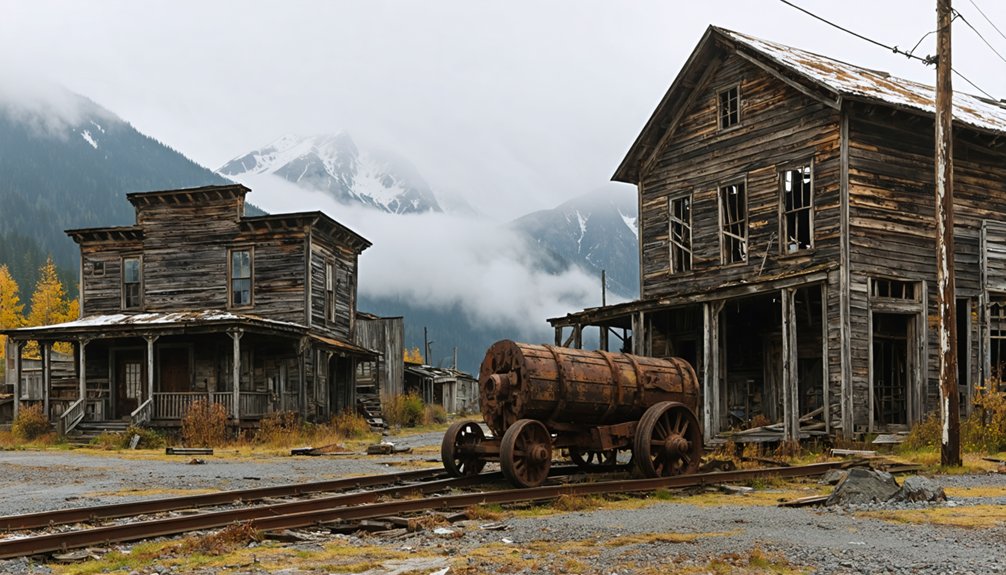
Nestled within the rugged terrain of Washington’s Northern Cascade Mountains, Monte Cristo emerged from Joseph Pearsall’s silver discovery in 1889 to become a short-lived but significant mining boomtown.
You’ll find its history marked by rapid growth—from 13 mining claims in 1891 to over 211 by 1893—attracting eastern investors like Rockefeller and notable residents including Frederick Trump.
Despite infrastructure development and a population that swelled to 1,000 by 1894, persistent mining challenges plagued operations.
The concentrator mill processed up to 300 tons of ore daily and was originally believed to be 85% efficient in extracting metals from ore.
Avalanches, floods, and inconsistent ore quality ultimately led to Monte Cristo’s abandonment by 1907, with final operations ending after a 1920 avalanche.
Visitors today can hike along the river to reach these historic ruins, following the same path used by miners during the 1890s boom.
Following decades of deterioration, the town experienced a ghost town resurgence in the 1960s under the Wilkies’ ownership, until the 1983 lodge fire sealed its fate as a remote historical site.
Sacred Ground: Claquato’s Historic Church and Cemetery
At Claquato, you’ll find Washington State’s oldest standing building—an 1858 Methodist church featuring a distinctive crown of thorns steeple and a Boston-cast bronze bell that journeyed around Cape Horn.
The historic structure served dual purposes as both a spiritual center and the Claquato Academy until the 1930s, eventually earning a place on the National Register of Historic Places in 1973 after significant restoration efforts.
Adjacent to this sacred landmark lies the cemetery established in 1856, where pioneer families including the town’s founders rest beneath a historic fir tree, preserving the memory of this once-thriving settlement named from Native American Salish terminology meaning “high land.”
Lewis County’s Oldest Church
Standing as Washington State’s oldest surviving church, the historic Claquato Church represents a remarkable symbol of pioneer perseverance in the Pacific Northwest.
Built in 1857-1858 with lumber from the first local mill, this Presbyterian-turned-Methodist sanctuary became the spiritual heart of Lewis County’s original county seat.
When you visit this pioneer heritage landmark, you’ll discover:
- A modest wooden structure measuring just 20 by 30 feet, constructed entirely with donated materials and labor.
- A building that served dual purposes as both church and school for seven years, per Lewis Davis’ deed stipulation.
- The lone surviving structure of a once-thriving town officially vacated in 1902.
- A meticulously preserved historic site, restored in 1953 and listed on the National Register of Historic Places in 1973.
Bell and Unique Steeple
One of the most extraordinary features of the Claquato Church, beyond its pioneering architectural legacy, is its distinctive steeple housing a bronze bell with a remarkable journey to the Pacific Northwest.
You’ll find the bell’s significance lies in its Boston origins and arduous voyage around Cape Horn—a reflection of the determination of early settlers to establish permanent religious institutions.
The steeple architecture, rising above a modest 20 x 30-foot wooden frame with one-and-a-half-story design, represents both spiritual aspirations and practical frontier construction limitations.
This architectural simplicity wasn’t merely aesthetic but reflected available resources and building capabilities of the 1850s settlement.
When you visit, remember you’re witnessing the culmination of community cooperation—from subscription-based funding to locally-sourced lumber from Lewis Davis’ newly established whipsaw mill—all contributing to this enduring historical landmark.
Cemetery Preserves Pioneer History
While the Claquato Church stands as Washington’s oldest surviving church building, the adjacent cemetery quietly preserves an equally significant legacy as hallowed ground for pioneer remembrance.
You’ll find this sacred acre bears witness to the settlement patterns that shaped western Washington Territory since the first burial in 1856.
The cemetery’s historic preservation efforts include:
- The iconic “Pioneer Fir” dedicated in 1937 with a bronze plaque commemorating early settlers
- Mary Spinning’s grave from 1856, marking the cemetery’s earliest documented burial
- The five-acre tract platted by the Odd Fellows in 1893 for member interments
- A perpetual care endowment system established by the Cemetery Association formed in 1920
This hallowed ground continues as a crucial repository of pioneer memorials and settlement history in Lewis County’s vanished frontier community.
Oregon’s Wool Empire: The Rise and Fall of Shaniko
Although virtually unknown to most tourists today, Shaniko once reigned as the “Wool Capital of the World” during the early 1900s, serving as the commercial hub for a vast 20,000-square-mile region in north-central Oregon.
Shaniko’s economy exploded following the Columbia Southern Railway‘s arrival in 1900, with annual wool sales reaching an astounding $5 million by 1904.
You’ll find it hard to imagine warehouses once holding 2,000 tons of wool in this now-quiet landscape. The town processed over a million bushels of wheat yearly alongside hundreds of railcars of livestock.
British Columbia’s Timber and Mining Ghosts

British Columbia’s remote landscapes tell a different ghost town story than Oregon’s wool empire, with abandoned mining communities scattered throughout its mountainous terrain.
These mining communities represent boom-and-bust cycles that shaped the province’s development:
- Anyox Boom – Once a thriving copper operation with 3,000 residents by 1914, now reduced to ruins after operations ceased in 1935 and fire consumed wooden structures in 1942.
- Sandon Resilience – The silver rush capital rebuilt its business district within months after a devastating 1900 fire, demonstrating determination during the Slocan mining era.
- Minto Internment – Became refuge for Japanese Canadian families during WWII, offering intact infrastructure when other communities wouldn’t.
- Bralorne Heritage – Persisted as BC’s last operational gold mine until 1971, outlasting all other regional mining operations.
Idaho’s Eastern Mining Corridors: Copper Country Relics
When you explore Idaho’s eastern mining corridors, you’ll encounter the remarkable copper deposits first discovered in the Copper Basin Mining District in 1888, where operations yielded ore containing 5-15 percent copper and substantial silver content.
You can still witness the remnants of once-thriving operations like the Copper Cliff Mine, which expanded to over 2 million tons of copper-silver ore reserves by 1973 and produced 409 short tons of copper valued at $630,000 in 1976 alone.
The weathered structures and abandoned machinery scattered throughout these rugged mountain landscapes provide tangible connections to Idaho’s mineral industry expansion that began with the first major mining discovery by Captain E.D. Pierce in 1860.
Rich Mineral Deposits
Idaho’s eastern mining corridors emerged as copper country powerhouses following significant mineral discoveries in the late 19th century.
The region’s mineral exploration activities revealed extraordinary deposits that would transform Idaho’s economic landscape, establishing essential mining centers like Mackay after the 1879 discoveries in the White Knob mountains.
When you explore these historic mining districts, you’ll find evidence of the remarkable copper wealth:
- Copper Basin Mine yielded ore with 5-6% copper content and 10-12 ounces of silver per ton
- Empire Copper Company constructed a substantial smelter with two 125-ton blast furnaces in 1901
- Copper Cliff Mine accounted for approximately 25% of Idaho’s copper output in the mid-1970s
- Blackbird district contained extensive copper-cobalt deposits supporting prolonged mining operations
These districts exemplify how innovative mining techniques extracted valuable resources that sustained communities throughout eastern Idaho.
Scenic Mountain Ruins
Nestled among the rugged peaks of eastern Idaho, abandoned copper mining towns stand as haunting reminders of a once-thriving industrial era.
You’ll discover places like Cuprum, whose Latin name literally means “copper,” where hospital ruins and post office foundations hint at a community that flourished in the challenging Seven Devils terrain.
For mountain exploration enthusiasts, the scenic ruins of White Knob and Cliff City offer glimpses into 1880s boom towns where hundreds once lived, complete with theaters and schools.
Throughout the Sawtooth and Salmon River corridors, towns like Gilmore reveal crumbling infrastructure amid spectacular alpine scenery.
These remote ghost towns in Custer and Lemhi counties preserve Idaho’s mining heritage in their weathered remains, allowing you to wander through history while surrounded by breathtaking mountain vistas.
Museum-Worthy Mining Artifacts
Throughout the eastern mining corridors of Idaho, exceptional copper artifacts have been preserved from the region’s industrial heyday beginning with discoveries in 1879.
When you visit local museums near Mackay and Copper Basin, you’ll discover mining relics that tell the story of Idaho’s copper boom.
Notable collection highlights include:
- Specimens of high-grade copper ore containing silver values worth $145 per ton
- Historic tools from square-set stoping techniques used in the 100-foot vertical shaft operations
- Equipment remnants from the electric railway that transported ore to the 600-ton smelter
- Preserved copper carbonates and red oxide minerals in silicious gangue formations
These artifacts document the technological evolution from crude extraction methods to sophisticated floating mill processing, preserving the legacy of innovation that drove Idaho’s copper industry despite economic challenges.
Walking Through Time: Best Hiking Trails to PNW Ghost Towns
The Pacific Northwest’s abandoned settlements offer hikers a unique opportunity to experience history through accessible trails that lead to once-thriving communities.
Step back in time as forgotten Northwest settlements reveal their stories through trails where history and nature intertwine.
Whether you’re seeking an ambitious 8-mile journey to Monte Cristo’s mining relics or a gentle 2.35-mile exploration of moss-covered Fairfax, these ghost towns reveal fascinating chapters of regional development.
For ghost town exploration with minimal elevation gain, Northern State’s hospital complex (50 feet gain) and Franklin’s coal mining remnants (200 feet gain) provide excellent starting points.
Melmont offers a moderate 3.84-mile adventure with visible foundations and ruins along an old railroad grade.
When planning your hike, consider seasonal conditions—sturdy footwear is essential for Melmont’s potentially muddy trails.
These pathways through abandoned communities deliver both freedom to explore and tangible connections to the region’s industrial past.
Government Intervention: The Unusual Story of White Bluffs
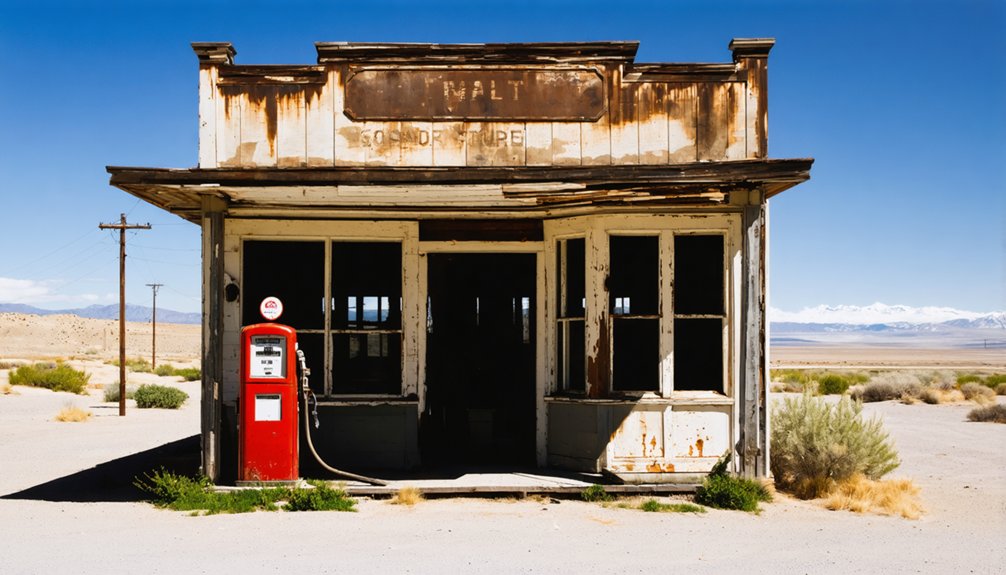
Unlike most abandoned settlements in the Pacific Northwest, White Bluffs disappeared not through economic decline but by direct federal mandate. This thriving agricultural community with schools, churches, and businesses fell victim to a swift government takeover in 1943 as part of the Manhattan Project.
The community displacement occurred through this sequence:
- Army Corps of Engineers surveyed the area in 1942 for nuclear weapons development
- Residents received evacuation letters on March 6, 1943, giving them just 30 days to leave
- Approximately 2,000 people were displaced from White Bluffs, Hanford, and surrounding areas
- Properties were hastily appraised and compensated before the community was erased
Today, White Bluffs exists primarily in historical accounts—a reflection of how quickly governmental priorities can transform ordinary American lives.
Preserving Pioneer History: Ghost Towns on the National Register
While many ghost towns across the Pacific Northwest have succumbed to nature’s reclamation, several historically significant settlements have gained protection through inclusion on the National Register of Historic Places.
Liberty, Washington’s oldest mining town, received this designation in 1974, preserving its gold rush heritage. Similarly, Claquato’s historic church, with its distinctive crown of thorns steeple, represents essential pioneer preservation efforts.
Preserving America’s frontier spirit through national recognition of these weathered yet enduring pioneer landmarks.
Monte Cristo showcases mining-era infrastructure through accessible hiking trails, while Molson’s transformation into an open-air museum demonstrates community-driven ghost town significance.
In Oregon, Shaniko stands as a reflection of the region’s boom-and-bust cycle with its impressive collection of intact structures.
These protected sites don’t just commemorate abandoned settlements—they’re living museums where you’ll experience authentic connections to Pacific Northwest pioneer history.
Frequently Asked Questions
Are There Paranormal Investigations Conducted in Pacific Northwest Ghost Towns?
Yes, you’ll find extensive paranormal investigations in Pacific Northwest ghost towns, with organized paranormal tours and ghost hunting expeditions targeting locations like Bodie, Nighthawk, and Silver City throughout the year.
What Safety Precautions Should Visitors Take When Exploring These Sites?
Always bring proper safety gear including sturdy boots and first aid supplies. Inform emergency contacts of your itinerary. Avoid unstable structures, respect preservation guidelines, and remain vigilant of environmental hazards.
How Did Seasonal Weather Patterns Impact the Sustainability of These Communities?
Harsh mountain winters isolated communities, while flooding damaged infrastructure and seasonal agriculture. You’ll find most ghost towns lacked climate resilience, with unreliable growing seasons and transportation disruptions ultimately forcing abandonment.
Many of these remnants of the past tell their stories through the eerie histories of deserted towns. Each building stands as a silent witness to the lives once lived there, offering glimpses into their struggles and the eventual decay. As nature slowly reclaims these spaces, the haunting remnants draw the curious and the adventurous looking for a deeper understanding of history’s forgotten chapters.
What Indigenous Communities Occupied These Areas Before the Ghost Towns Formed?
Before pioneers transformed these lands, you’ll find Coast Salish, Yakama, Nez Perce, and Secwepemc indigenous tribes inhabited these culturally significant areas, stewarding natural resources through ancestral wisdom for countless generations.
Are There Legal Restrictions Regarding Artifact Collection at These Sites?
Yes, you’ll face legal consequences under artifact preservation policies if collecting items. Most sites prohibit removal of historical objects, as they’re protected by federal and state heritage laws.
References
- https://stateofwatourism.com/ghost-towns-of-washington-state/
- http://pnwphotoblog.com/ghost-towns/
- https://www.wta.org/go-outside/seasonal-hikes/fall-destinations/hidden-history-ghost-town-hikes
- https://en.wikipedia.org/wiki/List_of_ghost_towns_in_Washington
- https://traveloregon.com/things-to-do/culture-history/ghost-towns/
- https://westernmininghistory.com/towns/washington/liberty/
- https://revisitwa.org/waypoint/liberty/
- https://en.wikipedia.org/wiki/Liberty
- https://www.youtube.com/watch?v=jDeqFHjZD0M
- https://digitalcommons.cwu.edu/local_authors/3/