In Rust Belt ghost towns, you’ll find massive steel mills like Joliet Works standing as silent monuments to America’s industrial power. Weathered worker housing, abandoned railway stations, and empty storefronts mark where vibrant communities once thrived. Art Deco bank buildings, Gothic churches, and shuttered schools reflect the demographic collapse that followed manufacturing’s decline. These architectural remnants tell stories of prosperity, community bonds, and economic transformation that shaped our national identity.
Key Takeaways
- Massive steel mills and industrial equipment like blast furnaces, coke ovens, and turret lathes symbolize America’s former manufacturing dominance.
- Abandoned railway stations, yards, and overgrown rail lines showcase architectural monuments and former transportation networks.
- Weathered company homes, row houses, and vacant commercial districts with ornate facades reflect once-thriving worker communities.
- Former community hubs including theaters, schools, and churches with distinctive architecture represent lost social connections.
- Healthcare facilities stand abandoned, illustrating the collapse of essential services following population exodus and economic decline.
Massive Steel Mills: Silent Monuments to Industrial Power
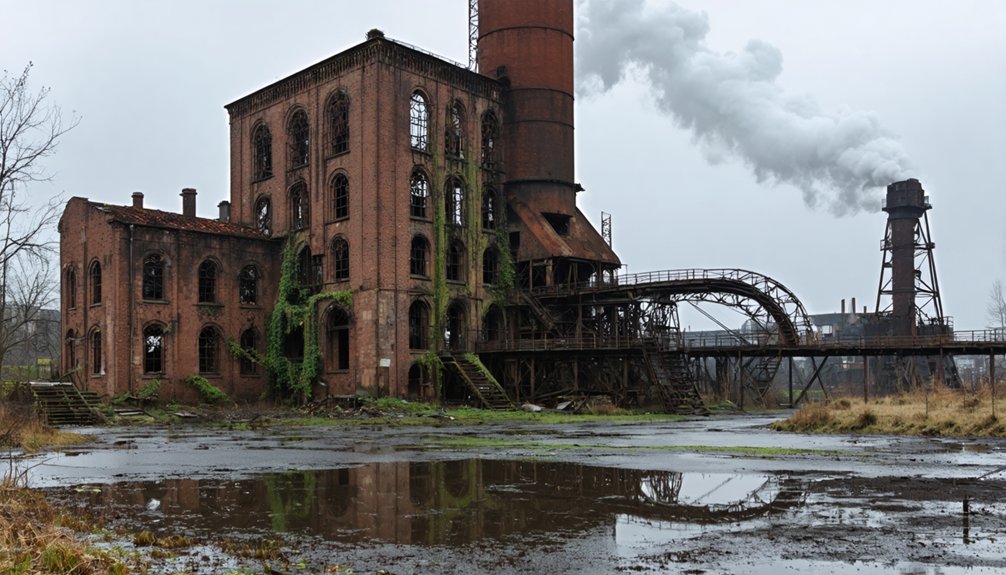
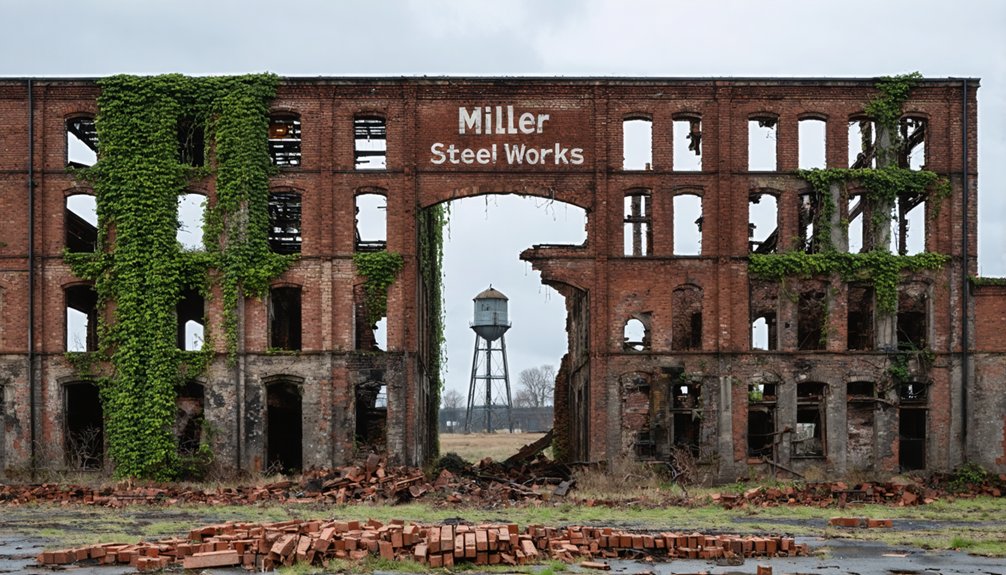
Standing like silent sentinels across America’s Rust Belt, massive steel mills represent the most visible monuments to our nation’s former industrial might.
You’ll find few better examples than Joliet Steel and Iron Works, once America’s second-largest steel producer, whose imposing ruins now tell stories through rusted frameworks and crumbling foundations.
Established in 1869, this industrial heritage site shaped not just steel but entire communities.
Workers—many immigrants from Southern and Eastern Europe—built lives around these facilities, creating economic dependency that rippled through railroad towns for generations.
The site’s ownership transitioned through various companies including Illinois Steel Company, Federal Steel, and ultimately U.S. Steel before closing.
When you walk the mile-long path through the preserved ruins today, you’re witnessing more than abandoned buildings.
You’re experiencing the physical remnants of an era when American steel forged our national identity before global competition forced operations to cease in the early 1980s.
The closure of these factories has devastated local economies in small Ohio towns that once relied heavily on manufacturing employment.
Abandoned Worker Housing and Neighborhoods
You’ll find row after row of weathered company homes standing as hollow shells in neighborhoods where generations of steelworkers once raised families.
These modest dwellings—characterized by their uniform facades, shared walls, and proximity to defunct mills—tell a silent story of demographic collapse as thousands of residents fled when industries shuttered.
The abandonment has been particularly severe in places like Monessen, Pennsylvania, where two-thirds population loss followed the closure of steel mills, leaving only a single elementary school in operation.
Many of these abandoned neighborhoods are located in the Rust Belt communities that have suffered severely from the collapse of manufacturing sectors.
What remains are the skeletal frameworks of once-vibrant community spaces: union halls with caved-in roofs, corner taverns with faded signage, and church buildings where congregation sizes dwindled until doors closed permanently.
Decaying Company Row Houses
Shadows of industrial prosperity linger in the decaying company row houses that once housed America’s manufacturing workforce across the Rust Belt. Built by corporations like Youngstown Sheet & Tube, these modest structures stand as physical representations to industrial paternalism—where companies quelled labor unrest by providing worker housing.
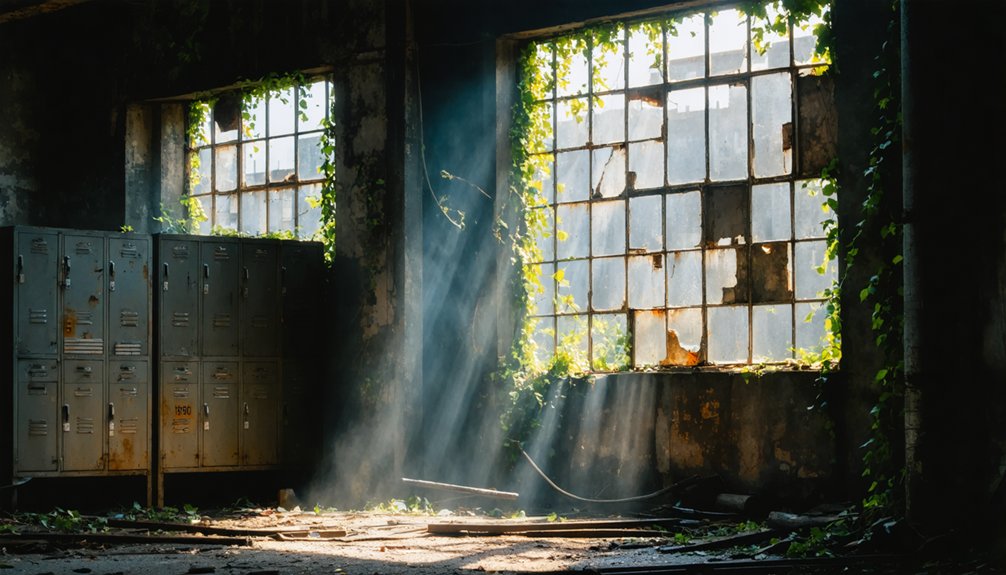
You’ll find these abandoned neighborhoods frozen in time: broken windows frame empty rooms where families once gathered, while exposed wiring and crumbling foundations make row house rehabilitation nearly impossible.
The close-packed dwellings that fostered tight-knit blue-collar communities now represent economic collapse. The dramatic closure on September 19, 1977, known as Black Monday, triggered massive job losses and the neighborhood’s eventual abandonment. Despite sporadic community revitalization efforts, unclear ownership and structural decay complicate preservation. In cities like Youngstown, these neighborhoods reflect a haunting 1950s noir ambiance that captures the essence of industrial decline.
These deteriorating homes tell America’s industrial rise and fall—where company towns thrived before being abandoned, leaving only architectural ghosts of the productive past.
Communal Gathering Spaces
Beyond the company row houses, entire neighborhoods once thrived as essential organs within Rust Belt industrial communities.
You’ll find their skeletal remains in the uniform worker apartments of Youngstown and the communal structures of Brownsville—now silent witnesses to vanished social connections.
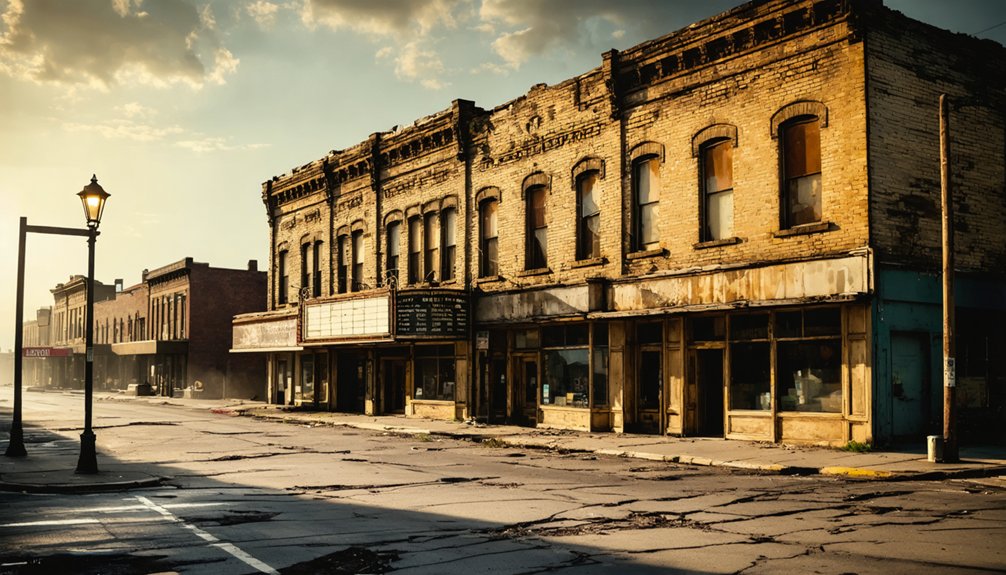
Walk these streets and you’ll encounter crumbling theaters with faded marquees, neoclassical bank buildings with boarded windows, and churches like First Baptist Church, now overtaken by nature.
Community memories linger in these architectural ghosts where workers once gathered, celebrated, and protested.
The urban fabric unravels visibly through broken infrastructure—cracked sidewalks, rusted lampposts, and vacant lots interrupting once-coherent streetscapes.
Recent demolitions create unsettling gaps between remaining structures, physical manifestations of the demographic collapse that fractured these working-class communities.
In Brownsville, the Plaza Theater stands among the many abandoned structures on Market Street, a stark reminder of the town’s economic decline that began in the 1970s when shopping malls drew patrons away from local businesses.
The town’s population plummeted from over 8,000 residents in the 1940s to just above 3,100 by the 1990s, creating a severe depopulation that hollowed out once-vibrant commercial corridors.
Railway Stations and Transportation Infrastructure
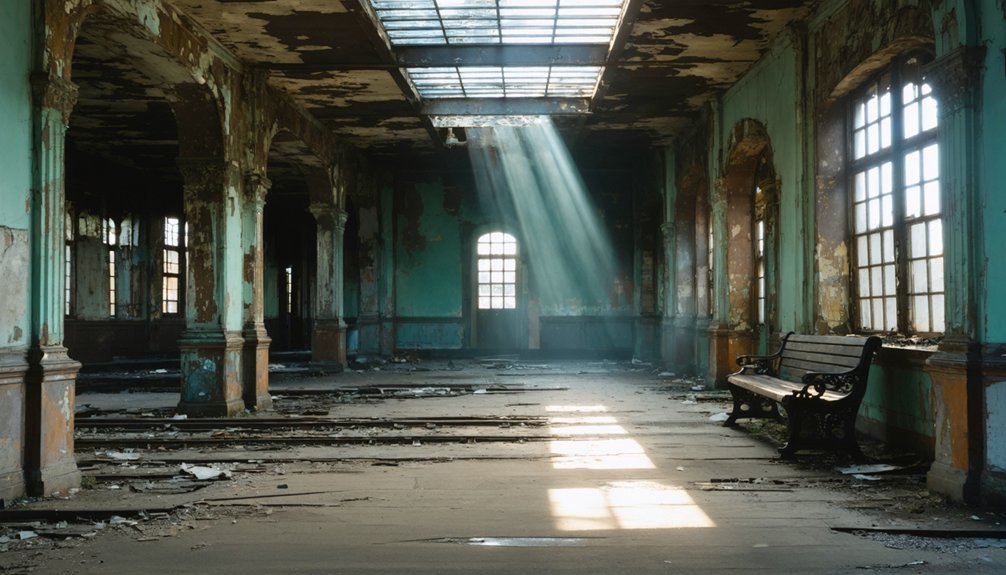
Throughout the Rust Belt’s abandoned towns, railway stations stand as the most poignant architectural monuments to a vanished industrial era. In places like Brownsville, PA, you’ll find five-story Union Stations with neoclassical facades, now boarded up but still displaying remarkable railway architecture. These weren’t mere transit points—they were community hubs that pulsed with life during industrial peaks.
Today, you can trace abandoned rail lines and spurs that once connected thriving communities to mines and mills. Overgrown railbeds and rusting bridges reveal the extensive transportation history that fueled local economies. The Tennessee Central Railroad’s 1901 purchase of smaller lines mirrors this consolidation pattern seen throughout the rust belt. Some railways, like the Northern Pacific, featured challenging construction through rugged mountains and rocky ravines.
Railroad yards with deteriorating loading docks and maintenance facilities offer glimpses into the region’s industrial might. The empty platforms, freight warehouses, and occasional preserved depot-turned-museum tell stories of prosperity, decline, and the abrupt cessation of activity that transformed vibrant towns into shells of their former selves.
Former Community Hubs: Schools, Churches and Hospitals
You’ll find the sacred architecture of once-vibrant churches standing sentinel across Rust Belt landscapes, where congregations have dwindled alongside the population declines exceeding 50% in many census tracts.
The abandoned school buildings with their distinctive early-20th century designs tell stories of educational systems that collapsed as manufacturing jobs disappeared, leaving behind empty classrooms and repurposed gymnasiums.
Meanwhile, the shuttered hospitals—grand structures that once symbolized industrial prosperity and community health—now represent healthcare deserts where residents must travel significant distances for medical attention, further accelerating the exodus from these ghost towns.
Sacred Spaces Endure
While industrial factories and commercial districts succumbed quickly to rust belt decline, the sacred spaces that once anchored community life have shown remarkable resilience amidst abandonment.
City Methodist Church in Gary stands as perhaps the most poignant example—its Gothic architecture still reaching skyward though its congregation has vanished. Built for 3,000 worshippers at a cost equivalent to $11 million today, its empty sanctuary now cradles spiritual echoes of a bygone era.
Similarly, Bodie’s preserved houses of worship retain their original fixtures, sacred relics frozen in time since 1942.
These enduring structures reveal demographic shifts that transformed vibrant communities into shells. In Johnstown, where poverty rates reached 35% by 2017, abandoned churches remain as final reminders to communities that once gathered in fellowship before industry’s collapse scattered their flocks.
Educational Ruins Persist
When manufacturing jobs vanished across America’s industrial heartland, they left behind not just empty factories but also the hollowed shells of once-vibrant educational institutions.
You’ll find these monuments to educational decay in nearly every rust belt city—massive brick structures with blown-out windows and collapsing roofs that once housed generations of students.
The statistics tell a stark story: 269 census tracts across 49 cities lost half their housing, while school closures mirrored population exodus.
Communities like Youngstown and Johnstown now navigate landscapes dotted with thousands of abandoned structures, including schools that symbolize community neglect.
While Pittsburgh and Buffalo show signs of recovery with rising educational attainment rates, cities like Detroit and Cleveland struggle with flat growth in poorer neighborhoods, highlighting how unevenly distributed educational renaissance remains across the former industrial powerhouse region.
Healthcare Ghosts Remain
Ghost-like structures of former hospitals loom across the rust belt landscape, standing as hollow reminders of once-thriving healthcare systems that anchored community life. Brownsville General Hospital’s demolition in 2020-2021 after 35 years of abandonment typifies this healthcare erosion.
You’ll find these institutional voids mirrored in boarded-up churches and nursing homes—architectural monuments to demographic collapse.
As populations fled, healthcare disparities widened dramatically. The buildings themselves tell stories of community resilience through adaptive reuse attempts: former hospital grounds transformed into senior housing or green spaces like Hope Park.
Yet for every successful conversion, countless medical facilities remain in decay, their empty corridors echoing with past liveliness. These healthcare ghosts represent more than vacant structures—they’re physical manifestations of essential services that disappeared, leaving communities to navigate their future with diminished resources.
Rusting Machinery and Factory Equipment
Hulking giants of American industrial power, the rusting machinery and factory equipment that remain in Rust Belt ghost towns tell a story of economic transformation more eloquently than any history book.
Walking through these silent cathedrals of industrial decay, you’ll encounter massive turret lathes and stamping presses that once shaped America’s military might and automotive dominance.
In former steel mills of Western Pennsylvania, you’ll find blast furnaces and coke ovens standing like ancient monuments.
The machinery nostalgia hits hardest in places like National Tube in McKeesport, where equipment that once employed 10,000 workers sits frozen in time.
Republic Rubber’s abandoned molds and mixers in Youngstown reveal another facet of manufacturing history.
Even in rural areas, potato processing equipment and grain elevators stand as sentinels of agricultural industry past.
Commercial Districts: Storefronts, Banks and Markets
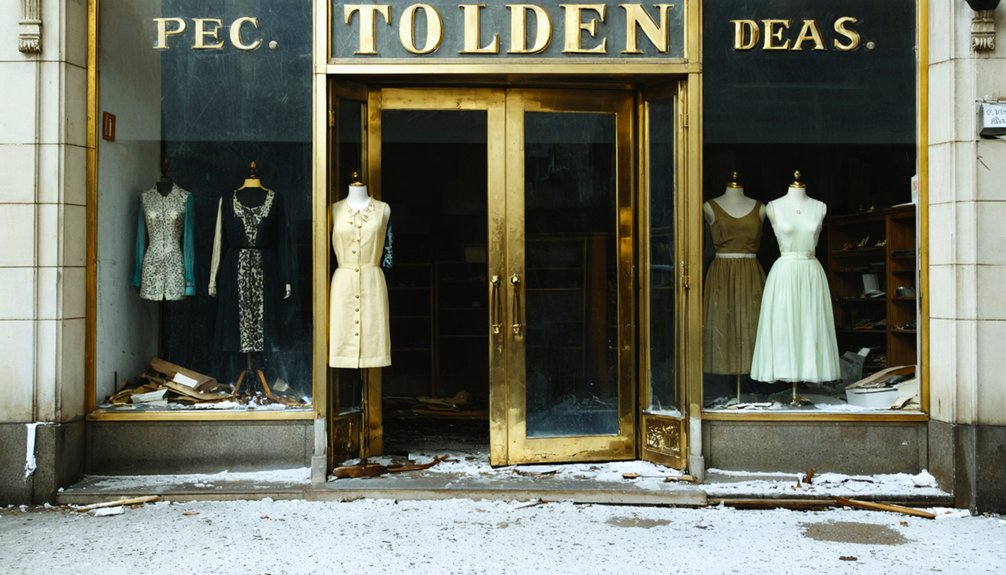
The commercial hearts of Rust Belt towns stand as architectural witnesses to economic narratives that once played out alongside the factory floors.
You’ll find Art Deco, Classical Revival, and Streamline Moderne storefront styles lining walkable main streets, their plate-glass windows now vacant where goods were once proudly displayed.
Bank buildings with ornate stone facades project the stability their communities once enjoyed, many featuring marble floors and intact vaults despite decades of abandonment.
Market trends of different eras remain visible in the infrastructure—central market halls that served as community hubs for industrial workers, positioned strategically near transportation networks and dense neighborhoods.
Today, these commercial districts reveal layers of economic evolution: former department stores standing empty, repurposed malls marking shifting consumer patterns, and faded neon signs hinting at vibrant street life now silenced.
Environmental Transformation and Natural Reclamation
While industrial decline hollowed out the economic cores of Rust Belt cities, nature has begun to assert itself in these abandoned landscapes, transforming former production zones into laboratories of ecological succession.
You’ll find poplar trees rising from contaminated soil in Gary, Indiana, where 60 acres of vacant land now serve as carbon-sequestering tree farms, capturing an estimated 14,000 tons of CO₂ over 15 years.
The ecological recovery extends beyond passive reclamation.
Strategic demolitions of abandoned structures create depressions that capture stormwater, relieving pressure on aging sewer systems. Green infrastructure transforms these spaces into functional components of urban watersheds.
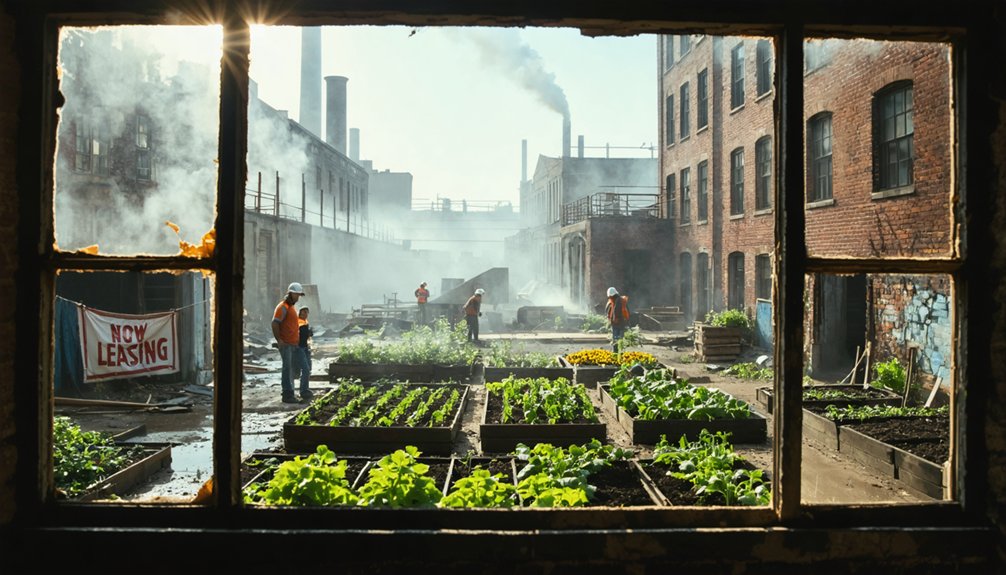
Native plants gradually colonize former industrial sites while community-led initiatives convert vacant lots into productive gardens and pocket prairies—reclaiming the urban fabric not just for nature but for the people who remain.
Architectural Preservation Efforts and Heritage Sites
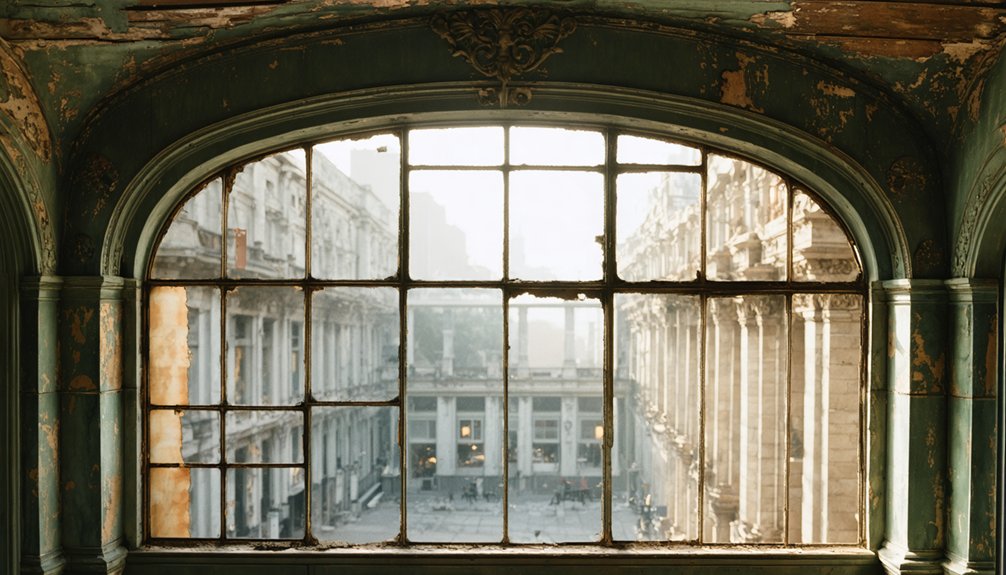
Across the decaying landscape of America’s Rust Belt, architectural preservation has emerged as a powerful counterforce to demolition and decline.
As communities work to revitalize their cities, they are uncovering forgotten treasures of the rust belt that tell stories of resilience and innovation. These remnants of industrial glory not only preserve history but also inspire a new generation of artists and entrepreneurs to reimagine their potential. Through adaptive reuse and creative community engagement, the spirit of these once-thriving hubs is being rejuvenated, fostering a vibrant sense of place.
You’ll find community preservation efforts transforming vast industrial complexes like the Pierce-Arrow building into vibrant mixed-use spaces that honor original architectural integrity while serving contemporary needs.
When you explore these sites, you’re witnessing a fundamental shift from throwaway development to thoughtful adaptive reuse.
Grassroots urbanism initiatives have proven critical in saving factories, train stations, and iron mills that define these cities’ identities.
Citizen-led preservation movements rescue industrial landmarks, protecting the soul of Rust Belt communities against erasure.
Rather than watching skilled craftsmanship bulldozed into landfills, you can now see salvaged old-growth timber and vintage fixtures finding new life through deconstruction techniques.
These preservation efforts aren’t just about buildings—they’re liberating communities from the cycle of devaluation while maintaining authentic connections to industrial heritage.
Frequently Asked Questions
How Safe Are These Abandoned Structures for Urban Explorers?
These structures aren’t safe for urban exploration. You’ll face serious safety concerns including collapsing floors, toxic contamination, and unstable masonry—artifacts of industrial decline accelerated by decades of structural abandonment.
What Legal Protections Exist for Historic Ghost Town Artifacts?
Like sentinels guarding the past, historic preservation laws shield these relics from enthusiastic hands. You’ll face federal and state artifact protection measures if you disturb ghost town treasures without proper permission.
Where Can Visitors Find Maps of Accessible Rust Belt Sites?
You’ll find detailed site maps through state historical archives, university digital resources, and preservation websites, revealing how industrial corridors contracted as demographic shifts transformed once-thriving factory towns into explorable industrial ruins.
Do Former Residents Still Return to These Towns Regularly?
Like fireflies in winter, former residents rarely return regularly. You’ll find mostly occasional nostalgic visits or community gatherings for funerals and family events, while abandoned industrial landscapes speak of permanent demographic shifts.
How Do Local Economies Benefit From Ghost Town Tourism?
You’ll witness economic impact through affordable housing markets and job creation, while tourism growth transforms abandoned industrial complexes into cultural attractions—fueling hospitality sectors and preserving authentic architectural remnants of America’s manufacturing legacy.
References
- https://www.arizonahighways.com/article/arizona-ghost-towns
- https://inspiredimperfection.com/adventures/leadfield-ghost-town/
- https://furtraders.com/blogs/blogs/whispers-of-the-past-unearthing-yuba-countys-ghost-towns
- https://farandwide.com/s/us-cities-ghost-towns/
- https://www.youtube.com/watch?v=inRD6vYBy8M
- https://www.atlasobscura.com/lists/americas-best-preserved-ghost-towns
- https://www.youtube.com/watch?v=7WskZvzr960
- https://allthatsinteresting.com/rust-belt
- https://www.loveexploring.com/galleries/127789/then-and-now-us-rust-belt-cities-that-bounced-back
- https://www.placesthatwere.com/2016/11/into-rust-belt-legendary-ruins-of.html