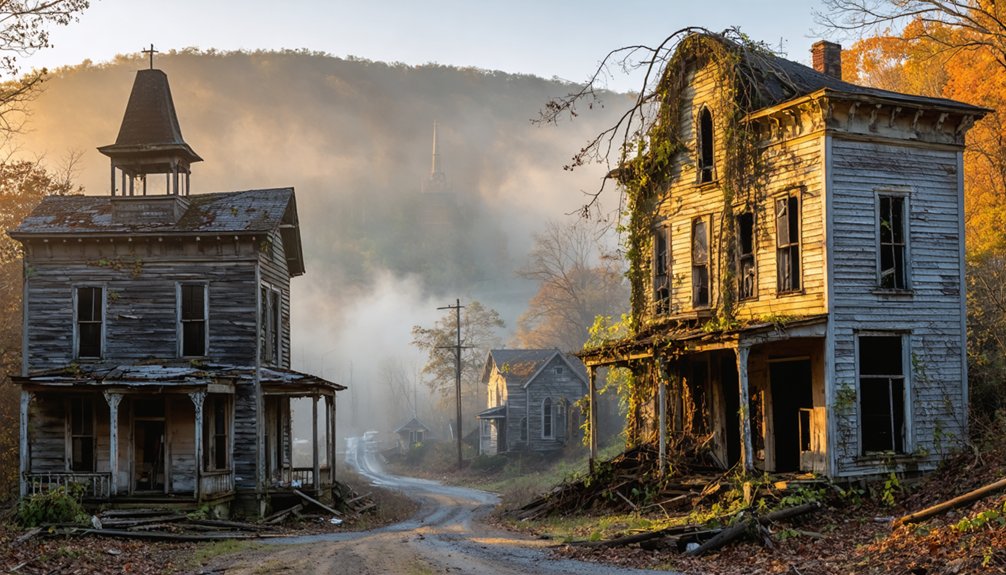
Appalachian ghost towns harbor diverse artifacts revealing the region’s industrial past. You’ll find small-denomination coins and personal items from logging camps, abandoned mining equipment including coal carts and carbide lamps, and architectural remnants ranging from intact structures to mere foundations. The Bell Witch site contains ritual objects and mysterious relics linked to supernatural folklore. Unlike Western counterparts, these artifacts face unique preservation challenges due to Appalachia’s humid climate and dense vegetation. These silent witnesses await your discovery.
Key Takeaways
- Small-denomination coins and company store tokens reveal economic systems and constraints in isolated logging communities.
- Personal items like pocket knives, tobacco pipes, and grooming tools provide insights into daily routines of former residents.
- Abandoned mining equipment, coal carts, and carbide lamps showcase technological evolution and working conditions in Appalachian coal operations.
- Architectural remnants ranging from intact buildings to foundations and stone chimneys illustrate community organization and adaptation to mountain landscapes.
- Bell Witch-related artifacts, including ritual objects and grave boxes, represent the supernatural legacy and cultural beliefs of Appalachian communities.
Unearthed Treasures: Coins and Personal Items From Logging Camps

Beneath the forest floor of abandoned Appalachian logging camps lie tangible remnants of a bygone industrial era, preserved in the form of monetary and personal artifacts.
If you explore these sites, you’ll discover small-denomination coins—pennies and nickels from the late 19th and early 20th centuries—indicating workers participated in local commerce despite their isolation.
These monetary fragments, alongside trade tokens from company stores, reveal the economic constraints of logging culture.
You’ll find pocket knives, tobacco pipes, and personal grooming items scattered near living quarters and refuse dumps. These artifacts, similar to those found throughout the White Mountains region, provide valuable insights into the daily lives of logging camp residents. Eyeglass fragments and handwritten notes offer intimate glimpses into daily routines.
The artifact significance extends beyond mere objects—each item tells a story of adaptation, self-reliance, and community.
Each artifact whispers tales of resilience, revealing how isolated workers forged community amid industrial demands.
These material remains construct a demographic profile of diverse workers who shaped Appalachian industrial history through their daily lives, including locals, immigrants, and freed slaves who all participated in the logging industry.
Industrial Remnants: Mining Equipment and Railway Artifacts
Across the rugged landscapes of Appalachian ghost towns, industrial remnants silently chronicle the region’s extractive past through an array of mining equipment and railway artifacts.
You’ll discover evolution from primitive wooden supports and hand drills to mechanized mining machinery, with abandoned coal carts, rail tracks, and blast drills marking economic decline. Miners once relied on these tools while earning just $3-$5 daily for dangerous work in harsh conditions. Rusting coke ovens and coal tipples stand as evidence to processing operations that once flourished.
Railway infrastructure formed the backbone of these communities, evidenced by decaying bridges, abandoned tracks, and weathered depots. In towns like Thurman, West Virginia, the arrival of the Chesapeake and Ohio Railroad transformed small settlements into bustling coal-driven boom towns.
Specific artifacts include switch levers, signal equipment, and rail ties gradually reclaimed by nature. Notable tunnels like Moonville endure as prominent historical markers despite graffiti.
These industrial remnants collectively illustrate the technological transformation that powered Appalachia’s coal economy before its eventual collapse.
Architectural Survivors: Ghost Town Buildings and Foundations
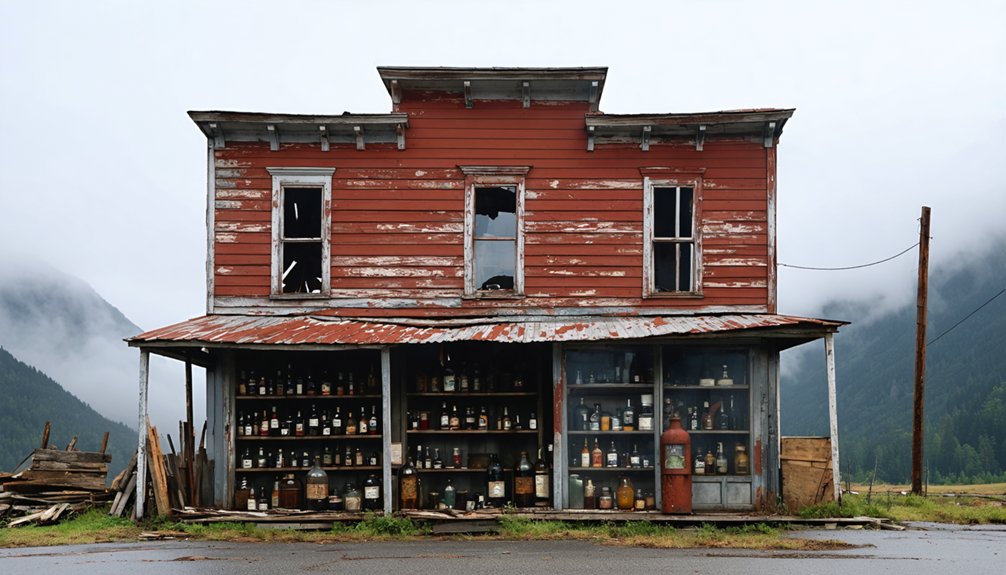
While the industrial machinery of Appalachia’s ghost towns reveals technological evolution, the architectural remnants serve as equally powerful indicators to human settlement patterns and community development.
You’ll find varying degrees of preservation across these forgotten communities—from Thurmond’s intact depot and commercial buildings to Blue Heron’s creative metal shell reconstructions positioned atop historical foundations.
Elkmont’s stone chimneys and foundation work along hiking trails offer glimpses into the spatial organization of former communities, while Matildaville’s stone retaining walls reveal engineering adaptations to Potomac River landscapes.
The silent stone sentinels of Appalachia’s past reveal how communities both shaped and adapted to mountain landscapes.
The Great Smoky Mountains National Park Service has established plans to preserve and restore 19 historical Elkmont Historic District buildings by 2025, transforming them into museum exhibit spaces that showcase early 20th century resort life.
The submerged foundations of Loyston occasionally emerge during low water periods, creating temporary windows into pre-flood community layouts.
These architectural remnants—whether standing structures or mere foundation outlines—provide essential spatial context for understanding how Appalachian communities organized their lives around industrial enterprises.
In many cases, wooden houses built by mining companies still stand as silent witnesses to the rapid development and subsequent abandonment of once-thriving coal towns throughout the region.
The Supernatural Legacy: Bell Witch and Haunted Site Relics
When you visit the Bell Family Farm in Adams, Tennessee, you’ll encounter a compelling array of tangible artifacts—including the mysterious vial of black liquid linked to John Bell’s poisoning and ancient Native American grave boxes in the Bell Witch Cave.
These physical remnants serve as material anchors for the supernatural narrative that has persisted for over two centuries, connecting visitors to the reported phenomena of objects moving, physical assaults, and audible manifestations.
Ritual objects like Witch Balls further contextualize the community’s response to perceived supernatural threats, illuminating how material culture interfaces with spiritual belief systems in Appalachian folklore traditions. The story gained historical documentation when Martin V. Ingram published An Authenticated History of the Famous Bell Witch in 1894, providing one of the earliest formal accounts of this haunting. The Bell Farm’s cave, where the witch allegedly resided, continues to attract paranormal enthusiasts seeking evidence of the supernatural occurrences that tormented the Bell family.
Tangible Witch Remnants
The supernatural legacy of the Bell Witch manifests not merely in spectral tales, but through tangible artifacts that continue to draw historical scrutiny and paranormal interest.
When you visit the Bell property in Adams, Tennessee, you’ll encounter witch artifacts including remnants from the original structure housed within the reconstructed Bell cabin. The site’s haunting evidence extends to preserved period buildings—a log tenant house, barber shop, and doctor’s office—relocated to authenticate the historical context. The cabin features a realistic mannequin in John Bell’s deathbed that startles many visitors with its lifelike appearance.
Most compelling is the Bell Witch Cave, where stone formations created over centuries include one resembling a demonic figure.
Archaeological evidence of Mississippian burials—rectangular box graves carved into the cave floor—suggest the spiritual significance predates European settlement by over 1,000 years.
The Bell family cemetery and old well remain as silent witnesses to the supernatural events documented in Ingram’s 1894 account. Visitors can still trace portions of the rural lane that General Andrew Jackson traveled during his famous visit to investigate the Bell Witch phenomena.
Ritual Objects’ Power
Among the most spiritually charged artifacts found throughout Appalachian ghost towns, ritual bells stand as potent vessels of supernatural energy that transcend mere historical significance.
You’ll discover these protective symbols served dual purposes—cleansing spaces of negative energies while strengthening communal bonds during ceremonies.
The Bell Witch legend exemplifies their ritual significance, where bells marked boundaries between natural and supernatural domains. These artifacts weren’t merely decorative; they functioned as spiritual “battle cries” against malevolent forces.
When consecrated with moonlight, herbs, or crystals, bells amplified magical intent during critical shifts and liminal periods.
In abandoned settlements, uncovered bells reveal complex cultural practices where fertility symbolism merged with protective magic—a reflection of how Appalachian communities weaponized sound to defend against the unseen threats that haunted their mountain existence.
Social Hubs: Evidence of Community Life in Abandoned Towns

Scattered across the abandoned landscapes of Appalachian ghost towns, social hubs once vibrated with the daily interactions that defined community life for mining and logging families.
You’ll find evidence of these social gatherings in the skeletal remains of dance halls, private clubs like Elkmont’s Appalachian and Wonderland establishments, and company-owned general stores that operated on restrictive scrip systems.
Churches and schoolhouses—often the last structures still standing—served as anchors for community identities, hosting everything from mandatory religious services to holiday celebrations.
The architectural stratification of residential areas reveals social hierarchies that once governed these spaces.
Commercial districts with empty storefronts that once hummed with commerce now stand as silent witnesses to the economic control companies exerted over workers’ professional and personal lives.
Underground Stories: Tools and Technology of Appalachian Coal Mining
You’ll find carbide lamps among the most telling artifacts of Appalachian mining communities, their carefully crafted acetylene systems illuminating not just coal seams but miners’ daily struggles for survival.
The evolution from primitive hand drills to hydraulic equipment and black powder blasting techniques reveals how explosive technologies fundamentally transformed both extraction methods and settlement patterns throughout the region.
Abandoned rail systems, with their specialized cars and loading mechanisms, offer critical evidence of the sophisticated transportation networks that connected isolated mountain operations to broader economic markets.
Mining Lamps Reveal Lives
Deep beneath the Appalachian mountains, the evolution of mining lamps illuminates far more than coal seams—it reveals the complex interplay between technology, safety, and miners’ daily struggles.
You’ll notice how Sir Humphry Davy‘s 1815 safety lamp, with its ingenious metallic mesh, represented one of the earliest mining innovations addressing methane explosions.
Despite these advances, miners often resisted adoption due to financial concerns—poor illumination meant reduced productivity for workers paid by weight.
These safety challenges persisted through the oil-wick and carbide lamp eras, with miners frequently choosing brightness over protection.
The true transformation arrived with electric lamps in 1915, following Congressional establishment of the U.S. Bureau of Mines.
This technology finally reconciled the competing demands of visibility and safety, dramatically reducing accidents while ending miners’ dangerous dependence on open flames underground.
Explosive Technologies Shaped Towns
As explosive technologies revolutionized Appalachian coal mining in the late 19th century, they simultaneously transformed the physical and social landscapes of mountain communities.
You’ll find evidence of this explosive legacy in abandoned towns where blasting enabled the shift from surface to underground extraction, pushing miners deeper into perilous mountain interiors.
The artifacts tell stories of mining hazards: wooden timbers that once supported blasted tunnels, remnants of carbide lamps that risked igniting methane, and crude safety equipment developed after deadly accidents.
Later evidence reveals mountaintop removal‘s devastating environmental impact, where millions of pounds of explosives literally reshaping Appalachia’s peaks.
These technologies didn’t just extract coal but fueled social upheaval, driving labor conflicts like the Mine Wars as communities struggled against the deadly toll of explosive-based extraction methods.
Rail Systems’ Hidden Clues
Beneath the forest-reclaimed ghost towns of Appalachia, hidden rail systems chronicle the technological evolution of coal extraction with remarkable precision.
You’ll discover how transport capacities advanced from two-ton mine cars to thirty-ton behemoths in Pike County, reflecting mining’s industrialization.
The rail road infrastructure’s expansion tells a story of economic ambition—from Pennsylvania Railroad’s 1854 Pittsburgh-Philadelphia connection to strategic lines extending into remote coalfields.
Technology evolution is evident in rail composition: wooden rails gave way to iron-capped versions, then wrought iron, cast iron, and finally steel.
Preservation Challenges: Comparing Appalachian Ghost Town Artifacts to Western Counterparts
While Appalachian ghost towns harbor rich historical artifacts, they face preservation challenges distinctly different from their Western counterparts. The region’s high humidity and frequent rainfall accelerate artifact deterioration, particularly affecting wooden structures and metal mining tools that would survive decades longer in the arid West.
Abandoned towns in Appalachian mountains often reveal the stories of hard-working communities that once thrived on coal and timber. Exploring these remnants can provide a glimpse into the cultural heritage and resilience of the region, despite the harsh environmental factors that hasten their decay. Efforts to preserve these sites are crucial, as they serve as valuable lessons in understanding the intersection of history, ecology, and economy.
The mountains weep, their moisture reclaiming history faster than preservationists can document our Appalachian past
You’ll find preservation techniques in Appalachia must contend with dense vegetation and remote, rugged terrain that complicates restoration logistics.
Western sites typically benefit from drier climates, greater accessibility, and more substantial tourism revenue supporting conservation efforts.
The contrast is striking: Western ghost towns often stand as open-air museums with stone or adobe structures, while Appalachian sites—predominantly timber-based and subject to aggressive decomposition—require more urgent intervention despite having fewer resources available for their protection.
Frequently Asked Questions
How Can Hobbyists Legally Explore Appalachian Ghost Towns?
You’ll need to secure legal permissions from property owners, research public access sites, conduct thorough safety precautions, and document your intentions while carrying appropriate protective equipment for responsible exploration.
What Artifacts Indicate Ethnic Diversity in Appalachian Mining Communities?
Birds of a feather once flocked separately. You’ll discover pepperoni rolls, stone coke ovens, accordions, banjos, and fiddles as cultural symbols, while hard hats, goggles, and trade items demonstrate the region’s rich ethnic tapestry.
How Did Prohibition Impact Artifact Patterns in Logging Towns?
You’ll find prohibition effects visible in artifact distribution patterns: scattered glass bottles, hidden caches near borders, and copper still fragments commingled with logging equipment in remote, defensible locations.
Were Children’s Toys or School Items Commonly Found?
You’ll find vintage dolls and school supplies among the most prevalent children’s artifacts unearthed in these settlements, evidencing educational infrastructure and family life within these once-vibrant, now-liberated mountain communities.
What Dating Methods Determine the Age of Unmarked Artifacts?
Beneath layers of time, you’ll uncover truth through radiocarbon dating of organic remains and stratigraphic analysis of soil layers. Typology and artifact association further authenticate unmarked Appalachian relics you’ve discovered.
References
- https://www.thewanderingappalachian.com/post/appalachian-ghost-stories
- https://www.youtube.com/watch?v=RdEbyUaaK44
- https://www.youtube.com/watch?v=4oHlJFXbrCk
- https://icatchshadows.com/jellico-the-appalachian-coal-mining-town-with-an-explosive-past/
- https://albiongould.com/ghost-towns-to-visit-in-the-states/
- https://www.appalachianhistory.net/category/ghost-towns-2
- https://www.scenicnh.com/blog/2016/05/image-search-term-logging-era-artifacts/
- https://www.appalachianforestnha.org/working-in-the-woods
- https://www.youtube.com/watch?v=9NZq08XTg1M
- https://www.nrs.fs.usda.gov/pubs/gtr/gtr_ne241/gtr_ne241_171.pdf