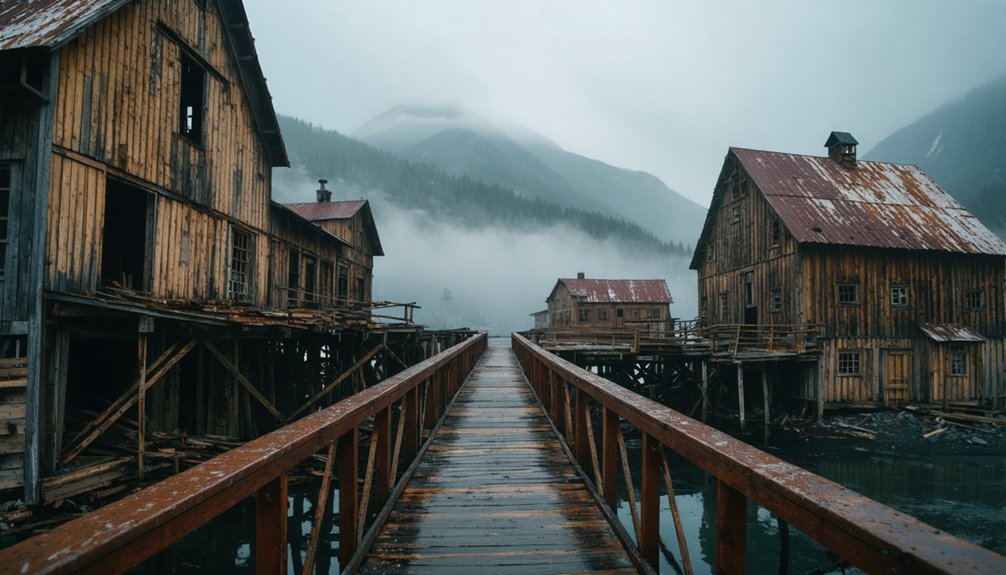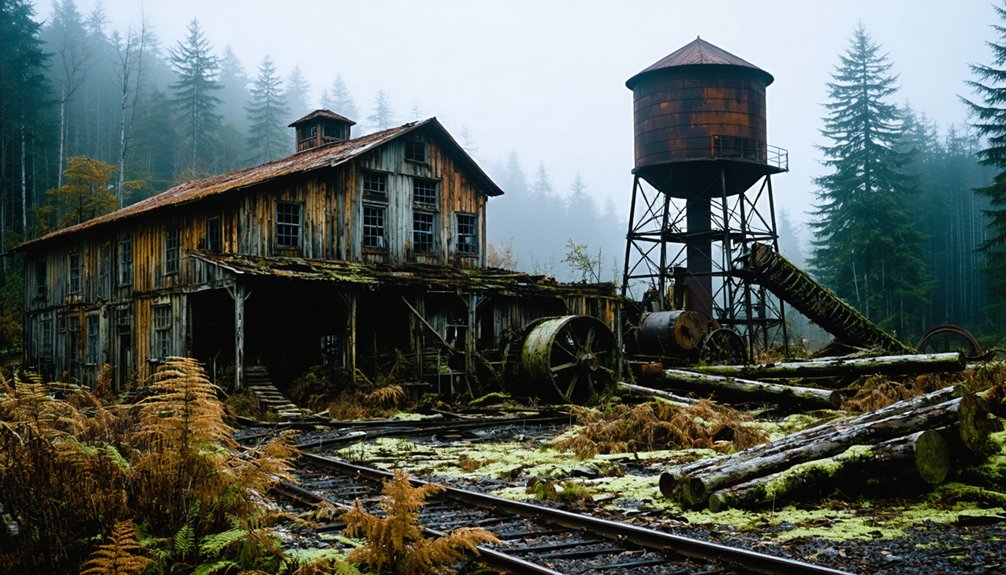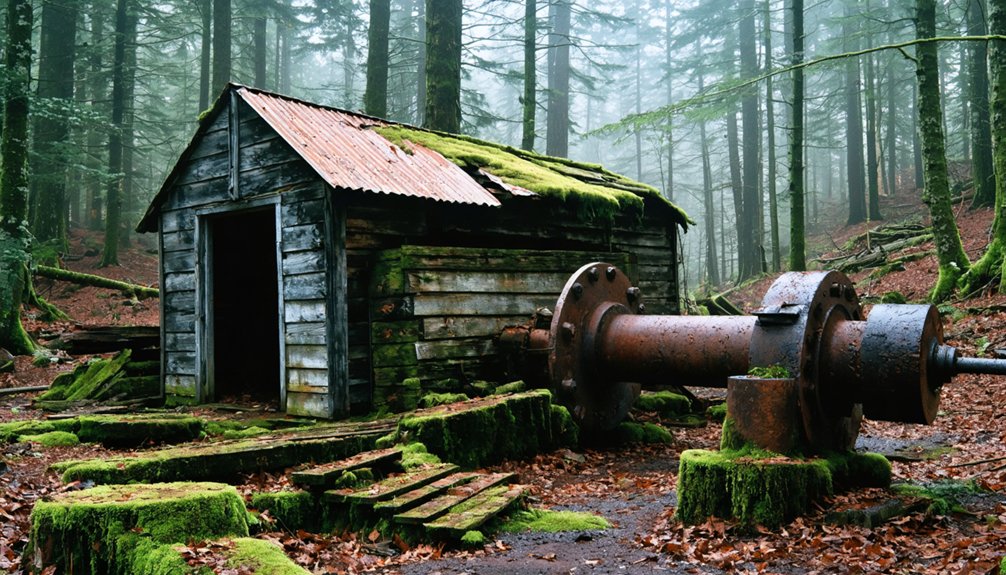
Logging hamlets disappeared due to several converging factors. You’ll find these settlements vanished as mechanized harvesting eliminated labor needs, while resource depletion forced operations to migrate elsewhere. Transportation networks contracted as railroads ceased operating in remote areas, and mills centralized near major transportation hubs. Economic instability, environmental regulations, and rural-to-urban migration further hollowed out these communities. The landscape of abandoned settlements tells a deeper story of industrial evolution.
Key Takeaways
- Mechanized harvesting systems allowed single operators to efficiently harvest entire forests, eliminating the need for large logging crews.
- Decline of timber railroads isolated remote communities as transportation networks ceased operations, making settlements economically unviable.
- Youth exodus (13-37% among 15-29 year-olds) toward urban areas with better wages and career advancement depleted the workforce.
- Timber industry consolidation centralized operations around larger mills near rail lines and waterways, rendering small settlements obsolete.
- Unsustainable forestry practices depleted local timber resources, forcing operations to relocate as nearby forests were exhausted.
The Timber Economy’s Boom-and-Bust Cycle
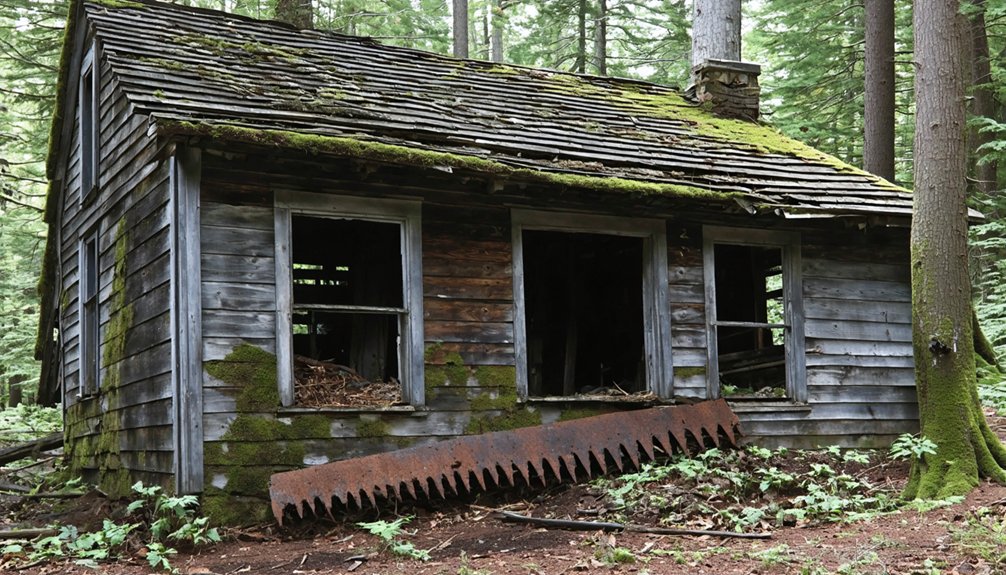
When examining the timber economy‘s explosive growth following World War II, you’ll find a distinct spatial pattern of boom-and-bust cycles that fundamentally altered settlement landscapes across logging regions.
Housing construction demand nearly doubled lumber production while concentrating half the workforce in a single industry.
You’d witness these communities rise and fall with national housing markets, their physical footprints expanding during prosperity, then contracting during inevitable downturns. This intense economic dependency created unsustainable settlement patterns tethered to timber market fluctuations.
By the 1960s, technological displacement further transformed these landscapes as machines replaced human labor, despite maintained production volumes. Per-capita personal income dropped below state levels as manufacturing jobs disappeared from local economies. Regulatory changes often exacerbated these cycles by imposing harvesting limitations during economic booms when communities were most vulnerable.
Mechanization hollowed timber towns while logs continued flowing, creating ghost communities in once-vibrant forestlands.
The spatial consequence was clear: once-thriving hamlets began emptying as employment opportunities vanished. Population shrinkage marked the physical manifestation of an economic system vulnerable to national recession sensitivity and incapable of sustaining the communities it created.
When the Forests Disappeared: Resource Exhaustion
The disappearance of forest resources fundamentally reshaped the physical and economic geography of logging settlements across North America. As you examine the abandoned hamlets dotting the landscape, you’re witnessing the aftermath of unsustainable forest management practices that exhausted timber supplies with remarkable speed.
- When New England’s forests vanished, logging operations migrated southward and westward in a relentless pursuit of untapped resources.
- The Great Lakes region suffered particularly severe overlogging, described as “cutting in two and setting the match to the four ends.”
- Longleaf pine forests in the Southeast shrank dramatically from 90 million acres to near-extinction through overharvesting.
- Pacific Northwest communities faced similar collapse when private timber supplies dwindled, forcing increased dependence on national forests.
This pattern of resource exhaustion repeatedly transformed thriving logging communities into ghost towns as logging sustainability was sacrificed for short-term profits. During this transition, residents were often told one moment, please as companies verified the viability of remaining timber stands before announcing closures. By 1860, over 153 million acres of forest had been cleared for agricultural expansion alone, drastically reducing the viability of logging-dependent settlements.
Changing Technology and the Decline of Small Operations

You’ll find abandoned logging hamlets scattered throughout former timber regions, their collapse largely driven by the shift from labor-intensive operations to mechanized harvesting systems.
Where once hundreds of workers wielded axes and crosscut saws, modern feller bunchers and harvesters now enable single operators to harvest entire forest sections with unprecedented efficiency.
This technological revolution centralized operations around fewer, larger mills connected by improved transportation networks, rendering the spatial pattern of numerous small settlements obsolete as the industry consolidated. The Industrial Revolution transformed logging practices fundamentally, making many traditional logging communities economically unviable as steam-powered machinery replaced manual labor. The introduction of gasoline chainsaws in 1929 further accelerated this transition, dramatically increasing the speed and efficiency of tree felling compared to traditional methods.
From Steam to Diesel
Throughout the American logging landscape, a profound technological revolution unfolded as diesel engines gradually displaced steam power, forever altering the settlement patterns of timber-harvesting regions. This shift wasn’t immediate—spanning several decades between 1925 and the 1960s—as steam technology persisted due to abundant coal supplies and established infrastructure.
- Diesel engines eliminated the need for water stations and coal depots that once anchored small hamlets.
- Improved power-to-weight ratios allowed operations to penetrate deeper into forests without nearby settlements.
- Centralized maintenance facilities replaced the distributed repair networks that supported isolated communities.
- Higher mobility of diesel equipment reduced dependency on fixed-location camps near cutting sites.
The integration of internal combustion engines into logging machinery marked the industry’s transition from steam to more efficient power sources. Similar to farm tractors, logging equipment experienced a messy middle period where multiple fuel types coexisted before diesel became dominant. You’re witnessing the physical imprint of diesel advantages on the landscape—as efficient transportation and mechanization freed operations from geographical constraints while simultaneously stripping small communities of their economic purpose.
Centralized Mill Revolution
As massive centralized mill complexes emerged across America’s timber regions, they reshaped not just production methods but entire settlement geographies.
You’d find these industrial behemoths strategically positioned near rail lines and waterways, drawing timber from increasingly distant forests.
The economics were ruthless. Small water-powered mills scattered through the backcountry couldn’t compete with steam-powered centralized logging operations.
Their efficiency—employing mechanized gangsaws, continuous operations, and integrated processing—crushed small-scale competitors through economies of scale.
Your ancestors’ hamlets, once essential nodes in a decentralized production landscape, became obsolete as capital concentrated in fewer hands.
Railroad networks redirected timber flow, bypassing communities that once processed logs locally. The invention of steam donkeys in 1881 further accelerated this centralization by making it possible to haul logs over greater distances.
Centre County’s landscape was particularly transformed, with what was once vibrant logging communities reduced to nothing but stumps and ashes after the timber was exhausted.
When the trees were gone and the mills consolidated elsewhere, these small settlements simply faded away, leaving ghost towns across the once-forested landscape.
hidden gems in California’s ghost towns often reveal stories of resilience and creativity. Each abandoned structure and overgrown path tells a tale of the past, inviting adventurous spirits to explore their history. As you wander through these remnants, the beauty and mystery of a bygone era become apparent, making these forgotten places worth the journey.
Labor Force Shrinkage
The relentless march of mechanization across America’s timber regions hollowed out logging hamlets‘ populations, creating demographic voids where vibrant communities once stood.
You’ll notice abandoned structures dotting landscapes where labor market dynamics shifted dramatically over decades. As logging employment declined by 2% annually since 1997, the spatial distribution of timber communities contracted.
- Workforce aging accelerated as younger generations avoided the dangerous profession
- Small operations closed, unable to invest in capital-intensive equipment
- Settlement patterns shifted from dispersed hamlets to centralized production hubs
- Traditional logging communities withered as 7,000 worker shortages emerged
The geography of timber country transformed as mechanization replaced manual labor, driving population exodus from once-thriving hamlets.
You can trace this abandonment pattern across the South and West, where employment drops exceeded 14% in states like Montana and Louisiana.
Transportation Networks: Lifelines Cut Short
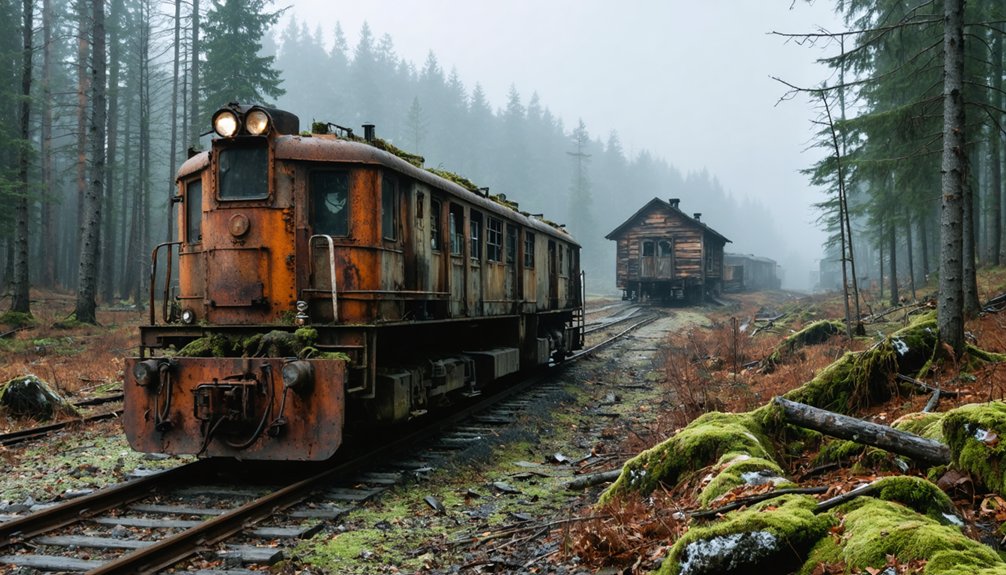
You’ll find that abandoned logging hamlets withered rapidly once railroad networks ceased operation, leaving these once-vibrant communities stranded in increasingly inaccessible terrain.
The economic burden of maintaining remote roads proved insurmountable for small operators, who couldn’t justify the expense as timber resources depleted and mechanized transport shifted to trucks requiring different infrastructure.
This transportation void allowed larger, centralized lumber companies to consolidate operations at fewer, strategic hubs connected to regional highways, effectively severing the lifelines that had sustained scattered forest settlements across the landscape.
Isolation After Rail Decline
Rail networks once served as critical lifelines for logging hamlets, but their dramatic decline has severed these communities from the outside world. When rail companies reduced operations by 40,000 jobs between 2018-2020, your access to markets vanished.
The landscape transformed as abandoned tracks cut through forests that once bustled with commerce. Without rail accessibility, your hamlet’s economic viability collapsed, forcing a critical decision: struggle in isolation or relocate.
- Longer, less frequent trains meant unreliable connections to essential supplies
- Abandoned rail lines left physical scars across the settlement pattern
- Emergency services faced increasingly difficult access as infrastructure deteriorated
- Rail volume declines of over 20% prioritized profitable routes, abandoning remote communities
The spatial transformation couldn’t be clearer—where tracks once connected freedom-seeking settlers, isolation now defines these forgotten landscapes.
Road Maintenance Impossibilities
As isolated rail-dependent hamlets faltered, their tenuous road connections deteriorated beyond salvation.
You’d witness a perfect storm of impossibilities: road funding evaporated as timber profits vanished, leaving essential infrastructure to crumble under nature’s relentless assault. The Forest Service’s 400,000-mile network became financially unsustainable, particularly in remote hamlets where maintenance challenges multiplied.
You could trace the physical transformation across these landscapes – severely compacted soils persisting for decades, washouts severing crucial connections, and abandoned roadbeds channeling destructive erosion into once-pristine streams.
When the 1998 Roadless Rule imposed construction moratoriums, it sealed these hamlets’ fate. Without regular maintenance, these fragile transportation lifelines – built for temporary extraction rather than permanent settlement – quickly surrendered to the surrounding wilderness, permanently severing communities from the outside world.
Centralized Logistics Takeover
While isolated hamlets struggled against nature’s reclamation, a sweeping revolution in timber transportation networks reshaped the forest landscape and sealed their fate.
You’ve witnessed the shift from scattered, river-dependent settlements to centralized transport systems anchored by railroad mainlines. As mechanization replaced oxen teams with steam donkeys and trucks, logging efficiency soared while dispersed camps vanished.
- Railroad spurs penetrated deep forests, drawing operations away from remote hamlets.
- Transfer stations became new hubs where trucks connected to trains, concentrating activity.
- River-based settlements withered as predictable rail transport eliminated seasonal drives.
- Mobile mechanical equipment reduced the need for permanent settlements near timber stands.
The geography of timber extraction transformed as centralized logistics took control, leaving a constellation of abandoned hamlets as silent markers of an obsolete transportation era.
Environmental Regulations and Forest Management Policies
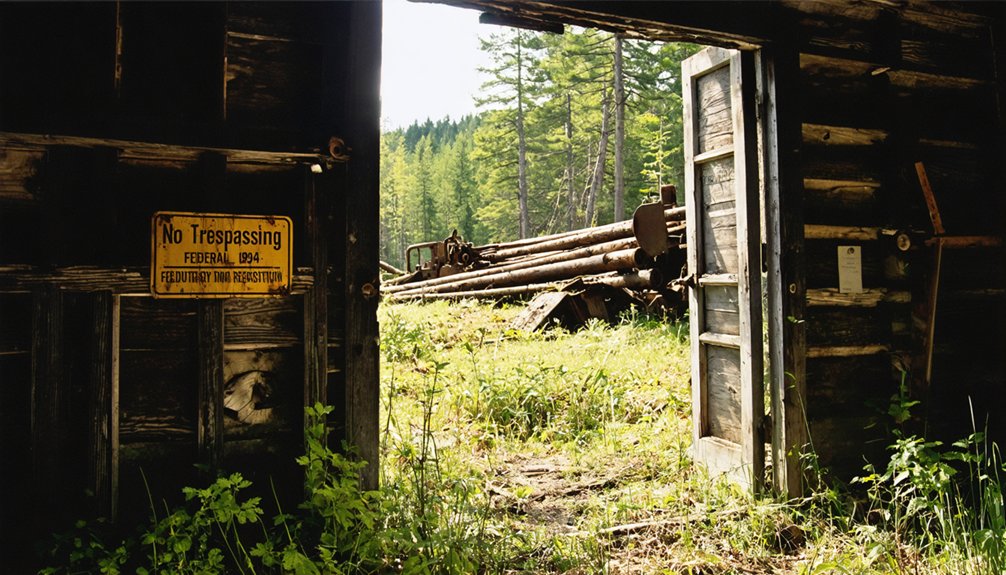
Environmental regulations enacted during the 1990s dramatically reshaped the spatial distribution of logging communities across America’s forestlands.
The listing of the northern spotted owl under the ESA triggered restrictions that transformed once-bustling hamlets into ghost towns. You’ll find former logging settlements abandoned as the Northwest Forest Plan imposed new boundaries on timber harvest zones, pushing human activity away from ecologically sensitive areas.
When NEPA reviews began slowing timber projects, these hamlets lost their economic lifelines. Your once-thriving communities couldn’t survive the shift toward sustainable practices that prioritized selective thinning over clear-cutting.
As environmental impact assessments became mandatory, logging roads were decommissioned, cutting off hamlet access. Forest management policies created buffer zones around watersheds, effectively redrawing the map of viable settlement locations and forcing communities to relocate or dissolve.
The Pull of Urban Life: Demographic Shifts
The hollowing of logging hamlets wasn’t solely driven by environmental policies—powerful demographic currents were simultaneously pulling residents toward urban centers.
The rusting of logging towns reflects America’s inexorable demographic tide—pulling rural lives toward urban shores.
You’re witnessing the remnants of a larger rural-to-urban migration pattern that’s transformed America’s settlement landscape. Remote logging communities, often positioned far from metropolitan areas, have experienced the most severe population losses, particularly among young adults seeking liberation through expanded opportunities.
- Youth exodus: 15-29 year-olds leave at rates of 13-37%, seeking education and diverse employment
- Economic gravity: Urban labor markets offer higher wages and career advancement unavailable in isolated hamlets
- Generational imbalance: Outmigration leaves aging populations with different service needs
- Spatial inequality: Communities distant from metropolitan areas face steeper rural decline without suburban connectivity
Community Infrastructure Challenges
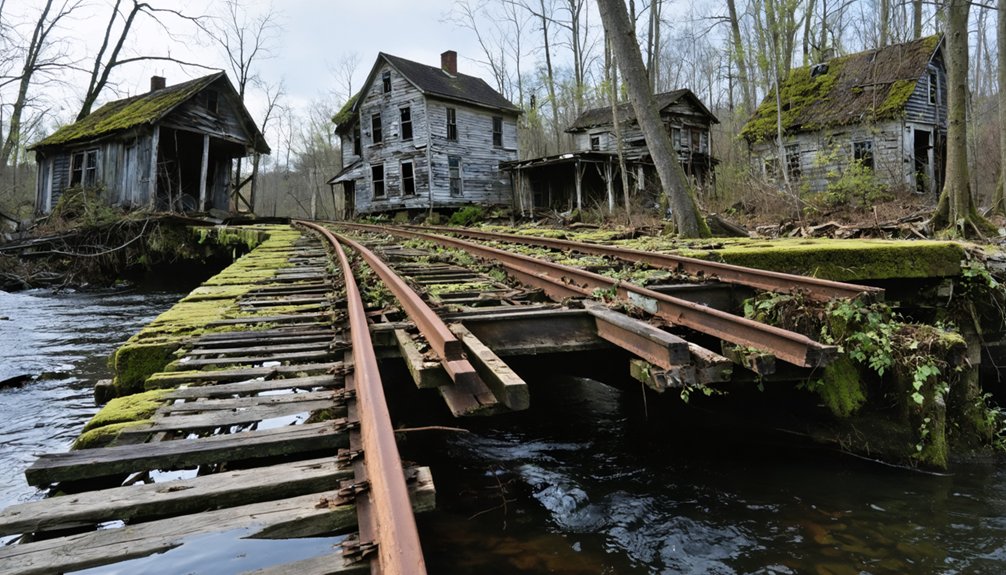
Beyond the demographic shifts hollowing out logging communities, critical infrastructure systems have deteriorated to crisis points across these settlements.
You’ll find water lines over half a century old threading beneath these hamlets, many just one technical failure away from complete collapse.
When you examine the funding obstacles, the pattern becomes clear: with 84% of infrastructure costs falling on local water rates, these communities simply can’t generate sufficient revenue.
Their isolated landscapes deter construction crews and specialists, while small project sizes make them economically unattractive.
The spatial distribution of these failing systems creates a landscape of vulnerability.
Community needs accumulate as grant reappropriation processes move glacially, forcing residents to choose between persisting amid crumbling foundations or seeking modern infrastructure elsewhere—a freedom increasingly exercised through abandonment.
Natural Disasters and Geographic Vulnerability
When examining abandoned logging hamlets across varied terrains, you’ll discover natural disasters serve as decisive catalysts accelerating settlement decline.
Geographic vulnerability patterns similar to those in Asia’s mountainous regions reveal how poorly constructed timber structures offered minimal disaster preparedness against nature’s fury. You’re witnessing settlement patterns that demonstrate physical vulnerability combined with socioeconomic fragility.
- Steep terrain hamlets faced disproportionate damage from landslides, particularly where deforestation compromised slope stability.
- Riverside logging communities lacked urban resilience against increasingly frequent flooding events.
- Isolated settlements without evacuation routes experienced prolonged displacement following disaster events.
- Housing infrastructure quality directly determined which hamlets survived disaster cycles versus those permanently abandoned.
This landscape change narrative unfolds differently based on wealth disparities – wealthier logging communities could rebuild while poorer settlements disappeared forever when natural calamities struck.
Corporate Consolidation in the Timber Industry
Corporate consolidation transformed the timber industry’s geographic footprint across rural America, dramatically reshaping settlement patterns in logging communities.
The corporate reshaping of timber empires has rewritten the map of rural America’s existence.
You’ve witnessed corporations swallowing smaller operations through aggressive mergers, creating vast empires that dominate markets while systematically dismantling the local economic fabric.
As vertically-integrated companies splintered and sold off timberlands to TIMOs and REITs, your community’s relationship with surrounding forests fundamentally changed.
The landscape of employment hollowed out when mechanization replaced manual labor, requiring fewer workers to harvest more timber.
Mills closed across the countryside, concentrating production in fewer, larger facilities.
Where once stood a constellation of small, independent hamlets supported by family-owned operations, corporate market domination has left only scattered remnants of a decentralized industry that once sustained rural livelihoods throughout forested regions.
Frequently Asked Questions
Were Abandoned Logging Hamlets Ever Repurposed for Other Industries?
No, you won’t find industrial reuse in these sites. Their remote locations prevented economic revitalization, permanently altering settlement patterns as infrastructure decayed and landscapes returned to wilderness.
Did Any Logging Hamlets Successfully Transition to Tourism Destinations?
Like phoenixes from sawdust ashes, many logging hamlets have risen as tourism havens. You’ll find transformed landscapes where historical preservation meets eco tourism development, offering you liberation through authentic wilderness experiences.
How Did Indigenous Communities Adapt to Abandoned Logging Settlements?
You’ll find indigenous communities demonstrated cultural resilience by reclaiming abandoned logging sites, transforming cleared spaces into new settlement patterns while adapting resources from industrial remnants to support traditional practices across changed landscapes.
What Happened to the Architectural Remains of These Communities?
Over 80% of logging structures deteriorated into the landscape. You’ll find remaining buildings repurposed as heritage sites, their architectural preservation highlighting historical significance while revealing settlement patterns across changed rural landscapes.
Did Company Towns Face Different Abandonment Patterns Than Independent Settlements?
You’ll notice company town dynamics created more abrupt abandonment compared to independent settlements. When resources vanished, corporate decisions dictated complete shutdowns, whereas settlement sustainability gradually declined in independent hamlets as workers naturally dispersed.
References
- https://en.wikipedia.org/wiki/Abandoned_village
- https://en.wikipedia.org/wiki/Strategic_Hamlet_Program
- https://pmc.ncbi.nlm.nih.gov/articles/PMC9132457/
- https://ideas.repec.org/a/eee/lauspo/v95y2020ics0264837719305563.html
- https://www.cambridge.org/core/books/rewilding/rewilding-through-land-abandonment/23199DA126ACE9194415F52F755340D2
- https://fiveable.me/key-terms/hs-appalachian-studies/boom-and-bust-cycles
- https://sciencepolicy.colorado.edu/admin/publication_files/resource-2658-2002.34.pdf
- https://www.humboldt.edu/economic-index/humboldt-county-economy-where-have-we-been-and-where-are-we-going
- https://www.fs.usda.gov/pnw/pubs/pnw_gtr624.pdf
- https://www.americanheritage.com/days-boom-and-bust