Colorado ghost towns harbor more than abandoned buildings—they contain rich historical narratives shaped by economic collapse, brutal alpine winters, and transportation shifts. You’ll find remnants of diverse communities from mining settlements to all-Black enclaves like Dearfield. Beyond historical artifacts, these towns have developed supernatural lore, with places like St. Elmo considered Colorado’s most haunted location. The silent structures and forgotten pathways reveal fascinating stories about resilience and failure in the American West.
Key Takeaways
- Supernatural lore is abundant in Colorado’s ghost towns, with places like Cripple Creek featuring haunted casinos and buildings.
- St. Elmo has earned a reputation as Colorado’s most haunted ghost town, attracting paranormal enthusiasts and investigators.
- Abandoned mining structures reveal industrial complexity and serve as physical archives of frontier life and community dynamics.
- Economic devastation and demographic whiplash left psychological imprints that manifest in reported paranormal experiences.
- Forgotten stories of survival, tragedy, and cultural diversity remain in these abandoned towns, preserved in remaining structures.
The Silver Crash of 1893: How Economic Forces Created Ghost Towns

When the Silver Crash of 1893 swept through Colorado, it transformed thriving mining communities into ghost towns virtually overnight. The repeal of the Sherman Silver Purchase Act eliminated government silver purchases, collapsing the industry that formed these towns’ economic foundation.
You can still see the economic decline’s stark physical evidence today. Towns like Leadville witnessed catastrophic unemployment, with operational mines plummeting from 100 to merely 20. Unemployment reached nearly 100% in smaller communities dependent on single mines, crushing the local economies. The economic distress was part of a nationwide financial catastrophe that saw 86 bank failures in Washington state alone between 1893 and 1897.
The mining legacy of Colorado bears permanent scars from this financial calamity. Infrastructure deteriorated as abandoned mines flooded and shafts collapsed. A decision by the British Parliament on June 26, 1893, triggered this disaster when silver prices dropped from 80 cents to 64 cents an ounce overnight.
While some communities pivoted to gold mining, most couldn’t recover. The crash’s devastation rivaled the Great Depression’s impact, leaving behind empty buildings that now stand as haunting monuments to boom-and-bust capitalism.
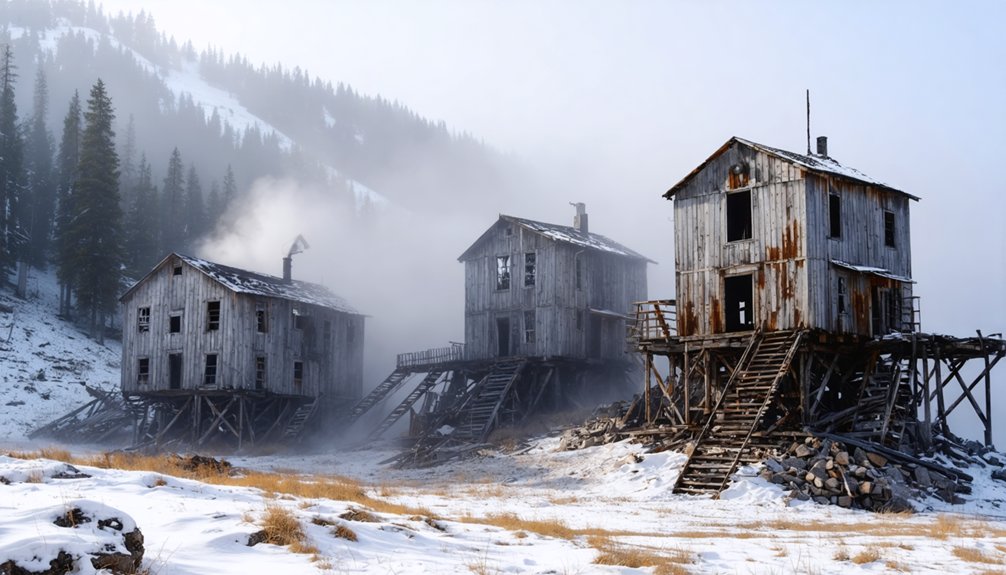
Abandoned in the Snow: The Role of Harsh Alpine Winters
You’ll find that Colorado’s harshest winters played a decisive role in transforming thriving mining communities into ghost towns.
In places like Ashcroft, where the devastating 1899 storm forced residents to fashion escape skis from their own dismantled homes, winter conditions made continued settlement economically and physically impossible.
These extreme conditions pushed populations toward lower-elevation towns with milder climates, as miners abandoned high-altitude settlements like Carson City (12,000 feet) and Animas Forks (11,185 feet) where avalanches regularly destroyed infrastructure and winter supply routes frequently collapsed. Animas Forks’ extreme elevation made it particularly vulnerable to unpredictable mountain weather that frequently isolated the community.
Independence ghost town suffered particularly from the harsh winters that contributed to its eventual abandonment as residents were lured to the more hospitable climate of nearby Aspen.
Winter’s Deadly Embrace
Though Colorado’s ghost towns captivate visitors with their weathered facades today, the brutal alpine winters played a decisive role in their ultimate abandonment. You’d face temperatures plummeting below 0°F at elevations like Gilman (9,000 ft) or Carson (12,000 ft), where winter survival became a daily battle against the elements.
Isolation challenges mounted as snowstorms cut supply routes, leaving communities like Holy Cross City completely stranded during the devastating winter of 1899. You might’ve torn apart your own home to fashion crude skis for escape when provisions ran dangerously low. The community of Gilman was particularly vulnerable to these harsh conditions after suffering significant destruction from a fire in 1899. Independence was eventually abandoned in 1899 due to the incredibly harsh winters and severe snowstorms that made life unsustainable.
The freeze-thaw cycles rapidly deteriorated structures, while hidden dangers lurked everywhere – from collapsing snow caves to unstable mine shafts undermined by frost. Ultimately, these relentless seasonal hardships drove residents to seek more hospitable environments at lower elevations.
Snowbound Exodus Stories
As winter’s grip tightened around Colorado’s mining communities, dramatic exodus stories unfolded across the alpine landscape.
You’d witness desperate scenes at elevations nearing 11,000 feet, where oxygen-starved residents faced life-or-death decisions during brutal storms.
The infamous 1899 blizzard triggered remarkable snowbound survival efforts. Trapped by impassable mountain passes, miners dismantled their own structures for firewood and crafted makeshift skis from building planks. These improvised tools enabled winter migrations as families fled when food ran critically low. Animas Forks, positioned at over 11,200 feet, experienced frequent avalanche threats that compounded winter survival challenges.
Economic pillars collapsed alongside snowdrifts—rail services halted, supply chains failed, and maintenance costs skyrocketed.
Once-thriving towns emptied rapidly after severe winters, particularly when Alpine Tunnel closed in 1910, severing essential transportation arteries. For many settlements, one devastating winter marked their permanent shift to ghost town status. Animas Forks saw its population dramatically decline in the early 1910s as the harsh alpine conditions proved too difficult to sustain community life.
The Forgotten Railroad Towns: Transportation’s Impact on Survival

Railroad construction across Colorado’s rugged terrain fundamentally altered the state’s settlement patterns, creating a network of towns whose existence hinged entirely on the iron rails that connected them to the wider world.
You’ll find these settlements originated as construction camps like East Portal or emerged around critical infrastructure like water stops and sidings.
The railroad impact on town survival was absolute—communities thrived when positioned on main routes but quickly vanished when economics shifted.
Operating challenges, particularly in mountain regions where snow removal consumed up to 41% of railroad budgets, strained the entire system.
When railroads faced financial trouble or routes became obsolete through engineering improvements like the Moffat Tunnel, the towns they served were abandoned just as swiftly as they’d been established.
Towns like Rollinsville became important supply centers with stage stations and post offices during the railroad’s heyday.
Ghost towns like Alder, established in 1881, represent the direct consequence of railroad abandonment when companies changed their routes.
Boom to Bust: The Rapid Rise and Fall of Mining Settlements
You’ll find Colorado’s mining settlements experienced meteoric rises followed by catastrophic collapses, exemplified by towns like Leadville expanding from 600 to over 10,000 residents in just two years.
The fatal blow came with the 1893 repeal of the Sherman Silver Purchase Act, which sent silver prices plummeting and triggered widespread economic depression throughout mining communities.
Miners and their families fled these once-bustling towns virtually overnight, abandoning homes and businesses as job opportunities vanished, transforming vibrant communities into the skeletal ghost towns that dot Colorado’s landscape today.
Mining Dreams Shattered
While towns like Georgetown, Creede, and Leadville emerged with explosive growth during Colorado’s mining rushes, their prosperity proved devastatingly fragile.
You’d have witnessed thousands of miners and entrepreneurs, their mining aspirations tied to the whims of ore quality and metal prices. When the Sherman Silver Purchase Act was repealed in 1893, silver markets crashed overnight, transforming boomtowns into landscapes of economic despair.
Towns that once supported 10,000 residents emptied rapidly as mines closed. The Portland Mine in Goldfield, once employing thousands, left workers with no alternative income when operations ceased.
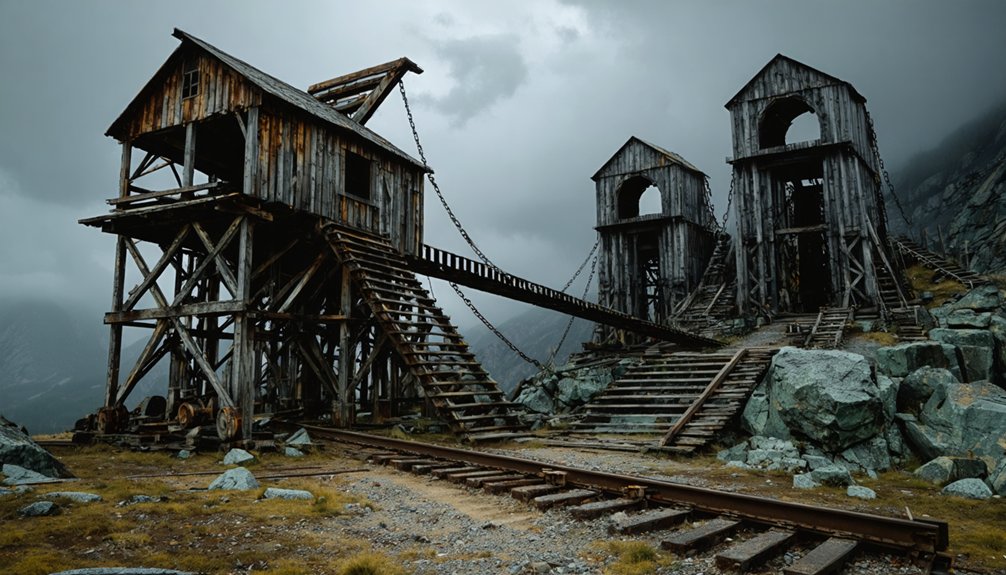
You can still find abandoned tramways and rail lines that once transported wealth from mountain veins—now silent monuments to collapsed dreams. Even towns that partially shifted to tourism couldn’t escape the shadow of their mining dependency.
Silver’s Fatal Collapse
Colorado’s monumental silver boom, which transformed sleepy mountain outposts into vibrant economic centers beginning in 1879, met its catastrophic end with the 1893 repeal of the Sherman Silver Purchase Act.
The resulting silver market fluctuations devastated communities that had come to depend on government-supported prices, causing silver to plummet virtually overnight.
You’d have witnessed unprecedented economic collapse as unemployment soared to 40-50% in larger towns and nearly 100% in single-mine settlements.
Mining labor shifts occurred rapidly as desperate workers fled by the thousands, seeking survival elsewhere.
Bank failures and property devaluations followed, with even wealthy mining magnates like Horace Tabor losing everything.
The boom towns that had flourished with hotels, banks, and breweries emptied, leaving behind abandoned infrastructures—silent monuments to freedom’s fragility when tethered to government policy.
Overnight Exodus Patterns
When booms turned to busts in Colorado’s mining towns, population shifts happened with astonishing speed—a demographic whiplash that defined the state’s settlement patterns.
You’d witness entire communities dissolve within months as mining capital chased richer deposits elsewhere.
Consider Leadville’s rise at Central City’s expense, or how thousands fled once-prosperous towns after the 1893 Silver Purchase Act repeal.
These transient populations rarely established deep roots, making exodus inevitable when economic foundations crumbled. Within a single generation, thousands became hundreds.
What made these shifts so dramatic was their cascading nature—as mines closed, businesses followed, then schools and services collapsed.
With little economic diversification, community continuity fractured. The abandoned infrastructure now stands as stark evidence to freedom’s price in single-industry economies where fortunes changed overnight.
Beyond the Mines: Lost Communities and Diverse Populations
Although mining claims dominate Colorado’s ghost town narrative, the state’s abandoned settlements reveal a far more complex tapestry of human experience.
The mysteries of Colorado’s mining shafts often lead to discoveries that challenge the conventional understanding of resource extraction. Hidden beneath the surface are stories of resilience, innovation, and the harsh realities faced by those who sought fortune in the dark depths. Each tunnel and shaft stands as a testament to the ambition and struggle of a bygone era, waiting to be uncovered by those willing to explore.
You’ll find Dearfield, Colorado’s only all-Black settlement, where 700 African Americans built a farming community before drought and the Great Depression forced abandonment. This cultural heritage extended to diverse agricultural towns that succumbed to harsh conditions on the eastern plains.
Beyond extraction economies, many settlements maintained vibrant social structures with schools, newspapers, and churches—evidence of community resilience despite isolation.
Transportation shaped these communities’ fates markedly. When railroads redirected or mines depleted, towns emptied rapidly.
The story includes Ancient Puebloan villages abandoned centuries earlier and immigrant enclaves of Chinese, Irish, and Italian workers who faced discrimination yet contributed notably to Colorado’s development—histories often overshadowed by romanticized mining tales.
Remnants of Daily Life: What Buildings Tell Us About the Past

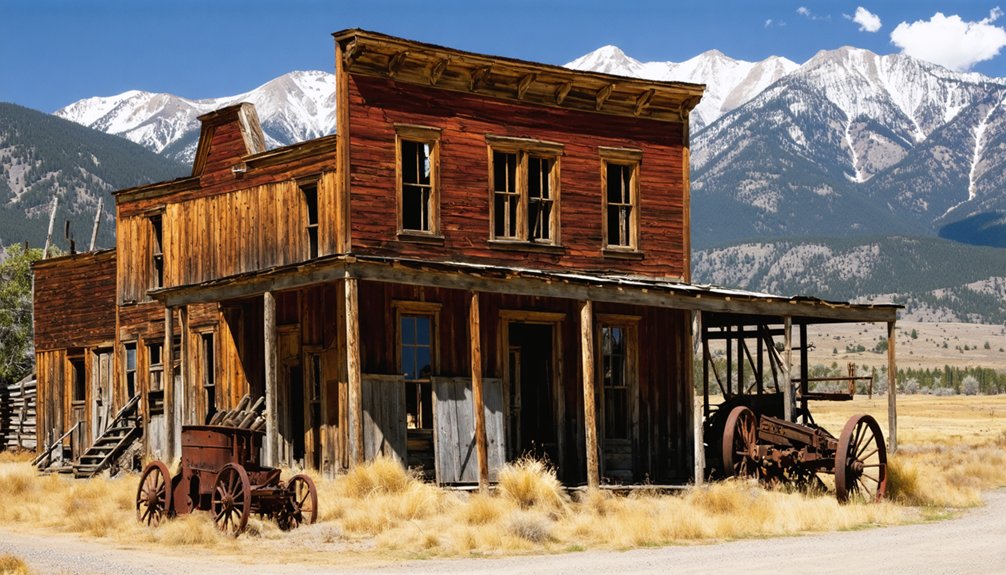
Standing silently across the Colorado landscape, abandoned buildings serve as physical archives of frontier life, each structure telling a specific story about the people who once inhabited these ghost towns.
You’ll notice building evolution through false-front facades that projected prosperity despite frontier challenges. The concentration of commercial structures—from numerous saloons in Teller City to general stores doubling as boarding houses—reveals community dynamics and social stratification.
Mining structures illustrate industrial complexity beyond basic survival needs. When you explore these towns, cemetery locations and gravesites provide insights into mortality rates and cultural practices.
The materials used—local wood and stone—demonstrate environmental adaptation, while preservation efforts in places like St. Elmo and Animas Forks maintain these tangible connections to Colorado’s boom-and-bust past.
Modern Hauntings: Legends and Lore of Deserted Mountain Towns
Beyond the physical remnants of Colorado’s ghost towns, a rich tapestry of supernatural lore has emerged that continues to captivate visitors and paranormal enthusiasts alike.
You’ll discover Cripple Creek’s haunted casinos where apparitions move glassware and create inexplicable drawings, while Georgetown offers tours featuring benevolent spirits from its Gold Rush era.
St. Elmo stands as Colorado’s most haunted ghost town, where spectral legends like Annabelle Stark persist from the fading silver boom.
Named entities enhance these ghostly encounters—Silver Heels wanders near Cañon City, while Maggie and Lily playfully haunt Colorado Grande Casino.
These hauntings often trace back to tragedy: the Jokerville Mine explosion claimed 60 lives, leaving spirits lingering in Gunnison, while Manitou Springs’ tuberculosis deaths created a lasting paranormal imprint on the landscape.
Preservation Efforts: Saving Colorado’s Vanishing History

As Colorado’s ghost towns face the relentless forces of time and nature, preservation efforts have emerged as critical bulwarks against their complete disappearance from the landscape.
You’ll find success stories like Animas Forks, which secured National Register listing in 2011, releasing essential preservation funding exceeding $330,000 for structural stabilization and roof repairs.
Local community involvement drives these initiatives, with historical societies like Silverton’s partnering with state agencies to maximize impact.
Organizations such as Historic St. Elmo actively fundraise while on-site caretakers in towns like Ashcroft deter vandalism.
These efforts yield measurable results – stabilized historic structures, climate-controlled archives protecting fragile documents, and interpretive signage enhancing visitor experience.
This preservation work not only safeguards Colorado’s vanishing history but generates tourism revenue for surrounding communities.
Frequently Asked Questions
Were Ghost Towns Ever Reclaimed During Subsequent Mining Booms?
In a mind-blowing turn of fate, you’ll find many Colorado ghost towns experienced brief resurrections during mining resurgence periods. Reclamation efforts at Gilman, Tomboy Mine, and Revenue Tunnel sustained production into mid-20th century.
What Happened to Personal Belongings Left Behind by Fleeing Residents?
You’ll find abandoned possessions weathered by time—furniture, tools, and household items deteriorating in place. They’re scattered relics of lost history, left behind when residents couldn’t transport their belongings during hasty departures.
How Dangerous Is Exploring Abandoned Mining Structures Today?
You’re gambling with your life! Exploring abandoned mines is extremely dangerous due to collapsing shafts, toxic gases, and compromised structural integrity. No safety precautions can fully protect you from these deadly, unpredictable environments.
Did Indigenous Communities Interact With These Mining Settlements?
Yes, indigenous peoples had complex interactions with mining settlements, involving some cultural exchanges but primarily characterized by historical conflicts over land rights, broken treaties, and forced displacement from their ancestral territories.
Why Do Some Ghost Towns Have Paranormal Reputations?
When push comes to shove, ghost stories emerge from traumatic mining disasters, unresolved deaths, and psychological responses to desolation. You’re experiencing the haunted history through collective grief, environmental isolation, and cultural storytelling.
References
- https://www.coloradovirtuallibrary.org/resource-sharing/state-pubs-blog/time-machine-tuesday-roaring-fork-valley-ghost-towns/
- https://www.uchealth.org/today/ghost-towns-abound-in-colorado/
- https://www.americansky.co.uk/colorado-holidays/exploring-colorados-ghost-towns
- https://en.wikipedia.org/wiki/List_of_ghost_towns_in_Colorado
- https://www.colorado.com/articles/colorado-ghost-towns
- https://seelincolncounty.com/ghost-towns-lincoln-county-colorado/
- https://janmackellcollins.wordpress.com/2021/09/26/the-ghost-towns-we-love-to-love-colorado/
- https://skjtravel.net/index.php/15-features/484-ruins-of-the-silver-mining-boom-in-leadville-colorado
- https://www.historylink.org/file/20874
- https://www.ebsco.com/research-starters/history/leadville-historic-site