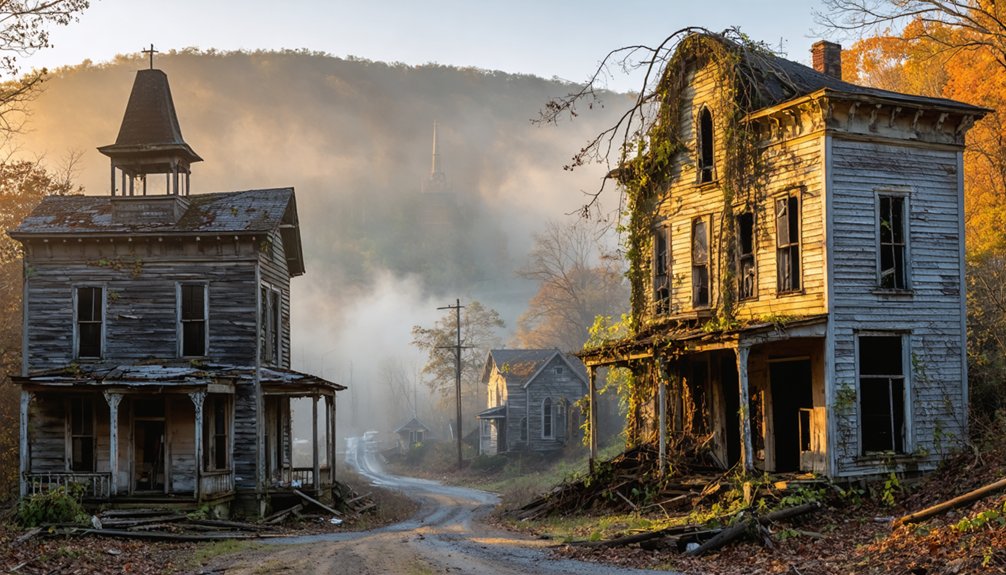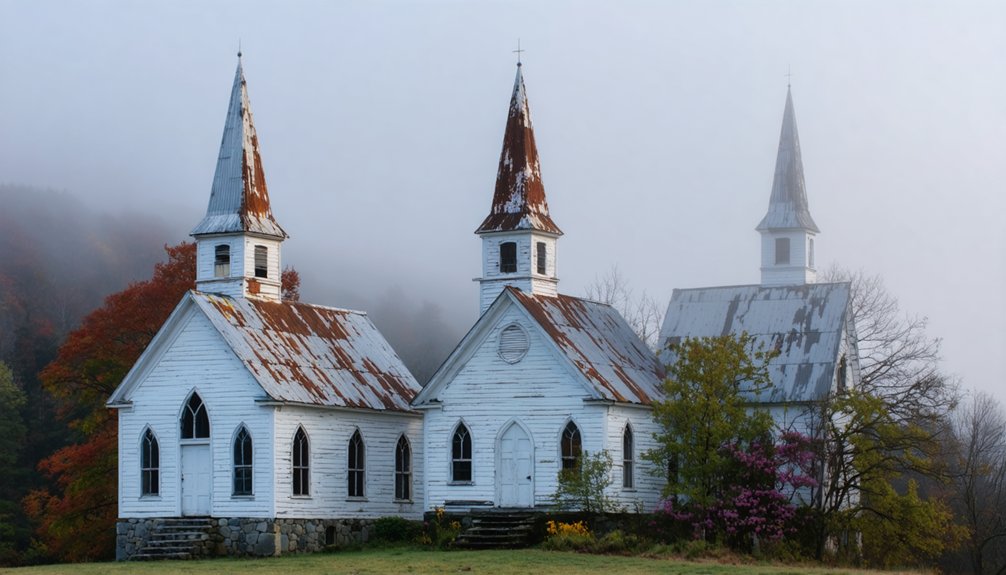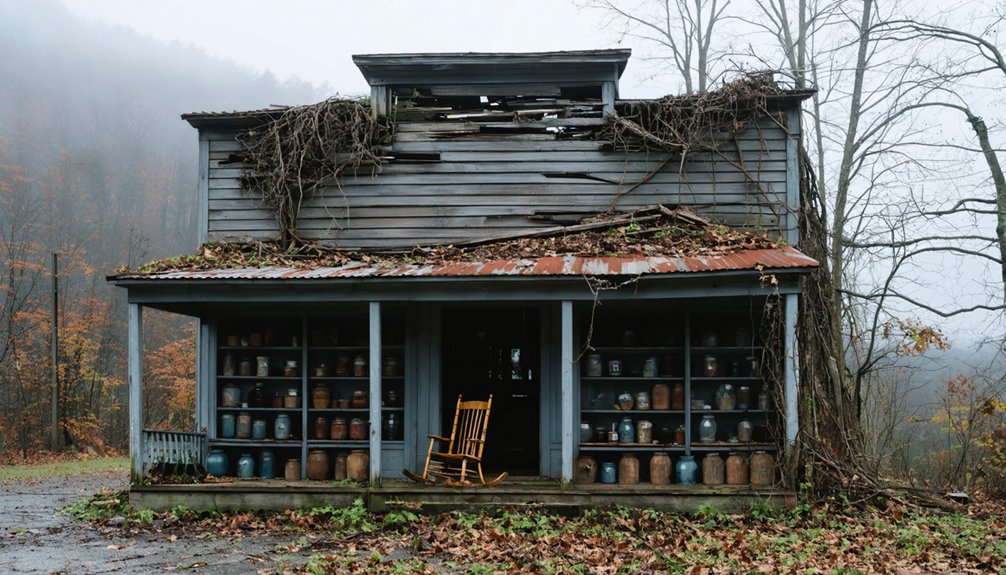
Appalachian ghost towns decay uniquely due to the region’s humid climate and heavy rainfall, which accelerate wood structure deterioration. You’ll find distinctive patterns like standing stone chimneys amid collapsed wooden buildings, moss-covered foundations, and abandoned tools frozen mid-use. Unlike western ghost towns, these communities didn’t gradually decline but collapsed suddenly when coal operations ceased. The surrounding forest rapidly reclaims these spaces, creating hauntingly beautiful tableaus that tell stories of abrupt abandonment.
Key Takeaways
- High humidity and rainfall accelerate wood deterioration, causing faster structural collapse than in arid western ghost towns.
- Dense Appalachian forest quickly reclaims abandoned sites, creating a distinctive “soft decay” aesthetic with moss and vine coverage.
- Stone chimneys and concrete steps often outlast wooden structures, creating architectural whispers amid the returning wilderness.
- Sudden economic collapse led to tools and belongings being abandoned mid-use, creating time capsules rather than gradually declining towns.
- Environmental damage from acid mine drainage creates uniquely toxic waterways with bright orange coloration, forming a distinctive decay signature.
The Boom-Bust Cycle of Coal Company Towns
When examining the economic trajectory of Appalachia’s coal industry, the boom-bust cycle of company towns stands as a defining feature of the region’s development and subsequent decline.
You’ll find that corporations rapidly transformed forested landscapes into industrial communities, constructing uniform housing and essential facilities to maintain operational efficiency.
These towns embodied extreme economic dependency, with 65-80% of miners living in company-controlled environments during the early 20th century.
Economic dependency defined Appalachia as corporations confined most miners within their controlled domains, shaping every aspect of existence.
Every aspect of life—from housing to commerce—remained under corporate oversight, creating a closed economic system vulnerable to market shifts.
Social stratification defined these communities, with visible hierarchies reflected in housing quality and neighborhood segregation by race, ethnicity, and job classification.
Companies often provided extensive amenities through welfare capitalism specifically designed to prevent unionization while maintaining control over their workforce.
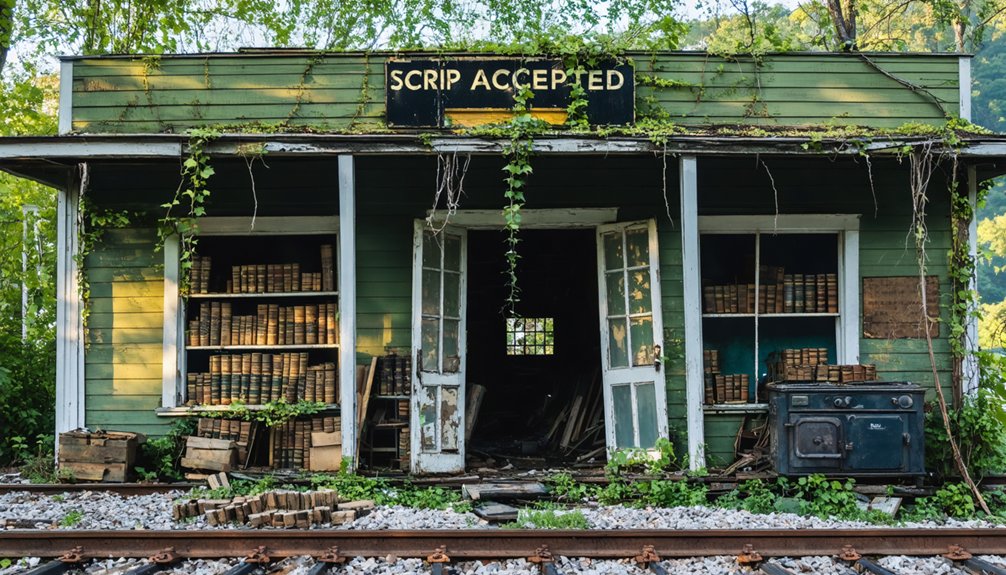
The use of company scrip as currency further restricted miners’ purchasing power and reinforced corporate dominance over daily life.
When coal demand eventually collapsed mid-century, these single-industry towns lacked diversification options, leading to mass abandonment and decay.
Geographic Isolation in Mountainous Hollows
Deep within the Appalachian region, geographic isolation has fundamentally shaped the development and eventual abandonment of mountain communities that would later become ghost towns.
These ghost towns hold remnants of forgotten farming practices in ghost towns, revealing techniques once vital to survival in these secluded areas. As time passed and families relocated, these methods faded into obscurity, leaving behind artifacts that tell a story of resilience and adaptation. Exploring these abandoned sites offers a glimpse into a way of life that was deeply intertwined with the land and its challenges.
You’ll find these settlements nestled in steep hollows where “crow flies” distances translate into hours-long journeys. Mountain ridges and winding roads create natural boundaries that limited infrastructure development. Many roads stop abruptly, like “The Road To Nowhere,” reflecting failed attempts at connection. Lost Cove exemplifies this isolation, having developed into a self-sustaining agricultural community despite its remote location.
This geographic isolation preserved unique dialects and cultural practices that mainstream America never touched. Neighbors relied on foot or mule for communication rather than modern conveniences.
When railroads arrived, they temporarily linked these communities to outside markets, but their eventual abandonment severed these lifelines. Without reliable transportation, communities couldn’t access medical care, education, or economic opportunities.
This isolation fostered remarkable self-sufficiency but ultimately contributed to their decline when centralization of resources elsewhere left them vulnerable.
Environmental Scars From Resource Extraction
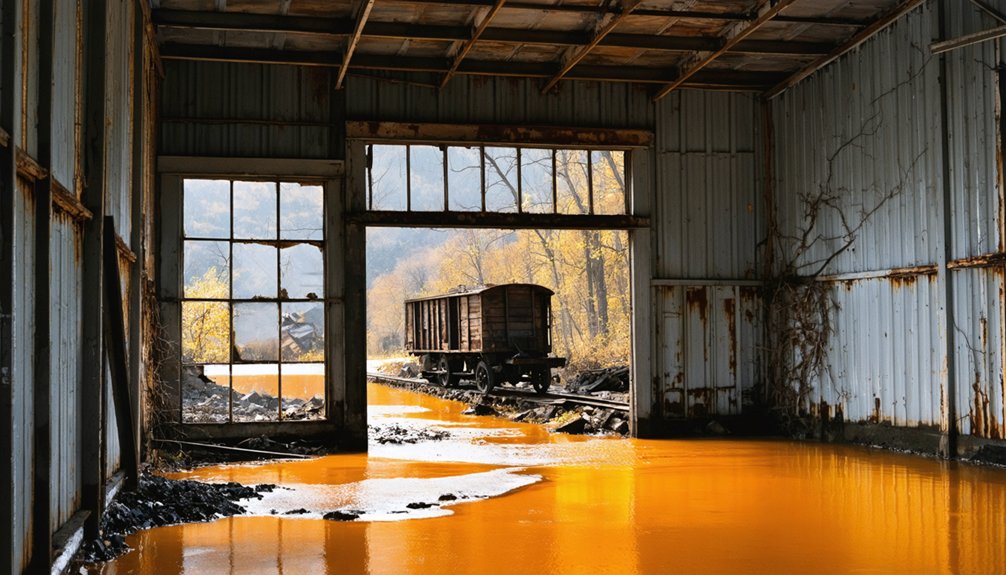
You’ll find acid mine drainage creating orange-red streams throughout abandoned mining communities, where toxic metals leach from exposed coal seams into local watersheds.
The collapsed mountain ridges, once towering peaks, now resemble flattened plateaus where mountaintop removal operations have permanently altered the topography of over 500 mountains across Appalachia.
These environmental wounds extend beyond visual scars, with buried headwater streams and contaminated groundwater continuing to impact ecosystems decades after mining operations have ceased. The resulting health problems in nearby communities have sparked important discussions about environmental justice and the unequal distribution of pollution burdens. Research has documented elevated mortality rates in areas near mountaintop removal sites compared to non-mining regions, even when controlling for factors like poverty and smoking.
Acid Mine Drainage
The enduring environmental legacy of mining across Appalachia manifests most visibly through acid mine drainage (AMD), a devastating chemical process that continues to scar waterways long after extraction operations have ceased.
You’ll witness bright orange streams where pyrite (FeS₂) from abandoned mines interacts with oxygen and water, generating sulfuric acid and dissolving toxic metals.
These acid mine discharges create toxic waters with pH levels below 3, effectively sterilizing aquatic ecosystems. The health of communities downstream is severely threatened as waterways become unsuitable for drinking or recreational purposes. The STREAM Act passed in 2022 directs critical funding toward addressing these persistent environmental hazards. The environmental damage extends far beyond ghost towns, as contaminated waters travel downstream, poisoning communities with arsenic, lead, and mercury.
What’s particularly troubling is AMD’s persistence—these chemical reactions continue for centuries, requiring extensive treatment through limestone channels and constructed wetlands.
Despite remediation efforts under the Surface Mining Control and Reclamation Act, these orange scars remain evidence of extraction’s true cost.
Collapsed Mountain Ridges
Beyond toxic waterways, Appalachia’s extractive industries have physically reshaped the mountain landscape through devastating mountaintop removal mining practices.
You’re witnessing the aftermath of a 40% flattening of Central Appalachia’s once-proud topography, where steep ridges have been blasted into artificial plateaus.
These collapsed ecosystems will persist for millennia, with slopes reduced by over 10 degrees across southern West Virginia.
The displacement of entire mountain ridges has created valley fills up to 200 meters deep, burying headwater streams and permanently altering watershed dynamics.
Forest fragmentation continues at alarming rates, with 65 square kilometers cleared in 2019 alone.
Despite this extensive damage, the total land actively mined decreased from 914 square kilometers in 2018 to 890 square kilometers in 2019, marking the fifth consecutive year of decline.
The result is an altered “erosion machine” that increases flash flooding risk—as evidenced by the deadly 2022 Kentucky floods that claimed 45 lives.
These 1,300 zombie mines across Appalachia remain in regulatory limbo, neither operational nor fully abandoned, creating perpetual environmental hazards.
These aren’t mere scars but fundamental, irreversible terraforming of Appalachia’s essence.
Sudden Community Exodus and Social Collapse
If you’d walk through these ghost towns today, you’d encounter school buildings with textbooks still open on desks and family homes with dishes waiting to be washed, scenes that reveal how abruptly communities dissolved when mines closed.
The sudden economic collapse triggered mass exodus, leaving behind not just physical structures but fracturing the social fabric that had sustained generations of miners and their families.
You’ll notice how time has suspended these communities in their final moments—public spaces devoid of human sounds, personal possessions abandoned mid-use, and communal gathering spots eternally waiting for people who never returned.
Lives Frozen Mid-Movement
Walking through an Appalachian ghost town today, you’ll encounter haunting tableaux of lives suspended mid-narrative—communities that didn’t gradually decline but rather collapsed with startling suddenness.
These frozen memories manifest physically in tools abandoned mid-task, personal belongings scattered as if their owners might return momentarily. Unlike settlements that withered slowly, these coal communities imploded when mines closed, triggering mass exodus within weeks.
You’ll find churches where hymnals remain open, schools with lessons still chalked on blackboards—halted lives crystallized in decay.
The economic infrastructure collapsed simultaneously: general stores shuttered, theaters darkened, and social networks fractured beyond repair.
Railroad lines that once carried coal and connected communities now lie rusted and overgrown, physical reminders of the transportation lifelines severed when industry abruptly departed.
Schools Without Laughter
Perhaps the most poignant symbols of these abandoned communities are their empty schools—buildings once filled with children’s voices now stand as hollow monuments to community collapse.
As you explore these ghost towns, you’ll notice how educational decline directly precipitated community disintegration. When mines closed and environmental disasters struck, families fled seeking safer conditions and stable employment.
Schools rapidly lost students, forcing closures that severed essential social bonds. Without these educational anchors, remaining residents faced increased isolation as churches and gathering places subsequently shuttered.
The cycle accelerated as youth migration created aging populations, further diminishing social significance.
What you’re witnessing in these abandoned classrooms isn’t just physical decay—it’s the visible evidence of how quickly Appalachian communities unraveled once their social infrastructure collapsed, leaving behind only echoes of bustling community life.
Submerged Villages: The Underwater Ghost Towns

Beneath the placid waters of numerous Appalachian reservoirs lie the remnants of once-thriving communities, intentionally submerged during the mid-20th century to create hydroelectric power sources and flood control systems.
These submerged histories include Proctor and Judson in North Carolina, Gad in West Virginia, Loyston in Tennessee, and settlements beneath South Carolina’s Lakes Jocassee and Keowee.
You can glimpse these forgotten legacies during periodic drawdowns when Summersville Lake reveals Gad’s foundations every decade during maintenance, or when drought exposes Judson’s ruins in Fontana Lake.
Some locations remain permanently inaccessible—like Loyston beneath Norris Lake—while others can be visited by hiking to Proctor’s above-water cemetery or scuba diving Summersville’s clear depths.
Each submerged town represents communities displaced by government mandate, their residents forced to abandon generational homes and family gravesites.
Nature’s Reclamation: The Distinctive Decay Pattern
While submerged towns preserve their structures in the underwater environment, ghost towns left exposed to the elements follow a dramatically different fate. Unlike western ghost towns that stand stark against desert backdrops for centuries, Appalachian abandoned settlements surrender quickly to nature’s embrace.
The region’s high humidity, abundant rainfall, and aggressive forest growth create architectural whispers where buildings once stood firmly.
- Wood-frame structures collapse within decades, not centuries, as moisture accelerates rot, mold growth, and structural failure.
- Dense forest reclamation creates a “soft” aesthetic with moss-covered foundations and vine-entangled walls blending into surrounding woodland.
- Distinctive remnants like stone chimneys and concrete steps often outlast wooden components, creating poignant markers of human habitation amid the returning wilderness.
Frequently Asked Questions
Are Appalachian Ghost Towns Legally Accessible to Visitors?
Accessibility varies widely: you’ll find some ghost towns legally open with visitor safety regulations, while others remain private property where you’d be trespassing, particularly in underwater or contaminated locations.
Can These Abandoned Towns Be Legally Reclaimed or Repurchased?
You’ll face significant legal challenges reclaiming abandoned towns due to complex property rights issues, government acquisition, environmental restrictions, and incomplete documentation. Reclamation possibilities exist primarily when land remained in private ownership.
What Paranormal Activity Is Commonly Reported in These Locations?
Like whispers through the fog, you’ll encounter spectral sightings of miners and children, disembodied voices, cold spots, moving objects, shadow figures, electronic interference, and ghostly encounters tied to regional tragedies and folklore.
How Do Local Communities Preserve Memories of These Lost Towns?
You’ll find local communities preserving ghost town memories through community storytelling events, oral history archives, physical restoration of structures, museum collections, and digital documentation projects led by passionate local history advocates.
What Artifacts Are Most Commonly Found in Appalachian Ghost Towns?
You’ll find domestic artifacts (tobacco tins, bottles), structural remains (foundations, chimneys), Native American relics, and industrial debris. Artifacts analysis reveals historical significance through everyday items and occupation patterns spanning centuries.
References
- https://jrap.scholasticahq.com/api/v1/articles/9543-the-economics-of-ghost-towns.pdf
- https://www.youtube.com/watch?v=7LUFkjf3KnI
- https://appalachianmemories.org/2025/10/16/the-lost-towns-of-appalachia-the-forgotten-mountain-communities/
- https://www.thewanderingappalachian.com/post/the-underwater-towns-of-appalachia
- https://smart.dhgate.com/why-is-elkmont-tn-abandoned-uncovering-the-ghost-towns-secrets/
- https://mascomedia.org/3822/uncategorized/the-terrifying-ghost-towns-of-deep-appalachia-documentary-review/
- https://www.appalachianplaces.org/post/appalachia-s-other-company-towns
- https://coalheritage.wv.gov/coal_history/Pages/Company-Towns.aspx
- http://www.cpreview.org/articles/2025/5/king-coals-last-reign-how-corporate-greed-keeps-appalachia-underdeveloped
- https://socialwelfare.library.vcu.edu/organizations/labor/company-towns-1890s-to-1935/