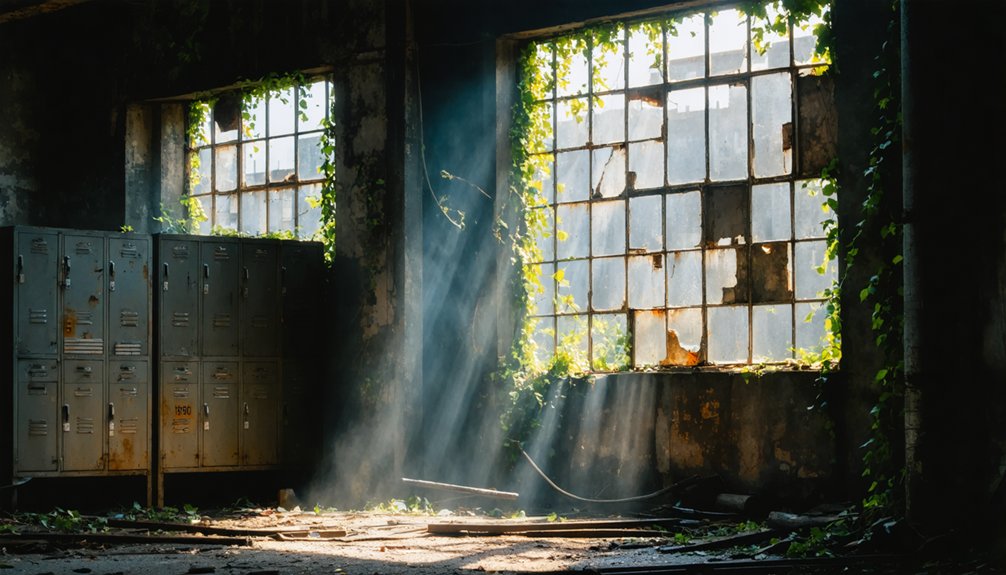
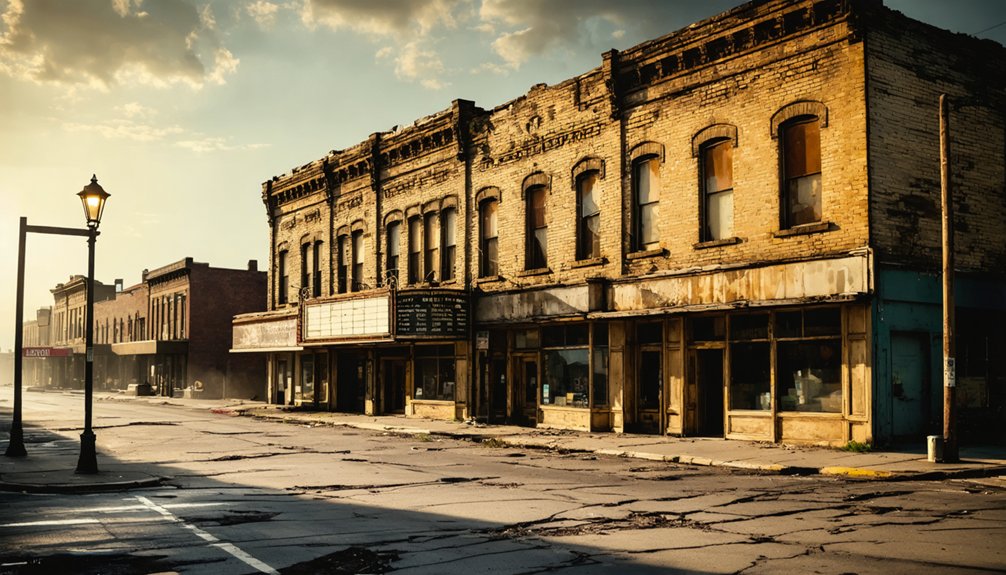
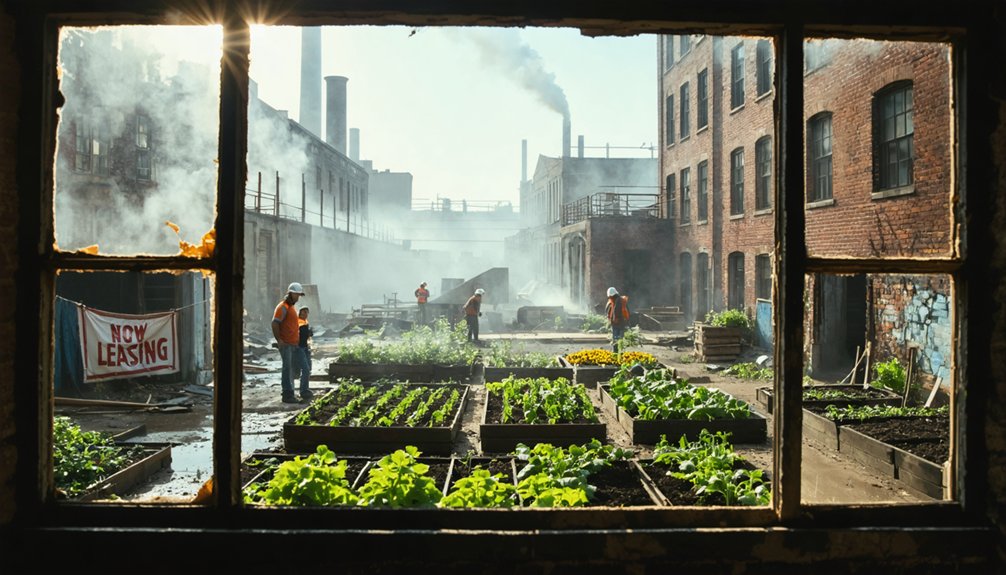
Rust Belt ghost towns captivate you through their paradoxical beauty—where nature reclaims rusted machinery and crumbling factories stand as monuments to America’s industrial past. These abandoned spaces tell compelling stories of working-class pride, economic collapse, and community resilience. Their emptiness evokes both melancholy for what’s lost and possibility for renewal, creating emotional landscapes frozen in time. The contradiction between decay and potential makes these spaces powerful three-dimensional time capsules worth exploring beyond their haunting façades.
Key Takeaways
- The haunting juxtaposition of industrial decay and nature’s reclamation creates a unique aesthetic that photographers and visitors find mesmerizing.
- Abandoned factories serve as three-dimensional time capsules, preserving mid-20th century architecture and telling stories of American industrial might.
- These sites evoke powerful emotional responses, blending nostalgia, melancholy, and hope for renewal within decaying landscapes.
- The stark contrast between past prosperity and current abandonment creates visual drama that captures America’s economic transformation.
- Ghost towns embody collective memory and working-class identity, connecting visitors to authentic cultural heritage and lost ways of life.
The Silent Monuments of American Industrial Power
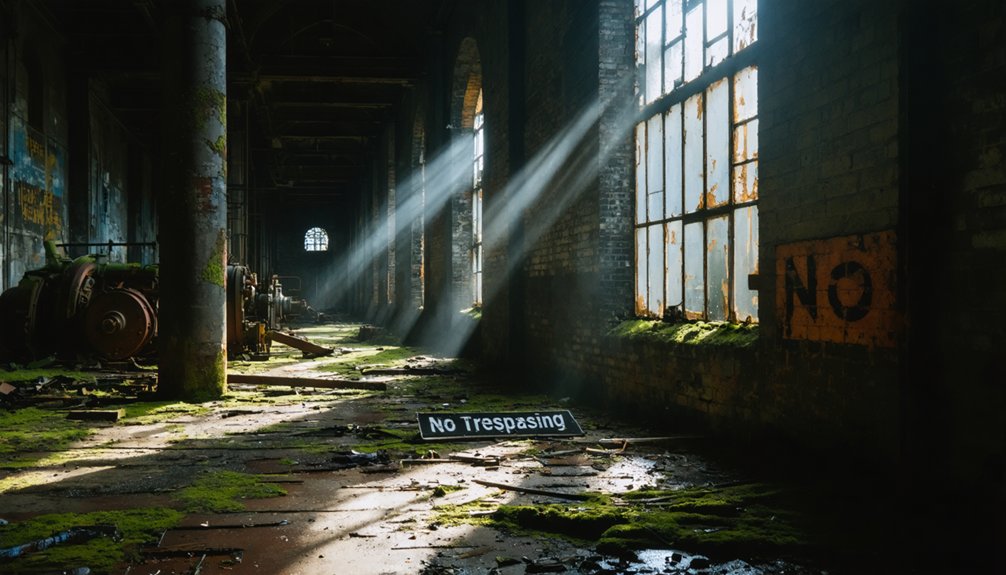
The crumbling factories and silent mills that dot the landscape of America’s Rust Belt stand as poignant reminders of the nation’s former industrial might.
When you visit these ghostly structures, you’re witnessing the physical manifestation of America’s economic transformation—monuments frozen in time that once represented technological achievement and regional prosperity.
These abandoned complexes aren’t merely decaying buildings; they’re testimonies to the human cost of deindustrialization. Since the 1980s, outsourcing and globalization triggered a devastating economic shift that hollowed out once-thriving manufacturing centers.
The Rust Belt region experienced a dramatic 32.9% decline in manufacturing employment from 1969 to 1996, leaving countless factories abandoned and communities struggling.
Each empty factory floor tells stories of lost livelihoods and disrupted communities. As you walk through these spaces, you’re experiencing America’s industrial heritage in its most raw form.
The preservation efforts surrounding these sites reflect their importance to regional identity and collective memory, capturing both the triumph of American manufacturing and its subsequent decline under the forces of globalization.
Haunting Beauty in Decay: The Visual Allure of Abandoned Places
Within these silent industrial relics exists a paradoxical visual phenomenon: the haunting beauty of decay.
The poetry of abandonment speaks through rust and ruin—where humanity’s absence creates unexpected visual elegance.
You’ll notice how seasonal transformations orchestrate nature’s reclamation—snow blanketing forgotten factories in winter stillness, while summer brings rebellious green growth through cracked foundations. This interplay creates textural contrasts that captivate your eye: peeling paint against persistent bark, rusted metal embraced by climbing vines. Photographers like Edgar Cardenas capture this dance between human absence and natural resilience through intimate close-ups that reveal overlooked textures and patterns.
What draws you isn’t grandiose devastation but intimate details—footprints in dust, a door left ajar, graffiti transforming crumbling walls into impromptu galleries. In Steubenville, once-prosperous structures like the Greek Revival courthouse stand as testaments to faded industrial glory.
The visual narrative unfolds through juxtaposed elements: dead-end staircases alongside wildflower patches, abandoned highways beneath panoramic vistas. These places hold power precisely because they’re neither fully dead nor alive, but suspended in a haunting visual limbo between human absence and nature’s persistent return.
Echoes of Working-Class Identity and Lost Community
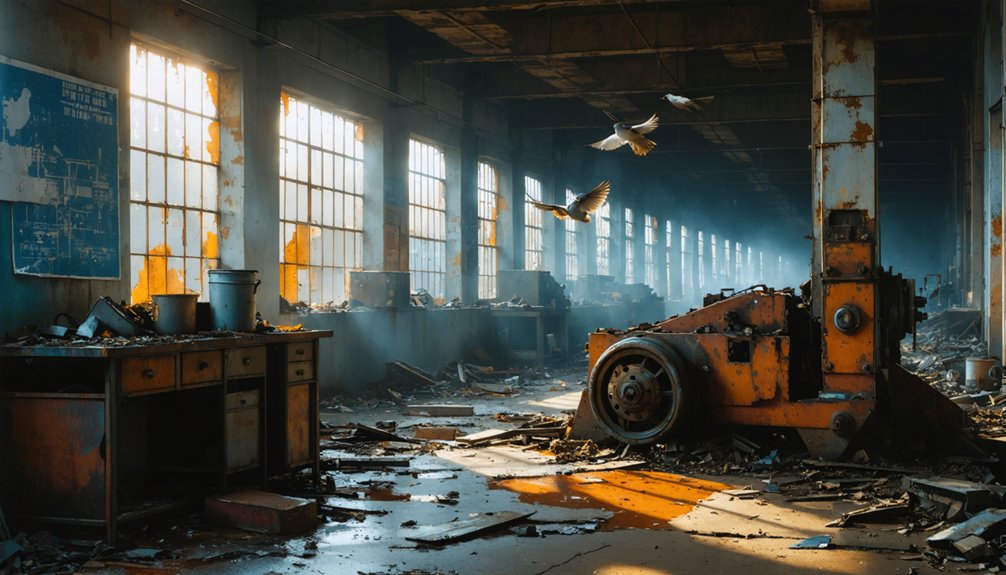
When you stand amid the skeletal remains of abandoned factories, you’re not merely witnessing architectural decay but confronting the dissolution of once-vibrant social ecosystems.
These industrial husks represent more than economic failure—they’re monuments to lost working-class pride, where generations forged identity through physical labor and union solidarity.
The rhythms of shift work once orchestrated entire communities: families coordinated their lives around mill whistles, while churches, union halls, and neighborhood bars functioned as essential social anchors.
Despite racial stratification that limited Black workers’ opportunities, a resilient community fabric emerged through shared industrial experiences.
What captivates in these ghost towns isn’t just aesthetic ruin but the palpable absence of community resilience that once defined them—when interdependent neighborhoods, bound by common purpose, created meaning amid the industrial grit.
Among these remnants of abandoned factories in Detroit, the echoes of laughter and cooperation are now replaced by silence and decay. Once vibrant spaces, they stand as silent witnesses to the dreams and aspirations of a bygone era. The stories of those who worked within their walls linger in the air, waiting to be remembered and honored.
Many outlying mill towns that once sustained Pittsburgh’s industrial might now face wealth extraction, desolation, and persistent addiction crises.
The environmental legacy of these abandoned industrial sites continues to impact residents through chronic health issues stemming from decades of unaddressed pollution.
Time Frozen: Ghost Towns as Living Museums of the Past
Walking through a Rust Belt ghost town today, you’re fundamentally stepping into a three-dimensional time capsule where physical environments have crystallized at the moment of economic collapse.
These architectural time capsules present mid-20th century commercial façades, theaters, and murals that preserve visual narratives of vibrant town life from decades past.
What you’re experiencing is an outdoor museum offering immersive, multisensory encounters with post-industrial heritage.
While national historic registers may protect structures from demolition, they often remain in suspended animation—intact but unused.
This preservation paradox creates the haunting “time frozen” atmosphere that makes these places so enthralling.
Through architectural preservation, you’re directly engaging with industrial history and witnessing socio-economic narratives of deindustrialization.
These physical remnants foster critical reflection on urban transformation, economic change, and community resilience in ways no textbook could replicate.
Once-thriving cities like Stubenville, with its peak population of 37,000 in 1940, illustrate the dramatic demographic shifts that accompanied industrial decline across America’s Rust Belt.
The DIY preservation movement has emerged as a powerful force in reclaiming these abandoned industrial structures and transforming them into meaningful community spaces.
From Rust to Renewal: The Phoenix Stories of Recovery
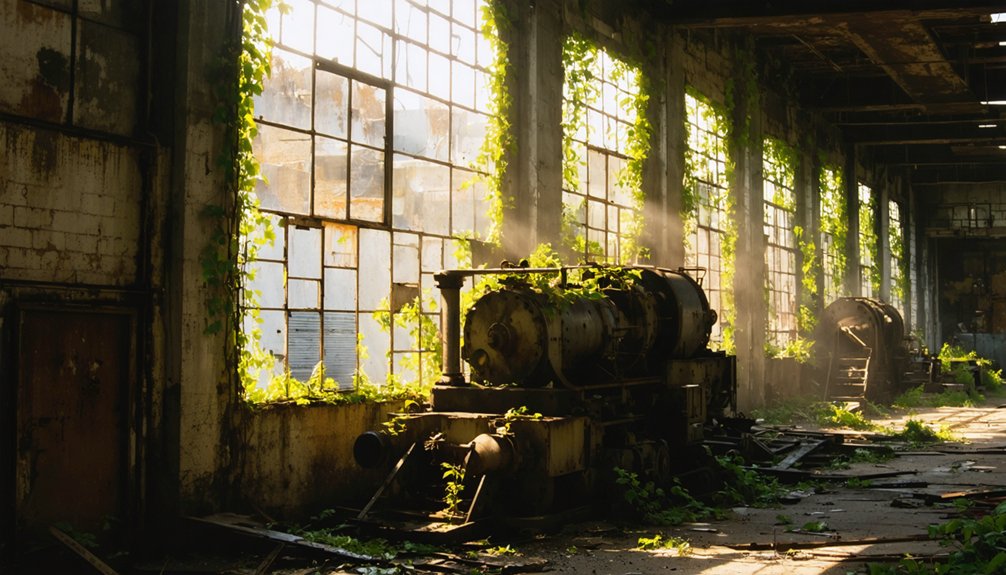
While some Rust Belt towns remain trapped in economic limbo, a remarkable 34% of former manufacturing centers have achieved full employment recovery since their industrial collapse, demonstrating that decline isn’t necessarily permanent.
When you explore revitalized cities like Pittsburgh or Columbus, you’ll witness economic resilience initiatives that successfully transformed industrial wastelands into vibrant communities.
These phoenix stories share common urban revitalization strategies: diversifying beyond manufacturing into education and technology sectors, attracting college-educated workers, and adaptively reusing abandoned industrial sites as mixed-use developments.
The most successful recoveries occurred in cities that invested in educational infrastructure and addressed housing vacancies. Cities with higher education levels showed substantially better employment growth during the deindustrialization period compared to those with less educated populations.
Despite industrial challenges, census data reveals Rust Belt residents have experienced substantial income growth over time, contradicting narratives of economic stagnation.
However, the renewal remains uneven – German industrial hubs outperform their American counterparts, with nearly 50% regaining employment levels compared to just 17% in the U.S.
This disparity highlights both challenges and opportunities in Rust Belt renaissance.
The Paradox of Nostalgia and Hope in Forgotten Spaces
The paradox of nostalgia and hope permeates abandoned Rust Belt landscapes, creating emotional spaces that simultaneously represent industrial decline and potential renewal. As you explore these forgotten spaces, you’ll encounter contradictions that evoke both melancholy and possibility—places where collective memory lives within decaying architecture even as new futures emerge.
- Abandoned factories serve as both monuments to economic trauma and canvases for artistic revival.
- Urban gardens sprouting amid vacant lots demonstrate resilience against socioeconomic collapse.
- Communities facing high crime rates simultaneously nurture grassroots regeneration efforts.
- Visitors find themselves contemplating both what was lost and what might yet be created.
- These spaces function as powerful emotional anchors where past, present, and future converge.
Despite populations declining by over 40% since the 1970s, these communities demonstrate remarkable urban resilience through art initiatives and community-led projects that reimagine possibility amid ruins.
Frequently Asked Questions
Are Rust Belt Ghost Towns Safe for Urban Explorers?
No, they’re not safe. Your urban exploration faces substantial safety concerns including structural instability, toxic substances, legal risks, and potential criminal activity. Always research and use protective equipment beforehand.
What Legal Challenges Exist in Redeveloping Abandoned Industrial Properties?
With 60% of brownfields stalled by title disputes, you’ll face zoning regulations restricting usage, CERCLA liability issues for contamination, unclear property ownership, and burdensome approval processes requiring remediation plan compliance.
How Do Remaining Residents Cope With Living in Declining Communities?
You’ll find community resilience through local adaptations: establishing worker cooperatives, engaging in participatory budgeting, building trust networks, developing land trusts, and accepting alternative employment despite psychological challenges of visible decline.
What Environmental Hazards Persist in Former Manufacturing Sites?
You’ll encounter heavy metals, petrochemicals, PFAS, asbestos, and lead-based paint persisting in these abandoned sites. Hazardous materials remain decades after operations ceased, causing significant site contamination throughout soil, water, and air.
How Has Social Media Changed Perceptions of Rust Belt Decay?
Social media has democratized urban exploration, transforming Rust Belt decay from invisible tragedy to visual spectacle. You’ll notice how platforms amplify nuanced narratives, challenging stereotypes while aestheticizing abandonment as cultural commentary worth examining.
References
- https://globalurbanhistory.com/2016/02/01/the-spiritual-capital-of-the-rust-belt-pittsburgh-and-the-postindustrial-transformation-of-north-atlantic-cities/
- https://allthatsinteresting.com/rust-belt
- https://www.britannica.com/place/Rust-Belt
- https://www.youtube.com/watch?v=orM7mOwy11k
- https://fiveable.me/key-terms/united-states-history-since-1945/rust-belt-decline
- https://www.loveexploring.com/galleries/127789/then-and-now-us-rust-belt-cities-that-bounced-back
- https://study.com/academy/lesson/rust-belt-history-cities-decline.html
- https://www.industryweek.com/talent/article/22028380/the-abandonment-of-small-cities-in-the-rust-belt
- https://en.wikipedia.org/wiki/Rust_Belt
- https://commentaries.cberdata.org/1308/the-birth-and-death-of-rustbelt-cities