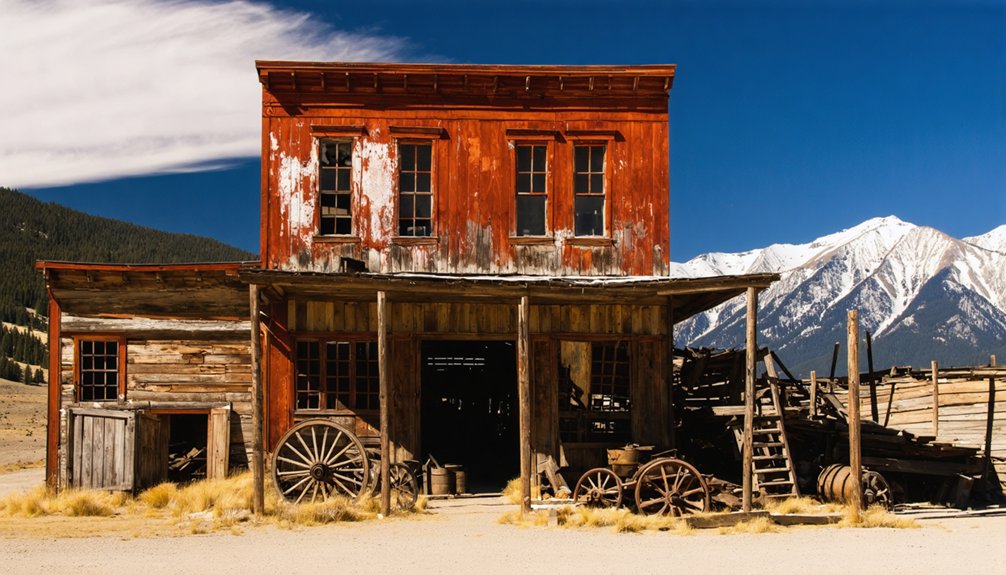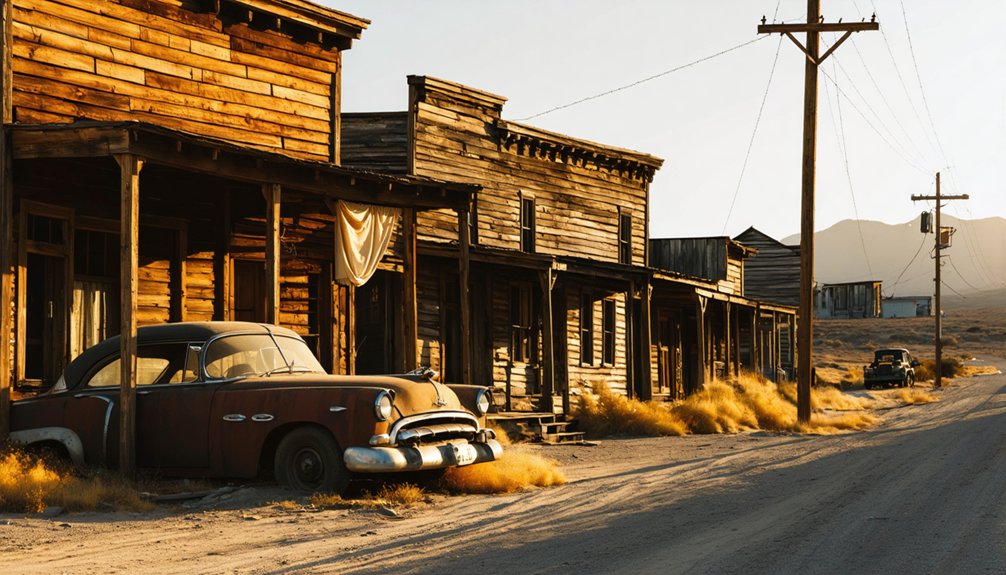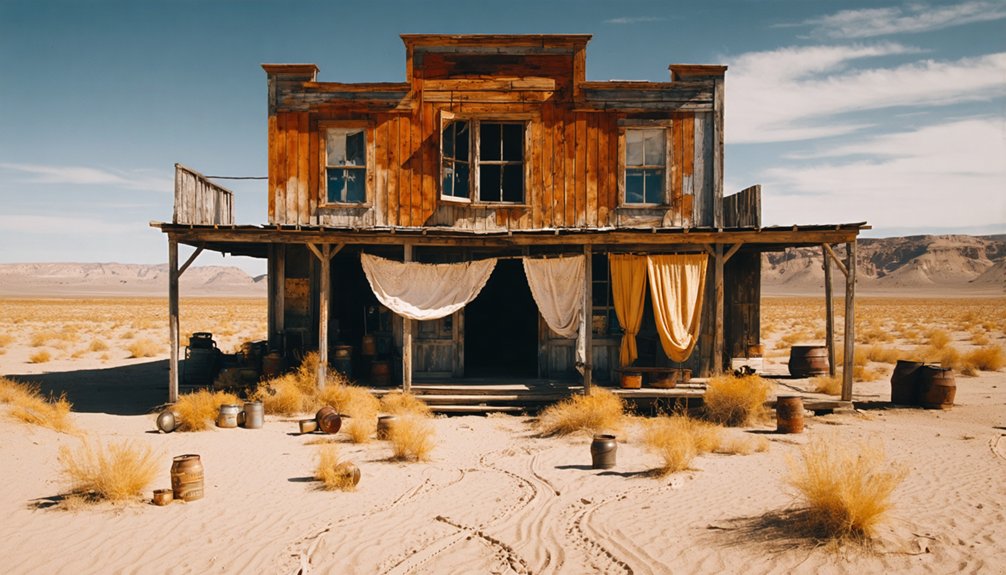
Wild West ghost towns offer you authentic glimpses into America’s frontier past without modern tourist contrivances. You’ll walk wooden sidewalks past original saloons where 19th-century boom economies once thrived before sudden economic collapse. These archaeological treasures showcase practical frontier architecture while generating tourism revenue for surrounding communities today. Beyond weathered facades lie complex narratives of immigrant communities and everyday citizens that challenge conventional Wild West myths—stories waiting to be uncovered in these frozen-in-time settlements.
Key Takeaways
- Authentic 19th-century architecture and artifacts preserved in their original state offer raw glimpses into frontier life.
- Ghost towns reveal the dramatic boom-and-bust economic cycles where populations exploded from hundreds to thousands overnight.
- Visitors can explore the complex histories of diverse communities beyond conventional Wild West myths.
- Tourism to these sites generates significant revenue for local economies while supporting preservation efforts.
- The absence of modern tourist contrivances maintains historical integrity, creating genuine educational experiences.
Time Capsules: Experiencing America’s Frontier Past Firsthand
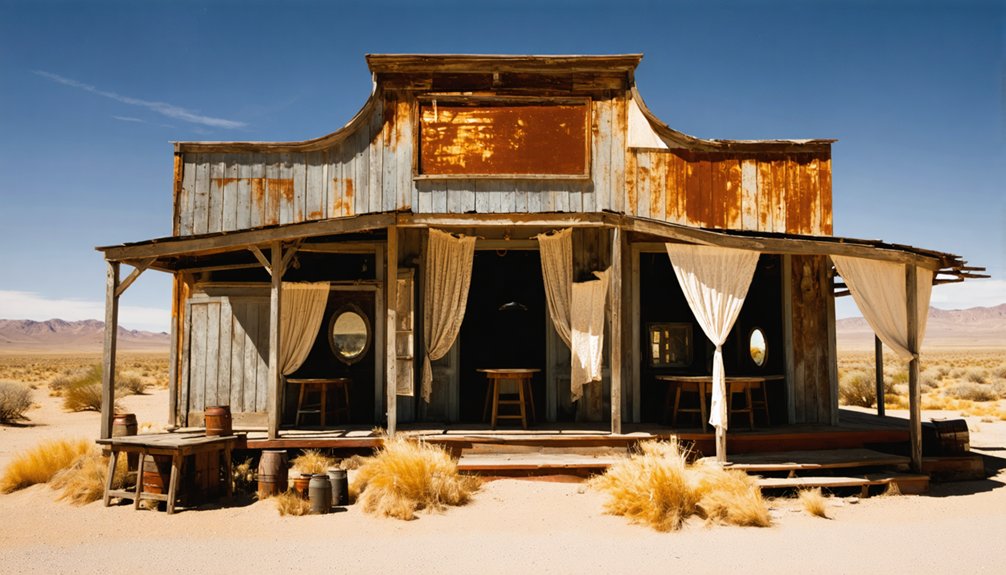
When you step into a Western ghost town, you’re literally walking through an archaeological treasure where America’s frontier past remains tangibly preserved.
These remarkable time capsules offer unfiltered access to authentic 19th-century life—wooden sidewalks still creak underfoot, saloon doors hang on original hinges, and abandoned stores display faded merchandise labels from 150 years ago.
What distinguishes these sites is their frontier architecture—from crude log cabins to ornate false-front commercial buildings—revealing both the pragmatism and aspirations of America’s westward expansion.
Unlike reconstructed tourist attractions, ghost towns like Bodie and Bannack present history in its raw, unvarnished state. Here, the natural decay itself tells stories of boom-and-bust cycles that defined Western development.
You’re not just viewing history; you’re experiencing the physical reality of frontier ambition. These historical sites serve as educational landmarks showcasing America’s heritage tourism appeal, attracting visitors from around the world. Many of these abandoned towns emerged during the economic opportunities of the 1870s and 1880s, transforming rapidly during gold and silver rushes before their eventual decline.
Gold, Silver, and Oil: How Economic Booms Created Instant Towns
You’ll find America’s frontier ghost towns littered with the stark juxtaposition of ambitious wealth creation and abandoned hopes.
When precious resources like gold, silver, and oil were discovered, instant communities materialized with astonishing speed—complete with infrastructure, businesses, and populations that could swell from zero to thousands within months.
These boom cycles created the physical framework for thriving communities, but when resources depleted or markets collapsed, they left behind the haunting skeletal remains we now explore as ghost towns. The California Gold Rush of 1848 triggered one of the most significant population surges, with makeshift camps evolving rapidly into bustling towns as prospectors flooded the region. Towns like Bodie, California once thrived with 65 saloons and thousands of residents before falling into decay.
Overnight Wealth Creation
The discovery of precious metals and oil across the American frontier sparked one of history’s most dramatic examples of instant wealth creation, transforming barren landscapes into bustling communities virtually overnight.
When you visit these ghost towns today, you’re walking through the remnants of places where overnight fortunes changed lives in mere weeks—where miners could strike paydirt one day and build empires the next.
- Witness the vestiges of Comstock Lode, where a population exploded from 100 to 20,000 in just two years (1859-1861)
- Stand where prospectors in Bodie, California once experienced the rush of a town that swelled to 10,000 residents almost instantly
- Feel the economic volatility that defined these communities, where fleeting success built mansions that would soon stand empty
Towns like Rochford, established in 1878, quickly grew to include theaters and saloons that served the rapidly expanding population of miners.
These classic boomtowns often collapsed just as quickly as they rose when the resources that supported them were depleted, leaving behind the fascinating ruins we explore today.
Abandoned Dreams Remain
Beneath the weathered facades and crumbling foundations of America’s ghost towns lies a stark economic narrative of resource-driven booms that created instant communities throughout the frontier.
When gold, silver, or oil reserves dried up, so did these towns’ futures. You’ll witness the remnants of abandoned aspirations in hastily-built structures that once housed thriving businesses—taverns, general stores, and blacksmiths that serviced the extraction economy.
Within months of a mine closure or price collapse, these supporting industries would shutter, leaving only hollow shells behind.
What you’re seeing isn’t simply deterioration, but forgotten legacies of America’s economic volatility. Without diversification beyond their extractive foundations, most boomtowns couldn’t evolve to stability.
These ghost towns stand as monuments to the frontier’s brutal economic reality—dreams built on resources that inevitably disappeared.
The Exodus: Why Thriving Communities Became Deserted
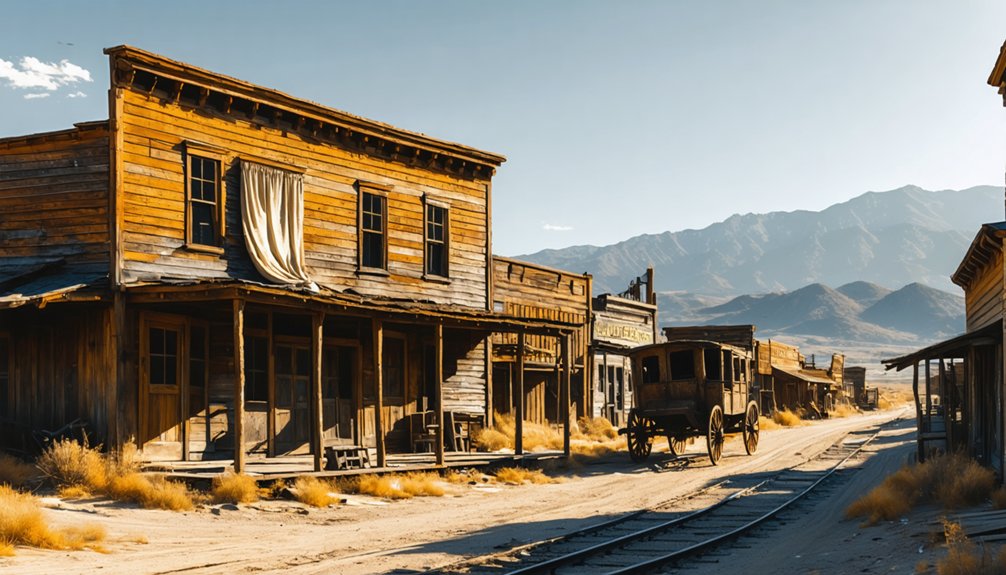
Across the rugged landscapes of the American West, once-thriving communities transformed into desolate ghost towns through a series of economic collapses, environmental challenges, and societal shifts.
The ghost towns of the wild west serve as haunting reminders of a bygone era when pioneers sought fortune and a new life. Today, these deserted settlements attract adventurers and historians alike, eager to uncover the stories hidden within crumbling buildings and rusted artifacts. Each visit to these locations offers a glimpse into the resilience and hardships faced by those who once called the Wild West home.
You’ll find these abandoned settlements tell a compelling story of population decline triggered by mining exhaustion, transportation evolution, and agricultural transformation.
When you explore these forgotten places, consider how quickly prosperity vanished:
- Resource depletion – when gold and silver mines emptied, entire economies collapsed overnight
- Transportation shifts – railroad bypasses and interstate highways rerouted commerce, isolating once-vital stops
- Technological advancement – mechanized farming reduced labor needs, driving younger generations toward urban opportunities
Unlike traditional mining ghost towns, the Great Plains has witnessed the emergence of farming ghost towns where agricultural decline since the 1930s has devastated small communities.
These ghost towns stand as monuments to American frontier ambition—settlements that boomed spectacularly before surrendering to economic realities, leaving only weathered remnants for you to discover and contemplate. Today, many of these historical sites like Bodie and Calico in California have become popular tourist attractions due to their preserved structures and fascinating histories.
Beyond Wooden Buildings: Architectural Treasures of the Old West
While ghost towns conjure images of weathered wooden storefronts slowly surrendering to time, these abandoned settlements actually showcase a remarkable architectural diversity that transcends simplistic frontier stereotypes.
You’ll discover the ingenious false front façades that rise majestically above actual rooflines, creating an illusion of grandeur with ornate details reserved for street-facing views. Behind these theatrical fronts lie pragmatic construction choices—quality materials for visibility, economy elsewhere.
Community buildings reveal the social fabric of frontier life. Churches with humble wooden interiors stand as monuments to spiritual aspirations, while fortified saloons and jails speak to wilder realities. The town’s main street features rows of old wooden structures that represent the quintessential Old West aesthetic.
Mining structures with towering smokestacks illustrate industrial ambitions. These boomtowns served as the foundation for many Old West settlements that eventually became ghost towns.
In places like Bodie, authenticity prevails—no neon signs or tourist contrivances, just honest preservation of a world where architecture reflected both practical necessity and cultural aspiration.
Ghost Town Revival: How Tourism Breathes New Life Into Forgotten Places
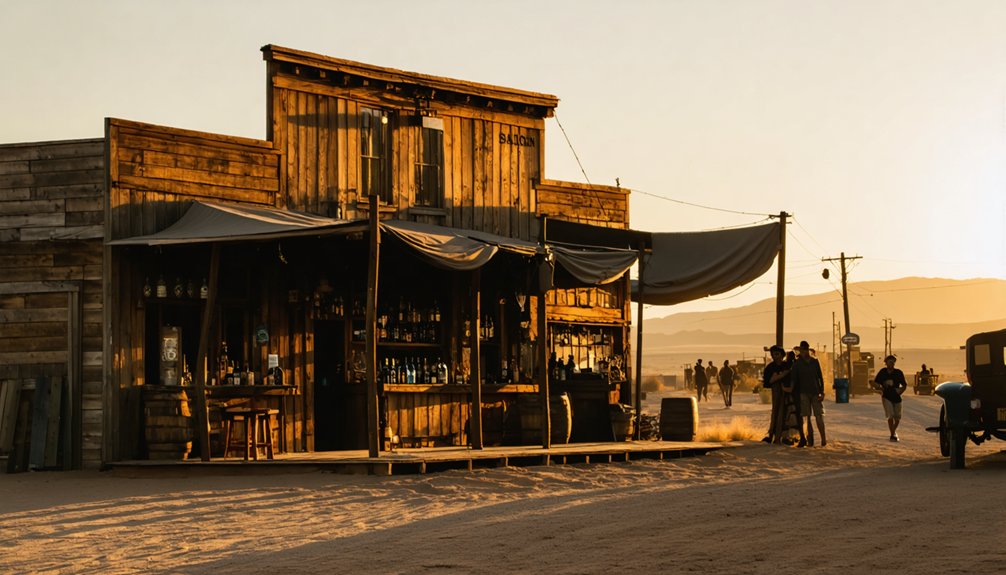
The weathered architecture that defines ghost towns has found new purpose in the twenty-first century, transforming from forgotten relics into economic engines for rural communities.
You’ll discover that ghost town tourism now contributes considerably to local economies—generating $1.7 million annually in some regions through visitor spending on meals, accommodations, and souvenirs.
- Paranormal tourism elements attract couples seeking thrilling historical experiences, who contribute nearly 42% of dark tourism revenue.
- Economic revitalization extends beyond ghost town borders, creating opportunities for restaurants, shops, and tour services throughout rural areas.
- Historic preservation efforts engage communities while satisfying your desire for authentic cultural experiences that connect with America’s frontier past.
This renaissance represents sustainable development at its finest—where historical legacy meets modern economic resilience through thoughtful tourism strategies.
Untold Stories: Discovering the Complex History Behind Abandoned Settlements
Beneath the weathered facades and crumbling foundations of America’s ghost towns lie intricate historical narratives that challenge simplistic frontier mythologies.
Beyond saloon doors and dusty streets, ghost towns whisper forgotten truths about America’s complex frontier experience.
You’ll discover evidence of cultural complexity far exceeding the standard Wild West tales—immigrant communities like Chinese railroad workers in Terrace, Utah, shaped these settlements despite their erasure from official records.
When you explore these abandoned places, you’ll encounter layered histories through preserved operatic halls, schoolhouses, and cemeteries—each telling stories of social interactions among diverse populations.
Notable figures like Calamity Jane walked these streets, but equally important were the everyday citizens who created vibrant communities with dance halls and post offices.
These physical remnants reveal not just economic booms and busts, but complex social fabrics that once thrived in America’s frontier experiment.
Frequently Asked Questions
Are Ghost Towns Safe to Visit With Children?
You can visit ghost towns with children if you select family-friendly activities at maintained sites and practice proper ghost town etiquette—maintaining vigilant supervision and respecting boundaries to mitigate inherent safety hazards.
Can Visitors Legally Collect Artifacts From Abandoned Ghost Towns?
Treading on thin ice legally, you can’t collect ghost town artifacts. Legal restrictions protect these sites for historical preservation, regardless of whether on public or private land—ownership doesn’t equate to removal rights.
Do Any Ghost Towns Have Overnight Accommodation Options?
Yes, you’ll find diverse overnight options with historical significance in ghost towns like Gold Point, St. Elmo, and Terlingua, offering unique experiences from restored miners’ cabins to luxury yurts.
What Camera Equipment Best Captures Ghost Town Photography?
Golden light streaks across weathered timbers as your camera waits. You’ll need a full-frame camera with wide-angle and prime lenses, unwavering tripod stability, and filters to capture ghost towns’ authentic desolation and hidden narratives.
How Accessible Are Remote Ghost Towns for Elderly or Disabled Visitors?
Remote ghost towns offer limited wheelchair accessibility and sparse transportation options. You’ll face unpaved roads, rugged terrain, and minimal accommodations, though some popular sites provide designated parking and improved pathways.
References
- https://www.geotab.com/ghost-towns/
- https://en.wikipedia.org/wiki/Ghost_town
- https://www.youtube.com/watch?v=2sIM72082jc
- https://www.atlasobscura.com/itineraries/the-wildest-west
- https://dornsife.usc.edu/magazine/echoes-in-the-dust/
- https://www.britannica.com/topic/ghost-town
- https://literaryfictions.com/articles/ghost-towns-in-the-american-west/
- https://wildwestcity.com/old-west-ghost-towns/
- https://freepages.history.rootsweb.com/~gtusa/definitions.pdf
- https://ridewayoutwest.com/2024/09/09/rise-and-fall-of-americas-frontier-towns-from-boom-to-bust/