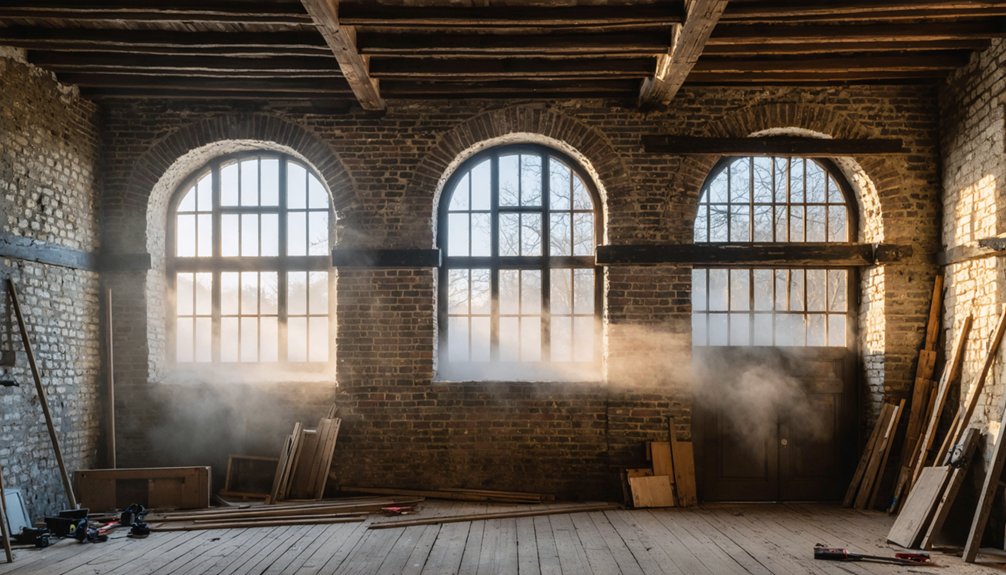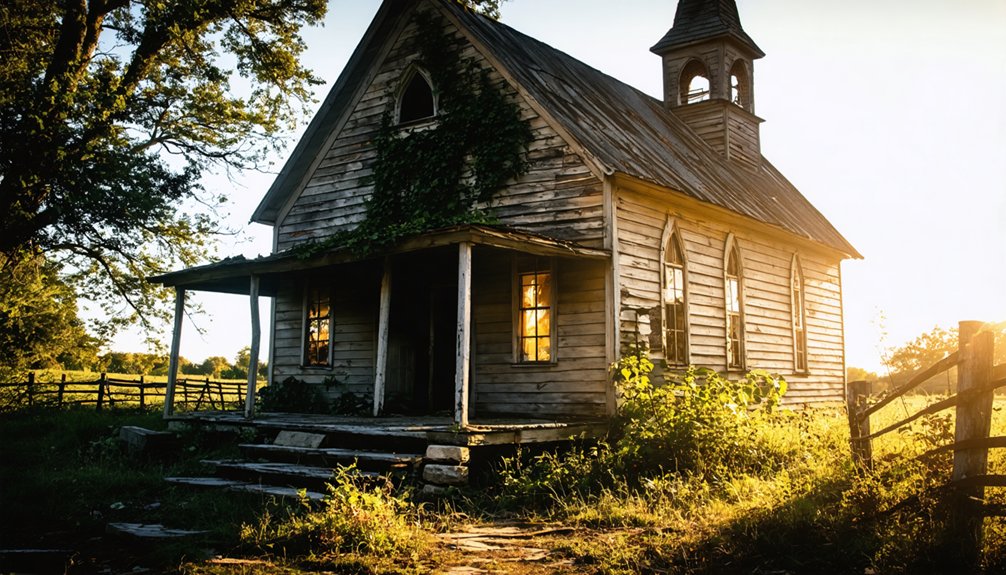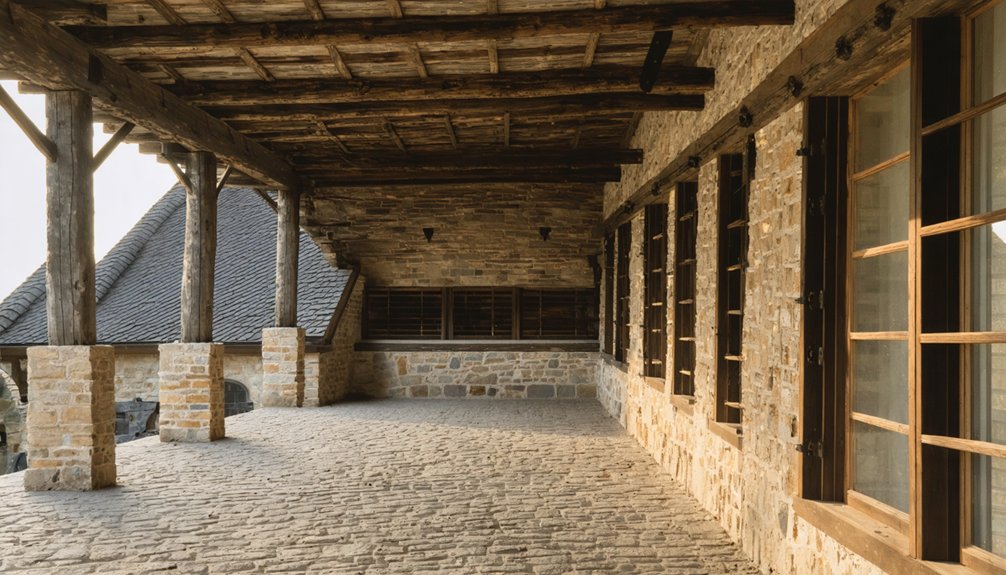
Colonial ghost town preservation employs multiple approaches to protect these historical treasures. You’ll find legal protections through the National Register of Historic Places alongside “arrested decay” stabilization techniques that prevent deterioration while maintaining authenticity. Conservationists implement erosion control systems, conduct archaeological research, and create interpretive programs for public education. Community partnerships with local historians and descendants guarantee culturally sensitive preservation. These interconnected strategies safeguard America’s colonial past for future generations to experience.
Key Takeaways
- “Arrested decay” preservation focuses on minimal intervention while halting deterioration to maintain historical authenticity in colonial structures.
- Legal protections through the National Register of Historic Places and Section 106 safeguard ghost towns from development and damage.
- Systematic archaeological research recovers and conserves artifacts while documenting site formation and historical context.
- Environmental management includes vegetation control, erosion prevention systems, and climate impact mitigation strategies.
- Public engagement through interpretive programs, youth initiatives, and community collaboration ensures sustainable preservation efforts.
Legal Protection and Heritage Site Designation
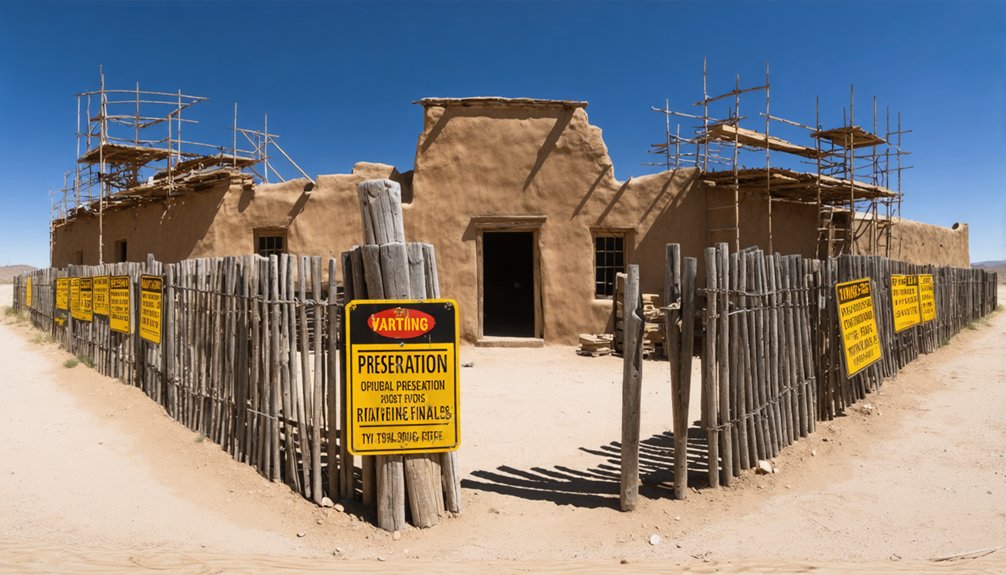
While ghost towns evoke a sense of abandonment, their legal protection requires deliberate and structured intervention through various designation processes.
You’ll find that colonial remnants typically gain protection through the National Register of Historic Places, where they must demonstrate historical or archaeological significance.
The process begins when a nomination reaches your State Historic Preservation Office, progressing through review commissions before reaching the National Park Service for final determination.
Preservation begins locally, travels through state review, and culminates in federal assessment for historic protection.
Sites must satisfy at least one of the four criteria for eligibility, with many ghost towns qualifying under Criterion A for their contribution to settlement patterns or Criterion D for archaeological significance.
For sites of extraordinary national importance, the more rigorous National Historic Landmark designation provides enhanced recognition.
Both designations activate Section 106 protections, requiring federal agencies to assess impacts on these sites during project planning.
Local and state legal frameworks offer additional layers of protection, often restricting modifications while providing tax incentives to encourage preservation efforts.
Property owners may also benefit from various financial incentives when their ghost town properties receive historic designation.
Structural Stabilization Through “Arrested Decay” Methods
When approaching colonial ghost town preservation, “arrested decay” emerges as the foundational methodology that balances authenticity with structural integrity.
You’ll notice this philosophy embraces minimal intervention—only necessary repairs are performed while leaving most surfaces “as found” to maintain the site’s aged character and emotional resonance.
Preservation techniques focus on halting active deterioration rather than full restoration. New roofs prevent water infiltration while maintaining original profiles. This focus on consolidation rather than restoration reflects the architectural philosophy that values historical charm over newness.
Foundations are carefully repaired without introducing visible modern alterations. Structural supports are added discreetly to prevent collapse without compromising visual integrity.
Traditional materials like adobe, lime plasters, and local timber are employed to match original construction methods. Similar to the approach at Bodie State Historic Park, preservationists may prevent major deterioration while respecting the site’s historical timeline.
The building’s patina—including peeling paint and surface wear—remains intact, allowing these fragile structures to continue telling their stories while standing securely against time.
Archaeological Research and Artifact Conservation
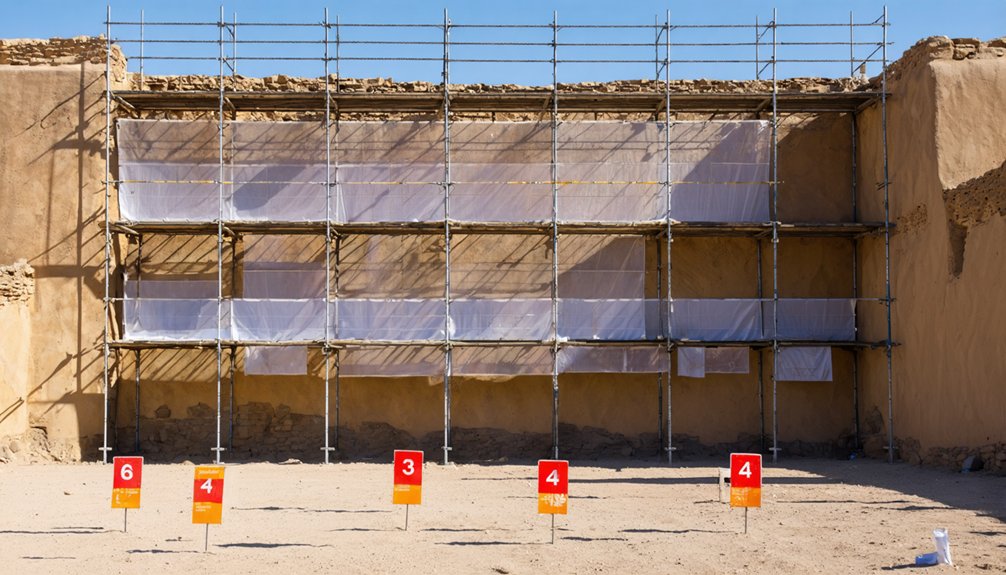
Archaeological research forms the backbone of colonial ghost town preservation, complementing structural conservation with scientific inquiry into the site’s material past.
You’ll find archaeologists employing systematic excavation techniques—digging 75-cm test units and screening soil through ¼-inch mesh to recover even the smallest artifacts. Careful documentation of stratigraphic soil characteristics enables archaeologists to reconstruct site formation processes over time. Unfortunately, colonial narratives often exclude Native American persistence through different waves of colonization, creating artificial gaps in understanding Indigenous experiences.
Every recovered item undergoes thorough artifact analysis in laboratory settings, where they’re cleaned, catalogued, and examined for function and date.
Laboratory analysis transforms dusty fragments into historical evidence through meticulous cleaning, cataloguing, and functional interpretation.
This meticulous work reveals domestic patterns and architectural details otherwise lost to time. The process incorporates archival records like death certificates and land grants to contextualize findings within historical narratives.
Conservation protocols guarantee artifacts remain stable through controlled environments, appropriate packaging, and reversible treatments.
Community collaboration, particularly with Indigenous perspectives, strengthens interpretive accuracy while maintaining ethical standards for preserving these fragile connections to our colonial heritage.
Public Education and Interpretive Programs
When you visit colonial ghost town remnants, you’ll encounter interactive historical experiences that transport you back to the 18th century through guided tours, hands-on demonstrations, and living history interpretations.
Educational media development now includes virtual reality reconstructions, documentary films, and online archives that make these fragile sites accessible even when physical visitation isn’t possible. The Bob & Marion Wilson Educator Resource Library provides free educational resources containing lesson materials and primary sources that educators can use to teach about colonial preservation efforts. Online workshops are available to teachers covering various historical topics that connect preservation efforts to classroom curriculum.
Youth preservation programs engage the next generation of stewards through archaeological field schools, conservation workshops, and service-learning projects where students document and help stabilize deteriorating structures.
Interactive Historical Experiences
How can visitors truly understand the lives of colonial inhabitants without experiencing their world firsthand? Through immersive storytelling and participatory reenactments, you’ll connect emotionally with the past in ways textbooks can’t convey.
First-person interpreters in period attire guide you through authentic colonial activities—from cooking traditional recipes to practicing forgotten trades like blacksmithing. These programs enhance learning experiences by creating emotional connections that visitors retain long after leaving the site.
At sites like Kings Landing, you’re not merely observing history; you’re living it. Try your hand at carpentry with historic tools, participate in re-enacted trials, or join woodland walks that reveal settlement patterns through landscape features.
Even ghost tours, when properly grounded in historical documentation rather than fiction, can illuminate social aspects of colonial life while respecting scholarly integrity. Many sites prioritize using primary sources for ghost stories rather than sensationalized tales that compromise historical accuracy. These experiences transform abstract historical knowledge into tangible understanding of your cultural heritage.
Educational Media Development
While interactive experiences provide hands-on connections to colonial life, extensive educational media amplifies these encounters through carefully designed interpretive tools.
You’ll find multimedia tools strategically implemented at sites like the Old Molson Ghost Town Museum, where outdoor collections of pioneer buildings serve as living exhibits that preserve colonial remnants.
Award-winning kiosks and interpretive panels along established trails combine historical facts, images, and personal anecdotes to deepen visitor engagement without supernatural emphasis.
These self-guided educational resources explain community functions, governance structures, and social relations that once animated these abandoned spaces.
Organizations like Harpers Ferry Center exemplify extensive development approaches by creating audiovisual programs, publications, and exhibits that assist onsite interpreters while ensuring historical accuracy through partnerships with conservation departments and historical commissions.
Youth Preservation Programs
Engaging the next generation in heritage conservation, youth preservation programs serve as a critical bridge between colonial ghost town remnants and their future stewards.
These initiatives foster youth engagement through hands-on experiences that instill preservation ethics early in life.
You’ll find diverse opportunities for young people to connect with colonial history:
- Living history demonstrations and archaeological field schools where participants practice traditional crafts and excavation techniques
- Interactive tours led by costumed interpreters who blend historical narratives with preservation challenges
- Digital storytelling projects and augmented reality experiences that make remote exploration possible
School partnerships extend these efforts through curriculum integration and field trips, while youth advisory councils provide students with genuine voices in preservation planning.
These programs transform passive observers into active protectors of our collective heritage.
Environmental Management and Site Preservation
You’ll notice that environmental management at colonial ghost towns requires systematic vegetation control to prevent roots from destabilizing foundations while preserving historically significant plant species.
Protecting these fragile sites demands engineered erosion prevention systems, including water diversion channels and soil stabilization techniques that preserve original contours and archaeological deposits.
The hidden coastal fishing sites significance extends beyond just ecological preservation; they represent vital cultural heritage and historical knowledge passed down through generations. As local communities engage in sustainable fishing practices, they help maintain the balance between economic viability and environmental stewardship. These efforts not only protect marine resources but also foster a deeper connection to the landscape that has sustained their ancestors.
Your preservation efforts must now incorporate climate impact mitigation strategies to address increased rainfall, temperature fluctuations, and severe weather events that accelerate deterioration of exposed structures and artifacts.
Strategic Vegetation Control
Effective strategic vegetation control forms the cornerstone of preserving colonial ghost town remnants against environmental degradation.
You’ll find that combining manual, mechanical, and selective chemical approaches creates a thorough defense against both erosion and invasive species.
Cultural practices like prescribed burning, mulching, and strategic grazing work synergistically with physical barriers to protect these delicate historic sites.
When managing these landscapes, consider:
- Establishing windbreaks and vegetative barriers along exposed slopes and riverbanks to prevent erosion
- Implementing contour hedges and grass strips to trap sediment and reduce runoff velocity
- Creating native forest reserves to stabilize foot-hills and steep areas while providing sustainable resources
This integrated approach not only preserves structural integrity but maintains the authentic character of these colonial remnants while minimizing environmental impact.
Erosion Prevention Systems
Erosion prevention systems form the backbone of any thorough ghost town preservation plan, building upon the vegetation strategies previously outlined.
You’ll find drainage control measures particularly effective—installing French drains and subsurface pipes to channel water away from vulnerable remnants prevents soil saturation that leads to collapse.
For slope stabilization techniques, consider implementing revetments with graded riprap or gabions to armor eroding bases.
When facing steep terrain, bank battering creates more stable gradients while reducing landslide risk.
Combine these approaches with turf reinforcement mats that hold soil in place during vegetation establishment.
The most effective erosion control methods incorporate multiple strategies: contour banking to slow runoff velocity, strategic placement of rock structures in high-flow areas, and careful land contouring to guide water away from fragile colonial structures—all while maintaining the site’s historical integrity.
Climate Impact Mitigation
While ghost town preservation begins with structural interventions, climate impact mitigation forms the critical next step in protecting these fragile historical assets from accelerating environmental threats.
You’ll find extensive systems now deployed to defend these sites against nature’s persistent assault.
Environmental management typically includes:
- Microclimate monitoring systems that track temperature, humidity, and wind patterns, enabling predictive maintenance before damage occurs
- Strategically placed vegetation buffers that moderate temperature extremes while preventing moisture buildup against structures
- Application of breathable, reversible conservation materials that allow buildings to “breathe” while protecting against environmental damage
These approaches preserve authenticity while acknowledging freedom—allowing these structures to weather naturally but with dignity, standing as honest witnesses to our past rather than artificially preserved replicas.
Community Partnerships and Descendant Collaboration
Successful preservation of colonial ghost town remnants depends heavily on the integration of diverse voices through community partnerships and descendant collaboration.
You’ll find preservation efforts thrive when local historians, scholars, and descendants unite, as with Dearfield, Colorado’s partnership between universities and community members.
Descendant testimonies enhance site interpretation by providing cultural context and genealogical information that physical artifacts alone can’t convey.
Collaborative storytelling transforms one-dimensional historical narratives into nuanced explorations that include difficult histories like slavery and displacement.
Nonprofits like Historic Charleston Foundation facilitate these connections, while funding through competitive grants enables research and educational programming.
Your participation matters—whether through volunteerism at annual events or sharing family histories, you contribute to a preservation ethic that respects both architectural remains and their deeper cultural significance.
Frequently Asked Questions
How Are Funding Priorities Determined for Competing Ghost Town Preservation Projects?
Like texting Paul Revere, you’ll find funding sources evaluate ghost town projects based on historical significance, community impact, project feasibility, preservation goals, and alignment with funding priorities that emphasize sustainable communities and cultural heritage.
Can Private Individuals Purchase and Preserve Colonial Ghost Town Properties?
Yes, you can purchase colonial properties when titles are clear. Your private ownership carries responsibility to preserve their historical significance through documented stabilization methods while maintaining authentic character.
How Do Preservationists Handle Human Remains Discovered During Excavations?
You’ll face a mountain of ethical considerations when handling discovered remains. You must follow strict legal frameworks, consult descendant communities, document meticulously, and determine appropriate disposition while respecting cultural beliefs and scientific value.
What Technologies Are Used to Date Structures Without Damaging Them?
You’ll find preservationists using non-invasive techniques like nondestructive radiocarbon dating with supercritical fluids, OSL on surrounding sediments, ESR on ceramics, and digital imaging to precisely date structures without compromising their integrity.
How Does Climate Change Impact Preservation Strategies for Colonial Remnants?
As Rome wasn’t built in a day, you’ll find climate change forcing adaptive strategies like relocation, elevation, and green infrastructure implementation, while creating funding challenges that require innovative financial mechanisms for colonial preservation efforts.
References
- https://www.terrastories.com/downloads/CaliforniaGhostTown.pdf
- https://thesecretlifeofmarbles.com/ghost-town-marbles/
- https://en.wikipedia.org/wiki/Ghost_town
- https://www.forestsociety.org/property/monson-center
- https://www.californist.com/articles/interesting-california-ghost-towns
- https://bentoncountymuseums.org/painting-ghost-town/
- https://www.imls.gov/blog/2012/12/bench-conservators-save-colonial-era-artifacts-corrosion
- https://florida.universitypressscholarship.com/view/10.5744/florida/9780813060705.001.0001/upso-9780813060705-chapter-2
- https://www.sapiens.org/archaeology/antioch-colony-texas/
- https://en.wikipedia.org/wiki/National_Register_of_Historic_Places