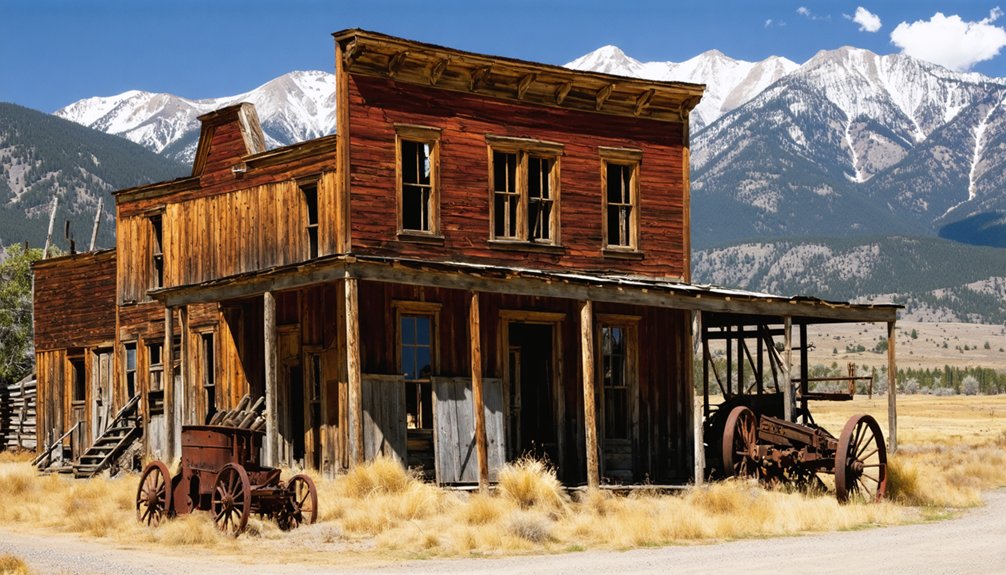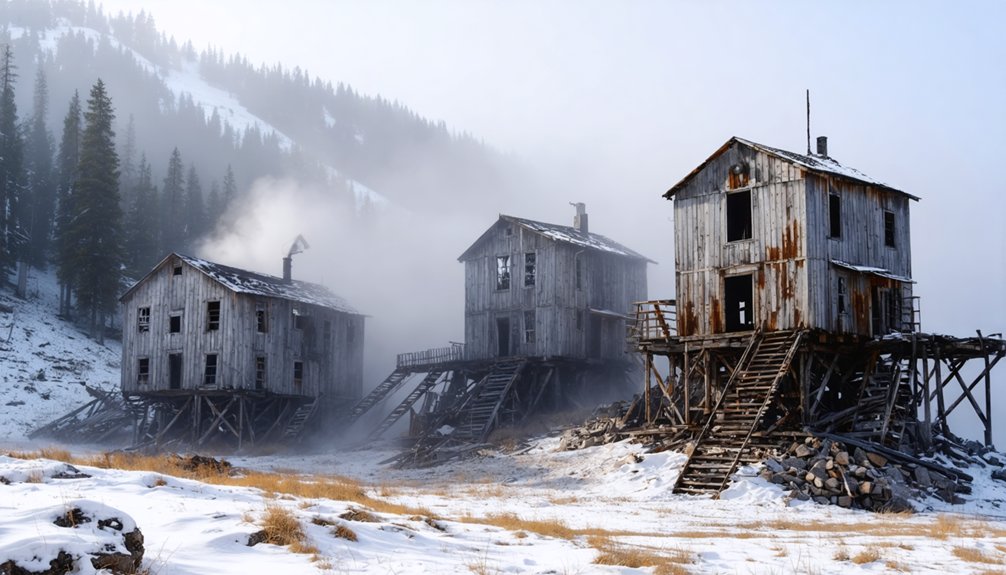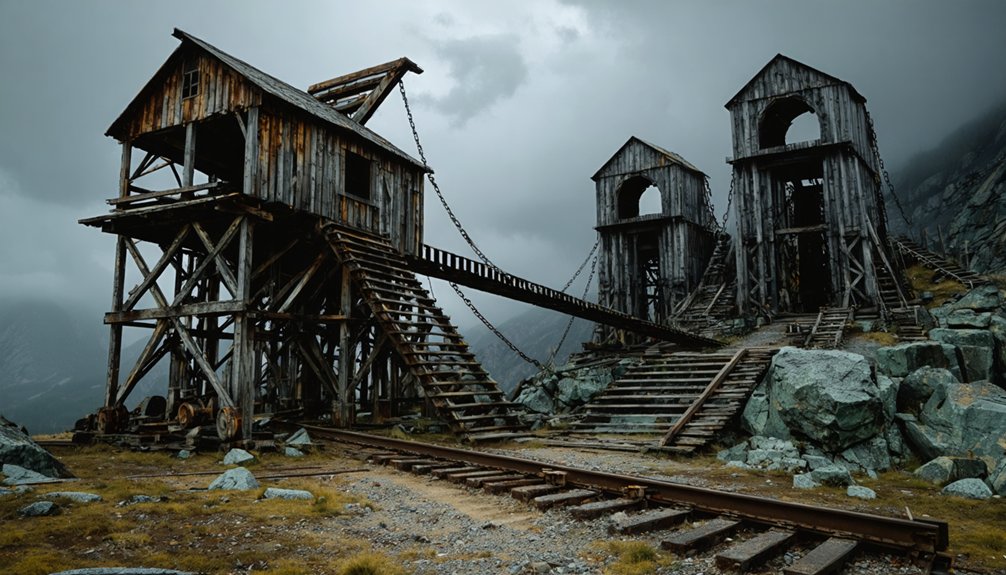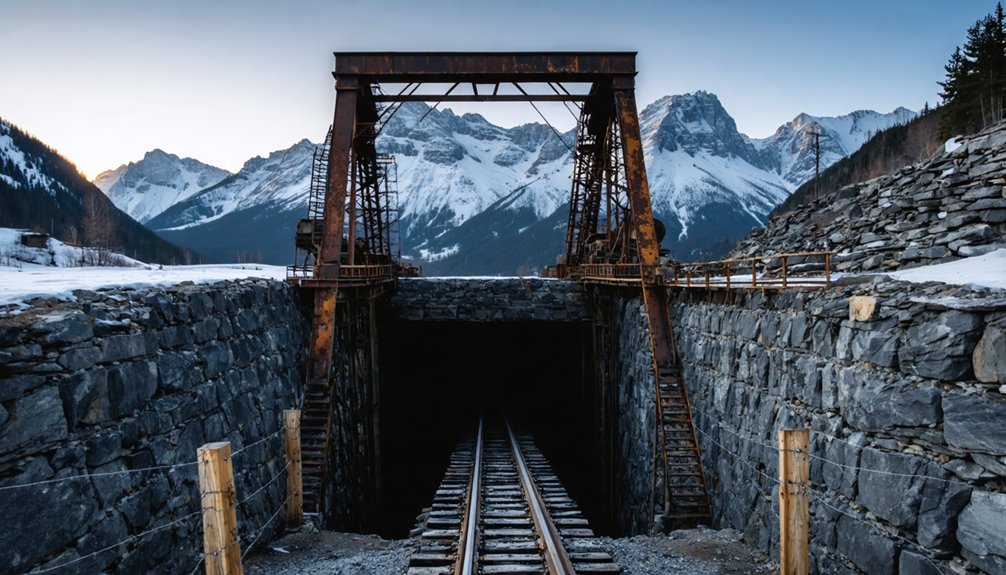
Colorado’s abandoned mining shafts hold mysteries from the state’s industrious past, with 23,000 sites containing historical artifacts, deteriorating 19th-century structures, and environmental secrets. You’ll find dangerous vertical drops exceeding 15 feet, toxic gases, and contaminated water alongside glimpses into Colorado’s gold rush legacy. These silent time capsules tell stories of technological evolution and human ambition, but approach with extreme caution—these aren’t natural caves but lethal hazards waiting beneath deceptive surfaces.
Key Takeaways
- Abandoned Colorado mines contain historical artifacts and mining equipment dating back to the 1858 gold rush era.
- Thousands of unmarked mine openings conceal unexplored tunnels and chambers throughout Colorado’s mountainous regions.
- Environmental scientists study unique underground ecosystems and mineral formations preserved in sealed mining shafts.
- Local legends suggest some abandoned mines contain undiscovered gold veins and precious mineral deposits.
- Ghost towns surrounding these mines hold stories of frontier life, documented through leftover personal belongings and structures.
The Forgotten Legacy: Colorado’s 23,000 Abandoned Mines
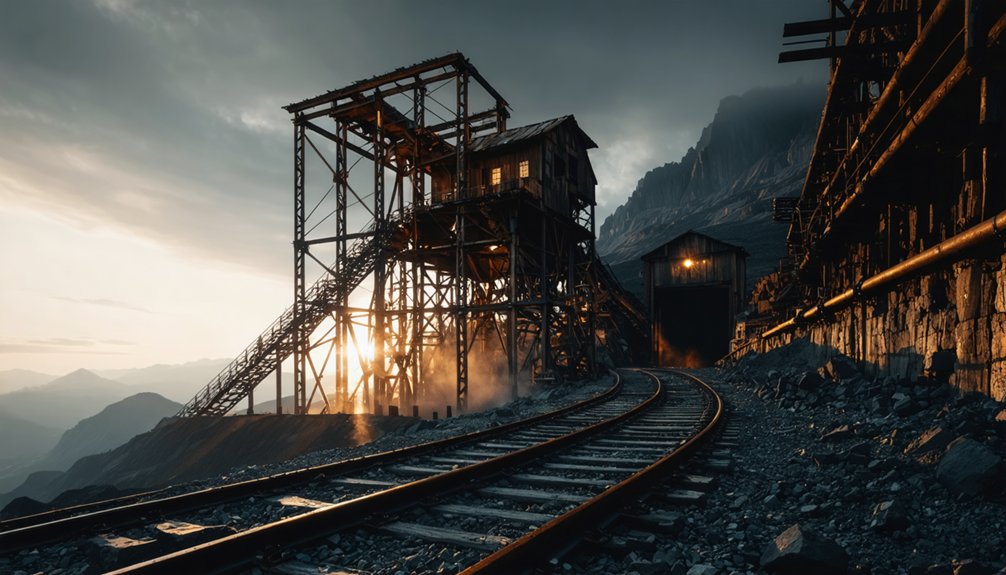
While numerous ghost towns dot Colorado’s mountainous landscape, they represent only the visible remnants of a much larger industrial legacy hidden beneath the surface.
The true scale of Colorado’s mining heritage is staggering—approximately 23,000 abandoned mine sites scattered across public and private lands throughout the state.
These remnants of Colorado’s abandoned history include hardrock mines, prospects, adits, shafts, and waste piles. Most lie on federally managed lands, with the U.S. Forest Service overseeing about 18,382 mine features in 2,742 inventory areas.
The Bureau of Land Management accounts for another 2,800 hardrock abandoned mines with over 10,000 hazardous openings. Together, they form an underground network that silently testifies to the state’s complex relationship with resource extraction and freedom to pursue mineral wealth.
Visitors to these sites are strongly cautioned that physical hazards like unstable structures and dangerous gases pose serious risks to explorers.
These abandoned mines continue to threaten water quality in the region, with approximately 89% of Colorado streams being impacted by acid mine drainage when water interacts with exposed sulfuric rock.
Down the Dark Descent: Physical Dangers Lurking Underground
You’re confronting three lethal hazards when entering Colorado’s abandoned mine shafts: the silent peril of vertical drops exceeding 15 feet, which claim more explorers’ lives than any other mining hazard as rotted timber or false floors give way without warning.
Decayed support structures, some dating to the 1860s silver rush, have deteriorated beyond safe load-bearing capacity, creating unpredictable collapse zones that can entomb the unwary within seconds. The prospect pit near Maryland Mountain, with its vertical walls descending 15-16 feet, exemplifies these deadly terrain features that have claimed lives throughout the state. Colorado’s extensive network of over 23,000 sites makes these dangers particularly widespread throughout the state’s mountainous regions.
The mine’s atmosphere itself becomes your enemy as oxygen-depleted pockets and concentrated carbon monoxide, methane, and radon accumulate in these poorly ventilated underground spaces, capable of rendering you unconscious before you’ve recognized the danger.
The Deadly Vertical Plunge
Darkness masks the most lethal threat in Colorado’s abandoned mining landscape: the vertical shaft.
These hidden dangers have claimed at least 18 documented lives since 1955, though actual fatalities likely exceed official counts. You’ll find no warning before the earth gives way beneath your feet—vegetation, erosion, and weathered timbers conspire to conceal these vertical hazards until it’s too late.
The consequences extend beyond the initial fall. At the bottom, near-freezing water pools await, causing drowning or hypothermia. Toxic, odorless gases collect in these subterranean voids, silently asphyxiating explorers. The tragic death of a 54-year-old hiker who fell into an 8-foot wide shaft near Ouray demonstrates the continuing danger of these obscured openings.
Despite closure efforts addressing 14,000 openings since 1980, thousands more remain unmarked across Colorado’s 23,000 inactive mining sites—each a potential death trap disguised by time and nature’s reclamation.
Ancient Supports Fail
Even as weathered portals beckon with historic allure, the ancient support structures within Colorado’s abandoned mines constitute their most insidious threat.
You’re witnessing the final days of engineering never meant to endure—timbers installed during mining booms of the 1800s now crumble at the slightest touch, their structural integrity compromised by decades of moisture and decay.
These ancient techniques relied on wooden square-set timbering and unreinforced stone—methods that deteriorate predictably with time.
What appears solid can collapse without warning, especially after rain or snowmelt infiltrates and weakens surrounding rock. The subtle creaking you might hear isn’t the mountain whispering secrets—it’s the final warning before catastrophic failure.
False floors hide deadly drops, masked by standing water or debris, completing the perfect trap for the unprepared explorer. With approximately 23,000 abandoned mines in Colorado, the sheer number of hazardous sites compounds the danger of exploration. The growing trend of amateur exploration fueled by social media has significantly increased the risk of serious accidents in these dangerous environments.
Invisible Toxic Gases
While ancient timber supports represent visible threats, the most lethal dangers in Colorado’s abandoned mines often can’t be seen at all.
You’ll encounter invisible killers—odorless methane, carbon monoxide, and carbon dioxide—that displace oxygen with no warning. These gases accumulate in poorly ventilated shafts where historic mine ventilation systems have long since failed.
At oxygen levels below 19.5%, your judgment becomes impaired; below 16%, unconsciousness follows quickly. Even lighting a match can consume precious remaining oxygen in confined tunnels.
Modern toxic gas detection equipment is essential for survival, as your senses provide no warning before asphyxiation begins. The geological processes continuing within these mountains silently generate deadly atmospheres through decomposition, acid mine drainage reactions, and natural gas seepage—turning these historic passages into invisible death traps. Since the late-1970s, mine operations have been required to reclaim and properly close sites, but thousands of Colorado’s mines were abandoned before these safety regulations existed.
Silent Killers: Environmental Threats Beyond the Mine Entrance
Beyond the weathered timbers and rusted metal frames that mark abandoned mine entrances, an invisible network of environmental hazards silently threatens Colorado’s landscapes and communities.
You’ll never see the toxic legacy spreading from these relics as contaminated dust carries arsenic and lead into surrounding ecosystems. During periods of heavy rainfall, these abandoned mines can flood, leading to catastrophic leaching of contaminants into nearby waterways and drinking water sources. Windblown particulates settle on vegetation you might hike past, while acid mine drainage—a poisonous cocktail of heavy metals—seeps into watersheds that supply drinking water.
Each rainstorm accelerates this contamination, carrying toxins further from their source.
Environmental surveillance reveals staggering facts: approximately 23,000 abandoned mines dot Colorado’s terrain, each potentially leaching contaminants for decades.
The unvegetated slopes surrounding these sites accelerate erosion, destabilize hillsides, and fragment wildlife habitats—extending their damage far beyond the mine’s physical boundaries.
Gold Rush to Ghost Mines: The Historical Significance of Mining Shafts

When prospectors discovered glittering placer gold near the confluence of Cherry Creek and the South Platte River in 1858, they unknowingly ignited Colorado’s transformation from untamed wilderness to industrial powerhouse.
The “Pikes Peak or Bust” migration that followed created a landscape punctuated by historical mysteries – thousands of shafts penetrating deep into the Rockies’ heart.
You can trace Colorado’s evolution through these abandoned portals. Mining techniques evolved rapidly from simple placer panning to complex hard-rock extraction, with John Gregory’s 1859 lode discovery marking the critical shift toward industrial shaft mining. These advancements contributed to making Central City Colorado’s most important city by 1878, showcasing the remarkable pace of development.
What began as hand-dug holes became elaborate underground networks requiring advanced engineering. By 1861, these subterranean labyrinths generated enough wealth to establish Colorado as a territory, eventually propelling it to statehood in 1876.
Death in the Darkness: Tragic Stories From Colorado’s Mine Shafts
You’ll shudder at the documented fatalities in Colorado’s abandoned mine shafts, where at least 18 recorded deaths since 1955 represent merely the tip of a grim statistical iceberg.
Some victims plummeted through false floors or debris-covered openings into cold, watery graves below, their bodies sometimes recovered days or weeks after disappearing.
Others experienced the silent horror of oxygen deprivation in horizontal tunnels, where odorless toxic gases replaced breathable air without warning, leaving rescuers to find victims who appeared to be sleeping but had suffered cerebral hypoxia within minutes.
Fatal Falls Claimed Many
Eighteen documented fatalities in Colorado’s abandoned mines since 1955 represent only a fraction of the dark toll these silent deathtraps have claimed over decades.
You’d vanish without a trace if you step onto the wrong patch of seemingly solid ground. Vertical shafts, concealed by rotting timbers or false floors, remain the leading killers at these sites.
The April 1970 Glory Mine tragedy, where a man plunged through snow-covered ground, and the 1986 death of an 11-year-old Aspen skier illustrate why mine safety has become a critical public awareness issue.
Despite efforts to secure 14,000 openings since 1980, over 23,000 abandoned mines dot Colorado’s landscape, with thousands still unmarked.
The earth literally swallows victims whole when deceptive terrain gives way unexpectedly.
Cold Watery Graves
Beyond the perils of unexpected falls lurks another deadly threat in Colorado’s abandoned mines: the icy depths of water-filled shafts that have claimed countless lives throughout mining history.
You wouldn’t suspect these death traps until it’s too late. When mining operations cease, pumps shut down, allowing groundwater to flood shafts with near-freezing cold water.
What’s particularly treacherous is how these hazards hide beneath seemingly solid surfaces—rotten timber “false floors” and overgrown vegetation disguise deadly plunges into frigid darkness.
The White Ash Mine disaster of 1889 demonstrates these waters’ lethal nature, where victims were lost hundreds of feet below, their bodies never recovered.
Even if you survive the initial fall, hypothermia rapidly sets in, paralyzing your muscles and diminishing survival chances within minutes. The combination of freezing temperatures and unexpected submersion creates perfect conditions for swift, silent deaths.
Oxygen-Starved Final Moments
While hikers and amateur explorers focus on visible dangers, the silent killer lurking in Colorado’s abandoned mine tunnels remains largely invisible until it’s too late.
You’ll never receive warning signs as oxygen deprivation takes hold in these poorly ventilated caverns. The odorless gases—carbon monoxide and methane—accumulate in these forgotten spaces, creating death traps for the unsuspecting.
- Victims collapse suddenly when oxygen levels plummet, their bodies discovered in positions suggesting they’d no time to react.
- Rescuers entering these tunnels face double jeopardy—navigating unstable structures while risking the same suffocation risks.
- Horizontal tunnels, appearing safer than vertical shafts, often harbor the deadliest atmospheric conditions due to stagnant air pockets.
Since 1955, Colorado’s incomplete records suggest numerous explorers have drawn their final breaths in these oxygen-starved chambers.
Hidden Treasures: Geological Wonders and Mineral Deposits
Deep beneath Colorado’s rugged landscape lies a geological wonderland that few modern eyes have witnessed. The Colorado Mineral Belt harbors a treasure trove of gold, silver, lead, zinc, copper, molybdenum, and tungsten deposits waiting to be rediscovered through modern mineral exploration techniques.
As seekers of adventure and history set out on their quests, exploring Colorado’s historic silver sites offers a glimpse into the past, revealing the stories of pioneers who once flocked to these mingling veins of wealth. These remnants of bygone eras, often nestled in breathtaking mountain vistas, provide not only a rich tapestry of mineral exploration but also a backdrop for unforgettable experiences. Each visit to these sites invites travelers to connect with the land’s heritage while marveling at the natural beauty that surrounds them.
When you descend into these abandoned shafts, you’ll encounter spectacular mineral crystallizations and vein sulfides that tell the story of Colorado’s metallogenic history.
Abandoned workings, with their exposed fault lines and mineralized breccia zones, offer unprecedented opportunities for geological mapping of structures rarely visible on the surface.
The vibrant surface coatings—black manganese, red-orange iron, green-blue copper—aren’t just environmental indicators but signposts to potential wealth.
These forgotten corridors still contain valuable minerals in tailings and waste dumps, holding clues to undiscovered deposits nearby.
Mapping the Invisible: How Authorities Track and Monitor Abandoned Mines
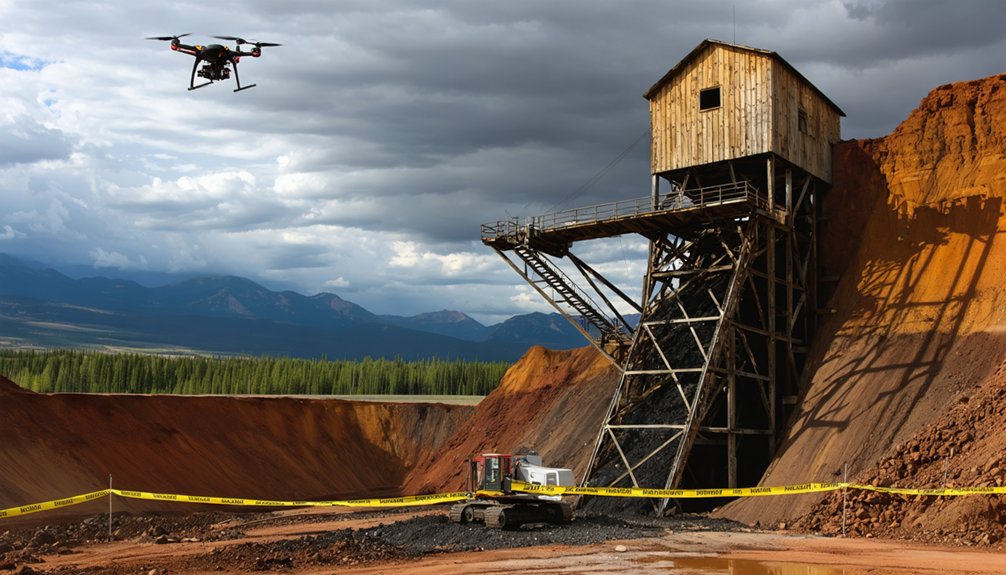
Although invisible to the casual observer, Colorado’s 23,000 abandoned mine sites form a complex subterranean network that state and federal authorities track through sophisticated mapping initiatives.
Beneath Colorado’s scenic landscapes lies a hidden labyrinth of 23,000 abandoned mines, meticulously monitored by government mapping experts.
You’ll find agencies like CGS and BLM collaborating on abandoned mine monitoring efforts, cataloging thousands of hazardous openings across public lands.
When conducting environmental hazard assessment, authorities employ cutting-edge technologies:
- Remote sensing platforms detect invisible thermal signatures and subsurface instabilities
- GIS-integrated databases compile hazard data from multiple federal and state sources
- Lidar and satellite imagery track erosion, vegetation recovery, and contamination spread
These monitoring systems help prioritize intervention based on physical and environmental risks, particularly where heavy metals threaten water quality.
The Arkansas River restoration near Leadville exemplifies successful long-term tracking that’s transformed once-toxic waterways into recovering ecosystems.
The Stay Out, Stay Alive Campaign: Public Safety Initiatives
Beyond mapping and monitoring, public safety around abandoned mines demands active education and prevention strategies. The “Stay Out, Stay Alive” campaign, spearheaded by MSHA and adopted by Colorado’s Division of Reclamation, Mining and Safety, targets those drawn to these historical sites.
You’ll find safety awareness messaging across Colorado’s 23,000 abandoned mines, particularly in popular recreation areas where your explorations might lead. Campaign materials warn that mines aren’t natural caves—they harbor deadly gases, unstable supports, unexpected water hazards, and even explosive remnants without warning signs.
Rather than risking your life in deteriorating structures, the campaign encourages community involvement through educational alternatives. Visit designated tourist mines and museums instead, where you’ll experience mining heritage safely, without facing the very real dangers that have claimed numerous curious explorers.
Reclamation Efforts: Transforming Dangerous Sites Into Safe Spaces
Since Colorado’s mining heyday ended, the Inactive Mine Reclamation Program has worked tirelessly to transform the state’s dangerous abandoned mines into safe spaces for both people and wildlife.
Colorado’s mining past finds new purpose as abandoned dangers transform into sanctuaries for humans and nature alike.
Despite closing over 10,500 hazardous openings and reclaiming 4,000+ acres, thousands remain unsecured due to challenging terrain.
Modern reclamation techniques involve thorough environmental restoration:
- Installing engineered drainage channels that divert contaminated runoff from critical watersheds
- Securing openings with specialized steel grates that prevent human entry while preserving bat habitats
- Stabilizing waste rock and tailings piles with native vegetation to prevent erosion
Safety protocols include coordinating with environmental agencies to guarantee water quality standards are met while addressing immediate physical hazards.
You’ll find these projects aren’t merely about filling holes—they’re about restoring ecosystems while preserving Colorado’s mining heritage for future generations to appreciate safely.
Modern Explorers: Urban Legends and the Allure of Abandoned Mines
You’ll find today’s mining shaft explorers documenting their adventures on platforms like YouTube and Instagram, where firsthand encounters with century-old infrastructure garner millions of views.
The digital urban exploration movement has transformed lone adventurers into social media personalities who broadcast both the historical artifacts and spine-chilling legends of places like Nevadaville’s abandoned tunnels.
Despite Colorado authorities’ repeated warnings about lethal dangers including sudden collapses and toxic air, these explorers continue feeding the modern fascination with mining history’s physical remnants and ghostly narratives.
Daredevil Lore Persists
As daylight fades across Colorado’s rugged backcountry, stories of daring explorers and their close encounters with death circulate among those drawn to the state’s estimated 23,000 abandoned mine shafts.
Despite explicit “Stay out and stay alive” warnings, daredevil motivations drive you and fellow thrill-seeking behavior enthusiasts toward these forbidden portals to history.
The subculture’s allure stems from three distinct elements:
- The physical rebellion of bypassing official barriers, heightening the adventure’s intensity
- The sensory impact of absolute darkness, amplified sounds, and historical artifacts preserved in underground time capsules
- The stark contrast between sterile modern life and the raw, unfiltered experience of traversing century-old industrial ruins
You’re not merely trespassing—you’re joining a community that values unmediated exploration of America’s industrial past, despite the lethal risks.
Digital Exploration Movement
While traditional mine exploration involved physical trespassing and tangible risk, the digital age has transformed how abandoned mines captivate public imagination through a growing movement of virtual explorers.
You’ll find these modern adventurers wielding drones and high-definition cameras to document vast underground systems that once pulsed with industrial activity. Their footage reveals near-pristine conveyor belts, abandoned vehicles, and fully intact infrastructure—frozen moments of Colorado’s mining heritage.
Through digital storytelling, they’re creating virtual preservation archives of deteriorating historical sites while traversing the ethical boundaries of access.
These explorations serve dual purposes: documenting ephemeral mining history before sites collapse or become permanently sealed for safety reasons, while satisfying your curiosity without physical danger.
The movement has democratized access to these forbidden underground domains, allowing you to witness Colorado’s industrial past without risking life or breaking trespassing laws.
Frequently Asked Questions
Are Any Abandoned Mines Home to Unusual Wildlife Species?
Yes, you’ll find ringtails unexpectedly expanding their range in these mine ecosystems. Townsend’s big-eared bats demonstrate remarkable wildlife adaptations, while bighorn sheep utilize these structures as essential mineral sources despite predator proximity.
Can Private Citizens Legally Purchase Abandoned Mining Properties?
The key to freedom’s door—yes, you can purchase abandoned mining properties. Mining property ownership requires maneuvering specific abandoned property laws, acquiring either patented claims (full ownership) or unpatented claims (mineral rights only).
What Mining Technologies Were Uniquely Developed in Colorado?
You’ll find Colorado pioneered Parshall’s water measurement flume, Gleazen’s portable dams, and the Argo Mill’s integrated ore extraction systems combining gravity separation, cyanidation, and flotation beyond standard hydraulic mining techniques.
Do Paranormal Investigators Regularly Explore These Abandoned Mines?
You’ll find paranormal investigations are indeed common in Colorado’s mines, where investigators armed with EMF meters and cameras regularly document mining folklore through overnight vigils in these historically charged, isolated locations.
How Have Climate Changes Affected Abandoned Mining Shaft Stability?
You’ll find abandoned shafts increasingly destabilized as climate impacts accelerate erosion, trigger more powerful flooding events, reduce structural integrity through freeze-thaw cycles, and mobilize toxic sediments during unprecedented precipitation episodes.
References
- https://coloradogeologicalsurvey.org/wp-content/uploads/woocommerce_uploads/OF-19-12.pdf
- https://coloradosun.com/2025/11/24/abandoned-mines-colorado-ouray-hiker-death/
- https://coloradogeologicalsurvey.org/hazards/aml/
- https://drms.colorado.gov/programs/inactive-mine-reclamation-program/stay-out-stay-alive
- https://www.denvergazette.com/2025/11/25/with-23000-abandoned-mines-around-colorado-these-11-fatalities-highlight-hidden-risks/
- https://archives.colorado.gov/collections/historic-mine-reports
- https://www.blm.gov/programs/aml-environmental-cleanup/aml
- https://en.wikipedia.org/wiki/Abandoned_mine_drainages_in_Colorado
- https://erams.com/catena/wp-content/uploads/2020/01/Abandoned-Mine-Water-Quality-Study_06-01-17.pdf
- https://www.cpr.org/2015/08/14/mapping-1645-miles-of-colorado-waterways-affected-by-abandoned-mines/