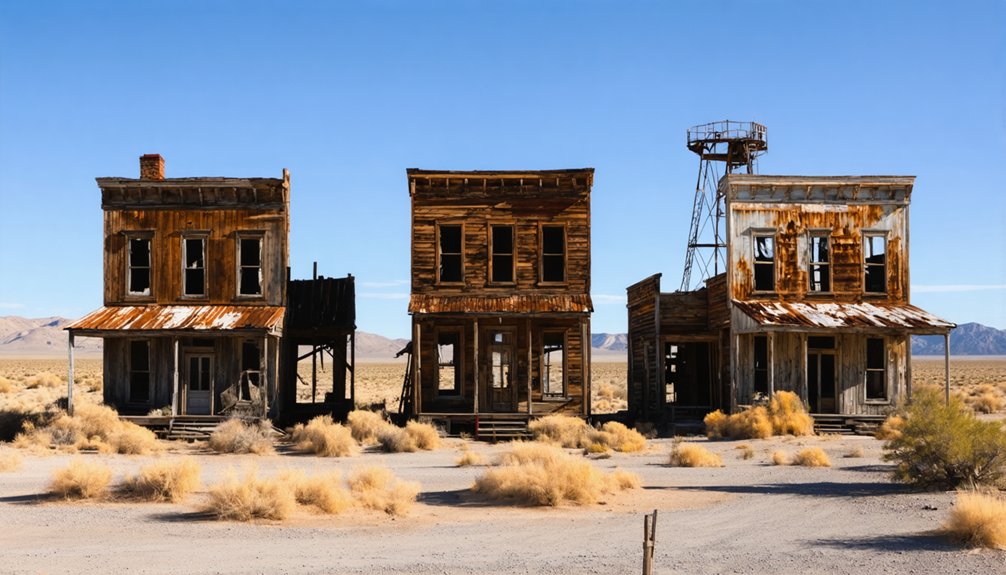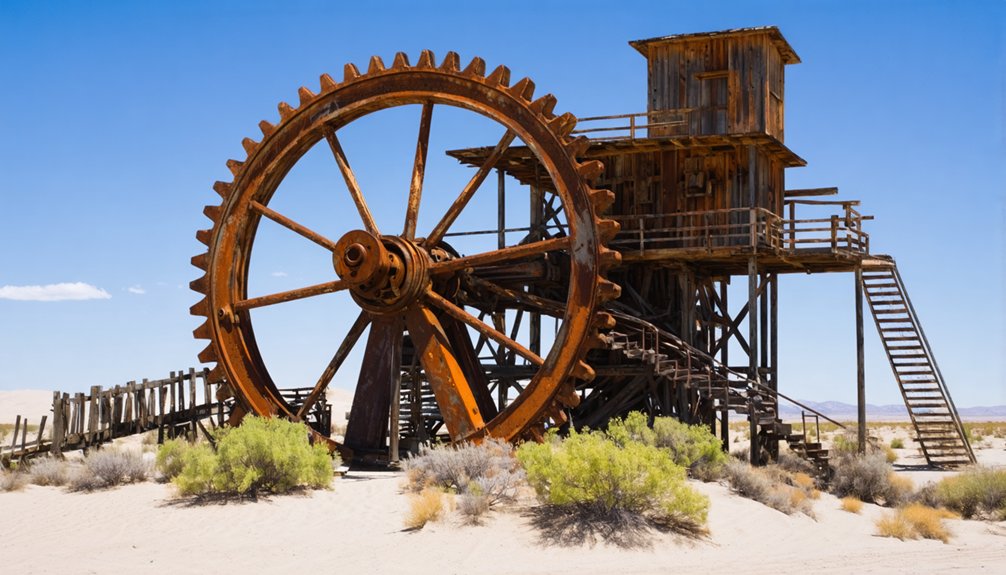
You’ll find over 300,000 industrial artifacts scattered across Nevada’s historic mining districts, ranging from massive multi-stamp mills to jaw crushers and headframe remnants. The state’s arid climate has helped preserve many structures, though deterioration accelerates yearly through harsh weather cycles and structural failures. While some equipment remains intact in remote areas, others face advanced corrosion and decay. These silent giants tell complex stories of technological evolution, environmental impact, and preservation challenges.
Key Takeaways
- Massive multi-stamp mills, jaw crushers, and headframe remnants dominate Nevada’s abandoned mining landscapes, particularly in remote desert regions.
- Steam-powered machinery foundations, engine beds, and heap leaching equipment from the Carlin Trend showcase technological evolution.
- Over 300,000 mining features remain across Nevada, including deteriorating structures, equipment, and hazardous materials.
- Ore cars in Pioche and haul trucks in the Carlin Trend demonstrate distinct geographical patterns of abandoned equipment.
- The arid climate has preserved many artifacts, though metal corrosion and structural failures continue to threaten remaining equipment.
Legacy of Industrial Giants: Common Equipment Types
The rugged landscape of Nevada’s mining districts holds an extensive array of abandoned industrial equipment that tells the story of mineral extraction from the 1800s through the early 20th century.
Scattered across Nevada’s harsh terrain, silent machinery and industrial ruins chronicle over a century of the state’s mining heritage.
You’ll find massive multi-stamp mills, with their heavy iron shoes and dies, alongside jaw crushers that once processed precious metals. This legacy equipment reveals the evolution of mining technology.
At shaft sites, you’ll discover remnants of headframes that supported hoisting operations, with their steel legs and concrete footings still anchored to the earth.
Steam-powered machinery left its mark through massive boiler foundations and engine beds, while later electrical systems show the industry’s technological progression.
The historical significance of these artifacts is evident in preserved examples like Nevada City’s Fortuna Mill, where you can trace the path ore once took through the crushing and processing stages.
The Carlin Trend district features remnants of innovative heap leaching equipment from the late 1960s, marking a revolutionary period in gold extraction methods.
The Toll of Time: Current State and Deterioration
Despite decades of exposure to Nevada’s harsh climate, abandoned mining equipment continues to deteriorate at an accelerating pace across the state’s historic sites.
Time’s impact is most evident in the widespread structural failure you’ll find – from rotted support timbers to rusted headframes and collapsed mill buildings.
You’ll notice machinery’s structural integrity has been particularly hard-hit.
Stamp mills and crushers sit frozen in place, their gears seized and components fractured.
Metal surfaces show advanced corrosion, while rubber and plastic elements have largely disintegrated.
The harsh cycle of hot days and cold nights has caused concrete foundations to crack and spall.
Amidst the ruins, hazardous materials like decaying explosives and chemicals pose serious risks to visitors exploring these sites.
The state’s roughly 200,000 abandoned mines dot the landscape, each containing deteriorating equipment and infrastructure.
Chemical residues from processing operations have accelerated decay, especially in areas exposed to old cyanide or mercury.
Many sites also bear the scars of vandalism, with valuable components stripped away and remaining structures destabilized.
Geographic Distribution Across Nevada’s Mining Districts
Scattered across Nevada’s diverse topography, abandoned mining equipment follows distinct geographical patterns that reflect each district’s operational history and mineral wealth.
The NBMG historic data shows how mining districts evolved over time, revealing where different types of equipment were deployed. You’ll find massive haul trucks and heap leach systems dominating the Carlin Trend’s gold operations, while silver districts like Pioche showcase rusted ore cars and tramway remnants.
The mining legacy varies considerably between remote and accessible areas – equipment in isolated regions like the Kawich Range remains largely intact, while sites near urban centers show more evidence of scavenging.
The desert’s arid climate has preserved many artifacts, particularly in districts like Bullfrog and Amargosa, where you can spot deteriorating but recognizable processing plants, trucks, and rail infrastructure.
Each commodity type has left its distinct equipment signature, from mercury retorts to copper concentrator ruins. Researchers can now locate and study these sites using the interactive map system that provides detailed geographical data on mining districts.
Safety Concerns and Hidden Dangers
Hidden dangers lurk beneath Nevada’s abandoned mining landscapes, where over 300,000 mining features pose significant safety risks to visitors and explorers.
Among these deserted sites, one might stumble upon the mysterious native american village remnants, revealing traces of a rich history that echoes through the canyon walls. These remnants tell stories of a culture that once thrived in harmony with the harsh desert environment, offering a glimpse into their way of life. As explorers navigate these forgotten paths, they uncover artifacts that connect them to a past long overshadowed by the area’s mining boom.
When conducting safety assessments, you’ll find unstable ground, deteriorating support structures, and water-filled shafts that can be deceptively dangerous. Hazard awareness is critical as you navigate these sites. The Bureau of Land Management actively works to address these hazardous conditions.
You’ll encounter numerous threats: vertical shafts concealed by vegetation, unstable highwalls prone to collapse, and submerged hazards in water-filled quarries.
Deteriorating explosives and chemical containers present additional risks, as abandoned sites often contain unstable dynamite and toxic substances.
The structural integrity of remaining equipment, including headframes and catwalks, can’t be trusted – even seemingly solid platforms may give way without warning.
Metal components have weakened through decades of exposure, creating potential collapse zones throughout these historical sites.
Legal Ownership and Management Challenges
Beyond the physical hazards of abandoned mining sites, complex legal frameworks govern the ownership and management of deserted equipment and infrastructure.
You’ll need to navigate intricate ownership disputes when claiming abandoned mining equipment, as state laws require specific procedures for establishing new possession rights.
If you’re interested in acquiring abandoned mining assets, you must follow strict regulatory compliance measures, including a 6-month prospecting period and proper documentation with county recorders. According to state mining laws, prima facie evidence of abandonment exists when tailings or waste materials are left unattended.
Equipment left unused for 10 consecutive years on public land may revert to county ownership through revenue laws.
You’re also bound by reclamation requirements – any equipment you claim comes with environmental obligations and potential financial liability.
Active permits and bonds serve as essential tools for maintaining legal control while ensuring responsible management of mining infrastructure.
The Division of Environmental Protection maintains oversight authority for addressing abandoned mining equipment through comprehensive reclamation plans.
Historical Preservation Efforts
While abandoned mining equipment faces deterioration across Nevada’s landscape, numerous preservation initiatives work to protect these invaluable historical assets.
You’ll find both community engagement and preservation funding playing vital roles in saving these artifacts through organizations like Preserve Nevada and the Tonopah Historic Mining Park Foundation.
- The Goldfield Historic Equipment Park provides free access to preserved machinery through local historical society support and donations.
- Archaeological surveys document significant features while informing preservation strategies.
- The Comstock Foundation actively restores historic mining structures and equipment.
- Community-led educational programs teach mining history firsthand, ensuring future generations understand their importance.
The environmental impact was severe, with hydraulic mining debris causing widespread damage to river systems and habitats throughout the region.
Recent cuts to federal funding have made it increasingly difficult for preservation organizations to maintain and protect historic sites across Nevada.
These preservation efforts balance historic conservation with public safety, implementing protective measures like bat gates while maintaining site authenticity.
Environmental restoration projects often work alongside preservation initiatives, creating thorough approaches to protecting Nevada’s mining heritage.
Modern Documentation and Mapping Methods
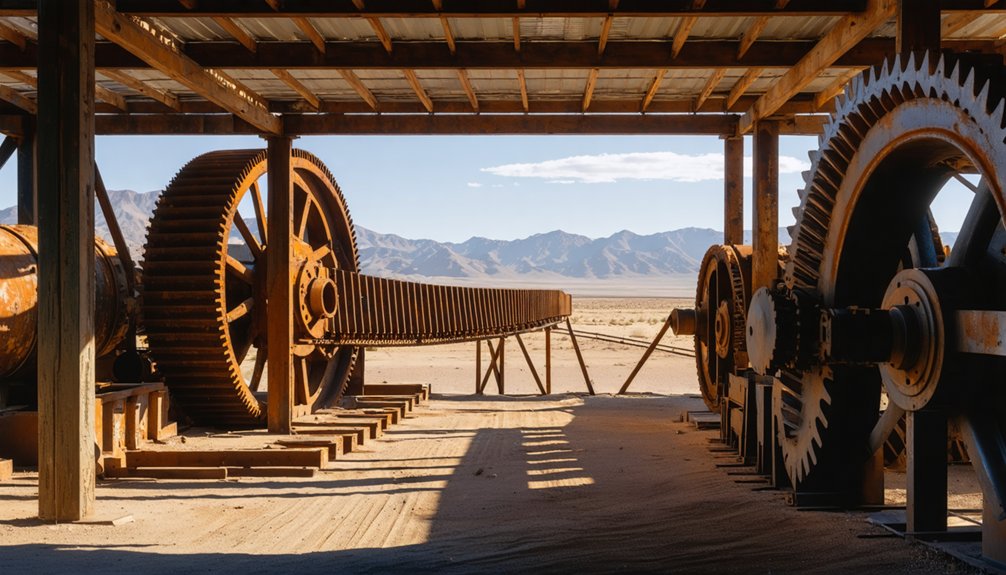
Modern technology has revolutionized how we document Nevada’s abandoned mining equipment through advanced surveying and visualization methods.
You’ll find terrestrial laser scanning capturing millimeter-accurate 3D models of underground machinery, while drone photogrammetry techniques map surface equipment across vast desert landscapes.
These digital tools create detailed spatial inventories of every drill, hoist, and crusher left behind.
Mobile laser scanning systems navigate tight mine tunnels, documenting abandoned equipment that’s difficult to reach. The data flows into GIS databases, where you can track equipment locations, conditions, and environmental risks.
Virtual reality lets you explore these sites remotely, while augmented reality overlays reveal historical details during site visits.
This thorough digital preservation guarantees Nevada’s mining heritage won’t be lost to time.
Frequently Asked Questions
Can Abandoned Mining Equipment Be Used to Estimate Historical Production Values?
Sharp as a miner’s pickaxe, you can rely on abandoned equipment for historical production estimates through methodical analysis of machinery scale, operational infrastructure, and cross-referencing with documented yields for technical validation.
How Did Transportation Limitations Influence Equipment Placement in Remote Locations?
You’ll find equipment concentrated along transportation routes where rail or wagon access existed, with lighter, modular machinery placed in areas where remote access required pack animals or manual transport.
What Tools and Techniques Were Used to Install Large Equipment?
You’ll find the installation techniques relied on hoisting systems, cranes, and telescoping boom lifts to position heavy machinery, with load pins monitoring structural stress during placement in underground mining sites.
How Did Nevada’s Mining Equipment Differ From Other Western Mining States?
At 3,000+ feet deep, Nevada’s mines needed unique designs unlike other Western states – you’ll find taller headframes, stronger hoists, and regional adaptations like the specialized Washoe pan process for ore processing.
What Determined Which Equipment Was Left Behind Versus Salvaged?
You’ll find salvage criteria centered on equipment value, mobility, and removal costs. Heavy machinery stayed if transportation was costly, while portable, valuable items were typically recovered for reuse elsewhere.
References
- https://www.silverstatechronicle.com/article/635
- https://www.reviewjournal.com/local/local-nevada/all-the-ways-a-mine-can-kill-you-nevadas-abandoned-mines-pose-endless-risks-2914561/
- https://minerals.nv.gov/uploadedFiles/mineralsnvgov/content/Programs/AML/2020_NDOM_AML_Report_Final_Draft_v4.pdf
- https://www.las-vegas-real-estate-authority.com/abandoned-mines-in-nevada/
- https://minerals.nv.gov/uploadedFiles/mineralsnvgov/content/Programs/AML/2017_NDOM_AML_Report_Final.pdf
- https://www.blm.gov/sites/default/files/uploads/AML_PUB_Inventory.pdf
- https://www.leg.state.nv.us/Division/Research/LegInfo/Orientation/2010-11/Handouts/Dec7/13-MiningHandouts.pdf
- https://nbmg.unr.edu/geohazards/MiningRelatedContamination.html
- https://www.mining.com/web/abandoned-copper-mines-embraced-as-fast-track-to-boost-output/
- https://nbmg.unr.edu/geohazards/AbandonedMineDangers.html