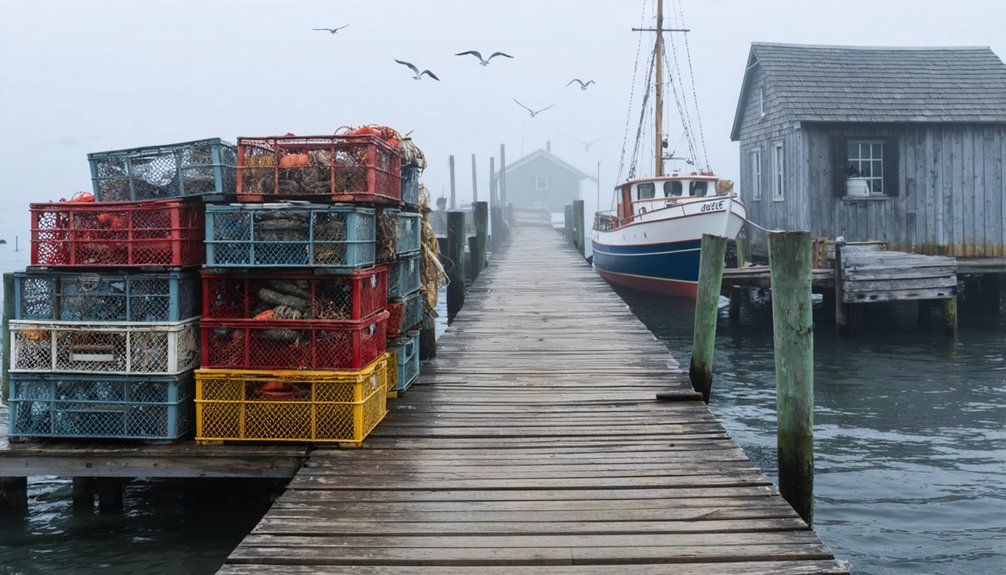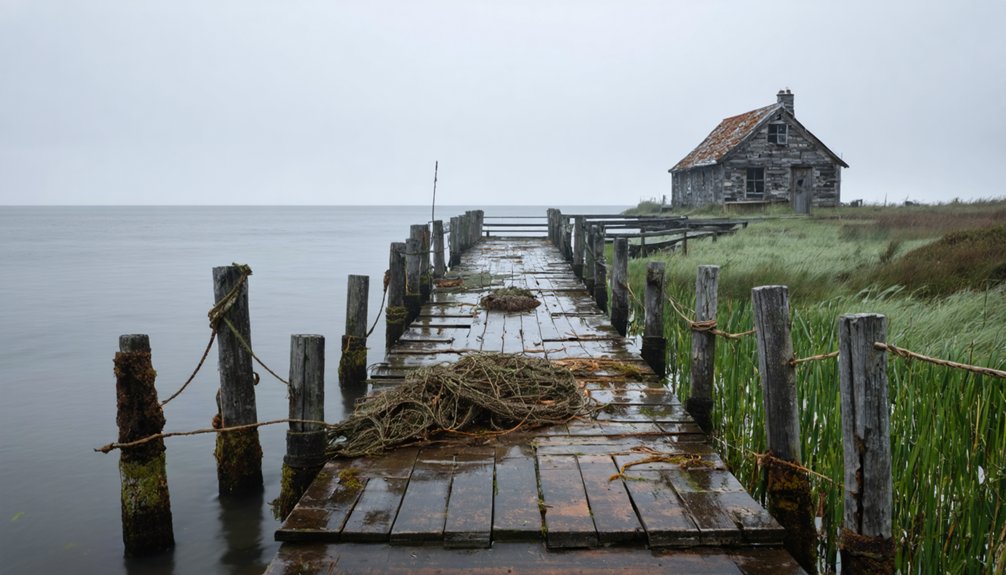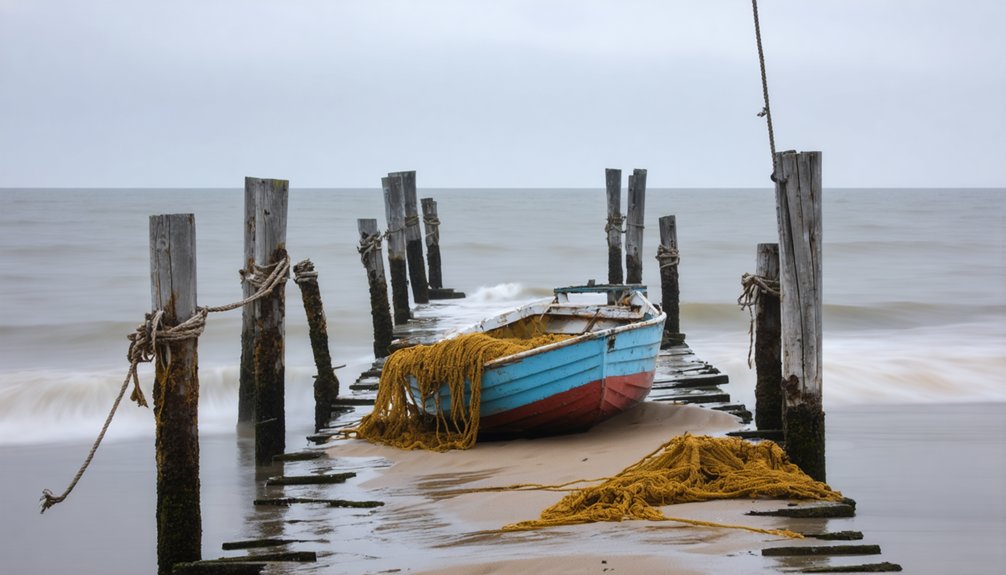
You’ll find extensive archaeological remains of coastal fishing villages preserved through material evidence spanning millennia. These vestiges include stone foundations, shell middens, mooring stones, and dock structures that indicate thriving maritime communities. Navigation artifacts and fishing implements like hooks, weights, and net fragments reveal sophisticated fishing technologies. Burial sites containing ritual objects and fishing tools demonstrate complex social hierarchies. The traces of these ancient communities continue to yield insights into maritime cultural heritage.
Key Takeaways
- Stone foundations and shell middens near harbors provide physical evidence of ancient coastal settlements and their maritime activities.
- Archaeological remains include mooring stones, dock structures, and underwater artifacts that reveal extensive maritime trade networks.
- Burial sites contain fishing implements, ritual objects, and shell items indicating social organization and spiritual practices.
- Village layouts feature residential clusters near water, with specialized areas for different fishing activities and species targeting.
- Artifacts like stone weights, bone hooks, and weighted nets demonstrate the technological evolution of fishing methods across time.
Archaeological Footprints of Ancient Maritime Communities
Ancient maritime communities left behind rich archaeological footprints that reveal sophisticated coastal adaptations and seafaring capabilities.
You’ll find their settlements strategically positioned around natural harbors and estuaries, where remains of stone foundations and shell middens tell stories of thriving coastal life. Evidence of ancient navigation appears in the form of mooring stones and dock structures, while maritime trade networks emerge through artifacts scattered across underwater sites. The discovery of Basque whaling stations in Hare Harbor demonstrates extensive maritime industrial operations dating to the 1500s.
In these coastal zones, you’ll encounter fascinating vestiges like semi-submerged palafittes and stilt houses, reminiscent of early Venice along the Tyrrhenian shore. Analysis of recovered stone tools shows evidence of plant fiber processing, indicating the manufacture of ropes and nets essential for fishing and boatbuilding.
The preservation of sewn-plank boats and edge-joined vessels in underwater sediments demonstrates advanced shipbuilding knowledge dating to the Bronze Age, challenging previous assumptions about early seafarers’ capabilities.
Material Evidence of Fishing Technologies Through Time
Material evidence of fishing technologies reveals a sophisticated progression spanning tens of thousands of years, from early net fishing to complex deep-sea capture methods.
You’ll find the earliest traces in 15,800-year-old German engravings showing netted fish, while Korean stone sinkers from 29,000 years ago demonstrate advanced fishing technology evolution.
Through coastal artifact analysis, you can track how ancient communities adapted their tools, from simple bone hooks dating back 40,000 years to sophisticated weighted nets.
Archaeological findings reveal humanity’s journey from primitive bone hooks to advanced net fishing over 40,000 years of coastal innovation.
The Tennessee River Valley’s grooved limestone weights and Alaska’s plummet-style cobblestones prove widespread adoption of net fishing across continents.
The Ice Age site of Gönnersdorf has revealed numerous slate slabs depicting fish with grid patterns representing early fishing nets and traps.
While organic materials rarely survive, stone weights, hooks, and rare bone implements tell the story of maritime innovation – from basic spears to complex systems capable of catching massive deep-sea species like tuna and sharks.
Archaeological evidence shows that freshwater drum remains were abundant at sites near the Nickajack Reservoir, indicating their dietary importance to indigenous peoples.
Social Organization in Coastal Settlements
While coastal fishing villages may appear simple on the surface, you’ll find they operate through intricate social hierarchies and networks that optimize resource management and community resilience.
The kinship dynamics create tightly-woven extended family groups that form the foundation for crew recruitment, labor sharing, and economic support.
You’ll observe how community leadership seamlessly blends traditional authority with modern governance through village chiefs and beach committees.
These settlements feature strategic spatial organization, with dense residential clusters near water bodies and dedicated zones for cultural activities and fish processing.
You’ll notice how shared spaces facilitate essential social interactions, while community organizations like fishermen’s associations strengthen collective identity and provide significant support during challenging times.
Environmental Impacts on Heritage Preservation
Coastal fishing village vestiges face unprecedented environmental threats from the compounding effects of climate change and anthropogenic pressures.
You’ll find heritage vulnerability intensifying as sea-level rise permanently inundates low-lying sites and saltwater intrusion accelerates structural decay. Storm surges and king tides are washing away exposed foundations and middens, while chronic erosion removes critical stratigraphic layers. The annual cost of $143 billion from extreme weather events in the United States further strains preservation efforts. Coastal regulation zones have been established by governments to protect environmental and livelihood security.
Your coastal adaptation strategies must contend with ecosystem changes that threaten these historical remains. Warming seas alter fish migration patterns, while coral bleaching undermines traditional fishing markers.
Urban expansion and tourism development fragment archaeological sites, and agricultural intensification encroaches on settlement margins. Without integrated coastal management, you’re witnessing the rapid loss of irreplaceable cultural heritage through both direct destruction and environmental degradation.
The story of abandoned towns in the western US adds another layer to this cultural erosion, revealing the ghostly remnants of communities that once thrived. These sites offer valuable insights into the past but are often overlooked in favor of more prominent attractions. As development continues unchecked, the risk of losing these narratives to time and neglect increases significantly.
Cultural Traditions Revealed Through Artifacts
Through careful examination of burial artifacts from coastal fishing communities, you’ll find that grave goods like specialized fishing hooks and ceremonial vessels reveal both technological sophistication and social hierarchies.
You can trace complex spiritual beliefs through ritual objects such as carved deity figures and offerings of precious shells, which suggest organized religious practices centered around maritime resources. The Camins de Ronda trails along the coast provide evidence of ancient defensive routes used to protect against invaders and pirates.
The diversity and quality of artifacts recovered from village sites help you understand how fishing activities influenced everything from social status to cosmological worldviews in these ancient coastal societies. Archaeological evidence has uncovered ancient bone carvings depicting human and animal figures that date back over 5,000 years.
Burial Goods Tell Stories
Ancient burial practices in coastal fishing villages reveal intricate cultural narratives through their deliberately placed grave goods. You’ll discover how burial symbolism reflects deep connections between communities and the sea, with grave offerings ranging from utilitarian fishing tools to ritual shell ornaments.
- Shell artifacts and marine remains demonstrate your ancestors’ reliance on ocean resources, with both practical tools and symbolic items accompanying the deceased. The discovery of thirty-one individuals buried at the Salango site provides the most substantial evidence of Middle Formative funeral practices on Ecuador’s coast. A remarkable burial found in Indonesia contained five fish hooks placed beneath the chin of a 12,000-year-old skeleton.
- Gender distinctions emerge through burial patterns – women’s graves often contain ritual shell items while men’s feature more fishing implements.
- Trading networks become visible through non-local shell species found in coastal burials.
The evidence shows how coastal communities maintained complex social structures, with burial goods reflecting both practical fishing traditions and sophisticated spiritual beliefs about the afterlife.
Sacred Fishing Ritual Objects
Sacred objects from maritime communities reveal sophisticated networks of ritual significance, where practical fishing implements evolved into powerful ceremonial artifacts.
You’ll find this transformation in Tlingit and Haida halibut hooks, which transcended their utilitarian origins to become sacred artifacts.
Similarly, Coast Salish carved figures aren’t merely art – they’re considered living ancestors connected to ancient fishing grounds.
Ritual significance permeates diverse coastal cultures: CHamoru fishermen presented catches to ancestral skulls, while Moche communities placed shark remains in ceremonial contexts.
Northwest Coast halibut clubs and raven rattles showcase intricate iconography, with complex spiritual meanings encoded in their designs.
These objects bridge practical fishing knowledge with cosmological understanding, demonstrating how coastal communities wove spiritual meaning into their maritime practices through tangible artifacts.
Village Social Status Markers
Archaeological evidence from shell-ring villages along the South Atlantic coast reveals remarkably egalitarian social structures, where status differentiation remained minimal and temporary.
You’ll find little evidence of permanent social hierarchy in these communities, where matrilineal kinship systems and solidarity feasting reinforced community cohesion rather than elite power.
The archaeological record shows:
- Village layouts lacking elite residences or status-marked architecture
- Equal distribution of food resources across households, with no privileged access
- Communal feasting patterns that rotated hosting duties among different families
While individuals could gain temporary prestige through hosting feasts, these roles didn’t translate into lasting status differences.
This flexible social organization helped communities adapt to environmental changes and maintain resilience through strong kinship networks connecting multiple villages.
Maritime Resource Exploitation Patterns
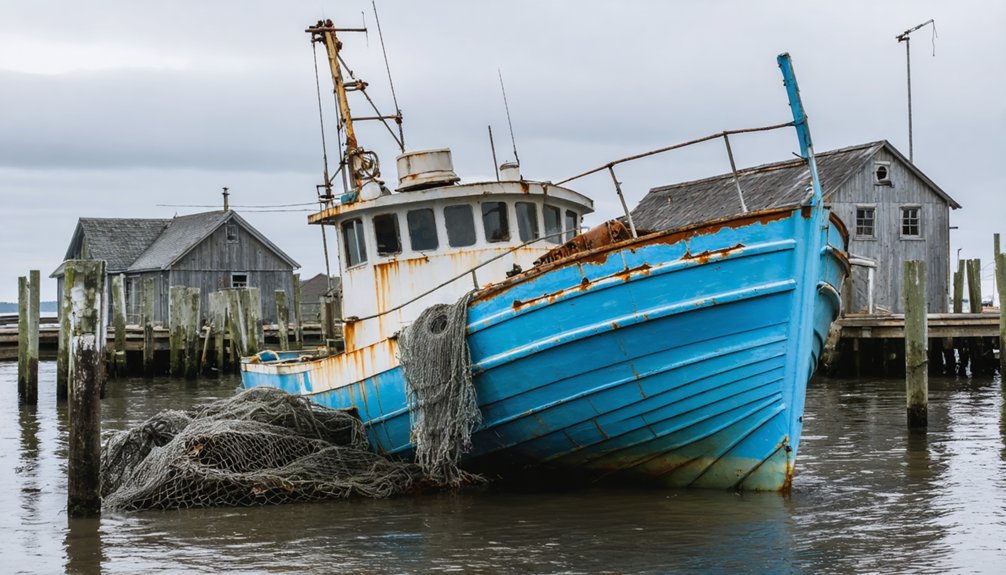
You’ll find evidence of sophisticated species targeting through the seasonal exploitation patterns revealed in archaeological deposits, where remains of migratory fish like herring and salmon appear in distinct temporal layers.
The discovery of specialized fishing gear, including remnants of large nets and weighted lines, indicates these communities developed advanced offshore fishing capabilities beyond simple coastal harvesting.
The spatial distribution of marine resource remains suggests these villages maintained extensive fishing territories, with different areas designated for specific species based on habitat types and seasonal availability.
Targeted Species Selection Patterns
Through extensive analysis of coastal fishing practices, the selection of target species emerges as a complex interplay between ecological availability and human adaptability.
You’ll find that successful fishing strategies often involve targeting multiple species simultaneously, allowing you to adapt to environmental changes and maintain sustainable harvests.
- Species selection varies considerably based on your fishing method – whether you’re gleaning Holothuria atra in shallow waters or SCUBA diving for *Actinopyga lecanora* in deeper zones.
- Your latitude affects catch diversity, with northern ports typically offering more species options than southern locations.
- Your choice of fishing grounds directly correlates with species diversity – high-diversity fishers maintain consistent locations, while those targeting fewer species must shift areas more frequently.
These patterns reflect the dynamic relationship between fisher communities and their marine resources, demonstrating remarkable adaptability in resource exploitation.
Evidence of Offshore Fishing
Recent analyses of offshore fishing patterns reveal distinct spatial and temporal distributions of maritime resource exploitation across global waters.
You’ll find that industrial fishing dominates the high seas, with vessels from high-income nations concentrated in the Indian Ocean and Clarion-Clipperton Zone. The data shows over 95% of fishing hours in these areas involve drifting longlines, while fishing regulations struggle to monitor extended trips lasting months or even years.
Through AIS tracking, you can observe how different vessel types create unique exploitation patterns – industrial vessels >24m focus on open ocean areas, while artisanal fleets typically remain in coastal zones.
This spatial distribution reflects complex socioeconomic dynamics, with fishing pressure varying considerably between regions due to gear types and fleet composition.
Research Methods in Coastal Village Archaeology
Archaeological investigation of coastal village vestiges employs multiple scientific methodologies to reconstruct past maritime lifeways. You’ll find researchers combining radiocarbon dating of shell materials with ethnographic analogy to build precise chronologies and understand fishing practices. These methods reveal sophisticated coastal adaptations spanning thousands of years.
- Bayesian statistical modeling refines construction sequences of shell rings and mounds while accounting for old wood effects.
- Zooarchaeological analysis identifies fish species and fishing strategies through bone assemblages and shell midden contents.
- GIS-based predictive modeling maps submerged sites on continental shelves using paleocoastal reconstructions.
Through these techniques, you’re able to uncover evidence of early fishing villages that predate ceramic technology, with surveys documenting over 9,000 years of coastal occupation in some regions.
The integration of multiple scientific approaches provides unprecedented insight into maritime cultural landscapes.
Frequently Asked Questions
How Did Ancient Fishing Communities Adapt During Periods of Extreme Weather?
Like Noah’s wise preparation, you’ll see ancient fishers mastered storm preparedness through nomadic resource management, shifting between marine and terrestrial food sources while adapting their tools and seasonal migration patterns.
What Rituals or Ceremonies Were Performed Before Fishing Expeditions?
You’ll find fishing blessings, ceremonial feasts, and prayers were essential before expeditions. Communities performed First Salmon ceremonies, drank sacred water, shared traditional foods, and sought ancestral spirits’ guidance for success.
How Did Fishing Villages Trade or Interact With Inland Communities?
You’ll find coastal villages established barter systems with inland communities, exchanging seafood for agricultural goods along established trade routes while maintaining essential economic networks through strategically placed trading posts.
What Role Did Children Play in Ancient Fishing Village Activities?
You’ll find children engaged in essential community education through hands-on child labor, learning net-mending, fish processing, shellfish gathering, and apprenticing alongside elders to master important fishing techniques and traditions.
How Did Fishing Villages Resolve Conflicts Over Marine Resource Access?
You’ll find that villages with 4.7% higher catch rates implemented marine spatial planning and resource sharing agreements, while using co-management arrangements and trade-off mechanisms for effective conflict resolution between competing groups.
References
- https://www.tehrantimes.com/news/517025/6-000-year-old-fishing-village-reveals-ancient-maritime-diet
- https://www.nature.com/articles/s41598-024-55047-z
- https://www.nps.gov/articles/aps-19-1-8.htm
- https://www.californiaprehistory.com/Vol34N2/342Noah.pdf
- https://snr.org.uk/the-mariners-mirror-podcast/the-lost-fishing-village-of-hallsands/
- https://qmackie.com/2012/08/31/bead-rich-burials-in-shishalh-territory/
- https://onlinelibrary.wiley.com/doi/full/10.1002/arp.1937
- https://www.popularmechanics.com/science/archaeology/a69445731/ancient-boats-found-southeast-asia-timeline/
- https://ocean.si.edu/ocean-life/marine-mammals/archaeologists-study-early-whaling-community-quebec-canada
- https://worldarchaeologicalcongress.com/wac10/exploring-the-depths-maritime-archaeology-across-the-globe/